


09/09/2026 Legal Affairs and Human Rights
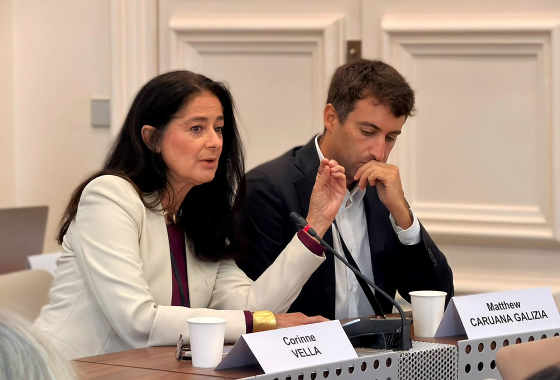
Members of the family of Daphne Caruana Galizia, the investigative journalist assassinated in Malta nine years ago, have denounced the “complete failure” to convict anyone for ordering her assassination following the acquittal by a Maltese jury last week of Yorgen Fenech, a Maltese businessman accused of being the mastermind.
Speaking at the hearing, organised by the Assembly’s Committee on Legal Affairs and Human Rights as part of a coming report on the unfinished implementation of the case, the murdered journalist’s son Matthew Caruana Galizia said he and his family were “doing everything we can to ensure that there is a retrial and that the retrial is done properly”.
“My mother was murdered for her journalism, specifically for her journalism on corruption,” he pointed out.
Daphne Caruana Galizia’s sister Corinne Vella said that the culture of impunity in Malta that had enabled her murder was “engendered by government” and that this culture had in fact been strengthened by the assassination and the events since.
Introducing the hearing, rapporteur Baroness Shami Chakrabarti (United Kingdom, SOC) expressed concern that, nine years after the assassination, the absence of critical reforms in Malta continues to leave the country vulnerable to high-level corruption and has limited the press freedom which could hold it in check.
She recalled the “shocking” conclusions of the Maltese public inquiry into the journalist’s murder, finalised in July 2021, which found that had the assassination – and its repercussions – not occurred, the general situation may have deteriorated further to such an extent that the state could be described as being led by a mafia organisation.
Baroness Chakrabarti also recalled the finding of the public inquiry that although there was no evidence the Maltese state as such had a role in the murder, it bore responsibility for it “by creating a climate of impunity, generated from the highest levels at the core of the administration and spreading to other entities such as regulatory institutions and the police”.
This impunity applied not only to the highest public officials, but also to a restricted circle of politicians, businessmen and criminals.
Her report is ongoing.


