Hopes for a charter of rights
When the Council of Europe met for the first time in the summer of 1949, there was a widespread expectation that one of its most urgent tasks was to draft a “charter of individual rights”, to cement democracy in Europe and avoid a repeat of the horrors of Nazi rule.
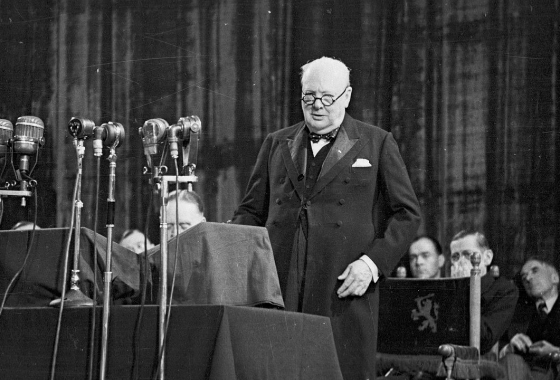
This had been a key demand of the Hague Congress a year earlier, when its honorary President Winston Churchill told delegates: “in the centre of our movement stands a charter of human rights, guarded by freedom and sustained by law.”
A number of lawyers associated with the European Movement began drafting just such a charter, with the declared aim of creating “a system of collective security against tyranny”. They arrived in Strasbourg in August 1949 with a blueprint ready to propose.
The key figures
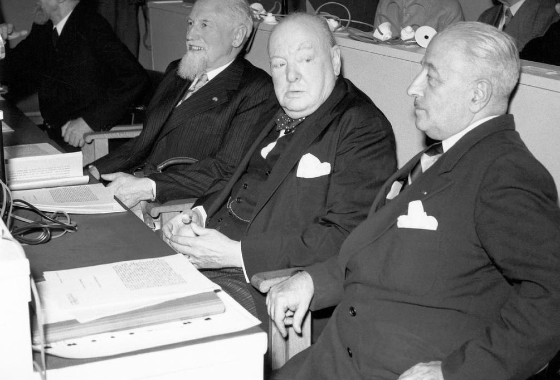
Two of them were to become key figures behind the Assembly’s push for the Convention – French lawyer, former minister and Resistance fighter Pierre-Henri Teitgen, and Scottish barrister and Conservative MP Sir David Maxwell-Fyfe.
The two had first met at the Nuremberg Tribunal, where Maxwell-Fyfe had been Deputy Chief Prosecutor, and they had worked together at the Hague. Both thus had first-hand experience of the potential of international justice.
Within days of the opening of the Assembly’s first session, together with 45 other members, they had put forward their draft in a historic motion, declaring boldly that a human rights convention “can and must be concluded immediately”.
A warm reception in the Assembly
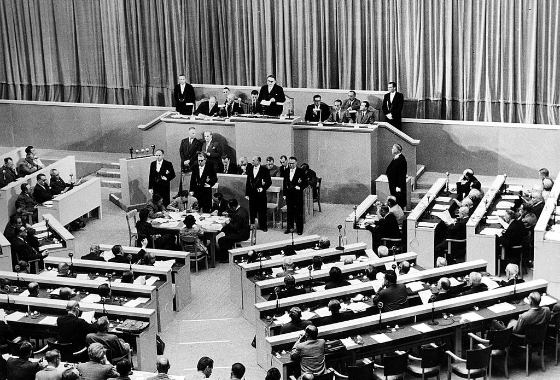
The first task was to persuade the full Assembly of their vision. Opening the debate on “a collective guarantee of human rights and fundamental freedoms” on 19th August 1949, Teitgen set out in his speech [begins page 404], patiently yet persuasively, why a Convention was needed and how it might operate.
The proposal was warmly received. Speaker after speaker – from Denmark, Greece, Italy, Sweden, the United Kingdom, Belgium, Ireland, Türkiye and the Netherlands – rose to support the principle of a human rights convention, and set out their hopes for what it might contain.
The Assembly swiftly referred the question to its 24-member Committee on Legal and Administrative Questions, chaired by Maxwell-Fyfe, which got to work. Over 14 meetings and some 40 hours of debate, it debated every aspect of the new convention.
Which rights to include?
The committee's final report, with Teitgen as rapporteur, went straight to the heart of the matter with two key questions: which rights should be included in the future charter, and what mechanism should be developed to guarantee them?
On the first, the committee felt only the most serious rights violations should be included: “‘Professional’ freedoms and ‘social’ rights [...] must also, in the future, be defined and protected; but everyone will understand that it is necessary to begin at the beginning.”
The committee was also clear that the new convention should base itself, as far as possible, on the rights already set out in the Universal Declaration of Human Rights, which had been agreed at the UN a few months earlier.
On the second question, the committee felt that a mere right of petition would be completely insufficient. There needed to be judicial muscle to give real effect to these guarantees – it proposed a full-fledged court, backed by a commission to filter cases.
Teitgen presented his report to the Assembly in a second speech to the Assembly on 7 September 1949 [begins on page 1142] outlining the debates that had taken place in committee and making the case for its final conclusions.
On the very last day of the month-long 1949 session, the Assembly voted for Teitgen’s report by 64 votes to 1, with 21 abstentions.
The Assembly's recommendation
The recommendation adopted that day called on the Council of Europe's executive body, the Committee of Ministers, to “cause a draft Convention to be drawn up as early as possible, providing a collective guarantee”, and listing the 10 rights the Assembly thought should be included.
The bare bones of the Convention system as we know it emerged in these fascinating debates – the general scope of the rights to be guaranteed, a court to enforce them, the requirement to “exhaust all means of national redress”, application at national level, and more.
The idea that the Council of Europe should insist on ratification of the European Convention on Human Rights as a condition of membership also emerged from the Assembly at this time – a far-sighted step which was to have a huge impact in the years ahead.
Now the turn of the ministers
Amid high hopes, the Assembly’s recommendation was transmitted to the Committee of Ministers, which on 5th November 1949 agreed to set up a group of legal experts to draft the Convention.
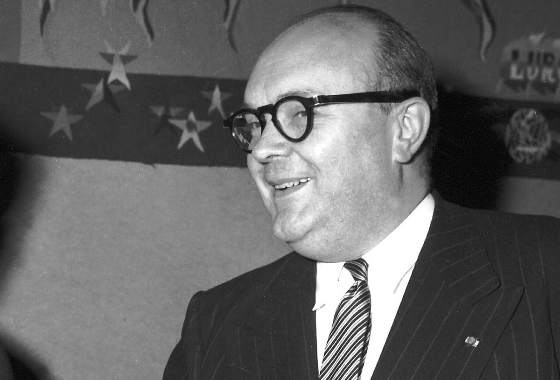
This, it seems, wasn’t sufficient for the Assembly’s ebullient President, Paul-Henri Spaak, who – five days later – wrote to the ministers regretting there had been no approval in principle for the Assembly’s draft, and worrying that it could be “pigeon-holed”.
But the process at ministerial level was under way. There were many battles to come over the winter and spring - and the draft finally proposed by the Council of Europe’s Committee of Ministers fell short of the Assembly's draft in key respects.
Pressing for more
Most crucially, in a compromise between governments, the right of individual petition was made optional. The ministers also agreed to allow derogations in emergencies, and removed the reference to regular free elections - much to the disappointment of some members.
Maxwell-Fyfe returned to the fray with a report to the Assembly in August 1950, welcoming the ministers' draft, but pressing for a Preamble to the convention, as well as reinstatement of the right to free elections.
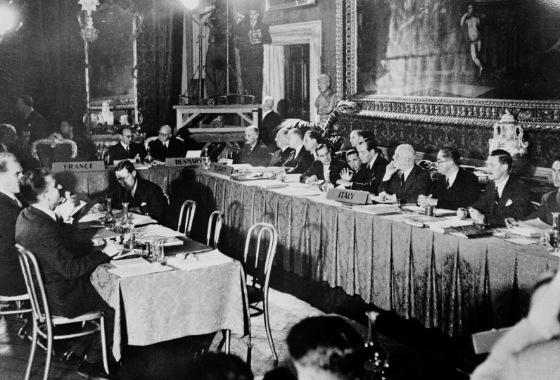
Just fifteen months after the Assembly’s recommendation, on 4 November 1950, the original text of the Convention was signed at the Barberini Palace in Rome.
The Assembly played a key role in initiating and shaping the convention - and, over the years, many of the aspects it had pressed for in its original recommendation came to pass, one way or another.