


01/10/2026 Session
In an address to PACE, the Prince champions the rule of law, calls for dialogue between nations and urges protection of the planet.
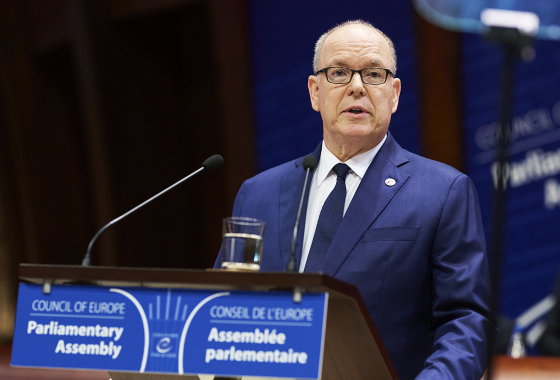
“Our future cannot be built in isolation or through the use of force. It must be rooted in accountability, co-operation and respect for the rules we have set for ourselves,” said H.S.H. Prince Albert II of Monaco, addressing the Parliamentary Assembly during its autumn plenary session in Strasbourg.
He was speaking as Monaco approaches the end of its six-month Presidency of the Council of Europe’s Committee of Ministers.
In his address, the Prince reaffirmed Monaco’s deep commitment to the rule of law, justice, the safeguarding of fundamental freedoms and respect for human dignity.
He also paid tribute to the Council of Europe’s role as a community of law, built on a shared legal heritage and underpinned by robust mechanisms, foremost among them the European Convention on Human Rights and the Court.
“This system is only as strong as each state’s commitment to honouring its obligations and fully implementing the judgments handed down to it. It is a collective obligation from which no one is exempt – to step back from it is to weaken the entire edifice,” he said.
On Ukraine, he reiterated that Monaco had supported all initiatives demanding the withdrawal of Russian forces and reaffirming the country’s territorial integrity. “Violations of international law cannot pass without consequence. Lasting peace cannot be built on the violation of shared principles or the impunity of those who trample on them,” he said.
The Prince also called on the Parliamentary Assembly to press ahead with its deliberations on recognising the right to a clean, healthy and sustainable environment. “Protecting nature means safeguarding the very conditions under which the rights we defend today can be exercised tomorrow,” he said.
He reaffirmed Monaco’s deep commitment to protecting the environment, emphasising that the response could only be a collective one, “based on scientific knowledge, international co-operation and our responsibility towards future generations”.
“The case law of the European Court of Human Rights also reminds us that environmental damage has very tangible consequences for the rights enshrined in the Convention,” he added.
“In a fragmented world, it falls to us to preserve spaces where nations can come together, understand one another and act in the service of peace, stability and progress. For multilateralism is a treasure that we must protect and nurture. For it is our shared destiny”, he concluded.