


22/10/2021 European Conference of Presidents of Parliament
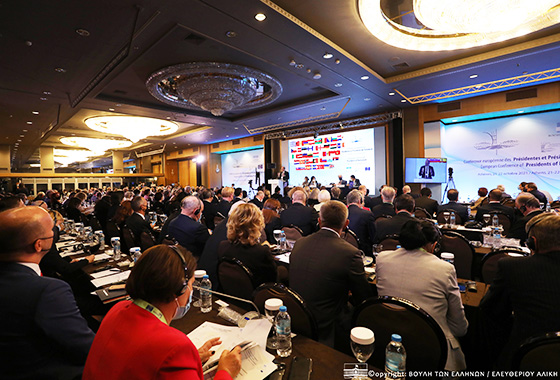
“While we may feel engulfed by the magnitude of the challenges that confront us – a global pandemic and climate change, to name but a few – these same challenges offer us an incentive to move forward, to take on the future together," said the President of the Belgian Senate Stephanie D’Hose, opening a debate on “The common future of all European citizens” at the European Conference of Presidents of Parliament.
Responses, she emphasised, can be found only by overcoming national navel-gazing. “The national interest nowadays coincides with multilateralism. It requests a Europe without dividing lines, sharing the same values and fundamental principles. These are the goals for which we have been striving for decades. And we need to continue,” she stressed.
The Council of Europe has a special role to play in the multilateral architecture, Mrs D’Hose added. It is “THE Organisation which has made democracy, human rights and the rule of law its coat of arms, and supports its member States in the effort to translate them into reality”. The Council of Europe should be able to rely on “all possible support to carry out its mission and, even more importantly, to enjoy the trust and political support of all its member States,” she concluded.
“It is a remarkable achievement that today more than 830 million Europeans have a collective conviction that respect for human rights, democracy and the rule of law constitutes an essential condition for achieving peace, prosperity and security,” added the President of the Cypriot House of Representatives Annita Demetriou. But the adherence to these principles and values, she warned, “is being challenged on many fronts, and certain Council of Europe member states continue to violate fundamental human rights and undermine democracy and the rule of law”.
To meet these challenges, she said, we need to revitalise our democracies. “We need to ensure that checks and balances are in place, and that parliament exercises its oversight role over the executive effectively. We also need to protect and promote social and economic rights, and the fight against corruption at all levels of governance must also constitute a high priority,” she underlined.
As the long-term repercussions of the pandemic continue to unfold, we realise that “the crisis is also an opportunity to push for change for a better prepared, more resilient and humane Europe. Let us not miss this chance,” Mrs Demetriou concluded.
“Integration is a key element of stability," said the President of the National Assembly of the Republic of Slovenia Igor Zorčič, adding that the stabilisation and normalisation of the Balkan region, and the accession of Western Balkan countries to the EU, are crucial. But the region faces common challenges such as migration, climate change and cyber threats, while strongly also feeling the impact of Covid-19, and its current progress is "far from encouraging”.
“The fact is that the EU is no longer the only player in the Balkans,” but it is the only one, he stressed, that can offer the region a better standard of living, not only in economic terms, but above all in terms of implementing common European values.
In such contexts, he said, “we must also not disregard the inter-connectedness and inter-dependence of the European Union and the Western Balkans”. The citizens of the Western Balkans “deserve a better future, too. They deserve to pass the gate at which they have been waiting for over a decade,” Mr Zorčič concluded.