


07/11/2025 Artificial Intelligence | Elections
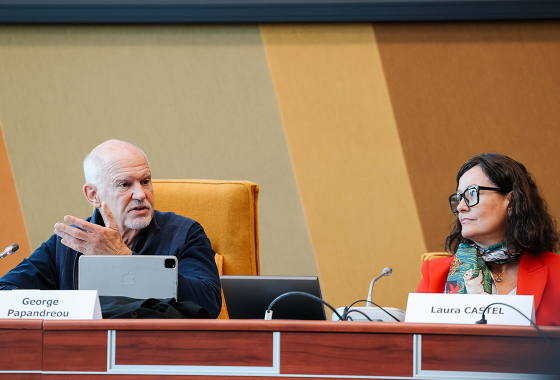
At the 2025 World Forum for Democracy in Strasbourg, participants discussed how artificial intelligence affects elections and democratic participation. The session, titled “AI at the ballot box: threat or opportunity for democratic elections?”, was co-organised by PACE and the Council of Europe Committee on Artificial Intelligence (CAI), and facilitated by George Papandreou (Greece, SOC), PACE’s General Rapporteur on Democracy.
Opening the debate, Mr Papandreou underlined that AI is reshaping political communication, public opinion, and voter engagement — posing both risks and opportunities. He invited participants to explore how democracies can harness technology to strengthen electoral integrity and public trust, pointing out that “the more people own the technology, the more they can trust it”. He added: “What’s the goal for AI — profit or democracy?”
PACE President Theodoros Rousopoulos, who attended the discussion as a guest, explained that the so-called “social media” are not media, but rather a kind of social connection: in media, there are professionals who are obliged to find the news and maintain connections with their sources, ensuring that what they report is true. He added that in the current era, it is increasingly difficult to discern fake from real, and that while it is good to have opinions, opinions require substance.
Laura Castel (Spain, UEL), a member of the Parliamentary Alliance for Free and Fair Elections, warned that elections — the cornerstone of democracy — are facing unprecedented challenges. “Technology must serve democracy, not dominate it. Citizens must be able to vote free from manipulation and fear,” she underlined. Ms Castel noted that polarisation, disinformation, and foreign interference have become constants in electoral life, while AI adds a “powerful new dimension, transforming political communication and voter influence”.
She highlighted some examples of PACE’s work on the ground to make institutions more resilient: “In Ukraine, we support cybersecurity for the Central Election Commission and help counter disinformation. In the Republic of Moldova, we provide crisis-communication training and innovative monitoring against online hate.” She concluded: “Protecting electoral integrity in the age of AI requires anticipation, preparedness, and long-term strategic vision across the entire electoral cycle.”
The discussion also featured Laura Silver (Pew Research Center, USA) and Mario Hernández Ramos (Chair of the Council of Europe Committee on AI, Spain), who explored public attitudes toward AI and the potential of the Council of Europe’s Framework Convention on Artificial Intelligence to provide global safeguards for democracy and human rights.