28/09/2023 European Conference of Presidents of Parliament
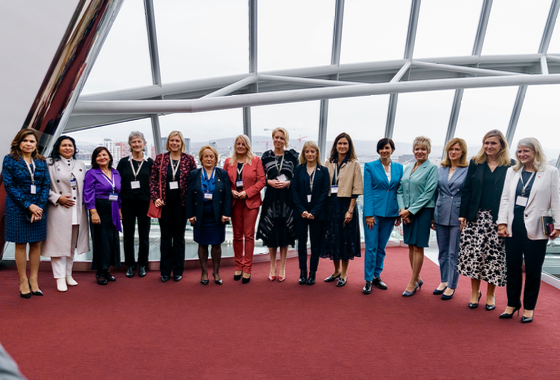
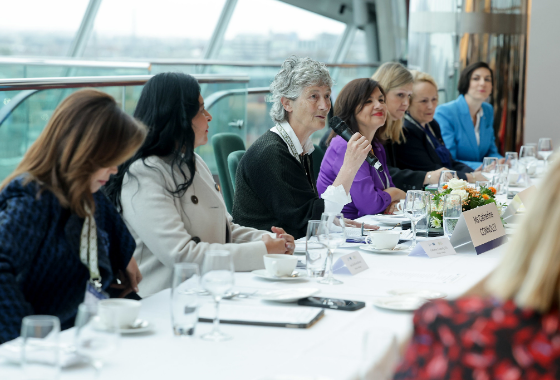
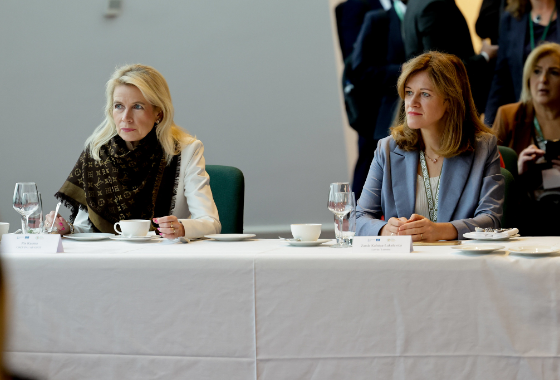
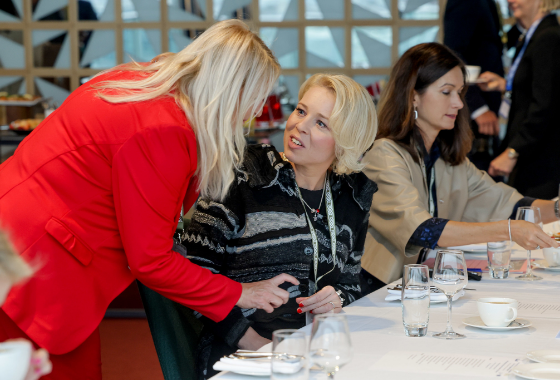
Women Speakers and Presidents of Parliament met this morning for a working breakfast on the margins of the European Conference of Presidents of Parliament in Dublin to share experience and ideas on how to encourage women’s leadership in political and parliamentary life – and reflect on how it could move beyond existing models.
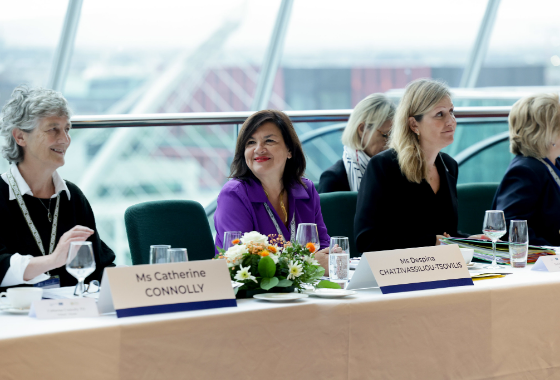
Some 20 Speakers or Deputy Speakers gathered for the event, hosted by Catherine Connolly T.D., Leas-Cheann Comhairle, Dáil Éireann (the Deputy Speaker of the lower house of the Irish Parliament), who invited participants to reflect on how women can “lead in a different way”.
Despina Chatzivassiliou-Tsovilis, Secretary General of PACE, spoke about rule changes that had enabled the Assembly to increase the proportion of women. She also presented the Assembly’s new Prize for women’s empowerment, the Vigdís Prize, named after the first elected woman President of Iceland, and invited participants to promote the Prize in their parliaments and to submit candidates.
Yaël Braun-Pivet, the first woman Speaker of France’s Assemblée Nationale, said it was no longer enough for women to arrive “by chance” in high positions. Despite legal changes in France to bring about parity in Mayoral races, she said, women still found themselves in second place: “Our voice counts, but the work is still ahead, and the road is long.”
Annita Demetriou, Speaker of the Cypriot House of Representatives, said women leaders needed to support each other, think outside the box and speak to the world: “If you want something done, ask a woman!”.
Maja Regula Riniker, the Vice-President of Switzerland’s National Council, said hate speech against women was a big reason why they hesitated to go into politics. Although there were more women voters than men, they were still a minority in parliament, but her country was pushing towards parity.
Pia Kauma, President of the OSCE Parliamentary Assembly, spoke of her experience of quotas, which had been effective, though women often found places in committees dealing with issues such as social matters or health. “I want to see women in financial committees, pursing positions where the men are, because that’s where the power is.”
Jöelle Garriaud-Maylam, who heads the NATO Parliamentary Assembly, said there was still resentment in some quarters about women achieving success. “We need to be strong all together,” she declared.
Blanca Alcalá, Vice-Speaker of the Mexican Chamber of Deputies, spoke about advances in her country as regards equality, including constitutional reforms which had helped to prevent violence against women.
Eliane Tillieux, Speaker of Belgium’s House of Representatives, said words were important, including gender-sensitive language – “la Présidente” rather than “le Président” – but lamented that there was still little space for young mothers in high-level positions.
Markéta Pekarová Adamová, Speaker of the Czech Chamber of Deputies, quoted former US Secretary of State Madeleine Albright: “democracy has to deliver to all” – men and women equally. “It’s nice to know we are not alone” she said.
Urška Klakočar Zupančič, the first woman Speaker of Slovenia’s National Assembly, said she had been targeted by hate-speech since entering politics: “You need a thick skin.” She recounted how wearing red shoes on the day of her election had led to sexist insults on social media – which in turn led to many women wearing red shoes to show their support for her.
Elvira Kovács, Vice-Speaker of the National Assembly of the Republic of Serbia, praised the progress made by PACE – and particularly its Secretary General - in advancing equality issues, citing the presence of this theme on the agenda of the Speakers’ Conference itself.
Claudia Arpa, Speaker of Austria’s Federal Council, outlined the situation in her country, including the number of women in senior positions in the Austrian parliament.