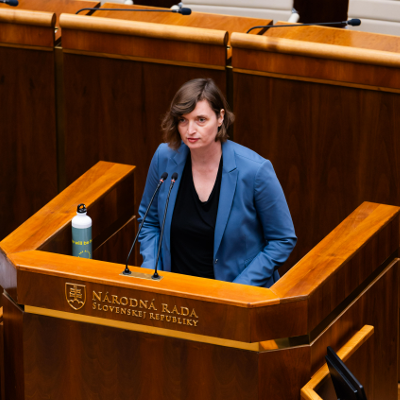
Greece, EPP/CD, President of the Assembly
11:43:54
Dear colleagues, good morning. There was a slight problem with registration, which is why we're delayed.
Dear colleagues,
Ladies and gentlemen,
Although we are at the end of June, today I will talk to you about May. May is more than just the month of spring for Europe – it is a month of foundations and milestones.
In May 1945, hope returned after the war.
In May 1948, the idea of European unity was born at the Hague Congress.
In May 1949, the Council of Europe was founded.
Decades later, this May came with a different tone.
On that day, nine European prime ministers signed a joint letter, expressing concerns about the interpretation of the European Convention.
This should not be seen through a lens of confrontation, but rather as a call for dialogue and reflection.
When the same date in the past brought decisions that strengthened rights, today it might – if we are careful – open space for discussion and understanding.
The history of May, dear colleagues, is a history of values. And it calls on us to defend them, not only when they serve us, but also when they challenge us.
I understand the reasoning that led the prime ministers to make this joint public statement. Even when we do not like or agree with a decision delivered by the European Court of Human Rights, disagreement must not become a pretext to undermine the very institution that renders those decisions.
I am fully aware of the problems caused in many countries by uncontrolled migration, including challenges that affect long-standing social balances. My own country, Greece, faced it first. I personally chaired the Committee on Migration, Refugees and Displaced Persons for two years, and I understand all kinds of concerns. But we, as politicians, must follow the difficult path to find solutions.
Accusing the Court is the easy way – and it is contrary to our principles and ethics. Yet in difficult times, disagreement must not become a pretext to undermine the very institution that renders those decisions.
History has shown us that when political power interferes with justice, it is democracy that pays the price. I do not believe that the prime ministers seek such interference. If this letter expresses a need for institutional discussion, let us welcome it. Yet we must also acknowledge a growing tendency among member states to underestimate or even ignore the Council of Europe.
This is not a personal comment. We all share responsibilities.
Even my own country has almost 60 unexecuted judgments from the Court. Others, unfortunately, have thousands.
You all know that the Committee of Ministers is represented on a daily basis by the esteemed ambassadors who attend our sessions, and I want to thank them for the productive dialogue we have had since the first day of my presidency. And I know that they work tirelessly and with dedication, serving the historic diplomatic mission of this Council for many years.
Once a year, the Ministers for Foreign Affairs of our countries are called upon to meet for a few hours. This meeting is largely symbolic. This year’s annual meeting of Foreign Ministers took place in Luxembourg. Out of 46 Ministers, only 16, mostly Deputy Ministers, were present.
Just one third. Is that not a warning sign?
We are all aware of Secretary General Alain BERSET’s initiative for the “Pact for Democracy.” In this context, I call on member states to contribute ideas. But these ideas should be debated properly: within this Assembly and within the Committee of Ministers. Otherwise, flashy interventions may attract attention, but they do not help safeguard the independence of the Court.
If we want the Council to remain a living institution, we must launch a public information campaign: to our parliaments, to our universities, to our youth.
We must explain why this institution is essential to the very meaning of democracy.
Because, dear colleagues, democracy without checks and balances is no longer democracy.
I therefore call on the new President of the Court – to whom I extend my congratulations on his election – to respond positively to the challenges of our time and to strengthen the Court’s authority in the way judges know best: through reasoned judgment, legal consistency and moral independence.
We here, dear colleagues, have the power to represent our people. With that power, we elect the judges of the Court of Human Rights. With that power, we elect the Secretary General of the Council of Europe, the Deputy Secretary General, the Secretary General of our Assembly and the Commissioner for Human Rights.
We entrust them with full authority to act – not as directed by us individually – but as guided by the institutional framework of the Council of Europe.
By the European Convention on Human Rights and the other treaties we have collectively agreed upon. Any suspicion that the separation of powers could be eroded through this organisation must be dispelled. The independence of the judiciary, the separation of powers – principles born in the country that hosts us, France – shall not be compromised.
The Council was not born from the ashes of war to serve individual political agendas, for any one of us. It was born to uphold the European vision of peace and justice. And our visions usually become reality.
Do you remember, dear colleagues, those who were laughing against this Assembly three years ago, when from this very hemicycle came the idea of creating an international tribunal for the crime of aggression against Ukraine?
Today, we are as close as we have ever been to creating such a tribunal within the Council of Europe, and I wish to reiterate my call to the Committee of Ministers and the Secretary General to make the final steps towards its establishment and ensure that history is once again made here in Strasbourg.
It is this week that we will welcome President Volodymyr ZELENSKYY of Ukraine, who will address our Assembly on Wednesday evening, according to the latest information. At the end of his speech, President ZELENSKYY will take questions from members – a sign of democratic engagement and mutual respect.
Another vision of the world, dear colleagues – the hope for peace in the Middle East, a vision we have shared for decades – is not progressing. The war continues, more cruel and more indiscriminate, with tens of thousands of innocent civilians already dead, defying the values we are here to defend. And in recent days, global security and peace are being threatened by the escalation of the conflict in the Middle East and the humanitarian catastrophe in Gaza. Civilians are paying the price of this cruelty in Gaza, in Israel, in Iran.
But let us not surrender.
Though disappointment often follows our visions and actions, we must continue our efforts tirelessly. Because we are the only institution globally to work exclusively on democracy.
Not the power of guns or money.
But the people.
And our guide for 75 years now is the Human Rights Convention written by statesmen bigger than history, in times less prosperous than ours.
Thank you, let's go to work now.
Greece, EPP/CD, President of the Assembly
11:52:17
Before I move on to our first item, I remind the Assembly that Members who have not submitted an annual declaration of interests are required to start any intervention with an oral declaration of interests under paragraph 20 of the Code of Conduct for Members of the Parliamentary Assembly.
Dear colleagues, the first item on the Agenda is the examination of credentials of new members. The names of the members are in Doc. 16203. If no credentials are challenged, the credentials will be ratified. Are any credentials challenged?
The credentials are ratified. I welcome the new German delegation to the Assembly, whose credentials have just been ratified. I understand that some procedures are ongoing at the national level. I trust that this process will be completed in reasonable time in accordance with all democratic international standards.
The next item on the Agenda is the election of Vice-Presidents of the Assembly in respect of Cyprus, Bulgaria and Germany, Doc. AS/Inf (2025) 02. The three candidates are Mr Nicos TORNARITIS, from the Cypriot Delegation; Ms Denitsa SACHEVA, from the Bulgarian Delegation; and Mr Knut ABRAHAM, from the German Delegation. If there is no request for a vote, Mr TORNARITIS, Ms SACHEVA and Mr ABRAHAM will be declared elected.
I want to congratulate our vice-chairs.
The next item on the Agenda is changes in the membership of Committees. The candidatures for the general committees of the Assembly have been published as Document Commissions 05 (2025) and Addendum 1. Are these proposals approved?
Thank you, approved.
Before we examine the draft Agenda, the Assembly needs to consider requests for debates under the urgent and current affairs procedures.The Bureau has received the following requests:
Urgent procedure debate requested by the Committee on Equality and Non-Discrimination: “Women's rights in Europe – Progress and challenges”
Urgent procedure debate requested by the Committee on Social Affairs, Health and Sustainable Development: “Halting the genocide in Gaza – The Council of Europe must act now”
Urgent procedure debate requested by the Committee on Political Affairs and Democracy: “The urgent need to put an end to the war in Gaza”
Current affairs debate requested by the ALDE political group: “A call for the immediate release of persons facing politically motivated persecution in Georgia”
Current affairs debate requested by Mr Christophe LACROIX, Belgium, (SOC) supported by 21 Members of the Assembly: "Attempts to undermine the European Convention on Human Rights and to attack the independence and impartiality of the European Court of Human Rights through political interference"
Urgent procedure debate requested by the political groups: “Global peace under threat: halting the humanitarian catastrophe in Gaza and addressing the wider conflict in the Middle East”
Current affairs debate requested by the political groups: “The European Court of Human Rights: rising to the challenges of our times”
At its meeting this morning, the Bureau decided to recommend to the Assembly to hold two urgent procedure debates on “Women's rights in Europe – progress and challenges” and “Global peace under threat: halting the humanitarian catastrophe in Gaza and addressing the wider conflict in the Middle-East”, and two current affairs debates on “A call for the immediate release of persons facing politically motivated persecution in Georgia” and “The European Court of Human Rights: rising to the challenges of our times". Is that agreed?
Yes, thank you.
So, as it is obvious that the Bureau's recommendation is accepted, the current affairs debate on “The European Court of Human Rights: rising to the challenges of our times” will take place tomorrow morning. The urgent procedure debate on “Global peace under threat: halting the humanitarian catastrophe in Gaza and addressing the wider conflict in the Middle-East” will take place on Wednesday afternoon. The urgent procedure debate on “Women's rights in Europe – progress and challenges” will take place on Thursday afternoon. The current affairs debate on “A call for the immediate release of persons facing politically motivated persecution in Georgia” will also take place on Thursday afternoon.
So, the next item of business is the adoption of the Agenda for the Third part of the 2025 Ordinary Session. The draft agenda submitted for the Assembly's approval was adopted by the Bureau this morning. I remind you that we have also agreed to hold two Urgent Procedure debates and two Current Affairs debates. I also inform the Assembly that the Bureau agreed this morning that speaking time for the debates we will hold on Tuesday and for those debates on Wednesday afternoon must be reduced to 2 minutes. Is the draft agenda agreed to?
Thank you, it is agreed.
The minutes of the Standing Committee, which met in Malta on 23 May 2025, have been distributed. The Assembly takes note of those minutes.
I see no objections.
Now we come to the joint debate on the Progress Report of the Bureau and the Standing Committee. The Progress Report will be presented by Mr Frank SCHWABE. With this, we will consider the report by the Ad hoc Committee of the Bureau on Observation of the parliamentary elections in Albania, which took place on 11 May. The report on election observation will be presented by Ms Luz MARTINEZ SEIJO, on behalf of the Rapporteur, Mr Simone BILLI. We will suspend this item at 12.30 pm to enable the prize award ceremony for the Vigdís Prize for Women's Empowerment. The debate will then continue at 4.30 pm this afternoon. I call Mr Frank SCHWABE to present the first report on behalf of the Bureau. You have 7 minutes now, and 3 minutes at the end to reply to the debate. You have the floor.
I'm a little bit colour-blind, so I don't see the difference.
Mr President, thank you very much for your introductory speech. Dear colleagues, ladies and gentlemen, it is my pleasure to present the progress report on the activities of the Assembly's Bureau and standing committee from 11 April to 22 June 2025. Let me begin with our key meetings. The Bureau convened in Strasbourg and Valletta, where we set the agenda for the upcoming part session and addressed urgent issues facing Europe today.
We responded to requests for current affairs debates, including the need to ensure the survival of Radio Free Europe. Very small amount of money needed, but a very big outcome, so we should do everything to support the survival of Radio Free Europe. And the vital role of parliamentarians in safeguarding investment in human rights and democracy, especially as military spending rises.
Election observation remains a cornerstone of our democratic mission. Over the past months, we organised and deployed observation missions to Albania's parliamentary and Poland's presidential elections. Looking ahead, we had set plans to observe Moldova's parliamentary elections in September.
We have also advanced several special initiatives. The Bureau approved a new child safeguarding policy to protect children in all Assembly activities. We are moving forward with the selection of candidates for the Vigdís Prize for Women's Empowerment, whose laureate will be announced in a few minutes, and the Václav Havel Human Rights Prize, supporting those who champion human rights and gender equality.
International engagement has also been a priority. Our representatives participated in the European Conference of Electoral Management Bodies in Vilnius, the European Dialogue on Internet Governance and the Conference on Missing Migrants.
We are also preparing to send a delegation to the European Holocaust Memorial Day for Roma and Sinti at Auschwitz. We can now reaffirm our commitment to re-embrace injustice.
Looking ahead, the Bureau and Standing Committee will meet in Paris, Strasbourg and Chisinau. The Assembly will also play an active role in the World Forum for Democracy this November, helping to shape the future of democratic governments in Europe.
Allow me now to highlight some of our current challenges. Dear colleagues, furthermore, underlining that the Convention is a treasure of our organisation and the treasure of human rights in Europe, and underlining again that the European Court of Human Rights is the heart of the Council of Europe and we have to do whatever we do, if we don't do more, we have to protect the Convention and we have to protect the Court. This is what we have to do. And for sure it is allowed to send letters, to write letters. We don't know really to whom people send letters, but it is allowed to have a debate in public, and it is allowed to look for some other countries to ask them to sign letters as well. And I understand that in some member countries we do not have an easy debate about migration. And there are several cases where it is not easy to the public to explain that even when there's a kind of criminal, you have to respect fundamental human rights. And I understand that there is a kind of misuse from some countries, like Russia and Belarus, to use migrants to organise a kind of hybrid war and attack against other countries. But, we are the Council of Europe and we act in the sense of human rights. Human rights are valid. They are valid for all humans, wherever they are, whatever they did. And, wherever and in which sense they ever are misused, even for serious criminals. And that's what we have to do, and that's what we have to protect. And that's why the world understands what we are doing and why we are needed.
And again, discussions are possible. But finally we have to make clear we have a convention. And I don't see any kind of political movement to change this convention. Maybe those one who wants to do it have to read in the papers and to inform what would be necessary to do it. So because of this, I ask each and every one who write letters to be careful and to think what could be the result of writing such letters.
Dear colleagues, the Council of Europe is in historical situation, at the crossroads. We are at the crossroads. But how we should not be at the crossroads if the world is at the crossroads, if Europe is at the crossroads. The Council of Europe is an organisation of dialogue. It's very good to sit here together with all of you and to speak about the future of this organisation. But we have various dialogue forums in Europe. There is a new one around the European Union, with almost the same membership like in the Council of Europe. This is a possibility to have a dialogue. Dialogue is important. But what is the core of our organisation? And what we can do more than others, is to protect human rights, democracy and the rule of law. We are the guardian of those values and rules. And this is what we always have to know and what we always have to make clear to those countries who want to undermine our organisation with our rules and our values.
And the question is how we proceed with such countries. For sure, we want to keep each and everyone on board because we care for the people who live in the countries. But if the price would be to keep each and everyone on board, to lose the human rights, the democracy and the rule of law, our instruments, even for the other countries who are committed to our values, then I would say the price is to high. And this is something we have to discuss this week. I think it's an honour for us that President Zelenskyy will be here and to address us and that he's prepared to get, maybe as well, critical questions. I think it's good. It's a sign of a real democrat to do this, and it's a good sign that this week, again, we do everything to support our Ukrainian friends who had a really horrible shelling this night again. So it is good that we are making an important step on implementing the tribunal. And it's good that we deal, for instance, with the question of kidnapping of children. So I really want to say, although it's difficult after so many years of war to concentrate and to focus, we are still very focused on Ukraine and to support them wherever we can do it. Slava Ukraini.
Greece, EPP/CD, President of the Assembly
12:06:42
Thank you, Frank.
I call now Ms MARTINEZ SEIJO to present the second report. You have five minutes.
President, distinguished colleagues, it is my great pleasure to present to you the report on the observation of parliamentary elections in Albania on behalf of Simone BILLI, who is the head of the delegation, the author of this text, who cannot be with us here today.
Albania has been involved in post-monitoring dialogue with the Parliamentary Assembly since 2023, which includes a commitment to invite the Assembly to observe elections. Our delegation was made up of 22 parliamentarians, including the rapporteur from the Monitoring Committee, a representative of the Venice Commission, and three members of staff, whom I should like to thank most warmly for all of their hard work. We also carried out a pre-electoral mission, spanning two days in Tirana, about a month prior to elections, in order to evaluate the campaign and the general political climate. This mission was carried out in the framework of an international electoral observation mission in conjunction with the delegations from the Organization for Security and Co-operation in Europe (OSCE), the European Parliament and the Office for Democratic Institutions and Human Rights (ODIHR). We'd like to thank the Albanian authorities for their invitation as well as their support, as well as all the international interlocutors and partners for their co-operation. We'd also like to acknowledge the support of the Council of Europe's Tirana office, as well as the secretariat of the Albanian delegation, which were able to facilitate meetings.
The delegation concluded that elections were competitive and were carried out in a professional way. Nevertheless, there was a highly polarised backdrop to the elections, candidates were not competing on a level playing field, and although the majority of them were able to campaign freely, some complained of intimidation. The general organisation was inclusive and transparent, but the governing party was able to have recourse to administrative resources, which gave it a certain advantage. There were also reports of pressure on voters, particularly on public employees.
Electoral legislation, along with a restrictive interpretation thereof, were not sufficient to prevent certain abusive practices. We also saw the adverse effects of the concentration of media ownership, self-censorship by journalists, and the domination of coverage on the main political parties, which limited the plurality of sources and the capacity of voters to make informed decisions. On top of all that, there was extensive use of social networks, which amplified a confrontational discourse, and there was no office which was entrusted with supervising manipulative or harmful content.
But one positive advance was the creation of a new co-ordination mechanism to investigate and to prosecute electoral offences, but we have to follow up on certain recommendations to prevent malpractice. But elections were calm and transparent, although there were certain deficiencies or shortcomings in some polling stations. There were also some instances of intimidation, interference by party observers, breaches of the right to secrecy, and also a lack of accessibility. Over half of the centres we observed were not accessible to people with disabilities.
Now, electronic voting seemed to run pretty smoothly, although many voters were not familiar with the system, and some of the officers did not have sufficient training. At the last minute, the electronic transmission of results was cancelled, and there was manual transmission at the district level. But the count was orderly, but not all observers had full access, and there were some procedural shortcomings. But a milestone was the out-of-country voting, which was introduced by the country. Now, this innovation was well-received, although it will have to be properly evaluated to identify areas in which improvements could be made. The delegation acknowledged the work done by the National Bureau of Investigation, the Special Anti-Corruption and Organized Crime Structure, the so-called SPAK, as well as the prosecutor's office and the Central Electoral Commission, which effectively co-ordinated to safeguard the integrity of the electoral process.
Now, I'd like to conclude by asking the Albanian authorities to address the shortcomings that have been identified; they will do so, of course, as part of the post-monitoring dialogue, with the Assembly and its electoral co-operation programmes. We would suggest giving priority to the following areas: addressing the Venice Commission and OSCE recommendations in an inclusive manner, and also look at de-politicising the electoral administration, particularly at lower levels, take measures to prevent vote-buying and make sure there is no use of state resources by parties in power. They also have to adopt measures to increase political education and also try to fight corruption and organised crime, and also carry out a proper assessment of out-of-country voting and identify areas for improvement in future.
Greece, EPP/CD, President of the Assembly
12:12:18
Thank you, Luz.
Dear colleagues, in the debate now we will call first Ms Saskia KLUIT on behalf of the Socialists, Democrats and Greens Group.
Saskia, you have the floor. Have you inserted your badge first? Okay, press the button and wait for some seconds. I want to remind you that we have to wait for a few seconds.
Yes, I think I'm live.
Thank you very much, President.
And thank you very much to the Standing Committee and the Bureau for doing a wonderful job. I am very impressed if you read the report about what we all do here. And I think one of the things that Mr Frank SCHWABE already mentioned is we live in extremely dangerous times, times that attack the very fundamentals of what we are doing here.
And sometimes you think you are having reasonable arguments to start a dialogue on certain things that you can improve, but before you know it, you are actually collaborating and attacking the foundations of your organisation.
So my group wants to express their full support of the Convention, especially the Court and the three parts of the trias politica. Also, in our organisation, if we want to have a dialogue about the functioning of both the Convention or the Court, it should be done here and not in the press outside. We are the body for that. And we should be very careful not to talk about the foundations, but talk about the problems.
We have to face that anti-democratic forces are growing in our communities and that we have to stand together to defend them, and the defence should be done by all of us.
Then, on the content of the work we are doing, I want to take out three things. One is the tribunal that we worked on. This shows the power of our organisation. We do not only talk here in the Parliamentary Assembly of the Council of Europe, but we also make steps and we make a difference in the world. And it's very good that Mr ZELENSKYY will come this week and we will discuss the tribunal further to have it work better.
Also, I want to talk about the visit that we made. It was already told like it's in the future, but today it's in the past. The visit that was made by the network of the Ukrainian children to Kyiv because it showed the impact of war on just ordinary citizens and the smallest of them, and how we and our work can improve the lives of small children who are in very dire situations.
And I want to thank all our colleagues who make it possible for us to do these kinds of visits, because that is so important for our work.
And the other one, and that is the topic of humanity. I think this is one of the topics we talk about, but it shows the humanity we show each other here, which is the conference on missing migrants. It was one of the first reports that was done when I came into this organisation. And I think this is so wonderful that we show respect to the dignity of people not only when they are alive, but also when they have lost their lives. And that we do all we can to reunite families not only in life, but also in death.
So I want to thank the Bureau and the Standing Committee for their work. And I look forward to the debates we have on these topics.
Greece, EPP/CD, President of the Assembly
12:16:05
Thank you, Ms Saskia KLUIT. Mr Christophe BRICO, on behalf of the European People's Party. Christophe, you have the floor.
Thank you, Mr Chairman,
For months, almost years, we've been talking here about the setbacks to democracy, and although the report on the elections in Albania mentions that things went well overall, if we listen to the rapporteur right to the end, we hear about pressure, organised crime, vote-buying and a number of things that are detrimental to a functional election. Elections are the foundation of democracy. A free and fair election, with equitable access to the media, for example, was also mentioned by the rapporteur. Obviously, reality is always a little more complex. But Mr Frank SCHWABE was talking about dialogue; dialogue is only possible if it is based on a clear and observed reality. And we have the impression that the reports tend to water down a number of things that shouldn't be acceptable, even if they only happen once or a few times. For these reasons, we will remain attentive to the continuation of the dialogue, since the country, Albania, is still in dialogue. However, we strongly urge that election observation reports be a little stricter on the elements and the deviations observed from a virtuous system. And I believe that in this house, which defends democracy, the rule of law and fundamental rights, we are entitled to expect the highest standards when it comes to elections.
Thank you very much.
Greece, EPP/CD, President of the Assembly
12:17:56
Thank you, Mr Christophe BRICO.
On behalf of the European Conservatives, Patriots & Affiliates, the leader of the group, Mr Zsolt NÉMETH.
Zsolt, you have the floor.
Thank you, Mister President.
Dear colleagues,
Mr Frank SCHWABE said that there are countries that want to undermine our values. I hope he did not mean the letter of the nine prime ministers on the European Convention of Human Rights. I think we need to demonstrate a bit more self-criticism as a consequence of this letter. Me, personally, I would like to welcome the letter of the nine prime ministers, and I'm sure that there are many other prime ministers who would have signed this letter if they had the opportunity and who have joined this initiative.
I would like to take note of the fact that the president of the Court is going to participate in our debate. It's a good sign. However, if he decides to participate in the debate, I think it would be wise also to respond to the reflections of the parliamentarians.
I don't think that it is an attack against the Council of Europe, nor towards the Court. I believe that it has two main reasons, colleagues.
One is the problem of migration. Migration is one of the most serious challenges to Europe, and we haven't found until now the proper answer to this new scale of the phenomenon.
And court judgments, yes, tend to block viable solutions which our member states have developed. For example, in my case, Hungary. Hungary has to pay €1 million every day for its migration policy. Altogether, it is close to half a billion, and in a year's time it will be over €1 billion. Is it a proportionate decision of the Court? Isn't it a punishment rather to the migration policy Hungary is having?
Secondly, colleagues, I have to underline that we, and definitely we, respect the independence of the judiciary. But there is a phenomenon called "courts activism", and courts sometimes tend to disregard their written competences, and not just in the field of migration. Sometimes they act like loose cannons. This judicial activism is a major challenge to democracy. The Council of Europe should become a vehicle of political dialogue to save the Council of Europe, the Convention System, and the Court itself.
Thank you very much.
Greece, EPP/CD, President of the Assembly
12:21:23
Thank you, Zsolt.
Ms Lucia PLAVÁKOVÁ on behalf of Alliance of Liberals and Democrats for Europe.
Dear colleagues, dear friends, on behalf of the Alliance of Liberals and Democrats for Europe (ALDE) group, I would like to express our deep concern over the ongoing erosion of human rights standards across Europe.
Just last week in Slovakia, the final debate took place on a constitutional amendment, with the final vote scheduled for September. This proposed change includes a provision that openly undermines the supremacy of international human rights treaties and obligations. It asserts that the Slovak Constitution shall take precedence over EU law and international treaties in matters related to national identity, especially in fundamental areas such as the protection of life and human dignity, private and family life, marriage, parenthood, public morality, personal status, culture and language. It even extends to healthcare, science, education and inheritance.
As you may see, the provision is so broad that it could cover nearly all rights protected under the Convention. As explicitly stated by the Slovak Ministry of Justice, this means that Slovakia could choose not to comply with the decisions of the European Court of Human Rights when it considers them incompatible with the constitutional provision.
Moreover, the amendment includes recognition of only two sexes – male and female – determined strictly biological, effectively banning gender transition, a parental right to exclude children from certain parts of education based on their beliefs, and the definition of parenthood as strictly between a man and a woman, banning same-sex parenthood.
Some supporters of this constitutional change have even expressed the hope that it will inspire other countries to follow. If that happens, the system of human rights protection in Europe, which we have built and defended for decades, would be gravely endangered.
On behalf of our group, I urge you to continue standing up against such attacks on human rights and fundamental freedoms. We must not stay silent.
Next month, in July, we will mark 30 years since the Srebrenica genocide. A horrific reminder of what happens when hatred goes unchecked. It always starts with hate, fear and discrimination, and it ends with lives lost. Let us never forget, and let us never stop defending human rights and human dignity for all. Really, for all. Thank you.
Greece, EPP/CD, President of the Assembly
12:24:28
Thank you, Lucia. On behalf of the United European Left, the co-chair of the group, Laura Castel. Laura, you have the floor.
Thank you, Chair.
About undermining common values, we would stress several issues that we consider paramount.
First, about Gaza. We strongly condemn the genocide that Israel has been carrying out for too long as a systematic assault on the Palestinian civil population that has caused unbearable deaths. This is a war against children. The destruction of all vital infrastructure, the attacks on hospitals and the obstruction of the entry of humanitarian aid are facts that are considered war crimes and acts of genocide. It is unacceptable that human beings are being massacred while many of our governments maintain passive attitudes towards grave violations of human rights and international humanitarian law. It is a dehumanisation in front of our eyes. The tolerance towards this barbarism is horrifying. And we urge our governments and international institutions to act forcefully and cease this horror, cease this unlawful collective punishment and the crime of using the starvation of children as a method of warfare. The international community has to cease its silence and and its inaction.
Secondly, we have to mention the aggression of Iran by Israel and the United States. Indeed, we strongly condemn the Iranian regime, a dictatorship that has killed thousands of its own civilians. We will always stand by oppressed people. But the aggression to Iran is unacceptable since it is a breach of international law. No authorisation from the Security Council has been granted. Even the United States Constitution has been violated since no authorisation from the Congress has been granted. Moreover, the International Atomic Energy Organisation has declared there is no evidence of nuclear weapons in Iran. In a nutshell, this has been a clear warning message from the US to the rest of the world. They are disseminating the chaos widely. They don't care about international law or human beings and they act like the authoritarian regimes that they intend to destroy.
And to conclude, a comment on the elections in Germany, the final result remains pending due to an ongoing review by the Bundestag's Committee for the Scrutiny of Elections. We are concerned that the Bundestag's role in validating the elections may present a conflict of interest, but also the absence of a timeframe for resolving complaints raises questions about the protection of electoral rights. This situation was highlighted in the OSCE reports and falls short of the standard set by the Venice Commission. So, we call on German authorities to complete the electoral process, including their accounts, within a reasonable timeframe, to ensure the legitimacy of the elections for the sake of transparency and fair electoral process in line with international democratic standards. Thank you, President.
Greece, EPP/CD, President of the Assembly
12:28:08
And with Laura, we have concluded the speakers on behalf of the political groups.
And now I open the list. We will not have much time because, as I said, we have to continue with the Vigdís Prize Award.
But now we have the time to listen to our first speaker, Mr Jone BLIKRA. Jone.
Thank you, Mister speaker.
One of the main conclusions in the report is that the 2025 parliamentary elections in Albania were competitive and professionally conducted but took place in a highly polarised environment and that contestants did not enjoy a level playing field. Still, candidates were generally able to campaign freely although some reported facing intimidation.
The electoral administration managed the process in an inclusive and transparent manner.
But it is a big concern that the ruling party clearly benefited from widespread use of administrative resources during the campaign, creating an undue advantage.
There was a high number of negative assessments, largely regarding procedural shortcomings.
Therefore a progress is needed in the broader political culture to strengthen public trust and ensure good governance reaches all levels of society, which starts with elections fully complying with European standards.
The diaspora vote marks an important milestone in Albania's democratic history. Out-of-country voting, introduced for the first time for these elections, enabled Albanians living abroad to contribute to their country's development as citizens.
The turnout was 42.2% compared to 46.2% in the 2021 parliamentary elections. This of course is a concern.
One of the reasons is that young people are disinterested in elections because they feel unrepresented and see little difference between the policies of existing parties.
Although the report describes several challenges related to the elections and the political system in Albania, Albania is on the right track and well on its way towards EU membership and a political system that promotes democracy and transparency.
Greece, EPP/CD, President of the Assembly
12:30:57
Thank you, Jone.
Dear colleagues, we will now have a 2 minute break. Please remain seated so as to allow the award to be cited in the hemicycle and the final candidates to enter the room.
Greece, EPP/CD, President of the Assembly
12:32:30
Dear colleagues, ladies and gentlemen,
It is a pleasure to open the awards ceremony of the second edition of the Parliamentary Assembly Vigdís Prize for Women's Empowerment. I was wondering yesterday, why do I award prizes? Looking back in history, I found that prizes speak a language as old as politics. They are society's way of saying, "we see you." They illuminate paths, celebrate courage and validate hope. From ancient laurel wreaths at the Olympic Games to today's ceremonies, prizes have always been more than just recognition. They have been a signal to others. That is the message: follow the light. Some say excellence is an outdated idea in an age of algorithms and mass production.
But I believe the opposite. In our noisy, distracted world, excellence matters more than ever. It reminds us that determination, resilience and integrity still count and still inspire. The Vigdís prize honours excellence with a purpose: that of empowering women in all their diversity. This means supporting not only gender equality, but also visibility, participation, dignity and agency. It means amplifying voices that have too often been silenced and recognising efforts - from grassroots to global - that lift women up and help them take their rightful place in society.
I wish to express my heartfelt gratitude to the Republic of Iceland for its unwavering support - not just financially, but also symbolically - through the powerful legacy of Vigdís FINNBODGADÓTTIR, the first woman elected president in the world. A pioneer, a cultural leader and a visionary, Vigdís has shown us that leadership does not need to shout to be strong. Her life remains a testament to quiet revolution and peaceful courage. We are honoured to welcome today Ms Auður Edda JÖKULSDOTTIR, Special Envoy for Gender Equality at the Ministry for Foreign Affairs of Iceland. Ms JÖKULSDOTTIR, you have the floor.

Special Envoy for Gender Equality at the Ministry for Foreign Affairs of Iceland
12:35:02
Dear President of the Assembly,
Distinguished Members of Parliament,
Dear nominees and colleagues,
On behalf of my government, I warmly salute this year’s nominees for the Vigdís Prize for the empowerment of women. My thanks also go to the selection panel for spotlighting remarkable projects from different contexts and parts of the world that confront urgent global challenges – from the green transition and gender-based violence to securing women’s place at decision-making tables.
I also wish to commend the Council of Europe, and especially the Parliamentary Assembly of the Council of Europe (PACE), for initiating this prize during Iceland‘s recent Presidency of the Council. It was both timely and visionary – especially now, amid conflicts, rising polarisation, and global pushback on gender equality. This is reflected in negative trends such as increased disinformation and gender-based violence, both on and offline. Here, the Istanbul Convention plays a vital role within Europe and beyond.
Gender equality is central to Iceland’s foreign policy. We collaborate with like-minded countries on how to react to the pushback we face, we advocate for women's empowerment at the UN Human Rights Council, where we are now an elected member, as we did here in Strasbourg during our presidency. Our foreign service is hosting events and discussions around the world on gender equality. Tomorrow, I look forward to attending the third event on the role of men and boys in gender equality hosted by the Nordic permanent missions here in Strasbourg.
At the domestic level, gender equality – and gender mainstreaming – remain a priority for my government with a strong focus on ending gender-based violence and closing the gender pay gap. This year, we also celebrate “Women’s Year” in Iceland – honouring the 50th anniversary of the 1975 women’s strike, when 90% of women across the country took the day off in solidarity to fight for their rights. We celebrate how far we've come, and we recall what still needs to be done to achieve full gender equality.
As we award this prize for the second time, I find great joy in honouring the legacy of our President Vigdís FINNBOGADÓTTIR, and I know she is in Iceland watching us as we speak. She led with courage and conviction, becoming a powerful role model – grounded in values we continue to cherish still today; fostering peace, the art of dialogue, language learning, co-operation across cultures, and care for our nature and planet.
The Vigdís Prize honours those who empower women and girls – and reminds us that their struggle is our collective duty. On behalf of my government – the first one in history led by three female political leaders – I offer all nominees heartfelt congratulations. In times of backlash, and as we celebrate the 81st birthday and the 25th anniversary of UN Security Council Resolution 1325 on women, peace and security, we must remain steadfast in our fight for gender equality.
Thank you.
Greece, EPP/CD, President of the Assembly
12:38:57
Thank you, Madam JÖKULSDÓTTIR.
I'm really glad and honoured to hear that Vigdís is watching us like she did last year. And we want to thank her for what she has done for women in politics. But for politics in general. We can never forget, we will never forget the role that she played in this very important meeting between the leaders of the two worlds at that time. I'm talking about Ronald REAGAN and Mikhail GORBACHEV.
Dear friends, before we proceed, I would like to invite you to watch a short video that tells the story of this prize and of the extraordinary woman whose name it bears. Let us watch the video.
Greece, EPP/CD, President of the Assembly
12:46:01
I will comment on that later, about women in the world.
I'm really glad that I see our former president, Tiny KOX, is with us today. You have already seen him on screen, signing on behalf of the Assembly this very important prize.
Dear colleagues, more than 100 eligible nominations were submitted for the Vigdís Prize Award. They came from all over the world, diverse in form, scope and setting, but they shared a common thread. They offered hope, hope that the world can indeed be more just, more inclusive and more equal because of the actions, energy and leadership of women.
To each and every one of the nominees, I extend my deepest respect and warmest congratulations. To the three shortlisted initiatives who are with us today, I offer special recognition to The Green Girls Organisation, represented by Ms Monique NTUMNGIA. Mme Gisèle PELICOT, represented by her lawyer, Mr Stéphane BABONNEAU. Women of the Sun, represented by Ms Reem ALHAJAJRA. What you have done, what you are doing, is not just admirable, it's tangible, demanding and deeply human. You remind us that real change is not born in headlines or hashtags, but in daily choices, quiet persistence and the decision to act even when the odds seem impossible.
Let me also thank the members of the selection panel for their rigorous and thoughtful work, namely Robert BIEDROŃ from Poland, Rósa Björk BRYNJÓLFSDÓTTIR from Iceland, Sandra KONSTATZKY from Austria, Iris LUARASI from Albania, Sanam NARAGHI ANDERLINI from the UK, and Finnborg Salome STEINÞÓRSDÓTTIR from Iceland.
I am participating, and this is the only option I have to vote in this jury. You have approached, dear colleagues, the task – I'm talking about the jury now – not just with discernment, but with a sense of purpose. And that's what gives this prize its additional weight and meaning.
And once again, let us send our thoughts and admiration to Vigdís FINNBOGADÓTTIR. Though she cannot be with us in person, as we have heard earlier, she is watching us from Iceland.
As you heard in the video, she once said, "If the world can be saved, it will be by women". As a man and a politician, I must say this sounds less like a prediction and more like a much-needed correction. So, before that correction leaves me permanently in charge of the refreshments, let me at least finish representing the prize.
And the winner is the organisation Women of the Sun. Congratulations.
You may come. Women of the Sun has created opportunities for women to enter fields traditionally dominated by men, including politics, business and technology. By empowering women also through financial means, they have made sure that they are equipped to support their families and claim their space in public life. The organisation has also led initiatives that bring Palestinian and Israeli women together, fostering dialogue. And one of the sponsors for proposing Women of the Sun for the biggest prize was precisely the sister organisation in Israel, Women Wage Peace. I believe this is proof that when women sit together, they do not speak of war, but rather of solutions, dignity, and a better future for their children.
So I invite the winner, Ms Reem ALHAJAJRA, to come to the rostrum and say a few words.
Ladies and gentlemen,
Members of the Council of Europe Parliamentary Assembly,
Honoured guests,
Dear friends,
I stand before you today carrying this recognition with both pride and humility. Not in my name alone, but on behalf of the thousands of Palestinian women who continue to raise their voice, despite all challenges, declaring, we will not wait for our turn. We will create it.
This award is not mine alone. It's a tribute to every Palestinian woman who has resisted marginalisation and insisted on becoming a leader in her community. I have seen women transform pain into power, exclusion into initiative, and silence into a strong voice demanding rights. We are not asking for sympathy. We are asking for opportunity. We don't want symbolism. We want true inclusion. We are not victims in need of rescue. We are leaders who deserve recognition and support. We the women build the economy, educate generations, care for our society and lead change. We seek genuine empowerment that includes access to education, funding and decision-making spaces.
This award sends a message to the world: invest in women, believe in women, follow women. And to every girl who thinks her dream is too big for her reality or that her voice is unheard, I say, you are not alone. We rise together, hand in hand. Thank you from the bottom of my heart for this recognition and for believing in the power of women.
Greece, EPP/CD, President of the Assembly
12:54:23
I would now like to call the two rest nominees to take the floor and give us a sight of the speech.
"But Madam, we have no light... so how are we going to study at night?"
It was this simple question that Aminata asked me in September 2014, when I was a young programme director working in northern Nigeria, in Kano in fact, that led to the creation of the Green Girls Organisation ten years later.
Distinguished guests, ladies and gentlemen, all duly respected authorities, good afternoon to you all.
From the moment we learned that the Green Girls Organisation had been shortlisted for the Vigdís 2025 Prize, we knew that the world would learn more about our work, its innovative nature and our commitment as the only pan-African social enterprise in the energy sector that uses artificial intelligence to identify the specific clean energy problems faced by women and girls in rural Africa, and transform this data collected via our algorithm into specific solutions: solar installations for electricity and biogas installations for clean cooking.
At the heart of our work, three words define us and guide our actions: innovation, impact and sustainability. This is what drives us to go further: we don't just provide clean energy, we also train these women and girls in eco-entrepreneurial skills, so that they become financially self-sufficient through the sale of the solar lamps that they learn to assemble, or through the sale of organic fertiliser, a by-product of biodigesters. We show them how to collect and package it, and create outlets for its sale.
To the Assembly of the Council of Europe, thank you. Thank you for seeing us. Thank you for giving us this platform for the world to discover work that is replicable, scalable, and whose impact today crosses 7 African countries and 78 rural communities, touching the lives of over 15 000 women and girls, with over 3 500 solar installations providing electricity and 3 100 biogas installations ensuring clean cooking.
Through organisations like the Council of Europe and awards like the Vigdís Prize, women like me who have made this cause their life's mission feel recognised, heard and supported. For this, I say thank you. Thank you for seeing our struggle. Thank you for recognising our work. We still have a long way to go, and so much remains to be done. But rest assured, 10 years from now, the impact of the Green Girls Organisation will continue to resonate across the African continent.
Thank you for your support.
Thank you very much.
Ms Gisèle PELICOT would have liked to have been here with you today so that she could tell you herself about her struggle. However, judicial proceedings are still ongoing and that accounts for her absence from this Assembly. She didn't choose this struggle, but she has wholeheartedly embraced it since, less than a year ago, she was suddenly thrust into the limelight.
Because wherever women are victims of violence, there can be no freedom. Sexual violence, of which rape is the most brutal expression, is the ultimate denial of women's freedom, the denial of the very essence of their humanity: the right to respect for the integrity of their bodies in all circumstances. When a woman loses this freedom, she loses part of her humanity and is reduced to the status of an object.
Ms Gisèle PELICOT was subject to hundreds of attacks over a ten-year period, but in the face of this breathtaking denial of humanity, Ms Gisèle PELICOT has made a deliberate choice to hold her head up high and reclaim the freedom that had been stolen from her.
Ms Gisèle PELICOT has done me the honour of asking me to give a message here today, addressed to all women who have lived through this ordeal, or who will unfortunately have to live through it in the future. To these women, Ms Gisèle PELICOT wishes to say the following:
"I want you to know that we have within us unsuspected reserves of strength, which sometimes only reveal themselves when we're faced with trials that seem insurmountable. If you feel isolated, know that you're not alone, for our numbers run into the tens and perhaps even hundreds of millions. Never allow yourself to be robbed of your freedom, never allow yourself to be robbed of your humanity. And above all, never be ashamed of the fact that you have been subjected to violence."
Ms Gisèle PELICOT has powerfully challenged the world about the extreme seriousness of rape, but also about the equally extreme courage of the women who face it. But individual courage is not enough to ensure that sexual violence becomes part of our shared history. For its eradication to become a reality, society's view of victims and perpetrators of sexual violence must change.
Members of the jury, by inviting Ms Gisèle PELICOT here today, you have helped build a shared foundation, shifting the way we look at things, so that shame can change sides. And for this, Ms Gisèle PELICOT is extremely grateful.
Greece, EPP/CD, President of the Assembly
13:02:17
So, dear colleagues, the sitting is adjourned.
At 4:30 p.m., we will start our evening work. Thank you.