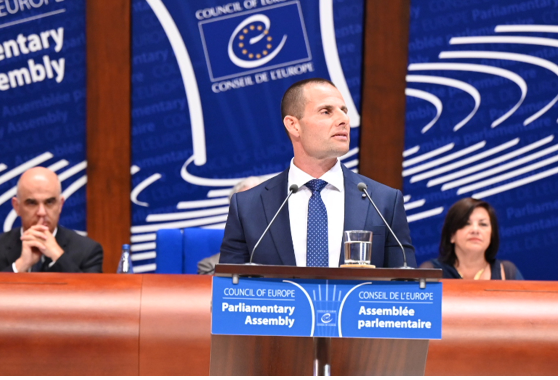
Greece, EPP/CD, President of the Assembly
10:03:12
The sitting is open.
Good morning, dear colleagues.
Let me remind members that they should insert their badges before taking the floor. As you begin your speech, please press the microphone button once only, wait a couple of seconds and then start speaking.
I would also like to remind the Assembly that members who have not submitted an annual declaration of interest are required to start any intervention with an oral declaration of interest under paragraph 20 of the Code of Conduct for members of the Parliamentary Assembly.
We now come to the joint debate on two reports from the Committee on Culture, Science, Education and Media. The first is titled "Protecting human rights in and through sport: obligations and shared responsibilities", Document 16196, presented by Mr Kim VALENTIN. And the second is titled "The Olympic Movement and peacekeeping: is sport neutrality serving sport values?", Document 16185, presented by Mr Mogens JENSEN.
We will aim to finish this item by 12:00 p.m.
Both rapporteurs have 7 minutes each now, and 3 minutes each at the end to reply to the debate.
I call first Mr Kim VALENTIN, rapporteur, to present the first report. Kim, you have the floor.
Mr President, dear colleagues,
It is an honour to present the report entitled “Protecting human rights in and through sport: obligations and shared responsibilities”. That is an important byline. But sometimes I also have been a little sad about how slow progress have been in the sports federations about human rights. Just on a personal note, to start off, this has been a journey where we had to push and pull everyone to the table.
Sport is a powerful tool for inclusion, well-being and human connection. But that same power can be misused. In recent years, we have seen growing evidence of abuse, discrimination and exploitation within sport. Athletes and children have suffered in silence. Major events have taken place in countries with poor human rights records. Sports governance has too often lacked transparency and accountability. That is the easy way of saying it and it is our job to do something about it.
This report sets out a clear roadmap for change. It focuses on three main priorities: ending abuse in sport, promoting gender equality and inclusion, and embedding binding human rights standards into the organisation of major sporting events.
I have three points.
First, the fight against abuse. Our Committee heard moving testimonies from survivors of violence in sport. We heard how a culture of silence and impunity has allowed psychological, physical and sexual abuse to persist - this is children we are talking about - particularly against children and young athletes. These are not isolated incidents. Abuse in sport is widespread and systemic.
That is why we call on all 46 Council of Europe Member States to integrate human rights protections into national sport policies, appoint child safeguarding officers in federations, and establish independent national safe sport units. These bodies must be trauma-informed, victim-centred and well-resourced. This will not be easy but this is the way we have to go.
We also call on international sports federations to put in place clear safeguarding policies, provide mandatory training, and create accessible, multilingual reporting mechanisms. Athletes must have safe spaces to speak out. Survivors must be included in decision-making. Above all, we must make clear that abuse will not be tolerated. This is the first point.
Second, we address discrimination and the need for gender equality in sport. Despite some encouraging developments, women and marginalised groups continue to face barriers. They are under-represented in leadership, underpaid and under-protected. Sport should empower all, not exclude some.
We welcome the progress made through the joint Council of Europe and EU project “All In Plus”, and the initiatives of many Federations. But much more is needed. Governments must invest in programmes that support women’s participation, penalise discrimination, and collect data to guide effective policy. Sports bodies must adopt measurable gender equality plans, improve representation, and support mentoring and leadership for women.
Inclusion must also address intersecting forms of discrimination. LGBTI persons, persons with disabilities, ethnic minorities and others face specific barriers. We urge all actors to develop intersectional approaches to make sport truly open to all. To make sport truly open to all.
Third, we address the need for strong human rights conditionalities in the hosting of major sports events. It is no longer acceptable that tournaments are awarded without transparent human rights assessments. All too often, such events are hosted in countries where workers' rights, freedom of expression and safety are not guaranteed.
We call for binding standards to be applied to all bidding processes, including requirements for contextualised human rights risk assessments, human rights action plans and independent monitoring mechanisms. Host countries must be held accountable. Victims must have access to remedies. And civil society must have a voice throughout the process.
Thank you.
Greece, EPP/CD, President of the Assembly
10:12:20
Thank you, Kim. I call now Mogens JENSEN, rapporteur, to present the second report. Mogens, you have the floor.
Thank you very much, Mr President,
Dear colleagues,
It is with great enthusiasm that I present the report entitled “The Olympic Movement and peacekeeping: is sport neutrality serving sport values?”, which the Committee on Culture, Science, Education and Media unanimously adopted on 7 April.
Sport, at its very best, is a unifying force. It brings people together across borders, languages and ideologies. It builds bridges in times of tension and provides common ground where politics cannot. The Olympic Movement, in particular, has long been a symbol of peace and international cooperation.
But today, colleagues, we are compelled to ask difficult questions: are the ideals of Olympism truly being upheld in a world shaken by conflict and rising authoritarianism? Is the principle of sport neutrality shielding values, or is it at times being used to evade responsibility?
The principle of neutrality in sport must never become a pretext for silence. When war is waged, when human rights are violated, when the very fabric of democratic values is torn, sport cannot look the other way.
This report is not an attack on the International Olympic Committee. It is a call. It's a call for greater clarity, for stronger accountability and for renewed courage to ensure that neutrality never comes at the expense of human dignity. It is a call to reinforce the Olympic Truce, to make it binding, to ensure that peace is not just an aspiration, but a precondition for participation in the Olympic Games.
Our Assembly has consistently affirmed that while athletes should not be punished for the actions of their governments, we must recognise the very real risk of their victories being misused for political propaganda. Where athletes are state employees, where freedom of expression is suppressed, where dissent leads to persecution, neutrality becomes fiction. In such contexts, we must uphold the principle of allowing participation only under the Olympic banner, as independent and truly neutral athletes.
In addition, exceptional circumstances may require even stronger measures, including a total ban on athletes from a given country. The situation in the Russian Federation and Belarus illustrates this vividly. This approach is not punitive. It is principled. It is a form of sanction that speaks the language of sport, removing the symbols of state power and abuse without punishing individual excellence.
At the heart of our report lies a simple truth: human rights must take precedence over political convenience. We urge the IOC to amend the Olympic Charter to make this truth explicit. Rule 50, which limits the political expression by athletes, must be reformed to ensure that speaking out for peace or denouncing human rights violations is not only permitted, but welcomed. Silence is not neutrality when injustice is at stake. Athletes are not just participants. They are role models. They are ambassadors of values. They must be free to express themselves, within reasonable and respectful bounds, and we must protect that freedom.
Colleagues, as you might know, on 21 May, I had the honour, with Mr Kim VALENTIN and the President of the Committee, of visiting FIFA headquarters in Zurich with FIFA representatives. We met them, some of the world’s most powerful football body, to discuss these concerns: human rights, governance and the responsibilities that come with wealth, power and influence. I am encouraged by FIFA’s openness and the opportunity for continued dialogue, including through the work of our newly established Parliamentary Alliance for Good Governance and Integrity in Sport.
This Alliance, which you all can be a member of, is an important milestone. It signals that parliaments, the democratic conscience of our societies, are ready to engage directly with sport bodies to ensure that ethics, transparency and accountability are not optional, but essential.
I sincerely hope that the International Olympic Committee, under its newly elected President, Ms Kirsty COVENTRY, will seize this opportunity. Ms COVENTRY's election is historic: she is the first woman and the first African to lead the IOC. Her leadership comes at a time when the Olympic Movement is at a crossroads. I express my hope that she will take bold steps to engage with our Assembly, and with the Council of Europe, to help chart a future where sport is genuine for peace and democracy.
Our recommendations today are feasible and necessary.
We call on the IOC to make the Olympic Truce an enforceable condition of participation, to amend Rule 50 to ensure that athletes can speak out in defence of peace and rights, to establish an independent human rights monitoring mechanism, and to develop a sports judiciary body to interpret the Charter with impartiality and consistency.
Let us make it clear that neutrality without values is not neutrality, it is abdication.
Let us, instead, reaffirm the Olympic spirit, as a spirit of peace, of dignity and of shared humanity.
I thank you and I count on your support.
Thank you, rapporteur JENSEN.
We'll now move on to the general discussion, and I would remind you that speaking time is limited to three minutes per speaker.
On behalf of the political groups, for the ALDE Group, I call Mr Petri HONKONEN.

Finland, ALDE, Spokeperson for the group
10:20:03
"Thank you, President. Dear colleagues", [spoken in French]
First, I want to thank you, our Danish colleagues, for your excellent work with these reports.
Sport is a value and an ideology in itself too, and one of the fundamental principles in the Olympic Charter is that Olympism seeks to create a way of life based on the joy of effort, the educational value of good example, social responsibility and respect for universal, fundamental ethical principles.
In sports, athletes compete against each other, but at the same time, nations also compete by shared values. Recently we have witnessed attempts to tarnish these core values of sport, one of the saddest examples being to attempt to allow Russia to participate in the Paris Summer Olympics.
Sport is not political and politics should not be mixed into it. But we must also understand that sports cannot be entirely neutral either. I used to serve as the Minister of Sports of Finland when the sports movement, the Olympic Movement, was preparing the previous Summer Games. And to me it was self-evident that Russia, as a state that brutally violates international law, could not take part in the Olympic Games. Many of my European colleagues in that time shared this view and I understand, personally, I totally understand that individual athletes may face a difficult choice between representing their country and seizing a rare opportunity in their personal careers. However, those of us who respect democracy and international law must also uphold our values in the realm of sports.
Awarding the FIFA World Cup to Saudi Arabia, a country hostile to human rights, is also a miserable example of this phenomenon I described. I hope, I deeply hope also on behalf of all the group, I hope that Member States will strongly support respect for the sacred values of sport and through that also support a just and rule-based world order. I agree with the draft resolution of Mr Kim VALENTIN that it is necessary for this assembly to continue monitoring the framework of the Parliamentary Alliance for Good Governance and Integrity in Sport, and to work with these sporting bodies, governments, and ensure that the promise of human rights in sports becomes a reality for all.
Thank you.
Thank you, Mister HONKONEN.
Madam CATHALA has the floor for the Group of the Unified European Left.

France, UEL, Spokesperson for the group
10:23:22
Thank you, Mister Chairman.
Mister Chairman, we have two joint debates today on neutrality in sport and respect for human rights in and through sport.
The first debate leads me to say that I believe it's important to remember that sport is political. When, in 1968, Black athletes raised their fist in an era of segregated America, I believe it was political.
When Russia has been excluded from the Olympic Games since 2022 and its athletes can only compete under neutral banners, and if they say they don't support the war or haven't taken part in it, I think it's necessary, because Russia is aggressing against Ukraine, and I hate its policies.
And when, likewise, the Olympic Committee decides that Israel, which commits war crimes and crimes against humanity, like Russia, can take part in the Olympic Games and not suffer the same sanctions as Russia, I think that's political.
Incidentally, Russia is going to be excluded from the 2026 Winter Olympics, which I think is totally normal. And other countries that commit crimes should suffer the same fate, and here again we see a double standard, which I find intolerable.
The second debate on human rights leads me to draw the attention of the entire Assembly here, of the Council of Europe, to what is happening in France, because what is happening in France is special among the countries of the European Union and the Council of Europe.
France may well become the first country to ban the veil from sports competitions. You'll tell me, this is totally ridiculous since during the 2024 Summer Olympics, our Minister of Sport, Amélie OUDÉA-CASTÉRA, banned our own French athletes from wearing the veil while all spectators, including French ones, could applaud women wearing veils from other countries.
Secularism is therefore used in France to stigmatise a single religion and, in particular, women are obviously stigmatised, such as women who accompany children on school outings in France and who are veiled, or students who wear the veil at university in France are stigmatised by an Interior Minister, Mr RETAILLEAU, who could be Ms LE PEN's minister.
And I'm going to read you what Amnesty International has to say in this respect, since the law currently being drafted in France, and which is the Interior Minister's project, would make the ban on the veil a position of principle, whereas today in France it's the federations that are free to ban the veil on a case-by-case basis.
And Amnesty International tells us: "France is the only country in Europe to ban the wearing of religious head coverings in sport, notably in football, basketball and women's volleyball. No other country in the region, either in national laws or in the rules of individual sport, has written into its rules a ban on religious head coverings that applies to certain Muslim women and girls."
I think this should alert our entire Assembly and illustrate the pre-fascist period we're heading into.
Thank you very much.
Thank you, Ms Gabrielle CATHALA.
I now give the floor to Ms Marietta KARAMANLI for the Socialists, Democrats and Greens Group. Ms KARAMANLI, you have the floor.

France, SOC, Spokesperson for the group
10:26:51
Thank you, Mister Chairman.
Yes, first of all, on behalf of the Socialists, Democrats and Greens Group, I'd like to thank our two colleagues, Mr Kim VALENTIN from Denmark and Mr Mogens JENSEN from Denmark, for their two reports.
Both examine the place and role of sport in political, social and international life, based on two related subjects. The Council of Europe has contributed a number of important sporting standards, including the European Sports Charter, the Code of Sports Ethics and the Anti-Doping Convention. Along with our Assembly, it is the founder of the Parliamentary Alliance for Good Governance and Integrity in Sport.
The draft resolution on the protection of human rights in sport calls on states, among others, to include the promotion and protection of human rights in their national frameworks and sports policies as a legal and ethical obligation. In particular, the fight against violence against athletes, especially women and children, must be part of a sustainable, victim-friendly framework.
For its part, the draft resolution on the neutrality of sport calls for the provision of the Olympic Charter that commits the International Olympic Committee (IOC) and its members to respect and protect human dignity and human rights to be strengthened, and for Rule 50 of the Olympic Charter to be amended to specify that political neutrality does not prevent athletes from supporting peace or condemning human rights violations.
All these proposals are a step in the right direction. I would like to draw your attention to four points. The existence and work of the Alliance must be better identified and publicised, not only at Council level, but also among states and all those interested in or affected by sport. The issue of standards is important, but it cannot stand alone. We can see this in a country like France, where a parliamentary report highlighted a systemic failure in the prevention and treatment of abuse and violence, despite the existing mechanisms.
It's therefore essential that all those involved – local committees, local clubs, supervisors, coaches, parents and even financial partners – feel committed. The principles need to be reiterated: acting in the interests of the athletes, drawing up a clear protection procedure to prevent and limit risks, commitment on the part of all players – international and national federations, local committees, local clubs, coaches, even partners and financiers.
Another point to bear in mind is that a large number of sports and sporting activities are now practised outside clubs, and therefore sometimes require little equipment. It's a phenomenon we need to understand and follow.
Finally, I'd like to say that our group supports the two rapporteurs and the two reports recommended today. And indeed, we are also embarking on a new stage in this work with the Parliamentary Alliance for Good Governance and Integrity in Sport.
Thank you for your support.
Thank you, Marietta KARAMANLI.
Ms Yelyzaveta YASKO has the floor for the Group of the European People's Party. Ms YASKO, you have the floor.

Ukraine, EPP/CD, Spokesperson for the group
10:30:18
Thank you, Chair.
Let me congratulate our rapporteurs for bringing this very important topic of sport as a soft power in our lives. I'm grateful personally, because I was present when these reports were discussed in the Committee on Culture, Science, Education and Media and hearings brought me back to when I was studying ancient Greek philosophy, which actually says that sport is incredibly important for democracy.
And I just want to ask here: do we remember that sport can actually be used to promote democratic security? Do we remember that? Maybe we can use it much more in our countries for positive reasons.
However, as rightly said, sport is very often used with political goals, with manipulation, with propaganda. And I want to emphasise a number of these cases.
First of all, it matters from whom you take money if you want to fund your sporting activities. I mean, Russian Gazprom, which continues to sponsor European sports clubs. And while there are sanctions on Russia and there are certain limitations on the Russian sportspeople, still, Russia manages to sponsor very openly, despite the fact that this money is dirty.
The second question that I want to raise is whether the sportspeople who represent the Russian Ministry of Defence or the Russian military can be neutral or whether they can participate in big sports competitions in the same way. Can this even be discussed as neutrality? Probably, of course, not.
On the positive side, I want to mention that sport really helps to heal society and many Ukrainian sportspeople, including young children. There is the story of Oleksandra PASKAL, who lost her leg, but she continues competing in sports competitions with a prosthetic leg. And I want to applaud all these people who continue their fight through sports, and where sports can be so useful.
There are many examples in history where sport can be used as healing after war. And that's something I would like to encourage all of us to look at more, establish and support more, because sport can be very healthy and very good for the health of the democracies of our societies.
Thank you.
Thank you, Yelyzaveta YASKO.
And on behalf of the ECPA group, I'd like to call on Ms Victoria TIBLOM.

Sweden, ECPA, Spokeperson for the group
10:33:42
Thank you, Mr President [spoken in French]
Esteemed colleagues,
We are gathered here today to reaffirm the vital principle of protecting human rights in and through sport, a mission that speaks to the heart of our democratic values. Sport is more than competition, it is a reflection of the societies we strive to build — inclusive, fair and respectful of human dignity.
But as lawmakers and guardians of rights, we must also address the difficult questions. One such question concerns the participation of transgender athletes in competitive sports. This is a topic that demands both compassion and clarity, especially when the rights of different groups come into conflict.
Let me be clear: every individual, regardless of gender identity, has the right to be treated with dignity and respect. Transgender people must never be marginalised or excluded from public life. That includes access to physical activity and sport. But we must also ensure that our pursuit of inclusion does not undermine fairness, particularly in women’s sports, where physical advantages from male puberty can remain even after transition.
This is not merely a theoretical debate. Across Europe, female athletes are voicing concerns that their hard-won rights to fair competition are being eroded. They ask a legitimate question: can inclusion be meaningful if it comes at the cost of fairness? When biological males compete in women’s categories and consistently dominate, are we still protecting equal opportunities?
The Council of Europe has a duty to lead with both courage and integrity. Protecting human rights through sport means protecting all rights — the right to compete, but also the right to fair and safe conditions. These are not mutually exclusive goals, but they require evidence-based policies, transparency and open dialogue. Science, not slogans, must guide our approach.
Our challenge is to craft solutions that respect gender identity while preserving the integrity of women’s sport. This is not exclusionary, it is responsible governance. It is our shared responsibility as public representatives.
Let us work together towards balanced, rights-based policies that uphold the principles of fairness, inclusion, and respect, in sport and beyond.
Thank you.
Thank you, Madam TIBLOM.
That concludes the list of political group speakers.
We now move on to the general debate, with Luz MARTINEZ SEIJO taking the floor.
Thank you, President.
I'd like to start by expressing my sincere gratitude to the two rapporteurs, Mr Kim VALENTIN and Mr Mogens JENSEN, for their wonderful job drafting these reports.
They don't pull any punches when it comes to issues that we cannot ignore: systemic abuse and discrimination, gender inequality, a lack of transparency when it comes to bidding processes for major sporting events, and the urgent need to establish independent mechanisms for protecting and providing redress for victims.
However, the demand for including binding human rights clauses in bidding and organisational processes is essential. When it comes to children, we need to focus on protections for them in the world of sport as an urgent priority. We need to denounce the physical, psychological and sexual abuse which young boys and girls face in the world of sport. Unfortunately, in many cases, this is simply covered up due to a culture of impunity. That is why the proposal has been made to create independent bodies and implement accessible, trauma-sensitive reporting mechanisms. These measures demonstrate that it is possible to move towards a governance model for sport based on human rights, fairness and accountability.
However, as the report points out, although a great deal remains to be done — the persistence of abuse, the lack of effective mechanisms for reporting and reparations, the fact that many countries with major deficits when it comes to human rights can bid for international events — this shows that we need to tighten things up. We should not forget that sport must be a space for freedom, respect and achievement, and we should not allow it to become a space for impunity and suffering.
That is why in my own country, and I say this with pride, we are promoting the values put forward in these two reports in our new Sports Law. Neutrality in sport should not lead us to stand aside when it comes to violations of human rights. Sporting organisations have the duty to act responsibly to protect and promote human rights. That is why it is essential to have policies that protect the freedom of expression of athletes, allowing them to support peace and condemn violations of human rights without fear of retaliation.
In addition, the Olympic Truce should become more than just a symbol, it should be a binding obligation, so as to ensure that countries taking part in the Games undertake to cease hostility during the period of the Olympic Games. This would promote peace and global co-operation while underlining the need to respect human rights in the world of sport. These two reports give us a clear vision of the challenges facing us in the world of sport, as well as the opportunities we have when it comes to enabling sport to become a driving force for fairness, inclusion and human rights.
I'd like to once again thank the two rapporteurs, Mr Kim VALENTIN and Mr Mogens JENSEN, for their excellent work.
Thank you.
Madam DALLOZ has the floor.
Thank you, Mister Chairman,
Ladies and gentlemen,
Article 50 of the Olympic Charter clearly sets out the principle of political, as well as religious, neutrality in sport. In 2019, International Olympic Committee (IOC) President Thomas BACH asked the national committees: "Focus on the unity of sport, focus on what unites us and not on what divides us or on those who try to divide us." Because that's what it's all about. To question neutrality in sport is to reject the universality and solidarity that lie at the heart of the Olympic message.
Olympism has all too often been the victim of the world's upheavals: the bombing in Atlanta, the massacre of Israeli athletes in Munich, the boycotts in Moscow and Los Angeles, not to mention the 1936 Games. The athletes were the only victims, having to decide not to take part after four years of effort and sacrifice. We must demand this neutrality from everyone, in every competition. We cannot tolerate the instrumentalisation of sporting events.
Rapporteur, you emphasise the difficulty for athletes from authoritarian countries to take a stand against their government. This is a reality. Can we imagine that the great Olympic champions of the USSR, for example, supported their regime because they didn't condemn it? Does this mean they should be banned from all competition? I don't think so. Should they appear under a neutral banner? In some cases, probably. The refugee team is a good example of the power of the neutral banner. Remember that in Moscow, Sebastian COE listened to the Olympic anthem on the podium.
In your report, you place little emphasis on the issue of religious neutrality, even though it is enshrined in Article 50 of the Charter. Yet it seems to me essential to the universalist message of Olympism. Essential, because this neutrality also serves as a reminder that in the face of religious extremism, men, and above all women, are fighting every day, and that their courage must be supported. The courage of Algerian Hassiba BOULMERKA in the midst of civil war, the courage of Iranian climber Elnaz REKABI, the courage of athletes who fight to practise a sport that is forbidden or reserved for men.
We must demand strict neutrality from every athlete, whatever their religion. Like the neutral banner, people should not be identified by their religious affiliation. Or rather, to demonstrate that sport's only religion is performance, courage and surpassing oneself, and its credo is respect for all and fraternity. Without political and religious neutrality, Olympism will not be able to spread its values, let alone carry its message of peace. This is the greatest challenge facing the first woman president of the IOC, who took up her post yesterday.
Thank you for your support.
Thank you. Ms Mónika BARTOS has the floor.
Dear Mister President,
Dear fellow representatives,
Sport is a segment of the common good. It strengthens the cohesion of the members of our communities and the physical and mental health of our individuals. Hungary's goal is not only to excel in professional sport, but also to become a sporting nation.
Sport can create a sense of cohesion and solidarity and contribute to skills and self-development outside traditional institutions such as school, work or family. Sports activities can help young people acquire skills that complement formal education and enhance their employability.
The Hungarian Government considers sport to be a national strategic sector. It pays particular attention to improving the health of the population, increasing the number of people who regularly take part in sport and reducing regional disparities, as these can significantly lower our health expenditure and improve our economic performance in the long run.
The Olympic Movement has long been associated with the promotion of peace through sports, while it is not immune to geopolitical conflicts. Founded on the principles of unity, respect and fair competition, the Olympics aim to transcend political, cultural and religious differences by bringing people together in a spirit of friendship and mutual understanding.
The concept of sport neutrality refers to the idea that sports should remain free from political, religious or other external influences, focusing solely on fair competition, mutual respect and the spirit of the game.
Sports can serve as a neutral platform to bring people together across conflicts. We really need this now.
Last but not least, I would like to thank the rapporteurs for their great work.
Thank you.
Thank you. Mr Roland Rino BÜCHEL has the floor.
Dear President, ladies and gentlemen.
Many thanks to the two rapporteurs for their reports, and also to the staff of the Secretariat. The people who have worked on this and the people sitting here in the Chamber have a great deal of experience. We have former sports ministers, we have athletes, we have former top athletes.
I am looking at seat 347, Mr Joachim VOGT, a new member. He has won a Ski World Cup race, competed in the Olympics and so on. He was part of the Swiss training team at the time, for which I managed the sponsorship activities.
Later, I was responsible for FIFA projects and I tried to establish the Club World Cup, among other things. It was a disaster. No chance. We had five or six teams and couldn't get anything together.
Today, this event, which is currently taking place in the USA, generates millions, tens of millions, hundreds of millions. The winner will be paid over 100 million euros. But much more important is the money that is generated, which can be used for the sport, for the development of the sport.
As you can see, theory meets practice here in this Chamber, and that's a good thing. I will now switch to English and say a few things.
I'm convinced that sport has the power to drive change in our societies as a tool for diplomacy, a catalyst for social inclusion and a force for promoting fairness and equality. Let's be specific.
When we talk about the IOC, when we talk about FIFA, when we talk about global associations, we go out into the wider world, beyond the borders of our member countries.
Since 2017, FIFA has aligned with the Council of Europe recommendations by embedding human rights requirements into its bidding and hosting processes. This includes the need for independent human rights assessments, strategic frameworks and formal guarantees from host governments.
Such measurements have already led to significant human rights commitments, even from the Saudi government, for the World Cup, which will be held in 2034. Similar in Qatar.
Sport is not enough exclusion. Sport is about inclusion and engagement. It's about sharing the beauty of the game across all regions and using it as a bridge for dialogue, progress and transformation.
Like rapporteur JENSEN, I welcome the federations', especially FIFA's, openness and willingness to engage in honest, constructive dialogue. We should seize this opportunity to make a real impact with the people who have the real impact in sport.
Thank you.
Thank you.
Baroness Ruth HUNT, you have the floor.
"Thank you very much" [spoken in French].
I want to start by thanking the two rapporteurs and my colleagues on the Committee on Culture, Science, Education and Media for their excellent, thoughtful and detailed analysis of sport. I know that the hard work will now begin in attempting to implement the recommendations of the report, and I hope that they have our full support.
Sport teaches us that fairness is sacred – it is the foundation upon which all competition rests. Protecting human rights through sport signals a way of living in the world and demonstrates how to treat people. Therefore, as we grapple with complex questions around trans and intersex participation, we must remember that how we treat these athletes sends ripples far beyond our stadiums.
When athletes are exposed to public scrutiny and speculation, and rigid ideas about what makes a woman, sport risks creating a narrative that travels across borders. In countries where being perceived as LGBTI can mean persecution, imprisonment or worse, these frantic speculations carry profound weight.
Every athlete questioning their place in sport is watching. Every young person struggling with their identity sees how sport responds. Every government seeking to justify discrimination points to how sport manages these issues as a justification for their own approach.
The Olympic movement speaks of building a better world through sport, yet we risk teaching the opposite lesson if we do not find a humane way of managing difference; the events around women’s boxing in 2024 signalled that difference is dangerous, that inclusion requires conformity, that some bodies are less worthy of celebration than others.
True fairness demands clear and proportionate rules and regulations, but it also demands that sporting bodies implement those rules with scientific rigour and discretion, but, above all, humanity. It requires us to hold space for complexity while refusing to compromise human dignity. It calls us to lead with compassion, knowing that the signals that are sent from sport echo in villages and cities where vulnerable people depend on our moral courage.
The question is not whether inclusion is challenging – it is. The question is whether we choose to meet that challenge with wisdom and humanity.
Thank you.
Thank you.
Lord Leslie GRIFFITHS, you have the floor.
You take me by surprise, President. But it's very nice to be...
I'm sorry.
No, no, not at all. I'm most grateful to the two great Danes who have introduced these debates and for all the thinking that the Culture Committee has gone through in order to bring these matters to our attention.
I've listened carefully to the points that have been made. I share with Mr Petri HONKONEN the experience of having been my government's or my party's spokesperson for sport in the House of Lords in the British Parliament. And there I discovered some very interesting things that perhaps are not touched upon in this report. For example, we had consideration of budgets from government, from our treasury, to support the world of sport. Governments see an importance in putting out money behind the sporting endeavours that we take for granted.
But, I have to say that what we worried about was how the proportion between supporting elite sports to produce medal-winning athletes was taking over from the amount of the budget that was intended at grassroots to encourage the playing of games and sports. Now I am, despite my appearance, a passionate rugby player, also a cool cricketer, and in all senses of the sport, I should say too, an Arsenal supporter. All these things are important because at grassroots level, sport as we understand it, in our schools, in our parks, in our public places takes energy and provides opportunities — and this is where it touches what the Council of Europe's all about — provides opportunities for ordinary young people and older people to participate in their community lives, to represent their community, their team, their village, or whatever it is. And participation is at the very heart of of what we call democracy.
So sport must be seen as an adjunct to help us to develop a democratic spirit. And therefore all the theorising, and it's been brilliantly exposed in the reports and in speeches up to now, is important, but not at the expense of grassroots sport properly provided. In our schools in England, for example, where budgets in difficult economic times were squeezed, schools were selling their playing fields to raise money to meet their budgetary needs. We simply have to remember that sport is about ordinary people and it fosters community developments. And it isn't just about medals and awards and the elite.
Thank you.
Madam VASILEIOU CHATZIIOANNIDOU, you have the floor.
Thank you Mr President.
Mr Rapporteurs, thank you for this enlightening report.
As a Greek parliamentarian allow me to begin with a historical reminder. Greece is not only the birthplace of democracy, but also the cradle of the Olympic ideal. The ancient Olympic Games were more than a mere sporting event. They were a celebration of human excellence and a truce, the Ekecheiria, a pause in hostilities, to remind warring city-states of their shared humanity.
This legacy carries immense symbolic weight. But it must also carry political and ethical responsibility. In today’s world, sport is no longer confined only to arenas or stadiums. It is a global force, a cultural and economic phenomenon, and a powerful vehicle for values at times of distortion.
Sport has the potential to be a driver of social change. It can empower youth, promote gender equality, integrate migrants, and contribute to mental and physical well-being.
It is a platform where human rights can be exercised but unfortunately also where they can be violated.
Let us not ignore the troubling paradoxes, presented also by this report. Major international sporting events have, in recent years, been hosted in countries where fundamental freedoms are systematically suppressed. Athletes have faced punishment for political expression. Migrant workers have been exploited in the construction of sports infrastructure.
We cannot turn a blind eye.
The Olympic Charter speaks of political neutrality. But neutrality must not be a shield for inaction. The values enshrined in the Charter, respect human dignity, non-discrimination, peace,and these values are not neutral. They are normative and they demand action.
The Council of Europe, through its Enlarged Partial Agreement on Sport (EPAS), has been instrumental in promoting ethical sport governance and we have made important steps, but we must build on this further. As a Greek, I feel a deep national connection to the Olympic spirit. But as a European, I feel an even greater responsibility to ensure that this spirit does not become only a historical relic.
We must embed human rights in all stages of sport governance. From bidding and hosting international events to national training centres and local clubs, human rights due diligence must become the norm. We must protect athletes' freedom of expression. We must create independent monitoring mechanisms.
Sport is not a luxury. It is a mirror of our society and a culture creator. Let us return to the true spirit of the Olympics, not in nostalgia, but in action.
Let us ensure that sport is not merely neutral, but positively and unapologetically on the side of human rights. Thank you!
Thank you, Mr Mike READER has the floor.
Thank you, colleagues.
I speak today to echo the calls made by both rapporteurs in the reports in front of us today on human rights in sport. I support the recommendations on ensuring binding human rights across all levels of sports, from grassroots to elite competitions.
What is particularly important right now is that we stand up against the weaponisation of trans rights and ensure that trans athletes are protected in sport from grassroots to elite level. I also in particular join in the calls for human rights conditionalities in bidding and hosting major sporting events. As someone who worked in the bidding profession and was involved in a number of major sporting events in my time in the construction sector, I think this is absolutely critical. And I saw firsthand in Peru, the UK government supported the Peruvian government to deliver the Pan American and Parapan American Games in Peru. And the power that had in transforming communities and opening up opportunity with people was really important. It wasn't about the most money made from the Games, it was about opening up opportunity.
I also welcome the report's focus on safeguarding and support its recommendations, the establishment of an independent trauma-informed system to protect athletes. Back home. I'm very fortunate to chair the All-Party Parliamentary Group on Wrestling and I'm picking up from my predecessor, the fantastic Honourable Alex DAVIES-JONES MP who has done some brilliant work on safety standards, on calling out misogyny and athlete abuse across the sector. Human rights and safety must be the foundation of any domestic or international sporting pursuits and this assembly does have a role in ensuring that.
Turning to the report on the Olympic Movement and peacekeeping, I fully support the recommendations for strengthening the Charter and particularly protections for athletes under Rule 50. They should be able to show political expression without fear of recourse. The integrity of sport and the principle of peaceful competition demands no less from us. And whilst we see Russia and Belarus excluded rightly by the IOC, we must make sure that other nations who use sport as a political tool to harm people and where we see those countries having documented human rights abuses, that they too are held to account in the sporting world.
Finally, I echo the rapporteur's calls for strong international co-operation, whether it's through EPAS and other platforms, so that our collective actions match the scale of the challenges that face us. The European family has and always will be stronger when it stands together. And it's for these reasons I urge colleagues to adopt both reports in full.
Thank you.
Thank you.
Mr KAMELCHUK has the floor. I'll give him a little time to settle in.
Don't worry. "You've got time. Take your time. You're welcome" [spoken in English].
Dear Chairman,
Distinguished colleagues,
Let me start with a question: Is neutrality still neutral – when it protects the aggressor more than the victim?
For decades, the Olympic Movement has insisted on staying outside politics. But when a terrorist country bombs cities, universities, hospitals and sports infrastructure, including one of Ukraine’s leading technical institutes – it is no longer possible to separate sport from violence.
Facilities meant to train athletes and educate youth are turned into rubble. Yet athletes from the same state, often affiliated with the military, continue to compete internationally under so-called neutral banners. But when missiles are launched at students and sports halls, no neutral form can conceal that complicity.
As of March 2025, Russia has killed 591 Ukrainian athletes and coaches. Twenty-two are being held in captivity. Eleven are missing. These are not just numbers – they are destroyed futures. These were individuals who should have brought glory to sport and their nation – not fallen victim to an aggressor’s war.
We are told sport must unite. But what are we uniting around – silence?
Neutrality was never meant to shield regimes that glorify war. It was meant to protect values: peace, dignity and fairness. When neutrality is exploited to enable propaganda, it betrays the very spirit it claims to protect.
Russian athletes have become instruments of state narrative. Some serve in military clubs. Others publicly endorse the invasion. Their victories are broadcast as national triumphs even as their country erases Ukrainian innocent lives.
Participation must be principled. “Neutral” athletes must prove true independence: no military ties, no support for war, independent verification and no state declarations.
And the Olympic Truce must carry weight. A country that launches a full-scale war during the Games cannot be treated as just another competitor. It must face real sanctions, including bans from hosting or participating.
Colleagues, neutrality in sport cannot become complicity in aggression.
When sport is used to glorify autocracy, silence is not impartiality – it is surrender.
Thank you!
Thank you, Mister KAMELCHUK.
Madam JUHÁSZ has the floor.
Thank you very much.
The Council of Europe recognises that sport is far more than a form of physical exercise or entertainment. It is a potent social force that can promote human rights, democracy and the rule of law. Sport provides a unique platform where the fundamental rights of individuals, such as non-discrimination, dignity, freedom of expression and equal participation, can be expressed, protected and amplified. In this light, Hungary holds a firm and principled position: athletes must not be punished or excluded from international sporting events, including the Olympic Games, solely based on the geopolitical actions of their governments. Such exclusions risk undermining the universal nature of sport and the individual rights of athletes, who often have no influence over the decisions of their states.
At the same time, safeguarding the integrity of sport requires ongoing commitment and collaboration. The Council of Europe has been a pioneer in this regard. It has led international efforts to combat doping, match-fixing and corruption. Threats that not only endanger fair play but also erode public confidence in sport as a whole. Instruments like the Macolin Convention on the manipulation of sports competitions and the Anti-Doping Convention have set strong legal and ethical benchmarks. These Conventions emphasise that protecting the integrity of sport is inseparable from protecting the rights of all participants – athletes, fans, officials and communities alike.
Sport also plays a vital role in advancing social cohesion and intercultural understanding. Whether through grassroots initiatives or major international events, sport has the capacity to bring people together across boundaries of nationality, language, religion and social status. It helps build inclusive communities and fosters values such as respect, teamwork and solidarity. In this sense, sport can be a bridge to peace and reconciliation, particularly in divided or post-conflict societies.
However, for sport to truly fulfil this peace-building function, its governance must be transparent, inclusive and ethically sound. The Council of Europe stresses the need for democracy, accountability and human rights-based governance structures within sports organisations. Promoting integrity in leadership and decision-making processes ensures that the values of sport represent fairness, respect and human dignity.
In conclusion, the protection and promotion of human rights in sport is not the responsibility of any single actor, but a shared duty. Governments, international organisations, sports federations, and civil society must work together to ensure that sport remains a force for good.
Thank you very much indeed.
Thank you.
Ms GREENWOOD has the floor.
Thank you, Mister Speaker.
Pierre DE COUBERTIN, the founder of the modern Olympic Games, once said: “The Olympic Games are for the world, and all nations must be admitted to them”.
As was the case in his lifetime – and has been ever since – that ideal has often run up against geopolitical tensions and war, leading to boycotts and bans.
Reconciling the Olympic ideals of neutrality, inclusivity, and peace has and will always be a significant challenge. That’s why the ancient Greek tradition of the Olympic Truce is indispensable. It envisions a world where sport can promote peace, dialogue and reconciliation. But only, of course, if the Truce is actually respected. Sadly, right now, it is simply a symbolic measure.
The United Nations recognises the Olympic Truce's potential to foster peace and understanding. The UN General Assembly has adopted resolutions promoting peace through the Olympic ideals.
Indeed, rapporteur JENSEN’s report proposes making this Truce a binding condition of participation. That is, creating a requirement for any country engaged in active warfare or armed conflict to “commit to a temporary cessation of hostilities for the duration of the Olympic Games.”
Though the International Olympic Committee is often opposed to this idea, I believe it holds great merit. Other international sporting events, such as the Commonwealth Games and the North American Indigenous Games – the latter of which was first proposed by the eminent Canadian, Cree Chief Willie LITTLECHILD – place a strong emphasis on peace and reconciliation in sport. They also emphasise the importance of culture. The Commonwealth Sport’s Declaration on Reconciliation and Partnership with Indigenous Peoples, for example, affirms the importance of celebrating languages, cultures and histories. This is something I feel has been increasingly lost in the excessively commercial modern version of the Olympic Games. Today, as broadcast rights sell for billions and are fuelled by even greater advertising revenues, it’s clear that the ideal of profit often takes precedence.
It’s striking to recall that the 1912 Stockholm Olympics featured competitions not just in athletics, but also in painting, sculpture, architecture, literature and music. Indeed, competing under a pseudonym, DE COUBERTIN himself won a gold medal for his poem, Ode to Sport, and I end with a quote from that poem:
“O Sport, You are Peace! Through you, the young of all the world learn to respect one another, and thus the diversity of national traits becomes a source of generous and peaceful emulation.”
"Thank you" [spoken in Cree].
Thank you. Ms Meritxell ALCOBÉ has the floor.
Thank you, Mr President,
Ladies and gentlemen,
Transparency, accountability, inclusion, respect for human rights, democracy and the rule of law are the foundations of good governance that every country, large or small, should have, in every field, including the field of sport, which is our focus today.
The Principality of Andorra, my little country, had the honour of hosting the Games of the Small States of Europe a few weeks ago. It was an intense week, marked by the fraternity and cooperation that unite our states such as Monaco, San Marino, Malta, Montenegro, Cyprus, Luxembourg, Liechtenstein and Iceland.
The Games were an opportunity to reaffirm our commitment as a country deeply attached to the fundamental values of sport: well-being, respect, inclusion and social cohesion.
Two major areas of co-operation brought us together, and will continue to do so, to guide the future of our sports policies.
On the one hand, the safety and protection of everyone involved in sport.
Institutions have a duty to act firmly to ensure that sporting environments are free of violence, abuse and discrimination.
On the other hand, sport must be a source of well-being, social interaction and personal development, particularly for children and the younger generation. This is why we are working to guarantee universal access to physical activity and sport.
The right to lifelong physical activity should be on every politician's agenda.
Physical activity is essential not only for individual and collective health, but also for mental health, inclusion and social cohesion.
In this sense, our approach is cross-functional: it brings together the Ministries of Social Affairs, Culture, Youth and Sport, which has just presented a Sports Bill to Parliament, as well as the Andorran Olympic Committee and the Secretariat of State for Equality, among others, who are working towards the goal of ensuring that by 2027, Andorra will be a 100% fit for life country.
No child, elderly person, disabled person or vulnerable person should be excluded from these fundamental rights linked to sport.
We aspire to promote a sport that is safe, inclusive, accessible to all, based on gender equality at all levels, respectful of the environment, and free of all forms of discrimination, manipulation or violence.
Because of their size and the proximity between institutions and citizens, we are convinced that small states have a powerful lever to drive concrete progress in the protection of human rights and fundamental freedoms, in line with European values.
Thank you for your attention.
Thank you.
Ms Agnes Sirkka PRAMMER has the floor.
Thank you, Chair.
Dear colleagues,
Sport has the power to inspire, but also the power to harm. That’s why both reports we are discussing today share an essential insight. The responsibility for protecting human rights in sport cannot be left to sport alone. It is a public duty.
Too often, we hear the argument of autonomy and neutrality. But let’s be honest: when young athletes are sexually abused, when girls are excluded, when athletes face reprisals for speaking up, neutrality becomes a cover for neglect. States cannot look away.
They have a duty to protect athletes from abuse, to ensure access to justice and to make public funding of sport conditional on human rights standards. That includes independent safeguarding bodies, effective complaint procedures and laws that make human rights due diligence mandatory for major events.
The Olympic movement must also be held accountable. If a host country wages war or violates fundamental rights, allowing them to wrap themselves in the Olympic flag is not neutrality, it's whitewashing.
Sport is not a parallel world. It is part of our societies and must be held to the same standards.
This Assembly has the tools to lead. Let’s adopt both reports and send a clear message: human dignity is not optional, not in politics, not in war, and not in sport.
Thank you.
Thank you.
Mr Georgios STAMATIS has the floor.
Thank you, Mister President.
Allow me to speak in Greek, because we are talking about the Olympic movement.
Thank you.
I would like to start by thanking and congratulating the two rapporteurs. These reports are very timely.
Mister STAMATIS...
Is there a translation? Yes. We were waiting for the translation.
Can we reset and start again?
Shall we start again from where we left off?
[Mr Georgios STAMATIS off mic] Okay, thank you.
Thank you very much.
[Spoken in Greek, no interpretation]
Sorry. We have a problem with the translation. Could you do it in English?
We are sorry.
Dear colleagues, I would first of all like to congratulate the rapporteurs for this report, especially in the time that our parliamentary simply has the new parliamentary network Alliance for Good Governance and Integrity in Sport.
And this is very important, but we have to be clear in this room, when we're talking about the Olympic Games or the Olympic Movement, it's not only the case when we have wars in the time of the Olympic Games. We have athletes that came from countries with dictatorships, we have countries that don't recognise the Olympic Movement. So I think it's very crucial, not to go from the ethical type to the loyal type.
So, when we have the war, none of these countries ought to be accepted in the Olympic Games. For me, it is very, very crucial because in our days, you have to see we don't only have the Olympic Movement, we also have the Paralympic Movement. We have to fight, we have to ensure equality, to give people with disabilities the opportunity to be members of the Olympic Movement.
I think it's very important that the new President of the International Olympic Committee is a woman. This is a signal to us, for the International Olympic Committee, how to see the upcoming days and years for the Olympic Movement. I think it's very important to talk about equal opportunities. Equal opportunities came when we have democracy in our countries.
So I think it's very important when we talk about the Olympic Movement to talk about democracy. And this is for us, for the Council of Europe, very crucial for the upcoming years to support our countries to be more democratic with human rights for all. And then, at the end of the day, we have the Olympic Movement the day of the Olympic Games.
Thank you.
Thank you and sorry again for the interruption.
Ms Alexandra SCHOOS has the floor.
Mr President,
Distinguished colleagues,
Sport, and the Olympic Movement in particular, has long stood as a symbol of peace, dialogue and mutual respect among nations. But in a world increasingly marked by conflict and instability, we must ask ourselves a difficult but necessary question: does the principle of neutrality in sport still serve the core values it claims to uphold — fairness, human dignity and peace?
Neutrality and autonomy are essential principles in sport. They safeguard fairness, ensure global participation and protect sport from political exploitation. When these principles are cast aside, sport risks becoming a tool of division rather than unity.
My party firmly believes that sport must remain above politics. Let us be unequivocal: we condemn all acts of war and aggression. But we also draw a vital distinction between those who make political decisions and those who dedicate their lives to sport. It is not the athlete who commands armies. It is not the athlete who drafts policies of oppression. It is the athlete who trains, who competes, who inspires — across borders, beyond ideologies. Why should athletes not serve as symbols of unity in times of division? Should they not embody the very peace and reconciliation that the Olympic Charter proclaims? We hold that athletes, regardless of their nationality, must be allowed to compete under their national flag, even in times of geopolitical tensions. Denying them this right undermines not only the unifying spirit of sport, but also punishes individuals for the actions of their governments, actions over which they have no control. We do not believe that excluding individual athletes based on nationality will bring us any closer to peace. It is neither just, nor effective. It risks turning sport into a tool of division, rather than a vehicle for unity and understanding.
If we are serious about honouring the ancient Greek tradition of Ekecheiria, the Olympic truce, then we must do more than commemorate it in words. Ekecheiria was not symbolic, it was binding. A sacred commitment among warring states to suspend hostilities during the Games. Let us have the courage to act in the same spirit.
As rightly stated in the report, "sport has an undeniable economic weight" and "it will increasingly become an instrument of economic pressure." This reality makes one thing clear: sport is not, and perhaps has never been, truly neutral. But instead of lamenting this fact, why not turn it into a constructive opportunity? Let us be brave and send a clear political message: The Olympic Games should only be held under conditions of peace, for instance, within the framework of a verified ceasefire. Such a condition would not only uphold the moral integrity of the Games, but would also generate significant macroeconomic and diplomatic leverage, capable of influencing political decisions where it truly counts. Of course, we must also acknowledge the other side of this equation: all athletes would be affected. This is in contrast to what I just mentioned earlier, but perhaps, in the name of peace and shared responsibility, this temporary sacrifice could become a symbol of global solidarity, a unified call to end violence and to restore peace.
Thank you.
Thank you.
Mr RUSHWORTH has the floor.
Thank you.
Sport, as we all know, has the power to promote health and fitness, to teach our children values like hard work, fairness, teamwork, humility, and has the power to bring people together, to build up friendships across divides, and to unify nations.
As we saw when South Africa hosted the 1995 World Cup, or indeed the Christmas Day truce football match during the First World War, we've seen how sport can be a platform for promoting equal rights, such as Tommie SMITH and John CARLOS' raised black glove at the 1968 Olympics. But sport has also been used to abuse, to exclude, and to distract. We must guard against sportswashing, and in my opinion, without denying the power of sport to bring nations together. And despite those differences, there've got to be some lines drawn.
Think of the example of Saudi Arabia, whose Crown Prince Mohammed bin SALMAN told Fox News: "if sportswashing is going to increase my GDP by 1%, then we'll continue sportswashing". Research by Play the Game identified 910 Saudi sponsorships in global sports and 1 412 positions across Saudi entities since 2024. And this expansion is not about sport. It's a strategy to improve the Kingdom's image. It's a facade to cloak Saudi Arabia's serious human rights abuses, discrimination against women and girls and people who identify as LGBT, to cloak unfair trials and torture in detention and oppression and execution for juvenile offences.
And what hits really close to home is Newcastle United being bought by the Kingdom. All I can say is that I hope Sunderland gets six points against them this season. Many states within this council supported Qatar's bid to host the 2022 World Cup, which has been dubbed "the Death Games" due to the death of migrant workers building the stadiums. Amnesty International reported 15 000 deaths. And while this figure is disputed, and I won't litigate that argument, what is not in any doubt is that migrant workers from countries like Nepal and Bangladesh had their passports seized. So they were left with no choice but to live in overcrowded conditions and work long hours in intense heat for poverty wages. And that's why I welcome this report and its recommendation to put human rights and human dignity back at the heart of sport and not leave it to the sport's governing bodies themselves to police these important values.
Friends, it falls to us.
Thank you.
Mr MULLEN has the floor.
Mr MULLEN?
The next speaker is Ms TANGUY.
Thank you, Mr President.
Sport embodies a universal ideal: inclusion, respect, dignity. But behind the ceremonies of unity and the emotions of victory, there are realities that we can no longer ignore.
The two draft resolutions we are examining today reiterate a simple requirement: sport cannot remain indifferent in the face of abuse, discrimination and violations of fundamental rights.
France has undertaken concrete reforms. Equality between women and men, a major national cause since 2017, has resulted in ambitious sports policies: equal pay, parity in governing bodies, the fight against gender-based and sexual violence.
In the run-up to the Paris Olympic Games, several pieces of legislation have been adopted. The law of 2 March 2022 to democratise sport, which strengthens equality and training for educators. The law of 19 May 2023, which requires all federations to set up reporting units, appoint an integrity officer, and measures to protect minors, with a secure reporting system. And the national violence prevention plan, strengthened in 2023, which makes these actions mandatory and systematic.
I had the opportunity to present these developments at the conference on promoting safety, integrity, equality and inclusion in sport. I stressed the need to prevent violence and protect minors, both upstream and downstream.
Mr Kim VALENTIN's report proposes strong measures: zero tolerance for abuse, ethical governance, support for victims, and the creation of an independent global entity. Mr Mogens JENSEN's report reminds us that the neutrality of sport must not be used as a pretext for inaction, particularly in the face of authoritarian regimes.
These two resolutions share the same imperative: sport cannot be separated from the law, morality and democratic values. There is an urgent need to make sport a lever for action, justice and integrity, a safe, ethical and inclusive space.
The question is: how can the Council of Europe continue to take concrete steps to make this ambition a lasting reality?
Thank you for your attention.
Thank you.
Mr ROBERTSON has the floor. Mr ROBERTSON?
The next speaker is Ms Pavela MITOVA.
Thank you, Chairman.
Distinguished colleagues, the Olympic Movement was created to unite, promote peace and ensure fair competition. But today we face a serious conflict that challenges one of sport's core values, equality. And I do not understand the meaning of equality as most of you do, apparently.
The inclusion of trans women, individuals born male, who have transitioned, in women's categories raises concerns. We cannot ignore the physical advantages linked to male biology which persist even after hormone therapy. This creates unfair and, at times, disturbingly unsafe conditions for female athletes. I'm a woman. I perceive myself as a woman, and believe me when I tell you I will not appreciate more gender identity if a biological male with pink shorts beats me to death on a boxing ring, because today, he, she, it, I don't even know any more, decides it is better to feel as a woman and not face the consequences of being a total loser in his own category.
Neutrality must not mean silence in the face of injustice. It must not be used to justify political correctness and liberal pseudo-ideology that undermines the very foundations of sport. Bulgaria was among the first to officially oppose trans participation in Olympic boxing. We therefore call on the Council of Europe to support fairness based on biological reality, protection of women's categories in sport and to put a stop on this political nonsense. This is not about discrimination. It is about real equality rooted in science, fairness and the respect of all athletes. Let us have the courage to speak the truth through peace and tolerance, come through reason and common sense and not denial of reality and distortion of biology.
Thank you.
Mr HASIPOĞLU has the floor.
I am speaking on behalf of the Turkish Cypriot young people, young athletes. I would like to thank the rapporteur Mr Kim VALENTIN for the title of this report, because it is protecting human rights in and through sports obligations and shared responsabilities.
Unfortunately, we couldn't protect the Turkish Cypriot people sports rights through politics. We as Turkish Cypriot people, who had voted positively all the previous United Nations unification plans. Unfortunately, we are the one who are being penalised and under isolations and restrictions.
Remember, in 2004 there was a referendum. Turkish Cypriot side, Greek Cypriot side had voted whether we can unite the island again or not.
Turkish Cypriot people voted positively 65%. Greek Cypriot side voted 75% "No". They become European Union member and we Turkish Cypriots, unfortunately stayed outside the European Union and other organisations. And that's why this title is very important "Protecting human rights in and through sports". So we should be able to achieve this through sports because we failed to achieve it through politics.
Remember, even this very Assembly in its Resolution 1376 adopted in 2004, has made a call and I quote “The Turkish Cypriots’ international isolation must cease”.
Although more than two decades have passed since this Resolution was adopted, the Turkish Cypriot people and athletes continue to face barriers to engagement with the international community, even in the field of sports. Their rightful participation in international sporting events remains obstructed, further deepening their unjust isolation.
We are not asking for anything political. We are asking for fairness. We demand to take part in international sports platforms. Unfortunately, when international federations and organisations block these young people, they send a message to them: “You don’t matter. Your dreams are not valid.”
This Assembly must not stay silent. It is time to find solutions that open the doors of sports to the Turkish Cypriot people as well.
Sports should build bridges, not walls. Let Turkish Cypriot athletes compete.
Thank you very much.
Thank you.
Mr AKALIN has the floor.
Thank you, Mr Chair,
Dear colleagues,
First of all, I must congratulate the rapporteurs for these extensive reports. There are many excellent suggestions within the reports to be taken seriously and actions to be taken by all the relevant governing bodies and stakeholders.
Sport is one of the most powerful tools that can unite people beyond borders, languages and ideologies. At its best, sport represents fairness, respect and integrity — values that are central to democratic societies. But for sport to continue to inspire, it must be protected from threats that undermine its neutrality and values.
We cannot ignore that discrimination, violence and human rights violations persist in the world of sports. These issues not only affect fans, but especially harm athletes, who often bear the burden of political and social tensions. Maintaining neutrality in sport is not about being silent in the face of injustice, but about ensuring that all individuals can participate equally and safely.
Gender equality remains a critical issue. Female athletes must have equal opportunities, pay and recognition. Similarly, the protection of athletes and players, including mental health support and safeguarding especially women, children and the vulnerable against abuse, must be a priority for all governing bodies.
Match fixing and illegal betting are another serious threat to the integrity of sport. It erodes trust, damages reputations and betrays the very essence of competition. Upholding strong legal frameworks and cross-border co-operation is essential to fighting these crimes.
We must continue to champion these principles. By supporting legislation and initiatives that reinforce fairness, transparency and inclusion, we defend not just the purity of sport, but the values of our shared humanity. Let us ensure that sport remains a space where human dignity is upheld, everyone is welcome and excellence is achieved not through exploitation, but through respect and equal opportunity.
Thank you.
Thank you.
Mr NATALUKHA has the floor. Mister NATHALUKHA?
I give the floor to Ms Lianne ROOD.
Honourable colleagues,
For decades, female athletes have fought hard to be treated like their male peers. Whether in terms of resources for amateurs or salaries and prize money for professionals, unacceptable disparities have long existed, and many persist. Thankfully, with the growing popularity of women’s sports, that is starting to change.
In other respects, however, female athletes remain just as – if not more – vulnerable than before. Nearly 21% of professional female athletes report having experienced sexual abuse as a child in sport, almost double the rate among male athletes. Female athletes are also more likely to report anxiety, depression, and disordered eating.
Clearly, more must be done to ensure girls and women can safely participate in the sports they love. But safe participation isn’t just about protection from abuse and mental health support – it also means fair and safe competition.
The UN Special Rapporteur on violence against women and girls, Ms Reem ALSALEM, has noted that female athletes are "more vulnerable to sustaining serious physical injuries when female-only sports spaces are opened to males." She cites evidence from volleyball, basketball, and football or as we call it in Canada, soccer. As a result, she recommended that “female categories in organised sport [be] exclusively accessible to persons whose biological sex is female," in order to safeguard "equal opportunities for women and girls." And I couldn’t agree more. I was encouraged to see World Boxing recently announce that it will introduce mandatory sex testing to determine the eligibility of male and female athletes in its competitions. It's about ensuring women are safe, protected, and able to compete on a level-playing field.
Now let me turn now to the second half of today’s joint debate: on whether sport neutrality is serving our values.
The report rightly notes that some governments use major sporting events "as a means of asserting their power and gaining influence and prestige." This is certainly true, though I would have also welcomed an explicit reference to sportswashing – when authoritarian hosts use sport to whitewash their human rights abuses.
Nonetheless, I support the report’s recommendation that the International Olympic Committee verify that a host country’s political vision is "compatible with Olympism and its values." Olympism, as defined by the Olympic Charter, is a philosophy that respects internationally recognised human rights.
If we are to take the recommendation seriously, we must put our money where our mouths are. We must refuse to award major sporting events to countries that systematically violate human rights.
Thank you.
Thank you.
Mr CASEY has the floor.
Thank you for the opportunity to speak today on the subject that matters to Ireland and to all of Europe, the role of the Olympic Movement in promoting peace and whether the idea of neutrality in sport is truly helping us live up to the values we claim to hold.
The Olympic Games are more than just a sporting event. They are meant to bring people together to celebrate fairness, respect and unity. The Olympic Truce, which asked countries to stop fighting during Games, is a powerful symbol of that hope. But when Russia invaded Ukraine, even during the Olympic period, that symbol was broken.
Ireland, like many of our European neighbours, could not stay silent and we took a clear stand. We said that Russia and Belarus athletes should not be allowed to compete internationally while their governments were violating peace and international law. This is not about politics. It's about protecting the values of sport itself. We backed up our words with action. Irish sport organisations opened their doors to Ukrainian athletes. Sports halls became shelters. Coaches and volunteers stepped in. We showed that sports can be a force for good, not just on the field, but in our communities.
But now, as we approach the next Olympics, we face the difficult question. Some athletes from certain countries will be allowed to compete under the so-called neutral flag. What does that really mean? And can we say sport is neutral when we allow those who break the peace to take part without consequences? Neutrality sounds fair, but in practice it can sometimes mean looking the other way. And when we look the other way in the face of injustice, we risk losing the very heart of what sport is supposed to stand for.
The Council of Europe has made strong recommendations. These include meeting the Olympic Truce as a real condition for taking part in the Games, protecting athletes who speak out for peace and making sure human rights are respected in sports. These are not extreme ideas, but they are common sense.
Ireland has shown how you can stand for justice and still succeed. In 2024, we had our most successful Olympics year yet. Our athletes brought home more medals than ever. But more importantly, they brought home pride. They showed that Irish sport is built on values, fairness, courage and the community. We support our athletes not just in training, but with care. Programmes like the International Carding Scheme and the Athletes Career Transition Programme help them to grow as people, not just as performers. That's what real sporting success looks like.
For me, sport has always been about more than the medals. It's about the meaning. The Olympic flame is not just a symbol, it's a light that should guide us even in dark times. Let's make sure neutrality doesn't mean silence, but solidarity.
Thank you.
Greece, EPP/CD, President of the Assembly
11:47:11
Ms Mira NIEMINEN is next.
Mr President,
Dear colleagues,
Sport should unite people, not divide them. Sport must not be a tool for politics, but neither should it be an area of silence or fear. The freedom of expression of athletes and their right to defend human rights must be protected. Political neutrality cannot and must not mean moral indifference.
The essence of sport is community, respect and fair competition. It is our responsibility to ensure that countries hosting international sporting events are committed to human rights, not just in words, but in actions. Human rights violations must lead to concrete sanctions. As the report states, those who commit violations should be brought to justice, not allowed to hide behind the Olympic flag. There can be no grey areas here.
Systematic abuse of children and vulnerable adults is of particular concern. Psychological, physical and sexual violence, harassment, subjugation and coercion are not the dark side of sport, but issues we prevent and address. It is unacceptable that such violations are enabled by a culture of silence, impunity and weak legal protection. Every child has the right to a safe environment for their hobbies.
We must also ensure that support personnel have clear responsibilities, proper training and background checks, especially in clubs and coaching. This is proactive accountability.
Finally, I want to speak about fairness in sport. Equality does not mean abandoning biological realities, it means recognising the right of different groups to fair competition. Women have the right to compete against women. That is not discrimination, it is a prerequisite for fair play.
Mr President, at its best, sport is the most powerful common language in the world. But when we allow injustice, abuse or silence, we break that core promise.
Let us work together to ensure that sport truly is a safe, just and dignity-respecting space for everyone.
Thank you.
(Undelivered speech, Rules of Procedure Art. 31.2)
We all know that Olympic Spirit can guide us to promote tolerance and to understand each other. Indeed, educating youth through sports for a peaceful future is one of the main goals of the Olympic Movement.
It is important to remember that Olympism aims to promote a peaceful society with human dignity and respect. It seeks to create a way of life based on the joy of effort, the educational value of good example and social responsibility.
However, I would like to remind the Assembly that like every people, we, the Turkish Cypriots deserve a future shaped by dignity, inclusion, and opportunity, regardless of political status.
Despite the complexities of the Cyprus issue, we must not allow politics to limit the dreams of young people. Young Turkish Cypriots, like youth everywhere, deserve access to international platforms, especially in sport, where talent speaks louder than borders.
I would like to mention the names of some prominent Turkish Cypriot athletes who have faced tremendous hardships since their childhood in order to pursue their dreams.
Buse Savaşkan, made it to the finals in the women’s high jump at the 2024 Paris Olympics.
Yiğitcan Hekimoğlu and Meliz Redif are the two other Turkish Cypriot athletes who competed in the Olympic games as members of the Turkish national team.
Of course being a professional athlete is difficult but being a Turkish Cypriot athlete is more difficult due to the isolations imposed on them.
Therefore, the Turkish Cypriot athletes I just mentioned are not just athletes; they are symbols of resilience, hope, and the silent voice of the young generation seeking acknowledgement through peaceful means.
We must not forget that sport is not just about winning, it is about participating and connecting.
This is why basketball initiatives like PeacePlayers are so important. They bring together young people from both communities in the Island of Cyprus, Turkish Cypriot and Greek Cypriot, to play, learn, and grow together. Sports is used as a reconciliation tool to empower youth across physical divides and create the next generation of advocates for peace.
Such projects must not only continue but be expanded. They prove that when children play together, they start seeing teammates and friends instead of enemies.
The future of Cyprus cannot be written by political declarations alone. It will be shaped in classrooms, playgrounds, and sports arenas, where a new generation grows up knowing each other, trusting each other, and building something together.
However, are these kind of initiatives enough? The answer is simply NO. As long as the Turkish Cypriots are excluded from international competitions, the injustice will continue.
It is rightly stated in the draft resolution that I quote “right of athletes to participate in sports competitions must be preserved as far as possible.”
Like all youth, the Turkish Cypriot youth deserves a formula, a solution that includes them, empowers them, and allows them to take part in international competitions such as Olympics, like their Greek Cypriot peers.
Sports with its universal language can help lead the way.
The founder of the modern Olympics, Pierre de Coubertin, once said: “Sport is part of every man and woman’s heritage and its absence can never be compensated for.”
Thank you.
Speech not pronounced (Rules of Procedure, Art. 31.2), only available in French
Greece, EPP/CD, President of the Assembly
11:50:03
Thank you, Mira.
Dear colleagues, I have to interrupt now the list of speakers. I just want to remind to the speakers who didn't have the opportunity to take the floor during this debate that they can table the speech to the Table Office for publication in the official report. I remind colleagues that the typewritten text can be submitted electronically if possible, no later than four hours after the list of speakers is interrupted. I now call Mr Mogens JENSEN to reply. Mogens, you have three minutes.
Thank you very much, Mr President.
And thank you colleagues, I think, for a very substantial discussion on the true report and of course, specially, I will direct my words to my report. And thank you also for some questions raised.
I think the very, very important thing to outline here is that sport is not superior to international conventions and treaties. The obligation to fully respect the international human standards and rights, they must take precedence over the need to ensure the political neutrality of sport. And the concept of autonomy of sport does not shield the sports organisations from accountability when they fail to protect human dignity and human rights. I think this is very essential, a very essential result. Also after the debate we have had today, there has been raised questions. I cannot, due to time, comment all of them, but I would say that Ms Marie-Christine DALLOZ was talking about religious neutrality and I would say there that neutrality is not conflicting with the promotion of human rights and peace. And this applies for me to say, to all religious views and also across cultural differences.
Several colleagues, especially from Ukraine, but also others, of course, raise the question, can athletes from a country that has imposed a war on another country participate in Olympic sport events? We have had this discussion and my view, as it's also reflected in the report, is quite clearly that in these circumstances there is a possibility, and should be a possibility to ban athletes from at all participating in Olympic activities. And I agree very much with the colleagues that has emphasised that.
And then, just to Leslie GRIFFITHS, my good colleague, about grassroots and elite sport, I totally agree that this is one that is one branch. We should at the same time, of course, support our grassroots sports organisations and the sports and local level at the same time as we support elite. That's two things of the same kind. So thank you very much for the warm welcome of my report. Now, it's not to hide this away in committee meetings and so on. I call on all of you and also of the governments to use your possibilities now to make this happen also in reality.
Thank you, Mr President.
Greece, EPP/CD, President of the Assembly
11:54:16
Thank you, Mogens.
Kim VALENTIN, you have 3 minutes to reply.
Yes, thank you. Thank you to all for your fine interventions. I have heard them all. I will take them on with me to the work we are continuing on this report on human rights in and through sport.
I would like to use my last minutes to congratulate the great work that many of you have already done on this issue. But I would also like to emphasise that when we look at the future, it's not words, it is actual change that we need. That's what we heard in the last couple of years from all the hearings we held before we wrote this report.
I remember in London, the hearing in London in 2023. I remember the quite terrible stories told by people who have been abused in sport, people like the legend Patrice EVRA. I remember telling myself that this report would have to be the change. I still feel the same.
So, I have a request for you. My request is: could you help me do that?
We have formed the Sport Alliance and I think, with your very good remarks regarding this report, that you should join the alliance, you should join the change, you should join the action plan to actually do more than the words we wrote in this report. We have a brilliant chance of actually doing something about it, because I can hear that we are on the same page. We want change.
Sport is not just sport. For many children and youngsters, it is a dream of a future, of a better future. So let's make a lot of these dreams come true.
Sport must be governed by humanity, transparency and integrity. Let us lead that change. Thank you very much.
Greece, EPP/CD, President of the Assembly
11:57:02
Thank you, Kim.
Linda Hofstad HELLELAND.
As Chair of the Committee, do you want to reply?
If yes, you have 3 minutes.

Norway, EPP/CD, Chairperson of the Committee on Culture, Science, Education and Media
11:57:10
President,
Colleagues,
It is with deep pride and unwavering conviction that I rise to support two important reports presented today. Both were adopted unanimously by our Committee after two years of robust hearings, wide consultations and meaningful engagement with athletes, sporting bodies, human rights defenders and national authorities. And colleagues, these are not just reports. They are a call to action, a blueprint for safeguarding the dignity, safety and rights of all who participate in sport. They urge us to face uncomfortable truths and to reform structures that have, for too long, tolerated silence, impunity and exclusion.
Sport should inspire and unite, not harm or divide. Yet we have heard testimonies of abuse, discrimination and political exploitation. We have seen how athletes are silenced, how neutrality is distorted, how vulnerable groups are left without protection. Our Assembly cannot accept this. And I believe we are showing that we will not.
Together, these reports make a powerful case for change. They call for the integration of binding human rights standards into every level of sport governance, from grassroots clubs to the organisation of mega-events. They urge good governance in sport, protection for whistle-blowers, and safeguards for children and marginalised groups. They demand that neutrality never be used as a shield for complicity. They reaffirm that athletes are not just competitors. They are human beings, rights-holders and voices of conscience. It is time to move from promises to systems of accountability.
That is why I am especially proud that, just weeks ago, we launched the Parliamentary Alliance for Good Governance and Integrity in Sport, and I hope you will all join it. Let me also pay tribute to FIFA's important role and commend them for their willingness to strengthen co-operation with the Parliamentary Assembly of the Council of Europe going forward in order to achieve our common goals.
I would especially like to emphasise the open and honest dialogue we have had in recent times with FIFA, not least through our work related to the upcoming football World Cups and our visit to FIFA's leadership in Zurich. It's more important than ever to have a close and constructive co-operation going forward.
So, colleagues, the reports before us today represent the best of our Assembly's work. Principled, practical and grounded in our shared commitment to human rights. Let's adopt them with clarity and unity. And let us ensure that every athlete, every child and every citizen knows that this Assembly stands for safe, fair and human-centred sport.
Thank you.
Greece, EPP/CD, President of the Assembly
12:00:31
Thank you.
Thank you, Linda.
The debate is closed.
Dear colleagues,
As part of the report protecting human rights in and through sports obligations and shared responsibilities, the Committee on Cultural Science, Education and Media has presented a draft resolution to which one amendment has been tabled and a draft recommendation to which no amendments have been tabled.
I understand that Ms Luz MARTINEZ SEIJO would like to withdraw Amendment 1 in favour of an oral amendment of conciliation. Is that so, Ms SEIJO?
Yes.
Greece, EPP/CD, President of the Assembly
12:01:03
Yes. Thank you.
Amendment 1 is therefore withdrawn.
I've been informed by the Committee of an oral amendment as follows: in the draft resolution, paragraph 5.3, replace the words "ensure the appointment of child safeguarding officers in sport federations" with the words "ensure the appointment of child safeguarding officers by sport federations". In my opinion, the oral amendment meets the criteria of Rule 34, 4.7, paragraph A. Any opposition to this amendment being debated?
No.
I give the floor to Mr Kim VALENTIN to speak in favour of the oral amendment. You have 30 seconds, Kim.
I am in favour.
Greece, EPP/CD, President of the Assembly
12:01:55
Okay, this is enough.
You are in favour. Thank you.
Is anyone against?
No.
I consider that the Committee is in favour.
So I put the oral amendment to the vote.
The vote is open.
The vote is closed.
I call for the result to be displayed.
It is agreed.
So we will now proceed to the vote on the draft resolution as amended, contained in Document 16196. A simple majority is required.
The vote is open.
The vote is closed.
I call for the result to be displayed.
The draft resolution in Document 16196 is adopted.
We will now proceed to vote on the draft recommendation contained in Document 16196. I remind you that a two-thirds majority is required.
The vote is open.
The vote is closed.
I call for the result to be displayed.
The draft recommendation in Document 16196 is adopted.
As part of the report "The Olympic Movement and peacekeeping: is sport neutrality serving sport values?", the Committee on Culture, Science, Education and Media has presented a draft resolution to which one amendment has been tabled. I understand that the Chairperson of the Committee wishes to propose to the Assembly that Amendment 1 to the draft resolution, which was rejected by the committee with a two-thirds majority, be declared as definitely rejected.
Is that so, Linda?
Norway, EPP/CD, Chairperson of the Committee on Culture, Science, Education and Media
12:04:26
Yes.
Greece, EPP/CD, President of the Assembly
12:04:27
Yes, it is.
If no one objects, I will consider the amendment to be rejected. Any objections? No? No.
So, the last part. We will now proceed to vote on the draft resolution, as amended, contained in Document 16185. A simple majority is required.
The vote is now open.
The vote is closed.
I call for the result to be displayed.
The draft resolution in Document 16185 is adopted.
Colleagues, please remain seated. In a minute, the Prime Minister of Malta will enter the hemicycle and address the Assembly.
In the meantime, allow me to welcome in this hemicycle today two former Secretaries General of the Council of Europe, who have made us the honour of being with us, with you.
Madam Marija Pejčinović BURIC, Secretary General from 2019 to 2024, and Mr Daniel TARSCHYS, Secretary General from 1994 to 1999.
I also welcome our former President, Mr Tiny KOX.
Thank you all for being with us today.
Greece, EPP/CD, President of the Assembly
12:08:21
Ladies and gentlemen,
Dear colleagues.
It is my great honour to welcome His Excellency Mr Robert ABELA, Prime Minister of Malta, who will address the Assembly for the first time today.
This year, Malta is celebrating the 60th anniversary of its membership of the Council of Europe. This is a time, therefore, to reflect on all that has been achieved, but also to look forward and prepare for a new generation of human rights. We had a most interesting exchange of views yesterday with Deputy Prime Minister BORG, who I'm happy to welcome once again to the hemicycle today, and of course, with the Prime Minister just a few minutes earlier in my office.
Prime Minister, we look forward to continuing our collaboration with you and your government to advance our shared goals both during Malta's presidency of the Committee of Ministers and beyond.
Dear Prime Minister, you took office in January 2020, and so your first task was to guide your country through the global pandemic, a challenge requiring strong leadership and clear communication with the people of Malta. These qualities remain more vital than ever at this critical time in our organisation’s history, as the core values of our institutions are being increasingly challenged.
We look forward to hearing your message today, after which you have kindly accepted to answer questions from our parliamentarians. So, without further ado, Prime Minister, I call you to take the floor.
President of the Parliamentary Assembly, Secretary General of the Council of Europe, former Secretary Generals, distinguished members of the Parliamentary Assembly, excellencies, esteemed visitors and, of course, our esteemed youth.
It is indeed a true privilege to address this Assembly for the first time, an occasion made all the more significant as it coincides with Malta's fourth Presidency of the Committee of Ministers, as well as its 60th anniversary as a proud member of this pertinent organisation. Just seven months after gaining independence in 1964, Malta found in the Council of Europe a natural home, one which united us with others in our aspirations for peace and respect for fundamental human rights, democracy and, of course, the rule of law.
Our steadfast commitment to dialogue and multilateralism has always shaped our foreign policy. In fact, Malta has long punched above its weight in international peace-building, guided by its constitutional neutrality, an active neutrality and strong commitment to multilateralism. From the 1989 Malta Summit, which has been widely regarded as the symbolic end of the Cold War, to launching the 5+5 Western Mediterranean Dialogue, from hosting the 2015 Valletta Summit on the sensitive topic of migration, which led to the EU Emergency Trust Fund for Africa, to hosting the third Ukraine Peace Formula talks, bringing together over 65 countries to advance President ZELENSKYY's peace formula. From our recent role as Member of the United Nations Security Council, to being appointed as Chairperson in office of the OSCE, where Malta secured consensus on the top four leadership positions, as well as on the 2026 chairpersonship. Malta continues to position itself as a bridge between regions and to prove that small states can indeed lead in shaping peace.
And this commitment remains not just central, but essential in today's geopolitical context. Today, we are confronted by a cascade of interlocking crises that threaten democracy and human rights like never before: democratic backsliding, rising authoritarianism, shrinking civic space, and the alarming surge in hate speech and hate crimes that together threaten the very fabric of open societies, while economic and climate changes deepen inequalities. These challenges demand a united, principled and strategic response. No nation, no matter its size, can thrive in isolation or remain disengaged from the responsibilities of the global community.
Against this backdrop, the Council of Europe has a vital role to play in providing a framework for collective solutions. It was, in fact, this very organisation that, way back in 1949, first championed the vision of European unity, and it must remain our guiding compass as we continue to pursue that enduring goal. Ever since joining the Council of Europe, Malta's engagement and active participation has deepened, driven by a profound dedication to progress and a strong commitment to upholding its core values. Our firm resolve has been reflected in sustained, open, constructive and meaningful dialogue with the Venice Commission, GRECO, MONEYVAL and many other key bodies. Guided by their expertise and technical knowledge, Malta has benefited from valuable advice while undertaking far-reaching reforms, which I made a top priority when becoming Prime Minister way back in January 2020.
Significant achievements in strengthening institutional integrity and constitutional reforms and safeguards include the restructuring of the Office of the Attorney General in Malta, the overhaul of the judicial appointment system, where government has absolutely no say today in the appointment of our judiciary, and the expanded powers of the Office of the Ombudsman and the Permanent Commission Against Corruption. In parallel, we have worked hard to bolster the capacity, the independence and the accountability of institutions responsible for the oversight and management of public resources. And we have also redoubled our efforts in combating money laundering and the financing of terrorism.
Public safety remains also a cornerstone of our government's agenda. We fully recognise the essential role that journalists play in a healthy democracy. Their work informs the public, fosters transparency and strengthens our institutions. Yet, due to the nature of their profession, journalists often face heightened risks. It is our duty to ensure their protection, not just in principle, but also in practice. Malta has implemented a series of robust reforms to strengthen legal safeguards and institutional protection for journalists. We were also the first EU member state to implement the Anti-SLAPP Directive into national law. And this was not by chance. It is part of our broader commitment to ensure that journalists can work freely and safely, and we will continue on this path with more administrative and legislative reforms.
The safety of journalists is high on our international agenda. Earlier today, I also had the privilege of signing a series of voluntary contributions, including support for the Council's Platform for the Safety of Journalists, an initiative that reflects our international commitment to this important cause. As a government, we have been, are and will remain steadfast in our commitment to the safety and protection of journalists. Only a few days ago, the Criminal Court of Malta, following a trial by jury, found another two people guilty of the assassination of Ms Daphne CARUANA GALIZIA and condemned them both to life imprisonment. Justice is indeed being served. The recent targeting and killing of journalists in conflict zones around the world illustrates the dangerous environment in which media professionals operate today. These acts are not only attacks on individuals, they are attacks on the very principles of media freedom and pluralism that underpin democratic societies. We call on all stakeholders to recognise the urgent need to protect journalists and safeguard their ability to report freely without fear or intimidation.
Distinguished members, the threats to safety and dignity in our societies extend beyond the media sphere. Across the globe and across all walks of life, women continue to bear the brunt of violence and discrimination. One in three women, in fact, experience physical or sexual violence during their lifetime. And we continue to witness its lethal manifestation of femicide across our continent, a brutal reminder that violence against women remains a pervasive crisis that no country is immune to. That is why Malta, under my watch, a few months ago, took the step of introducing the concept of femicide into our criminal code to acknowledge this gender-based crime, raising public awareness and to send a very clear and unequivocal message that there will be no leniency for perpetrators of this horrific crime.
Yet, legal recognition is not enough. That's why we are also committed to empowering women, to support their participation in public and political life, enable them to pursue and advance in their careers, and also secure financial independence. Among other measures, in Malta, we provide free childcare and have introduced a gender quota in our parliament aimed at breaking down structural barriers and normalising women's participation in political decision-making. Just yesterday, we marked the International Women and Diplomacy Day on which, I am proud to note, that Malta's recent historic roles on the multilateral front at the United Nations Security Council, at the OSCE, and here at the Council of Europe, have all been led by female ambassadors. Their leadership is a testament to the indispensable contributions of women and diplomacy.
Distinguished members, two years ago at the Reykjavik Summit, alongside my counterparts, we reaffirmed our commitment to standing in unwavering solidarity with Ukraine in the face of Russia's brutal aggression. The Register of Damages has since then been established and operationalised. Negotiations on the Claims Commission are well advancing. The action plan for Ukraine's resilience, recovery and reconstruction is producing real and tangible outcomes on the ground. The Consultation Group on the Children of Ukraine is indeed also making a difference in protecting and supporting the displaced children. And the necessary preparations for the establishment of the Special Tribunal for the Crime of Aggression against Ukraine are progressing rapidly. With the Maltese Presidency's unwavering support, we are, in fact, looking forward to this evening's signing of the bilateral agreement between the Council of Europe and Ukraine.
From the onset of this war of aggression, Malta has stood firmly with the brave Ukrainian people. Already now, for more than three years, Ukrainians have not only defended their sovereignty, but at the same time have defended the core principles upon which this same organisation is founded. And so, no matter the obstacles that we face and new challenges that from time to time arise, we cannot waver in our support for Ukraine. We must continue in our efforts to secure a peace that is just and lasting, a peace that honours the values that we strive to protect and uphold.
And such a just and lasting peace must also reach beyond our continent and to our doorstep, where grave and unbearable human suffering persists. As the humanitarian catastrophe continues to unfold in the Middle East, with an ever worsening situation in the Gaza Strip, we cannot turn a blind eye. We cannot stay silent. The international community must unite to stop the bloodshed, uphold international law and urgently call for de-escalation. It is only through collective action and the return to diplomacy that we can ensure that humanitarian assistance reaches all those in need, and that an enduring peace is reached that honours the equal rights of Israelis and Palestinians to dignity, peaceful coexistence and security.
Distinguished members, across our societies, it is young people who are most often standing up for human dignity. Their voice is not only vital, it is transformative. Recognising their role means giving them real space at the table, as equal partners to shape a more just and democratic future. For Malta, it was only natural to put youth empowerment at the centre of our Presidency, because we take great pride in entrusting young people with real responsibility, from the youngest head of delegation in the Parliamentary Assembly, to the youngest European Union Commissioner and the youngest ambassador leading the Committee of Ministers, with the support of a dynamic young team. Malta believes in youth. It truly does.
And not just as the future, but as leaders that drive today's change. We also have set up, in the last months, a Youth Cabinet of Ministers known as the Youth Advisory Forum, which consults and advises the formal Cabinet of Ministers. And that is why we are convinced, from our own experience, that lowering the voting age to 16 is a logical and necessary step that leads to a stronger and more representative democracy. This isn't just, however, about rights. It's about tangible results. Voting early builds lifelong habits. When young people vote while they are still at school and receiving their education, it creates a powerful link between education and a strong sense of civic action and responsibility. It's an investment in active citizenship and in a democracy that listens, includes and lasts.
But youth participation alone is not enough. It must be managed by systems that deliver the rule of law, independent and resilient institutions, real accountability, and an information environment where truth can prevail over disinformation. That is the core of democratic resilience, after all. Not just the ability to endure disruption, but the capacity to resist manipulation, safeguard core values and rebuild trust where it falters.
Those ideas do not exist in a vacuum. They are given structure and coherence by legal frameworks such as the European Convention on Human Rights. This Convention, which we are proudly celebrating this year, its 75th anniversary during our Presidency, is, however, more than just a legal instrument. It is a shared foundation for democratic life in Europe, a unifying expression of our commitment to dignity, justice and also freedom. And the judgments of the European Court of Human Rights help translate those principles into practice. Their impact extends beyond individual cases, setting clear limits on power and affirming that rights and responsibilities are rooted in law and not political whim. Executing the judgments of the European Court of Human Rights is thus vital to preserve the credibility, the integrity and the effectiveness of the Convention system and obligation, which we hold in the highest regard. In fact, it was a pivotal case before the European Court of Human Rights, way back in 2010, Ms Joanne CASSAR versus Malta, that had served way back as a reality check for my country about our shortcomings when it came to the rights of the LGBTIQ+ community.
Guided by our deep commitment to equality, Malta had embraced that judgement, years after, as an opportunity to lead by example, and undertook a series of vital reforms to address the identified gaps. And today, we are proud that Malta is widely recognised as a global leader in protecting LGBTIQ rights, and has in fact ranked as number one on the ILGA Rainbow Map for a number of consecutive years.
Yet, our achievements must never give way to complacency. Our work continues, driven by a vision of a fairer, more inclusive and more just Europe, one that puts dignity, equality and mutual respect at its core, where our experience reminds us that no nation is too small to shape the direction of our shaped future and our shared future. And no global challenge can be met without genuine and bold cooperation.
With more than 220 conventions, the Council of Europe remains a cornerstone of legal standards in Europe and, of course, beyond as well. These are not just European frameworks. They are global standards, influencing legislation far beyond our borders. But global challenges require a global reach. That's why we must amplify the voice of the Council of Europe beyond Europe itself.
At a time of rising global divisions, the North-South Centre of the Council of Europe, which Malta proudly chairs, serves as a bridge to keep dialogue alive between different cultures and regions. And we strongly encourage all member states who have not yet done so to join the Centre to strengthen global cooperation, grounded in the Council's values.
Distinguished members, while the path forward may be demanding, and it indeed is, we are convinced that through unity, resilience and clarity of purpose, we can transform challenges into opportunities and vision into reality. We are proud to champion the Secretary General's bold democratic pact for Europe as a crucial step towards shaping a future that reflects our shared vision, towards shaping a future that the next generations will be proud to inherit.
I wish to conclude by underlining that, for Malta, multilateralism is not a slogan. It is a strategic choice and a political imperative which we'll continue to uphold as the foundation for effective global cooperation and, perhaps even more importantly, lasting peace.
Thank you.
Greece, EPP/CD, President of the Assembly
12:31:03
Thank you.
Dear Prime Minister,
As you know, the procedure is that we will first hear questions from the speakers on behalf of the political groups, and then we'll hear a response from the Prime Minister of Malta. For those questions, I would like to ask the speakers to limit their intervention to 30 seconds, and colleagues should ask questions and not make speeches. So I'll first give the floor to the speaker on behalf of the Socialists, Democrats and Greens, Ms Bisera KOSTADINOVSKA-STOJCHEVSKA. Bisera.

North Macedonia, SOC, Spokesperson for the group
12:31:40
Thank you, Mr President.
Respected Prime Minister,
As a frontline state at the crossroads of the Mediterranean, Malta is often among the first to feel the impact of regional crises, particularly in relation to illegal migration. How can we best address these challenges?
Thank you.
Greece, EPP/CD, President of the Assembly
12:31:57
Thank you, Bisera.
Prime Minister, would you like to respond?
Just a minute, Prime Minister.
Thank you for your question.
First of all, I believe this is a very pertinent one, particularly in the light of the letter which was sent a few days ago by nine member states of the European Union to the Council of Europe.
Migration is a very sensitive topic in the sense that on one part, we're dealing with humanitarian tragedies. And I'll explain why. Let's discuss the southern Mediterranean route, of which Malta is a frontline country. How do you explain a boat with a maximum carrying capacity of 10 people having 40 people on board – young children, babies, mothers – and attempting to cross a distance of 200 nautical miles in inclement weather? Nobody would do that unless they're in a desperate situation. So that's one facade of the issue.
The second part – the other part, the other side of the coin – is the interests of each and every country. Going back to the early months of 2020, at the beginning of the pandemic, Malta had faced a huge migratory crisis. So, what was happening? People were leaving Libya and Tunisia, boat after boat after boat. We had our ports closed, our airports closed, due to the health restrictions, yet hundreds of migrants were making their way into our harbours. And we had a whole population who was exasperated against us as a government. The population couldn't understand – and rightly so – how we were blocking our ports to tourism, to essential cargo as well on occasion, but at the same time opening our ports to migration.
So, those are the two sides of the coin, which I'm sure you can appreciate, and the difficulties that we face each and every day as leaders of our countries.
The recent uprisings in Libya have once again led to an increase in migratory flows. So what are the solutions? The realities are what I have just explained. I visited Lampedusa a few months ago and what one can see is impressive. Boat after boat entering their harbour. The solutions lie on the ground, they do not lie on ad hoc solutions for each and every boat. Unfortunately, that is the reality today.
So, how does the system work in this other Mediterranean route? Three, four, five, 10 boats leave Libya's or Tunisia's shores. Once they leave, it is an issue. If they are outside our SAR (Search and Assistance Region), it's the responsibility of somebody else. Once they enter into our SAR, then it is our responsibility. But, for our patrol boats to reach out and assist, it takes hours. In the meantime, hundreds of lives, thousands of lives of innocent people have been lost. So the real solutions lie on the ground.
Let me take Libya as an example, perhaps it's the best country that we know. The solutions lie in investing in Libya. We have been discussing this point at the European Union level, but unfortunately that discussion has of yet fallen quite flat in the sense that we have seen no real tangible investment in Libya. Whereas foreign actors who have different interests rather than controlling migration have put their foot down on Libya's territory and have their controlling interests. Another part is the role that seemingly genuine NGOs play in this whole game.
So let us not make the mistake of saying that migrants cross by themselves. They do not. They are assisted by very well organised and well lubricated criminal organisations that are the same organisations that deal in the narcotics business and the oil smuggling business, and a plateau of other illegal activities that give them the real financial muscle. So, of course, we're combating against very organised structures who are involved in this trade of human smuggling. So, it is definitely not an easy situation to solve.
And these NGOs have the facade of saving migrants at sea, but at the very same time, on many occasions, they are financed by the criminal organisations themselves. Unfortunately, we have even had European governments who have financed NGOs for their own political reasons. I'm not saying that they were the facade for criminal organisations, but we have had governments – you all know who they are – who have financed these NGOs and we have had to take a hard-stance approach of sending the flagged vessel to its particular flag state. So, we have had to take tough decisions, obviously.
Now, the second point I would like to discuss with you, which leads me to the letter sent by nine EU member states, is whether there should be a discussion on amending the European Convention for Human Rights. I think we are at a very embryonic stage where we have not even engaged in discussion, let alone considered any amendment, whereas that discussion at the EU level has been started already. We have not had a formal engagement with the Council of Europe.
And I think the next step following tomorrow's meeting – which we shall be holding at the EU level, where I shall be forwarding the idea of the Council of Europe that we should start discussions – is to examine whether the ECHR (European Convention on Human Rights), whether international conventions, whether EU legislation itself caters to today's realities, whether the Convention of 75 years ago addresses today's realities.
I do not think that amendments should be necessary to this debate. I think we should start with this debate by realising each other's realities, what we face as political leaders, what the realities are on the ground, and, on the other hand, the protection that has to be offered to migrants that deserve asylum, for example, the genuine migrants – we're not talking about economic migrants, we're talking about asylum seekers here. And then, at the same time, the policy which has to be applied as a returns mechanism to countries considered as being of safe origin, and there, as Malta, we have a very strong policy of repatriating those migrants who are not worthy of asylum when the country of return is one of safe origin. So that's the holistic policy that we adopt.
Obviously, this is a subject about which the discussion is increasing because the pressures are huge on each and every one of us. So, I do appreciate that the different perspectives are taken into consideration. After all, we have to treat this subject with the dignity that it deserves. At the end of the day, we are talking about humans in very sensitive and fragile positions, about lives that potentially risk being lost. So, at the end of the day, we also have a human duty to make sure that all those migrants worthy of protection and that deserve protection receive their protection. However, at the same time, we must also manage each and every country's perspective well.
Thank you.
Greece, EPP/CD, President of the Assembly
12:39:49
On behalf of the European People's Party, Mr Vladimir VARDANYAN. Vladimir.

Armenia, EPP/CD, Spokesperson for the group
12:39:55
Thank you, Mr Chair.
Mr Prime Minister,
Nearly eight years have passed since the assassination of Daphne CARUANA GALIZIA and justice has yet to be fully achieved. As you have already mentioned in your speech, several individuals involved in the murder are now serving sentences, including the recent accomplices serving life imprisonment. Nevertheless, the alleged mastermind, Yorgen FENECH, remains awaiting trial and no substantial developments are not visible for a while. Mr Prime Minister, what concrete steps is your government taking to ensure that the masterminds are finally brought to justice?
Thank you.
Greece, EPP/CD, President of the Assembly
12:40:35
Thank you.
Prime Minister, would you like to respond?
Thank you. Thank you for your question.
First of all, I will kick off with the investigation itself. The investigation into this case was a very complex one and it showed that our authorities rose to the occasion. Our investigative authorities also, with the help of authorities from other countries managed to track down a very complex criminal case and they brought several perpetrators before our courts. And the results, the tangible and concrete results to date, show that that our investigative authorities have done their job to perfection, I would say. Our prosecutorial authorities have done their job to perfection as well.
And our courts have also risen to the occasion. I will start with the first five judgments. So up until now we have had six people arraigned in court and we have had judgments delivered against five of them. Two people have been condemned to 40 years of imprisonment. A third person was condemned to 15 years of imprisonment, but he contributed to the finding of guilt in another trial by jury. The last two people who were found guilty just a few days ago were also sentenced, as I mentioned in my introductory remarks, to life imprisonment. Life imprisonment in Malta means just what it means: life. So they get out of prison dead.
I will address now your question on the alleged perpetrator or mastermind of this crime. So Yorgen FENECH was kept in preventive custody for the maximum period allowable under our law, which is 60 months, five years. Following that, he was granted bail under the most stringent bail conditions I have ever witnessed in Malta, and I am a practising litigation lawyer. I have practised in the criminal area, civil as well. So, they are the most stringent bail conditions ever, including multi-million euros of guarantees in favour of the State of Malta should he not abide by his bail conditions.
Obviously, a legal process means that accused people exercise their rights. A number of them which have been exercised in this case by Mr FENECH himself arise from the European Convention on Human Rights itself. And they are rights which are given to people accused of crimes, which people in Malta, as they do also in other countries which are signatories of the European Convention on Human Rights, which in Malta's case is also part of our national legislation and transposed into our national legislation, they are rights which they exercise.
The total processes of to date has taken from 2017 to date, we're in 2025, as you say, around eight years, but we have had results as well. So, five people convicted, the last one awaiting trial by jury. And I am very, very confident that the investigations have been very thorough ones, as results from the convictions which have been registered in the first five cases, we have had nobody who has been accused and acquitted, nobody. So that is a very positive development.
Obviously, this case does not represent what the Maltese people stand for and the real values of the Maltese people. And I think our actions after that case happened, the total reform which we have done in our institutional setup, the way Malta appoints its judiciary. So, following the implementation of the Venice Commission Report, which is a body of the Council of Europe, we are one of the only countries of the few countries where the political arm, the executive arm, the government, does not have any say whatsoever in the appointment of the judiciary, the appointment of judges and magistrates. So that was a very solid power that I released way back in 2020.
The only involvement of Parliament is where it concerns the appointment of the Chief Justice. But that carries a two-thirds majority. So the opposition and government have to agree. The Commissioner of Police, who heads our investigative authorities, is appointed after a public call. He is examined by the Public Service Commission. He is subjected to scrutiny by the Parliament, including by the opposition members. So we have done an overhaul of our institutional set-up following that case. And I think if one were to consider the institutional set-up of Malta today, I think many other countries could look at us and consider us as an example of best practice when it comes to the implementation of the best rule of law practices. So I think we have learned from that case and implemented robust reforms in practice.
Thank you.
Greece, EPP/CD, President of the Assembly
12:46:02
Thank you, Prime Minister.
On behalf of the European Conservatives, Patriots & Affiliates, Katalin CSÖBÖR. Katalin.

Hungary, ECPA, Spokesperson for the group
12:46:12
Thank you, Mister Chairman,
First of all, I'd like to thank you all.
We had the opportunity to listen to the Maltese Choir yesterday, here in Strasbourg, in the magnificent cathedral. Thank you, and thank you, Malta.
Prime Minister, there are few European countries that do not supply arms to Ukraine, but your country is certainly one of them that does. In recent months, several positive steps have been taken towards peace in Ukraine, but what do you think you can do to speed up these processes?
Thank you.
Greece, EPP/CD, President of the Assembly
12:46:51
Prime Minister, would you like to respond?
Can the question be repeated, please, because I didn't have interpretation at first.
Greece, EPP/CD, President of the Assembly
12:47:02
So do you need to repeat the question?
Okay. Katalin, can you please repeat the question?
Hungary, ECPA, Spokesperson for the group
12:47:09
There have been a number of positive steps towards peace in Ukraine in recent months, but what do you think you can do to speed up these processes?
We know that you are not supplying arms to Ukraine during the war.
Thank you.
Thank you.
We don't even provide arms to Malta.
Why? Because we have very stringent constitutional obligations that make us abide, and rightly so, to the principle of neutrality and non-alignment. However, we pursue a policy of active neutrality in the sense that we do not stand silent in the face of injustice. That is why we have taken very clear positions when the war broke out in February 2022, have taken a very clear position that we could never accept Russia's aggression on Ukrainian territory and that Ukraine has a right to its territorial sovereignty.
However, I do not think the solution lies in supplying more and more armaments, arms, weapons, weapons of destruction, weapons of debt. And I think what has happened in these last three years and four months has shown us that without the tool of diplomacy, without the will to sit around the table of peace discussions, I think this is a war that will keep dragging on.
During our tenure on the United Nations Security Council and also when chairing the OSCE, notwithstanding our small size, the smallest island Member State in the European Union, I think we have managed to make very solid contributions when it comes to pushing forward the message of peace, both when it concerns Ukraine and both when it concerns the Middle East. We have a humanitarian catastrophe happening there before our eyes. And I think we have to be very careful not to speak on one issue, but keep silent or relatively silent on the other. Both need to be given equal importance. That's why also the EU initiative, ReArm, we have taken a very clear position there that we will not disrupt the Commission's plans there. But at the same time, we cannot participate in that part of the ReArm initiative that speaks about investing around 800 billion euros in our defence. And I think that line of approach goes beyond the issue of respecting our constitutional neutrality.
I think we need to acknowledge that what has happened in the last month has not given us solutions. Rather, it has made matters perhaps worse. There have been thousands of lives which have been lost, children which have been displaced, 20,000 children who do not know who their real family is anymore. And I think we have to speak on behalf of all those people.
The solution does not lie in giving more weapons to Ukraine. At the same time, if you were to ask me what the real solution is, I would be hard-pressed to find the right answer. But it definitely does not lie in giving more weapons. Ukraine, no, must not cede its territorial sovereignty. But at the same time, we have had voices over the last months that have fuelled the intensity of the war by saying that absolutely Ukraine must win the war. I will not say that Ukraine will not win the war, but I think the reality is there for all to see. So I think that is where the Council of Europe also has a very important role in the setting up of the Special Tribunal. Obviously, the question will be now, when will the Special Tribunal start to function? But I think, whereas the setting up is still at an embryonic stage, tonight's signing is a very important step. The funding of the Tribunal, the jurisdiction which concerns crimes of aggression, when the Tribunal will start to function, in which building, the yearly budget it will need to operate. But the Register of Damages as well, how it will intertwine with the Claims Commission as well. I think those are all points that we need. The construction of Ukraine as well, those are points that we need to discuss, but also always in the context of pushing forward peace and not investment in armaments and weapons of destruction.
Thank you.
Greece, EPP/CD, President of the Assembly
12:51:51
Thank you.
On behalf of the Alliance of Liberals and Democrats for Europe, Liliana TANGUY. Liliana.

France, ALDE, Spokesperson for the group
12:51:57
Thank you, Mr President,
Prime Minister,
On behalf of the ALDE Group, I welcome Malta's commitment to protecting the oceans, as demonstrated by its recent ratification of the High Seas Treaty at the United Nations Ocean Conference held in Nice, France, two weeks ago. This powerful political gesture comes at a crucial time for our planet, and is of great importance to me as a Member of Parliament from Brittany, in a coastal constituency in Finistère.
Mr Prime Minister, what role can the Council of Europe play in advancing the right to a healthy environment that we defend at the Parliamentary Assembly of the Council of Europe, and in encouraging Member States to act more ambitiously to protect our planet?
Thank you very much.
Greece, EPP/CD, President of the Assembly
12:52:49
Prime Minister, would you like to respond?
Thank you.
We come from an island which, of course, has the issue of insularity and in the case of our sister island, Gozo, the issue of double insularity. And, of course, the oceans for us are of primary importance. The blue economy for us is pivotal. In fact, in the coming months, we're issuing blue bonds for the first time in Malta to push forward the message when it comes to climate awareness. I will share some of our experiences when it comes to the preservation of the oceans, and obviously, those could be shared with the Parliamentary Assembly of the Council of Europe.
It kicked off with some thinking from our end about the incompatibilities that we were witnessing. Imagine having vessels carrying cargo across our oceans, obviously needed for supplies, for logistics, being powered by heavy fuel oil – the most intoxicating and damaging fuel to our environment. But at the same time, ashore, we were launching initiatives to electrify the car fleet, the transport fleet. This is what we were seeing. We were not even, as a maritime fleet, using less air-polluting fuels. Why? Because of cost. Now we have seen the major cruise liners, even those that visit Malta, switch to liquefied natural gas (LNG), which I believe is an intermediate fuel, not the end-target fuel, which will probably be hydrogen at the end of the day, but a step in the positive direction has been registered.
We have taken some initiatives to protect our seas in Malta, which obviously remain a vital part of our economy. Tourism makes up approximately a third of our economy, concerning main tourism itself, hospitality and the ancillary services. So for us, preserving our seas and the integrity of our seas is of paramount importance. At the same time, we're launching interesting renewable energy projects and utilising the sea as a resource. And we are in the procurement process of offshore renewable projects, which will see us installing floating solar panels within our territorial waters, and wind turbines beyond our territorial waters but within our exclusive economic zone, which will supply us with a great percentage of our energy needs. And that is why preserving the quality of our seas is also very important for us.
When it comes to the maritime industry, which, of course, is a heavy pollutant of the maritime sector and our seas, an initiative which we had launched a number of years back saw us introducing a shore-to-ship project. Whereas ships which come into our harbour, for now, are limited to the cruise liner industry, which we have fortunately good numbers of, when they enter our harbour, they switch off their engines and their generators, and they take electricity from ashore. It's an EU-funded project, mostly from the EU and with a small percentage of national funds. Right as we speak, we're also extending this project to our commercial port, where it will be extended to commercial vessels.
So, what we're doing within the context of the smallest EU Member State, I think, we're introducing a number of measures which obviously cumulatively contribute to a larger extent. When it comes to the transport system of Malta, what we've seen is that we have immense potential to utilise the seas for transportation within the island. And that would lead us to a model shift in how we utilise transport. So what we have done, and what we're inaugurating also in the coming days, is separate ferry landings which will see us cross the island with a number of ferry stops and also encouraging people by giving certain subsidies to use maritime transport as their daily means of commuting. So I've mentioned a number of initiatives.
When it comes to onshore initiatives, what we're trying to do is maximise the use of renewable energy. However, within the context of the challenges that a small island faces, what we lack, for sure, we don't lack wind and we don't like the sun, but we lack land space. So we have this ongoing challenge of utilising agricultural space to create more renewable energy installations. And that is something, and that is a direction which we do not want to pursue. So, what we're doing right now is utilising the maximum roof spaces over our buildings, utilising public spaces like car parks to install solar panels. Within the challenges that we face, huge challenges that we face as a small island member state of the EU, we're doing our best to really concentrate on the subject of environmental sustainability. And I believe that, yes, it should be a top priority for each and every one of us.
Thank you.
Greece, EPP/CD, President of the Assembly
12:58:01
Thank you, Prime Minister.
On behalf of the Group of the Unified European Left, George LOUCAIDES. George.

Cyprus, UEL, Spokesperson for the group
12:58:09
Thank you, Mister Chair.
Mister Prime Minister, how do you intend to help safeguard the credibility of member states and the Council of Europe itself when geopolitical self-interest leads to double standards and selective sensitivity to violations of international law, even in the face of genocide, as in Gaza?
Second question, in relation to Malta. As you already responded to the matter of Daphne Caruana GALIZIA, how do you respond in criticism as well about the reforms, and, as you said, that these reforms should be an example to follow. How do you respond to the question if you are willing to send these reforms to the Venice Commission for opinion, as you consider them an example?
Greece, EPP/CD, President of the Assembly
12:58:54
Thank you, George.
Prime Minister, would you like to respond?
I am very proud to say that we implemented the Venice Commission report in full, apart from some very minor aspects where, unfortunately, our opposition opposed, and right as we speak, last week, one of the suggestions of GRECO, if I'm not mistaken, was that we should give the Chief Justice a role in the appointment of his successor when he comes to retirement age. And that is what we precisely did. We wanted to introduce a new role for the Chief Justice, a consultative role, as suggested by GRECO, if I'm not mistaken, and the opposition opposed to that.
But when it comes to the absolute majority of the reforms of the Venice Commission, we took the report and we implemented it lock, stock and barrel. And that is something which has found acceptance over these last four years. So we had, following the reforms of 2020, which dragged on then to 2021, but by 2021, we had finished the whole raft of reforms which had been suggested to us. We have had absolutely no issue with the Venice Commission. I think all, also the Venice Commission cites us as an example of best practice when it comes to reforms.
But at the same time, I do have to state that not each and every member of the Council of Europe or of the European Union has implemented these reforms. So, citing Malta's example, I think they could follow suit as well. I think they have served us well. The reforms that we did, particularly when it concerns the independence of the judiciary, have served us very, very well. And during these last years, we have had absolutely no controversies on the appointment of the judiciary. The fact also that we have managed to increase court efficiency, both when it comes to the civil caseload, the administrative caseload, and also the criminal backlog of cases.
So one of the results of those reforms was that we increased the number of members of our judiciary to a record high, and the efficiency within our law courts has really increased. So that is something which we are very happy about.
As regards the first part of your question, I mean, I was the first to raise the point that we should not get caught in double standards. And I will go back a bit to 2022 February and October. Whereas the approach following February 2022, I think, was quite unanimous, and that's good, that we need to support Ukraine fully, as we do within our constitutional limitations, with humanitarian assistance, with non-lethal equipment, with life-saving equipment, with getting people from Ukraine for medical treatment. That is something which we do constantly, because that is in line with our constitution, and it allows us. So we support constantly. Up until a few days ago, we allotted another pocket of financial aid to Ukraine. That is what we do constantly.
But after the 7th of October 2022, I think what was characteristic was our fragmentation in the sense that we had sides. Some of us supported one side, some supported the other side. Instead of taking a clear line of condemning the 7 October attacks by Hamas, of not accepting retaliation which exceeded the limits of proportionality.
And I'll tell you what Malta has done. I have asked the family members of the hostages who were captured by Hamas to visit me, and I hosted them in my office. I spent two hours with them, and you could see the pain in their eyes. The families of the hostages, some of whom have been released, some of whom have died, some of whom remain in captivity, and I once again appeal for their immediate release, but you could see the pain. They are not against the Ukrainians. They are victims themselves. They are Israeli people who are victims themselves of these atrocities. But at the same time, I cannot close my eyes to the 55 000 people who have lost their lives, to the Palestinians who have brought children to Malta. They weren't even aware that their limbs, their arms, were bombed, that they lost their legs, their feet, their arms. These are the children that I met four weeks ago in Malta. We brought them over to give them whatever medical care we can give them, but we can only provide them with a prosthesis because they have no arms, they have no legs, and their faces are all marked in black with the explosives. So those are the realities. They are permanently scarred for life psychologically. They have lost their mothers, their fathers, their grandparents, their brothers and sisters. So those are the realities.
Humanitarian aid is not reaching Gaza, and people are dying of hunger, of thirst, from lack of medicines, from infections, from the lack of basic sanitary facilities. And I think we have to be equally strong, that the only solution to these atrocities is peacebuilding. We have to sit around the table of negotiations, of peace building and ensure that we reach a permanent ceasefire, both where it concerns the war between Ukraine and Russia, and also Gaza.
Greece, EPP/CD, President of the Assembly
13:04:21
Thank you, Prime Minister.
Dear colleagues,
Actually, we have concluded the questions, but we have heard earlier, Prime Minister, talking about the Youth Council. So we have among us a representative of the Maltese Youth Council, Mr Francesco GELLEL, who has the opportunity to ask a question to the Prime Minister. I would very much like to welcome this initiative of our Maltese delegation and the Maltese authorities, which I hope will be followed by the forthcoming Presidency of the Committee of Ministers. Mr GELLEL, you have the floor for 30 seconds.
Thank you, Mr President.
Honourable Prime Minister,
Across Europe, many young people are hesitant to engage in the democratic process, often due to a feeling of being uninformed or excluded. In 2018, Malta lowered the voting age to 16, marking a pivotal step towards ensuring that young people have a say in the choices that affect their future. How would you assess the development of youth empowerment in Malta over the past seven years? What additional initiatives should be taken in Malta and across Europe, particularly in the realm of civil education, to strengthen young people's democratic participation?
Thank you.
Greece, EPP/CD, President of the Assembly
13:05:34
Thank you, Francesco.
Prime Minister.
I think lowering the voting age to 16 was one of the better decisions that we took as a government. And it wasn't just a symbolic decision. It wasn't done for the aesthetics of it. It was done because we truly believe that our younger generation is not tomorrow's leaders, but rather, they are today's leaders.
That is why only a few months ago we came up also with the idea of the introduction, as I mentioned earlier, of the Youth Advisory Forum, a consultative forum, true, made up of our younger generation, which meets every month or every three weeks and which advises us as the Cabinet of Ministers on the most sensitive of topics.
Just a few weeks ago, we launched a public consultation process on voluntary euthanasia in Malta. And it was the Youth Advisory Forum that we consulted first with the first draft of legislation that we proposed. But rather than going through the formal route and through the usual route of the Cabinet of Ministers, I had decided to first consult the Youth Advisory Forum. And it was very worthwhile that I did, because they suggested a number of changes there, which I then proposed to the formal Cabinet of Ministers before launching the formal public consultation process. And that particular example showcased the importance of involving our youth's perspective in decision making. So the lowering of the voting age, the right to have people aged 16 becoming vice-mayors and mayors of our localities, that was a subject with which, in our regional elections of 2019, we had an issue. A 16-year-old got the second largest number of votes in the locality, meaning that he had to be appointed as vice-mayor, but he couldn't because of the prohibition of our legislation, which we then amended to address that situation.
Ian, our Deputy Prime Minister, was appointed as mayor of his locality when he was still 18 years old. The results were there for all to see. So I thoroughly believe in the capabilities of our younger generation. Of course, the major challenge lies in attracting our younger generation to participate more. And that is why I think we shouldn't do politics necessarily only in the traditional way. But we have to appeal to what our younger generation is looking for.
That is why I commend the initiative of the Secretary General to launch the Framework Convention on Artificial Intelligence. I think that is a major milestone that our youth can really contribute to. And in the digital sector, our youth are the best. And that is why we have to bring them forward, to engage them more in the importance of public life. At the end of the day, politics shapes today's decisions and shapes tomorrow's landscape. And the younger generation has a choice to make. They can remain spectators and let others dictate their decisions and impose them on them, or they can be themselves the protagonists and the future-shapers of the future that they want to.
I do understand. I mean, sometimes we get disenchanted ourselves with politics done in the traditional way. The personal attacks, which I personally don't like at all. But at the end of the day, politics can bring about huge positive changes in people's lives. Looking to Malta's example, the way we have managed to strengthen our pension system, the way we have managed to totally better the lives of our older generation, the way we have managed to strengthen our stipend system given to our students, the way we have introduced a free childcare system for all, a free public transport system both by land and by sea for all people residing in Malta. The way we have managed to keep down our energy costs and fuel costs. They are all major strategic decisions which we have managed to shape through political decisions.
That is where our younger generation has to contribute. I invite you to participate in public life. I am sure that you have a very important role to play and an excellent contribution to give. That is why I have a very young Cabinet of Ministers with the average age of around 43. That is why a good number of young people form part of our parliamentary group, as well as the government. So that is something which I really believe in, as well as the abilities and capabilities of our younger generation to shape not only today's, but also tomorrow's future.
Thank you.
Greece, EPP/CD, President of the Assembly
13:10:07
Dear Prime Minister, on behalf of the Assembly and most warmly for this address, and for answering the questions.
Dear colleagues, I just want to inform you that the Maltese Presidency is organising an event immediately after this meeting, outside of this hemicycle. You are all welcome to participate, and I want to tell you that this Assembly will hold its next public sitting this afternoon at 4 p.m., with the Agenda approved on Monday. I hope you will all be here. I just want to remind you that this evening we are receiving at the organisation, at the Assembly later, the President of Ukraine, Volodymyr ZELENSKYY.
The sitting is adjourned.