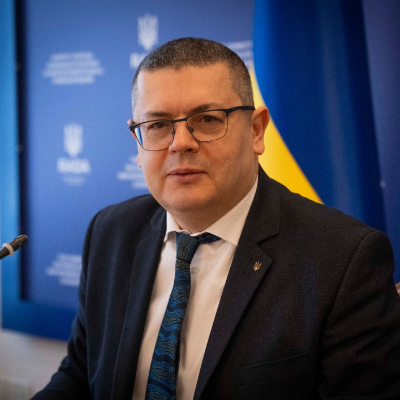
Greece, EPP/CD, President of the Assembly
10:03:32
The sitting is open.
Good morning, dear colleagues.
I remind members that they should insert their badge before taking the floor. As you begin your speech, please press the microphone button once only, wait a couple of seconds and then start talking.
I also remind the Assembly that members who have not submitted an annual declaration of interest are required to start any intervention with an oral declaration of interest under paragraph 20 of the Code of Conduct for Members of the Parliamentary Assembly.
The first item of business this morning is the free debate. I remind members that this debate is for topics not already on the Agenda, agreed by the Assembly. Speaking time will be limited to three minutes. Speakers should start by identifying the topic they wish to raise.
I call first on behalf of the Socialists, Democrats and Greens, Ms Petra BAYR. Petra, you have the floor.
Thank you very much, Theodoros.
I want to speak about Belarus, because I think that, because of all the wars and all the severe problems we face in our own member countries, we often tend to forget about other regions in Europe, which are also very important. And we all welcomed, of course, the release of 14 prisoners recently, among them Siarhei TIKHANOVSKY, which is, of course, very good and a very good example. But we should also be aware that since the release of these 14 prisoners, 20 more prisoners have been imprisoned. And there was also one US citizen, for instance, released, and another US citizen imprisoned at the same time. And most of them were only for issues that are not at all severe, like being outspoken on social media, for instance, criticising LUKASHENKO, or criticising the elections held in 2020 or criticising in any way the regime and such.
So, we see; we see it especially with US citizens. And I think the release was done mainly to have good publicity, good press. But the LUKASHENKO regime really uses political prisoners as a kind of international currency. And we must not accept it. We see that all the repressions are continuing. And that means that we really must put pressure on the regime, because it's obvious that dictatorships are not open to any negotiations. They do not understand the language of negotiations, unfortunately.
And so I call on the European Union to uphold sanctions and to also close all the possible ways to circumvent them. We see it, for instance, with Kali, which is used for fertilisers. They use shadow enterprises elsewhere – for instance, in Ukraine – to still bring their products to the European market. So it's important to close loopholes and to make sanctions work better.
I also want to mention that Belarus is really used, or misused, by the Russian Federation for this war of aggression in Ukraine. We know that most Belarusian people do not want this war, but they are nevertheless forced into it. And that's again something that is very much of concern.
Let me, at the end, get back to the political prisoners. There is now a humanitarian list that enshrines a little more than 20 people – a little bit more than 20 prisoners – who either have health issues or little children. And, as we know, on 3 July the Independence Day will be celebrated in Belarus. It's a habit for amnesty, also amnesty for prisoners. And so I call on all my colleagues to try to put pressure, individually, to release some prisoners. I will do so for Maria KALESNIKAVA; she is one of the most prominent prisoners. And she is now more than 500 days without any contact outside the prison.
So, please let us take action jointly.
Thank you very much.
Greece, EPP/CD, President of the Assembly
10:07:58
Thank you, Petra.
On behalf of the European Conservatives, Patriots and Affiliates, Mr Oleksii GONCHARENKO.
Oleksii, you have the floor.

Ukraine, ECPA, Spokesperson for the group
10:08:07
Thank you.
Dear president, dear colleagues,
I want to raise an issue today of several issues.
The first is about reports and their unfortunately unequal distribution between political groups. We took numbers and I can tell you that this year, if we take reports, 45% of rapporteurs are representatives of the Socialists, Democrats and Greens Group, 24% EPP, 22% ALDE, 4% European Conservatives, Patriots and Affiliates and 2% the Unified European Left.
We are an even bigger group, for example, than ALDE, but we are in more than five times less likely to have reports and have rapporteurs than our respected colleagues. I think we should watch this closely in committees and I think we need to have a fairer distribution between the political groups. It will improve the situation and maybe also it will improve their acceptance of reports because sometimes we see that this is quite hard for some groups. But if they will be more involved as rapporteurs, I think it will be better.
One more thing I want to raise, I want to thank the Parliamentary Assembly of the Council of Europe, our Assembly Secretariat, Parliamentary Assembly, became a partner for the Odesa Black Sea Security Forum, which happened for the second year this year in my native city, in Odesa. And it was a big success. And I want to thank PACE for being our partner. I want to thank Konrad-Adenauer-Stiftung, I want to thank Lord Michael ASHCROFT and his foundation. I want to thank the Hepatica Foundation in Sweden for working together and making this happen.
This was a very important forum. Next year it will continue and I hope more members of PACE will join. And this year we had quite a lot and I hope next year even more. And through these we are making a unique platform of cooperation in the Black Sea region, which is super important.
One more thing I want to raise is saying we are speaking a lot about Ukraine here this week. And thank you very much to all of you colleagues for this. Thank you from all my heart, щиро дякую in Ukrainian, thank you very much. And I want to tell you that we see it in Ukraine and also part of Ukrainian resilience is Ukrainian civil society. And part of this we are proud. And I am the founder and I run the biggest in-Ukraine network of educational cultural centres which are called Goncharenko Centres, with 41 centres throughout the whole country. And we are proud to be a drop in the ocean of Ukrainian volunteering and social entrepreneurship. Everything, education for free, culture for free. And I want to thank our partners, Cisco Networking Academy, University of Pennsylvania, GIZ and the German Government, Alliance Clubs International, the National Open University of Taiwan and Shih Chien University for their cooperation. And I hope we will have more partners and we will work together.
Thank you again, colleagues, to all of you.
Greece, EPP/CD, President of the Assembly
10:11:20
Thank you, Oleksii.
As far as the first part of your intervention is concerned, allow me to say that it was an issue that was discussed last night at the Presidential Committee. Your President, Mr Zsolt NÉMETH, raised the issue and we discussed it thoroughly. Although I asked my dear friend, Zsolt, I would like to have the elements of how many requests have been placed by your party, because you know that, and I'm going to make a joke recalling what Disraeli used to say about statistics, there are lies, damn lies and statistics.
The result is as you mentioned it, I don't doubt it, but it has, of course, to to be related with the request. If the requests were fulfilled 100%, then there's another result that one could take out of your specific points, which I don't doubt, as I said once again, but thank you so much.
And yes, it was a historic week this week that we had the pleasure and the honour to have in our Assembly, in our Hemicycle, President ZELENSKYY, and of course to have been witnessing the agreement between Ukraine and the Council of Europe for the ADOC International Tribunal for the Crime of Aggression.
I'm going now to the next colleague, who is Mr Richard BAKER. Richard, you have the floor.
Thank you, Mister President.
Dear colleagues,
It's a privilege for me to make my first speech here as a member of our Parliamentary assembly, which will be on the rights of people with intellectual disabilities. This assembly exists to promote the human rights of our citizens and nowhere is the need to guarantee these rights more urgently required than for people with learning disabilities.
Before I was elected to the UK Parliament, I worked with the charity Enable, which is the UK member of Inclusion Europe, who represent over 20 million people with intellectual disabilities and their families across our continent, including in Ukraine, where disabled people are particularly suffering because of the criminal actions of President PUTIN's regime. Across Europe, people with intellectual disabilities have fewer chances in education, in employment, and too often they are not provided with the support they need in their own community. In too many of our member states, our mental health laws mean that because someone has an intellectual disability or because they are autistic, they can be deprived of their liberty. In my role at Enable, I provided advocacy for the family of a young man with a learning disability who has been in a secure institution over 100 miles from his home for more than 15 years.
This is a human rights emergency happening right now here in Europe. I'm pleased that the UK government is introducing new mental health laws so that this will not be the case in future in England and Wales for people with intellectual disabilities. I'm a Member of Parliament for Fife in Scotland, so I hope the law will change in the Scottish Parliament too, and that parliaments across Europe will now introduce laws which protect the rights of people with intellectual disabilities, including in mental health settings.
I know that Inclusion Europe and other disability organisations have written to this Assembly to highlight their concerns over the proposed additional protocol to the Oviedo Convention on patients' rights in relation to coercive practises and mental health treatment. I hope these concerns will be considered carefully by this Assembly, Mister President.
There will be times when it will be required that someone receives mental health treatment in a secure setting, but that should never only be justified in law because they have an intellectual disability or because they are autistic. Now is the time for us to act so there is genuine inclusion in our society, always, for people with intellectual disabilities. They must always have the support which they need in their own home, in their own community, close to the people they love, because this is their human right.
Greece, EPP/CD, President of the Assembly
10:15:50
Thank you, Richard. I now call Ms Marianne BINDER-KELLER. Marianne.
Mr President,
Dear colleagues,
I would like to express my concern about the growing threat to democratic forces in Europe. The aim of the Council of Europe is to promote democracy and protect human rights and the rule of law in Europe. The Council of Europe was founded in response to one of the most terrible wars to have been waged in Europe by anti-freedom, autocratic, terrorist and racist forces.
The Second World War was preceded by a sustained propaganda campaign trumpeting the need to restore freedom of expression, as if dictators, autocrats and narcissists had anything to do with freedom of expression and pluralism. The Second World War was the result of ongoing propaganda that led to freedom being abolished in the name of freedom.
Just imagine that for a moment. In full consciousness, the continuosly brainwashed voters said yes to the real question: "Do you want to elect dictators who will allow you to vote for the very last time?". The whole thing led to the hell of the Second World War, the murder of 6 million Jewish people and millions upon millions of deaths worldwide. And we asked ourselves, how did freedom come to be abolished, how did we come to yearn for dictatorship, so to speak?
Dear colleagues, I cannot shake the impression that we are currently being given a real-life lesson now. It was a complete underestimation of what guarantees us freedom and self-determination - the rule of law. Why was it undermined back then? Because of indifference, laziness, ignorance of history, spoiledness, carelessness and stupidity. I don't want to paint a bleak picture, but the forces that are dismantling our liberal order are at work again. And when we talk about human rights, integration, solidarity and tolerance, let's not forget who guarantees these values: the rule of law and democracy.
And they are showing signs of disintegration in these demonstrations, in which anti-Semitism is becoming the common denominator of the various extremist movements of all political persuasions, and in some cases even terrorist organisations. You can see this with ISIS flags in our city centers, and Jewish people being threatened. We, however, are also seeing echoes of CHAMBERLAIN, those who call on Ukraine to make a kind of peace, to pacify the aggressor. As if the war of aggression against a free country had nothing to do with any other war of aggression.
I will conclude. You are familiar with Bertolt Brecht's March of the calves. I would like to quote the first lines: "Following the drum. The calves trot. The skin for the drum. They deliver themselves".
The Council of Europe bears responsibility for democracy and the rule of law. Let us protect it vigorously with our constitutions. Never again is today.
Greece, EPP/CD, President of the Assembly
10:19:31
Thank you, Marianne. Brecht is my favourite, I want to say. Especially Stories of Mr Keuner.
Mr José María SÁNCHEZ GARCÍA is next.
Thank you very much, Mister President.
I would like to make a few general remarks about immigration, not specifically in connection with the various resolutions that were debated this week, but perhaps some more general considerations. Now we regularly debate migration in this Assembly, but, in my view, we often overlook certain aspects that are relevant. Firstly, the European Left, the self-styled progressives, in our view, actually amount to a form of cultural regression, basically renouncing Western values. The progressive left seem to think there is some kind of universal right to migrate, with no limitations. The radical left say that economic migration should be completely deregulated.
But the current state of international law, and indeed the law in the European Union, as well as in the vast majority of Council of Europe member states and possibly even in all member states, is such that we guarantee the status of refugees and asylum seekers. That is the basis of migration. So what the Left is saying actually contradicts the current legal situation. They can, of course, call for legal reform. But I do not actually believe that there is general agreement on this.
Now according to the so-called progressive left, there is no such thing as illegal immigration. Whereas in actual fact it is not in compliance with the law. So they have this wish for a universal recognition of a right to migration. But I do not believe that that is borne of a yearning for justice. Rather, I believe that this goes hand-in-hand with Marxist ideology – internationalism. I don't know if those who defend the universal right to migration are aware of this. I really don't care one way or the other. This is part of the heritage of Marxist ideology that is present in this ideological debate in the 21st century. So the Left basically say that multiculturalism is a value in and of itself and that it is self-evident in their world view. However, it is a false axiom. You can either be in favour of or against multiculturalism, you can view it positively or negatively. But you have to respect both views and those that do not are attacking ideological freedom.
We take a negative view of multiculturalism because, unlike other countries, such as the United States and Canada, multiculturalism is not a characteristic of European nations. That is just a fact. Furthermore, unlimited multiculturalism may lead to the dissolution of European culture and ultimately contribute to the decline of Western civilisation.
And I don't have time to make the final comment that I would have liked to.
Thank you very much.
Greece, EPP/CD, President of the Assembly
10:23:52
Thank you.
Mr Oleksandr MEREZHKO is next.
Have you inserted your badge? Press the button once.
Now it works. Yeah.
Thank you, Mister President.
Dear friends,
I really like this format for our discussion because it gives us a chance to talk about really important issues within the framework of the activities of the Parliamentary Assembly of the Council of Europe, which were not covered during the week. I would like to raise an important issue. In my previous pre-political life, I was an international legal scholar, a professor of international law. And I still pay attention to international law and how it can be implemented.
This week was truly historic for not only the Council of Europe, but also for the development of international law. I mean, of course, the creation of the Special Tribunal for the Crime of Aggression against Ukraine. But there is always room for improvement. And I would like to pay attention to how the text of the statute can be improved. I mean, of course, Article 1, which is about jurisdiction of the Special Tribunal. According to this article, who is the subject of the crime of aggression and who should be tried, investigated by the Tribunal. Individuals, "persons" as it is said in the text of this article. But I firmly believe that if we truly want justice, for international justice and law to prevail, we need to bring to justice not only individuals, but also the state itself. The Russian State.
There is a term used in international legal discourse: "criminal state". And Russia is a criminal state. Because when we take the concept of the crime of aggression, we can vividly see that the subject of this crime is the state. Because what is the aggression about? It's about armed attack, aggression of one state against another. That's why it's extremely important to include in this Article 1 of the jurisdiction also "states".
I would also add here as another subject, another perpetrator for the crime of aggression, criminal organisations. The concept of criminal organisations was created by the Nuremberg Tribunal. It's also important. We cannot have justice unless we bring to justice Russia as a state. And it will not only have theoretical consequences, but also important practical consequences, because it would create legal grounds to punish Russia as a state. For example, to confiscate Russian sovereign assets in the territories of the European countries as a kind of punishment for the damage inflicted upon Ukraine, as reparations, as a form of international legal responsibility.
There is a whole concept firmly established in international law, the concept of international criminal responsibility of a state. We have all three theoretical scientific tools to do it.
Thank you, dear colleagues.
Greece, EPP/CD, President of the Assembly
10:27:26
Thank you so much, Oleksandr.
And now it's Ivan, Mr Ivan RAČAN.
Thank you.
Three days ago right here, President of Ukraine, Mr Volodymyr ZELENSKYY, and Secretary General of the Council of Europe Alain BERSET signed the statute for a Special Tribunal for the Crime of Aggression against Ukraine. It is the first court in modern history designed exclusively to judge the decision to wage an illegal war, closing the gap the International Criminal Court still has over aggression cases.
This signature comes after two years of Ukrainian diplomacy and a decisive stand by forty Council of Europe Member States. It sits alongside the Register of Damage created at the Reykjavik Summit in 2023 and the International Centre for the Prosecution of the Crime of Aggression at Eurojust – together forming a new architecture of accountability.
However, we must speak frankly about what this Tribunal is – and what it is not.
Regarding jurisdiction. It will focus narrowly on senior political and military leaders who planned or ordered the invasion, not on every atrocity on the ground; those crimes remain with the ICC and national courts.
Regarding enforcement. Like Nuremberg, its power ultimately relies on custody. If the accused never leave the territory of the aggressor state, trials may proceed in absentia or be delayed, but the warrants may never be fulfilled.
Regarding resources and reach. The court’s budget, staffing, and even venue still need to be secured; universal recognition is not automatic, and some partners remain to be convinced.
However, with all these constraints in mind, the value of this is profound. It signals that aggression is not an act of realpolitik to be forgotten in a settlement, but a crime. This is the main idea of this initiative. It preserves evidence now, deters repeat offenders tomorrow, and offers survivors the truth that law, not force, has the last word.
So let us remember this step we took but keep our eyes open. A tribunal cannot alone stop aggression, destruction and killing, but it can strip the invader of impunity and anchor any future peace in accountability. That, in itself, is no small accomplishment – and it is worth every effort we make today.
Greece, EPP/CD, President of the Assembly
10:30:11
Thank you, Ivan.
Ms Albana VOKSHI is next.
Dear President,
Dear colleagues,
What may seem like a domestic Albanian issue is, in fact, a European and transatlantic security threat.
Recent investigations by Radio France and German Die Zeit reveal what many Albanians already witness daily: Albania has become a central hub for laundering drug money, serving international trafficking networks whose operations extend into many EU countries. One of the biggest media in the US, Fox News, two days ago called the Albanian PM "Ramaduro".
There is a rising concern, not only for Albania. Criminal groups are no longer struggling to legitimise their profits. Albania solves that problem, offering an easy gateway to clean and recycle illicit wealth through construction projects worth billions.
But this is not just about corruption. It is about the full-scale capture of the Albanian state by criminal interests.
Construction permits are handed out not based on merit or market logic, but as political rewards, often to entities without even basic capital. In most cases, the real actors behind are criminal networks. The one who authorises the permit is the Prime Minister. If you come to Tirana, now, it's filled with skyscrapers, and many are under construction and many are given permits. Billions of euros every year in construction. But over 40% of them is empty. In Tirana, the square-metre price for an apartment is higher then in many EU countries. Three thousand, five thousand, even ten thousand now. I cannot afford these apartments. Albanians cannot. If a get a loan I need fifty to one hundred years to pay it back. So, who buys them?
What the EU once blocked as a formal fiscal amnesty, it seems that has now been silently implemented: a hidden pact between politics and organised crime. As Die Zeit wrote, two days ago, even international architects invited by the Prime Minister expressed concern over who will buy the towers, and if they are unintentionally legitimising money laundering.
Why do I raise this concern? This is not just destroying Albania’s economy, it's not about Albania, it is weakening our European financial integrity. Once laundered, these criminal funds re-enter the EU, distorting markets and undermining fair competition. It is a direct threat to the rule of law across the continent.
Meanwhile, Albania’s population is collapsing, and is ageing.
The government controlled by trafficking interests cannot ensure democracy or stability. It will produce confrontation, impunity, and regional destabilisation.
Therefore, I urge this Assembly, and the Council of Europe, to act without delay: investigate the origin of capital in Albania’s construction boom, examine political-criminal links, and support to raise awareness in the fight against organised crime.
The longer we stay silent, the more damage will be done, not just to Albania, but to the values we claim to defend across Europe and the transatlantic community.
Thank you.
Greece, EPP/CD, President of the Assembly
10:33:23
Thank you, Albana.
And now it is Hripsime GRIGORYAN.
Thank you, President.
I wil be talking about the peace process in the South Caucasus.
Armenia and Azerbaijan are on a verge of a historic breakthrough. After three years of intense negotiations, Armenia and Azerbaijan finalised a draft agreement in March, creating the opportunity to end conflict and establish relations based on mutual recognition of territorial integrity.
Azerbaijan, regretfully, introduces new preconditions, one concerning dissolution of the OSCE Minsk Group, and the other concerning Armenia’s Constitution, allegedly containing territorial claims against Azerbaijan.
Regarding the OSCE Minsk Group, Armenia shares the approach that after the conflict is resolved, those mechanisms are no longer necessary and proposes to sign both the peace treaty and the dissolution of the Minsk Group bodies, so that by closing the page on the conflict, we can open a page of peace.
Per the Constitution, again, the shortest way to address Azerbaijan’s concern, given that it is an honest concern, is to sign the treaty because during the ratification process the Constitutional Court of Armenia, the only legitimate body to interpret Armenia’s Constitution, will address the issue. And given that last year another document, the statute of Armenia’s and Azerbaijan’s delimitation committees has been ratified and the Constitutional Court has decided that the document, stating that the two countries' mutual recognition of territorial integrity is in line with Armenia’s Constitution, we can certainly say that this concern of Azerbaijan will be easily addressed.
Armenia emphasises that unblocking regional transport links while respecting sovereignty, equality, and reciprocity, which is the essence of the "Crossroads of Peace" project proposed by Armenia’s government , will unlock the South Caucasus' economic potential, fostering prosperity, stability, and lasting peace. This initiative could become a vital platform for regional co-operation and confidence-building.
Therefore, esteemed colleagues, our message to Azerbaijan is clear: for the eternity of our sovereignty and the well-being of our peoples, now is the time to forge institutional peace. This will enhance regional stability amidst current uncertainties, fostering peace well beyond neighbouring regions and globally. And your role, dear colleagues, is essential in continuing to keep in focus and support the finalisation of institutional peace.
And I thank you.
Greece, EPP/CD, President of the Assembly
10:36:03
Thank you, Hripsime.
It is Roland Rino BÜCHEL now.
Dear President,
Ladies and gentlemen,
I would like to say a few words about the relationship between the Council of Europe and the EU.
The last week and even more so the last few months have prompted me to reflect on the Council of Europe, in particular the Parliamentary Assembly of the Council of Europe.
We actually agree that the Council of Europe should be an umbrella for human rights, democracy and the rule of law for the citizens of all 46 member states. Unfortunately, this sense of identity has become increasingly distorted in recent times.
I have been a member of this Council since 2016. In these nine years, my impression has grown that the Council of Europe has moved too close to the European Union, both politically and institutionally. That is problematic. More and more often, I ask myself, where is our pride, our pride as independent members of parliament?
Almost half of the member states of the Council of Europe, 19 out of 46, as you know, are not part of the EU. Nevertheless, not only political narratives, but also the setting of priorities and ultimately decisions in the committees and here in this Plenary are increasingly dominated by the perspective and interests of the EU.
Our Parliamentary Assembly is increasingly losing its real strength. All too often, the majority of members of this Council feel almost obliged to take on EU-centric political agendas. We should once again become a supranational, broad forum – a forum that is open to different ways of thinking and seeing things. If we increasingly move along a one-way street, we weaken our institution.
Let us once again accept that the Council of Europe is an independent space for co-operation between states with different political, economic and cultural backgrounds.
We need a fair balance. Only in this way can we gain and retain the trust of the people in our member states. This Assembly needs more independence again. So, in conclusion, let us listen more to the voices of the citizens in our member states and a little less to the voices of the bureaucrats in Brussels.
Thank you very much.
Greece, EPP/CD, President of the Assembly
10:38:54
Thank you.
Dear Roland Rino, in my opinion we should be complementary, the two bodies, and we can work on that. I believe that this year that we celebrate the 75th anniversary of our Convention on Human Rights, it is a good start to work with our colleagues from the European Parliament. We should never forget, and I agree with most of what you have said, that this is the only body working for democracy only. Of course, all institutions are devoted to democracy, but we are here to talk and to support democracy, human rights and the rule of law as the only institution globally. So thank you for your views on that very important, in my opinion, issue.
Ms Naomi CACHIA is next.
Mr President, I wanted to take this opportunity to close off what has been an incredible and very significant week here in Strasbourg, especially for the Maltese delegation.
We are so proud of how it has all unfolded. We are a small team from a small country with big ambitions, and it was always our intention to make the Maltese presidency an impactful one.
But I also wanted to look ahead. And once we return home, we will immediately set forth with a ministerial conference on the protection of children from sexual violence. Having to put children and sexual violence in the same sentence is a reminder of how evil this world can be and a reminder of the responsibility that we have to enact powerful instruments for the protection of our children. And while over the past 15 years significant progress has been made in this regard, it is important to recognise that violence against children, be it physical, emotional or sexual, continues to be alarmingly present in our societies.
Abuse happens in-often familiar places or what are supposed to be safe places, at home or in schools. And what is truly heartbreaking to see is that the digital transformation is contributing or compounding the reach of sexual exploitation and abuse, creating a situation where sharing, disseminating and spreading abusive material online can happen with just one click. And so, symbolically, next Tuesday, the 1st of July, the exact date of the Lanzarote Convention's entry into force, we will have this informal Conference of Ministers for Children's Rights.
We want to reaffirm our collective commitment and drive forward a stronger, coordinated response to addressing and preventing sexual exploitation and the sexual abuse of children. We need to continue to teach children how to report abuse, professionals need to be trained and more able to recognise the signs of abuse and give an appropriate and timely response. And finally, we must truly ensure that children are not just passive recipients of policy, but prioritised stakeholders in shaping a fairer, safer and sustainable future for them. And not just that, we really need to actively listen to our children and young people. That is the only way in which we as parliamentarians, safeguard our younger generations and leave behind a world in which every child is safe, heard, free from abuse and able to follow their dreams.
Thank you.
Greece, EPP/CD, President of the Assembly
10:42:22
Thank you, Naomi.
And now it is Vinzenz GLASER.
Thank you very much, Mister President,
Ladies and gentlemen,
I will begin with some disturbing news from Hungary. The Hungarian government under Viktor ORBÁN is threatening demonstrators with fines, and organisers and people calling for participation in the Pride parade in Budapest with prison sentences of up to one year.
This threat once again demonstrates the authoritarian tendencies in Hungary. The government is disregarding democratic values and is taking unscrupulous action against freedom of assembly and critical voices. We must not allow this to continue. We should not leave it like this, and we should stand up against it.
But today I would like to draw attention to another, particularly alarming case, that of Maja T.. Maja T. is an anti-fascist activist with German citizenship, and Maja is being held in pre-trial detention in Hungary under extreme conditions. Maja was unlawfully extradited to Hungary exactly one year ago, on the night of 27 to 28 June 2024. It was illegal because the conditions of detention, especially with regard to Maja's non-binary identity, were not sufficiently examined. The German Federal Constitutional Court has since declared the extradition unlawful, which is why I would like to, and indeed must, clearly criticise the German authorities and the political leaders, because I see it as my responsibility as a parliamentarian and as a member of the Parliamentary Assembly of the Council of Europe. Maja T. is therefore in solitary confinement. They have hardly any social contact and suffer from inadequate hygienic conditions. The cell has no window, Maja is monitored every hour, and Maja also complains of severe headaches, tiredness and exhaustion. These are inhumane prison conditions designed to systematically break Maja. Maja went on a hunger strike 22 days ago to protest against these conditions and the lengthy trial. Maja's father describes their solitary confinement as psychological torture.
The case of Ilaria SALIS, an Italian teacher who was imprisoned under similar conditions, shows that these practices are not unique in Hungary. I, therefore, call for an end to solitary confinement and the guarantee of humane detention conditions, as well as a transparent procedure that meets international standards and the immediate return of Maja T. to Germany.
We must not allow a member state to continue to trample on the rule of law and human rights. It is our responsibility to stand up for human rights here in this Assembly. I, therefore, call on everyone to sign the written declaration on the detention conditions of Maja T. You can find it in the Parliamentary Assembly and the Council of Europe app. And please let us send a clear signal for human rights, the rule of law and against the increasing authoritarian tendencies in Europe.
Thank you very much.
Greece, EPP/CD, President of the Assembly
10:45:49
Thank you, Vinzenz, for bringing under the light of this assembly this very important issue.
Pierre-Alain I would like to ask you, and whether the colleagues will agree, to be the last speaker today. Pierre-Alain is participating for the last time in this assembly. So I think that we will honour him by being the last speaker.
So I'll ask Emmanuel FERNANDES to take the floor now.
Have you entered your badge?
Thank you, Mr President.
Dear colleagues,
On this last morning of our week together, I would like to sound the alarm on the grave threat hanging over our continent, resulting in the trampling of fundamental rights, the endangerment of the rule of law, and the weakening of democracy.
These attacks are the work of the extreme right, which is advancing across Europe with a clear strategy of undermining checks and balances, curtailing freedoms and governing through fear. Viktor ORBÁN's Hungary is the most obvious example. Since 2010, the rule of law has been methodically weakened. The judiciary has been placed under subjugation, the media muzzled, NGOs obstructed and the Constitution amended. The Hungarian regime has made minorities a central target, in particular women and LGBTI people, who are increasingly stigmatised and invisible. Marriage and adoption for all are banned; pro-LGBTI content is censored. This year, a new milestone was reached. Budapest Pride has been banned. This is not an administrative decision, it's obviously a political one, a message of hatred sent to an entire community.
Let's make no mistake about it. Viktor ORBÁN's durability makes him the driving force behind Europe's far right. His reactionary ideology inspires and inhibits parties like France's Rassemblement National, with whom he publicly exchanges authoritarian strategies and retrograde practices. At the beginning of June, a rancid line-up of Europe's most toxic politicians, heirs to fascism and would-be dictators, gathered in France for a boot-slapping contest. But we're not impressed.
As the guarantors of respect for human rights, democracy and the rule of law, we are and always will stand up to this fascist threat. From Hungary, the anti-LGBTI offensive is spreading across Europe, fuelled by hate speech, discriminatory legislation and co-ordinated attacks. A veritable common front against fundamental rights is taking shape. In the face of this reactionary offensive, the Council of Europe cannot remain silent. We will not let our values become empty slogans. We will not let Hungarian citizens down. We will continue to defend the rights of LGBTI people throughout Europe, in this hemicycle, in our respective parliaments, but we will also do so in the streets. And my colleagues Ms Manon AUBRY, Ms Emma FOURREAU and other MEPs will be present at the forbidden Pride in Budapest on Saturday June 28, to stand shoulder to shoulder with those who are fighting and resisting against the foul beast, to show our solidarity and to remind us that these struggles are also our own.
More than ever, we must stand firm, we will stand firm and we will push back the reactionary and authoritarian wave to realise the humanist and universal project corresponding to the fundamental values of the Council of Europe, despite the revisionists and agitators in the seats before me, who believe they can destroy what our predecessors built for the common good.
Thank you very much.
Greece, EPP/CD, President of the Assembly
10:49:49
Thank you, Emmanuel. And now, dear colleagues, I will give the floor as the last speaker of this sitting and of this third-part sessions to our colleague from Switzerland, Mr Pierre-Alain FRIDEZ, who is honouring you by his presence and his work in this Assembly for 10 years. Pierre-Alain, you have the floor.
Thank you, Mister Chairman,
Dear colleagues,
I joined the Council of Europe in January 2016. That was almost 10 years ago, an honour for me. I was entering the temple of democracy, the rule of law and respect for human rights.
I was going to take part, however modestly, in building a fairer world and a more united Europe. In 2015, we had the Syrian migration crisis, and a million refugees had just been accepted by Angela MERKEL in Germany.
I thought the time had come for an open and charitable Europe. I really believed in that. I was hopeful. During these 10 years, I have been fully involved in the work of the Committee on Migration, Refugees and Displaced Persons, and I have travelled all over Europe and beyond. And I've seen it all. Refugee camps in Jordan, Greece, Lesbos, Tenerife, Bosnia and Herzegovina.
As general rapporteur against the detention of migrant children, I saw places full of humanity and hope in Greece. And among the young people present, I saw a 13-year-old Congolese refugee, seven months pregnant after being raped crossing the Mediterranean. I saw children detained behind bars and barbed wire in Hungary. I've walked through the Lande of Calais, the absolute horror. I went to the border between Belarus and Poland and met a Kurdish family of four children, whose mother had just died following a miscarriage in the freezing cold of a Polish forest, a victim of both the hybrid war waged by dictator Alexander LUKASHENKO and the intransigence of border guards.
When I was preparing a report on co-operation and development, a response to migration, I visited Burkina Faso in Africa, and felt hope in the determination of many of its inhabitants to lift their country up and create the conditions for an economic take-off that would offer the younger generations a future there, rather than dying in the Mediterranean. I believed in it so much that I contributed financially to the purchase of a collective tractor for the farmers of a local co-operative. I believed in it, but the recent troubles in the Sahel seem to have dashed those hopes. I was also well aware of the threats posed by climate change to the migration issue.
As part of the Committee on Social Affairs, Health and Sustainable Development, I was confronted through reports with extreme poverty and illtreatment of children, and child abuse in public and religious institutions, with a particularly striking visit to one of the death orphanages on the outskirts of Bucharest, of sinister memory from the time of Nicolae CEAUŞESCU.
I've seen a lot and become a little disillusioned, and the Russian Federation's aggression against Ukraine has only made my feelings worse. At a time when crucial decisions on climate issues and social inequalities are needed, the geostrategic situation is driving massive arms purchases.
A world that's closing in on itself instead of opening up avenues for a better world. And I've also noticed for some time that the chill of intolerance and exclusion has been gradually spreading to some of the benches of this hemicycle. The ECHR is being challenged, and centrifugal tendencies are gaining ground. Contested, certain delegations are withdrawing. But until when? How far will they go?
Dear colleagues, dear friends, and for some, dear comrades, after 10 years and 13 reports later, today I deliver my last speech before this noble chamber. My heart is a little heavy, but I'm leaving people I love, sincere friends, sincere friendships, and passionate struggles.
I entrust you with the heavy responsibility of meeting the enormous challenges that lie ahead. I know that you will unite all forces of goodwill to fend off the headwinds that threaten our institution and the ECHR. Because, like me, you still believe in a Europe that is open to the world, respectful of the rights of the weakest and imbued with feelings of justice and solidarity.
Thank you for your support.
Greece, EPP/CD, President of the Assembly
10:54:41
Dear Pierre-Alain, after our meeting yesterday in the afternoon in my office, I wrote a farewell message to you, which I'm going to read now.
It is not often that you meet a colleague from a different political group and immediately feel a bond of shared purpose. But that is exactly what happened with you. Despite coming from different political families, we worked side by side for years in the Committee on Migration, Refugees and Displaced Persons, united by a common compass: human dignity. As a doctor, you brought empathy. As a parliamentarian, you brought reason. And as a humanist, you brought heart. I learned a great deal from you and your calm persistence and your deep sense of justice. You departure leaves a quiet but undeniable void. I will miss your voice, always thoughtful, always measured, always driven by compassion rather than ideology.
Thank you, dear Pierre-Alain, for your friendship, your example and your unwavering dedication to the people who needed it most. I wish you joy and peace in the new paths ahead.
Greece, EPP/CD, President of the Assembly
10:56:08
Dear colleagues,
The debate is closed and I have to say that I am really happy that more and more participants are in our Friday free debate.
The next item on today's agenda is the continuation on the debate on the Progress report of the Bureau and the Standing Committee, Document 16198 and Addendum 3.
The Bureau has proposed several references to Committees. These references must be submitted for ratification by the Assembly in accordance with Rule 26.3. Any objections successfully raised means those references will be referred back to the Bureau.
Are there any objections?
No.
I now propose that the other decisions in the Progress Report be ratified. Any objections?
No objections.
We have now come to the end of our business. I would like to thank all members of the Assembly, particularly the rapporteurs and chairs of committees for their hard work during this part session.
I would like to thank the Vice-Presidents who chaired during the part-session: Ms Bernadeta COMA, Lord Don TOUHIG, Mr Bertrand BOUYX, Mr Nicos TORNARITIS, Mr Marko PAVIĆ, Ms Miapetra KUMPULA-NATRI and Mr Andries GRYFFROY.
I would also like to thank the staff, technical personnel and interpreters, both permanent and temporary, who have worked hard to make the part-session a success. The fourth part-session of the 2025 session will be held from 29 September to 3 October 2025.
I declare the third part of the 2025 session of the Parliamentary Assembly of the Council of Europe closed.
The sitting is closed.
Have nice summer holidays.