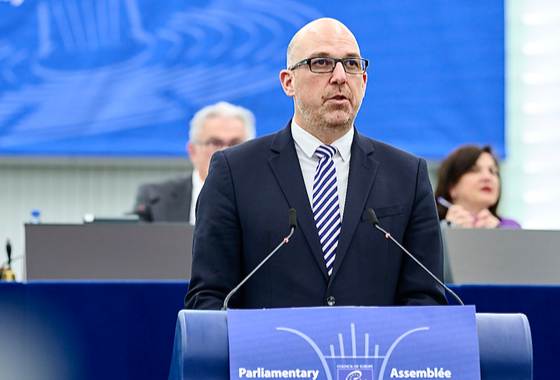
Greece, EPP/CD, President of the Assembly
14:40:05
Dear colleagues, good afternoon.
The sitting is open.
This afternoon the Agenda calls for the second round of the election of a Council of Europe Commissioner for Human Rights and a judge to the European Court of Human Rights in respect of Bulgaria. In the second round a relative majority applies. In the event of a tie, there will be a third round of voting and, if necessary, further rounds until a decision is reached.
The list of candidates and biographical notices for the election of the Council of Europe Commissioner for Human Rights are to be found in Document 15870 and an opinion from the Sub-Committee on Human Rights of the Committee on Legal Affairs and Human Rights in Document 15885 Addendum 2.
The list of candidates and biographical notices for the election of a judge to the European Court of Human Rights in respect of Bulgaria can be found in Documents 15867 rev, and an opinion from the Committee on the Election of Judges to the European Court of Human Rights in Document 15885 Addendum 3.
The voting will take place in the foyer in front of the hemicycle.
The votes will be open from 2:30 p.m. to 6:00 p.m.
Each political group has appointed a teller according to the rules. The tellers are:
SOC: Ms Marietta KARAMANLI
EPP/CD: Mr Sergiy VLASENKO
EC/DA: Mr Kamal JAFAROV
ALDE: Ms FRESKO-ROLFO
UEL: Ms Laura CASTEL
I would like to remind them that they will have to be in the room set aside for this purpose at 6:00 p.m. The result of the votes will be announced, if possible, before the close of today’s sitting.
I now declare the ballot open, and we continue our work in the meantime.
We have a point of order.
Yes, please.
Thank you, Mister President.
For the records, I would like to make an amendment to my voting of yesterday's debate on recent developments in the Middle East.
For the records, my intention was to reject this resolution. However, I accidentally pushed the green button during the voting of the resolution.
Thank you.
Greece, EPP/CD, President of the Assembly
14:42:24
Thank you.
We will now hear an address by Mr Daniel RISCH, Prime Minister of Liechtenstein.
After his address, the Prime Minister will take questions from the floor.
Dear colleagues,
On our agenda this afternoon I have told you that we have the honour and pleasure of welcoming the Prime Minister of Liechtenstein, Mr Daniel RISCH.
After his intervention, Mr RISCH has kindly accepted to reply to questions from the members.
Mister Prime Minister, we are particularly happy to have you among us today at a period where your country is so successfully chairing the Committee of Ministers, guided by the motto "United by our values, towards a better future for the needs of all".
I would also like to greet the Minister of Foreign Affairs, Education, and Sport of Liechtenstein and President of the Committee of Ministers, Ms Dominique HASLER, who is present with us today. I look forward to her communication tomorrow morning.
Among the priorities chosen by your presidency are the protection and promotion of human rights, democracy, and the rule of law, strengthening the European Court of Human Rights, and providing support for Ukraine.
There is also the implementation of the decisions taken at the Fourth Summit of Heads of State and Government of the Council of Europe: how to end the war of aggression and deliver justice in Ukraine, how to oblige us all to the Reykjavík principles of democracy, how to make the Istanbul Convention really the gold standard in protecting the rights and lives of women and girls, and how to deliver on environmental human rights.
Much is on our plate, as your country is at the helm of the Council of Europe, coinciding also with the 75th anniversary of its creation.
I now have the honour to give you the floor, Mister Prime Minister.
Dear President of the Parliamentary Assembly,
Dear Secretary General of the Parliamentary Assembly,
Dear Secretary General of the Council of Europe,
Dear members of the Parliamentary Assembly,
Excellencies,
Dear guests,
"Many small people, in many small places, doing many small things can change the world."
This African proverb means a lot to me. Aren't we all small or little in a sense? All of us are merely individuals living and acting in small places. Strasbourg, like most places in the world, is a small place, too, if you look at it individually. Only if in many small places many people do many things, a great movement can and will happen.
Just recently, I attended a church service, and a priest talked about scientific findings outlining that this planet, Mother Earth, has been inhabited by 107 billion human beings up to the present day. Currently, as we all know, there are around 8 billion people on this planet, 640 million of them living in the countries we represent in Europe. Indeed, 107 billion is truly an impressive number. However, it is a historic number, indicative of the past, the generations before us.
Shouldn't we focus on the generations to come? The hopefully infinite number of people living on this planet after us. I believe, no, I am convinced, that our desire to shape the world or at least Europe with our decisions for future generations is the reason why all of us, all of you, decided to pursue a career and politics.
When talking about the past and the future, I would like to add an additional aspect to the African proverb I mentioned at the very beginning of my remarks. The phrase "do many small things" includes a particularly significant element, the verb "do". Significant because we can only do things right now. We might be able to plan or aim to do things in the future but we are only actually able to take action in the present. Equally, we are not able to change what we did or did not do in the past, even if we may regret our decisions and now need to bear to consequences. So, all we have is now.
I myself decided to give a speech that matters to me here in this room today and that is what I am doing right now. All of you in this room, are free to decide on what you want to do in this very moment as well. You could interrupt me by yelling, "Yes, you're right" or even, "Please stop, I think you're wrong" or you can, what I personally would appreciate most, listen and connect with what I say. The decision is all yours.
Having said this, let me continue with a small place I call home. Some of you have already had the opportunity to visit Liechtenstein when the Standing Committee of the Parliamentary Assembly met in our capital Vaduz last November. I hope that the rest of you will get the chance as well. It definitely is a place where many people do many things. A place where we feel as proud Europeans, too, and a place where we know that only if we interact, work together and engage, we can be successful.
This also brings me to our current Presidency of the Committee of Ministers and the term "multilateralism". Over the last few years, headlines repeatedly proclaimed that multilateralism is dead. Some journalists and scholars put a question mark at the end of the sentence, which is a little more encouraging, I find, but the sombre spirit remains the same. Liechtenstein very much relies on the effective functioning of the international rules-based order. Multilateralism is one of our lifelines. Statements like these, therefore, worry me, particularly in my role as the Prime Minister of Liechtenstein. With a surface area of 160 square kilometres and a population of 40 000 citizens, Liechtenstein can be considered to be a small place – but a great one at the same time. Let me emphasise that geographical size is not indicative of the impact a state can have, particularly in multilateral fora.
Liechtenstein has proven this time and again, be it at the Council of Europe, the United Nations or the European Economic Area. The multilateral system faces multiple threats. The core values of the Council of Europe, human rights, democracy and the rule of law, are increasingly challenged. The present seems to be characterised by aggressive power politics, anti-democratic tendencies, growing nationalism and disregard of the rule of law and the rules-based international order.
Tragically, we have seen what can happen when these threats escalate. The Russian aggression against Ukraine serves as a painful example for the culmination of the mentioned elements. Particularly in times like these, the Council of Europe and its core principles prove not only important but urgently necessary. Let me reiterate Liechtenstein's continued solidarity with Ukraine and its people. After almost two years of war, it is unimaginable what the people of Ukraine have had to endure in their places. We honour their unbreakable spirit.
In these current times, we are reminded that multilateral organisations, such as the Council of Europe, play a critical role in promoting peace and stability. Aggressive power politics must not prevail. Those challenging our common commitments must be held accountable. With the establishment of the register of damage, the Council of Europe has taken a critical first step towards ensuring accountability for Russian aggression. On the way forward, it remains of critical importance that the crime of aggression be investigated and prosecuted and that all those responsible be held to account. There will be no peace without justice. Initiatives like these underline the importance of multilateral co-operation once again. As member states of the Council of Europe, we all are connected through our common commitment to multilateralism and the principles of human rights, democracy and the rule of law. As member states, it is our shared obligation to do our utmost to safeguard those principles.
It is important to mention that we do this not only for our benefit in this room but for the people in our countries, the people we represent. This is, of course, also the case with our memberships in other multilateral organisations. In the United Nations Liechtenstein has repeatedly proven that even a geographically small country can make a difference.
In 2022, Liechtenstein championed the so-called veto initiative. The use of the veto in the United Nations Security Council has increased significantly over the past years with far-reaching consequences on the work and effectiveness of the United Nations. The broader UN membership in the General Assembly has a legitimate interest and a political responsibility to address situations in which the use of the veto leads to paralyses in the decision making of the Security Council that carries out its function on their behalf. With the veto initiative, Liechtenstein thought to strengthen inclusive multilateralism and to provide a mechanism to ensure accountability between the organs of the United Nations. With this initiative, the General Assembly mandates a formal meeting every time a veto is cast in the Security Council allowing for the broader UN membership to express its views. The veto is not the last word anymore but the starting point of a broad discussion. We are proud that the resolution establishing the veto initiative was ultimately adopted by consensus, sending an important message in support of multilateralism. By enhancing the role of the General Assembly the veto initiative took an important step towards strengthening inclusive multilateralism and the international rule of law.
In Liechtenstein, we tend to take such a pragmatic approach in other areas as well. We are doers, not talkers, and as such, we prefer to implement standards before we adorn ourselves with labels that entail the ratification of conventions, for example. In Liechtenstein, we are pragmatists not only because this is the mindset that has proven successful in the past but also because we have to. Being a small place, a very active one, I may emphasise, translates to limited resources and a lean state administration. We maintain efficient processes and put tailored and pragmatic solutions at the centre of our policymaking. I, therefore, often speak of an entrepreneurial way of running the state. Liechtenstein has always considered itself quintessentially multilateral. The world does not stop at our borders: only together can we effectively address the challenges ahead.
The Council of Europe and the United Nations are not the only organisations or collaborations we are part of or engage on a daily basis. The customs treaty we share with Switzerland is an excellent example of this. For more than 100 years, Liechtenstein has been part of the Swiss customs area. The customs treaty has created a strong foundation for relations between Liechtenstein and Switzerland, which today, affects many areas of life. Through its membership in the European Economic Area, Liechtenstein is also integrated in the European single market, the world's largest internal market encompassing 30 states and around half a billion people. This has proven immensely important not only for Liechtenstein's economy but also for the overall prosperity and security of our country. For 30 years now, the European Economic Area ensures a level playing field through the application of homogeneous rules and accompanying policies in the areas of competition, environment, climate action, and social policy. It also facilitates Liechtenstein's co-operation with our EEA partners Iceland, Norway and the European Union in the field of research, technological development, environment, culture, education, health, and civil protection.
Well before joining the European Economic Area, however, Liechtenstein became a member of the Council of Europe. Last year, we celebrated the 45th anniversary of our membership. What a fitting time for us to take over the Presidency of the Committee of Ministers! We took over the Presidency last November. Tomorrow, Liechtenstein's Minister of Foreign Affairs, Education and Sports, and my dear colleague, Ms Dominique Hasler, will address you in her role as President of the Committee of Ministers. She will further elaborate on how Liechtenstein, also in this role, continues to take a principled position in support of multilateral co-operation and the core principles of the Council of Europe.
Liechtenstein's membership in the Council of Europe has helped to further secure our sovereignty and to extend our international recognition as an independent state. Without membership, we receive a seat at the table in this European community of values. It offered us the opportunity to actively contribute both to the development of new European standards and to the protection of human rights, democracy and the rule of law in all of Europe. A responsibility we take very seriously. It also allowed us to grow and progress with our common standards.
Since the Ministry of Finance is part of my responsibilities as a Prime Minister, let me highlight just one area in a particular: fighting money laundering and terrorism financing. For a number of years now, Liechtenstein has placed particular significance on the fight against money laundering and terrorist financing, and in doing so follows the international standards of the Financial Action Task Force (FATF). The government, the authorities, and the financial market participants are aware of their respective central roles in the effective fighting against money laundering and terrorist financing, not least due to our membership in the Council of Europe and in MONEYVAL. The determined adoption and implementation of international standards is an important part of this. Liechtenstein's approach is based not only on the implementation of international requirements but primarily on the certainty that the effective fight against abuse is a competitive advantage for the financial centre, in addition to the quality of services and the general conditions. MONEYVAL's latest assessment confirmed Liechtenstein's targeted measures and high overall compliance. As a consequence, Liechtenstein is considered to be eligible for the regular follow-up process, becoming one of only five member jurisdictions with this outcome so far. MONEYVAL recognises the progress made by Liechtenstein to combat money laundering and terrorist financing. The report makes it very clear that decisions taken in the past were the right ones. We will, of course, continue to consistently pursue this path.
Multilateralism and implementing the standards we set together, therefore, not only serve the so-called greater good but ultimately also benefit us. Without planned membership in the International Monetary Fund (IMF) later this year, Liechtenstein again strives for more multilateralism, not less, both for the benefit of others and ourselves. Of course, multilateralism is not always easy and certainly not always pleasant. Ultimately, however, it benefits us all, and we need to emphasise this aspect today more than ever. Implementing standards that we set together as a European or an international community through multilateral fora leads to progress and stability. History has proven this time and time again.
I had the opportunity to attend the 4th Summit of Heads of state and Government of the Council of Europe in Reykjavík in May last year. We stood together against Russia's aggressive power politics and we sent an important and powerful signal in support of multilateralism. We recommitted to the Council of Europe and its core principles. Now it is up to us to work together to ensure that these become not just empty words.
The European Court of Human Rights is a critical ally in this endeavour. As such, it acts as the principal safeguard to protect our values and to guarantee that Europe remains a continent of democratic societies, guided by the rule of law. As member states, we have the obligation to ensure the full, effective and prompt execution of all judgments of the Court and to respect its case law. Contrary actions undermine the authority and functioning of the convention system and they pose a dangerous threat to our rules-based order. Let us not go down this path.
Before I conclude, I would like to once again come back to the proverb I mentioned at the beginning of my speech. "Many small people, in many small places, doing many small things can change the world." I tried to give you an insight into how we, in our small place, do many things for our people but also to make Europe and the world a better place.
But we cannot do this alone. This is the reason we are here today, at the United Nations tomorrow, and in Brussels just next week. Multilateralism is not dead, not even with a question mark. It does, however, certainly face multiple threats and challenges in the current times. The good news is that it is in our hands to reverse them and to take a different path. Collectively, we must do our utmost to preserve multilateralism. It is up to us, so let us make the most out of our now.
Thank you.
Greece, EPP/CD, President of the Assembly
15:04:51
Prime Minister, thank you for your most interesting speech.
I would like to inform you now that the members of the Assembly have questions for you.
We will first hear the questions from the speakers on behalf of the political groups and then hear the response of Prime Minister Daniel RISCH on those questions.
Please, will the speakers limit their interventions to 30 seconds.
I would like to remind the colleagues that they should ask questions and not make speeches.
First on behalf of the Socialists, Democrats and Greens Group is Ms Lise CHRISTOFFERSEN.

Norway, SOC, Spokesperson for the group
15:05:29
Thank you, Mr President.
Mr Prime Minister,
The application for membership in the Council of Europe of Kosovo is important, especially for the people of Kosovo, who should also benefit from all that the Council of Europe can offer on human rights, democracy, and rule of law.
If the opinion of our Assembly is adopted in April, will the government of Liechtenstein facilitate so that the issue of membership can be on the agenda at the ministerial meeting in May?
Thank you.
Greece, EPP/CD, President of the Assembly
15:06:06
Prime Minister, you have the floor.
Thank you. As I said we are pragmatists in Liechtenstein.
Thank you for your question on the accession of, or the application of Kosovo.
As you all know, an official application for the membership was received in May 2022, and now we're moving on in this topic.
We know there are different views on the entering of Kosovo to the Council of Europe. We already made our national point and we are very clear on that. But we think it needs a well prepared and good decision by all of you to move forward. We will do our part in the presidency and bring it in when it's ready.
Thank you.
Greece, EPP/CD, President of the Assembly
15:07:32
Ms Andrea EDER-GITSCHTHALER from the Group of the European People's Party.
It looks like we have a problem today. Please, press the button for the microphone or change microphone.

Austria, EPP/CD, Spokesperson for the group
15:07:53
Dear Mr President,
Dear Prime Minister,
I also come from a small country, as you pointed out, in Europe, your neighbouring country. We maintain good neighbourly relations and multilateralism with each other. You have taken the human rights project seriously and implemented it in Liechtenstein in order to better realise the fundamental values of the Council of Europe in Liechtenstein.
What specific measures and priorities are you setting to implement the strengthening and promotion of human rights in Liechtenstein, but also in Europe?
What is the current status of the frozen Russian assets in Liechtenstein?
You also mentioned the fight against money laundering. What is the current process there?
Greece, EPP/CD, President of the Assembly
15:08:48
Prime Minister, would you like to respond?
Thank you for your question. I will answer in German.
Thank you for this question from a neighbouring country.
When it comes to human rights in Liechtenstein, we naturally keep an eye on where we can do even better. It is perhaps important to mention that we have adopted 90 conventions. All the rulings, including those from the Court, have been implemented, so we are making good progress in this area.
Of course, we also always have an open exchange with civil society on where we can improve; for example, we have just taken another big step forward in the area of rights for people with disabilities. I think Liechtenstein is always doing very well here, I would say. However, I would not go so far as to say that we are exemplary everywhere, because I believe that there is always room for improvement. And that's what we do, it's very important to us.
With regard to the frozen assets in Liechtenstein, the fact is that Liechtenstein has implemented all European sanctions autonomously from the very beginning. Of course, we have also frozen assets, some of which are still frozen - which is also an issue in this room, whether we can confiscate them and continue to use them. In our view, there are major legal hurdles that are being discussed in various countries. In our country too. And we are of course open to discussion and we are willing to move forward on these particular issues.
Greece, EPP/CD, President of the Assembly
15:10:26
Ms Eka SEPASHVILI from the European Conservatives Group.

Georgia, EC/DA, Spokesperson for the group
15:10:36
Dear Prime Minister,
You have mentioned in your speech that peace and security are one of the issues where the Council of Europe plays its prominent role and is important in promoting these issues.
At the same time, the Liechtenstein presidency announced to us issues as priority issues, and these issues were priority for other countries in previous years: for Georgia, Italy, Ireland, Iceland, Hungary, and so on.
My question is regarding what kind of actions or additional mechanisms should the Council of Europe introduce in order to keep us interested or make them involved in the work of organisations and to make them more active in responding to the global or domestic challenges, especially stability and peace, as you have mentioned in your speech.
Thank you.
Greece, EPP/CD, President of the Assembly
15:11:35
Prime Minister, would you like to respond?
Thank you for your question.
I understand that you asked me where we think that we can, with additional measures, additional mechanisms, secure peace not only in Europe but also in the world.
I mean, if we have a broader look at the world, we know we have more than 50 armed conflicts now in the world.
Some of them unfortunately even on our continent. And I think the work of the Council of Europe and other international organisations is so important that we try to keep in contact, that we try to still talk to each other and find solutions, to move these conflicts forward to a just peace in the end.
And we all know it is very difficult.
So I don't have the solution as Prime Minister of Liechtenstein unfortunately, but I think the most important thing is to keep up dialogue, to be in contact, and to try and work hard for the better.
Greece, EPP/CD, President of the Assembly
15:12:47
Ms Karin LILTORP on behalf of the Alliance of Liberals and Democrats for Europe.

Denmark, ALDE, Spokesperson for the group
15:12:52
Thank you.
And thank you for your speech.
I'm aware that you have no main issues regarding human rights in Liechtenstein, which is of course very good, especially when you see what is happening in Ukraine.
So the issues you might have might seem very insignificant, but still, I would like to know about the national perspective, because even though you have small issues we can all improve. And where do you see the major areas of improvement in your home country?
Thank you.
Greece, EPP/CD, President of the Assembly
15:13:27
Dear Prime Minister?
Thank you.
Thank you for your question.
On the one hand, before I answer directly to your question, we try to help the others as well.
Around 1.5% of our population at the moment are refugees. A lot of them are children we try to include in our schools, so we do a lot there.
When I answer your questions directly, one issue we face, probably not only in our country, but especially as well, is psychological issues with children and the capacities there to help children to find their way into real life.
That's something we really have some issues with and we work hard on.
Greece, EPP/CD, President of the Assembly
15:14:25
Thank you, Prime Minister.
I will now give the floor to other speakers, and I will take them in groups.
I will start with a group of three and I would ask... oh sorry, sorry, it is Mr Marco NICOLINI from the Group of the Unified European Left.
Really sorry, Marco. You have the floor.

San Marino, UEL, Spokesperson for the group
15:14:47
Thank you, Mr Chair.
Mr President, yesterday I had the opportunity to ask the President of Montenegro a question, drawing a sort of a comparison between two small countries that are preparing to join, Montenegro, and to associate, the Republic of San Marino, to the European Union.
There are more affinities between us, because San Marino and Liechtenstein are two countries that have the same number of citizens and a very similar surface area, even if they are different in historical institutions.
Your government has been forward looking and for almost 29 years Liechtenstein has joined the European Economic Area with certainly positive results, given that you are the richest country in the world. You fully belong to the border-free Schengen area and participate fully in the Dublin system for asylum applications.
And my question, perhaps a little too broad, and for this I apologise, but it is very important for us, is: how can you safeguard your peculiarities as a small and historical state, despite belonging to such a large supranational union?
Thank you.
Greece, EPP/CD, President of the Assembly
15:16:05
Prime Minister, would you like to respond?
Thank you for your questions.
I could elaborate for hours on this question, but I won't. I think that the main point lies in some things I mentioned in my speech.
Being an active member, even though you're a small country, but having your ideas, bringing your ideas in, and having the attitude to give more than can be expected from the geographical size of your country, this is something we are really convinced of. That's our attitude to entering also negotiations on an EU level. For us, it was always clear that we are not able just to pick what we think is good for us, but to take the whole package, work closely together with our friends, with our northern friends, with Iceland and Norway.
As Liechtensteiners we are a double landlocked country, as you might know. We have only countries besides us that are landlocked as well, but we know a lot about fishing, because Iceland and Norway are much into these topics. For us, as a small Alpine state, it just broadens the view if you work together with other countries that have other circumstances.
This is something I can just give to everybody as a part of Europe: to be interested in what others think.
I think the diversity within Europe, diversity within the countries of the Council of Europe, these 46 countries, to understand the diversity and see it as a chance is not only important for the big countries, but for all us small countries as well.
Thank you.
Greece, EPP/CD, President of the Assembly
15:18:03
Prime Minister, thank you for keeping your promise and you didn't elaborate for hours.
Now we're going on with the colleagues. As I mentioned earlier, I will take them in groups of three, and I would like to remind my colleagues that their intervention should be limited to 30 seconds.
And the first is Mr Roland Rino BÜCHEL.
Dear Prime Minister,
I never thought I would address you like this, especially in connection with the question from my colleague from San Marino.
Liechtenstein is a small state of 40,000 inhabitants, 160 km in size, with lean organisation, pragmatic people, pragmatic government, pragmatic colleagues.
Is it good for such a small state to participate in parliament, is it good to participate in the large organisations, the UN, the European Free Trade Association (EFTA), Council of Europe, or does this not overburden the state, as it were, if you do a check?
Is it worth the effort for the population?
Greece, EPP/CD, President of the Assembly
15:19:12
Mr Peter FRICK.
Dear Chairman,
Dear colleagues,
On behalf of the Liechtenstein delegation, I would like to thank the Head of Government, Mr. Daniel RISCH, for his presentation.
The European Court of Human Rights plays a special role in ensuring respect for human rights and fundamental freedoms as enshrined in the ECHR, as you mentioned in your speech.
How does Liechtenstein contribute to the implementation of the Court's judgments?
Thank you very much.
Greece, EPP/CD, President of the Assembly
15:19:53
Mr Alain MILON?
Thank you, Mister Chairman.
Dear Prime Minister,
As part of your Chairmanship of the Committee of Ministers, you are planning to hold a high-level conference in Strasbourg on 27 March on improving the execution of judgments of the European Court of Human Rights, in particular those concerning involuntary internment and the treatment of people with mental illnesses or disabilities.
Can you tell us why you have chosen to focus on this particular theme and what your expectations are?
Greece, EPP/CD, President of the Assembly
15:20:31
Thank you.
Prime Minister, would you like to respond to the first three questions?
Thank you.
First of all, I'd like to respond to the question of Mr Roland Rino BÜCHEL.
I'll do that in German.
The question was how small states or smaller countries manage in these large organisations and where there may or may not be problems.
I am convinced that as a small state you cannot and should not be involved everywhere, but that you have to focus, that you have to find a niche, just as our economy does, for example. They are not great everywhere, but where they are, they have to be very good so that they can assert themselves. That's why I think specialisation, finding a niche and finding the topics where you can really make a difference, I think that's the place for us small states to find ourselves.
I gave examples of the veto initiative in my speech. There are other examples where we really have the feeling that we can assert ourselves with very focused approaches.
Greece, EPP/CD, President of the Assembly
15:21:59
Prime Minister, they told you this is not our room, so now it's okay... the mic... you can...
Then I come to the question of the European Court of Justice and the implementation of the judgments. I think there is already something there, or what Liechtenstein can contribute to this, in that we have made it a priority to strengthen the Court of Justice during our Presidency.
We will also be holding a special conference during our Presidency on exactly how to deal with judgments that have perhaps not yet been implemented. That is a major focus. That is also a focus here in the Parliamentary Assembly of the Council of Europe, as I understand it these days. Against this background, I believe that it is very important for us not only to do it ourselves, but that the Council of Europe and Europe can only function if we all adhere to the rules that we have set ourselves.
Then I'd like to answer the questions I got from your side.
Also in this respect, I'd like to have a specific focus on the conference we are doing about strengthening the Court and strengthening the rules of the Court.
There are a lot people involved and focused in there. I just think here also it is very important that we have the exchange between the institutions and that we can help each other not only to strengthen the Council of Europe, but also to strengthen the Court and bring it even more to work.
Thank you.
Greece, EPP/CD, President of the Assembly
15:24:23
Thank you, Prime Minister.
Dear colleagues, we only have five minutes, so I will give the floor to three more colleagues to ask their questions.
Mr Darko KAEVSKI from North Macedonia.
Next is Ms Khatia TSILOSANI from Georgia.
Thank you, Chair.
Dear Prime Minister,
The Declaration of the historical Reykjavík Summit has strongly condemned Russia's aggressive war against Ukraine and Russia's aggression also against Georgia, and calls on the Russian Federation to comply with its international obligations and fully and unconditionally withdraw its forces from the territories of Ukraine, of Georgia, and of the Republic of Moldova.
I'm very much convinced about your pragmatic approaches. I want to hear your opinion on how you see the role of the Council of Europe and its main bodies in fulfilling this desire.
Thank you very much.
Greece, EPP/CD, President of the Assembly
15:25:39
Mr Enis KERVAN from Kosovo.
Thank you, dear President.
Dear Prime Minister,
It's our pleasure to have you in the Assembly here.
I am a member of the Kosovo delegation to the Parliamentary Assembly of the Council of Europe, presiding over the non-majority communities.
My question has already been addressed by my colleague, but we are looking to celebrate the 75th anniversary of the Council of Europe and the decision of the membership of Kosovo.
Do you agree to celebrate these two great events with us?
Thank you.
Greece, EPP/CD, President of the Assembly
15:26:17
Mister Samad SEYIDOV from Azerbaijan?
Not here.
Madam Yelyzaveta YASKO from Ukraine.
Dear Prime Minister. I'm Ukrainian and in our group, the European People's Party, we also in this Assembly discussed a lot of the question of the frozen assets and how it should be transferred to the needs of Ukraine's recovery.
Could you please update us on the stages of that, on behalf of Liechtenstein?
Thank you.
Greece, EPP/CD, President of the Assembly
15:26:51
Mister Prime Minister, you have the floor.
Thank you.
To the question from up there on Ukraine and the role of Ukraine, Georgia, and Moldova and to the role of the Council of Europe.
I think we have a view also a little bit to the past. I emphasised on the now in my speech, but I think the Council of Europe made a great step when the register of damage was set in place, just as a first step to really have a broad view and that we can, when things proceed, have a basis to hold Russia accountable for the aggressions.
I think this is something the Council of Europe should be proud of, but it's not enough, as we all know. This is something we can base upon and move forward here.
Then I go to the question from Kosovo and about the 75 years of celebration we are heading to. It's not only within the decision of our country whether or not we proceed as fast as I understand your wishes are, but to celebrate together is always a good thing, and might it be the 75th or the 76th or another date will be a good occasion to have a celebration there.
Then I go to the question regarding the frozen assets and whether or not they can be confiscated. As I mentioned before on a similar question, we closely co-ordinate with our like-minded partners, in particular the European Union, the US, the UK, and Switzerland, with regard to the discussion on forfeiture of frozen assets and combating sanction evasion. What's clear from my point of view and from Liechtenstein's point of view is that Russia has to pay for what it did.
Greece, EPP/CD, President of the Assembly
15:29:25
Mr Prime Minister, I'm not here to comment on the answers, but I have to comment on the time.
You were fast, brief and accurate.
Thank you so much for being with us today. It was an honour.
Colleagues, I want to remind you that voting is open in the second round of the election of the Council of Europe Commissioner for Human Rights and the Judge to the European Court of Human Rights in respect of Bulgaria.
The votes will close at 6 p.m.
I invite those of you who have not yet voted to do so.
The next item on the agenda is the debate on the report titled Globalisation in times of crises and war: the role of the OECD since the Russian Federation's aggression against Ukraine, presented by Mr Bertrand BOUYX, Chair of the Committee on Political Affairs and Democracy.
We will then hear from Ms Liliana TANGUY, who will present an opinion on behalf the Committee on Social Affairs, Health and Sustainable Development.
This will be followed by a statement by Mr Mathias CORMANN, Secretary-General of the OECD.
In order to finish by 5:25 p.m. I will interrupt the list of speakers at about 5:15 p.m. to allow time for the reply and vote on the draft resolution.
I call Mr Bertrand BOUYX. You have seven minutes to speak now, and three minutes at the end to reply to the debate.
You have the floor.
Thank you.
So, Mr Bertrand BOUYX, I have changed the pronunciation of your name, and I know that you can do the same with mine, which is equally difficult to be pronounced, thank you.
You have the floor for seven minutes.
Thank you, Mister Chairman.
Mister General Secretary,
Ladies and gentlemen,
Dear colleagues,
It falls to me today, in my capacity as Chairman of the Political Affairs and Democracy Committee, to present to you the report prepared by our former colleague Mr George KATROUGALOS, who is no longer a member of this Assembly, on the activities of the Organisation for Economic Co-operation and Development.
Our debate today is of an institutional nature. Relations between our two organisations date back to the early 1960s. Since 1993, the Parliamentary Assembly, enlarged to include representatives of OECD member states who are not members of the Council of Europe, has provided a unique platform for parliamentary scrutiny of OECD activities.
On this occasion, I would like to welcome Mr Mathias CORMANN, OECD Secretary-General since June 2021.
Mister CORMANN, your term of office at the head of the OECD coincides with a period of great turbulence in the global economy, which poses many challenges for our countries and our organisations.
I hope, Mister Secretary-General, that in the face of these challenges you will continue the traditions of your predecessors, in particular Mr Ángel Gurría, who took to heart the dialogue with the members of this Assembly on the issues that concern us all.
To make this dialogue more substantive, the OECD Assembly concluded an agreement in 2019 which provides, among other things, that the specific theme of the debate will henceforth be chosen by mutual agreement between the two parties.
Thus, our former rapporteur proposed, with the agreement of OECD colleagues, that the present debate should focus on the consequences for the global economy of two major and unprecedented shocks: the Covid-19 pandemic and the Russian Federation's aggression against Ukraine, this in a context that was already characterised by negative trends of slowdown in the world economy, so much so that some speak of "deglobalisation".
Of course, the role that the OECD can play and is already playing in countering or at least mitigating these negative trends is the key element of our debate today. Indeed, our former colleague's report, drawn up on the basis of contributions from several OECD expert departments, presents a very detailed landscape of the state of the global economy and identifies a number of alarming problems and trends within our countries and societies.
As my time is limited, I won't read out the report, but I encourage you all to study it. It's well-structured, well-documented, and all thanks to the research of our OECD colleagues. I would like to take this opportunity to thank them.
However, I would like to draw your attention to a number of challenges identified in the draft resolution presented to you by the Committee. According to the OECD, in the wake of the Covid-19 pandemic, the Russian Federation's war of aggression against Ukraine and the ensuing energy and cost-of-living crisis, most of our countries have been grappling with budget deficits, high public debt, and modest economic growth prospects. Public spending has soared, and the public debt ratio has increased considerably. Medium- and long-term trends such as the aging of the population and the rise in the relative price of services will continue to put further pressure on public spending on pensions, public health, and long-term care.
The combined effects of the Covid-19 pandemic, global conflicts, the climate crisis, and growing inequalities have reversed the progress made worldwide in reducing poverty. The number of people living in extreme poverty, which had been falling for almost 25 years, is now on the rise.
With the disruption of food and energy markets caused by the Russian Federation's war of aggression against Ukraine in February 2022, global inflation is reaching levels not seen in many countries since the 1970s. This high inflation has led to a sharp rise in the cost of living, eroding households' net disposable income and standard of living, while slowing growth and consumer spending. Low-income and rural households are generally hardest hit by rising food and energy prices.
Along with the OECD, we are very concerned about the negative effects of the crisis on confidence in public authorities. According to OECD studies, less than a third of respondents in all countries believe that their country's political system gives them a voice in public decision-making. Young people, the poorly educated, and those on low incomes, on average, place less trust in government than these other groups.
These trends underscore the need for OECD countries to consolidate their systems of democratic governance by strengthening citizen participation in the political process and combating the spread of false and misleading information that can discourage democratic participation, distort political debates and weaken the resilience of society.
With this in mind, we welcome the OECD Declaration on Building Trust and Strengthening Democracy adopted by Ministers in November 2022, which includes commitments and measures to strengthen trust and democracy.
The multifaceted crisis is likely to affect our policy ambitions to halt climate change. If we are to truly mitigate climate change, we will need to transform our economies and energy supplies radically, massively and rapidly. Strong emission reduction measures, technological progress, and large-scale investment will be crucial.
In this context, our co-operation with institutions such as the OECD becomes even more important. It is essential that the community of OECD member countries remain committed, as reaffirmed in the political conclusions of the 2023 Ministerial Council, to the shared values of individual freedoms, democracy, the rule of law, the protection of human rights, gender equality, environmental sustainability, and the fight against inequalities, as well as diversity and inclusion.
It is also essential that OECD member countries reaffirm the importance of multilateralism and unity in tackling global challenges, as well as the willingness to go beyond current member states to strengthen and develop global partnerships.
Global policies that take account not only of fiscal and economic issues, but also of all elements of economic reality in different countries, including environmental challenges, social policies, and employment, are the key to an effective response to the multifaceted crisis we are experiencing, and must therefore ensure that no one is left behind.
The Draft Resolution presented to you by the Committee also contains proposals to amend the Rules of Procedure for enlarged debates on OECD activities to take account of the organisation's enlargement, notably as a result of the accession of two Latin American countries: Colombia and Costa Rica.
At the same time, we express our conviction that full respect for democracy, human rights and the rule of law, including international law, is an essential criterion in the OECD enlargement process.
In this context, we welcome the adoption by the OECD of the roadmaps for the accession of the three Council of Europe member countries, Bulgaria, Croatia, and Romania, as well as Brazil and Peru.
Before concluding, I would like to welcome the opinion presented by the Social, Health and Sustainable Development Committee, as well as the proposed amendments it contains. Our Committee found them positive and useful, and was in favour of including them in our resolution text.
Mister Chairman, I'll leave it at that, and hope that our Committee's report to the members of the Assembly provides sufficient material for an informed and stimulating debate.
Thank you all for your attention, Mister Chairman.
Greece, EPP/CD, President of the Assembly
15:42:04
Thank you, Mister BOUYX.
Now I call Ms Liliana TANGUY, the rapporteur.
You have 3 minutes.
Thank you, Mr Chairman.
Ladies and Gentlemen,
I would like to congratulate Mr George KATROUGALOS on his particularly enlightening report, which rightly highlights the significant role played by the OECD in countering the devastating effects of a series of interlocking crises that have shaken the established order.
As a result, the direction of current policies is being called into question, and reflection is being encouraged on what national authorities and international organisations could do to resolve current and future systemic problems.
I also share the rapporteur's analysis based on the OECD's reflections and recommendations, which stress the need for more transversal and global policies. For this reason, any initiative aimed at strengthening cooperation between the OECD and the Council of Europe, which are key institutions in the fight against growing inequality, is to be welcomed.
The report puts into perspective the influence of the global context on international trade and economic growth. The Committee on Social Affairs, Health and Sustainable Development was nonetheless deeply concerned that geopolitical tensions, the pandemic, the climate crisis and rising inequality have reversed progress towards the Sustainable Development Goals and relegated socio-economic rights to the background.
Unbridled economic growth risks compromising not only the environmental and social sustainability of the global system, but also, in the long term, economic resilience and public confidence in democracy. We must therefore advocate a fairer balance between public and private interests.
On a more personal note, I'd like to return to the question of artificial intelligence. I regret that it was not developed in greater depth in the work carried out by the Committee on Political Affairs and Democracy. Artificial intelligence is increasingly present in our daily lives, which is why the Committee on Social Affairs, Health and Sustainable Development proposed an amendment to this effect.
I would like to remind you that the OECD is helping to address this issue by hosting the secretariat dedicated to the activities and governance of the Global Partnership on Artificial Intelligence, which was proposed by France and Canada at the Biarritz G7 summit.
We should also mention the OECD's role in the fight against poverty and climate change, with the hosting in the coming weeks of the secretariat of the Paris Pact for People and the Planet, which was initiated at the Paris Summit last June: because, let's not forget, developing countries must not choose between fighting poverty and protecting the environment.
The energy crisis, the global economic slowdown and widespread impoverishment are weakening our democratic model and undermining public confidence in the competence and values of our public institutions. These crises call into question the vulnerability and resilience of our societies.
I believe that, in this context, states must be the guarantors of a well-functioning democracy, giving civil society the right to freedom, and surrounding businesses with clear regulations: this is the basis for human rights and a greener, more resilient and fairer world.
Thank you very much.
Greece, EPP/CD, President of the Assembly
15:46:13
Dear colleagues,
We shall now hear a statement from the Secretary-General of the Organisation for Economic Co-operation and Development, Mr Mathias CORMANN, whom I'm very pleased to welcome amongst us today.
I remind you, dear colleagues, that the first Parliamentary Assembly debate on the activities of the OECD took place in 1963, and that the enlarged Parliamentary Assembly debates were introduced in 1993 on the basis of special rules to allow delegations of national parliaments of OECD member states which are not members of the Council of Europe and of the European Parliament to participate.
Since then, the enlarged assembly operates as a unique platform for parliamentary scrutiny of OECD activities.
Following the adoption of a new methodology for enlarged debates in 2019, with the aim of achieving a stronger and more efficient institutional relationship between the Assembly and the OECD, streamlining procedures, and making better use of both organisations' strengths, enlarged assembly debates take place every two years focusing on specific themes.
Dear Secretary-General, you began your mandate as the sixth Secretary-General of the OECD on 20 June 2021.
Prior to this appointment you served as the Australian Minister of Finance, the leader of the Government in the Australian Senate, and a Federal Senator representing the state of Western Australia.
We very much value the institutional partnership and dialogue among our two institutions.
The theme chosen for today's debate is obviously highly topical and has seen some recent developments which we are looking forward to hearing from you.
I have the pleasure now to give you the floor.
Thank you very much, dear President, and warm congratulations on your election as President of the Parliamentary Assembly of the Council of Europe earlier this week.
Cher Mr Bertrand BOUYX,
Ms Liliana TANGUY,
Members of the Parliamentary Assembly of the Council of Europe,
Thank you very much for the opportunity to discuss the role of the OECD in supporting effective international policy co-operation as set out in the report before you today.
The OECD and the Council of Europe have very much in common. We share an enduring commitment to upholding the values of freedom, democracy, human rights, and the rule of law.
We share a mission to support effective policy co-operation and development of common standards on the foundation of those important values, with the aim to increase people's economic and social well-being.
Our shared values and mission have stood the test of time, and in a deeply uncertain disrupted and challenging global environment, they continue to provide a vital very solid foundation for the future.
The geopolitical environment in particular is increasingly challenging. Now, in addition to the economic and social impacts of Russia's ongoing war of aggression against Ukraine, the evolving conflict following Hamas' terrorist attacks on Israel is putting further pressure on the global outlook and international co-operation.
Disruptions to Red Sea shipping, which so far have been limited, could have wide ranging impacts on global energy and food markets if the conflict escalates further.
Global trade is also facing pressure from evolving concerns about economic coercion, supply disruptions, and market concentration.
Economies are feeling the impact of these shocks and pressures, as well as the intended impact of monetary policy tightening aimed at tackling inflation over the past couple of years.
Still, the global economy has shown remarkable resilience. We project global GDP growth to soften slightly this year to 2.7%, but for growth to continue, and for growth –global growth– to increase to 3% next year with growth in the Euro area of 0.9% this year, and 1.5% next year.
However, risks to the near-term global outlook remain tilted to the downside on the back of tighter finance, weak trade growth, and lower business and consumer confidence.
Inflation, a persistent global challenge of the past two years, has declined across OECD economies this year –in 2023 I should say– thanks to tight monetary policy and the decline in energy prices.
However, in the Euro area, inflation has become broad based, and core inflation –that is excluding volatile items such as food and energy– has been persistently above 5% throughout 2023 and will require continued restrictive monetary and fiscal policy until inflation is durably brought under control.
We do expect that by 2025 inflation will return to central bank targets in most major economies.
In parallel, the OECD expects that in 2024 sovereign debt will reach a historic high of 56 trillion US dollars across OECD countries.
Governments will have to rebuild fiscal space to ensure public debt, sustainability and to be able to ensure resilience in the context of any future shock, and to ensure we can respond effectively to the longer term spending pressures from population ageing, national defence, and the climate transition.
In response to recent shocks, the Council of Europe and the OECD have stepped up our co-operation. The report before you highlights several opportunities for deeper engagement going forward, building on the Council's participation in our committees as an observer, and the OECD's contributions to your discussions, such as the analysis we presented on women's entrepreneurship and employment to your Committee on Equality and Non-Discrimination.
But first, we will continue to support Ukraine, which I know is a very high priority for the Council of Europe. But at the same time, expanding our work to protect and strengthen democracies.
In June of last year, together with Prime Minister Denys Shmyhal, the OECD launched our country programme for Ukraine, which is already progressing reforms in the areas of public governance and anti-corruption, education, environment, and competitiveness.
The programme will also help advance Ukraine's OECD and EU accession aspirations, especially following the European Council's decision last month to open accession negotiations.
In the face of foreign influence, and mis- and disinformation aimed at eroding public trust in democratic governance, our reinforcing democracy initiative is aimed at combating mis- and disinformation, enhancing public participation, and strengthening global governance and institutions.
Our 2022 Trust Survey across OECD member countries has delivered evidence on key areas where action is needed, including ensuring open and participatory governance processes and government responsiveness to concerns about poor quality public services.
The OECD has also launched a DIS/MIS Resource Hub which helps governments, media and civil society share their experiences with policy tools to tackle miss- and disinformation.
The second, we will continue to work with all our members and partners to help ensure a rules-based international trading system and good working order while working to improve the social and environmental sustainability of global supply chains.
Well-functioning global markets and open trade are a key driver of global growth and will help us secure the green and digital transformations of our economies in a cost-effective and efficient way.
We are also building the evidence base on vulnerabilities and restrictions across supply chains to help boost the resilience of global trade. Our work has shown, for instance, a five fold increase in export restrictions in trade and critical minerals since 2009.
We're helping governments address legitimate concerns about the social and environmental sustainability of trade among citizens and civil society, for example, with our instruments on responsible business conduct.
Addressing these issues effectively while ensuring the benefits of trade are broadly shared, will help us rebuild and maintain public support for global trade moving forward.
Last year we launched an update of the OECD Guidelines for Multinational Enterprises on Responsible Business Conduct, including among others, recommendations for enterprises to align with internationally agreed goals on climate change and biodiversity.
Third, we are redesigning policies to adapt to the demographic trends highlighted in the report, which I know are an important focus for this Parliamentary Assembly.
While responding to recent shocks, policymakers need to tackle long-term trends that will shape our growth prospects and the well-being of our populations, including population ageing, shifting patterns of migration, and evolving workforce needs as a result of the digital transformation.
The share of population aged 65 and over stood at 18% in 2022, and is projected to rise to 21% by 2030 in the OECD economies, while for the countries in the European Union, it is higher, and stood at over 21% in 2022, and is projected to rise to 24% by the end of this decade.
Migration can help alleviate some of the labour force pressures from ageing, at least in the short term, but only with effective migrant integration policies to ensure we are fully drawing on migrants potential.
In parallel, technological change is changing jobs and the skills that are in demand. We estimate that 28% of jobs have a high share of tasks that can be automated with low educated workers more likely to be at high risk of automation.
In our flagship Employment and Migration Outlook, the OECD has identified policy tools to increase the participation of all our workers to better integrate migrants, and to respond to the changing nature of work resulting from the digital transformation through upskilling, supporting lifelong learning, and promoting job quality that reconciles employment with health issues and caring responsibilities.
Fourth, we are providing global leadership in support of ambitious and globally effective action on climate change.
The OECD is committed to supporting countries in reaching the Paris Agreement mitigation objectives and the EU's objectives under the Fit for 55 package, to achieve at least 55% emissions reduction by 2030, and net zero by 2050.
As you all know, no single region can tackle climate change on its own. Well coordinated approaches are essential for ensuring that the ambitious approach in Europe translates to globally effective emissions reductions as outcomes. This includes peer learning, which allows countries to adopt lessons on what works and what hasn't worked, adopt best practices in other jurisdictions, adapting them to their own circumstances and contexts.
Towards this, in February of last year, the OECD launched the Inclusive Forum on Carbon Mitigation Approaches (IFCMA) designed to help optimise the global impact of emissions reduction efforts around the world through better data and information sharing on the comparative effectiveness of different carbon mitigation approaches, to evidence-based mutual learning, and through inclusive multilateral dialogue involving advanced, emerging, and developing economies.
Our international programme for action on climate, which has benefited from strong support from European countries, also provides countries with data to assess progress towards net zero.
In closing, as this report rightly points out, globalisation, and indeed our rules-based global order, is under significant pressure. This pressure calls for more co-operation, not less. And the most pressing challenges we face today are shared challenges requiring shared solutions.
The Council of Europe and this Parliamentary Assembly provide a valuable perspective on what our shared solutions should look like. A perspective that strengthens our standards, instruments, and best practices, with its experience and ambition.
Through our global engagement, the OECD aims to broaden the reach of their standards and instruments, supporting effective global co-operation that is grounded in evidence-based best practices and the values we share.
We look forward to continuing our work together to promote economic resilience, to support freedom and democracy, human rights and the rule of law, to enhance good governance, and boost skills and jobs, to ensure effective international co-operation on tax and climate, and ultimately, to support better policies for better lives in Europe and beyond.
Thank you very much, Mr Chair.
Greece, EPP/CD, President of the Assembly
15:59:40
Thank you very much, Mister Secretary General.
Thank you for your personal wishes as well. And thank you for your statement which has been listened to with keen interest by all members of our Assembly.
We will now move to the debate.
We will first hear from the speakers on behalf of the political groups.
I call first Mr Kim VALENTIN on behalf of the Alliance of Liberals and Democrats for Europe.
Thank you.
The Report and the Resolution are generally a good description of the OECD initiatives over the last couple of years, and therefore positive about the content, the praises, the co-work of the OECD and the Council of Europe.
It is important to recognise the significant role that both institutions have played through the many decades.
The Report sets a finger on Russian aggression on Ukraine and the impact this has had in the aftermath of the Covid-19 crisis. Both crises are global but in different ways, both have created bottlenecks in supply chains and heavy influence on expectations for globalisation and international trade.
Macroeconomic key figures have changed to the worse and inflation has pushed a recession into markets. Everything creating difficult condition for growth, the green transition, welfare systems, and human rights.
The Report shows an overview of consequences and developments. However, there are gaps between the focus in the OECD work programme and the few significant conclusions in this Resolution.
The problems and the challenges of the multiple crises over the last 5 to 10 years are very precisely described, but the solutions are in general just that the rich should pay more money to the poor countries/ persons to secure more social justice, environmental mitigation and adaptation, and rising migration demands.
There are some weak points of the resolutions, too, that you should think about when you use the conclusions.
Corruption and nepotism are not mentioned as a cause to growing inequalities, higher interest rates and the effect of higher interest rates on capital markets and therefore on companies, households, and states are not explained as a cause to greater instability in the world economy. Taxes are not needed or even proven as a general tool towards the distribution of wealth.
The market economy is not mentioned as an important part of the way to secure solutions to most of all the problems. And reforms of the labor markets are not emphasised in the light of the latest AI developments.
The report from OECD is there. However, a good background to understand what has happened the last five years in the world economy in a broader concept.
Therefore I endorse the Resolution with all the conclusions to approval by the Assembly.
Thank you.

Switzerland, SOC, President of the Assembly
16:03:31
Thank you for your contribution.
I now give the floor, on behalf of the Group of the Unified European Left, to Mr Thomas PRINGLE.

Ireland, UEL, Spokesperson for the group
16:03:46
Thank you, Mr Chairperson,
The Organisation for Economic Co-operation and Development (OECD) has outlined in the report that general government spending is on the increase around their organisation. And it was also concerned that the Covid-19 pandemic, global conflicts and the climate crisis and raising inequalities have reversed global progress on poverty reduction. But it is clear that all of those factors are influenced by human activity. And it is human activity that can solve those conflicts as well.
In 2020, 700 million people were living in extreme poverty and nearly half the world was living with less than $6.85 per day. So it is organisations like the OECD that can contribute to resolving this issue as well. At times of crisis, country deficits should grow, I believe. If we are to leave no one behind, as the report says, then at times of difficulty, they should grow deficits and that is the only way to protect citizens. But ultimately the role of the OECD, and also of the Council of Europe, should be the protection of those citizens.
The Assembly also noted that in 2021, in a survey of trust, only 40% of people did not trust governments. Less than one-third of people think they can participate in government decision making. This is a real crisis for governments and the OECD and indeed for governments right across the world.
I believe that when governments ignore and isolate so many people, it will come home to roost in the future.
I believe that we are seeing that right across Europe now at the moment and indeed we will see it in Ireland in the coming year as well.
As all politics seem to move to the centre, the isolation will become more and more problematic, and also governments are not talking to people, governments are talking at them, and they're not including people in decision making and that is a real problem and is something that we need to address.
I believe that the OECD and the Council of Europe should be working on that.
Mr Mathias CORMANN, the Secretary-General, did say that more co-operation is what what is needed but more co-operation in the right way is what is needed.
More co-operation involving our citizens in the decision-making process and ensuring that if we can bring all our citizens with us, that is what will ensure our success and that is what will ensure that 40% of the people in the world will actually start to trust their governments as well. That is what we should be aiming for, rather than economic development solely in its own right.
Thank you.
Switzerland, SOC, President of the Assembly
16:06:38
Thank you, Mr PRINGLE.
I now give the floor, on behalf of the Socialists, Democrats and Greens Group, to Mr Titus CORLĂŢEAN.

Romania, SOC, Spokesperson for the group
16:06:47
Dear colleagues, Secretary-General CORMANN,
First of all, on behalf of the Socialists, Democrats and Greens Group, but also as a representative of member state Romania, which is advancing in having the quality of a candidate towards full membership of the OECD, I would like to emphasise a few topical issues which are reflected in this report and the draft resolution, so well drafted by our former rapporteur Mr George KATROUGALOS and now followed by Mr Bertrand BOUYX.
This report, which is a very good report - and the Socialists, Democrats and Greens Group will support and vote through the draft resolution - is focusing especially on the current very serious challenges, but also on possible concrete solutions.
It's focusing on the new global context resulting from shocks provoked by the Covid-19 pandemic but also mainly on the Russian Federation's war of aggression against Ukraine and, in more concrete terms related to the situation of different member states from both the Council of Europe and OECD, on fiscal deficits, elevated public debt levels, on the inflation pressure, on the combined effects of the pandemic, the global conflicts, climate crisis, and rising inequalities, but also, of course, on the intensified extreme poverty.
From this perspective, the partnership with OECD, which is a solid one, is a functional one, and I want also to welcome on behalf of our group the Secretary-General CORMANN, it's extremely important.
And from our side, I would like to remind colleagues, also myself, the fact that we are organising every two years a debate in the plenary, now on the proposed enlarged framework of the Assembly. We have a designated rapporteur on the topic, and a Parliamentary Assembly delegation is attending the global parliamentary network organised every year at the headquarters of OECD; I attended this meeting in Paris.
Now, this partnership is extremely important, but I want to underline one fundamental issue: we have the same foundation.
That means, on both sides, the fact that we are committed to fundamental values of democracy, the rule of law, human rights, gender equality, social justice, environmental sustainability, tackling inequalities, diversity, and inclusion, but more specifically, in the current very complicated international context, focusing on the need of coming back to multilateralism and the need to assure that accountability for the crime of aggression is respected.
This is why we have organised the Fourth Summit in Reykjavík. This is why we have adopted a very large partial agreement for establishing a register of damages. This is why we are advocating for an international tribunal for punishing the crime of aggression.
I want to mention also our report [on flight] MH17 that also identifies the responsibility of the Russian state, also the admissibility of the ECHR judgements last year exactly on focusing on responsibility for these crimes.
I'm interested in maybe to have some comments at the end on behalf of the Secretary-General CORMANN on the updated amount of the damages that are estimated by OECD as concerns the destruction committed by Russia in Ukraine. I'm interested also on the concrete role of the OECD on the reconstruction process of Ukraine, and, last but not least, how to use the confiscated assets of Russia for paying for the destruction.
Thank you very much.
We'll vote in favour of the draft resolution.
Switzerland, SOC, President of the Assembly
16:10:51
Thank you, Mr CORLĂŢEAN.
It's now the turn of Mrs Yelyzaveta YASKO, for the Group of the European People's Party.

Ukraine, EPP/CD, Spokesperson for the group
16:10:59
Dear colleagues,
It is very important that we talked about policies and the challenges that our economies currently have. The OECD is working on that as the Organisation for Economic Co-operation. I want to bring you to history, because I think it is very important that in this organisation we remind ourselves about the purpose. As well as this organisation, the OECD was created also for managing recovery after the Second World War for different European countries. Since then, many new challenges have arisen.
I want to congratulate the authors of this report and also on OECD's work but also to encourage us to think how we can open the doors to the new mechanisms and new solutions and also the politics of enlargement of OECD. There are many countries that I am sure would really be very beneficial for the OECD co-operation. There are also many challenges that we are all currently facing. Yes, it is mentioned in the report that, unfortunately, there are lot of challenges connected to the energy and food security situation. Unfortunately, there are aggressors who are using these challenges, these fluctuations, to undermine us.
I want you to think about human security but also from the economical side. I am sure that it should be at the core of OECD.
Another thing that I want to mention, something that we started to discuss here recently, is the question of sanctions and how we can all make sure that those who don't obey ethical rules and continue having trade with aggressors, for instance, how they are responsible. We had a fantastic presentation by The Economist when we saw that, unfortunately, many European business companies, and not only European, also American and from other parts of the world, they still trade with aggressors. How can this organisation, the OECD, help with promoting the question of the corporate responsibility of not having trade with an aggressor?
These are the questions that I really want to address to the organisation of the OECD. I really hope that together with this organisation, we can focus on human security and human rights from an economic angle to proceed with economic co-operation with security and with a wise purpose for the future.
Thank you.
Switzerland, SOC, President of the Assembly
16:14:05
Thank you very much, Madam.
I now give the floor to Sir Edward LEIGH, on behalf of the European Conservatives and Democratic Alliance.

United Kingdom, EC/DA, Spokesperson for the group
16:14:15
Dear President,
Of course this report is adequate in itself and the language is worthy, but I don't think it's really tough enough, given the challenges that the West faces, faced with despotic countries such as Russia, China, Iran, North Korea.
I think there is a unique challenge to our values in the West of human rights and democracy and safety. And the world has become even more dangerous following the hideous terrorist attacks by Hamas in October.
Frankly, the West has been almost asleep for the last... well, perhaps since the end of the Cold War. Our countries are spending far too little on defence and we're now warned by very senior figures in NATO, admirals, that we could even be, and we all sincerely hope not, but we could even possibly be at war in Russia in a few years time.
It's not just a fact that we spent too little on defence. I think in so many areas we've been weak. For instance we've tried to solve our own economic problems and finding the necessity of getting people to take low-paid jobs by encouraging mass migration, and this is really an existential crisis now in Europe. Mass legal migration, which in terms of the United Kingdom is running at 600 000 a year, but also our failure to stem illegal migration. In our case, boats across the channel, and in countries like Italy in facing even greater challenges.
And of course we've seen that if you try and solve your problems, your economic problems, with mass migration, your productivity at home goes down. It's all too easy for employers to pay inadequate wages because they can always think that they can get migrant labour. So I think we've been weak on that. I think we were weak during the whole lockdown period on locking down our societies for far too long and imposing far too restrictive measures on people.
I think, given the challenges we face, of course green energy in itself is a good thing, but it's got to be economically viable. And we've seen, for instance in my own area, in the United Kingdom, that we're closing down our blast furnaces, our ability to make virgin steel, perhaps because of the cost of energy or because of green policies, and all this is making us weaker.
And I would just say one thing about the OECD: stop concentrating on marginal things like tax harmonisation, and I say this to the Secretary-General, who is sitting here, and concentrate on trying to make the West tougher, more resilient, pursuing free-market, free-trade policies, always bearing in mind that countries like China will be ready to pounce on us and misuse free trade.
So the challenge is great, the report is fine, but it should go further.
Thank you.
Switzerland, SOC, President of the Assembly
16:17:52
Thank you.
That concludes our group spokespeople.
We'll now move on to the list of speakers.
Please note that we're going to interrupt the speakers at around 5.15 p.m.
Please respect the 3-minute time limit, so that as many people as possible can speak.
I now give the floor to Mr Lukas SAVICKAS from Lithuania.
Thank you, Chair.
Dear colleagues,
Today I wish to address you not only as a Parliamentary Assembly of the Council of Europe delegate of Lithuania, but also as a chairperson of the Lithuanian Parliament friendship group with OECD and also as a former deputy councillor of government in charge of Lithuania's successful application process to OECD.
It is exactly this application process to become a member country of OECD, very similar to, yes, the application process to become members of the European Union or NATO, that was a driving force of necessary reforms that helped and continues to help to build the foundation of economic growth and increasing prosperity.
It is exactly this experience that leaves us, leaves me determined that OECD has the potential to become the driving force of necessary change in times of global challenges. Unfortunately, the challenges are on the rise again.
The compounding effects of the Covid-19 pandemic, global conflicts, climate crisis, and rising inequalities have reversed global progress on poverty reduction. The number of people living in extreme poverty, which had been remarkably falling for almost 25 years, is now on the rise.
In the year 2020, 700 million people were living in extreme poverty.
The Human Development Index value is declining for the first time on record, with 9 out of 10 countries globally registering a backslide in health, education, and standards of living.
Inflation pressures emerged very early in all OECD countries at an unusually early stage during recovery from the pandemic. On the other hand, nominal wages did not keep up with inflation, and real wages declined in virtually every OECD country. This is a staggering reality, a reality of growing poverty and declining real wages.
It is exactly in this light, in the realisation of a necessary drive for holistic policy changes, that the importance of the OECD becomes even greater. It is essential that the community of OECD members and candidate countries remain committed to those fundamental values.
It is of utmost importance to adopt comprehensive policies that consider not only fiscal and economic challenges, but also encompass all aspects of countries' economic realities, including environmental concerns, labour, and social policies.
This inclusive approach is essential for an effective response that ensures no one is left behind.
I congratulate the rapporteur for the excellent report, and I urge you to vote in favour.
Thank you.
Switzerland, SOC, President of the Assembly
16:21:29
Thank you.
We now give the floor to Mr Mihail POPSOI from the Republic of Moldova.
Dear colleagues,
I would like to first commend the rapporteurs and the OECD and its member states for the generous and timely assistance to Ukraine.
Moldova will continue to provide its assistance to the largest number of women, children and elderly that have come to seek refuge in my country, but the OECD's shared values and global partnership can only be ensured through a robust sanctions mechanism. We are seeing that currently the sanctions regime is not really achieving its goals, and indeed, no amount of money will ever be able to repair the damage done, the life lost, the children abducted, the cultural heritage demolished. But nonetheless, it is high time that OECD member states and, in fact, all democratic countries and rules-based followers, make sure that preemptive reparations are in place and those €300 billion that are currently seized in Western jurisdictions are put to good use in Ukraine, in defending the country from the horrendous shelling and suffering that it is enduring every single day, including today, including yesterday, and sadly, most likely also tomorrow.
Securing a resilient future can only be done through a rules-based international order. The Council of Europe and OECD are important pillars in this order. Today, it is with a heavy heart – but full of hope nonetheless as this is my last session in the Parliamentary Assembly, as President Sandu nominated me to lead the Moldovan Foreign Ministry in these challenging times. So, leaving this esteemed organisation, I would like to thank you – every single one of you – for helping the Republic of Moldova in its quest to rejoin the European family of nations, to consolidate its democracy, but also for helping Ukraine, and ultimately, for helping yourselves because the support of Ukraine is the best investment in a peaceful, stable and prosperous Europe.
Thank you.
Switzerland, SOC, President of the Assembly
16:24:43
Thank you, Mr POPSOI.
Congratulations on your appointment and all the best for your future.
I now give the floor to Ms Beatrice TIMGREN from Sweden.
Thank you.
Our rapporteur made a report for the Committee on Political Affairs and Democracy. It shows that the Organisation for Economic Cooperation and Development (OECD) does more than just the economic.
The OECD also works in many other areas.
Since it started in 1960, after the Marshall Plan, the OECD has also focused on things supporting democracy, law, fairness, helping the environment, and taxes, to name a few.
Because it does so many things, more countries have to join OECD. It started with 20 countries and now has 38 members.
Our Assembly has worked with the OECD for many years. Now the OECD's role today is [amidst] a troubled world, including war.
I think the OECD is just as important now as when it was created. Sure, the world is different from 1960. We are richer and more connected, but we still face economic problems, war, and challenges like the Covid-19 epidemic.
About wars, our rapporteur says the OECD members fully support Ukraine against Russian illegal attack. He mentioned OECD's 2023 meeting where they said that they stand for freedom, democracy, law, and human rights.
Regarding globalisation, the OECD has a practical view. It doesn't completely like globalisation, but sees some good in moving some production close to home.
This can save transport costs and reduce the risk of trouble in far away places.
In the end, I hope our Assembly will fully agree with the proposed resolution.
Thank you.
Switzerland, SOC, President of the Assembly
16:27:35
Excuse me, sir. Thank you for your contribution.
I now give the floor to Mr Roland Rino BÜCHEL from Switzerland.
Dear Mister Vice-President
Mister Secretary General Mathias CORMANN,
I will start with the first sentence in the Resolution. I am quoting in English, which is the language of globalisation.
The Parliamentary Assembly of the Council of Europe enlarged to include the delegations of the national parliaments of the OECD member states that are not members of the Council of Europe. The delegation from the European Parliament is a unique platform for parliamentary scrutiny of OECD activities. Every two years, it holds the enlarged assembly debates focusing on specific themes defined in collaboration with the OECD.
I can understand a lot of what is written here, what we are discussing here, what we have heard. But I will focus on the integrity of the countries that are part of the OECD and the G20. They want large international companies to be taxed at a rate of at least 15% in future. This was pushed by the G20. It is being implemented to the letter by the EU member states.
Such a regime was also introduced in Switzerland on 1 January. This was neither a government nor a parliamentary decision, but a decision by the people, the people of the country, who gave their approval by 80% following a referendum. The people of the country have agreed to international soft law amending our constitution. Once again, international soft law has led to a constitutional amendment in Switzerland. How did that happen? A few large countries, high-tax countries, got together like a cartel to eliminate their competition, according to the motto "away with competition".
You must know that in our federalist-structured country, taxation is primarily a cantonal matter. Now the motto is "No more federalism, no more independence for the individual states", at least in one important area. As the tax burden in Switzerland is largely below this 15%, we now have to tighten the screw. We have to intervene, otherwise we have to fear sanctions.
Now to the question. Who is not taking part in this cartel, ladies and gentlemen? Who is not participating? I will end by naming a few countries that have so far made no effort to implement what is required. Just as an example, these are the G20 countries: the USA, China, India, and Brazil.
Thank you very much.
Switzerland, SOC, President of the Assembly
16:30:47
Thank you, Mr BÜCHEL.
I now give the floor to Mr Christophe CHAILLOU from France.
Mister Chairman,
Mister Secretary-General of the OECD,
Ladies and gentlemen,
Allow me first of all to say what a pleasure it is for me to address you as a new member of this Assembly since my election last autumn to the Senate of the French Republic.
I would like to congratulate Mr George KATROUGALOS and my colleague Ms Liliana TANGUY on the report submitted for our debate, which emphasises the role that multilateralism can play in combating the economic shocks caused by international crises, such as, as has already been said, the pandemic or the Russian aggression against Ukraine.
As some of you have said, these two crises led to high inflation, particularly in the food and energy sectors.
They have also highlighted the commercial dependencies to which globalisation exposes us, as well as the disruption of supply chains. This subject is all the more important as geopolitical tensions mount, sparking intense political debate in our own countries about the resilience of our economies and a possible slowdown in globalisation.
In the French Parliament, for example, we have had very lively debates on certain international trade agreements signed by the European Commission, perceived by many locally-elected representatives and citizens as fundamentally negative for Europe's agricultural sovereignty. The demonstrations that have been going on for the past few days in my country, France, but also in other European countries, sometimes dramatically underline the way these agreements are perceived on the ground.
These debates are therefore important. They call us back to our own internal coherence and respect for the values we defend, in particular the fundamental values to which we are particularly attached: human rights, the rule of law and the promotion of sustainable development. In this respect, we welcome the emphasis now placed by the European Union, in its trade negotiations, on the chapters relating to trade and sustainable development, the fight against deforestation, the fight against climate change and respect for the fundamental conventions of the International Labour Organization.
The OECD plays an essential role in promoting free and fair trade and resilient supply chains. I therefore welcome the institutional dialogue that can exist between this organisation and our Assembly, to emphasise the humanist values that underpin our shared membership of the Council of Europe, as well as the challenge of adapting the social policies put in place by our states to deal with the upsurge in poverty and its effects.
This report, and I'd like to end on this note, underlines the fact that extreme poverty, which had been in sharp decline for over 25 years, is now on the rise again. This trend, which we are witnessing in many countries, including my own, is obviously worrying, and calls for social, budgetary and fiscal measures that meet the expectations of our fellow citizens. The OECD, with the quality of its initiatives and analyses, can be an invaluable tool in calibrating these measures.
Thank you for your attention.
Switzerland, SOC, President of the Assembly
16:34:15
Thank you, Mr CHAILLOU.
I now give the floor to Ms Mariia MEZENTSEVA from Ukraine.
Thank you, Mr President [in French].
Dear Secretary-General,
Dear colleagues,
It is very important to talk today about the challenges that we are all facing, a very powerful organisation which unites 37 of the largest, most prosperous economies on the globe made a [call], as well as our organisation did, and in the fall of 2022 responded to the Russian war of aggression in Ukraine by not saying yes to the application of Russia, which it made in 2014 to join the organisation.
On the contrary, OECD sees a very prosperous integration of Ukraine as a potential member of the organisation. Indeed, in times of the most challenging crisis, which is touching upon food security, energy, supply chains, new business registries, ecological crisis - which this Assembly committed itself to investigating the ecocide which is actually spreading across the globe – the United Nations has calculated that it was 94 countries and 1.7 billion people who were directly affected by the war of aggression of Russia.
And the current technologies which Russia is producing, the recent shelling of the capital, Kyiv, of my home city, Kharkiv, leaving dust and wounded, are witnesses of the war crime to say that they are not targeting just war objects, they are not fighting Ukraine on the battlefield, they are fighting our economy, our schools, our playgrounds, our newly built facilities for business. That is why probably we will be facing a new era of living like Switzerland, in a way, of having more bombshells, being protected, bringing production under the ground, or many other things that we can inherit from other countries.
But this is us, colleagues, who may think that they may or may not join you in the next sessions.
This is us who are voting in the same resolution in our national parliaments when the air alarms are ongoing.
This is our children who are studying online and probably their marks could have been bad, but they are doing their best in their grades so they can become the best economists, the best specialists in artificial intelligence, the best doctors, the best space cosmonauts, the best soldiers and the best protectors.
So we do appreciate the co-operation with OECD.
Thank you for making this report. We thank the rapporteur for all your work that has been done, for the Committee, and for the effort to say that this war has affected us all.
The register of damage that this institution initiated has to be established with the money frozen in your member states, dear friends, to be used for the reparation and the reconstruction of Ukraine, and every victim who suffered this war.
Thank you, President [in French].
Switzerland, SOC, President of the Assembly
16:37:42
Thank you, Madam Mariia MEZENTSEVA.
I now give the floor to Ms Zeynep YILDIZ, from Türkiye.
Dear president, dear colleagues,
The Parliamentary Assembly of the Council of Europe, of which we are a member, is celebrating its 75th anniversary.
On the door where we enter the Assembly it says "united around our values".
We want to believe that this Organisation, established in the heart of the conflict after the bloodiest war that Europe and the world has ever seen, is a structural body that creates a system of shared values on the basis of human rights.
Bearing in mind that the economic issues, underlying conflicts and migration movements, the co-operation between OECD and the Parliamentary Assembly of the Council of Europe, forming an expanded assembly together is important in preventing conflicts before they start by fighting fiscal injustice, as well as determining the extent of conflicts after the conflicts begin, and helping to re-establish the conflict areas for the post-conflict periods.
The Report we are discussing today is a good example of using inter-organisational collaboration for the benefit of society and the world.
While revealing the socioeconomic situation in Ukraine after Russia's aggression, it clearly indicates the current economic situation and social opportunities, as well as the opportunities.
I would like to thank the rapporteur very much for this detailed analysis.
Before analysing the economic situation, we must remember that the major and the most crucial point we need to focus on is the right to live of individuals.
Civilians, especially children, are suffering in the ongoing war in Ukraine.
Following Russia's aggression in Ukraine, Russia is no longer a member of the Council of Europe.
I think it's important that the sensitivity of the Parliamentary Assembly of the Council of Europe on Ukraine covers all other conflicts.
As a result of Israel - which is also an observer member of the Parliamentary Assembly of the Council of Europe - attacks on Gaza, the Palestinian death toll from the ongoing Israel aggression has exceeded 25 000, of which five 75% are children.
Approximately 2.2 million are at risk of famine in Gaza.
In addition to the lack of access to hospitals and education, hundreds of thousands are starving in Gaza.
I would like to ask several questions as a representative of Türkiye which opened its stores to Jews escaping from the genocide in Second World War and did not remain silent while the Holocaust was taking place in Europe.
I ask as a representative of Türkiye, which did not remain silent while a genocide was taking place in front of the eyes of the United Nations in Bosnia.
And now we do not remain silent while similar crimes against humanity are being committed in Gaza by Israel.
Will Europe choose to share the shame by remaining silent about Israel's aggression against Gaza or will it choose to be on the right side of history, as in the case of Ukraine?
Thank you for your attention.
[Sporadic applause]
Switzerland, SOC, President of the Assembly
16:41:08
Thank you, Madam.
I now give the floor to Mr Erkin GADIRLI from Azerbaijan. I don't see him in his place.
We'll now go to the next speaker, Ms María Luz MARTÍNEZ SEIJO from Spain.
Thank you very much, Chairperson,
There are moments in politics where there is no place for disagreement or discrepancy. There are moments in history when politics must lead to dialogue, agreement, understanding without ambiguity, because the challenge that we are facing is greater than any of the differences that may separate us. We are living through one of those moments right now. We didn't choose this moment, we didn't cause this moment either but we are here having to face the consequences thereof.
Nothing is more valuable today than the poltical actions that we take, because they will affect the life and livelihood of many people. We are experiencing war – a war that is being waged against territorial integrity in Europe, against the security of Europeans and against peace and stability in our continent. A war that has worsened the negative effects of globalisation and has made inflation become a factor that destabilises politics. The risk premium has shot up, electrical companies are being nationalised, there have been cuts in gas supply. A real war that has meant that countries such as Finland or Sweden have abandoned their traditional neutrality and want to join NATO.
All has changed in our time, and our policies have had to adapt to this new situation. One in which we cannot understand political intolerance or that there should be any engaging in bipartisanship when we are trying to find solutions for the problems faced by millions of Europeans who are suffering the effects of war and lack of equality in their pocketbooks. In order to deal with the impact of inflation, we must take measures that offer responses to the fiscal, labour and social challenges that are presented in this report.
Spain has began doing so since the very beginning, we offer a special tariff for fuel, we have limited the increase of rent, we have created special support for workers and unemployed persons, financial support for companies and self-employed workers, social electricity tariffs, we have reduced VAT on electricity and essential food items, we have implemented financial support packages for lorry drivers and farmers, we have increased pensions and minimum wages in line with the CPI, because social cohesion is built on the values of solidarity, equality, justice and freedom.
And these policies can be done at the same time while the economy grows, while employment grows, while we control inflation. That is what we have done in Spain, and has been mentioned in this report, we have carried out fiscal justice with taxes on the big, financial companies, and others on specific digital services, carried out by large companies. We have lowered the taxes on electricity by 80% and at the same time, we have been trying to create a fair transition strategy to create energy sovereignty for our country to make sure that renewable energy is more accessible throughout the country, making us one of the countries that is working most on renewable energy.
So all of our support goes for this report. Because this can be achieved with dialogue with different political, social and economic groups, with unity but above all, taking into account people as the very centre of our policy priorities.
Thank you very much.
Switzerland, SOC, President of the Assembly
16:44:57
Thank you, Madam.
I now give the floor to Mr Lulzim BASHA from Albania.
Dear colleagues,
Russia's illegal war of aggression has caused catastrophic destruction and suffering to the Ukrainian people, to the country, resulting in grave human and material losses and numerous war crimes against civilians.
Ukraine requires significant assistance towards recovery and reconstruction.
The Russian Federation must be held responsible for compensating the human and material losses concerned.
It is crucial for the international community working in concert to address this challenge and ensure that the victims of the aggression receive the reparations they are owed.
As already called by the Parliamentary Assembly in its resolution on ensuring a just peace in Ukraine and lasting security in Europe, this shall involve establishing a comprehensive compensation mechanism, including an international commission for the examination of claims for the damages, recorded in the register of damage, and a compensation fund to pay out the decisions for compensation of damage awarded by the commission, in particular by confiscating and otherwise using the Russian Federation's assets to pay for war damages in Ukraine.
This will allow a way to use these assets as a means of coercing the aggressor state to comply with its international obligations.
Utilising frozen assets to fund the recovery programme for Ukraine would serve as both a warning and a strategic move with broader implications.
Such action would demonstrate the significant repercussions of violating global norms and engaging in wars of aggression.
It would serve as a reminder of the interconnectedness of the world and collective responsibility to uphold international law and prevent such actions from going unchecked.
Make no mistake, the stakes are high.
Failure to support and sustain Ukraine will come at a high price.
The Balkans will be next.
An already failed attempt at a land grab and change of borders occurred in September last year.
It is not an isolated incident.
It is an attempt to change the architecture of security in the Western Balkans and undermine the Euro Atlantic protection of this architecture of security.
That's why maintaining and strengthening our unity against this aggression, we should be studying in our objective to fortify Ukraine so that the consequences to Russia's aggression, including those of a financial nature, serve as a deterrent against any other future aggression in Europe and elsewhere.
Thank you.
Switzerland, SOC, President of the Assembly
16:48:29
Thank you.
I now give the floor to Mr Peter FRICK from Liechtenstein.
Dear Mr Chairman,
Dear colleagues,
I would like to begin by thanking the rapporteurs for their valuable work and for preparing this report.
The crises and challenges we are currently facing are having a negative impact on globalisation at almost all levels. The aftermath of the Covid-19 pandemic and the ongoing Russian war of aggression against Ukraine have clearly demonstrated our economic dependency. Added to this are the climate crisis, global conflicts and increasing inequality, which require and deserve our full attention and commitment.
Let me highlight a passage in the report that particularly concerns me. For the first time in 25 years, the number of people living in extreme poverty is on the rise again. Nine out of ten countries worldwide are experiencing declining health, education and living standards - with vulnerable groups, especially children and young people, suffering the most.
Dwindling trust in politics and misinformation are in turn putting pressure on the democratic order - a fundamental value of the Council of Europe. These developments must be taken seriously. Greater public participation in the political process is just one of many measures that will help us to restore people's trust in politics. I agree with you that we should make better use of synergies and the strengths of both organisations to counter these negative trends through a holistic approach. Our institutions share the same values, which need to be defended and strengthened more than ever. Strengthening multilateralism is essential to adequately address these global challenges.
Finally, I would like to take this opportunity to welcome Costa Rica and Colombia to their membership of the OECD.
Thank you very much.
Switzerland, SOC, President of the Assembly
16:51:02
Thank you for your contribution.
We'll now move on to Ms Khatia TSILOSANI from Georgia.
I'm sorry for mispronouncing your name a little.
Thank you, Mister President.
It's OK. It's always difficult to pronounce my names.
Let me start by expressing my gratitude to the rapporteurs for their contribution and elaboration of this really useful and important report, because it emits the demand that is now very actual, not only for the particular country, but to the democratic community.
I am very happy that we, as Georgians, have very good co-operation with the OECD. We are not member country yet. However, we enjoy their expertise and assessments and contributions from many directions.
I will focus today also on the achievements, reforms, and some steps that we have made despite the fact that we are part of a very fragile region. We also suffered from the Covid-19 pandemic, and post-pandemic recovery is still ongoing in my country. We still feel the occupation from the Russian Federation.
War and the pandemic put pressure on inflation, government spending, and public health not only in Georgia but globally. However, Georgia has shown that despite the continued occupation of our territories by the Russian Federation and existing security challenges in the region, we are continuing reforms and stand ready to further consolidate our democracy.
Even though Covid-19 and the Russian Federation’s war of aggression against Ukraine and the disruption of the supply chain obviously harmed Georgia’s economy, we have managed to maintain stable economic growth and made progress in achieving the country's European aspiration by getting candidate status.
Of course, I want to say thank you to all the member countries who voted for Georgia and who gave us the deserved acknowledgement.
I also want to focus on the two-digit economic growth, which gave us the potential to make progress in many directions, such as, for example, construction of roads and infrastructure, access to public infrastructure. We also made very substantial progress in regard to healthcare reforms. As we speak about globalisation and as we speak about the impact of negative consequences, we need to also see some progress that we made.
What we managed is that we have decreased public debt by 39%, which was 51% two years ago. We also showed faster recovery in the tourism sector. We are happy that we have managed to have the highest FDI increased some 73%, and the investment comes from the Western countries.
Unfortunately, I'm running out of time, and I would not be able to provide some more details. The very final conclusion is that we're number one in the global budget transparency ranking. I hope that together, jointly with the co-operation of our partners, we can have greater success in many directions.
Thank you very much. Please be assured that Georgia is a country committed to continuing reforms and to being a reliable partner in the direction to change the world for the better.
Thank you.
Switzerland, SOC, President of the Assembly
16:55:08
Thank you, Madam.
It's now Mr Oleksii GONCHARENKO's turn.
Thank you very much Mr President [spoken in French],
My dear colleagues,
I think it's a very important report, but we need to speak not just about the details of this report, but the idea.
Globalisation in times of crisis and war, and we want to discuss it.
But let us be frank: globalisation failed.
It failed, and this is the reality, because we started globalisation from the wrong end.
We started the globalisation from economic globalisation.
The idea was let us be economically globalised and then countries which have different values from us - countries which don't care absolutely about human rights, democracy, rule of law - they will change.
They are not going to. That doesn't work like this.
Globalisation should start with globalisation of ideas, of values.
That is the start of globalisation.
That is when we will have globalised values: when democracy, rule of law, human rights will be global values - we will easily globalise everything else. But when not, we're just playing silly games.
I took headlines from Chinese news. The top five: number one - supporting the international system with the United Nations at its core; number two - injecting new energy into economic globalisation; number three - necessity to firmly uphold the international order underpinned by international law. Do you really believe that they believe in this? That the Chinese state believes in this - do you believe in this? I do not - and you also don't believe in this.
They don't believe in this.
They are just saying it. It is part of a game, but during this game, Europe became dependent on Russian energy completely; the Chinese market completely; and then we're saying we have problems. Yes, we have problems.
For me today, green energy, first of all, is the energy from the countries with the green, with the human rights, with democracy, with the rule of law, with our values - that's number one. After this, defer all else. We should be self-sufficient here. We should be united inside our part of the world where we share the same values. It's not about part of the world - it's not about geography. Japan, Australia and New Zealand - yes! China, Russia, Iran, North Korea - we really believe in globalisation with them. So that's something we need to speak about, we need to admit it and we need to change our attitude in order to protect the core values which are important for us.
And by this, sooner or later, we will help, because the nations - these nations - they also need these values, but their governments do not.
And through economic globalisation we will never achieve this, but on the contrary we can become a victim of them, which is happening right now.
Let's make the right conclusions.
Thank you very much.
Switzerland, SOC, President of the Assembly
16:58:41
Thank you.
I now give the floor to Mr Nuno CARVALHO from Portugal.
Thank you, Mr President.
But first of all let me congratulate the rapporteur.
I would like to direct some questions regarding these issues of globalisation, after the war, and of course, after the effects of Covid-19.
First of all, this aspect that we are now living in, in which the United States, Japan, and also the European Union are now in the construction of an economic secure strategy. This means that economic policy is now being driven and influenced by the geopolitical events that we are assisting all over the world. This of course includes the illegal invasion of Russia against Ukraine, but also includes other threats that we know that may be upcoming in the future regarding Taiwan and China, and other problems that we are assisting all over the world.
So the first question that I would like to make, and and leave this little reflection, is regarding the possibility of establishing some connections regarding some economic blocs like we see in the European Union and Mercosur, like we see with European Union and Africa, and with this strategy that already exists in these economic blocs, try to compensate and create a framework that can create a better relation between these blocs.
For example, we have been talking about migration. We have been talking about the difficulty of financing. We know that regarding the European Union, the asset of having a currency like the euro, is something that some countries cannot afford, and they are struggling with finance.
We know that regarding immigration, in the case of Europe, we are struggling with an aged population that is being compensated by migration.
So is there a framework that we can establish between these economic blocs, South Africa, South America, Africa, between Europe, and try to enlarge the perspective regarding the economic relationship, and try to create a better and enlarged relationship that can bring these blocs together? Because we can see that now, in the future, we have to make choices regarding the economic blocs or countries in which we establish economic relationships, because these economic relationships have other consequences beyond only the economic ones.
Thank you very much.
Switzerland, SOC, President of the Assembly
17:01:38
Thank you, sir.
Now, a representative from Mexico, Ms Olimpia Tamara GIRÓN HERNÁNDEZ.
Chair,
Director General,
The OECD has been critical of Russia's actions in Ukraine and has urged Russia to respect Ukraine's sovereignty and territorial integrity and to abide by the ceasefire arrangements set out in the Minsk agreements.
This body has been actively involved in international diplomatic efforts to find a peaceful solution, promoting dialogue and negotiation and urging the parties to find a diplomatic and peaceful solution to the crisis in order to avoid an escalation of violence.
It's also closely monitored the economic impact of the conflict on both Russia and Ukraine as well as on the region as a whole.
The outlook highlights the unusually fragile and uneven outlook for the global economy over the next few years which will end up meaning persistent inflation, budget deficits, weak real household income growth, as well as deteriorating confidence and tighter financial conditions, all of which will dampen growth.
In addition, the OECD has pointed out that high interest rates, while necessary to contain inflation, will exacerbate the financial difficulties of indebted households and businesses.
Mexico has defended and will continue to defend, amongst other things, the principles of non-intervention, the peaceful settlement of disputes, the prohibition of the use of threat or force in international relations, the respect, protection and promotion of human rights, and the struggle for peace and international security.
All of these issues are related to the war between Ukraine and Russia and its consequences.
The Mexican government, through the official speeches that have been given by president Andrés Manuel López Obrador, as well as by the Mexican foreign ministry, have reiterated these principles, making it clear that Mexico and the international community must work for an early solution to the crisis, given the worrying humanitarian, economic and political consequences of the war, as predicted by the OECD.
Lastly, I express my hope for an early peaceful solution through dialogue and negotiation, which could be promoted by the OECD member countries, to end the armed conflict between Russia and Ukraine.
Thank you.
Switzerland, SOC, President of the Assembly
17:05:04
Thank you, Madam.
I now give the floor to Ms Lesia VASYLENKO from Ukraine.
Please turn on your microphone.
Thank you for the floor. [said in French]
I'd like to start by thanking the rapporteurs on the work they've done on this extensive report, which really covers everything from climate change to economic development to inflation and to the risks that we have already lived through and the risks that are yet to come. All this not just for the Council of Europe countries, but far beyond, because, of course, we are talking about the OECD, which is a more global, worldwide organisation.
Reports like this one are very important, as they take our discussion beyond our home countries and beyond our home continent. They urge to look at the interconnections in the world and also at institutional interconnections.
What is also important to realise for all of us is that the crisis has become the modus vivendi rather than an exception in our lives. It certainly feels like that in Ukraine.
Just yesterday my colleagues and I woke up at 4:00 a.m. because the air raid alarms on our phones went off. Of course, we were here in Strasbourg in the safety of our hotels, but back at home there was an all-out air raid on all of Ukraine. Forty missiles were launched, Kyiv and Kharkiv were hit, 60 people were wounded, and 4 were killed. There's destruction everywhere. This is something that has been happening in our lives every three or four days for the last two years. This has become the norm.
Apart from the massive pain and loss that it causes at a country level, these attacks also also global implications. Hunger has suddenly become a possibility again, and not in Ukraine, but in some African countries, because of Russia's blockade of the Black Sea.
The new sky-high energy prices, hopefully, have taught many important lessons to everyone in the world. The lesson goes something like this: you cannot buy up cheap energy resources becoming dependent on dictatorships and countries which disregard human rights and basic freedoms.
The war has also become a major contributor to migration, and not just the 16 million displaced persons in Ukraine, of which some 7 million are beyond Ukraine's borders, but also there's a risk of migration hitting at a global level.
I want to underscore these points, which are, of course, very clearly made in the report, just to make sure that we also think about the recovery period, because the recovery period of the war is another stress, is another risk and crisis which is still awaiting our continent and the world beyond.
It will take a couple of years for things to get back to normal. This is where I urge our countries to think about the resources, the strategies which will be implied and employed it.
First the strategy must be of the continuing of sanctions on the Russian Federation and, second, of the use of Russia's money, especially the frozen assets that sit today in so many central banks across Europe and across the world. That money must be used for the recovery and for the tackling of the crisis that has been created by Russia's aggression against Ukraine.
Thank you.
Switzerland, SOC, President of the Assembly
17:08:33
Thank you for your contribution.
We now turn to Ms Anna-Kristiina MIKKONEN from Finland.
Thank you, Mr Chairman.
Dear colleagues,
The new global context is the result, among other things, of the shocks provoked by Covid-19 and the Russian Federation's war of aggression against Ukraine.
In the wake of the pandemic and the war, there is also a consequent energy and cost-of-living crisis. High inflation is putting further pressure on public spending. The economic crisis has hit the economic well-being of vulnerable groups harder, such as young people and children from poorer households than other groups.
Most OECD countries are struggling with budget deficits, high public debt and gloomy economic growth prospects. Medium and long-term trends such as population ageing and rising prices for services will continue to put further pressure on public spending on pensions, public health and long-term care.
Fair and redistributive taxation is an essential tool enabling governments to raise the funds they need to run public services, and is a fundamental anchor of democracy.
Current public debates on the economic outlook highlight concerns about trade dependencies as a result of the traumatic arrangement of geopolitics. The creation of trading blocs influences the already existing negative trends of globalisation, and the OECD can play a more visible role.
There is an urgent need for policies that promote social cohesion and combat social inequalities; for example, in line with the proposals of the International Labour Organisation, in the fields of youth employment, education, public health, training and decent retirement, among others.
Global policies should simultaneously contribute to the environment and social justice.
The polarisation of political discourse, geopolitical tension, growing inequalities, economic and public health crises and increasing foreign interference in the democratic process are all equally fuelled by misinformation and disinformation.
Citizens' trust in public institutions has been put to the test, and is driving many governments to strengthen and protect democratic values and processes.
Together, we are stronger.
Thank you for your attention.
Switzerland, SOC, President of the Assembly
17:12:12
Thank you, Madame.
I wanted to congratulate you on your French which is significantly better than my Finnish.
Mrs Nadejda IORDANOVA.
Thank you, Mister President.
Dear Mister Mathias CORMANN,
Dear rapporteur,
I will speak in favour of the draft resolution and the report.
I firmly believe that strengthening the co-operation between the Parliamentary Assembly of the Council of Europe, OECD, and the European Parliament, is the way forward in this worrying time of polycrisis.
One of the fundamental factors behind globalisation and the multilateralism of the past decades has been our shared values and the readiness to uphold them.
Following Russia's full-scale invasion in Ukraine, democracy, freedom, territorial integrity, national sovereignty, international order, and human rights have been faced with the most significant challenge since the end of the Second World War.
Some 183 conflicts were documented for 2023, the largest number of the past three decades.
The security and economic risks for the international community seem at their peak. We need to accept that while globalisation has brought plenty of economic, social, and political benefits on a global scale, it is also a source of complex security risks.
The voices against globalisation in different states are often ideologically and organisationally motivated by Russia. We should recognise the urgent need to systematically tackle disinformation and address social inequalities, as those individuals and groups that do not enjoy the benefits of globalisation easily turn into its opponents.
We should also humbly understand that people feel fear and insecurities in this time of rapid transformation of their lives. It is our responsibility to ensure that no one is left behind. The joint efforts of the Council of Europe and the OECD could make the difference.
Bulgaria is among the five OECD candidate countries which have received the accession road map to join the organisation. It is one of Bulgaria's top priorities. My country works hard for it.
In June 2023, the newly formed government announced a hopeful full accession to the OECD within the next three years. Today we remain committed to ensuring the rule of law and to continuing our efforts to fight against corruption, especially in the light of the recently adopted ambitious judicial reform.
Despite the long-standing negative economic effects stemming from Covid-19 and Russia's aggression against Ukraine, in 2023 Bulgaria kept a budget deficit within less than 3% of its GDP, and registered a 2% economic growth, compared to the average 0.5% for the EU.
In 2024, we expect the national growth to be around 3%.
As a community with shared values, we should even further deepen our economic co-operation and stay together in defence of multilateralism and the values of peace and human life. Together, we're stronger and better capable of ensuring regional and international stability and prosperity.
Thank you.
Switzerland, SOC, President of the Assembly
17:15:52
Thank you Madam.
The last speaker in this debate will be Mr Markus WIECHEL, from Sweden.
Thank you, Mister President.
I'm honoured to attend this debate held within the framework of our traditional enlarged Assembly. "Enlarged" signifies that we have the participation of parliamentarians from countries that do not form part of the Council of Europe, but which nevertheless belong to the OECD.
Our debate could surely have been held against a background of a world economy in a better state than we have right now. Dear colleagues, as we all know, an economic crisis, regardless of its costs, will always hit the world's poor the hardest.
From an OECD perspective, we see the consequences, such as rising food scarcities and a surge in inflation due to Russia's brutal and unprovoked invasion of Ukraine.
My own reflection in reading the report and the draft resolution is how many so-called tipping points there seem to be confronting the world at this moment. Tipping points like whether, and if so when, peace can be restored in the ongoing war that I mentioned. Or beyond, which point they may be bound to dramatically expand. Or whether world poverty can be contained and remedied or risks to deepen even further. Or whether inflation can be tamed in time before it reaches the point of a runaway, an unstoppable process hurting middle class and low-income classes the most.
Dear colleagues,
Before I stop, I must stress the important message of my dear colleague, my group colleague, Mr Oleksii GONCHARENKO from Ukraine. We've looked at globalisation in the wrong way, here and in other places. We cannot only look at economic globalisation.
Thank you.
Switzerland, SOC, President of the Assembly
17:18:00
Thank you, Sir.
We must now interrupt the hearing of speakers.
Registered speakers who have been present during the debate but have not been able to speak may submit – within 4 hours – their typed statement to the Session Office for publication in the minutes. This text must not exceed 400 words and must be transmitted electronically.
I now call for the Commission's reply.
Mr Bertrand BOUYX , you have the floor for 3 minutes.
France, ALDE, Chairperson of the Political Affairs and Democracy Committee
17:18:34
I have no particular comments to make on the report. Thank you, President.
Switzerland, SOC, President of the Assembly
17:18:40
Very good. Thank you, Sir.
The general discussion is closed.
The Political Affairs and Democracy Committee has presented a draft resolution (Doc. 15868) to which 15 amendments have been tabled.
They will be called in the order in which they apply to the text as published in the collection of amendments.
Dear Colleagues,
I remind you that speaking time for each amendment is limited to 30 seconds.
Mr Mathias CORMANN, would you like to speak?
You may do so.
You have 3 minutes.
Thank you very much, Mister President.
I won't make a long intervention, but just to thank everyone for their contributions to this debate.
On behalf of the OECD, to again reinforce how much we look forward to our continued close co-operation with the Council of Europe, and indeed how much we look forward to strengthening that co-operation further.
I've taken good note of the issues that have been raised. Of course, we'll review the record, and we will reflect on how we can respond to the feedback that's been provided during this debate, and further improve our work.
I thought I'd just make a couple of very quick observations.
Firstly, of course, I agree with the observation that has been made that we don't just need more global co-operation. We also need more global co-operation done the right way and also in relation to the right issues.
I would like to reassure the Parliamentary Assembly that the priorities and the areas that we work on, and the way we work on them is very much driven by our membership, by the 38 member countries and the European Union. We are a member-led organisation, and we focus on those areas that are important to our membership.
In that context, and given some of the comments that have been made here in this debate, let me reinforce again our very strong support for Ukraine. We will continue to do everything we can, working closely with the government of Ukraine, working closely with our member states, working closely with the European Union and other international organisations, in supporting Ukraine's reconstruction, reform, and modernisation efforts, deploying all of our capabilities at the OECD.
Let me also make an observation quickly in relation to international tax reform.
Governments around the world have to raise revenue in order to fund the essential services that are required by the population across a wide range of areas, from national security to social services, health, education, social support, you name it. Governments need to raise those funds in a way that is as efficient and least distorting to economic growth as possible. They need to raise those funds in a way that is also equitable and fair, and seen as being equitable and fair.
For internationally operating businesses, it's very important for them to have international agreements that govern our tax arrangements, because in terms of the spectrum of risks, from no taxation to double taxation, there are a lot of undesirable potential outcomes. They are addressed through effective international co-operation. The OECD, indeed, has a long history of doing important work in this field, working together with more than 140 countries around the world through the inclusive framework on Base Erosion and Profit Shifting (BEPS).
It is true that we have facilitated an international agreement on the minimum level of corporate taxation at 15%, which is now in effect. We also hope to finalise the Pillar One part of the tax reform agenda to make international tax arrangements fairer and work better in the digitalised globalised world economy.
Let me finish very quickly by also making the point that some of the challenges we face as a global community can only be tackled by working together with as many countries around the world as possible. We will not be able to solve some of the structural challenges that we're facing as a global community just by engaging with our closest friends who already agree with us.
The truth is, that if we only talk to our friends, we will not be able to tackle climate change, we will not be able to ensure well-functioning global markets, and we will not be able to ensure that we seize all of the benefits of the digital transformation, but also making sure we better manage some of the risks, challenges and disruptions associated with it.
I will just leave you with this final thought.
International co-operation is important. Our shared values have stood the test of time, but in solving and tackling the challenges in front of us, I think that we do need to continue to engage widely and try and find the best possible way forward for people all around the world.
Thank you very much, Mister President.
Speech not pronounced (Rules of Procedure, Art. 31.2), only available in French.
(Undelivered speech, Rules of Procedure Art. 31.2)
One of the most pertinent issues currently affecting the world’s economy is the Russian invasion of Ukraine. Globalization, a driver of growth and development for decades, is now confronted with unprecedented challenges. The Russian invasion of Ukraine has not only resulted in a humanitarian tragedy and a security crisis in Europe but has also shaken the foundations of the global economy and politics.
Russia and Ukraine are significant producers of raw materials, and the conflict has led to an escalation in global prices, particularly for oil and natural gas. The costs of food have surged, with wheat reaching historic prices.
In this regard, the Organization for Economic Cooperation and Development (OECD), whose mission is to design policies for a better life and whose role is of fundamental importance, has strongly condemned the aggression mentioned above as a clear violation of international law and a severe threat to the international legal order.
It is crucial that this organization continues to alert the international community and consistently issues calls aimed at protecting the most vulnerable individuals, as this war is affecting global recovery. An illustrative example is the ongoing energy crisis, which continues to fuel inflation in several countries and adversely affects families' confidence and purchasing power.
This organization is responsible for leading the response to the global challenges stemming from the conflict and must not refrain from raising its voice to benefit those most affected.
Member countries must work towards achieving economic stability and undertake actions to mitigate, to the extent possible, the impact of the war, especially in the most vulnerable nations.
Let us not lose sight of the fact that the OECD is crucial in providing economic and humanitarian support to Ukraine and the millions of refugees affected by the conflict. Coordinating these aid efforts is essential.
This international crisis has underscored the need for various regulatory changes and strengthening cooperation among countries. Therefore, the OECD should become the primary forum for dialogue and concerted action to drive and enhance the resilience of global institutions, preparing them for future economic and political crises.
Globalization in times of crisis and war presents us with unique challenges, but at the same time, it offers opportunities to reaffirm our shared values and strengthen our cooperation. The OECD must pave the way for a more stable and prosperous future.
"The migration and asylum phenomenon in the context of the electoral campaign… and its consequences on the reception and human rights”
(Undelivered speech, Rules of Procedure Art. 31.2)
Dear colleagues, distinguished rapporteurs Mr KATROUGALOS and Ms TANGUY,
Distinguished Mr Secretary-General CORMANN,
Thank you for keeping the issue of Russian aggression on the top of our agenda.
Everyone is well aware that Russian aggression affects not only Ukraine. It has global implications for the entire international community.
In Ukraine, we talk a lot about the fact that only united we can defeat a common enemy. The challenges we face on our way to globalization hinder our rapprochement.
Let me thank you, Mr. Secretary-General, for recognizing Ukraine as a potential member of your organization and starting an initial dialogue on our country's accession. I thank you for the four-year program of support for Ukraine's reforms and reconstruction launched last year, which brought us one step closer to membership.
Despite the full-scale aggression, we are ready to follow the path of reforms to achieve full compatibility with OECD standards. And we are already doing so, in particular as part of our integration into the EU. These processes go hand in hand and complement each other.
Last year, we made significant progress in deepening our cooperation with the OECD.
In February 2023, Ukraine joined the OECD Working Group on Corruption.
In March, the OECD Liaison Office was opened in Kyiv.
Last month, the Ministry of Education and Science of Ukraine and the OECD signed a joint action plan to implement the reform of specialized secondary education.
Just a few days ago, for the first time in history, Ukraine took part in the OECD Health Committee meeting in Paris.
Let me emphasize that Ukraine's full membership will be beneficial not only for us, but for all member states. Ukraine is a promising place for investment and business development. We can offer our innovative solutions, particularly in the field of digitalization.
Strengthening the process of globalisation, including in the context of Ukraine's accession, will only enhance our common principles and unity in addressing global challenges.
I fully support the provisions of the resolution on the need to amend the Rules of Procedure for enlarged debates of the Parliamentary Assembly on the activities of the OECD to take into account the OECD enlargement.
Dialogue and the principle of multilateralism are key to our work together. And the challenges we face require new solutions. I urge you to support the resolution to overcome them.
Speech not pronounced (Rules of Procedure, Art. 31.2), only available in French.
(Undelivered speech, Rules of Procedure Art. 31.2)
The crisis in Ukraine has highlighted the necessity of international cooperation and a collective response to address challenges that exceed the capabilities of any single nation.
In this context, the OECD stands out as a key facilitator of dialogue and policy coordination among its members. It has become a central hub for exchanging knowledge, data and effective strategies to mitigate the impact of geopolitical tensions on global economic stability. In a world where economic ties are closely intertwined, fostering a resilient and inclusive global economy is essential for ensuring stability and prosperity.
Globalization has brought numerous benefits, fostering economic growth, technological advancement, and cultural exchange. However, the Russian aggression against Ukraine has revealed its less desirable aspects – potential to amplify conflicts and create ripple effects that overpass borders.
As highlighted by Mr. Rapporteur the combined effects of the COVID-19 pandemic, global conflicts and the climate crisis have led to increased inflation and the risk of extreme poverty in many OECD countries. In response to the dynamic nature of global crises, the OECD must continue to adapt and evolve.
The aggression of the Russian Federation against Ukraine is a stark reminder of the critical need to uphold our shared values and the principles of international law to maintain a stable and equitable global order.
The OECD must intensify its efforts in fostering dialogue and collaboration among its member states, and engage with non-member states to promote a more inclusive and resilient global community.
I am particularly proud that my country, Croatia, is making significant progress towards OECD membership, with the accession process expected to be completed by the end of 2025, and full membership anticipated at the start of 2026. We strongly support other membership candidates, believing that stronger organizations create stronger societies. In today’s world, unity and solidarity are more important than ever.
To summarize, the OECD’s role in managing crises and conflicts, especially in the context of the Russian aggression against Ukraine, highlighted the indispensable role of international cooperation in navigating the complexities of globalization. Let’s join forces to strengthen our organizational bonds and promote a global economic framework that elevates peace, stability and justice for all.
(Undelivered speech, Rules of Procedure Art. 31.2)
Mr. President,
Distinguished Ladies and Gentlemen,
I would like to start paying tribute to the work done by Mr. George Katrougalos for preparation of this report which has been presented today by Mr. Alexis TSIPRAS.
Today’s debate is an excellent example how the Assembly has scrutinized the work of one International Organization as OECD since many years.
And this example could be used when it comes to introducing a parliamentary scrutiny over other International Organizations in order to make them more accountable and efficient.
In this respect I would like to stress that OECD is a platform for multilateral cooperation. However, we have to think how to reshape the foundations of multilateralism in order to make the decision-making quick and with immediate effect.
We are facing global challenges which require a global response! The COVID-19 pandemic and the Russian Federation’s war of aggression against Ukraine, the previous aggression against Georgia and the one against Moldova too are challenges which require a global response.
I strongly support the proposed amendments to the Rules of Procedure of the Assembly written to the Appendix to the Draft Resolution in order to enlarge the debates on the activities of OECD and to allocate seats for the parliamentary delegations of non-European OECD members. OECD long time ago has started as European organization, but very quickly it turned into a global organization. That is why the parliamentary scrutiny should be enlarged in order to be more efficient.
And in this enlargement of the debates, I see the role of the Council of Europe which is reshaping the multilateralism.
Bulgaria is not yet a member of OECD, but we are a candidate for full membership. I dare to believe that this goal will be achieved soon.
In this respect I would like to admire the fact that in the Report and the Draft Resolution there are references not only to the members of OECD, but also to candidate countries. As a candidate country we also value the role of OECD in promotion of free and fair trade, investment and supply chain resilience which is the goal of the new OECD trade strategy. The key word here should be cooperation! And the facilitation of this international cooperation should counter attempts to undermine open, market-based economic system as the Rapporteur fairly pointed out.
Thank you!
(Undelivered speech, Rules of Procedure Art. 31.2)
Ladies and gentlemen,
Today, I stand before you to shed light on a pressing issue that demands our attention and collective efforts—the aggression faced by Ukraine from Russian Federation. In the face of this unprecedented war of aggression against Ukraine, it is crucial to recognize the role of international organizations in supporting nations striving for peace, stability, and sovereignty. Among these organizations, the Organization for Economic Co-operation and Development (OECD) plays a vital role in assisting Ukraine against Russia's aggression.
As we discuss the OECD's involvement, it is essential to recall that Russia’s war against Ukraine has roots in a pattern of aggression that we have witnessed before. It is not the first instance where Russia has employed military aggression as a means of achieving its geopolitical objectives. Georgia, a sovereign nation, was the first victim of Russia's large scale invasion in the 21st century. The events that unfolded in 2008 were a stark reminder of the challenges posed by an assertive Russia seeking to redraw borders through force.
Mikheil Saakashvili, then the President of Georgia, exhibited courage and determination in the face of the war. He stood firm in defense of his nation's territorial integrity, leading his people against external aggression. Saakashvili's commitment to the principles of democracy and sovereignty was evident as he sought to protect the lives of Georgians and preserve the unity of the country. Mikheil Saakashvili, once the defender of Georgia, now is personal prisoner of Vladimir Putin, imprisoned on politically motivated charges by the government of Georgia.
As we acknowledge the OECD's role in assisting Ukraine, it is essential for the international community to continue supporting and reinforcing these efforts. The situation in Ukraine is a test for the principles and values upheld by the international community. By standing together and leveraging the resources and expertise of organizations like the OECD, we can work towards a peaceful resolution, respect for sovereignty, and the protection of lives.
Speech not pronounced (Rules of Procedure, Art. 31.2), only available in French.
(Undelivered speech, Rules of Procedure Art. 31.2)
I am grateful to the speakers for raising the issue of current global challenges and a clear understanding of their causes.
Living in the era of Russian aggression against Ukraine and the aftermath of Covid pandemic, we are facing a significant change in globalization trends. It is important that the countries of the OECD and candidate countries work together to address global challenges.
We appreciate recognition of values that Ukraine defends fighting against the Russian aggressor. But we cannot put an equal sign between the illness and " ill imperial ambitions". While the former can be prevented by vaccination and isolation, the latter can be cured by coordinated action. Failing this, everyone loses in interconnected world. The profound consequences of war that go far beyond the direct impact of aggression. For example:
The war has caused serious shocks to the global economy. According to the International Monetary Fund, global GDP almost halved in 2022 and 2023. The forecast for the following years is also not optimistic, as according to the IMF, after 2023, the global economic growth rate will decline.
The destruction of the environment and greenhouse gas emissions threaten not only Ukrainian ecology, but also affect the global climate. In particular, the air pollution caused by Russian attacks on Christmas holidays alone released more than 5,000 tons of CO2 into the air, which is equivalent to the daily CO2 emissions from more than a million cars. But there are no "local effects" of carbon dioxide emissions. They are always global.
As a result of the Russian explosion of the Kakhovka hydroelectric power plant in June 2023, the largest nuclear power plant in Europe was left without a reliable source of water supply for cooling. The world knows how Chornobyl ended, and we must prevent another nuclear disaster.
The war has forced millions of Ukrainians to seek safety abroad, triggering the largest population movement crisis in Europe since World War II with only more than 4 million Ukrainians receiving temporary protection status in the EU.
An adequate assessment of the situation and the world's response to Russia's aggressive actions will help overcome global challenges and promote positive trends. Ukrainians are not only defending the borders of Europe, but also defending democratic values.
My congratulations to the countries that have received roadmaps to join the OECD, and I hope that Ukraine will soon become a member of the organization.
Switzerland, SOC, President of the Assembly
17:23:46
Thank you, Mister CORMANN.
I'd like to come back to what I was saying. I was referring to the fact that the Committee on Political Affairs and Democracy has submitted a draft resolution (Doc. 15868) to which 15 amendments have been tabled.
They will be called in the order in which they apply to the text as published in the collection of amendments.
Dear colleagues,
I remind you that the speaking time for each amendment is limited to 30 seconds.
I have been informed that the Chairman of the Political Affairs and Democracy Committee wishes to propose to the Assembly that Amendments Nos. 1, 13, 2, 10, 9, 3, 12, 14, 4, 5, 11, 7 and 8, which were adopted unanimously by the Committee, be deemed adopted by the Assembly.
Is this the case, Mister Chairman?
France, ALDE, Chairperson of the Political Affairs and Democracy Committee
17:24:40
Yes, that's right. So there are 14 amendments, to be exact.
Switzerland, SOC, President of the Assembly
17:24:45
That leaves just one amendment.
Are there any objections to the committee's proposal?
I see no objection.
The various Amendments quoted, n° 1, 13, 2, 10, 9, 3, 12, 14, 4, 5, 11, 7 and 8 on the draft Resolution are therefore adopted definitively. Consequently, Amendment no. 6 falls.
We shall now proceed directly to the discussion of Amendment no. 15.
The Committee has tabled an oral sub-Amendment to Amendment no. 15.
Mrs Mariia MEZENTSEVA has the floor to support Amendment no. 15.
You have the floor for 30 seconds.
Thank you, Mister President. [said in French]
Amendment 15: we suggest a very minor change to the text.
We suggested to insert in paragraph 16 the wording, after mentioning "Brazil, Bulgaria, Croatia, Peru, and Romania":
", as well as the preparation of the Accession Roadmap for Ukraine, which has made an application to join the OECD."
This was also referred to in our discussions at the Committee.
Thank you, Mister Chairman.
Switzerland, SOC, President of the Assembly
17:26:15
The Chair has received the following oral sub-amendment from the Political Affairs and Democracy Committee:
In the second paragraph of amendment no. 15, replace the words: "as well as the preparation of the accession roadmap for Ukraine" with the words: "as well as the opening of an initial accession dialogue with Ukraine".
I consider this oral sub-amendment admissible under the criteria of the Rules of Procedure.
However, it cannot be taken into account if at least 10 representatives or substitutes object and stand up.
Are there any objections to this sub-amendment?
Not at all.
There are not enough objections. There are no objections.
We shall therefore examine this oral sub-amendment.
Mr Bertrand BOUYX has the floor to support the oral sub-amendment. You have 30 seconds.
Yes, thank you, Mr Chairman.
In fact, it's a technical adjustment to the Amendment that was presented by the OECD experts, for this oral sub-Amendment, simply to make it more precise and better reflect the real situation.
This is what you specified, to replace the phrase "as well as the preparation of the roadmap for Ukraine's accession" by the phrase "as well as the opening of a first accession dialogue with Ukraine".
Thank you. And I invite you to vote in favour of this sub-Amendment.
Switzerland, SOC, President of the Assembly
17:27:52
Thank you.
Does anyone wish to speak against the sub-Amendment?
I don't see anyone.
The opinion of the sponsor of the Amendment on the oral sub-Amendment?
Madam Mariia MEZENTSEVA, do you agree with the sub-Amendment?
Yes, that's normal.
Switzerland, SOC, President of the Assembly
17:28:18
There you are. The Committee's opinion is obviously favourable?
France, ALDE, Chairperson of the Political Affairs and Democracy Committee
17:28:22
Yes, so it's my privilege to play both roles: yes, I'm in favour of this sub-Amendment and the Amendment.
Switzerland, SOC, President of the Assembly
17:28:29
All in favour.
We will now proceed to the vote on the oral sub-Amendment.
The oral sub-Amendment is adopted.
We return to Amendment no. 15.
Does anyone wish to speak against the Amendment as sub-amended?
I don't see anyone.
What is the opinion of the Committee?
France, ALDE, Chairperson of the Political Affairs and Democracy Committee
17:29:22
Mister Chairman, the Committee is in favour of this Amendment No. 15.
Switzerland, SOC, President of the Assembly
17:29:28
All in agreement.
The vote is open.
Amendment n° 15 is largely adopted.
We shall now proceed to vote on the draft Resolution contained in Doc. 15868 (amended).
The vote is closed.
I call for display of the results.
The draft Resolution contained in Doc. 15868 (amended) is hereby adopted.
Congratulations to its authors.
Does anyone wish to speak?
You have the floor.
Thank you, President [in Italian].
Thank you, President.
I take the floor to correct yesterday's vote.
I want to maybe record in one minute that yesterday during the vote on the resolution on the issue of migration in election campaigns, I mistakingly cast an absent vote, whereas my intention was to approve the resolution.
It was a mistake, so I called for a verbalisation of my will.
Switzerland, SOC, President of the Assembly
17:31:42
We take note of this, and it will be recorded in the minutes.
Allow me to remind you about the ballots underway for the election of the Commissioner for Human Rights and a judge to the European Court of Human Rights: voting closes at 6 p.m.
For those of you who haven't yet done so, there's still plenty of time to perform your civic and electoral duty.
Thank you for your time.
Greece, EPP/CD, President of the Assembly
17:35:25
Dear colleagues,
The next item on the agenda is a debate on the challenge on substantive grounds to the credentials of the delegation of Azerbaijan, which are still unratified.
We will first hear from Mr Mogens JENSEN on behalf of the Monitoring Committee, then we will hear from Ms Ingjerd Schie SCHOU for an opinion on behalf of the Committee on Rules of Procedure, Immunities and Institutional Affairs.
In order to finish by 6:25 p.m. I will interrupt the list of speakers at about 6:15 p.m. to allow time for the reply and vote on the draft resolution.
I call now Mr Mogens JENSEN.
You have 7 minutes, and 3 minutes at the end to reply to the debate.
Mr Mogens JENSEN.
Mister President,
Dear colleagues,
On Monday here in the Assembly chamber, our colleague Mr Frank SCHWABE, along with more than 30 members of the Assembly, challenged the still unratified credentials of the Azerbaijani delegation on substantive grounds, on the basis of Article 8 of the Rules of Procedure of our Assembly.
He cited, among other things, political prisoners in the country, the violent displacement of people from Nagorno-Karabakh, cases of lack of co-operation with the Assembly's rapporteurs, and the lack of an invitation to the Assembly to observe the country's 7 February presidential election.
Therefore, in line with Article 8.3 of the Rules of Procedure, the Monitoring Committee has ceased for a report on substantial grounds and adopted a report on this yesterday.
I would like to recall that at the Committee's meeting in Rome, last December, it adopted a report honouring the commitments and obligations by Azerbaijan.
The report has already been tabled but has not yet been published on the Assembly's website, since two days after the adoption of this report the President of the Republic of Azerbaijan announced a snap presidential election scheduled for 7 February 2024.
Therefore, the report is not yet in the public domain, but will be published shortly after the snap presidential election, and discussed in the Assembly during the April part session.
In acceding to the Council of Europe on 25 January 2001, the Republic of Azerbaijan has agreed to honour several specific commitments which are listed in the Assembly resolution and has accepted the obligations incumbent on all member states under Article 3 of the Statutes of the Council of Europe, compliance with the principles of pluralist democracy and the rule of law, as well as respect for human rights and fundamental freedoms of all persons placed under its jurisdiction.
Unfortunately, more than 20 years after joining the Council of Europe, Azerbaijan has still not fulfilled major commitments stemming from its membership of our organisation.
Very serious concerns remain as to its ability to conduct free and fair elections, the separation of powers, the weakness of its legislative vis-à-vis the executive, the independence of the judiciary, and respect for human rights, as illustrated by numerous judgments of the European Court of Human Rights and opinions of the Venice Commission.
In particular, the issue of the numerous political prisoners has not been resolved although it was already problematic at the time of the country's accession to the Council of Europe.
According to credible NGO reports as of 1 December 2023, there were 254 political prisoners in Azerbaijan. Therefore, the systemic issue of using criminal prosecution against government critics has not been resolved despite the Assembly's resolution on reported cases of political prisoners in Azerbaijan of January 2020.
Moreover, this evening our Chamber will debate a report of the Committee on Legal Affairs and Human Rights on allegations of systematic torture and inhuman and degrading treatment or punishment in places of detention in Europe, which refers to some shocking cases of torture by law enforcement authorities in Azerbaijan, including the so-called Terter cases.
For me, also as the Assembly's general rapporteur on media freedom and the safety of journalists, this particular concern about the increased number of violations of freedom of expression illustrated namely by the recent wave of arrests of journalists from the independent Abzas Media outlet.
It started with the arrest of Mr Ulvi Hasanli and two of his collaborators on 20 and 21 November. In January, two other Abzas journalists, Ms Nargiz Absalamova and Ms Elnara Gasimova, as well as Mr Hafiz Babali, the financial editor of the news agency, were arrested and placed in pre-trial detention in connection with the Abzas case.
The same is the case for five other journalists.
This only confirms the worrying trend of arbitrary arrests of government critics which was spotted in the monitoring report of our Committee and in a report by the Culture Committee on Media Freedom which will be debated in the Assembly tomorrow.
Since our colleague Mr Frank SCHWABE also referred to the recent events concerning Nagorno-Karabakh, I can only recall that last year the Assembly adopted two resolutions on this subject based on reports of the Committee on Migration, Refugees and Displaced Persons.
Besides these substantive issues, there have been flagrant cases of non-co-operation with the Assembly from the Azerbaijani side. In particular, our committees' rapporteurs in Azerbaijan were not allowed to meet the persons detained on allegedly politically motivated charges, during the two visits to Baku in 2023.
Moreover, the Assembly has not been invited to observe the forthcoming presidential election despite Azerbaijan's obligation to send such invitation to the Council, because it is under monitoring procedure. These refusals are a clear lack of co-operation with the Assembly's monitoring procedure in the meaning of Rule 8.2.b.
Furthermore, the Azerbaijani delegation did not co-operate with the rapporteur of the Committee and Legal Affairs and Human Rights, Ms Hannah BARDELL, and our rapporteur from the Committee on Migration, Refugees and Displaced Persons, Mr Paul GAVAN, who could not access the Lachin Corridor.
To conclude, all these issues cast serious doubt as to the compliance of the Republic of Azerbaijan with its commitments and obligations to the Council of Europe.
Under the rules, the Assembly must vote for one of three options: to ratify the credentials, not to ratify them, or to ratify them together with depriving or suspending the exercise of some of the rights of participation or representation of members of the delegation.
Me, myself, and the Monitoring Committee have reflected on all these options. The gravity of human rights violations and the non-observance of basic principles of pluralist democracy and the rule of law convinced me that the sanctions for such serious and long lasting disrespect for the country's and statutory obligations cannot be symbolic. The sighted cases of non-co-operation with the Assembly only can reinforce this conviction. Therefore, the conclusion of the Monitoring Committee is that the Assembly should not ratify the credentials of the Azerbaijani delegation.
An amendment was tabled to this report adding that the delegation may resume its activities in the Assembly when conditions provided by the Rules of Procedure are met.
This morning, during the Monitoring Committee meeting I supported this amendment and the Committee approved it unanimously. I think it is important, as this Amendment does, to leave the door open, of course, for the Azerbaijani delegation in case there is an improvement regarding the countries compliance with the basic principles of the Council of Europe and the obligations and commitments stemming from its membership of our organisation, as well as its co-operation with the Assembly.
On these grounds, I, of course, sincerely hope we have a good debate and that we all support our draft resolution.
Greece, EPP/CD, President of the Assembly
17:45:24
Thank you, Mr Mogens JENSEN.
I now call Ms Ingjerd Schie SCHOU. Dear Ingjerd, you have 3 minutes.

Norway, EPP/CD, Rapporteur for opinion
17:45:33
Thank you, President,
Thank you Mr Mogens JENSEN for the speedy work on this very important report.
Challenges of credentials on substantive grounds are few and far between. You can see this from the list in the opinion for which I am rapporteur.
Dear colleagues,
This rapporteurship is a task I did not take lightly.
It is a task that our Committee did not take lightly.
The consideration of the report of Mr Mogens JENSEN and the Monitoring Committee is a task our Assembly should not take lightly.
Depriving the right of a parliamentary delegation to partake in our work is serious business.
And President, my task, and the task of the Rules Committee, is to consider if the challenge of credentials is in compliance with our Rules of Procedure.
As you can see from the opinion, the conclusion of the Rules Committee, is that the report by the Monitoring Committee is indeed in compliance with our rules.
A formal requirement for a challenge of credentials on substantive grounds, set out in rule 8.1 is that such a challenge must be supported by at least 30 members representing at least 5 delegations.
This requirement was met.
Another requirement is that the reason for the challenge must be presented.
This was also met, Mr President.
There were no irregularities in the plenary.
The report of Mr Mogens JENSEN and the Monitoring Committee details the grounds for the challenge which Mr Frank SCHWABE presented in the plenary on Monday, 22 January 2024, which rule 8.2 requires.
The grounds are:
- Serious violations of our basic principles.
- Persistent failure to honour obligations and commitments and lack of co-operation in our monitoring procedure.
This has been presented by Mr Mogens JENSEN.
The conclusion of the Monitoring Committee, based on the facts presented in the report, is a proposal not to ratify the credentials of the delegation from Azerbaijan.
This is all in line with our rules of procedure and this is the conclusion of the opinion of the Rules Committee.
Adopting the resolution means that Azerbaijan cannot participate in any work at our Assembly until new credentials are presented in January 2025. This [is] unless a new parliament is elected and [they] present their credentials in the meantime.
President and colleagues,
Being a member of the Council of Europe commits.
Continuing on a path of democracy is a necessity.
I hope that we can welcome the Azerbaijani delegation in our hemicycle again.
Thank you.
Greece, EPP/CD, President of the Assembly
17:49:14
Thank you so much, Ms Ingjerd Schie SCHOU.
Dear colleagues, we now move to the debate.
We will first hear from the speakers on behalf of the political groups and I call Mr Paul GAVAN on behalf of Group of the Unified European Left to take the floor; Mr Gavan.
Thank you, Mister President,
On behalf of the Group of the Unified European Left, I want to endorse the recommendation not to ratify the credentials of the Azerbaijan delegation. This is undoubtedly a sad day for the Assembly. It is never good to lose the representation of a member state, but it is an absolutely necessary action. It is a necessary action, because the substantive grounds set out in the resolution are of such a magnitude that this action has to be taken.
The Azerbaijani government has consistently displayed a flagrant disregard for the key principles of the Council of Europe. The resolution lists numerous reports in this Assembly that have detailed concerns across several areas of human rights.
Now, I listen carefully today to the speech of Mr Samad SEYIDOV, the leader of the Azerbaijan delegation. He spoke outside of the hemicycle today at 3:00 p.m. He spoke of an orchestrated smear campaign against his country, and he made charges of political corruption and ethnic and religious hatred, and accused member states of attempting to unduly interfere with the ongoing electoral process in Azerbaijan. He also spoke of grave and irreversible consequences. I have to say, I think all of these words are really unfortunate. At no point did Mr Samad SEYIDOV attempt to deal with any of the issues set out in this resolution, and I am afraid to say, that is indeed very telling.
The resolution cites very serious concerns with regard to Azerbaijan's ability to conduct free and fair elections and also with regard to the separation of powers, the weakness of its legislature vis-à-vis the executive, the independence of the judiciary and respect for human rights. The resolution lists so many reports that have been completed by this Assembly that I could use the rest of my time just listing them.
Azerbaijan will feature heavily in a report that we will debate later this evening on systemic torture and inhuman or degrading treatment and punishment. The details of these acts of torture and murder are truly horrifying, and an affront to all that this institution should stand for.
I had the privilege of acting as rapporteur on two reports in relation to Azerbaijan. One on the humanitarian consequences of the conflict in 2020 and one on free and safe access through the Lachin Corridor. I did have some co-operation and was able to visit Azerbaijan in the first report, but tellingly, I was not able to access the political prisoners or get co-operation and relation to those who had disappeared.
In relation to the Lachin Corridor, I was given no co-operation whatsoever. It became a bizarre event whereby the Azerbaijan delegation would insist that there was free and safe access to the Lachin Corridor, but when I asked for that access I was consistently told that I could not access the Lachin Corridor. It would be funny if it wasn't for the absolutely tragic consequences and the ethnic cleansing that we have all witnessed. I took no pleasure in predicting that that would be the case when I reported earlier this year.
Colleagues, unfortunately, this is a very sad day. I think we should all endorse this recommendation and hope that Azerbaijan will listen and listen well, and work towards coming back into this Assembly in a way that respects the principles that this Assembly stands by.
Greece, EPP/CD, President of the Assembly
17:52:51
I call now on behalf of the Socialists, Democrats and Greens Group, the leader of the party, Mr Frank SCHWABE.
Thank you very much, Mister President.
Professor Doctor Gubad Ibadoghlu is a professor, a very well recognised professor from Azerbaijan. He should be professor at the university in Dresden just now. He is someone who is credible, who works and who works for the best of his own country, Azerbaijan.
But unfortunately, he is imprisoned. For nothing – just for speaking the truth – for speaking about the situation in Azerbaijan around corruption in the political sphere.
And he is not alone. They are more than 200. I stopped counting them because it looks like that every day, every week, we have more and more political prisoners.
He's one of the political prisoners in Azerbaijan. It's a shame that in this year, in this organisation, we have a member country with political prisoners. We are before an election and everybody knows the result of the election already; Wednesday 7 February 2024. We know the result of the election. These elections don't fulfil the minimum criteria of democratic elections, and the one before was the same, and before and before and before. It's always the same.
But – this is problematic enough, but it's not the reason to challenge the credentials of the delegation of Azerbaijan – we challenged the credentials because the delegation of Azerbaijan is responsible for co-operation with this Parliamentary Assembly.
We just do our job and the job is in the rules. We appoint rapporteurs, we decide about reports. We need free access to the member country. We have the obligation to send an election observation mission. The country has the obligation to invite us, and the obligation is the obligation from the parliament represented by the delegation in this Parliamentary Assembly.
And even more problematic is that Azerbaijan tried to play us against other international organisations, against the OECD. In 2015 we were invited because it was corrupted, and we have the proof about it. The election observation mission from this organisation, the OECD, was prevented from coming. Now, they invite the OECD and they don't want to have the Council of Europe with an election observation mission.
If we let this happen, we open Pandora´s box. And then it's not just about Azerbaijan. We have the responsibility of 45 other member countries as well.
How will it end when a country can decide which observation they like, from which organisation they like – which observation mission, which rapporteur they like, which report they like, and they choose one or another. This [leads] to nowhere. If we let it happen with Azerbaijan, and it happened more and more and more, then in the end it will happen with all the member countries.
So we have an obligation [not just] towards the democratic situation of human rights and rule of law in Azerbaijan, but for the whole organisation.
Because of this, I ask you to support the report from Mr Mogens JENSEN.
Thank you very much.
Greece, EPP/CD, President of the Assembly
17:56:19
Thank you, Mister SCHWABE.
I now give the floor on behalf of the Group of the European People's Party to the leader of the party, Mr Davor Ivo STIER.
Dear Davor.

Croatia, EPP/CD, Spokesperson for the group
17:56:34
Thank you president, dear colleagues,
When I was selected chair of the Group of the European People's Party group a few days ago, I did not imagine that my first intervention would be about not ratifying the credentials of a national delegation.
I believe that nobody here was looking forward to this situation.
Actually we were all looking forward to the celebration of the 75th anniversary of the Council of Europe by redoubling the efforts of every national delegation in promoting and defending democracy, human rights and the rule of law.
Still, we are now in this position.
We are in this situation due to the decisions taken by the authorities in Baku. To disregard all the signals that were sent by this Assembly, not fulfilling the obligations of every member state in the Council of Europe and of every delegation in this Assembly.
There were many signals.
In the Report you will find all the resolutions that were passed sending such a signal to the authorities and to our colleagues in the Azeri delegation.
The response unfortunately was the decision that they will not allow the rapporteurs of this Assembly to go to the places in Azerbaijan where they were tasked by this Assembly to do their job.
The response by the authorities in Baku was that they would not invite this Assembly to send an observation mission to the presidential elections in February.
So in accordance with Resolution 2517, passed by this Assembly just a few months ago, on Monday the credentials were challenged.
The Monitoring Committee examined the issue with an opinion from the rules Committee. They understood that these credentials cannot be ratified. We will support this decision of the Committee.
Now make no mistake about it: Azerbaijan is not expelled from the Council of Europe.
Let's also make very clear that we look forward to the fulfilment of the criteria by Azerbaijan and therefore resuming the activities of the Azeri delegation in the Parliamentary Assembly in accordance with the rules of procedure as we have specified also in this Amendment that we tabled yesterday.
So to sum up, the doors continue to be open. The obligations remain also there; they need to be fulfilled.
In all these efforts we all should remain committed to a culture of dialogue, the meaningful dialogue that is based on our core values of democracy, human rights and the rule of law.
Thank you.
[Sporadic applause]
Greece, EPP/CD, President of the Assembly
17:59:47
Thank you, Mister STIER, before I give the floor to the next speaker, I want to announce as it is 6:00 p.m. I declare now the voting of the election of the Council of Europe Commissioner for Human Rights and the election of three judges to the European Court of Human Rights is closed.
For the second round of the election of Council of Europe Commissioner, as I said, for Human Rights and for the three judges to the European Court of Human Rights.
Please, could the tellers for each political group go to the designated room to attend the counting? The result will be announced, if possible, before the close of today’s sitting.
Now, I call Mr Oleksii GONCHARENKO to speak on behalf of the European Conservatives.
Oleksii, you have the floor.

Ukraine, EC/DA, Spokesperson for the group
18:00:37
Thank you very much, Mister President.
It is really a very sad moment for me and I think for many of my colleagues. Nothing good is happening right now. We just need to acknowledge this and to understand this.
I have a question for all of us. Where will somebody be happy with what is going on now right here? In Moscow, definitely. In Baku? I don't think so. In Strasbourg? No. In Kyiv? No. So, the only player will be happy to see the divisions in the free world is the country which was violating everything here. At the same time, I just need to remind you that for many years, everything that the Russian Federation was doing was tolerated here and now they will use it, believe me, against all of us, against Azerbaijan and against all of us, and against our values.
We need to remember this. One more question. Is it making us stronger? No, I don't believe so. We have a problem. I agree with many words said about the problems which we have and questions that we have for Azerbaijan. But let us be frank. Azerbaijan became a member of this organisation in 2001. Did the situation really get so much worse just now than it was? I don't think so. No, I think that now is a very bad moment, because we see Azerbaijan restoring its territorial integrity and moving to a peace treaty with Armenia, which is something we were all praying for. We want to see peace in the South Caucuses, not like Moscow, not like Iran. We want to see peace between these two nations, and they are moving towards this. We see how they are moving towards this moment now.
I am very much concerned. What we are doing today, even if it postpones this peace treaty for just one day, it would be bad. I think it would be better to be now together and inside the Council of Europe to make this treaty to finally make peace, which is so wanted by all these nations. That is so important.
Also, I want to address the people of Azerbaijan. You belong to a free world. We want to see you here. That's very important. We want to fight for every nation which wants to be a part of the free world. That's very important for us. Please, let us forget about emotions, I urge both our Assembly and Azerbaijan to make steps towards one another to make the right decisions and to move ahead in building a better world, a more peaceful world, on the basis of our common values and that is really, very important.
Long live Azerbaijan! [in Azeri]
Long live Europe! [in French]
I believe that we can deal with this and we are waiting for the Azerbaijan delegation back here.
Thank you.
Greece, EPP/CD, President of the Assembly
18:04:05
Thank you, Oleksii.
I give now the floor to Mr Bjarni JÓNSSON on behalf of ALDE.

Iceland, ALDE, Spokesperson for the group
18:04:14
Mister President,
Today this institution, the Council of Europe, our Assembly, is choosing between Azerbaijan's credentials and its own.
Because if we allow ourselves to be separated from our rules, our obligations, our commitments to protecting human rights in our own member states, we collectively undermine and lose all credibility.
Some say - and rightly - that we need to continue the dialogue.
This is not the end of a dialogue with Azerbaijan. It is the beginning of a firm dialogue which we all want to see producing effective research for the good of our institution and the people of Azerbaijan.
As a part of this dialogue, we need to put an end to repeated violations of our rules and principles.
We need to have the same rules for all.
We need to hold all member states to the same standards, small or large.
Our European democracies are not established once and for all.
We need to strive to uphold them each and every day, continuously, in all parts of our continent.
We shall stay united around our values are stated in the Reykjavík Declaration.
We need to uphold shared standards for safeguarding the founding principles of our institution, our Assembly, of democracy, the rule of law and human rights.
Let us start the dialogue by reminding our member states and our dear colleagues from Azerbaijan not only of their rights but also of their obligations.
In this way we show respect to both the people of Azerbaijan and to ourselves and this institution that we hold so dear.
As stated in the report, we have had a dramatic escalation in domestic politics with more and more political prisoners, the violent displacement of more than 100 000 people in Nagorno Karabakh, the lack of co-operation with our Assembly rapporteurs, as well as the non-invitation to the Assembly to observe the early presidential elections which will take place on Wednesday 7 February 2024.
I should note that we have herein an important amendment proposed that would enable us to re-invite Azerbaijan when they have fulfilled their commitments to our organisation.
All this said, we should take a stand with the rapporteur and the Monitoring Committee to not ratify the credentials of the Azerbaijan delegation.
Thank you.
[Sporadic applause]
Greece, EPP/CD, President of the Assembly
18:06:59
Thank you, Mister JÓNSSON.
In the debate I call next Mr Samad SEYIDOV.
Mr SEYIDOV is not here.
I am going on with Mr Yves CRUCHTEN.
Thank you very much, Mister Chairman.
I was expecting to have our Azeri colleagues here to take the floor, that's why I wanted to take the floor as well.
As you know, I've been away here from this Assembly for five years now. I'm coming back, and I'm coming to the news that time travel is actually possible, because I feel [we have] turned back to the year 2013 or 2018.
We deal today with the exact same problems with Azerbaijan as 10 years ago. And they looked at the resolutions that are mentioned in the rapporteur's draft, and they cover the exact same topics, the same issues with the rule of law and democracy, the same issues with human rights that our reports covered back then in 2015.
Therefore it is to me crystal clear that no progress was made, absolutely none by Azerbaijan in all those years and they also don't give the impression that they are willing to improve the situation, on the contrary. And therefore it is absolutely right that this Assembly reacts by changing the credentials of the delegation.
Yes, it is absolutely necessary for the credibility of this Assembly to take action today, even if it is a sad move that nobody really enjoys taking.
Please, vote for this Resolution and let's tell our colleagues from Azerbaijan that we are not just a happy gathering of some European parliamentarians, but that we take our commitment seriously when it comes to human rights, when it comes to rule of law and democracy.
Human rights defenders, journalists, NGOs in Azerbaijan cannot operate freely. Prisons are filling with political prisoners, elections don't meet our standards. The Council of Europe cannot turn a blind eye on this anymore.
Our door stays open, but things have to change in Azerbaijan for the better.
Greece, EPP/CD, President of the Assembly
18:09:26
Thank you, Mister CRUCHTEN.
Mr François BONNEAU.
Mister Chairman,
Dear colleagues,
Every member state that joins the Council of Europe undertakes to respect a certain number of rules and duties. This is sometimes difficult and demanding, but it is necessary.
The report by our colleague Mr Mogens JENSEN is particularly severe in this respect, noting that 20 years after its accession to the Council of Europe on 25 January 2001, Azerbaijan has not fulfilled the major commitments arising from its membership of the Organisation.
On several occasions, our Assembly has adopted resolutions underlining the scale of the challenges to be met if the values of the Council of Europe are to be respected, whether in the fight against corruption, respect for the rights of LGBTI people, restrictions on the activities of associations or the freedom of journalists, while 18 journalists and media players are currently in detention.
The military operation in Nagorno-Karabakh came as a shock, and our Assembly strongly condemned it. It constitutes a major violation of the commitments to a peaceful settlement of the territorial dispute with Armenia, which Armenia undertook when it joined the Council of Europe. It has had very serious humanitarian consequences, throwing tens of thousands of people off the roads, and numerous human rights violations have been observed.
Azerbaijan is one of the countries of the Organisation with the highest number of unexecuted Court judgments. More than 120 Court judgments against Azerbaijan have not yet been executed, or have been only partially executed.
Azerbaijan has also failed to co-operate with the rapporteurs of the Monitoring Committee so that they can meet people allegedly detained for political reasons, or with those of the Migration Committee so that they can visit the Lachin Corridor.
That was already a lot. The fact that Azerbaijan is not inviting the Parliamentary Assembly of the Council of Europe to take part in observing the forthcoming presidential election is yet another failure, perhaps one too many.
What's the point of belonging to an organisation if you don't share its values? What does membership actually mean?
The values of the European Convention on Human Rights are elements that we must share as a whole; they are not à la carte commitments.
I therefore share the Monitoring Committee's view that, in view of these elements, we should not ratify the credentials of the Azerbaijan delegation. We need to make our mark.
On the other hand, I believe we must maintain channels for dialogue, and hope that this warning shot will lead Azerbaijan to reconsider its positions and practices.
The purpose of our Organisation is not to exclude. It is to share values.
I shall therefore support the Amendment stipulating that the Azerbaijan delegation may resume its activities within the Assembly if the conditions laid down in the Rules of Procedure are met.
Thank you for your support.
Greece, EPP/CD, President of the Assembly
18:12:30
The next speaker is Ms Sevil MIKAYILOVA.
Ms MIKAYILOVA is absent.
Mister Kamal JAFAROV? Mr JAFAROV is absent.
Ms Zeynep YILDIZ.
Dear President,
Dear colleagues,
Here, in this Assembly, maybe we do not share the same ideas. Of course, we do not have identical stances on each and every issue. However, the major point that brings us together is to have a medium for dialogue. We see this place as a centre of conflict resolution, and moreover, as a medium that reinforces collaboration. Therefore, the principal motivation that distinguishes this Assembly from the European Union and other international organisations is that the Parliamentary Assembly of the Council of Europe as a platform has the ability to have pluralism, a culture of dialogue, and maintains multilateralism.
Therefore, the main challenge awaiting us is whether we can maintain this culture or not. To be sure that every opinion can be expressed here in the Parliamentary Assembly of the Council of Europe without being marginalised or taking sides.
In the context of multilateralism of this medium, Azerbaijan's presence here is one of the hallmarks that distinguishes this institution from the European Union and other international organisations. Azerbaijan's absence here will both dysfunctionalise the pluralistic nature of the founding philosophy of this Assembly and eradicate the aim of conflict resolution. Under this roof, we all made speeches confirming the internationally recognised territorial integrity of Azerbaijan including Karabakh in previous years.
I would like to ask you, what has changed since then? We need to make a decision right there. Will the Parliamentary Assembly of the Council of Europe become a continental organisation like the European Union? Or will it continue to be a platform that is based on dialogue in conflict resolution and enables the parties to talk together? Will the Parliamentary Assembly of the Council of Europe choose to be an introverted structure that narrows its own space? Or will it remember its identity as a global actor?
In light of these questions, I would like to express my opinion regarding that Azerbaijan is one of the indispensable members of the Parliamentary Assembly of the Council of Europe for preserving PACE's pluralistic structure and that the Parliamentary Assembly of the Council of Europe would be incomplete in the absence of Azerbaijan.
I would like to call our esteemed colleagues not to approve this report and to find a way to preserve Azerbaijan's membership in this Assembly and give a chance to further dialogue with the Azerbaijan delegation.
Thank you very much.
Greece, EPP/CD, President of the Assembly
18:15:40
Thank you, dear Zeynep.
Dear colleagues, I must now interrupt the list of Speakers. The speeches of members on the Speakers list who have been present during the debate but have not been able to speak may be given to the Table Office for publication in the Official Report.
Type-written texts must be submitted electronically, no later than four hours after the list of Speakers is interrupted.
I call now Mr Mogens JENSEN to reply to the debate. You have 3 minutes.
Thank you very much, Mister President, and thank you very much colleagues, for your, I think quite clear interventions in the debate, but also for your major support of the conclusions of this report.
I think Mr Paul GAVAN said it quite clearly and shortly. Yes, this is sad. It is sad that we – for one year – will miss the Azerbaijan delegation in our Assembly, but it is necessary.
And, I think, just a few numbers from my report again underline this.
I have counted at least during the last years, 14 resolutions where Azerbaijan is mentioned on violating all three fundamental values of our Assembly: democracy, rule of law, and human rights.
And the number of political prisoners itself tells us how serious this is. There are 254 political prisoners and a huge number of journalists being in detention. And lately, 11 in a row have been sent to detention for having critical views on the developments in Azerbaijan.
I think these numbers speak for themselves.
Ms Zeynep YILDIZ said there should be a platform for dialogue. Yes, for sure. That's why we're here, to have dialogue on promoting the core values of our Assembly: rule of law, democracy, and human rights.
But of course, it is necessary to have dialogue here that we then respect the values on which we went into this organisation as countries. We are here to promote rule of law, democracy, and human rights. And not in our countries disrespect the values that this organisation stands for.
But Mr Davor Ivo STIER also said something very important. It is: Azerbaijan is not expelled from the Council of Europe. They still are here. They can speak in the Council of Ministers. They are still a part of this organisation.
And what also more have said, Mr Frank SCHWABE said it, is that the door is open, we have left the door open for the delegation to come back, and they have all opportunities to come back, they just have to act in accordance with the values of our organisations.
So, I hope that is what will happen, that the Azerbaijan delegation will find their way back to our Assembly. They know what to do.
So thank you very much for, I think, the clear signal that our Assembly is sending.
And with these words I thank you very much for the debate.
Greece, EPP/CD, President of the Assembly
18:20:03
Thank you Mister JENSEN.
Does Mr Claude KERN, Vice-President of the Monitoring Committee, wish to take the floor?
You have three minutes Mister KERN.

France, ALDE, Second Vice-Chairperson of the Committee on the Honouring of Obligations and Commitments by Member States of the Council of Europe
18:20:12
Thank you, Mister Chairman.
Dear colleagues,
The Monitoring Committee fully supports the report by Mr Mogens JENSEN and the written amendment proposed by Mr Davor Ivo STIER, Mr Frank SCHWABE, Mr Emanuelis ZINGERIS, Mr Iulian BULAI and Mr Damien COTTIER.
In recent months, the Committee has examined the situation in Azerbaijan on a number of occasions, including the most recent visits by the co-rapporteurs.
In December, in Rome, our Committee adopted its new report on Azerbaijan's compliance with its obligations and commitments for the first time since the end of 2012. It is regrettable that this report is not yet public, which would have greatly facilitated Mr JENSEN's task.
However, the Committee fully endorses the rapporteur's findings on the serious violations of the principles of democracy, the rule of law, respect for human rights and fundamental freedoms.
Within the Council of Europe, we have enough reliable sources to confirm these findings, such as the Assembly's resolutions and reports, the judgments of the European Court of Human Rights and the opinions of the Venice Commission.
Furthermore, the Monitoring Committee supports the rapporteur's argument concerning the Azerbaijani delegation's lack of co-operation in the monitoring process. The Committee was particularly disappointed by the fact that the co-rapporteurs on Azerbaijan did not have access to persons allegedly detained for political reasons, despite the fact that an additional visit had been organised last November in order to have such meetings.
Thus, the Assembly has no alternative but not to ratify the credentials of the Azerbaijan delegation.
However, this decision could be reviewed should there be any significant improvement in the areas mentioned by our rapporteur.
Thank you for your attention.
Greece, EPP/CD, President of the Assembly
18:22:07
Thank you, Mister Claude KERN.
The debate is closed.
The Monitoring Committee has presented the Draft Resolution to which one amendment has been tabled.
We will now consider the Amendment to the Draft Resolution.
I would like to remind the Assembly of Rule 10.3.
Members of a national delegation whose credentials are challenged may sit provisionally with the same rights as other Assembly members until the Assembly, or the Standing Committee acting on behalf of the Assembly, has reached a decision.
However, those members shall not vote in any proceeding relating to the examination of credentials which concern them.
Dear colleagues, I understand that the Vice-Chairperson of the Monitoring Committee wishes to propose that Amendment 1 to the Draft Resolution, Doc. 15898, which was unanimously approved by the Committee, should be declared as agreed by the Assembly.
Is that so, Vice-Chairperson?
France, ALDE, Second Vice-Chairperson of the Committee on the Honouring of Obligations and Commitments by Member States of the Council of Europe
18:23:13
Yes, it is so.
Greece, EPP/CD, President of the Assembly
18:23:16
Does anyone object?
If so, please ask for the floor by raising your hand.
No objection.
As there is no objection,
I declare that Amendment 1 to the draft Resolution has been agreed.
Dear colleagues,
We now proceed to vote on the draft Resolution contained in Document 15898 as amended.
A simple majority is required.
I remind you that if adopted, the credentials of the delegation of Azerbaijan will not be ratified.
If the draft Resolution is rejected, the credentials of the delegation of Azerbaijan will be ratified.
I will repeat, since it is a sensitive issue:
I remind you that if adopted, the credentials of the delegation of Azerbaijan will not be ratified.
If it is rejected, the credentials of the delegation of Azerbaijan will be ratified.
The vote is now open.
(Hurry up, Emanuelis)...
The vote is closed.
I call for the result to be displayed:
Yes, so the result is:
We have 90 votes, 76 in favour, 10 against, 4 abstentions.
The Amendment...no sorry...yes it is adopted.
The draft Resolution in Document 15898 as amended is adopted, therefore the credentials of the delegation of Azerbaijan are not ratified.
(Sole applause)
The next agenda item is a debate of the report titled: "Allegations of Systematic Torture and Inhuman and Degrading Treatment or Punishment in Places of Detention in Europe", presented by Mr Constantinos EFSTATHIOU, rapporteur for the Committee on Legal Affairs and Human Rights.
Dear colleagues,
In order to finish by 8 p.m., I will interrupt the list of Speakers at about 7.40 p.m.
Are you ready Mister EFSTATHIOU?
I call now Mr Constantinos EFSTATHIOU.
You have 7 minutes and 3 minutes at the end to reply to the debate.
You have the floor.
Thank you, Mister President.
We must not forget that this report that I am representing today comes after more than 70 years from entering into force of the European Convention on Human Rights. Seventy years. It deals with a very serious issue. It is really disappointing that after all these years, torture and other forms of ill-treatment, which are forbidden in absolute terms, still persist in Europe. If we do not finally acknowledge that this is a failure, we will continue to face the same situation 70 years later on.
Documenting the frequency and scale of the violation of this fundamental obligation towards all human beings, this practice is by...
[The speaker is interrupted by the President]
Greece, EPP/CD, President of the Assembly
18:29:41
Sorry to interrupt.
Dear colleagues, we have a speaker on the floor. Please, be quiet.
This practice is by itself far from the torture free-zone in Europe. It constitutes a serious threat to the democratic foundations of Europe and to the values the Council of Europe stands for.
The obligation of states to prevent torture and ill-treatment and to ensure non-repetition of this terrible practice is absolute.
Therefore, countries that deliberately and systemically use torture and other forms of ill-treatment in places of detention, should not be tolerated in the sustaining [of] their membership in the Council of Europe.
The culture of impunity and the lack of accountability, the ineffectiveness of investigations and the non-implementation of relevant judgments of the European Court of Human Rights and recommendations of the Council of Europe Anti-Torture Committee (CPT) are clearly the main elements of this appalling situation in many member states.
The judgments of the Court and the Council of Europe Anti-Torture Committee (CPT) reports unfortunately indicate that there are long-standing structural problems in relation to torture or ill-treatment in many Council of Europe member states.
The Council of Europe Anti-Torture Committee (CPT) reports sometimes refer to the “systematic or widespread” nature of the problem in certain states.
I have summarised all these findings in the explanatory memorandum.
We can see that problems exist in a variety of countries such as Azerbaijan, Hungary, Serbia, Türkiye, Ukraine, Bosnia and Herzegovina, Italy, Spain and Russia.
Of course, the scale and nature and intensity of the problem varies from country to country.
This is the reason why, in the draft Resolution, I have focussed on Russia, Azerbaijan and Türkiye, not only on the basis of the Council of Europe Anti-Torture Committee (CPT) reports, but also of other reports suggesting that the problem has become systemic and/or widespread.
For instance, we heard at our hearing last year the horrible stories of the “torture conveyors” in Russian prisons, documented by the Gulagu.net project.
With regard to Azerbaijan, I had the opportunity to meet with family members of victims of the so-called “Terter cases”, which were mentioned in the original motion for the Resolution that was merged with this Report.
That is why I have included in the draft Resolution specific calls addressed to Russian and Azerbaijani authorities and delegations, in relation to these concrete allegations and cases.
With regard to Azerbaijan, although the Azerbaijani delegation has informed us of recent convictions of high ranking officials (Amendment taken on board), there is still more to be done to hold all perpetrators to account.
So I strongly encourage the Azerbaijani authorities to do that.
I should also recall that Russia is still a state party of the Council of Europe Anti-Torture Committee (CPT) Convention, and under the obligation to execute past and future judgments of the Court finding violations of Article 3 of the Convention.
In any event, since the problem of the prevention of torture does not only concern these countries, I have included in the draft Resolution a general paragraph addressed to all member states.
This paragraph draws on the recommendations of the Council of Europe Anti-Torture Committee (CPT) and the UN Special rapporteur on torture.
These include: the criminalisation of torture and other forms of ill-treatment as self-standing offences; the abolition of a statute of limitations; the applicability of the so-called “trinity” of procedural safeguards from detention (lawyer, doctor, and contact with family); the inadmissibility of evidence obtained through torture; the mandatory videotaping of all interrogations; regulating the maximum duration and modalities of police interviews; change of police culture and interviews; better recruitment processes; better protection of whistleblowers; independent investigations according to procedural obligations under Article 3 of the Convention, etc.
With regard to the Council of Europe, what could be done better?
In the draft Resolution I call on states' parties to the Council of Europe Anti-Torture Committee (CPT) Convention to agree in advance to the automatic publication of all CPT visit reports, as some states already do.
And to authorise the publication of past reports if they haven’t done [so] yet, and this applies in particular to Russia, Türkiye and Azerbaijan.
The automatic and mandatory publication of all Council of Europe Anti-Torture Committee (CPT) reports should become the rule in practice.
I also propose that the Council of Europe Anti-Torture Committee (CPT) and the Court indicate more clearly in their decisions and reports whenever practices of torture and ill-treatment are systemic or structural in the country concerned.
This would help the State concerned and the Committee of Ministers to address the problem in a more comprehensive way.
There should also be more complementary synergies between all Council of Europe bodies, including the Assembly, the Court, the Council of Europe Anti-Torture Committee (CPT) and the Human Rights Commissioner, with a view to providing early warning and assistance in cases of emerging problems.
In this sense, the Assembly should invite our Committee on Legal Affairs and Human Rights to hold exchanges of views with national delegations of countries which have been found to have systemic or structural problems, on the basis of Council of Europe Anti-Torture Committee (CPT) reports and Court judgments.
In this light I call on all of you here to support this Resolution and send a strong message that torture is incompatible with our values.
Our heads of state and government, at the Reykjavík Summit last year, recalled that the absolute prohibition of torture and other inhuman or degrading treatment must continue to be upheld.
What is left, is to turn our words into actions and give real substance to what we continuously repeat. That is, “our shared values and principles”, no matter which is in violation.
Thank you for your attention.
Greece, EPP/CD, President of the Assembly
18:36:32
Thank you, dear Mr Constantinos EFSTATHIOU.
We now move to the debate.
We'll first hear from the speakers on behalf of the political groups.
And I call Mr Berdan ÖZTÜRK from the United European Left.
You can take the floor.
Thank you, Mister Chair.
First, I would like to say that we welcome this report and its eminently sensible recommendations, which should get the support of everyone with a conscience.
As a citizen of one of the countries singled out for its systemic practice of torture and ill-treatment, Türkiye, I want to give an outline of what is happening in my country to show why a focus on addressing torture and ill-treatment is badly needed.
I will begin with a reminder that these practices are not restricted to a few rogue states. One of the most notorious examples of torture and ill-treatment is being committed by the United Kingdom on Mr Julian Assange. Although he is not convicted of any crime, he is isolated in a 2 by 4-metre cell for over 20 hours each day.
In regard to Türkiye, severe isolation is a growing problem in Turkish prisons. The most extreme case is İmralı island prison. This houses Mr Abdullah Öcalan, whom millions of Kurds regard as their leader, and three other prisoners. They have to spend almost the whole day in their individual cells and all interaction is controlled. Visits from family and lawyers have always been restricted and are now banned. In fact, there has been no communication at all with the prisoners for nearly three years.
Öcalan was given a life sentence without possibility of parole. The European Court of Human Rights ruled that this denies him the basic right of "hope".
Others who were expecting to be released after 30 years have had their release delayed by prison boards on the slightest excuse, such as “not reading enough books”.
Isolation is torture in itself. It can also make it easier for prisons to inflict physical torture without being observed.
In Türkiye, ill-treatment starts from the moment of detention, with physical police violence, and is compounded by miscarriages of justice.
Of course, there is not enough time.
Of course, any rules still require a government that takes them seriously, but a clear framework is important. Because of that, we support this resolution.
Thank you very much.

Bosnia and Herzegovina, NR, President of the Assembly
18:40:05
Dear colleagues, the next speaker on behalf of the Socialists, Democrats and Greens Group is Ms Aurora FLORIDIA.
Take the floor, please.
Thank you, President.
Colleagues,
On behalf of the Group of Socialists, Democrats and Greens that I have the pleasure to represent here, I thank my fellow rapporteur Mr Constantinos EFSTATHIOU for having conducted this important work with great seriousness, competence, and precision.
The resolution that we are called to vote on today deals with a sensitive and thorny issue, that of systematic torture, inhuman or degrading punishment and treatment found in various places of detention in Europe.
Despite the efforts and strides made over time in the area of human rights, we still sadly find that such assurance and promotion efforts lose credibility and consistency when the need for protection involves the rights of vulnerable individuals such as detainees.
As the report under review points out, the European Committee for the Prevention of Torture and Inhuman or Degrading Treatment or Punishment has found that many countries that are signatories to the landmark European Convention No. 126 for the Prevention of Torture and Inhuman and Degrading Treatment or Punishment systematically engage in treatment that is grossly detrimental to the integrity and dignity of those in detention.
Crumbling facilities, overcrowding, unseemly living conditions disrespectful of a person's basic needs, but also acts of intimidation, mistreatment, and episodes of violence, including sexual violence. These are the reports that the CPT has collected during its numerous visits to the penitentiaries of the states parties to the convention.
The consequence of this dramatic condition can be seen in the high number of suicides among inmates. Just to report some figures I emphasise that, for example in my country, Italy, 68 suicides were recorded in 2023, and there have already been 8 since the beginning of this year with an overcrowding rate of 117.2 among the highest in Europe.
Monitoring the living conditions in prisons and introducing tools to protect and guarantee the rights and mental and physical well-being of prisoners is no longer just appropriate, but necessary.
Letting inmates live in utterly precarious conditions in narrow, dirty, insect-infested cells, deprived of basic tools for personal care, including access to linens, clean clothes and for female inmates even to menstrual pads, is no longer acceptable.
In this regard, the condition in which Italian citizen Ilaria Salis is currently being held in a maximum security prison in Budapest, Hungary, on charges of assaulting two neo-Nazis during a neo-Nazi demonstration called "Day of Honour" cannot but cause concern. The Foreign Ministry is taking action in this regard.
Here, at the Council of Europe, a place of confrontation, democratic debate and the institutional cradle of the European Convention on Human Rights, we sincerely hope that the recommendations expressed by the CPT and the resolution under discussion today can find acceptance in states that still maintain uncivilised and inhumane conditions in their prisons.
Our group supports this resolution, which we urge be passed.
Thank you.
Bosnia and Herzegovina, NR, President of the Assembly
18:44:14
Thank you, Madam FLORIDIA.
The next speaker on behalf of the Group of the European People's Party is Mr Vladimir VARDANYAN from Armenia. Mister VARDANYAN, please take the floor.

Armenia, EPP/CD, Spokesperson for the group
18:44:28
Thank you, Madam Chair.
Dear colleagues,
Let me first of all congratulate Mr Constantinos EFSTATHIOU for the brilliant report reflecting all the topical issues of combating torture and addressing the main strategic challenges of our organisation in that respect.
Absolute, imperative, unacceptable, prohibited, and immoral: these are the adjectives which may be used to describe torture as a phenomenon prohibited under general international law for a long time.
But torture is not just prohibited. It is absolutely prohibited under general international law, having the status of jus cogens prohibition with no derogation possible and no justification acceptable.
Frankly speaking, for the first time I read the draft resolution and faced some factual events mentioned there. I thought that I was mistaken, and I was not reading a contemporary document but I rather faced something which came to me from medieval times.
How is it possible, in the digital era, that there are such kinds of manifestation of torture win the member countries of our organisation.
Ladies and gentlemen, the absolute prohibition of torture is not just a legal imperative, it is a moral obligation that defines our civilisation, our wellness, our organisation. And hence a zero tolerance approach towards torture should be the only option for our Assembly.
Dear colleagues,
Despite the existence of innumerable international documents on the absolute prohibition of torture at a universal and European level, torture persists in various corners of the globe, reminding us of the need for continued vigilance and advocacy.
We are not naive believing that torture would be demolished as a social phenomenon entirely. The problem is not in the phenomenon of torture, but rather in a gap existing between international obligation taken and their implementation in practice. We should combat the culture of impunity, which is one of the main challenges.
It is quite alarming that in some countries of the Council of Europe, torture has started to be used in a widespread or systematic manner for the oppression of certain persecuted groups, which amounts to crimes against humanity.
Dear colleagues,
The Committee on the Prevention of Torture, CPT, is one of the main international instruments combating torture within the Council of Europe, and its activity should be supported in the widest possible manner, not only by incorporation of the standards in the national legislation, but also providing their full implementation on national level.
The automatic publication of all CPT reports, past and present, would be a manifestation of goodwill of all the countries concerned and would contribute to the elimination of culture of impunity and torture.
Last but not least, we fully agree with the rapporteur that, in the digital era, usage of information technologies, video recording, and other technologies would be served as a very efficient measure to prevent torture and ill treatment and for giving up the culture of impunity.
Let's make the digital era synonymous of an era without torture.
Thank you so much.
[In Greek] Thank you so much.
Bosnia and Herzegovina, NR, President of the Assembly
18:48:12
Thank you, Mister VARDANYAN.
The next speaker on behalf all the Alliance of Liberals and Democrats for Europe is Mr Damien COTTIER from Switzerland. Mister COTTIER, please take the floor.

Switzerland, ALDE, Spokesperson for the group
18:48:22
Thank you, Madam President.
Yesterday we were discussing whether to use the term "barbaric" or "undignified", "ignoble", sorry. Torture is both, and we can use both adjectives.
I'd like to thank the rapporteur, our excellent colleague Mr Constantinos EFSTATHIOU, for this excellent report, which really takes stock of an essential element, an essential value which lies at the heart of this Organisation's activities, a legal obligation which is often a constitutional obligation, he reminds us of this in the first point of the resolution, but which is also an obligation under international law, a positive obligation linked to the European Convention on Human Rights, to the Committee for the Prevention of Torture, but also to customary international law. It has become a rule of jus cogens, one of the strongest rules that can exist in our legal system.
What's more, Mr Vladimir VARDANYAN, our excellent colleague, is also right to point out that this is not just a legal obligation, but also, of course, a moral obligation for each and every one of us, each and every political leader and each and every member state of this Organisation or state party to the Committee for the Prevention of Torture.
This is what the Heads of State and Government reiterated when they met for the 4th Summit of Heads of State and Government in Reykjavík in May last year. In the Reykjavík Declaration, and here too, the rapporteur is right to recall it at the beginning of his resolution: the very clear words of the Heads of State and Government to themselves, to their country, to their government, to their administration, to all the institutions of the Council of Europe and therefore to our Assembly. Because, quite simply, in the end, it's about respecting human dignity, which is at the heart of our Organisation's activities and values.
Basically, there's a link between the debate we're having here and the debate we had earlier on Azerbaijan's credentials, since when this resolution was initiated, it was about dealing with violations in this area in Azerbaijan.
The Committee on Legal Affairs and Human Rights was right to extend the subject a little to see in which member states there were problems in particular. The rapporteur made it clear in his report that he sees systematic or widespread problems in three countries in particular, which he cites: the Russian Federation, Azerbaijan, and Türkiye. The Russian Federation, which is, unfortunately, no longer a member of this Organisation for good reasons, but which was a member at the time of the resolution and the allocation to the Commission, and which is still a member, as has been pointed out, of the Committee for the Prevention of Torture, and therefore retains its obligations in this area.
The rapporteur clearly details certain practices which are horrifying, which are truly... The report falls out of your hands when you read it. So unacceptable are the things described in certain countries. This is particularly the case in the Russian Federation, with the idea of torture couriers, where some detainees are forced to become the torturers of others, or certain things that are denounced in Azerbaijan, which I invite you to read in point 6.2 of the Draft Resolution.
It also cites the negative developments in Türkiye, but with a note of hope, particularly in relation to the decisions of the Constitutional Court, which is giving good signs of violations of the ban on torture.
It is therefore very important to support this resolution. On behalf of the Alliance of Liberals and Democrats for Europe, I invite you to do so. I thank the rapporteur for the very concrete proposals he has made in his report, which we support.
Thank you, Madam President.
Bosnia and Herzegovina, NR, President of the Assembly
18:52:12
Thank you.
In the debate, I call the next Speaker, Ms Petra BAYR from Austria. Madam BAYR, please take the floor.
Thank you very much, Madam Chairwoman.
Before I was elected to the Austrian National Council, I was a member of the State Parliament of the Federal State of Vienna. From there I was sent to the so-called Vienna Prison Commission, and we visited a prison in Vienna or around Vienna once a month unannounced. I was always interested in taking a look there, too. What is the human rights situation of those people who have been legally deprived of their human right to freedom by a court of law? Because, and we must never forget this, they also have infrangible human rights and the right to live free from torture is an absolute right.
At the European level, at the Council of Europe level, we have the CPT for this, a very important commission for the prevention of torture or inhuman or degrading treatment. The report proposes, among other things, a regular exchange with the members of the CPT. I do that; I regularly exchange information with my Austrian member of the CPT. I think that is very important, also in order to get suggestions for policy, for better legislation on this issue, but also for better monitoring of the human rights of those who are detained, mainly in prisons, but also in other institutions. I think this dialogue that is mentioned in the report is very important.
What I also find very important and would really like to support is what Mr Constantinos EFSTATHIOU already mentioned in his introduction, namely that CPT reports are actually published. Only then will it be possible for them to become known to a wider public, for there to be a certain political momentum, for states to really be pushed to implement the recommendations. That is the second thing I would like to point out. Yes, this issue of implementing the CPT's recommendations is incredibly valuable, incredibly important for people in prisons and should be taken much, much more seriously. The third suggestion that I would like to address, which is also very important, is co-operation with regard to the preparation of future visits by the CPT to the countries. The main countries mentioned are Russia, the Russian Federation, Azerbaijan, and Türkiye.
I hope that this works reasonably well for all the others. I said it at the beginning. The previous speaker has just said it. The ban on torture is an absolute human right. It is crisis-proof, so it also applies in times of war. Of course, it also applies to people held in prisons, for example.
It is sad that this needs to be pointed out, but it is good that this report draws attention to it.
Thank you very much for that.
Bosnia and Herzegovina, NR, President of the Assembly
18:55:37
Thank you, Madam BAYR.
Next speaker is Ms Franziska HOOP, from Liechtenstein.
Please take the floor.
There is no Ms Franziska HOOP.
She's not here.
Next speaker is Lord George FOULKES, from the United Kingdom.
Please take the floor.
Thank you very much, Madam President.
Can I say I greatly welcome this Report and congratulate my good friend Constantinos on a job well done.
Can I also welcome, as Chair of the Committee on Legal Affairs and Human Rights, my colleague Lord Richard KEEN not just from the United Kingdom, but from Scotland. And he's a great advocate and brings a good forensic skill to the Chair of the Committee, which will be particularly useful in areas like this, where he has a great experience and great knowledge.
Human beings we're strange things. We can do some of the finest, most wonderful things in art and literature and music, but also humanity, in terms of humane actions. And that's why we have the Václav Havel Human Rights Prize, and we'll be presenting one for 2024 later this year.
But we could also do awful, terrible things. And one wonders why. I trained originally, I didn't practice, but I trained as a psychologist and I try occasionally to think back.. why? Why? How do people do such awful awful things? And it's very difficult to understand.
Group psychology, the gang operation can be part of it. The hatred of other groups. And the build up of that kind of tension between one group and another can lead to some terrible terrible things.
However, we have to recognise that we do that and find some way of dealing with it. And that's why I think the CPT is a wonderful way of dealing with it.
It's a part of our work that isn't fully recognised and I'm very proud that the current chair of the Committee for the Prevention of Torture (CPT) is Dr Alan Mitchell who's a friend of mine also from Scotland. A doctor who does a brilliant job in his work as well as chair of this Committee. And I think we should be proud of the fact that we're doing this.
But it isn't well enough known. The whole of the Council of Europe, the whole of the work of the Council of Europe it's not known well enough in our own countries. And one of the things that we should be doing is spreading the word of this excellent work that is being done, of course by the Council of Europe as a whole, but by the Committee for the Prevention of Torture (CPT).
So, I really do welcome this Report.
I hope we will talk about it from the rooftops. And say that the Committee for the Prevention of Torture (CPT) is doing a brilliant job, but we should give it much greater credit than we do at the moment. It is undervalued and, unfortunately, as a result of that, sometimes its work is not fully understood and appreciated.
Bosnia and Herzegovina, NR, President of the Assembly
18:59:37
Thank you, Lord George FOULKES.
The next speaker is Ms Catarina ROCHA FERREIRA from Portugal.
Thank you, Madam President.
Honourable members of the Parliamentary Assembly of the Council of Europe,
Today, I address the concerning allegations of systemic torture and inhuman treatment in places of detention across Europe. That is unacceptable. I start by congratulating this report because we must prioritise the protection of human rights, ensuring conclusive investigations and accountability to uphold the principles we stand for.
Our collective commitment to justice and dignity demands swift action in addressing these distressing reports, fostering a region where human rights are not only proclaimed but actively safeguarded. The sanctity of human rights is the bedrock upon which our union stands and any transgressions demand our immediate attention.
The reports of abuse and degradation within our places of detention cast a shadow over the principles we champion. So, as custodians of human rights, it is our duty to rectify these grievous lapses in our commitment to justice and compassion. We must reinforce the structures that safeguard the well-being of those in detention, ensuring regrowth, oversight and accountability. It is only through a collective and resolute effort that we can reaffirm our dedication to upholding the fundamental rights and dignity of every individual within our borders.
Today, let us pledge not only words but concrete actions to eradicate inhuman treatment and fortify the very foundation of our shared values. Thank you.
Bosnia and Herzegovina, NR, President of the Assembly
19:01:50
Thank you, Madam Catarina ROCHA FERREIRA.
The next speaker is Ms Maja VUKIĆEVIĆ from Montenegro.
Please take the floor.
Thank you.
Dear Chair, dear colleagues,
First of all, I would like to thank the rapporteur for the very detailed information he provided in his report.
I will focus my address on the situation that has been happening in recent months in Montenegro, the country I represent, and the country that was mentioned in one part of the report as one of those in which complaints about the existence of police torture has been noted.
Over the last few months the public in Montenegro had the opportunity to read hundreds of messages shared between people belonging to criminal clans and members of the police administration concerning developments happening in Montenegro before the change of government in 2020. That correspondence clearly shows the connection between Mr Milo Đukanović's regime and part of the police with criminal activities.
Photos that police officers sent to leaders of criminal clans were also published, showing scenes of torture of people who are literally abducted for the sake of criminals. To date none of those cases have received a judicial epilogue.
In the messages that police officers and criminals sent to each other, there is also evidence of the intention to attack MPs before forming the government in 2020. Women parliamentarians were also among other targets of those attacks organised, with the aim to help the Democratic Party of Socialists and Mr Milo Đukanović to retain power.
That same regime, which was obviously in such a way connected with crime, enjoyed the support of various international institutions which didn't even react to the persecution of opposition leaders that took place in the period before 2020.
The police and the judiciary were used as a means of dealing with the opposition at that time, primarily the Democratic Front which today is the Coalition for the Future of Montenegro.
The leaders of the Democratic Front, Mr Milan Knežević and Mr Andrija Mandić were prosecuted in a fourth case of alleged terrorism.
Moreover, in the messages exchanged with the police officials, the leaders of the criminal clans mentioned an attempt to buy a verdict against the leaders of the Democratic Front.
I would like to remind you that the mother of Mr Milan Knežević, the president of the Democratic People's Party and a former member of this Assembly, a retired teacher, was arrested after a group of over 20 police officers entered her house in the middle of the night. That provoked no reactions from the Council of Europe, nor from many other international addresses.
On the contrary, such inaction revealed the existence of double standards and the fact that in this house, as well as other addresses, when it comes to things like this, we usually witness political hypocrisy. In which other way could we possibly explain the international support to that kind of regime in Montenegro until 2020?
People who held important positions during the government of Mr Milo Đukanović are now facing trials. The fact is that two former police directors were arrested on charges of serious crimes, several judges and prosecutors are also in custody, including the former special state prosecutor who played a major role in fabricating evidence against Mr Milan Knežević and Mr Andrija Mandić.
The former president of the Supreme Court is also part of this correspondence, in a case where she directed many lower ranking judges and prosecutors on how to proceed in certain cases. Among others the messages she exchanged with the President of the Judicial Council in the case against the opposition leaders are also available and shared with the press.
All this happened in Montenegro in the period before the change of government.
I underline that until 2020, Montenegro was a private state in which the police, judiciary, government, and crime were closely connected. Everyone closed their eyes to that. Luckily, this government lost the elections.
Nowadays Montenegro and its new parliamentary majority are strongly committed to speeding up the pace toward the full membership of the European Union.
Nevertheless, I believe that it is very important to talk about past mistakes and actions in order to ensure that they do not repeat ever again.
To conclude, it is also a message to all of us in the Council of Europe and other organisations that we must react equally to all cases of torture and political persecution without the selectivity that is still present.
Thank you.
Bosnia and Herzegovina, NR, President of the Assembly
19:06:03
Thank you, Ms Maja VUKIĆEVIĆ.
The next speaker is Mr Pierre-Alain FRIDEZ from Switzerland. Mister Fridez, you may take the floor.
Thank you, Madam Chairman.
Dear colleagues,
I have to tell you quite clearly. I was shocked to read the excellent report by our Cypriot colleague. Shocked and outraged.
We represent states that have voluntarily joined our Organisation and its values of democracy, justice and respect for the rule of law and human rights. Our various countries have ratified the legal foundation of our Organisation: the European Convention on Human Rights.
This text has been translated into every language, and we all know how to read it. When Article 3 of the European Convention of Human Rights states that, "No one shall be subjected to torture or to inhuman or degrading treatment or punishment", it seems to me that things are clear and easy to understand.
I am shocked and outraged to read once again that certain countries do not apply obligations that are nonetheless essential, simple to implement and respect.
A prisoner is condemned to deprivation of liberty, just that, in no way to violence or unworthy living conditions.
I sometimes think that we're dreaming a little, and that we've convinced ourselves that the fine words and fundamental values we gargle about in this palace have blossomed and spread to all the territories that claim to be part of the Council of Europe.
We must wake up again and again, and thank the CPT, whose work in the field and tenacity are admirable, for reminding us again and again of the horrors that take place in some of this continent's prisons. It's always the same countries that are in the hot seat: allegations of torture, political prisoners and journalists detained, refusal to implement the Court's rulings.
The member states of the Council of Europe have accepted the authority of the European Court of Human Rights and the visits of the CPT: this entails an obligation to accept its conclusions and recommendations, which must be implemented. Our various States must accept the automatic publication of CPT reports. It's true that when you have nothing to hide, it's easier.
Our Assembly must never compromise on our fundamental values, now or in the future.
Like the death penalty, torture has no place in Europe.
Bosnia and Herzegovina, NR, President of the Assembly
19:08:31
Thank you.
The next speaker is Mr Alain MILON from France.
It seems to me that his place is empty. Okay, the next speaker is Ms Lesia VASYLENKO from Ukraine. Madam VASYLENKO, please take the floor.
Thank you, Madam Chair.
First of all, I would like to complement the rapporteur on the excellent Report. He really sheds light on the deplorable fact of torture which is still taking place in Europe in the 21st century.
And while the Reports and the Recommendations are absolutely to the point, sadly, I feel a rather important example has been omitted. Russia, as it is rightly highlighted in the Report, for years, has been disregarding all recommendations to stop practices of torture and degrading treatment in its prisons. About half of all of the torture cases brought before the European Court of Human Rights have been dealing exactly with Russia and its policies of mistreatment of prisoners. As of 2014, the Russian penitentiary system has spread its claws to the territory of Ukraine where Russia, as the occupying power exercising effective control, has set up a myriad of torture centres and filtration camps.
It all started in June 2014 with Izolyatsia. What was an art centre in Ukraine, Russia turned into a military training facility and secret prison. Ukrainians who spoke Ukrainian and chose to openly stay Ukrainian in Russia-occupied Donetsk would be treated in that secret prison with the most degrading and disgusting torture methods.
Since February 2022, prisons like Izolyatsia are no longer secret in Russia-occupied Ukraine. They are the norm. People are taken from their homes and detained on fabricated charges then held in basements of police stations and other administrative buildings, which often are completely unfit to hold humans. The basements of the Zaporizhzhia nuclear power plant too are being used as a prison where workers of the power plant who refuse to comply with the orders of the Russian military are held in inhumane deprivation.
Overall, it is estimated that between 7 000 and 14 000 people from Ukrainian territories have been illegally arrested and detained by Russia. Ukrainian authorities have unfortunately been able to confirm only 1 600 cases so far, where the names and the locations of the people are known. As for the rest, these people are on the list of missing persons who have gone missing under special circumstances.
Russia has denied access to the Red Cross and all other international organisations in its territory to the places of detention of Ukrainians. And from what we know, Russian authorities have never initiated criminal or any other proceedings against these detainees. The detainees themselves can be grouped into three categories: Ukrainian ex-military or veterans, representatives of local authorities and volunteers – social workers, active members of civil society. And the prisoners of war is yet another category which is subjected to torture in Russian prisons. Forget about the Geneva Convention – Russia ignores them or makes it look as if it doesn't know they exist.
I bring these facts to your attention because they too must be known. They must be documented, spoken of and they must be used by our Assembly, by the Council of Europe and other organisations to bring the responsible persons to justice and to make sure that these crimes are never again repeated in Europe or beyond.
Thank you.
Bosnia and Herzegovina, NR, President of the Assembly
19:12:19
Thank you, Madam VASYLENKO.
The next speaker is Lord Leslie GRIFFITHS from the United Kingdom.
Please, take the floor.
Thank you, Madam President.
And I want to thank those who put this report together.
It is a prodigious piece of work, horrifying as it is. And once it concentrates on Azerbaijan and the Russian Federation and Türkiye it takes us on a whistle stop tour around many of the countries represented in this Assembly and shows just how much work there is still to do.
The bestiality of some of the punishments is almost beyond description, and we can only just regret that, and with hand on heart promise to activate the conscience of those we meet in order to do better in the future.
I'm also touched by the testimonies that have been put forward in the course of this debate that come from places where they have only too direct an experience of the phenomena being described in the Report.
But I want to just go off-piste a little and I hope that members of the Assembly will be patient with me.
I had most of my hands-on work with people suffering in this way when I lived in the Americas, and I just remember when I was in Montreal at a time when the Canadian government had given an amnesty to all people who are illegally in Canada.
And there's quite a lot of conversation going on back here which is troubling.
Can we just ask for a little bit of respect, please?
But I wanted to say, as a member of the Committee on Migration, Refugees and Displaced Persons, that the people I'm concerned about are the people who are detained when they seek refuge in a country not their own, and they are themselves vulnerable to what is not normally defined as torture, but is torture for them, having come from places where they were persecuted and went through difficulties.
I remember a man in Montreal faced by an official of the Canadian government who wanted to declare that he was now a free man and legitimately in Canada, and the sight of a policeman's uniform caused him to panic and run.
And I believe that we must look at the way in which we handle our immigration systems. For those people who themselves are already traumatised, though perhaps not obviously so, for whom torture is being brought face to face with powers that they still consider to be oppressive, dangerous, and threatening.
Our migration systems need looking at in a radical way.
But I end where I began.
This is a penetrating Report. It deserves to be widely read. We must shrink in horror from some of the descriptions in it.
We congratulate those who put the Report together. And let's hope that we can come to our mind as an Assembly to do our bit to try to reverse the tendencies and the phenomena that are so well reported in this Document.
Bosnia and Herzegovina, NR, President of the Assembly
19:15:55
Thank you, Lord Leslie GRIFFITHS.
The next speaker is Ms Beatrice TIMGREN from Sweden.
Madam TIMGREN, please take the floor.
Thank you.
Mister President,
Today's report is informative.
The report talks about the ongoing torture and bad treatment of prisoners in some European countries.
The situations in Türkiye, Azerbaijan and Russia are really bad.
This action goes against what we agreed in many international deals, important ones, including our own, Council of Europe´s, European Convention on Human Rights and our Anti-Torture Convention (CPT).
We also have an almost 30-year-old European Committee for the Prevention of Torture (CPT).
Often we see precedents by surprise.
So we must ask: why does this torture still happen?
Are these acts ignored, or just covered up?
Could it be that they are allowed or even approved at a local level or higher?
Could the fact that these countries have war nearby make their prison system more brutal?
We should ask our colleagues from Türkiye and Azerbaijan in the Assembly to find out more suggestions and solutions.
Maybe they can help by talking with the government involved.
The decision to take stronger actions was shown in the Reykjavík declaration at the Council of Europe´s 4th Summit in May 2023.
Our Committee of Ministers, our Assembly, especially our Committee on Legal Affairs and Human Rights and the Court of Human Rights will work closely on these.
Whether we can soon activate a torture-free Europe depends on the goodwill of all our countries by accepting this report.
We are at least moving in the right direction.
Thank you.
Bosnia and Herzegovina, NR, President of the Assembly
19:18:22
Thank you, Madam Beatrice TIMGREN.
Next speaker is Mr Nuno CARVALHO, from Portugal.
It seems to me that his place is empty, so we'll move the list to the next speaker. It is Mr Paul GAVAN, from Ireland.
Mister Paul GAVAN, please take the floor.
Thank you, Madam President.
I want to commend the rapporteur for a truly excellent report and especially the many detailed recommendations for all member states to adopt.
Torture and ill treatment continue today to be present in places of detention throughout the world including in Council of Europe member states.
There is a clear gap between the absolute prohibition of this egregious practice and the reality on the ground.
In the short time available, I want to focus on three issues.
The first is Azerbaijan. The rapporteur makes specific reference to the Terter Cases of torture which happened in 2017. We know that at least 11 soldiers died as a result of the most terrific torture. People were stripped naked, thrown out of windows, beaten with sticks, had their nails pulled out, subjected to electroshock, and other forms of extreme torture and humiliation, including the removal of genitals, rape, and threats of rape to family members.
It's important to see these cases against the wider backdrop of an extreme authoritarian regime in Azerbaijan. According to Amnesty International, freedom of expression, assembly, and association remains severely restricted, with authorities carrying out arbitrary arrests and politically motivated prosecutions of civil society activists and crushing peaceful protests.
For all these reasons, this is why we had to take the decision today to not ratify the credentials of the Azerbaijan delegation.
In relation to Türkiye again the report is very clear that there's been a rise in the use of torture and ill treatment in police custody and prison over the last number of years.
There's also the very worrying position of a number of political prisoners and related European Court of Human Rights judgments that the Turkish government still refuse to implement. The Kavala Case and Demirtaş Case, but I want to particularly highlight the case of Abdullah Öcalan. As we approach the 25th anniversary, Mr Öcalan's imprisonment on 15 of February and three years in which there has been no communication with him or news about his condition, which will be on 25 of March. His 75th birthday on 4 of April. Concern as to the situation only grows. It is the central issue for millions of Kurds who regard him as their leader and also for those who hope for a resolution to the Kurdish question. An end to this illegal isolation is essential for Mr Öcalan to be able to play his vital role in the negotiations for a peaceful and dignified future for the Kurdish people and for possibilities of democracy in Türkiye.
Thousands of political prisoners have been on hunger strike since 27 of November calling for an end to Mr Öcalan's isolation. What is happening to Abdullah Öcalan, this horrific isolation, constitutes, in my opinion, torture. It is a stain on Türkiye's already worrying record on human rights, and I call on this institution to insist that Türkiye address this issue.
Öcalan must be free.
Finally, I want to raise once again the issue of Julian Assange. When we talk about torture and imprisonment, in April he will have been in solitary confinement for five years. His only crime was to reveal war crimes across the world. There's a stain on Britain, and I urge this association to do everything to insist on freedom for Julian Assange.
Bosnia and Herzegovina, NR, President of the Assembly
19:22:03
Thank you, Mister GAVAN.
Next is Ms Gökçe GÖKÇEN from Türkiye. It seems that she is not present. And then we will move on the list to the next Speaker Mr Arben GASHI from the Assembly of Kosovo.
Is Mr Arben GASHI here?
So the next Speaker is Ms Olena MOSHENETS from Ukraine. Madam MOSHENETS, please take the floor.
We are thankful to the rapporteur for raising such a relevant topic.
Prison functions are facilities of correcting behaviour and changing mindsets, which is why the conditions of detention should help prepare prisoners for normal life in society with the legal framework. This is incompatible with inhumane treatment, bullying, torture and intimidation.
The situation in a penitentiary system of Ukraine escalated with the full scale invasion of the Russian Federation.
Beatings, murders, transportation to unknown places of detention and forced granting of Russian citizenship are just some of the systemic human rights violations.
There are numerous cases of prisoners being used not only for political pressure, but also as human shields in hostilities.
The most brutal manifestation of violence is the killing of prisoners.
During the first months of Russian aggression, Ukraine managed to evacuate about 4 500 people from 10 places of detention close to the frontline.
The prisoners are housed in a penitentiary institution on the territory controlled by Ukraine, which leads to overcrowding and poor detention conditions.
Also, the Resolution does not cover the issue of prisoners of war.
It is worth emphasising the difficult conditions of detention and serious threats to their lives.
Western journalists and human rights activists have reported systematic methods of almost non-stop physical and psychological torture of Ukrainian prisoners of war used by Russia.
This includes deprivation of medical care, information vacuum, lack of food and clothing, hours long interrogations, sexual violence and other forms of inhuman treatment.
We are grateful to the international community for recognising the facts of torture of Ukrainians, and call for an active response and co-operation to save lives.
Ukraine is confidentially working to improve the conditions of detention and ensure human rights, demonstrating its commitment to the principles that guarantee the dignified attitude towards all persons.
Thank you.
Bosnia and Herzegovina, NR, President of the Assembly
19:25:03
Thank you, Ms Olena MOSHENETS.
The next speaker is Mr Christophe CHAILLOU from France.
It seems to me that he is not present now.
The next speaker is Ms Nadejda IORDANOVA from Bulgaria.
Ms Nadejda IORDANOVA, please take the floor.
Dear colleagues,
Dear Mister EFSTATHIOU,
Great job.
Thank you.
I will speak in favour of the Report and the draft Resolution.
The Council of Europe, for the last 75 years, is a champion for human rights protection. Protection of human life, health and dignity is in the core of our Organisation. It is intolerable that torture and ill-treatment continue to be present in places of detention in Europe. It is high time to act with determination and close the gap between written law and reality in practice.
Both the practice of the European Court of Human Rights and the recommendation of the European Committee for the Prevention of Torture (CPT) are vital guidance for reforms and better protection of all citizens of the Council of Europe rights. I fully support the overall effort to persuade our member states to speedily implement the European Committee for the Prevention of Torture (CPT) recommendations and the European Court of Human Rights (ECHR) judgements.
And I’d like to share the latest achievement in Bulgaria concerning the Velikova group cases, after the Report was drafted, in countering torture and all forms of ill-treatment by police and detention officers.
Last year, the Bulgarian Parliament adopted two landmark reforms in this respect. Those two reforms were because of the European Court of Human Rights (ECHR) judgment and the European Committee for the Prevention of Torture (CPT) recommendations.
The offence of torture was established as a crime punished by imprisonment from one to six years. If the crime was committed by an official, the sentence might go up to eight years.
The other reform addresses a number of cases where unfortunately prosecutors refused to initiate criminal proceedings against a police officer or detention officer. Therefore, a procedure for judicial review of the prosecutor’s refusal to open criminal proceedings was introduced in the law. And it was a long awaited reform aiming to overcome possible reluctance of a prosecutor to initiate criminal proceedings because of working relationships with the suspect.
We are also working on a new legislation that will introduce an obligation for police officers to wear body video cameras in cases where force might be used; police interviews and interrogation, roads policing, demonstrations policing, etc. It is, in our view, that appropriate record keeping is a safeguard against potential ill-treatment and an important source for information and evidence in case of police violence investigations.
I will support the Resolution. It urges member states to take adequate measures to ensure that everyone is safe and his or her health and life are protected during any period of detention, that the prohibition of torture and other forms of ill-treatment is fully embodied in our legislation and that it is dutifully observed by our law enforcement bodies in their every day work.
Thank you.
Bosnia and Herzegovina, NR, President of the Assembly
19:28:39
Thank you, Ms Nadejda IORDANOVA.
The next speaker is Mr Ian PAISLEY from the United Kingdom.
He is not present.
So the next speaker is Ms Catia POLIDORI from Italy.
She is not present either.
So the next speaker is Mr Stefan SCHENNACH from Austria.
Mr Stefan SCHENNACH, please take the floor.
Thank you very much.
Congratulations, dear Rapporteur, on this report.
In my life, I have worked closely with prisons and prison inmates for over 35 years, as a probation officer and also as part of the Council of Europe. I have visited almost countless prisons, including every time I have observed an election as I did recently in Serbia.
This means that we have a very important question here, and our rapporteur raises it; it is about human rights, it is about human dignity, it is about reintegration into society. If a state has people in prison then that state is responsible to protect these detainees. I have tried to explain this countless times over 7 years as a rapporteur for Azerbaijan.
I know almost every prison in Azerbaijan, but I also know others, such as prison number 13, which is the central prison in Moldova. At the time, I gave a press conference in front of this prison as part of a Council of Europe mission, and said that this prison did not comply with human dignity and should have been shut down.
But the Council of Europe has said that prisons should be built in compliance with the principles of human rights and human dignity. And I think we must never forget how important that principle is. In a way, it is quite unique that we should take such a stance here in terms of the the Council of Europe Development Bank (CEB) and the Organidation itself.
But a very important point is that whatever a person has done, whatever they have done wrong - a prison is not something to lock people up or to victimise them; it is about resocialidation. That must always be the overriding principle; to create an opportunity for people to return to normal life
And another appeal - I also tried to implement this in Azerbaijan: Please separate juveniles from other offenders. Young people have different needs, and what prisons should and must have access to here is vocational training. Because only if I learn a trade, for example in a prison, will I have the opportunity to reintegrate into normal life in a valuable way.
What the rapporteur also raises here, which we see again and again, is what we call torture. Torture is so unacceptable and such an essential violation of human rights that anything obtained under torture must be declared invalid in court proceedings.
In terms of the European Committee for the Prevention of Torture and Inhuman or Degrading Treatment or Punishment (CPT), I have worked together with them. For instance, when it came to "hell on earth", I think you know the prison: Gobustan prison in Azerbaijan, and I can tell you that the work being done by the CPT is absolutely crucial and all of their reports should be made public.
Thank you.
Bosnia and Herzegovina, NR, President of the Assembly
19:33:04
Thank you, Mister SCHENNACH.
The next speaker is Mr Levan BEZHASHVILI from Georgia.
Dear colleagues, I express my sincere gratitude for the opportunity to address you today.
Nevertheless, I address you with deep concern as I draw your attention to the alarming health condition of the third president of Georgia, Mr Mikheil Saakashvili. Today Mr Saakashvili faces ill–health challenges while unfairly held on politically motivated charges.
If truth be told, he's being punished today for his dedication to fostering democracy, combating corruption, and creating an historical precedent of transferring power through democratic elections by today's oligarchic government of Georgia.
A recent report from the European Committee for the Prevention of Torture and Inhuman or Degrading Treatment or Punishment (CPT) highlighted his declining health as a severe risk due to the government's refusal to provide proper medical care.
In line with our commitment to justice and human rights in a democratic society, we must not overlook Mr Saakashvili's situation – who was the target of inhumane and degrading treatment posed during the detention in prison, as well as in the medical clinic, and allegedly had been poisoned following the transfer from the prison hospital to the civilian clinic.
Beyond his case, we must address the broader issue of diminishing democratic values and the misuse of legal systems for political purpose.
Many view Mr Mikheil Saakashvili's case as a consequence of his opposition to the Kremlin and his dedication to democracy; essentially making him a personal prisoner of Mr Vladimir Putin.
Giving these urgent circumstances, I ask the Committee: How does it perceive Mr Mikheil Saakashvili's case and what actions can be taken to ensure justice prevails, and his basic human rights are respected?
Let our voices unite in advocating for justice, the release of Mr Mikheil Saakashvili as a political prisoner and the assurance that fundamental human rights are upheld without compromise.
Thank you.
Bosnia and Herzegovina, NR, President of the Assembly
19:35:16
Thank you, Mister Levan BEZHASHVILI.
The next speaker is Mr Claude KERN from France. It seems to me that he's not present.
The next speaker is Mr José María SÁNCHEZ GARCÍA from Spain.
Please take the floor.
Thank you Madam President,
I think that all of the member states of the Council of Europe, and all those of us who meet in this chamber, all those of us who form part of this Parliamentary Assembly, are all, of course, opposed to torture and/or inhuman or degrading treatment or punishment.
Not only because our states have signed up to international conventions in this regard, but also because it really is a fundamental issue.
We're talking here about respect for human beings and elementary principles of justice.
I have read the report that is being tabled before the House today, for our deliberations and discussions here in this Assembly.
I would like to refer to the text up to point 6, including point 6.
I take note of the fact that we don't necessarily have a systematic or systemic practice here of torture or inhuman and degrading treatment in the three countries mentioned in the report: the Russian Federation, Azerbaijan and Türkiye.
But there are recommendations. There are subsequently some initiatives addressed to member states of the Council of Europe, and also in fact some that deal with countries that are supposed to abide by certain standards - the ius cogens in terms of torture.
I'll come back to the report itself: I can't see systemic practice in this report, as I have just argued.
Secondly, I have listened carefully to the debate and I am a little bit suspicious, I have to confess, about what I have just heard.
I heard for example one speaker from the Socialist Group talking about a case in Hungary - it seems to me, I know we're always talking about member states, but we seem to always be talking about the same member states, with the same ideological stance.
Also Mr Paul GAVAN talked about Mr Abdullah Öcalan in Türkiye, another example.
I am a little bit perplexed by this report, I am a bit puzzled.
I return to my initial report: namely that surely all member states are opposed to this kind of practice.
I am afraid I am going to have to abstain in the vote regarding the resolution.
Thank you.
Bosnia and Herzegovina, NR, President of the Assembly
19:38:10
Thank you, Mister José María SÁNCHEZ GARCÍA.
Because on the list we have only two speakers, I propose that we hear both of them.
So, the next speaker is Ms Laura CASTEL from Spain. Madam Laura CASTEL, you have the floor.
Yes.
Thank you, Chair.
Let me thank Mr Constantinos EFSTATHIOU for this important Report, and for reminding us that torture and ill treatment continues to be present in places of detention in Council of Europe soil.
In some member states, in fact, torture is systemic. Like in Türkiye, as the Report emphasises.
Dear colleagues, in fact, just an example of Türkiye. Despite several reports and recommendations by the European Committee for the Prevention of Torture, and several judgments by the European Court of Human Rights, Mr Abdullah Öcalan's rights to defence have been severely violated for the last 25 years. 25 years! That is systemic.
Mr Abdullah Öcalan, and the three other prisoners on the İmralı Island prison, have not had any contact with the outside world, not even with their lawyers, for almost three years. They are subjected to a strict incommunicado regime which constitutes a violation of the European Conventions of Human Rights.
The aggravated life imprisonment did not exist in Turkish law, but this regime targeted Mr Abdullah Öcalan specifically, and was first imposed on him.
In 2014, the Court ruled that this aggravated life imprisonment without parole constituted a violation of Article 3 of the Convention.
Some months ago I took part of a mission in Türkiye whose main focus was on political prisoners and conditions to which they were subjected, including Mr Abdullah Öcalan. We were informed that this aggravated life imprisonment sentence has been applied to thousands of prisoners in a systemic way.
It is crystal clear that an isolation prison regime on İmralı has been introduced throughout Türkiye, thus serving as a model for an entire prison system in the country, using İmralı as a laboratory of the worst prison practices.
No other regime that we know of has implemented long-term stoppage of letters, phone calls, visits, or any other form of outside communication. Not even in Guantanamo or Robben Island, or in the H Blocks of Northern Ireland in the 70s and 80s.
The United Nations Human Rights Committee told Türkiye some months ago to allow the prisoners unrestricted access to their lawyers. But this has had no effect.
We should agree that this incommunicado imprisonment requires condemnation from numeral rights bodies such as this Assembly.
To conclude, it was the clear understanding of all those we met, whether representatives of human rights organisations or whether political representatives, that there could be no real democratisation in Türkiye if the Kurdish question is not resolved. And that an absolute precondition for a peace process to be resumed is that the isolation of Mr Abdullah Öcalan must be ended, and he must be released, returning to a democratic solution to the Kurdish question.
Dear colleagues, neutrality in the face of violation of rights and freedoms is equivalent to backing the perpetrators.
Thank you, Chair.
Bosnia and Herzegovina, NR, President of the Assembly
19:42:08
Thank you, Madam CASTEL.
And the last Speaker from the list in this debate is Mr Givi MIKANADZE from Georgia.
Thank you, Madam President.
And thank you for providing this exceptional opportunity.
It is really important to have the possibility to speak in front of this important audience.
Just to start with some figures: since 2013, when the government changed in Georgia, we have achieved real significant improvements in the penitentiary system of the country.
My colleague, a few minutes ago, has been defining a case of Mr Mikheil Saakashvili, the former president who created a system of torture and inhuman degrading treatment in prisons, and I can give you some figures which are officially known worldwide. In 2012, when he was president, the number of prisoners was 25 000, with a 3.7 million population, which amounted to 676 prisoners per 100 000 inhabitants. It was the top one in Europe and in the top five in the world. And Georgia, from 2006 to 2012, during his presidency, lost 40 cases on the basis of the applications of the prisoners on the breach of Article 3 of the European Convention on Human Rights.
What is the situation after 2013? We only have an average of prisoners of 9 500, so 2.5 times less. From 2013, zero – I want to underline zero applications – from prisoners on a breach of Article 3, on violation of their rights to the European Court of Human Rights.
And I want to bring some information from the European Committee for the Prevention of Torture and Inhuman or Degrading Treatment or Punishment (CPT) reports from 2014–2018, that combating prison overcrowding and improving material conditions and healthcare services in prisons are underway. The delegation received no allegations of ill-treatment of inmates by staff of the visited prison institution. In addition, it should be stressed that the delegation did not receive any direct allegations of inter-prisoner violence in the establishment. The CPT, in 2018, noted a vast improvement in prison access to both primary and secondary healthcare, as well as a vast and significant improvement in the prevention and treatment of infectious diseases, such as tuberculosis, HIV and hepatitis in all prisons.
As regards to what has been set by my colleague, last week on Thursday 18 January 2024, the CPT published its ad hoc visit report on the human rights situation in the civil hospital, which was named by my colleague to provide adequate medical treatment. The delegation – I am citing this report – heard no allegations of ill-treatment of patients by staff working on the three secure wards of the clinic, the atmosphere appeared to be relaxed and several patients spoke positively of both the healthcare and custodial staff, material conditions in the secure part of the clinic were, on the whole, adequate, as could indeed be expected from a healthcare facility. All prisoners transferred to the secure wards of the clinic had consented to being treated there and that in their overwhelming majority, they expressed satisfaction with the treatment received. They had access to a wide range of somatic treatments provided by the clinic's numerous doctors and other medical professionals. At the same time, we have just adopted a new code of imprisonment which entered into force on Monday 1 January 2024, providing wide re-socialisation activities for inmates and their access to the outside world. And lastly, these positive observations provided by the CPT in its report, clearly reflect the spirit of the government of Georgia to respect the rights of prisoners as well as the quality of treatment and healthcare services provided to inmates.
Thank you.
Bosnia and Herzegovina, NR, President of the Assembly
19:46:22
Thank you.
All members on the Speakers list who have been present have been able to speak, so we will not have the solution to submit electronically any material.
So I call now Mr Constantinos EFSTATHIOU to reply to the debate. You have 3 minutes.
Thank you, all of you, for your contribution to this discussion, which is a very sensitive issue.
Yes, I can say that isolation is, according to the European Court of Human Rights judgments and CPT, a method of ill treatment, if not torture.
The deprivation of freedom must be limited only to that, and not extended beyond that limit.
This is a principle which everybody, every single state must obey.
Yes, the use of technology against torture is something which we have to proceed with. There is a moral obligation, not only a legal one, towards other human beings, and, yes, by respecting human beings, we respect our own human dignity.
According to the CPT recommendations, yes, this must be taken into account. This is why we suggest that these recommendations and the reports must be published.
I fully agree that torturing has nothing to do with the nature of human beings, when vulnerability renders this awful crime even worse.
We welcome Bulgaria's response to the European Courts of Human Rights judgments, which is something which I endorse.
I would like to finish with something which is true.
Depriving someone's freedom is by itself and by its nature something bad, which does not coincide with or agree with our nature as human beings.
This is why we have to be very firm when challenging and refusing torture. You know, on our planet, where there are hundreds of species, hundreds of thousands of species, there is only one species which tortures the other species, and this is the human beast.
So, we have to fight this dark side of mankind by enlightening our society with the absolute prohibition of torture.
Thank you very much.
[Applause]
Greece, EPP/CD, President of the Assembly
19:49:57
Thank you, Mister EFSTATHIOU.
Lord Richard KEEN, you have the floor.

United Kingdom, EC/DA, Chairperson of the Committee on Legal Affairs and Human Rights
19:50:06
Thank you, Mister President.
Colleagues,
Our Committee on Legal Affairs and Human Rights adopted this Report in June last year. The Report is based on a motion of resolutions tabled by our Committee which was merged with another reference sent to us by the Bureau called "Cases of torture and inhumane treatments in Azerbaijani prisons".
We held a hearing with the President of the European Committee for the Prevention of Torture (CPT), Dr Alan Mitchell, as well as with two experts from Russia, one of whom was a former prisoner who gave us an insight into the cases of torture in Russian prisons which had been leaked by an organisation called Gulagu.net.
Our rapporteur Mr Constantinos EFSTATHIOU also met the family members and lawyers of victims of torture in the so-called "Terter cases", of which we have already heard during his fact-finding visit to Azerbaijan in 2022.
I would like to thank the rapporteur for his excellent work. The Report itself refers to some particular countries and cases as examples but it is not country-specific. It addresses recommendations to all member states and pleads for better co-ordination between all Council of Europe bodies including the Parliamentary Assembly of the Council of Europe, the Court and the European Committee for the Prevention of Torture (CPT).
I take note in particular of the invitations to our Committee to hold exchanges in the future with national delegations of those countries which are being found to have systemic or structural problems of torture or ill-treatment on the basis of European Committee for the Prevention of Torture (CPT) reports and on the basis of the Court's judgments.
We will, therefore, as a Committee continue to follow closely the European Committee for the Prevention of Torture (CPT) and the Court in this area in order to be able to react to any possible warnings of structural problems.
Thank you.
Greece, EPP/CD, President of the Assembly
19:52:10
Thank you Lord Richard KEEN.
We will proceed to the vote after I announce the results of the election of the Council of Europe commissioner for human rights.
The total number of members voting: 215.
The number of spoilt or blank ballot papers: 4.
The number of valid votes: 211.
Absolute majority of the votes cast:
The votes were cast as follows:
Ms Meglena Kuneva - 70 votes.
Mr Manfred Nowak - 37 votes.
Mr Michael O'Flaherty - 104 votes.
[Applause]
Michael O'Flaherty, having obtained a majority of votes cast, is elected Council of Europe Commissioner for Human Rights for a term of office of six years. We wish him all the best.
Now I will announce the results of the election of a judge to the European Court of Human Rights for Bulgaria.
We had the second round today.
The total number of members voting: 214.
The number of spoilt or blank ballot papers: 13.
The number of valid votes: 201.
Absolute majority of the votes cast: 101.
The votes were cast as follows:
Ms Diana Kovacheva: 115.
Ms Galya Valkova: 73.
Mr Dragomir Yordanov: 13.
So Ms Diana Kovacheva, having obtained a majority of votes cast, is elected judge of the European Court of Human Rights for a term of office of nine years, which shall commence not later than three months after her election.
We congratulate her.
[Applause]
Now we pass to the vote.
Bosnia and Herzegovina, NR, President of the Assembly
19:54:23
Now we'll consider the Amendments to the draft Resolution.
And I inform you that the Committee on Legal Affairs and Human Rights has presented a draft Resolution to which to which 7 Amendments and two sub-Amendments have been tabled. I remind members of the Assembly that speeches on amendments are limited to 30 seconds.
I understand that the Chairperson of the Committee on Legal Affairs and Human Rights wishes to propose that Amendments 1 and 3 to the draft Resolution (Doc. 15868), which were unanimously approved by the Committee, should be declared as agreed by the Assembly.
Is that so, Lord KEEN?
United Kingdom, EC/DA, Chairperson of the Committee on Legal Affairs and Human Rights
19:55:16
That is correct, President.
Bosnia and Herzegovina, NR, President of the Assembly
19:55:19
Does anyone object? If so, please ask for the floor by raising your hand.
As there is no objection, I declare that Amendments 1 and 3 to the draft Resolution have been agreed.
I understand that the Committee on Legal Affairs and Human Rights also wishes to propose that Amendments 7, 4, and 6 to the draft Resolution, which were rejected by the Committee with a two-third majority, be declared as rejected.
Is that so, Lord KEEN?
United Kingdom, EC/DA, Chairperson of the Committee on Legal Affairs and Human Rights
19:56:03
That is again the case, President. Thank you.
Bosnia and Herzegovina, NR, President of the Assembly
19:56:06
If no one objects... does anyone object?
There is no objection, so I consider that Amendments 7, 6, and 4 are rejected and will not be called.
We will now consider the remaining amendments individually. The amendments will be taken in the order in which they appear in the Compendium. Speeches on amendments are limited to 30 seconds.
Now we come to Amendment 5, to which a sub-Amendment has been tabled.
Would any member like to support Amendment 5?
No-one supports Amendment 5.
So now we come to Amendment 6.
Would any member like to support Amendment 6? You have 30 seconds.
Yes, OK.
United Kingdom, EC/DA, Chairperson of the Committee on Legal Affairs and Human Rights
19:57:22
With respect President, it is Amendment 2.
Bosnia and Herzegovina, NR, President of the Assembly
19:57:26
Okay, sorry.
Now, we come to Amendment 2 to which a sub-Amendment has been tabled.
I first call Ms Mariia MEZENTSEVA to support Amendment 2. You have 30 seconds.
Yes, dear Chairwoman,
Thank you very much.
Thank you to the Committee.
We have suggested to insert in paragraph 8.17, the following paragraph, and I cite it: "Co-operate with the Council of Europe Development Bank to contribute to the implementation and possible financial support of prison infrastructure reform projects in member states that are aimed at (1) preventing torture and inhuman or degrading treatment inflicted in places of detention, and (2) fulfilling relevant CPT recommendations".
Thank you, dear Chairwoman.
Bosnia and Herzegovina, NR, President of the Assembly
19:58:20
Thank you, Madam MEZENTSEVA.
Now I call Mr Constantinos EFSTATHIOU, rapporteur, to support the sub-Amendment.
Yes, the sub-Amendment, I am in favour. This sub-Amendment is just to delete the words "torture and" because this awful is not limited only to torture.
Bosnia and Herzegovina, NR, President of the Assembly
19:58:51
Thank you.
What's the opinion of Ms Mariia MEZENTSEVA?
Thank you, dear Chairwoman. Thank you, Committee.
Yeah, for the sake of having the majority and in fact that not only tortures are applicable, we can agree to the sub-Amendment of the Committee, I think. It will be more inclusive. Thank you.
Bosnia and Herzegovina, NR, President of the Assembly
19:59:16
Thank you.
Does the committee approves this sub-Amendment?
United Kingdom, EC/DA, Chairperson of the Committee on Legal Affairs and Human Rights
19:59:21
That is correct.
Bosnia and Herzegovina, NR, President of the Assembly
19:59:23
Thank you.
Now I shall now put the sub-Amendment to the vote.
The vote is open.
The vote is closed.
I call for the result to be displayed.
The sub-Amendment is agreed.
Now we come to the main Amendment 2, as amended.
Ms Mariia MEZENTSEVA has already spoken.
Does anyone wish to speak against the Amendment?
What's the opinion of the Committee?
United Kingdom, EC/DA, Chairperson of the Committee on Legal Affairs and Human Rights
20:00:06
We are content and in favour. Thank you.
Bosnia and Herzegovina, NR, President of the Assembly
20:00:09
Thank you.
Now I shall put the Amendment to the vote.
The vote is open.
The vote is closed.
I call for the results to be displayed.
63 in favour, no-one opposite, no-one abstained.
So Amendment 2 is agreed to.
Now we will proceed to vote on the draft resolution contained in Document 15880 [as amended]. A simple majority is required.
The vote is open now.
The vote is closed.
I call for the results to be displayed.
The draft resolution in Document 15880 [as amended] is adopted with 66 votes in favour and 1 abstained.
Thank you very much, thank you Committee, thank you rapporteur, and thank you all of you.
I inform you that the Assembly will hold its next public sitting tomorrow morning, Thursday 25 January 2024 at 10:00 a.m. with the agenda which was adopted on Monday 22 January 2024.
I would like to remind members who are leaving the session after today to return their voting cards to the dedicated box at the entrance to the chamber, before departing the Palais.
The sitting is adjourned.
Thank you very much.