01/12/2025 Culture, Science, Education and Media | Parliamentary Alliance for Good Governance and Integrity in Sport
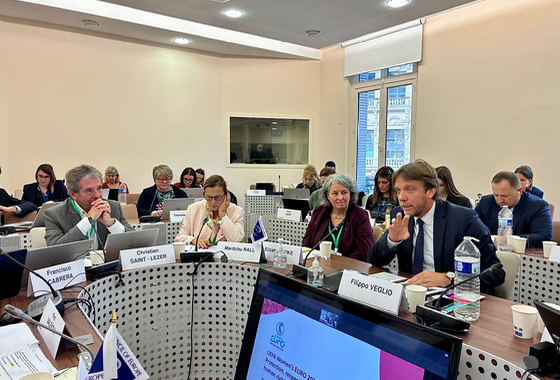
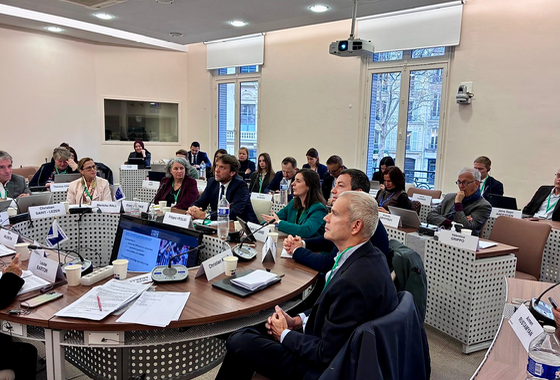
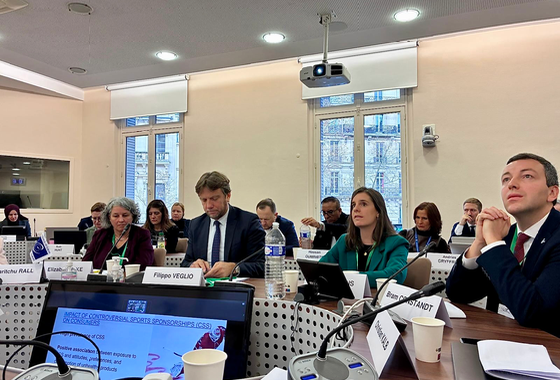
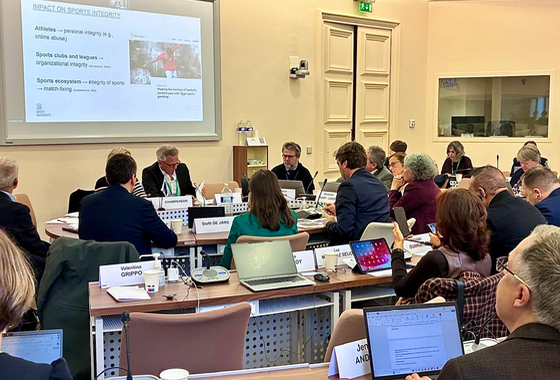
The Parliamentary Alliance for Good Governance and Integrity in Sport of the PACE, chaired by Kim Valentin (Denmark, ALDE), held a hearing on 1 December in Paris, addressing urgent challenges at the intersection of sport, public health, integrity, and human rights.
The first session, dedicated to advertising in sport, examined the ethical and public-health implications of gambling and unhealthy-product marketing.
Christian Kalb (CK Consulting) presented evidence showing the rapid expansion of gambling markets, the significant proportion of at-risk and problem gamblers, and the escalating societal costs. He outlined regulatory options including stronger supervision, transparency obligations, limits on payouts, marketing restrictions, and measures to curb illegal operators.
Complementing this analysis, Prof. Bram Constandt and Dr Steffi De Jans (Ghent University) shared new scientific findings demonstrating the harmful impact of controversial sports sponsorships on young people, including increased consumption of unhealthy products, normalisation of risky behaviours, and threats to sports integrity. They highlighted how subtle sponsorship formats reduce critical awareness and called for policy tools ranging from complete bans to alternative funding models.
The second session focused on UEFA Women’s EURO 2025 and its potential to advance gender equality and human rights in line with PACE Resolution 2607 (2025) on “Protecting human rights in and through sport: obligations and shared responsibilities”.
Filippo Veglio (UEFA) detailed the tournament’s comprehensive sustainability and human-rights programme, including an independent advisory board, a risk assessment identifying 38 risks, a joint Human Rights Declaration, and new mechanisms for safety, grievance handling, online-abuse monitoring, and accessibility across the eight Swiss host cities.
Professor Elizabeth Pike (University of Hertfordshire) emphasised the need for gender-equitable governance, strengthened safeguarding, and action against rising toxicity and online sexism in women’s sport. She encouraged policymakers to adopt gender-equality action plans, enforce safeguarding standards, address the gender pay gap and promote positive role models.
Maritchu Rall (European Social Action Network) and Christian Saint-Lezer (European Association for Education), speaking on behalf of the Conference of INGOs, underlined the importance of recognising access to sport as a fundamental right and ensuring that civil-society expertise is fully integrated into sport-governance reforms. Their contribution highlighted the essential role of INGOs in bridging grassroots experience and institutional policymaking to advance inclusion for all.
The Parliamentary Alliance reaffirmed its commitment to ensuring that sport in Europe remains ethical, safe, inclusive, and grounded in human-rights principles.