


21/10/2021 European Conference of Presidents of Parliament
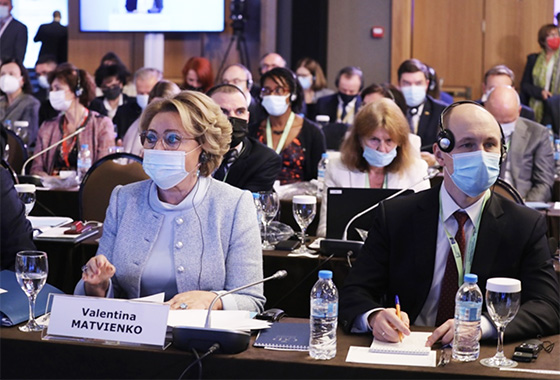
“The coronavirus pandemic has been a real challenge for the entire global community and the institutions of democracy. We, parliamentarians, had to take unpopular measures, difficult decisions, often creating serious inconveniences in the daily lives of citizens.”, said the Speaker of the Russian Federation Council Valentina Matviyenko opening the debate on Theme 1 ‘Democracies facing the Covid-19 public health crisis: sharing experiences’.
“Sanitary restrictions have dealt a tangible blow to national economies and income levels, and unemployment has risen. Were such decisions necessary? Undoubtedly. Otherwise, the epidemic could not have been contained, and its consequences could have been much more tragic. The derogation of certain rights and freedoms in emergency situations is in principle provided for in both national legislation and international legal instruments, including the European Convention on Human Rights. This is also confirmed by the recommendations that have been developed over the last year and a half within the Council of Europe and its Parliamentary Assembly”, she added.
“Of course, it has often been a matter of trial and error. The difficulty was that the balance between forced restrictions and guarantees of rights and freedoms had to be constantly redefined as one pandemic wave replaced another. But our work has been guided by the core democratic right to life and the need to avoid undue administrative coercion”, Mrs Matviyenko stated.
“Through the Covid-19 pandemic, we have realized that when a problem is perceived as global, the international community is also willing to work together on global solutions. This gives people confidence, which in turn has a stabilizing effect on our democratic systems”, said the President of Austria’s National Council Wolfgang Sobotka.
Because where politics and decision-making are not transparent, he added, or even perceived as such, “anti-democratic currents can occur. Even more so at a time when the difficult balance between individual fundamental rights and collective health has often put citizens' trust to the test”, he added.
“Our aim must now also be to give concrete expression to ways of democratic renewal resilience and audibility of our parliaments”, he stressed. At the same time, as proof of the functioning of democracy, “we must use the current transformation processes to promote gender equality and the sustainable restructuring of our economic systems to combat climate change, for example”, Mr Sobotka concluded.