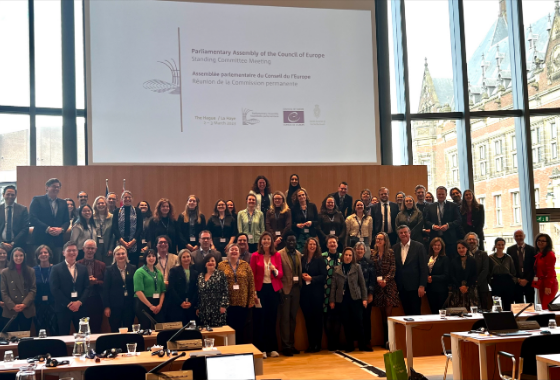
03/03/2023 Standing Committee
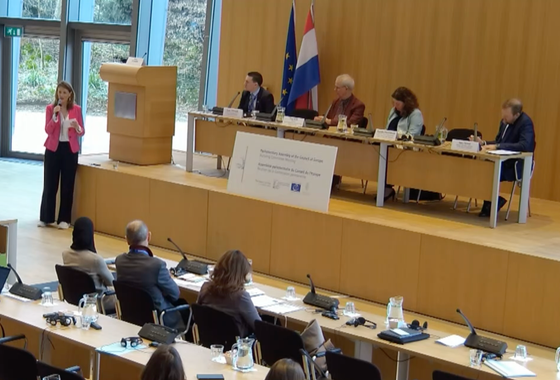
“Combatting violence against women should not be considered anymore as a feminist issue but as a human rights issue, and should be approached by the whole community, of whom men and boys should be a strong and vocal part,” said PACE President Tiny Kox, opening of a round table on “The role of men and boys in stopping gender-based violence”.
President Kox considers it essential to emphasise education in order to change mentalities, as he believes that “most men and boys are not violent by nature”. “Men should move from being mostly associated with the Prosecution pillar of the Istanbul Convention to being more closely associated with the Prevention, Protection and Policies co-ordination pillars,” he added. They would therefore not only be part of the problem, but they would become part of the solution.
Pascalle Grotenhuis, Director of Social Development at the Ministry of Foreign Affairs of the Netherlands, explained how her country managed to design a feminist foreign policy with the support of male allies.
Bjørn Berge, Deputy Secretary General of the Council of Europe, recalled that the Istanbul Convention “the gold standard in this field”, makes a clear reference to the subject, encouraging all members of society “especially men and boys” to “contribute actively to preventing all forms of violence” within its scope. He gave three concrete examples of in Andorra, the United Kingdom and Estonia, illustrating the involvement of men and boys, as actors of change. He also mentioned that a new Council of Europe Gender Equality Strategy – which will apply from 2024 to 2029 – will be adopted at the plenary session of the Gender Equality Commission next November.
Even Eriksen, PACE General Rapporteur on Violence against Women, believes that promoting equal sharing of care responsibilities between women and men, will be a step towards more gender equality. “Taking care of children is not a woman’s or man’s job. It is a responsibility for all parents. So-called traditional family values aim at promoting a patriarchal system, based on supposed different statuses of women and men,” he said, calling for the sharing of care responsibilities, which needs to be facilitated for all professions.
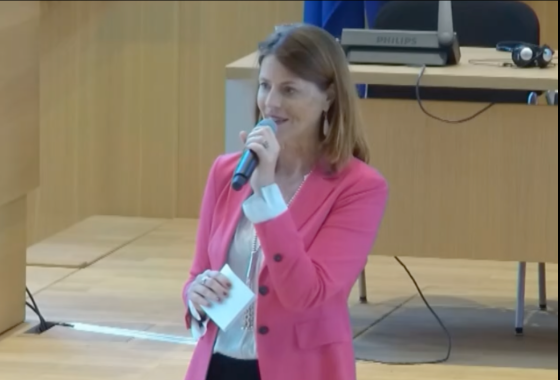
"When we look at statistics, we see that gender-based violence in most cases, has a male face. All men are not perpetrators, but most perpetrators of gender-based violence are men, everywhere in the world; regardless to culture, religion, ethnicity, background, economic class," said Petra Stienen (Netherlands, ALDE), Chairperson of the Dutch delegation to PACE, and PACE rapporteur on this issue, who moderated the discussion. "Involving men and boys in the fight against this scourge is not only the issue of mothers and fathers; it is a societal issue," she added.
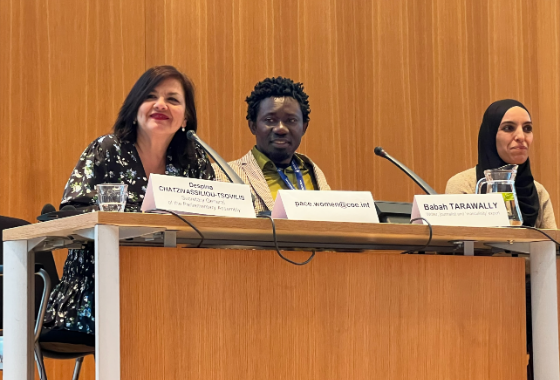
In her concluding remarks, PACE Secretary General Despina Chatzivassiliou-Tsovilis, presented an overview of the key points and take away actions raised by the panelists and the audience, and gave ideas for further work on these issues. She stressed, in particular, that change and education were key. “We must all change our mind-sets and behaviours and educate our societies about the importance of ending discrimination and providing equal opportunities for all,” she said. She added that gender equality and women’s rights were not a “women’s right” issue but a “global human rights” issue.
She gave the example of the Assembly, where efforts are being made to “strive to create an environment with zero tolerance for abusive behaviour”. In this regard, “we revised the code of conduct for PACE members, introducing the explicit prohibition of sexism, sexual harassment, and sexual violence and misconduct, for which parliamentarians can be sanctioned,” she explained.
“We need everyone on board to bring change, including civil society, governments, parliaments, private sector, the media, police, and of course, women and men, boys and girls,” she concluded.
Thematic discussions were an opportunity to provide examples of good practices and identify measures to further involve men and boys in the fight against gender-based violence.
This event was organised by the PACE Interparliamentary Cooperation and Project Support Division, in cooperation with Women@PACE, the Parliamentary Network Women Free from Violence and the Dutch Delegation to the PACE.