


21/01/2010 | Social Affairs, Health and Sustainable Development
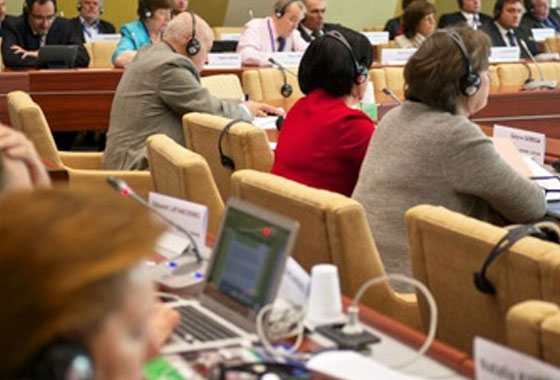
Strasbourg, 21.01.2010 – A public parliamentary hearing titled “The handling of the H1N1 pandemic: more transparency needed?” is to be held on the fringe of the plenary session of the Parliamentary Assembly of the Council of Europe (PACE) in Strasbourg from 8.15-10 a.m. on Tuesday 26 January...

18/12/2009 | Social Affairs, Health and Sustainable Development
Reacting to the speech given by US President Barack Obama today in Copenhagen, PACE’s rapporteur on climate change, former British Deputy Prime Minister and Kyoto negotiator John Prescott (United Kingdom, SOC), said it was wonderful to hear an American President calling for action on climate change, but said: “When he gets in the room with the other leaders he’s going to have to offer a little bit more”.

16/12/2009 | Social Affairs, Health and Sustainable Development
PACE rapporteur on climate change, former British Deputy Prime Minister and EU Kyoto negotiator John Prescott (United Kingdom, SOC), today issued a stern warning to the US that they must do much more to help secure a deal at Copenhagen. Addressing a meeting of the Inter-Parliamentary Union (IPU) at the Danish Parliament, Mr Prescott publicly criticised the US Special Envoy for Climate Change Todd Stern for saying emissions were “just maths”.

15/12/2009 | Social Affairs, Health and Sustainable Development
John Prescott (United Kingdom, SOC), the Assembly’s rapporteur on climate change, is posting a daily video diary from the UN Climate Change Conference in Copenhagen, which opened this week. Mr Prescott, who negotiated the 1997 Kyoto Accord as Britain’s Deputy Prime Minister, is part of a 13-strong PACE delegation at these key global talks.

11/12/2009 | Social Affairs, Health and Sustainable Development
"There is evidence that when family-friendly policies are pursued consistently over a long period, they do have a positive effect on individual decisions to have children and tackle the demographic problems of Europe," Luca Volontè (Italy, EPP/CD) stressed at a meeting of PACE Social Affairs Committee in Paris on 11 December.

11/12/2009 | Social Affairs, Health and Sustainable Development
Children witnessing violence against their mother are far too often neglected as victims of psychological trauma, as possible future victims and as links in a chain of violence, when they could help identify potentially violent situations and avoid new violence in the future. Adopting a report by Carina Ohlsson (Sweden, SOC) in Paris on 11 December, PACE Social Affairs Committee agreed on a list of measures to be taken by national parliaments and governments.

25/11/2009 | Social Affairs, Health and Sustainable Development
PACE rapporteur on climate change, John Prescott (United Kingdom, SOC), has welcomed US President Barack Obama’s decision to attend the UN Climate Change conference in Copenhagen. At a PACE committee meeting on Friday, and during a later House of Commons debate, Mr Prescott called on the President – as well as the leaders of China and India – to attend the event. “Hopefully China and India will now follow Obama’s lead,” Mr Prescott said today.

23/11/2009 | Social Affairs, Health and Sustainable Development
John Prescott (United Kingdom, SOC), PACE rapporteur on climate change, today called on the leaders of the United States, China and India to personally take part in the Copenhagen climate change conference in December. “These talks are vital for the future of the planet. These three countries can make the difference between success and failure. It is vital that their leaders are there, alongside the 60 other presidents and prime ministers who have already said they are coming,” he said.

16/11/2009 | Social Affairs, Health and Sustainable Development
The head of PACE’s Environment Committee, speaking on behalf of PACE President Lluis Maria de Puig, today encouraged Council of Europe governments to sign the new additional protocol to the European Charter of Local Self-Government, giving citizens the right to participate in the affairs of a local authority.

14/10/2009 | Social Affairs, Health and Sustainable Development
Local authorities will play a “crucial role” in translating the words of any coming global climate treaty into action and achieving the “deep and early cuts” in emissions that are needed, the Chair of PACE’s Environment Committee told local and regional elected representatives today.

13/10/2009 | Social Affairs, Health and Sustainable Development
The reference framework on regional democracy that has been proposed by governments is a “poor substitute” for a full European Charter of Regional Democracy, and the Parliamentary Assembly will “continue the battle” to achieve the stronger text, the Chair of PACE’s Environment Committee told the Council of Europe Congress today. In an address to its plenary session on behalf of PACE President Lluís Maria de Puig, Alan Meale (United Kingdom, SOC) said he “deeply regretted” the decision to draft only a reference framework, instead of a Charter equivalent to the successful European Charter of Local Self-Government.

30/09/2009 | Social Affairs, Health and Sustainable Development
The debate on the green economy in Europe and the United States held yesterday evening by PACE and the Alsace Region clearly underlined the urgent need to reduce greenhouse gas emissions at the earliest opportunity – between 50% and 85% by 2050 – as well as the idea that sustainable growth depends on the involvement of business. John Prescott (United Kingdom, SOC), PACE rapporteur on climate change, drew attention to the vitally important nature of the negotiations due at the Copenhagen Conference in December.