


25/03/2010 | Monitoring
PACE co-rapporteurs for the monitoring of Armenia have welcomed the prompt response of the Armenian authorities to their call for a “roadmap” to put into effect the reforms recommended in the aftermath of the March 2008 election violence. “We welcome the wide range of reforms announced in the preliminary response of the authorities to our recommendation, but we would also like to stress that, in the end, it will be the content of these reforms, and their implementation, that counts,” said John Prescott (United Kingdom, SOC) and Georges Colombier (France, EPP/CD).

25/03/2010 | Equality and Non-Discrimination
“Women continue to be discriminated against in manifold ways: they have less access to the labour market, they earn less and have lower pension income than men,” Anna Curdová (Czech Republic, SOC), rapporteur of the Committee on Equal Opportunities for Women and Men ‘on decent pensions for women’ said at a meeting in Paris today.

24/03/2010 | Political Affairs and Democracy
Sinikka Hurskainen, Jacek Protasiewicz and Uta Zapf, who head the bodies dealing with Belarus for the Parliamentary Assembly of the Council of Europe, the European Parliament and the OSCE Parliamentary Assembly, have firmly condemned the execution of Andrei Zhuk and Vasily Yuzepchuk which, according to human rights organisations, took place in Belarus last week in complete secrecy and which has yet to be confirmed officially by the authorities.

23/03/2010 | Equality and Non-Discrimination
At its forthcoming meeting in Paris on Thursday 25 March, PACE Committee on Equal Opportunities for Women and Men will be looking at gender inequality in pensions, with input from two experts. Anna Curdová (Czech Republic, SOC), currently drafting a report on this issue, will be calling for pension schemes offering women decent living conditions. The following day, Friday 26 March, the committee will hold a hearing on the real situation of rural women, the subject of a report being drafted by Carmen Quintanilla Barba (Spain, EPP/CD).

23/03/2010 | President
"The Council of Europe strongly condemns the executions of Andrei Zhuk and Vasily Yuzepchuk in Belarus," declared today the Chair of the Committee of Ministers Micheline Calmy-Rey, the President of the Parliamentary Assembly Mevlüt Çavusoglu, and the Secretary General of the Council of Europe Thorbjørn Jagland.
22/03/2010 | Social Affairs, Health and Sustainable Development
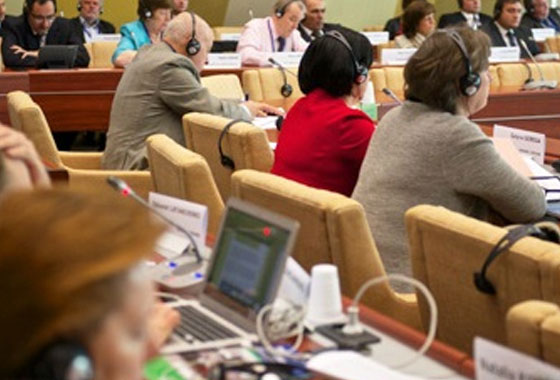
Strasbourg, 22.03.2010 – The Parliamentary Assembly of the Council of Europe (PACE) is to hold a second public hearing on the subject “The handling of the H1N1 pandemic: more transparency needed” in Paris on Monday 29th March, followed by a press conference.Participants at the hearing, organised...

22/03/2010 | Monitoring
Three rapporteurs of the Parliamentary Assembly of the Council of Europe (PACE) have welcomed the decision by President Ilham Aliyev of Azerbaijan to pardon 70 prisoners, including Ganimat Zahidov, the editor-in-chief of the opposition newspaper Azadlig. However, they regretted that Eynulla Fatullayev, another opposition editor, was not among those released.

19/03/2010 | President
PACE President Mevlüt Çavusoglu will make an official visit to Moldova from 22 to 25 March 2010, where he aims to promote stability and fully functioning democratic institutions, and contribute to moving the current political situation in the country forward.

19/03/2010 | Political Affairs and Democracy
Concerned at the upsurge of piracy, PACE’s Political Affairs Committee has encouraged Council of Europe member states to provide naval escorts to ships crossing areas at risk and asked NATO, the EU and countries concerned to renew and strengthen their anti-piracy operations off the coast of Somalia. Following the proposals by the rapporteur, Birgen Keles (Turkey, SOC), the committee called for a common and more relevant domestic legal framework in order to criminalise the act of piracy wherever it takes place. The Assembly will debate this question during its Spring Session (26-30 April 2010).

19/03/2010 | Monitoring
Mátyás Eörsi (Hungary, ALDE) and Kastriot Islami (Albania, SOC), co-rapporteurs for PACE's monitoring of Georgia, will visit Tbilisi from 21 to 24 March 2010 for talks on constitutional and electoral reform, the forthcoming local elections and media freedom, as well as minority issues. They are due to meet the President of the Republic, the Speaker of Parliament, the Ministers for Re-integration and for Refugees and the Deputy Foreign Affairs Minister, among others.

19/03/2010 | Monitoring
Andreas Gross (Switzerland, SOC) and György Frunda (Romania, EPP/CD), the new co-rapporteurs for the monitoring of Russia, will make their first visit to the country from 22 to 24 March 2010 to assess the state of Russia’s honouring of its obligations and commitments to the Council of Europe. In Moscow, they will hold an exchange of views with the Russian authorities and political forces on this question, and make a preliminary political evaluation of the situation.

19/03/2010 | Monitoring
PACE Monitoring Committee has welcomed the progress made by Bulgaria since the last Assembly debate concerning that country in January 2000. The text adopted yesterday in the framework of post-monitoring dialogue states that the ruling centre-right movement GERB (Citizens for the European Development of Bulgaria) "has set ambitious objectives and committed itself to continue democratic reforms", in particular to guarantee the proper functioning of justice and combat corruption and organised crime.