Application of the European Charter for Regional or Minority Languages (2018-2020)
Report by the Secretary General of the Council of Europe to the Parliamentary Assembly
Communication
| Doc. 15276
| 26 April 2021
- Author(s):
- Secretary General of the Council of Europe
1 Introduction
1. In accordance with Article 16,
paragraph 5, of the European Charter for Regional or Minority Languages (ETS
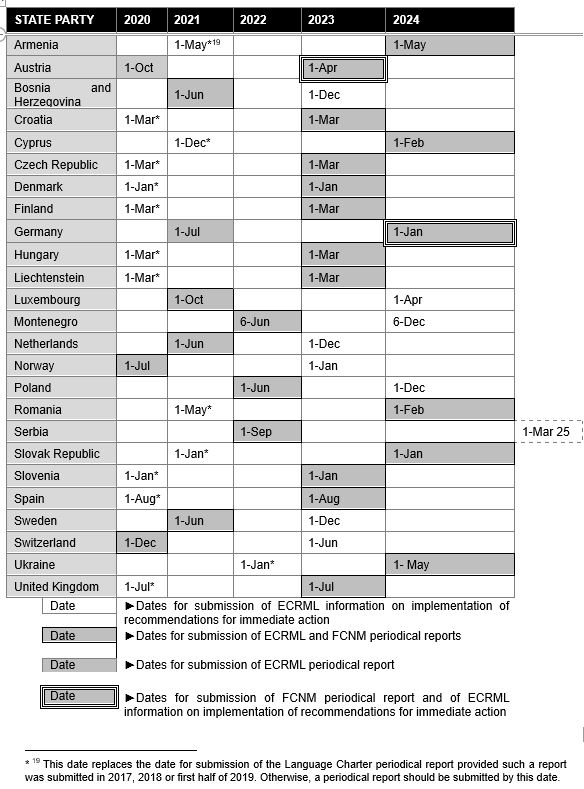
No. 148, hereinafter “the Charter”), the Secretary General is required
to present a two-yearly report to the Parliamentary Assembly (hereinafter
“the Assembly”) on the application of the Charter by the States Parties.
2. The Secretary General’s tenth report covers the period 2018-2020,
i.e. three consecutive years. This choice was dictated by the exceptional
circumstances surrounding the Council of Europe’s activities in
2020 which, particularly from March onwards, saw an unprecedented
public health crisis that had major ramifications for the whole
of Europe and its different bodies, both national and international.
The two-yearly report due in April 2020 could not be presented to
the Assembly firstly because this part of the 2020 parliamentary
session could not take place and secondly because all the Council
of Europe's activities were constrained by the various health restrictions
introduced across Europe. As a consequence, this report seeks to
reduce the backlog and take stock of the positions adopted by the
Charter’s Committee of Experts and the Committee of Ministers in
the field of the protection of regional or minority languages from
1 January 2018 to 31 December 2020.
3. In substance, the tenth report deals with the main issues
related to the functioning of the Charter system in the light of
the conclusions of the high-level conference held in Strasbourg
in June 2018 to mark the 20th anniversary of the entry into force
of the European Charter for Regional or Minority Languages and the Framework
Convention for the Protection of National Minorities (hereinafter
"the Framework Convention"). The present report highlights the improvements
that were made to the Charter's monitoring mechanism by the Committee
of Ministers in November 2018 and their implementation in practice
by the relevant stakeholders.
Note In addition, this communication
to the Assembly describes how the Committee of Experts has sought
to address challenges to the equal rights of speakers of languages
traditionally spoken in Europe in the context of the public health
crisis. The report briefly outlines what the secretariat has been
doing to strengthen the capacity of member states to honour their
commitments under the Charter and to contribute to the development of
anti-discrimination policies and practices in line with the standards
of the Council of Europe. Finally, it presents relevant inter-institutional
and international relations during the reference period.
4. The implementation of the Charter's provisions has been monitored
since 1998 by fully independent experts of the Charter’s Committee
of Experts (hereinafter “the Committee of Experts”), as well as
by the Committee of Ministers of the Council of Europe. Before drafting
its reports evaluating the commitments made by the States Parties
to the Charter, the Committee of Experts carries out on-the-spot
visits during which the emphasis is on face-to-face communication
with speakers of regional or minority languages and the organisations
that represent them. The members of the Committee of Experts thus
seek a balance between promoting the official language of the country
and protecting minority languages, a challenge at the heart of multilateralism.
At the same time, technological developments, in particular digitisation,
have created both fresh challenges and opportunities for minority
languages, which the COVID-19 pandemic has further accentuated and
which the Committee of Experts endeavours to take into account.
5. During the period covered by the report, the Council of Europe
has continued to stress the importance of multilateral collaboration
and the implementation of Council of Europe relevant standards at
national level. Emphasis has been placed on reforming the Charter’s
monitoring mechanism with a view to better incorporating the findings
of the monitoring into national anti-discrimination policies. Efforts
have been made to increase the synergies and co-ordination of the
Council of Europe’s monitoring mechanisms in the field of protection
of national minorities, starting with the above-mentioned Conference
in 2018. Other Council of Europe bodies, such as the Congress of
Local and Regional Authorities, the European Court of Human Rights or
the Venice Commission, refer to the Charter and the conclusions
of the Committee of Experts in their observations, while at the
same time enhancing the impact of the Charter's principles and specific
provisions in their own ways.
6. The Parliamentary Assembly has a key role in raising awareness
of the Charter and policies for the preservation of our linguistic
heritage in Europe. The recommendations of the Charter's Committee
of Experts and the Committee of Ministers provide a basis for action
by members of the Parliamentary Assembly to promote regional or
minority languages in each member State in the light of rapid developments
in European societies and economies, for example in the field of
information and communication technologies. The support of the Parliamentary
Assembly and national parliaments is key, particularly to increase
the number of ratifications of the Charter and the number of undertakings
given by States Parties.
2 Monitoring
the application of the European Charter for Regional or Minority
Languages
7. The provisions of the Charter
and the recommendations made after successive monitoring cycles
in the 25 States Parties to the Charter (see Appendix 1 to this
report) have led to the establishment of a growing body of national
laws safeguarding teaching in and of regional or minority languages
at all levels of public or private education, the use of these languages
in dealings with administrations and public services such as hospitals, on
topographical signs, and in participatory structures giving representatives
of linguistic minorities access to decision-making at national,
regional or local level. With a view to increasing the impact of
the Charter in the everyday lives of speakers of regional or minority
languages, the Council of Europe set about reforming the Charter's
monitoring mechanism during the 2018-2019 biennium.
2.1 Objectives
and key features of the 2018 reform
8. In light of the conclusions
of the high-level Conference held in Strasbourg on 18-19 June 2018
by the Croatian Chairmanship of the Committee of Ministers to mark
the 20th anniversary of the entry into force of the Charter and
the Framework Convention, on 28 November 2018 the Committee of Ministers
adopted, after consultations with the Committee of Experts, a comprehensive
reform of the Charter's monitoring mechanism (see Appendix 2). The
new provisions entered into force on 1 July 2019.
9. The reform was prompted,
inter
alia, by the desire to lighten the burden for national
administrations of the obligation to draft, at short intervals of
three years, long narrative reports and the resulting delays in
the submission of periodic reports by the States Parties to the
Charter. These delays have not yet been fully resolved, despite
important efforts on the part of States Parties and the secretariat.
The COVID-19 pandemic is now delaying the drafting of full reports,
whose preparation requires on-the-spot visits and direct contact
with speakers. A degree of latitude in the handling of cases has
proven necessary. The Committee of Ministers has acknowledged this
prerequisite by authorising exceptional measures for monitoring
mechanisms, including that of the Charter.
Note
10. Since the entry into force of the reform:
- the States Parties have been
required to present their full periodic reports on the implementation
of all their commitments under the Charter every five years instead
of three, and information about the implementation of the recommendations
identified by the Committee of Experts in the last evaluation report
as being for immediate action every two and a half years (see I.3
below);
- however, if and despite written reminders from the Charter
secretariat, or even the Committee of Ministers (see Appendix 2,
Decision No. 1 c. and d. of the Ministers’ Deputies), a State Party
fails to report to the Committee of Ministers within the prescribed
time, the latter may, under certain conditions, commence monitoring
with respect to the State concerned without a periodical report;
- States Parties to the Charter which are also parties to
the Framework Convention are to present their periodical reports
on the Charter and on the Framework Convention by progressively
aligned dates, as per the table in Appendix 2 to this report;
- on receiving the evaluation report for comments, a State
Party may ask the Committee of Experts for a confidential dialogue
if, in its opinion, there are factual errors in the report;
- the Committee of Experts is authorised to publish its
evaluation reports on receiving the final comments from a State
Party and before the Committee of Ministers examines the evaluation
report and adopts its own recommendation for the State concerned;
- the number of terms that members of the Committee of Experts
may serve has been limited to enable the Committee to be renewed
on a regular basis.
11. In addition, the Committee of Ministers has encouraged wider
use of the Committee of Experts’ rapid reaction capacity and ad
hoc missions, as provided for in its Rules of Procedure, amended
in March 2019. In order to support the optimal implementation of
the reform, the Committee of Ministers has also adopted a revised
outline for State reports. The information to be provided in accordance
with this outline should enable the Committee of Experts to better
assess whether a Party has implemented each commitment and each related
follow-up recommendation with respect to each protected language
within its territory.
2.2 Recommendations
to States Parties from 2018 to 2020
2.2.1 Committee
of Ministers’ recommendations
12. Over the period 2018-2020,
the Committee of Ministers adopted and published the following recommendations,
relating to the respective evaluation reports of the Committee of
Experts. The Committee of Experts also reached some important milestones
with the start of the 8th monitoring cycle for three States Parties
to the Charter (Hungary, Norway, Switzerland).
2018
2019Note
2020
13. Although progress was observed
in many countries, it was noted during the period under review that some
previous recommendations had to be reiterated. This is particularly
true of minority language education, which requires a structured
approach, and where there is a shortage of minority language teachers.
It was emphasised that teaching in and of minority languages is
also crucial in encouraging young people to be open-minded and fostering
respect and tolerance towards ethnic and cultural diversity.
14. Among the recurring issues in the field of minority language
protection, the Committee of Experts of the Charter and the Committee
of Ministers frequently stress the need for resolute and proactive
government measures to safeguard the use of minority or regional
languages by administrative authorities and public services. The
question that often arises in this field is how to enforce the Charter
in areas where a sufficient number of speakers use a language, but
where the formal threshold of the number of permanent residents
who identify themselves as an ethnic or national minority has not
been reached. In some countries, the thresholds set, for example,
for electoral purposes or as a condition for the use of a non-state
language in administration and public services, amount to 20% of
all permanent residents.
15. Another area of concern is the use of minority or regional
languages in the media, where some languages are absent, while for
others the frequency and duration of programmes in regional or minority languages
are considered insufficient to promote them as languages of communication
and fully reflect the diversity of society in the media.
2.2.2 Recommendations
for immediate action made by the Charter’s Committee of Experts
16. The 2018 reform introduced
a procedure for reporting on the implementation of recommendations
for immediate action at the mid-point of the new five-year monitoring
cycle (see I.1 above and Appendix 2 to this report).
17. Since 2017, the Committee of Experts has been sending States
Parties its recommendations for emergency measures to be put in
place prior to the next assessment. It is for the Committee of Experts
alone to identify, in its evaluation report as published prior to
its examination by the Committee of Ministers, a limited number
of recommendations for immediate action by the authorities of a
State Party. The aim of these recommendations is to help the State
concerned to remedy the most flagrant failures to honour its commitments
within a relatively short period of two and a half years from the
start of the monitoring cycle, according to a pre-determined timetable.
At the end of this period, the State is required to report briefly
on the implementation of the recommendations for immediate action,
as contained in the most recent evaluation report.
18. During a five-year transition period starting on 1 July 2019,
information on the recommendations for immediate action made in
the Committee of Experts’ evaluation report is to be submitted on
the dates indicated by the Committee of Ministers in its decisions
on the reform (see Appendix 2). After receiving the information, the
Committee of Experts consults in writing with the speakers of regional
or minority languages on the measures taken and makes a short assessment
of the situation, without carrying out an on-the-spot visit or making
further recommendations to the State Party. The conclusions of the
Committee of Experts are forwarded to the relevant national authorities
and to the Committee of Ministers for information. This simplifies the
procedure for all stakeholders and reduces their respective workloads
compared with the former three-year cycle. The new procedure ensures
regular monitoring of the situation with regard to language protection
and guides national authorities in their efforts, from one full
monitoring cycle to the next.
19. The recommendations for immediate action made between 2018
and 2020 to 20 States Parties were concerned mainly with education,
media, signage in different places around the country, awareness
of regional or minority languages, linguistic and multi-ethnic tolerance,
promotion and/or revitalisation of certain languages, especially
those in imminent danger of extinction. The Committee of Experts
has repeatedly stressed the need for resolute action and sustained
funding on the part of the competent authorities. It has called
for close co-operation between national, regional and local authorities
and speakers of regional or minority languages. A brief summary
of the recommended measures and the areas covered by the Committee of
Experts on a country-by-country basis can be found in Appendix 3
below.
20. Being unable to travel to States Parties during the COVID-19
pandemic in 2020, the Committee of Experts focused its monitoring
efforts on concluding the 2019 cases and, above all, on studying
the implementation of the recommendations for immediate action.
As this was the first such exercise in the history of the Charter,
the Committee began by producing an outline for its future reports
relating to state information on the follow-up given to the recommendations
for immediate action. In the course of 2020, the following cases were
dealt with: Czech Republic (
MIN-LANG(2020)7), Denmark (
MIN-LANG(2020)13), Finland (
MIN-LANG(2020)12) and Hungary
(MIN-LANG(2020)14; others were prepared for review in 2021. In the four
cases closed, the Committee of Experts noted progress made in response
to the recommendations for immediate action. The Committee also
observed that some of the information provided merely repeated points
that had already been established in the previous monitoring cycle.
The Committee therefore encouraged the States Parties to look more
closely at the actual content of its recommendations so as to implement
them through structured government action.
2.3 How
the Charter’s Committee of Experts has responded to the COVID-19
pandemic
21. The COVID-19 pandemic has exacerbated
the vulnerability of certain minorities and speakers of regional
or minority languages in many countries, widening existing inequalities.
Council of Europe standards that exist to assist member states in
dealing with emergencies are indeed in place as also demonstrated
during the pandemic. In some instances, however, full compliance
with relevant standards and recommendations is missing.
22. In 2020, for example, the Charter secretariat conducted research
into the teaching of regional or minority languages, as enshrined
in Article 8 of the Charter. The role of teachers and schools has
proven to be of the utmost importance in ensuring that students
have access to education in their own language during the epidemic.
Similarly, associations representing speakers of regional or minority
languages played an important role in the transition to online teaching
in and of regional or minority languages when European pupils and students
were in lockdown.
23. At its plenary session by videoconference on 3 July 2020,
the Committee of Experts adopted a declaration on regional or minority
languages and e-learning in the context of the COVID-19 pandemic
(see Appendix 5). In it, the Committee affirms that online education
can and should complement face-to-face education, if the latter
cannot be provided for compelling and duly justified reasons, and
that reasonable accommodation should be made in this area for the
benefit of teachers and learners alike. In its future reviews of
States Parties’ compliance with the Charter, the Committee states
that it intends to pay more attention to the use of information
and communication technologies in national education systems, given
that education is at the heart of the Charter's provisions and should
not be subject to lengthy interruptions.
24. As early as March 2020, the Committee of Experts highlighted
the importance to provide health-related information and communication
in regional or minority languages, repeatedly reminding States of
their obligations under the Charter (see Appendices 4 and 5 and
the
interview
with Vesna Crnić-Grotić, April 2020).
3 Assistance
to Council of Europe member states
25. The Charter’s monitoring mechanism
leads to the development of national legislation and policies and their
effective implementation for the benefit of speakers of regional
or minority languages.
26. With this in mind, the Council of Europe initiates and/or
organises assistance activities with States, both members and non-members
of the Council of Europe, parties and non-parties to the Charter.
In recent years, assistance activities have taken place in the following
geographical areas: the Western Balkans, the Republic of Moldova,
the Caucasus and Ukraine, in particular thanks to the commitment
and significant financial support of the European Union.
27. In order to assist all Council of Europe member states in
their regional and minority language policies, a call for examples
of good practice in the member states was launched by the secretariat
in 2019. A study resulting from this will be published shortly,
including data from 2020 (see point I.3. above).
3.1 Activities
and measures developed for States Parties to the Charter
28. In the past, round tables were
occasionally held on follow-up recommendations for all the stakeholders in
a country. Moderated by a member of the Committee of Experts, they
were aimed at identifying tangible ways to implement the recommendations
made by the Committee of Experts and the Committee of Ministers.
During the period covered, activities of this kind were not a priority
as efforts were concentrated first on reforming the monitoring mechanism
in 2018-2019 and then on the COVID-19 pandemic in 2020 (see above).
Only Germany and Sweden hosted round tables, at which measures to
strengthen the institutional and legal framework and to improve
the participation of minority groups in decision-making processes
were discussed with different partners. All States Parties are encouraged
to organise such events, in particular before submitting their information
on the recommendations for immediate action, even if only by videoconference
with the participation of all stakeholders (see I.2.b. above).
This particular strand of activities is very important for the success
of the system, especially in the wake of the recent reform (see
IV.1. below).
29. As part of the Council of Europe Action Plan for Ukraine,
the project Protecting national minorities, including
Roma, and minority languages in Ukraine (2018-2020) was
carried out. One of the aims of the project was to improve standards
of teaching in and of minority languages by improving the legal
framework and the capacities of education professionals. Legal advice
was provided on the conformity of the provisions of the draft Law
on General Secondary Education with Ukraine's commitments under
the Charter. In addition, members of the parliamentary working group
responsible for drafting new legislation on national minorities
were trained in Charter standards.
30. With regard to capacity-building, Ukraine received advice
on the provision of minority language education in the light of
existing teaching models in various Council of Europe member states.
Measures included the training of officials from the Ministry of
Education and Science and education professionals in good policies
and practices in Europe. The authorities were provided with teaching
materials to promote minority languages in schools and to raise
awareness of these languages and the groups that use them.
31. As part of the project, a Working Group on Codification of
the Romani Language was set up at the Pedagogical Institute of the
Ukrainian Academy of Sciences. Drawing on good practices from different
Council of Europe member states and the standards of the Charter,
the Working Group codified the basic vocabulary of Romani for use
in primary education. The authorities intend to use the codified
Romani language to design and implement a comprehensive Romani language
teaching strategy, including teacher training and the development
of curricula and teaching materials. The Council of Europe will
support this process in Phase II of the project in 2021-2022.
32. Elsewhere in Europe, the Horizontal
Facility for the Western Balkans and Turkey (2018-2020)
was applied to Bosnia and Herzegovina and Serbia. The programme
paved the way for the provision of financial support to Bosnia and
Herzegovina, a State Party to the Charter since 2011, to encourage
the use of Charter-protected minority languages in public life.
The focus was on translating certain sections of municipal websites into
Czech, German, Italian, Polish, Romani and Ukrainian, publications
on national minorities into Czech, German, Hungarian, Italian, Polish,
Slovenian, Turkish and Ukrainian and television programmes into
Romani. The Ministry of Human Rights and Refugees received support
in setting up a mechanism to facilitate, inter
alia, the implementation of the recommendations of the
Charter’s Committee of Experts and the drafting of the relevant
reports.
33. In Serbia, a State Party to the Charter since 2006, the Horizontal Facility was used to
advise the Serbian authorities on the organisation of bilingual
education (education in a minority language with a second language, mainly
Serbian).
3.2 Promoting
the Charter among the authorities of non-party States
34. During the period under review,
contacts were made and discussions on the ratification of the Charter initiated
with, for example, Ireland (non-party, non-signatory State) and
Italy (non-party state, signatory since 2000). Three other member
states (Albania, Georgia, Republic of Moldova) benefited from legal
advice and capacity building in relation to the ratification of
the Charter or the application of its standards.
35. In 2018 and 2019, the Council of Europe, drawing on the
Horizontal Facility for the Western Balkans
and Turkey financed by the European Union, helped the
Albanian authorities to,
inter alia,
review their domestic legislation and practice for compliance with
the Charter and to prepare a draft ratification instrument including selected
Charter commitments in accordance with its post-accession commitment.
In 2020, within the framework of
Horizontal
Facility II, the Albanian authorities obtained legal
advice when preparing the statutes relating to Law No. 96/2017 on
the
Protection of National Minorities
in the Republic of Albania, concerning the use of minority
languages in dealings with local authorities. During the COVID-19
pandemic, leaflets containing information about the virus were published
in the eight minority languages, including some covered by the Charter
in the Western Balkan region (Aromanian
Note, Bosnian, Bulgarian, Greek, Macedonian,
Romani, Serbian and Montenegrin), in co-operation with the State
Committee for Minorities and the Institute of Public Health/Ministry
of Health and Social Welfare of Albania.
36. As part of the European Union and Council of Europe Partnership
for Good Governance project
Protecting
national minorities and minority languages in Georgia, the Republic
of Moldova and BelarusNote, co-funded by the European
Union and the Council of Europe and implemented by the Council of Europe,
support has been provided to Georgia (non-party, non-signatory State).
The activity focused on signage and newspapers in minority languages,
and the provision of minority language education. In November 2018,
at a workshop on joint services, translations, training of journalists,
and the funding/promotion of media in Georgia’s minority languages
(Armenian, Azeri, German, Russian), participants discussed, in the presence
of an official from the Office of the Georgian State Minister for
Reconciliation and Civic Equality, how the print and broadcast media
could work together.
37. The same joint European project led to a major awareness-raising
operation on minority languages in the Republic of Moldova, which
signed the Charter in 2002. In November 2018, the capital city,
Chișinău, inaugurated new multilingual pedestrian signage showing
the way to any buildings that have connections with national minorities.
The signage is in three languages, namely the state language, English
and a relevant minority language (Russian, Ukrainian, Bulgarian,
German or Yiddish) and points the way to public institutions (Parliament,
presidency, government, town hall), cultural institutions (museums,
theatres, concert halls, etc.), churches and synagogues, monuments
and memorials, parks and main streets, university buildings, railway stations
and airports. The signs also include a reference to the Charter.
Located along Bd. Ștefan cel Mare și Sfânt, Chişinău’s main avenue,
the 184 signs attracted media attention at the time of their inauguration
and are a means of permanently raising the profile of almost all
the regional or minority languages of the Republic of Moldova to
be covered by the Charter.
Note
3.3 Work
with other stakeholders in the member states
38. The Charter was promoted, for
example, at the
Tutelar las Lenguas Minorizadas conference,
hosted by
Euskalzaindia in
January 2019 in Pamplona, Spain, a State Party to the Charter since
2001, to mark the 100th anniversary of the Royal Academy of the
Basque Language. As part of the Le Mois Kréyol festival staged in France
Note in October 2019, speakers
of Creole languages, including teachers, exchanged views at the
Council of Europe in Strasbourg on their language and its status
in France’s education system, including against the background of
the relevant provisions of the Charter and the experience of the
States Parties. The “meaning of language in the preservation of
minority identity" was discussed in Daruvar, Croatia
Notein
February 2020, with the participation of experts from the Charter
and the Framework Convention.
39. In order to support teachers and facilitate their work, the
Charter’s Committee of Experts produced and published in May 2019
an
Educational
Toolkit – Classroom activities. This document,
available in
16 languagesNote, came about as a result
of a thoughtful reflection on the importance of enhancing the visibility
of the Charter, in particular through the school system. Its main
purpose is to provide the educational community with a useful tool
with which to disseminate information about the Charter and minority
languages and so raise awareness of linguistic diversity. The activities
suggested in the publication were, for example, discussed and promoted
in November 2018 with Italian teachers of the Ladin language spoken
in north-eastern Italy
Note.
They were also promoted among European education ministers, stakeholders,
civil society representatives, teachers and educators at the second
European Education Summit, which was held in Brussels on 26 September
2019 to coincide with the European Day of Languages.
4 Inter-institutional
and international relations
4.1 Council
of Europe bodies
4.1.1 Committee
of Ministers
40. The Committee of Ministers
is an integral part of the Charter's monitoring system (Articles
15 and 16). This is the body that carried out the 2018 reform (see
section I – Monitoring the application
of the European Charter for Regional or Minority Languages)
in response to the problems encountered in monitoring, as provided
for in Part IV of the Charter – Application
of the Charter.
41. Between 2018 and 2020, the Committee of Ministers adopted,
at the level of the Ministers' Deputies, 20 recommendations to the
States Parties to the Charter, as mentioned and hyperlinked above
in section I.2.a. The Ministers' Deputies also elected or re-elected
12 members of the Committee of Experts, including seven new members
recognised as experts in the following States: Armenia, Denmark,
Serbia, Slovak Republic, Slovenia, Spain and Ukraine as well as
five former members of the Committee nominated by the following states:
Cyprus, Czech Republic, Luxembourg, Montenegro and Sweden. Fully
constituted, the Committee of Experts consists of 25 experts, including
legal and sociolinguistic experts, and its composition is expected
to evolve over time in the light of the reform. The Committee is
currently operating with 23 experts, pending future nominations
from the United Kingdom and Bosnia and Herzegovina.
Note
42. The Ministers' Deputies have close ties with the Committee
of Experts but are fully respectful of its independence when it
comes to evaluating the situation in a State. Exchanges of views,
notably within the Committee of Ministers Rapporteur Group on Legal
Co-operation (GR-J), are frequent and – at any rate – annual. In
October 2020, Ambassador Christian Meuwly, Permanent Representative
of Switzerland to the Council of Europe, Chair of the GR-J, spoke
to the Committee of Experts by videoconference. In November 2020,
the Chair of the Committee of Experts, Ms Vesna Crnić-Grotić held
an exchange of views with the GR-J.
4.1.2 Parliamentary
Assembly
43. Over the years, the Assembly
has followed, supported and encouraged the efforts of the Charter’s Committee
of Experts to promote and better protect regional or minority languages.
It regularly asks member states to undertake to become Parties to
the Charter and to uphold its fundamental principles and the undertakings
selected from Part III of the treaty.
Note Parliamentarians
instigate discussions with Charter experts whenever appropriate.
44. In 2018, the Committee of Ministers welcomed Parliamentary
Assembly
Recommendation
2118 (2018) on the protection and promotion of regional or minority
languages in Europe, whereby the Assembly supported the Organisation’s
efforts to give fresh impetus to the Charter. The Committee of Experts
took this recommendation on board when considering what measures
to suggest with a view to strengthening the Charter's monitoring
mechanism (see I.1 above). The Assembly also contributes to the
organisation of round tables or seminars in members’ home countries,
whether they are Parties to the Charter or not (see section II above).
4.1.3 Congress
of Local and Regional Authorities
45. Guided by the principles of
democratic participation, cultural diversity and social cohesion,
the local and regional elected representatives of the Congress of
Local and Regional Authorities endeavour to impress upon all national,
European and international stakeholders the need to ensure that
Europe's linguistic heritage is preserved, not least through wider
acceptance of the Charter. The Congress explicitly called for this
in its
Recommendation
410 (2017) on regional and minority languages in Europe today.
In 2018, under the Croatian Chairmanship, which included the Charter
among its priorities, the Committee of Ministers stated in its reply
to the Congress
Note that it shared that view. The Congress
took up the idea in
Recommendation
441 (2019).
4.1.4 Other
anti-discrimination and monitoring bodies
46. The Steering Committee on Anti-Discrimination,
Diversity and Inclusion (CDADI), set up in 2020 to strengthen the
intergovernmental sector and as the Council of Europe’s response
to racism, xenophobia, hate speech and discrimination, advises the
Committee of Ministers on
inter alia,
all matters relating to discrimination on the grounds of language.
Its objectives include safeguarding the rights of persons belonging to
national minorities and the use of regional or minority languages.
From the outset, the experience and conclusions of the Charter’s
Committee of Experts were taken on board by the CDADI when preparing
the study entitled
COVID-19:
an analysis of the anti-discrimination, diversity and inclusion
dimensions in Council of Europe member States (Strasbourg, November 2020).
47. The Committee of Experts has long maintained regular contact
with the Advisory Committee of the Framework Convention. Co-operation
between the two monitoring bodies is made all the easier as, since
May 2020, the secretariats of the two committees have been operating
together within the same administrative entity of the Council of
Europe’s Directorate General II – Democracy. The new Division of
National Minorities and Minority Languages is part of the Anti-Discrimination
Department in DGII, which also includes the European Commission
against Racism and Intolerance (ECRI).
48. The process of creating synergies between the three Council
of Europe anti-discrimination monitoring bodies was launched by
the Director General of Democracy, Ms Snežana Samardžić-Marković,
in January 2018 when she met in Strasbourg with members of the Bureaux
of the Committee of Experts of the Charter, the Advisory Committee
of the Framework Convention and ECRI. Participants discussed follow-up
to the conclusions and recommendations produced by the three bodies,
and ways to improve their implementation and impact in the member
states.
49. Bolstering the monitoring mechanisms of the two anti-discrimination
conventions, i.e. the Charter and the Framework Convention, was
one of the aims of the high-level conference held under the auspices
of the Croatian Chairmanship of the Committee of Ministers in June
2018. The
conclusions
of this conferenceNote, which was of major importance for
both legal instruments, marking as it did the 20th anniversary of
their entry into force, provided the inspiration for the reform
of the two monitoring mechanisms. The very tangible benefits for
the Charter are summarised above in section I –
Monitoring the application of the European
Charter for Regional or Minority Languages.
50. The Secretary General, for her part, convenes a meeting of
the heads of the Council of Europe’s monitoring and advisory bodies
every year. At the last and eighth meeting in June 2020, the Chair
of the Charter’s Committee of Experts, Ms Vesna Crnić-Grotić, reiterated
that the Charter is the world’s only treaty dedicated to the protection
and promotion of regional or minority languages. She asked that
States Parties be supported in the implementation of the Charter
through capacity-building involving all stakeholders of the Charter
process: authorities, minority language speakers and the Council
of Europe.
51. Assistance to member states also takes other forms, such as
legal opinions from the European Commission for Democracy through
Law (the Venice Commission). Where language issues are concerned, the
Venice Commission provides legal assistance to the national authorities
to advise them on their legislation in relation to commitments under
the Charter and other relevant Council of Europe instruments.
Note
4.2 International
organisations and European Union institutions
52. As a reference treaty on minority
languages, the Charter monitoring mechanism is of interest to the United
Nations. Exchanges of information take place, for example, between
the Charter secretariat and the Office of the High Commissioner
for Human Rights or UNESCO. In July 2019, for example, Ms Irmgarda Kasinskaite-Buddeberg
of the UNESCO secretariat spoke at a meeting of the Committee of
Experts in Strasbourg about recent developments at UNESCO regarding
the protection of indigenous languages. She mentioned in particular
the drafting of UNESCO recommendations on language issues, the fourth
consolidated report on indigenous languages, the UNESCO Atlas of
the World’s Languages, the International Year of Indigenous Languages
(2019) and the upcoming
Decade
of Indigenous Languages starting in 2022. The 2022-2032 Decade having been proclaimed
in February 2020, the Committee of Experts could both contribute
to and benefit from this, especially as the focus is to be on the
human rights of speakers.
53. As regards relations with the European Union, assistance to
States preparing for ratification of the Charter (legal advice,
capacity-building, awareness-raising) is provided under joint programmes
between the EU and the Council of Europe. In addition to its very
important financial support for the joint programmes, the EU raises
the issue of Charter ratifications in its bilateral relations with
States that have not yet ratified the Charter and are not in the
EU. EU assistance to Council of Europe member states in relation
to regional or minority languages is described above in section
II. As far as non-member states of the Council of Europe are concerned,
under the joint programme Protecting
minorities and minority languages in Georgia, Moldova and Belarus (2018),
co-operation with the Belarusian authorities on the identification
of cultural sites related to the cultural heritage of national minorities
(e.g. synagogues or churches) has been carried out with a view
to raising awareness of the cultural contributions made by these
groups.
4.3 Non-governmental
organisations in member and non-member states
54. The Committee of Experts has
particularly close relations with three major organisations active
in the field, namely the Federal Union of European Nationalities
(
FUEN), the Network to Promote Linguistic Diversity (
NPLD) and the European Language Equality Network (
ELEN).
55. At its Congress in Bratislava, Slovak Republic, from 12 to
14 June 2019, FUEN celebrated its 70th anniversary;
the organisation was established in tandem with the Council of Europe
in 1949 and currently enjoys participatory status with the Council.
Representatives of the Parliamentary Assembly’s Sub-Committee on
Minority Rights and the Charter secretariat participated in the
FUEN Congress discussions on the future of the protection of national
and linguistic minority rights in Europe. The Charter’s new monitoring
system was also presented and discussed at the Congress.
56. Co-operation with the NPLD is varied and supports the activities
of the Council of Europe. On 24 May 2018, for example, the Charter
secretariat participated in a high-level conference held by the
NPLD in Valencia, Spain, entitled
Towards
a multilingual world: the value of teaching and learning heritage,
home and regional languages at an early age. During the
conference, a discussion was held with the Spanish regional authorities responsible
for language policies. The Chair of the Charter's Committee of Experts,
Ms Vesna Crnić-Grotić, together with a representative of the Charter
secretariat, were among the hundred or so people who attended the
first NPLD-Coppieters Campus on Planning and Evaluation of Language
Policies in Udine on 12-13 September 2018. Among other issues, the
linguistic situation in Italy and the prospects for Italy's ratification
of the Charter were discussed. The NPLD and the Council of Europe
organised, on 27 September 2019, a meeting at the Council of Europe
office in Brussels to mark European Day of Languages. The main objectives were
to celebrate the Day and to discuss the implementation of the Charter
and the changes in the functioning of the Charter’s monitoring mechanism.
The NPLD also played a part in developing and publicising the Committee
of Experts’
Educational
Toolkit – Classroom activities. Lastly, a joint declaration was published in 2019 and
2020 by the NPLD and the Committee of Experts to mark European Day
of Languages (see Appendix 6 for the 2020 Declaration).
57. ELEN has regular dealings with the Committee of Experts, including
reporting on the status of regional and minority languages in Europe
and in certain countries, facilitating contacts with national NGOs
in connection with on-the-spot visits. On 23 October 2020, the Head
of the National Minorities and Minority Languages Division of the
Council of Europe together with the UN Special Rapporteur on Minority
Issues participated in an exchange of views with the ELEN Steering
Committee on the impact of the COVID-19 pandemic on regional or
minority languages.
5 Challenges
to be addressed by 2024
58. The smooth functioning of the
Charter’s monitoring mechanism was the primary objective of the
reform. The mechanism has, however, encountered a few problems in
the context of the COVID-19 pandemic. Still, despite the challenging
conditions, within the space of a year, from July 2019 to August
2020, the Committee of Experts managed to review the commitments
of 11 States Parties and the Committee of Ministers adopted six
new Recommendations. Eight new evaluation reports by the Committee
of Experts were made public immediately after they were adopted.
In addition, the report on the United Kingdom was published in 2020.
Two States Parties requested a confidential dialogue that led to
some minor factual changes to the relevant reports and their publication,
in final form, within a short time frame in line with the reform.
Some reports prepared following on-the-spot visits and prior to
lockdowns in various countries were able to be adopted under written procedure,
something the Committee of Experts had never used before.
59. The challenge now is to ensure the sustainability and effectiveness
of the reformed system, through co-operation activities to follow
up on the recommendations adopted. To this end, the Charter sector
will have more resources in 2022-2023 with which to work through
the backlog of on-the-spot visits and follow-up activities.
Note To date, five
visits – to Cyprus, Norway, Poland, Serbia and Ukraine – are overdue,
and on top of these, there will be other periodic reports. Round
tables should also be held on the implementation of the recommendations
of the Committee of Ministers and the Committee of Experts of the
Charter. This would contribute to a better understanding of the
measures requested in the monitoring cycles. The Council of Europe Secretariat
could play a more active role in promoting the actual implementation
of the Charter's provisions by its States Parties. Co-operation
projects targeting the main problems identified by the Committee
of Experts could be offered to all States Parties as soon as the
evaluation report on them is published. Such projects should include
speakers of regional or minority languages and become a regular
feature of the monitoring mechanism.
60. The question arises as to whether the interpretation of certain
provisions of the Charter should be reconsidered in light of the
transformations under way, such as digitisation in the fields of
education, administration and public services, the media and culture.
The Committee of Experts has already started working on this, with
the publication in 2019 of a specific report on new technologies
and the Charter.
Note With the
move to online teaching at every level of education, in response
to the COVID-19 pandemic, the Committee of Experts has set up a
special working group on a new reading of Article 8 of the Charter
–
Education and its method
of monitoring compliance with undertakings given in relation to
this key article of the Charter. Both subjects are highly topical
and could be of interest to national parliaments in the member states. Debates
on the place of regional or minority languages amid the exponential
growth of information and communication technologies and artificial
intelligence in education, media, culture, public administration
and economic and social relations could be organised both in national
parliaments and in the Parliamentary Assembly itself.
61. The protection of minorities and their traditional languages
is guaranteed at European level exclusively by the Council of Europe.
National minority issues are part of the fundamental values of the
EU and, hence too, the Copenhagen criteria to be met prior to accession
to the EU. However, the EU has no general legislative competence
in this area. European citizens have availed themselves of the opportunity
afforded by Article 11.4 of the Treaty on European Union (TEU)
Note and
applied to the European Commission with a European Citizens' Initiative
(hereinafter “ECI”) entitled
Minority SafePack –
One million signatures for diversity in Europe (minority-safepack.eu). In January 2021, however, the European Commission rejected,
for the second time, the proposals contained in the ECI. It considered
that proper implementation of existing legislation and policies in
EU countries, in keeping with the principles of subsidiarity and
proportionality, would accomplish the ECI's objectives of strengthening
the EU motto "United in Diversity" through the protection of national
and linguistic minorities in Europe. In its reply, the European
Commission also referred to the Charter and the Council of Europe’s
role in this field.
62. Today, the Charter remains the only legally binding instrument
that protects regional or minority languages in Europe. The Council
of Europe Secretariat will continue its efforts to support the Committee
of Experts in its monitoring activities and dialogue with the States.
It will work with the EU, the OSCE, the UN agencies and NGOs, such
as ELEN, FUEN or the NPLD, to strengthen the Charter’s place in
the international system and pursue its objectives on a pan-European
level.
Appendix 1 – Brief overview
of the Charter and the situation regarding signature and ratification
The European Charter for Regional or Minority
Languages is a convention designed to protect and promote States
Parties’ traditional minority languages and enable speakers of these
languages to use them in both private and public life. It requires
States Parties to actively promote the use of regional or minority
languages in education, courts, administration, media, culture,
economic and social life, and cross-border co-operation.
The Charter goes beyond minority protection and anti-discrimination,
requiring its States Parties to take active promotional measures
for the benefit of minority languages. The Council of Europe ensures
that the Charter is implemented in practice and regularly monitors
the commitments made by the States Parties.
By imposing promotional obligations on States, the Charter
complements the individual rights of minority language speakers
arising from national and international minority protection. These
provisions seek to give momentum to the implementation of minority
rights in daily life. Together with the Framework Convention for the
Protection of National Minorities, the Charter constitutes the Council
of Europe's commitment to protect national minorities.
The Charter is based on an approach that fully respects national
sovereignty and territorial integrity. It does not conceive the
relationship between official languages and regional or minority
languages in terms of competition or antagonism. Development of
the latter must not obstruct knowledge and promotion of the former.
Regional or minority languages are part of Europe’s cultural
heritage and their protection and promotion contribute to the building
of a Europe based on democracy and cultural diversity. The Charter
applies to 79 regional and minority languages, territorial or non-territorial languages and less widely
used official languages. It covers only the languages traditionally
used within a State’s territory, not those connected with recent migratory
movements or dialects of the official language.
Drawn up on the basis of a text put forward by the Standing
Conference of Local and Regional Authorities of Europe, now the
Congress of Local and Regional Authorities, the Charter was adopted
as a convention open for accession by non-member states of the Council
of Europe (ETS No. 148) on 25 June 1992 by the Committee of Ministers
of the Council of Europe. The Charter was opened for signature on
5 November 1992 and has been in force since 1 March 1998.
To date, the following 25 States have ratified the Charter
(listed in alphabetical order): Armenia, Austria, Bosnia and Herzegovina,
Croatia, Cyprus, the Czech Republic, Denmark, Finland, Germany,
Hungary, Liechtenstein, Luxemburg, Montenegro, the Netherlands,
Norway, Poland, Romania, Serbia, Slovak Republic, Slovenia, Spain,
Sweden, Switzerland, Ukraine and the United Kingdom. In addition,
the Charter applies in the Isle of Man, an official British Crown
dependency. Eight Council of Europe member states have signed the
Charter: Azerbaijan, France, Iceland, Italy, Malta, North Macedonia,
Republic of Moldova, and the Russian Federation. Six States undertook
to ratify the Charter at the time of their accession to the Council
of Europe: Albania, Azerbaijan, Georgia, North Macedonia, Republic
of Moldova and the Russian Federation.
Appendix 2 – Decisions
of the Committee of Ministers on the 2018 reform, including the
2020-2024 periodical reporting schedule
as adopted on
28 November 2018 at the 1330th meeting of the Ministers' Deputies
(point 10.4.e "Strengthening of
the monitoring mechanism of the European Charter for Regional or
Minority Languages")
The Deputies, having consulted the Committee of Experts of
the European Charter for Regional or Minority Languages (ETS No.
148, hereafter “the Charter”), and noting that there is consensus
among the States Parties to the Charter on the changes to be made
in the operation of its monitoring mechanism,
1. decided as follows with effect
from 1 July 2019:
a the Parties
shall present every five years periodical reports on the implementation
of the Charter and two and a half years thereafter information on
the implementation of a limited number of recommendations, if any,
namely only those that have been identified by the Committee of
Experts in its evaluation report as being for immediate action;
b while emphasising that the Charter and the Framework Convention
for the Protection of National Minorities (ETS No. 157, hereafter
“the Framework Convention”) have distinct aims and purposes and that
they remain two separate instruments, giving rise to distinct obligations,
with separate monitoring mechanisms and expert committees, the Parties
to the Charter which are also Parties to the Framework Convention
shall present their periodical reports on the Charter and on the
Framework Convention by the dates set out in the Appendix. During
a transition period of five years starting from the date the present
decisions take effect, information on recommendations for immediate
action from the Committee of Experts’ evaluation report shall be
presented by the dates set out in the Appendix;
c if a Party has not presented its periodical report or,
where relevant, information on the implementation of the recommendations
for immediate action five months after the due date and where two
reminders have been made by the Secretariat General, the Chair of
the Deputies shall address a letter to the Party concerned inviting
it to submit the report or information without further delay;
d the Committee of Experts is authorised to submit a proposal
to the Deputies regarding the commencement of the monitoring of
the Charter without a periodical report when a Party is more than twelve
months behind in submitting a report, together with the information
received from this Party concerning the reasons for the delay. In
so doing, the Committee of Experts shall invite the Deputies to take
a decision on the matter without a debate, unless at least one delegation
requests that the matter be discussed;
e a Party may submit comments on the Committee of Experts’
evaluation report within two months of its transmission. In these
comments, the Party may ask the Committee of Experts for a confidential dialogue,
which functions according to rules established by the Committee
of Experts. Where the Party does not ask for a confidential dialogue,
the evaluation report, together with any comments received from the
Party, becomes public upon expiration of the two-month deadline
where the Party does not submit comments, or upon receipt of the
Party’s comments, whichever is the earlier date;
f in the event that a confidential dialogue has taken place,
the Party may submit possible further comments within two months
of the transmission of the final evaluation report, which becomes
public upon receipt of any such comments from the Party, or following
the expiration of the two-month deadline, whichever is the earlier
date. Any such comments received from the Party become public together
with the evaluation report;
2. decided that members of the Committee of Experts appointed
for the first time on or after 1 July 2019 shall be eligible for
reappointment once. As a transitional rule, the members in office
on that date may be appointed to serve another term; the term of
members in office on that date who are completing their predecessor’s
term shall be extended to a total period of six years;
3. encouraged wider use of the Committee of Experts’ rapid reaction
capacity and ad hoc missions, as foreseen in its Rules of Procedure,
and encouraged the Committee to keep the pertinent rules under review;
4. noted that the reflection document “Strengthening the monitoring
mechanism of the European Charter for Regional or Minority Languages”
(
CM(2018)165) provided useful background information to the present decisions.
Alignment of periodical
reports on the European Charter for Regional or Minority Languages
(ECRML) and on the Framework Convention for the Protection of National
Minorities (FCNM) and information on the implementation of recommendations
for immediate action under the Charter (2020-2024)
Appendix 3 – Recommendations
for immediate action by the States Parties in the evaluation reports published
from 2018 to 2020 – country overview
i ARMENIA
(fifth report
MIN-LANGNote(2020)
3): provide teaching in/of Assyrian as well as well as
Greek and Kurdish up to secondary level; introduce broadcasting
of television programmes in Assyrian, Greek and Kurdish on a regular
basis; promote the adoption of place names in Assyrian, Greek and
Kurdish in accordance with the script and spelling of these languages;
provide support for Sunday schools which teach German and Ukrainian;
ii AUSTRIA (fourth report
CM(2018)38): provide financial support for Burgenland-Croatian,
Hungarian and Slovenian, include them in the curriculum of German-medium
schools; ensure publication by local authorities of their official
documents in Burgenland-Croatian; grant promotional funds for Romani; amend
the Private School Act with a view to ensuring the sustainability
of the Komenský School which is important for the Slovakian language;
iii CROATIA (sixth report
MIN-LANG(2019)18): introduce Boyash Romanian in pre-school and primary education
(Model C) in the counties of Međimurje and Osijek-Baranja, German
in municipalities where the German minority association is active,
e.g. Đakovo, Sirač, Vukovar and Zagreb, Istro-Romanian in the municipalities
of Kršan and Matulji; translate textbooks into Italian; train teachers
of Slovenian; introduce broadcasting of television/radio programmes
in Boyash Romanian, Czech, German, Hungarian, Italian, Ruthenian
and Ukrainian on a regular basis and of sufficiently long duration;
use Czech, Hungarian, Ruthenian, Slovakian and Ukrainian in the
municipalities where speakers of these languages live; ensure official
use of Serbian and its script in regional and local authorities;
develop and implement a strategy to safeguard Istro-Romanian as
a living language;
iv CYPRUS (fifth report
CM(2018)34): provide teaching of Armenian and Cypriot Maronite
Arabic up to secondary level; train teachers; develop and produce
teaching materials in Armenian and Cypriot Maronite Arabic for use
in pre-school, primary and secondary education; broadcast radio
and television programmes in Maronite Arabic, including for children;
v CZECH REPUBLIC (fourth report
CM(2019)73): examine, in co-operation with the speakers, ways of introducing
Romani into mainstream education; identify forms and means, including
new media, for the revitalisation of Moravian Croatian; reconsider
the thresholds for installing Polish place names and topographical
signs;
vi FINLAND (fifth report
CM(2018)114): make the funding for the promotion of Inari Sámi,
North Sámi and Skolt Sámi sustainable, and implement several other
recommendations concerning these three languages; increase awareness
vis-à-vis Karelian; develop an adequate and sustainable model of teaching
in and/or of Romani; increase awareness and tolerance vis-à-vis
Russian; ensure that the linguistic rights of Swedish speakers are
preserved and increase tolerance vis-à-vis Swedish in the general
public;
vii GERMANY (sixth report
CM(2018)142): offer radio and television programmes in Danish on
a regular basis; provide teaching of Upper and Lower Sorbian; teaching
of Romani, Low German, Sater Frisian and in/of North Frisian; introduce
broadcasting of television programmes in North Frisian on a regular basis;
viii HUNGARY (seventh report
CM(2019)86): train teachers and promote the teaching of German, Armenian,
Boyash, Croatian, Greek, Romani, Serbian, Slovakian, Slovenian and
Ukrainian; promote bilingual Croatian-, German-, Romanian-, Serbian-,
Slovakian- and Slovenian-Hungarian education at different levels
of education; extend the duration of public television and radio
programmes in Boyash and improve the time slots; train journalists
and other media staff using Serbian;
ix LUXEMBOURG (fifth report
CM(2019)93Note): no recommendations
to the authorities because no regional or minority languages are
spoken in Luxembourg;
x MONTENEGRO (fifth report
MIN-LANG(2020)1): intensify contacts with Romani speakers in order to introduce
their language into formal education and train teachers; make adequate
teaching material available in Romani; introduce Romani in equal
and official use in those local self-government units where the
Romani speakers have their highest (relative or absolute) concentration;
xi NETHERLANDS (sixth report
MIN-LANG(2019)15
final): increase the number of teaching hours of and in Frisian
at primary level as well as the number of secondary schools with
Frisian in their curricula; make the study of Low Saxon available
at university; intensify contacts with speakers of Romanes; establish closer
contacts with the community of Yiddish speakers in order to safeguard
the cultural heritage of the Netherlands related to Yiddish;
xii NORWAY (seventh report
CM(2018)88-final): adopt and implement national and regional action plans for
Finnish and Kven, in particular in education and broadcasting; encourage
the use of Lule Sami and South Sami in education, media, cultural
activities and social care facilities; ensure that all official registers
support Sami characters; eliminate any unjustified distinction,
exclusion, restriction, or preference relating to the use of Romani
or Romanes and encourage the use of spoken and written Romani and
Romanes in education, media as well as in cultural activities according
to the principles of respect and tolerance;
xiii ROMANIA (second report
CM(2018)4Note):
reconsider the thresholds for official use of minority languages in
administration; provide basic and further training for a sufficient
number of teachers to fully implement the undertakings in the field
of education with regard to the Bulgarian, Czech, Croatian, German, Hungarian,
Romani, Russian, Serbian, Slovakian, Turkish and Ukrainian languages;
develop comprehensive educational models for the teaching in/of
Tatar and Turkish, in co-operation with representatives of the minority
language speakers; continue to develop comprehensive provision in terms
of teaching in/of Romani, taking account of the needs and wishes
of Romani speakers;
xiv SERBIA (fourth report
CM(2018)144): extend the provision of education in Bosnian, Bunjevac,
Czech, German, Macedonian, Romani, Ukrainian and Vlach; take organisational
measures so that speakers of Albanian, Bosnian, Bulgarian, Croatian,
Hungarian, Romanian, Ruthenian and Slovakian can submit oral or
written applications in those languages to local branches of the
national authorities; introduce measures to encourage Hungarian
speakers to use this language in criminal and civil proceedings
as well as in proceedings concerning administrative matters; make
provision so that RTV Serbia and/or private stations offer radio
and television programmes in Albanian, Bosnian, Bulgarian and Croatian; facilitate
the adoption of place names in Romanian;
xv SLOVAK REPUBLIC (fifth report
CM(2019)126): extend the teaching of Croatian, German, Hungarian, Polish,
Romani and Ruthenian; apply Article 10 (administrative authorities
and public services) to Bulgarian, Croatian and Ruthenian, irrespective
of thresholds; improve public signage in Croatian, German, Hungarian,
Polish and Ruthenian;
xvi SLOVENIA (fifth report
MIN-LANG(2019)17final): recognise Croatian, German and Serbian as traditional
minority languages, initiate a dialogue with speakers of those languages
with a view to implementing Part II of the Charter and promote awareness
of those languages as an integral part of the cultural heritage
of Slovenia in mainstream education and in the media; strengthen
the system of bilingual education in Slovenian and Hungarian; increase
the duration and frequency of broadcasting in Hungarian; ensure
sufficient resources for the provision of radio and television programmes
in Italian at least at the present level; start teaching Romani
as a subject and develop a scheme for the training of teachers able
to teach Romani;
xvii SPAIN (fifth report
CM(2019)125): amend the Organic Law on the Judiciary so as to ensure
the use of Basque, Catalan, Valencian/Catalan and Galician in judicial
proceedings when requested by one of the parties; include the different
minority languages in the Statutes of Autonomy of the Autonomous Communities
where these languages are spoken; use of Basque in State administration
in the Basque Country and in the Foral Community of Navarre, of
Catalan in the Balearic Islands and Catalonia, of Valencian/Catalan
in the Valencian Community, and of Galician in Galicia; facilitate
the teaching of Galician and Aranese; provide protection for Galician-Asturian
in the Eo-Navia region, for Galician and Leonese in Castile and
León, for Fala/Galician in Extremadura, and for Amazigh in Melilla;
revitalise Portuguese in Extremadura, particularly in the field
of education;
xviii SWEDEN (seventh report
MIN-LANG(2020)4): take action and report on any steps taken to implement the
proposals of the inquiry on national minority languages at school,
in co-operation with Finnish, Meänkieli, Romani, Sami and Yiddish
speakers; develop a structured policy concerning teacher training at
all education levels, for the aforementioned languages; report on
the establishment of the Language Centres for the Finnish, Meänkieli
and Sami languages; extend the grounds set out in the Discrimination Act
so as to explicitly cover discrimination based on language; create
and implement the action plan for the promotion of the Romani and
Yiddish languages;
xix SWITZERLAND (seventh report
MIN-LANG(2019)10): promote the use of Italian in the cantonal administration
of Graubünden/Grischun/Grigioni; adopt cantonal and/or local legislation
on the public use of French and German in the municipalities where
French and German are minority languages; ensure that, in the case
of mergers of municipalities, local legislation and practice relating
to German are maintained or introduced;
xx UKRAINE (third report
CM(2017)97Note):
adopt, for each language, a structured approach to the implementation
of the undertakings chosen under the Charter, in co-operation with
the respective speakers; develop and implement, for each Part III
language, a comprehensive policy for teaching in/of these languages
at all levels of education; extend and strengthen the provision
of radio and television broadcasts in the Part III languages; ensure
that the Part III languages can be used in practice in the field
of administration; promote the adoption and use of traditional and
correct forms of place names in the minority languages; secure long-term
financial support for cultural facilities in order to provide stability
for cultural activities in minority languages; take resolute action
to promote Romani in order to safeguard it;
xxi UNITED KINGDOM (fifth report
CM(2019)84-final): devolve responsibility and provide funding to the County
of Cornwall and Cornwall Council for the promotion of Cornish; adopt
a comprehensive law and a strategy on the promotion of Irish in
Northern Ireland; provide basic and further training for a sufficient number
of teachers teaching in Irish; promote the Scots language.
Total number of reports
published
- 2018 – 8 - Austria,
Cyprus, Finland, Germany, Norway, Romania, Serbia, Ukraine;
- 2019 – 9 - Croatia, Czech Republic, Hungary, Luxembourg,
Netherlands, Slovak Republic, Slovenia, Spain, Switzerland;
- 2020 – 8 including
Appendix 4 – Statement
of the Chair of the Committee of Experts on the utmost importance
of Communication in Regional or Minority Languages in global medical
crises
as adopted at
the plenary meeting by videoconference on 3 July 2020
“Most countries in the world, including the Member States
of the Council of Europe, are facing an unprecedented pandemic,
the so-called coronavirus, or COVID-19. For a few weeks now, governments
have been introducing, gradually and at different paces, a wide
range of measures, ranging from basic hygiene recommendations to
partial or total confinement of their populations.
Relevant authorities at national, regional or local level
and medical experts are all reiterating that only by a strict compliance
with the measures proposed, will the further spread of the COVID-19
be controlled.
While welcoming the steps taken, it has to be noted that countries
have not systematically shared the information, instructions, guidelines
or recommendations in languages other than the official language
of the country. This also concerns the traditional regional or minority
languages spoken in the respective countries. The communication
of relevant recommendations in these languages is of utmost importance
for the well-being of the speakers of regional or minority languages.
It is important, and authorities should not forget, that national
minorities are an integral part of their societies and in order
for the measures adopted to have full effect, they should be made
available and easily accessible to the whole population.
While the above should be considered as a requirement for
the Council of Europe Member States that have ratified the European
Charter for Regional or Minority Languages – ECRML – (notably the
provisions concerning health care and public administration), other
Council of Europe Member States should strongly consider addressing
their nationals in all the languages traditionally spoken in their
countries.
In addition, some states have resorted to online teaching
or teaching through the medium of TV. In most cases, however, teaching
is limited to the official language(s), not considering the needs
of the pupils who usually receive education in regional or minority
languages. This approach can be considered not only contrary to
the Charter’s undertakings but also discriminatory.
Through this message, the Committee of Experts of the ECRML
would like to invite states to take language-related issues into
account when developing further policies and instructions to address
this exceptional medical crisis.”
Vesna Crnić-Grotić
Chair of the Committee of Experts
of the European Charter for Regional or Minority Languages
Appendix 5 – Committee
of Experts statement on Regional or Minority Languages in online
education in the context of the COVID-19 pandemic
as adopted at
the plenary meeting by videoconference on 3 July 2020
Online learning has the potential to provide diverse groups
of people the opportunity to participate in education at various
levels. Regional or minority language speakers may take a course
online for a variety of reasons such as being in lockdown because
of a health crisis, emergency or conflict situation, living in a
remote area where face-to-face classes are not easily accessible
or are not organised because of a lack of teachers or insufficient
number of children, having an itinerant lifestyle, following a busy
work schedule, or simply wishing to improve personal skills. Teaching
in or of regional or minority languages is part of the educational
obligations of Council of Europe member states party to the European
Charter for Regional or Minority Languages (ECRML).
Successful online teaching of regional or minority languages
or various school subjects in those languages requires changes in
teaching methods as compared to face-to-face classroom activities,
with a view to keeping learners truly motivated and engaged. Both
educators and learners are expected to be innovative and creative, and
to become even more active participants in educational processes.
In the opinion of the ECRML Committee of Experts, states parties
to the Charter should develop comprehensive strategies for distance education,
to complement physical courses in and of regional or minority languages,
especially for children and young people at the age of compulsory
education for whom school has strong social interaction and integration dimensions.
Such a strategy should ensure basic and further teacher training
in order to familiarise teachers with pedagogically sound methods
for effective online teaching. State authorities should build the
capacity of all stakeholders to create conditions for open access
and use of online learning tools as well as quality contents in
regional or minority languages. They should, in particular, take
into account the specific needs in terms of IT equipment and the
internet access of the most disadvantaged groups of learners.
Open learning and
open access
Open learning is an approach to education that represents
a real added value for some aspects of the fulfilment of undertakings
of every state party to the Charter relating to education at all
stages, including adult and continuing education. It seeks to remove
all barriers to learning, while continuing to provide learners with
a reasonable chance of success in an education and training system
responding to their specific needs and wishes in multiple areas
of learning. The Committee of Experts therefore notes with interest
the ongoing adaptations in education when and where face-to-face
learning for regional or minority language speakers cannot be organised
for administrative, organisational or health-related reasons.
The alternative schooling put in place during the COVID-19
crisis can be seen as a timely development potentially valid for
the future as an option and as a complement to face-to-face education.
In this context, and bearing in mind insufficient availability of
teaching materials in regional or minority languages noticed during several
monitoring cycles, the Committee of Experts would welcome public
financing of the development of quality open access textbooks in
all languages protected under the Charter. Such textbooks, registered
under open licenses, should be made accessible online for the use
of pupils, students, teachers and the larger public. They can be
distributed in print, open educational resources or audio formats
to be downloaded or purchased at little or no cost for the users.
Free access to teaching materials in regional or minority
languages can reinforce cross-border co-operation and mutual understanding
that are at the core of the Charter. Open access to educational
resources, their re-use and re-purpose can call for and enhance
open pedagogy used by teachers from various countries. Closer ties
can be set up, and better teacher training can be developed for
each regional or minority language, for example via MOOCs (Massive
Open Online Courses) or specific webinars.
Monitoring online
education
The protection and promotion of European linguistic cultural
heritage as well as education in or of regional or minority languages
as enshrined in the Charter are at the centre of the ECRML Committee
of Experts objectives. At each monitoring cycle, the Committee assesses
the implementation of Article 7 in every monitored state party as
well as, if appropriate, of chosen provisions of Article 8 on education
concerning languages protected under Part III of the Charter. The
Charter is an evolving legal instrument that can guide further developments
in teaching of and in regional or minority languages. Through its
monitoring work, the Committee of Experts will promote genuine equality
of opportunities in access to education by means of information
technologies, and encourage the tolerance and participation of various
stakeholders.
Appendix 6 – Statement
on the occasion of the European Day of Languages 2020
26 September 2020,
Strasbourg/Brussels
The Committee of Experts of the European Charter for Regional
or Minority Languages (COMEX) and the Network to Promote Linguistic
Diversity (NPLD) join all Europeans in celebrating this remarkable
European Day of Languages, mindful of the difficult times through
which we are currently living.
Especially now, it is crucial that governments communicate
clearly with their populations in their whole linguistic diversity,
both as a protective, public health response to the crisis, but
also as a reflection of that diversity. To combat exclusion and
isolation of communities or individuals, exacerbated during a time
of emergency, governments must pursue inclusion all the more. Using
regional or minority languages in the public sphere is central to
this pursuit.
Across Europe, children are returning to the school following
a most disrupted academic year. As they begin learning again, it
is vital that the teaching of and in regional or minority languages
is not overlooked as governments and schools plan their curricula
and make special arrangements in light of the emergency.
These principles and rights are upheld in European institutions
which have widely promoted the importance of preserving and promoting
our linguistic diversity. The only legally binding instrument worldwide
dedicated to the protection and promotion of the most vulnerable
languages – the European Charter for Regional or Minority Languages
– was adopted in 1992 under the auspices of the Council of Europe.
However, and whilst recognising the achievements to date, we note
that the progress expected is still far from being reached and the
tenets of the Charter are yet to be realised in several Member States.
Ratification of the Charter should be given serious consideration
in those States which have not yet done so.
On the seventieth anniversary of the European Convention on
Human Rights, it is also opportune to recall its Article 14, expressly
prohibiting any discrimination based on “language”.
“The use of regional or minority languages in the public sphere
is a way of foregrounding the diversity of society and promoting
inclusion”, stated Sietske Poepjes, Chair of the NPLD and Vesna
Crnić-Grotić, Chair of the COMEX. Both called on the European institutions
and national governments to work towards the fullest and utmost
application of the objectives, principles and values of the European
Charter for Regional or Minority Languages.


