24/06/2026 Session
PACE has underlined that Artificial Intelligence (AI) brings both major opportunities and serious risks for democratic systems, while warning that regulation and democratic governance frameworks are failing to keep up with the pace of innovation.
“AI may represent the most transformative revolution in human history” the Assembly said in a resolution, based on a report by Deborah Bergamini (Italy, EPP/CD), while expressing concern about its potentially disruptive impact on democracy in Europe and beyond.
At the same time AI “should not be demonised”, the Assembly pointed out, noting that with appropriate governance it can help to innovate democratic systems, by increasing public participation, promoting access to information and encouraging deliberative democracy.
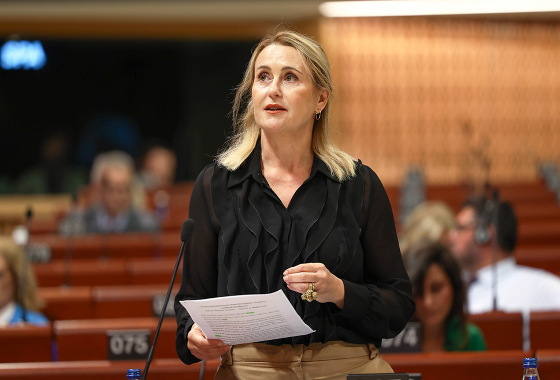
Estonia’s Minister of Education and Research Kristina Kallas, who addressed the Assembly as part of the debate, argued that AI could act as an “accelerator” which would force humans to make an evolutionary leap in their cognitive capacities. Education was key, she said: “The long-term resilience of our democracies will depend on how we regulate AI and also on how we educate people to live and participate in a society where AI is part of everyday life.”
“In a world increasingly shaped by AI, democratic societies will need citizens who can think clearly, evaluate information, exercise judgement and navigate complexity – and these capacities and skills need to be acquired at a much earlier age than they are now,” she added.
The resolution highlights both positive and negative impacts of the new technology. On the one hand, AI can “promote inclusiveness by eliminating socio-economic barriers” and improve access to public services, education and employment.
On the other hand, the large datasets used to train AI systems “can be exploited by malevolent individuals, companies or governments, for mass surveillance purposes, predictive policing, risk and social scoring, and censoring political opinions”.
The Assembly also warns that AI can be “polluted by politically based disinformation” or contain biases that could “lead to ill-informed decisions or discrimination against certain groups, such as women or minorities”. It can also sometimes “hallucinate”, generating incomplete or misleading information.
The parliamentarians urged Council of Europe member and observer states to ratify the Council of Europe Framework Convention on Artificial Intelligence and Human Rights, Democracy and the Rule of Law.