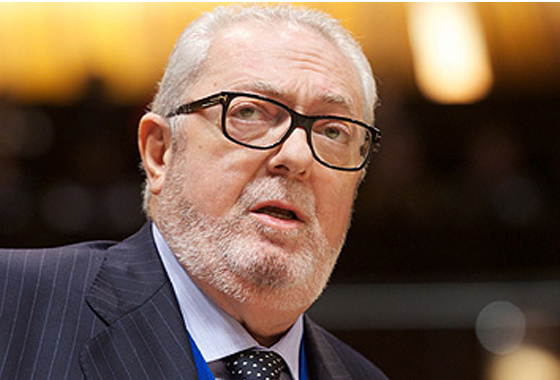
Spain, EPP/CD, President of the Assembly
12:01:15
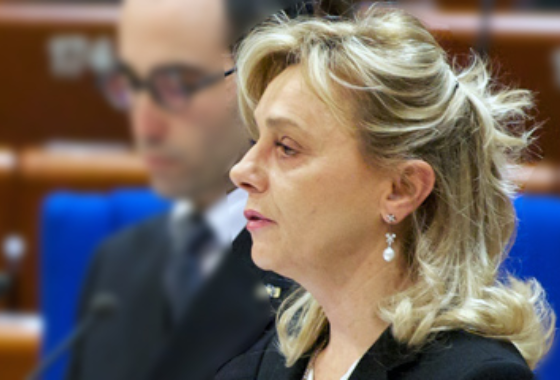
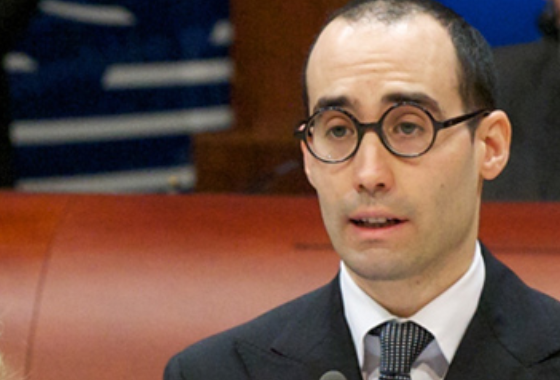
We now have the honour of hearing a statement by Their Excellencies, Ms Lorella Stefanelli and Mr Nicola Renzi, Captains Regent of the Republic of San Marino.
Your Excellencies, it is a great pleasure and honour to welcome you to our Chamber. Ms Stefanelli, it is always a special pleasure and a source of pride to welcome a member of our Assembly in their capacity as Head of State. It has been 14 years since the Captains Regent have addressed our Assembly, and we look forward to listening to your views on the challenges faced by small States in Europe. You can no doubt share with us your extensive experience in the importance of having friendly relations with our neighbours. In that context, I would also be interested to hear your views on the question of defending cultural specificities and identity. I thank you once again for being with us today. Your Excellencies, you have the Floor.
Mr President, Secretary General, honoured members of parliament, excellencies, ladies and gentlemen, the Regency would like, first, to congratulate the newly elected President of the Parliamentary Assembly of the Council of Europe and wish him every success in his job. The Regency is particularly pleased and honoured to pay an official visit to the Parliamentary Assembly of the Council of Europe today – it is the oldest of the European parliamentary institutions and it is a great honour to be able to take the Floor in the Chamber. Indeed, almost the whole of Europe is in attendance here, with its representatives, and its cultural and linguistic expressions, bearing witness to the lively diversity of our continent. It is our desire to pay tribute to this important European institution, of which we have been a part for more than 27 years, and to reaffirm our full support for, and the active participation of the Republic of San Marino in, the decision-making processes, which are part of the constant effort towards democratisation in European States.
The thousands of years of democratic tradition of our Republic, with its roots in Roman history and civilisation, which stretches back to the time of local communities that were autonomous and which is embodied in the institution which we represent still today, allows us to be numbered among the European family of nations. That family is based on the principles of the rule of law and the defence of human rights and fundamental freedoms. We are determined to make an effective and passionate contribution to this consensus. The Regency would like to reiterate the great value of the European Court of Human Rights, which represents the strongest bastion of the defence of human rights and fundamental freedoms. The Court in tandem with the European Convention on Human Rights makes up a system of protection of rights and fundamental freedoms that is without equal in other continents in its effectiveness and moral strength. It therefore goes without saying that San Marino recognises the overarching nature of the Convention, meaning that all our laws and case law, which is tantamount to law, must be in compliance with the Convention, because otherwise they would become unconstitutional.
On this occasion, we would also like to confirm the great value of all the other bodies of the Council of Europe, whose representatives regularly visit our Republic, and whose recommendations and suggestions provide a valuable input towards improving and updating our regulations. Among those institutions, I particularly wish to mention the Group of States against Corruption (GRECO) and its President Marin Mrcela, who was the official Republic orator on 1 October last, when we were sworn in as Heads of State. In his speech, he highlighted the enormous strides made by our Republic on stamping out corruption more and more effectively. That recognition carries a lot of weight, and we feel it is a further incentive to pursue our efforts and to maintain our vigilance at all times.
It is also a great honour to be here today at the first part-session of 2016, at a time when our State is depositing the instrument of ratification of the Istanbul Convention. In depositing this instrument, San Marino is bearing witness to its clear determination to say that violence against women is an odious, uncivilised attack on the person and a deep wound on the whole of humanity, and it must be opposed with the full force of the law, without any qualms. The recent deplorable episodes in Cologne show that we must keep up our guard at all times in the face of this social scourge, and that there should be no sweeping under the carpet of such acts, even when they occur in States where, predominantly, the political classes are champions of the multicultural society.
Dear esteemed members of parliament, human rights are put to a great test at this time. Our democratic societies therefore have to face major and compelling challenges: we need to reject war as a way of resolving conflicts between States in favour of dialogue; we need to cope with mass migration phenomena; and we need to respond with adequate policies to the danger of a declining faith in our democratic institutions, which derives from the fact that national and supra-national governments do not seem to be fully able to provide immediate and effective answers to the drama of new and old types of poverty and unemployment, especially youth unemployment. The economic crisis can lead on to a crisis in democracy. The current situation, which directly or indirectly affects the whole of the old continent, is characterised by upheavals and crises that are happening all the time and which deserve carefully considered political responses, because otherwise they could undermine the values of our societies, which we thought were unassailable.
It is still worth reiterating that given the challenges Europe has been facing in this century, within these walls, which represent the home of pan-European democracy, the Regency still feels very strong ties, arising because of our shared roots and the fact that the ongoing dialogue about democracy in this House feeds into constant reflection and consensus. Given our concern about the escalation of attacks on our freedom, it is vital to fight against extremism and radicalisation, which may lead to terrorism. That is the biggest priority for this organisation at the moment, because these phenomena are diametrically opposed to the fundamental values on which European societies are based: human rights, democracy and the rule of law. Any advanced democracy can see how religion is now invoked as a pretext to fight absurd battles and to achieve aims that are purely political in nature. Terrorist attacks, which recently undermined the rules under which we live together, feed an unparalleled hatred between people, and they are nothing but an insult to any form of spirituality or humanity and have no justification in whatever religion, ideology or philosophy.
In remembering the barbarous attacks that affected societies in Paris, Tunis and, recently, in Pakistan, our thoughts go out once again to the families of the many innocent victims and to the States which were the victims of such cruelty. We are facing a chilling scenario which cries out for the Council of Europe now to lead the drive to develop measures that will help us to form a collective conscience and reclaim the values of the rule of law and respect for the human person. There is a strong warning that the Regency would like to issue, even here in Strasbourg. Faced with an emergency that is without precedent and which does not allow any State, however small or big, to escape, we need a collective, concerted project to use all the resources at our disposal: the strength of the rule of law, education and general culture. Those are the only legitimate weapons that can be used by countries that subscribe to the values of the Council of Europe. These are our defence against extremism and radicalisation. We are also convinced that only through promoting and pursuing a true culture of peace and respect for others can we defeat the toxic ethos of death and violence based on hatred and intolerance between peoples. Respect for others must be based on full awareness of who we are and what our values, traditions and cultures are.
In Brussels, in May 2015, the Committee of Ministers of the Council of Europe unanimously adopted an action plan on “extremism and radicalisation leading to terrorism”, bringing to fruition the work done by the Parliamentary Assembly and the Secretary General. The decision adopted following the Paris attacks in 2015 led to specific proposals, such as further developing the annual meetings of the Council of Europe Exchange on the religious dimension of intercultural dialogue. This is all part of the fight against terrorism. Since 2008, the meetings have provided an excellent opportunity to discuss and compare questions linked to religious faith in Europe. In Sarajevo, a symbolic place for inter-religious and inter-ethnic dialogue and venue of the exchange’s recent eighth meeting, we discussed among other things Recommendation 2080 (2015) on “Freedom of religion and living together in a democratic society”. It is just one example of how the Assembly is very much engaged in defending dialogue and supporting a sustainable and long-term peace.
We should highlight the historic speech that His Holiness Pope Francis gave in this very Chamber on 25 November 2014. The Holy Father spoke of a Europe of dialogue such that shared opinions and thoughts would serve peoples who are united in harmony. On many occasions, the Assembly has firmly opposed the violence of terrorism on the basis of human rights and democratic values, and there is no doubt that the Council of Europe will continue to face up to the present situation and all its implications. The problem of terrorism is far from being resolved. We also cannot be sure that democratic forces will overcome, but they are duty bound none the less to combat radicalisation and hate, which feed violent extremism. It is necessary to strengthen our commitment and to find more effective initiatives to raise awareness of racism, hatred and intolerance. Our republic has not hesitated to support the No Hate Speech campaign, created in the Council of Europe last year, and its alliance of members of parliaments from all member States of the Council of Europe. It is necessary to set about creating an inclusive society that provides plenty of room for inter-cultural and inter-religious dialogue.
The Holy Father’s reference to the people who are arriving on our continent should motivate our thinking about the complexity of migration and humanitarian considerations. The migrant situation shows the unbreakable links between our continent and the circumstances of our neighbours, particularly those from North Africa and the East. Europe today finds itself having to manage the difficulties of uncontrolled migration and a mass exodus that are the result of confrontations that are themselves the outcome of inequities and mindless armed conflicts involving self-proclaimed terrorist States.
The Republic of San Marino does not want to be an idle bystander in the face of a humanitarian tragedy that is increasing exponentially and difficult to contain. With the force of its law and pursuant to all the norms, San Marino intends to condemn and act as a mediator. We have adopted acts and declarations from our national parliament that call for a co-ordinated response that does not ignore the countries on the front line of the issue of refugees and migrants escaping a desperate situation. We are proud to remember our friendliness in the Second World War when our State, despite its small size, was able to offer asylum for 100 000 people fleeing neighbouring countries, including the Jews who sought refuge there.
San Marino has accepted the invitation to make a voluntary contribution to the Council of Europe fund for refugees and migrants, and we have also set up various initiatives. We are also happy to announce that we have fully ratified the Istanbul Convention and have adopted all the measures necessary to combat the terrible phenomenon of violence against women. The campaign against this social scourge, including domestic violence, was launched in Madrid on 29 November 2006 under the San Marino presidency of the Committee of Ministers. It represents a commitment by member States to increased awareness at a national level. The campaign gave a further boost to the commitment to protect and promote human rights and fundamental freedoms.
The convention on preventing and combating violence against women and domestic violence opened for signature in Istanbul on 11 May 2011 and entered into force on 1 August 2014. It was created to fill a legal void and to harmonise legal measures across Europe to overcome the legacy of discrimination that undermines the success of a culture that offers equality for all. The significance and value of the Istanbul Convention to San Marino is clear, so we are happy to confirm officially today, within its natural home, the most recent ratification of the text of the convention, which happened this very month. We are now personally involved in the battle for civilised behaviour, which should be without boundaries. We also adopted measures to improve the defence of the rights of children and desire to provide a legal order, within which will be the full panoply of the most effective instruments for such a vulnerable category of people.
Our country was one of the first to sign the convention of the Council of Europe for the protection of babies and children against exploitation and sexual abuse, an international text that is aimed at combating one of the most perverse phenomena of our society, which we must continue to fight to be able to extirpate this inhuman violation of human rights. We are convinced that the protection of children should be one of prime concerns of governments, social institutions and families. There should be a global mobilisation to deal with these violations, which undermine the development of human beings. We need to defend children and protect their identity and integrity. During the current migration, there have been clear violations of their rights. More than 20 children have died in the Aegean Sea, to quote just the most recent example.
We should also mention the importance and value of culture. As John Paul II said, culture makes humans more human. Educational establishments are important and deserve particular attention. They inform future generations about the culture, in the highest sense of the word, of democracy and respect, and about the institutions and political life of the country. School should be a special place to raise awareness and share knowledge of traditions, institutions and democracy in respect of human dignity, and to bring about a civilian force for providing true education in goodness and beauty.
The Regency congratulates you, Mr President, on your recent election. I wish you all the best in the exercise of your functions. The regency is particularly happy to have the opportunity today to give our best wishes to this parliamentary institution. You are carrying out your duties on behalf of 800 million citizens in 47 member Countries. We join in mourning all the victims of the Holocaust and all the victims of the massacre of Srebrenica, one of the darkest pages of our history in the last 20 years. We must never forget what happened and we must defend peace for peoples and nations.
We pay tribute to Anne Brasseur, who was the President of the Parliamentary Assembly until a few days ago. All best wishes for 2016. After a year of indifference and crisis, we hope that this will truly be a year of hope and solidarity.
Spain, EPP/CD, President of the Assembly
12:45:35
Thank you very much, Your Excellencies, for your most interesting address.
Members of the Assembly have questions to put to you. I remind them that questions must be limited to 30 seconds and no more. Colleagues should be asking questions and not making speeches.
The first question is from Mr Allavena, on behalf of the Group of the European People’s Party.
As a representative of the only other tiny country in this Assembly, I welcome this double presentation, which was full of wisdom. What can small countries such as ours in this Assembly do to inculcate in our own countries the good practices of others, or perhaps you think we have a different part to play? What can we do about the more serious problems that face us? Are there ways in which we can hold our weight, or punch above our weight, in negotiations?
Thank you for your question, which provides me with an opportunity to say again how the values of small States in Assemblies such as this and in the Council of Europe mean that they are strengthened. In democratic institutions, we must ensure that the number of citizens is not the main feature; the main feature should be participation and the values and implementation of human rights in all our States. The role of small States should be welcomed and enhanced, particularly because they do not have major economic interests to defend. As a result, they can be free to act as mediators with regard to the situations around them, so we think it is important to belong to the major European family of the Council of Europe. We feel that it is strengthened by that.
I thank you for your question, because it is at the heart of the interests of those of us who come from small countries that are of strategic importance. The approach of San Marino is to have an ever closer rapprochement with Europe. There have been various stages. The first stage was cultural and social awareness of what this choice would mean. Then there was a period of maturity. Then there were negotiations, with a certain determination to find those goals that would be in the interests of both sides. Therefore, we do not look at this particular phase with any fear of slipping backwards. We know that, in various aspects, our role as small States is recognised for its fundamental contribution to Europe. There is also an openness on our side perhaps to give up some of our own peculiar characteristics to be able to join in something that would be of interest and value to both sides and an openness to supranational interests.
I welcome you to the Assembly. I have more or less the same question but I will pose it differently. San Marino and Monaco are establishing this special status with the Council of Europe. There are countries that are not members but involve themselves in the Assembly to be more effective on issues such as immigration. They offer, in their idiosyncratic situation as small countries, a different view or approach to solving these issues.
As you say, this question is rather similar to the first. We small countries play a fundamental role at this stage. The Republic of San Marino has, in the past few years, faced two crises, which are linked: the international economic crisis, of course, which had important knock-on effects for us; and a more structural crisis, to do with the decision to change the main assets on which the economy of the republic was based. That was a brave and important decision to take. With regard to our efforts to ensure greater integration, if other countries find themselves in the same position, we hope that we can share our experience regarding our courageous decision. We are fully aware of our counterparts. We are on a small scale, but we have our own special characteristics, and we are sure that our negotiations will have a very positive outcome.
I would like to answer the second part of your question, about the role of small States in human and humanitarian tragedies. What can small States do? We can do a lot – perhaps not a great deal in terms of hosting refugees and providing them with a haven, but a lot to raise our citizens’ awareness of these issues and of the need to be welcoming. We can provide solidarity and support, particularly of an economic nature. We are only 60 sq km, of course, and we do not have much space or any reception centres, but there are a lot of humanitarian organisations on our territory, and of course they are trying to help as many refugees as they can, as fully as they can. Our Regency aims to make a targeted appeal to our population, so that they respond generously, and show human solidarity. We hope that families can take in some of these people, and we hope to provide some State support for those who say that they can take refugees – particularly children fleeing war zones – into their homes.
On the role of small States, two years ago, the small States, including the Republic of San Marino, finding themselves in agreement on many points, set up an initiative. We agreed to present a recommendation to the Parliamentary Assembly on the need to face up to the global problem of immigration, which the few States that are on the frontline, including small States such as Greece, Cyprus and Malta, cannot deal with alone. Small States can easily play an active role in raising awareness of this great tragedy of mass migration – a phenomenon of the last year or two.
Thank you. Your ancient land – the land of freedom, as you called it – has welcomed many people. In Europe, fundamental freedoms are at risk. What can we do to fight together against the deterioration in our fundamental and human rights? I have just been appointed ambassador for the No Hate Speech campaign. I have listened carefully to what you have said, and take it that both of you will be able to sign up to the campaign. Thank you.
Of course, the Council of Europe’s activities are extremely important for us. We have been part of the campaign against hatred, and there is an important role for us in making our citizens aware of it. We are an ancient country of liberty, and our liberties are fundamental rights. If events pose any risk to the fundamental rights that we have had for thousands of years, we will work together effectively through dialogue and public awareness – they are the key to everything – to resolve issues, using frameworks such as the No Hate Speech campaign. In our charter of rights, we underline the importance of dialogue, opposing war, and dealing with the issues that are critical to our times; we can do this through the Council, by taking action in our republic, and through the international community. There ought to be inter-cultural and inter-religious dialogue. We must repudiate war above all; that ought to be at the core of our dialogue.
Whether we are talking of San Marino, Andorra, Monaco, Luxembourg or even the United Kingdom, there is a huge difference between legal tax avoidance and illegal tax evasion. What more do you think that all Council members can do in their respective countries to increase transparency in banking, while ensuring that large companies and very wealthy individuals pay the tax that they should pay, so that we can run our countries?
Thank you for your question, because it allows us to remind colleagues of the great steps our republic has taken on this issue, which is of course very delicate; since 2008 and 2009, it has been at the forefront of our considerations. We have adopted a clear approach of transparency – of being open to all international bodies, in complete accordance with international laws and standards. I am sure that you can recall various past situations. This issue involves fighting corruption, setting up support structures, and avoiding complicated structures. There are costs for the countries that take this route, but that should not deter leaders and populations from adopting this important approach. We have to be able to succeed in embodying these aims. We have to further examine the issue in future, too.
I recall that, after the Council of Europe summit in 2005 in Warsaw, negotiations started between the Council of Europe and the European Union. We still have to thank you, because it was the San Marino presidency that was finally able to arrange a memorandum of understanding between the two organisations. Almost 10 years later, how do the Captains Regent evaluate the development of the co-operation between the European Union and the Council of Europe? Would the San Marino Government support the organisation of a fourth summit of Council of Europe Heads of State and Government, as proposed by the Standing Committee in Sofia last year?
It is an invitation that we accept with great excitement and enthusiasm. The Government of San Marino supports the idea of a fourth summit and would very much like to undertake its organisation. Why not? The question emphasises some of the responses that we have given about small States and the roles that they can play. Our activities over the last couple of years have served some important causes.
The Council of Europe and the European Union are a reality not only for the European continent but much broader in world economics and humanitarian activity. One major institution complements the other, and they are important for economic development. The co-operation agreement has served all very well, and anybody who refutes that argument can be proved false.
Everybody asks what small countries can do for international organisations to solve problems that big countries cannot solve. My question is the opposite. What are your expectations of what the bigger countries can do to help you feel a respected and fully fledged member of international society?
That question gives us the honour to state what we can offer within a larger community. Our sovereignty is guarded on a daily basis; that is an important battle. Numerous events show again and again the role of small States in large forums such as this.
Our history shows the role that we have played in immigration and taking in refugees, which tells us about the importance of small countries. Emigration is important too. Part of our population had to leave San Marino after the war in search of new opportunities, and for that reason many of our citizens no longer reside within our territory. We have hosted large waves of immigrants during the major world conflagrations because of our neutrality in those conflicts. Many people have sought refuge in San Marino. There is a museum dedicated to immigration in San Marino that records our experience of major movements of population, and tells us all something about the importance of those events in the history of both San Marino and the world. The role that we have played with regard to those movements of peoples must be alive in historical memory. It is not only something of the past, but very much the reality today. Our contribution is valuable; there is no question about that.
You said that San Marino finds itself in a process of transformation because of its financial status. Does that have any effect on the budget? What measures are you taking? You talked about your integration into Europe. Are you interested in the European Economic Area?
I tried to explain this before, but the question provides me with an opportunity to reiterate it. Our brave and firm decision – we do not want to go back on it – has had considerable impact on the State budget. It is not a concern but an observation: the choice must remain irreversible and we must remain resolute. We need to explain to our population of 33 000 what the choice involves, what its down side will be, and what possible new developments for our economy might lead on from it.
Perhaps I can respond to the previous question too. We want an audience, because we are convinced that internationalisation pursuant to the rules of transparency might open up new possibilities, give a boost to our economy and attract foreign investors. That is important for our country and we will, of course, follow the rules of transparency when dealing with international and supranational organisations.
We are clear that this is a choice that may involve considerable sacrifices for our population. None the less, we stand by it resolutely. We want to emerge from the two crises, one of which was a structural crisis, while the other was a specific momentary crisis. We are changing the strategic assets of our country, although that will not provide an immediate response to the global crisis. Our country was helped by the supranational organisations of individual States, which may be able to offer further assistance.
The economic area is part of the ongoing negotiations. There have been various phases and, in recent years, close links with the European Free Trade Association (EFTA) have given us an opportunity to consider possible means of integration with other States. We are looking further into those possibilities. Further steps have been taken and we have to bring up to speed our – how shall I put it? – special, privileged position with regard to the proposals made by EFTA and other European bodies.
Spain, EPP/CD, President of the Assembly
12:45:35
Thank you, Mr Renzi. That brings to an end the questions to their Excellencies. On behalf of the Assembly, I thank them most warmly for their address and for the answers given to questions.