Good morning, Ladies and Gentlemen.
Formally, we must now say: the meeting is open.
Dear Colleagues,
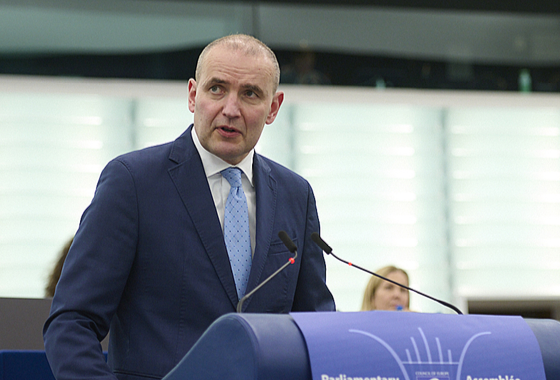
I now have the privilege and honour to welcome amongst us His Excellency Mr Guðni Th. JÓHANNESSON, President of Iceland, who will address us in a few minutes and has also kindly accepted to reply to questions from our parliamentarians.
Your Excellency,
Mister President,
In a few days your beautiful island will be the centre of focus of Europe with the 4th Summit of Heads of State and Government of the Council of Europe taking place in Reykjavík on 16 and 17 May 2023. You will have us, the parliamentarians, the day before, when we are going to meet with our Standing Committee in your beautiful capital.
This, Mister President, will be a historic opportunity for European leaders –almost all European leaders, I hope, to the Secretary General, yes– to reaffirm their unity around common values, express their support for Ukraine, demand the Russian Federation's accountability and launch a renewed forward-looking agenda for the Council of Europe.
Mister President, it will be the moment to reaffirm our commitments to the European ideal expressed by the Council of Europe's founding fathers in the preamble of the Statute of the Council of Europe, and I quote, "convinced that the pursuit of peace based upon justice and international cooperation is vital for the preservation of human society and civilisation".
Big words set in the aftermath of the biggest disaster that ever happened to us.
Mister President,
You declared when taking up office in 2016 that "there is one thing that applies to all nations, in Iceland no less than elsewhere, that what unites them must be stronger than what divides them".
It is with this hope for unity and a general genuine spirit of co-operation that we will continue the road to Reykjavík and, hopefully, establish a new long-distance path for European collaboration in the future.
As your former Icelandic President, and the first woman on earth to be elected head of state of a government, Madam Vigdís Finnbogadóttir said, "we are all as citizens of the world duty-bound to contribute to our utmost ability to the continuing progress of the spirit of humanity".
Wise words of a wise person.
Our Europe, Mister President, deserves its leaders now to meet the present extraordinary challenges to peace and security in the best possible ways.
There's no better place to do so then in Iceland, in Reykjavík.
Your Excellency, may I invite you to take the floor.
The floor is yours.
Thank you, Mister President.
Madam Secretary General, Madam Secretary General of the Parliamentary Assembly, distinguished parliamentarians, distinguished ambassadors, góðan daginn.
I am honoured to address you all. I am honoured to represent my country with representatives from other countries. I wish those of you who will travel to Iceland next month a safe journey, and a pleasant stay – I don't know how good the weather will be! – but I know that you will be most welcome.
And yes, I am here to represent my country. What does that mean? "My country, right or wrong". This old phrase can still be heard, or at least the sentiment that your country's interests always come first, no matter what. If not your own country's interests, whose interests then? But this cannot be the only correct approach. We need to talk about independence, and interdependence. We need to talk about nationalism; the need for nationalism – but also, the dangers of nationalism.
I believe that the Council of Europe is the perfect venue for such considerations. After all, it was founded by independent states in the wake of the Second World War, in order to safeguard and promote fundamental values and principles: the principles of democracy, human rights, and the rule of law – principles of interdependence.
In this regard, I commend the Parliamentary Assembly for its swift response to Russia's invasion of Ukraine. We must continue to condemn this violation of international laws and norms. Therefore, let us all hope that the Reykjavík Summit next month will deliver clear results: a renewed commitment to our common democratic values, strong support for Ukraine, and solid means to ensure accountability for crimes committed in this horrendous war.
I refer here to remarks made by the foreign minister of Iceland in this hall two days ago about a Register of Damages under the auspices of the Council of Europe, but with the broad support of leading world nations. Iceland counts on your continued support for the enlarged partial agreement.
Dear parliamentarians, dear ambassadors,
The Russian aggression in Ukraine highlights the evils of extreme nationalism and the abuse of the past for political purposes in the present.
There was a time in recent years when influential policymakers and scholars suggested that we were entering what was called a "post-nationalist world"; the Soviet Union had collapsed, the map of Europe had changed, the process of European integration was deepening.
As it happened, this thinking was fairly euro- or west-centered. And it was also short-sighted, and misguided. Today, you will instead hear statespersons, politicians and others talk about the rise of nationalism, for better or worse.
Allow me to recount a personal and positive anecdote about the recurring strength of nationalism. I am a historian by profession, and a number of years ago – well before I became president – the Association of Icelandic Historians, of which I am a proud member, announced an evening symposium on the end of nationalism. Admittedly with a question mark: the end of nationalism? This promised to be an interesting event. When the scheduled day arrived, we all received an email, saying that unfortunately the planned evening meeting on the end of nationalism had to be postponed.
Why?
Well the thing was, that Iceland's national team had a very important game that evening... and absolutely nobody was going to attend a symposium on the end of nationalism. We were going to cheer on our beloved team.
So nationalism is not nearing its end. But it must be a positive force. Positive patriotism can and should foster solidarity and support for each other in our societies. It should enhance our love and care for our nature and environment; it should connect our past, present and future, it should maintain and strengthen our diverse languages, cultures and customs.
At the same time, independence and interdependence must go hand in hand.
We Icelanders, for instance, we could never survive on our own in an island in the middle of the Atlantic. Independence is not about isolation.
And together, we must never forget the dark side of extreme nationalism; the disaster that befalls people when positive patriotism is replaced with distrust, racism and xenophobia, with fear and hatred towards others. This we have seen in the past, and this we can see today.
Therefore, our patriotism must be tolerant and inclusive. In my country for instance, all citizens who want to live in peace with others, should be able to call themselves proud Icelanders, regardless of their skin colour or faith, regardless of other beliefs, or whom they want to love, regardless of how well they speak the Icelandic language, regardless of all other factors and labels that can't be used to divide people into us and them.
Esteemed parliamentarians,
As I mentioned, I am a historian by profession, and by passion. But I am also a head of state. This combination can be problematic, believe me. It could be argued that as representatives of our respective countries, it's almost written in our job descriptions to be positive, to be optimistic, to advance the interests of our own countries.
Could you imagine if I were to begin my New Year's address by saying, "My fellow Icelanders, you aren't that great at all... My dear friends, this year is not going to be good."
No. But when you are an academic, you are meant to be critical, open-minded, and you're meant to never think first, what is best for my state. So, as I said, it can be problematic to be a head of state with a background in history, but it is also an asset, believe me.
So, I am fine with advancing the interests of my wonderful country – but with a caveat. We should combine our positive and optimistic patriotism with constructive criticism. An honest look at ourselves. People with healthy self-confidence do not brag. They do not belittle others in a mistaken effort to make ourselves more grand. They do not shy away from admitting their own weaknesses, and failings.
But at the same time, people with healthy self-confidence can talk about their achievements and aspirations. They have only to spur others on. During this visit to Strasbourg, gender equality will be high on my agenda; and it is high on the agenda of Iceland's foreign policy.
Iceland and gender equality: this connection does not come out of the blue. Yes, we are a small nation. A sovereign state of fewer than – well how many are there? There's me, lots of a good people here around me, the Icelanders – altogether less than 400 000 people.
Some things we happen to do very well, others not well. But when it comes to increased gender equality, we Icelanders have been doing fine. Actually, better than most other nations – or even, perhaps better than all the others, to judge from studies and assessments in recent years. In this field, we are leaders. We don't even need our beloved per capita to add to that!
If you visit Iceland you will learn that we Icelanders love per capita. We love per capita statistics; it makes us a bit more grand. We have more per capita statistics than any other European nation – per capita. Longest river in Europe... per capita. It makes us grand.
But, our success when it comes to gender equality is not because we are better than others. It's more a case of proven results, because the truth is, ladies and gentlemen, that gender equality is not only a matter of fairness. It is not only about human rights. Those are not the only reasons why gender equality is among the UN Sustainable Development Goals, goal number five.
No, gender equality is also a matter of objective interests. Increased gender equality benefits everyone. When we all have the same opportunities and rights to show what we are capable of, society as a whole benefits. If justice is not considered a good enough reason, then surely money is.
People prosper better in their working lives when domestic responsibilities are shared. If one half of a population is undervalued, and not given the opportunity to show their full potential, the whole community suffers. The more gender equal a society is, the more healthy and happy its people are, and the more prosperous as well.
To be sure, there is still work to be done back home. There will always be work to be done. We still have to deal with domestic and sexual violence where the victims are predominantly women.
Fortunately, we do have the Istanbul Convention. I am pleased to mention it here, among members of the Parliamentary Assembly of the Council of Europe.
It is now more than a decade since the Committee of Ministers adopted this landmark treaty to end violence against women. It is sad to note, however, a rise in mistaken objections to a convention about an end to violence! So I encourage all member states to sign and ratify the Convention. And I repeat what I just said: that there will always be work to be done.
With that in mind, the Icelandic Presidency of the Council of Europe has organised a conference later today, on the role of men and boys in combatting gender based violence, and working in general for gender equality and human rights. I'd like to invite you all to join us for this event.
Again, and finally, I am grateful for this opportunity to address you, distinguished parliamentarians.
I take the opportunity also to thank the ambassadors present here for your help in gathering support from your governments for the Reykjavík Summit. Also, I express my thanks to Madam Secretary General, to the Secretariat of the Committee of Ministers, to the Parliamentary Assembly, and to you Mr Tiny KOX, to the Secretary General and the whole Secretariat for the excellent co-operation that we have enjoyed during our presidential term.
I will also use this opportunity to thank our small but efficient team here in Strasbourg. We're working so hard ahead of the big summit in Reykjavík. Yes, in three weeks or so, European heads of state and government will gather in Iceland at the Council of Europe's fourth summit since its establishment.
Let us hope that it will be a fruitful gathering, to the benefit of the peoples of Europe. What I know for certain is the established truth: while the Council of Europe may not be the centre of power on this continent, it can and should remain its conscience.
Thank you. I look forward to your questions. Þakka þér fyrir. All the best.
Thank you very much, Mister President, for your, indeed, most interesting address and also thank you very much for praising everybody here in the hall.
I was looking here to the ambassadors. They felt great. I was looking to our colleagues, and I was looking here. Thank you very much. We will want to praise you for being here and for being so confident that the preparation for the Road to Reykjavík is on its way.
That is good. the President said while his microphone was not functioning that nothing can go wrong. I thought that this was interesting! We had some problems with our machinery during the week.
Thank you very much, Mister President, and as you also said you are also willing to take questions. I remind members that questions must be limited to 30 seconds and that questions are not speeches.
Firstly, I call Mr Kimmo KILJUNEN from Finland. He speaks on behalf of the Socialists, Democrats and Greens Group.
You have 30 seconds, Kimmo.

Finland, SOC, Spokesperson for the group
14:56:39
Yes, Mister President.
As we all know, the Council of Europe unites the whole of Europe behind the common values of human rights, democracy and the rule of law. All of Europe except two countries, Russia and Belarus, which are not eligible.
Nevertheless, there is one exception: a small country, Kosovo.
Mister President, I will ask you as a historian, how you assess the aspirations of Kosovo, especially Kosovans, to have access to our organisation, our value-based family with its normative system.
Thank you, Mister Kimmo KILJUNEN.
Mister President?
Thank you, friend from the Nordic region.
Yes, I understand that the Council of Europe is already working in Kosovo on human rights and democracy. Of course, for any country, membership has the potential to greatly increase human rights, democracy, and rule of law for the citizens. That is what I can say in my capacity as head of state. I would have to refer to a more detailed description of Icelandic attitudes towards the possibility for Kosovans to be part of the Council of Europe human rights system to representatives of Iceland here or the government of Iceland.
Thank you.
Thank you, Mister President.
The next question comes from Mr Emanuelis ZINGERIS from Lithuania. Emanuelis speaks on behalf of the Group of the European People's Party.
You have 30 seconds, Emanuelis.

Lithuania, EPP/CD, Spokesperson for the group
14:58:26
[...] yes, thank you so much.
Mister President, Iceland is a leading nation if you are talking about freedom in the world.
You talk about the Istanbul Convention.
During the bombing, the Ukrainian Parliament adopted the Istanbul Convention during the war. During the bombing of Kyiv. We viewed your Reykjavík Summit hosted by you and your fantastic team as a landmark, after 17 years.
My question to you will not only be about the register, which is a fantastic achievement for damages and accountability, and a large partial agreement, but about the International Court of Justice.
We need to find the formula. We expected from your side to circulate, from your government, respected government, to circulate the formula and to sign that like an open document.
If possible, I would like you to say a few words about that.
It will be an historic summit, if you will have those two elements.
Thank you so much for your support for freedom.
Thank you.
Sorry for interrupting you, but we need to stick to the 30 seconds.
Mister President.
Yeah, I can easily give very short answers if you want me to. And in this particular case, Iceland follows developments, of course, closely when it comes to a possible special tribunal, but we have joined a group of states working on the practical and legal issues at stake, and Iceland will always support Ukraine. There can be no doubt about that.
Regarding, however, the possible inclusion of a language on this in the Summit outcome document, again, I refer that issue to the Icelandic Presidency, but I think they will be tight-lipped until the negotiations have concluded. So: no revelations now.
The next question comes from Mr Damien COTTIER from Switzerland on behalf of the Alliance of Liberals and Democrats for Europe.
Mister COTTIER?

Switzerland, ALDE, Spokesperson for the group
15:01:03
Thank you, Mister President.
Mister President, first of all, let me on behalf of the Alliance of Liberals and Democrats for Europe group thank the Icelandic Presidency of the Committee of Ministers for the remarkable work that has been done in the presidency and also for preparing the summit of Reykjavik. The road will lead us to Reykjavik but it does not stop in Reykjavik. There will be other steps further, it goes further.
And my question would be, do you agree that it would probably be wise to put an appointment clause in the declaration to already prepare the next summit, to take stock of what has been decided and prepare for the future?
And the second question, as a historian myself, I am very glad to ask the question to another historian, if the Declaration of Reykjavik wants to leave a mark in history that it should address very important issues for the world and for the youth, like the environment and the human rights and artificial intelligence and its impact on human rights.
Thank you very much, Mister Damien COTTIER.
Mister President?
Thank you very much.
And I allow myself to agree with you that the Icelandic team has done a wonderful work, but not alone, because this is a team effort as well within the Council of Europe.
So, thanks to my good Icelandic friends should also be extended to others involved in the preparation of the summit.
And I would allow myself to agree that it would not be a stupid idea to start thinking about the next Summit, whenever that may be.
These Summits do not happen very often, as we have seen from the past, but the better prepared you are, the more likely it will be that you will get a positive outcome.
And maybe this is something that our good friends in Latvia have also already given consideration to, taking over the presidency from us in Reykjavik. And I wish them all the best.
There is a cliché saying about us Icelanders that we do not like planning that much, we just go into things and see how things happen. I allow myself to express a dissenting opinion: I think the preparations over this Summit have shown that we're okay at organising as well.
Well, thank you very much, Mister President.
The next question comes from Mr Zsolt NÉMETH from Hungary, and Zsolt speaks on behalf of the European Conservatives Group.
Zsolt.

Hungary, EC/DA, Spokesperson for the group
15:03:32
Thank you very much to both presidents.
My question would follow up a bit with what was said by Mr Damien COTTIER.
President, I am behind you actually, in this direction behind your back. We had our last summit 18 years ago. And I think in the past couple of weeks the Council of Europe has proved that it is an important international organisation but we feel that without the summits, this organisation is lagging behind the other international organisations.
So do you see it, by your own understanding, that we should establish a regularity for the summits to be organised by the Council of Europe? And if so, what kind of regularity would you prefer? I believe it is not just an important job for the presidency but for the Committee of Ministers, for the whole Parliamentary Assembly, to move on with this subject.
Thank you very much.
Thank you very much, Mr Zsolt NÉMETH.
Mister President?
Yes, I think it's best to be honest. I say, to begin with, that I have not given this any thought and, secondly, I shouldn't give it any thought.
It is not my role to make suggestions in this regard. I just say this in full friendship. I believe that it would be appropriate for the Council of Europe, for the Parliamentary Assembly, to maybe look into this.
First and foremost, having said that, I should think that summits should be relevant and with an outcome, with an idea, with a need, not just hold a summit because an X number of years has passed or something like that.
As we are witnessing today, the Reykjavík Summit ahead has a clear agenda. We are all determined to see visible, viable, tangible results from that Summit. That might be the indirect outcome as well that we will all see together that a summit of this kind can be a positive step. Therefore, we should consider holding another one, not only after 18 years, but maybe slightly before, because there will always be challenging tasks ahead of us.
There are some outcomes we'd like to see. The Icelandic Presidency has placed a priority on reaching an agreement on a strong language on human rights and the environment and some form of concrete action in this area. We did mention the register of damage, maybe a text to support the children of Ukraine, and so on and so forth.
While holding the Summit itself is a viable constructive outcome, we also foresee some lasting declarations that will have a positive impact on this continent.
Thank you, Mister President.
The last question on behalf of the political groups comes from Mr Andrej HUNKO from Germany. He speaks on behalf of the Group of the Unified European Left.
Andrej, 30 seconds.
Thank you very much, Mr President,
Iceland has always been a beacon for journalists' freedom and also freedom of information.
The journalist Julian Assange has now been sitting in a maximum-security prison in Belmarsh for more than four years awaiting extradition, where he faces 175 years imprisonment in the United States.
We have repeatedly called for his release because the case is a dangerous precedent for journalism worldwide.
What can the summit in Reykjavík do, what signal could Reykjavík send here?
Thank you very much.
Thank you, Mr Andrej HUNKO. [in German]
Thank you for this question. [in German]
I'll reply in English, a few months ago, I had a meeting with a fellow Icelander, Kristinn Hrafnsson, I guess we can call him a representative of Julian Assange. Iceland is and will remain firmly committed to the protection of journalists and media freedom.
On this specific case and its connection to the European Convention on Human Rights and the Council of Europe, I asked in cases before here, I would refer you to the Presidency of Iceland in the Committee of Ministers.
Let me reaffirm that we are committed to the protection of journalists and media freedom.
Thank you.
Thank you, Mister President.
If you allow, we will now take three questions together in order to make it, perhaps, possible to accommodate all the people who have asked for the floor.
First, I give the floor to Ms Catia POLIDORI from Italy.
You have 30 seconds, Catia.
Thank you, Mister Chair, Mister President.
I took part in the meeting in Reykjavik of our Standing Committee that was to prepare the forecoming summit of heads of states. Among the many topics was that of combating violence against women, as you just said. I think that at the time, when the ongoing wars have highlighted the social drama even more, at such a meeting, it is impossible not to talk about it.
What do you think about this topic being present and relevant?
Thank you.
Thank you, Madam Catia POLIDORI.
The next question comes from Mr Ahmet YILDIZ from Türkiye.
Ahmet.
Thank you, Mister President.
Mister President, the record of the international community, especially the countries here, was not a good one during the migration from Syria. We did better after the Russian aggression on Ukraine but these migration influxes may continue due to climate change, crises, and conflicts like from Afghanistan, from Eastern Africa.
What would your suggestion be to best manage this, should we expect this? And should we include this in the Summit documents in your country?
Thank you.
Thank you, Mister Ahmed YILDIZ.
Now the last of these three questions comes from Mr Oleksii GONCHARENKO from Ukraine.
You have 30 seconds, Oleksii.
Mister President,
I would like to thank Iceland for recognising last month the Holodomor as a genocide of the Ukrainian people, but I want to ask you to take the next step to recognise what's going on now in Ukraine as a genocide. Something is more important than just speaking about history to prevent what's going on now.
Also, I would like to invite you to Ukraine. You haven't been to our country, and I think it's something which should be changed. I also would be absolutely happy to host you not only in Kyiv, but to see you, for example, in my native city Odesa.
Welcome.
Thank you.
So, you got an invitation and three questions, Mister President.
Thank you all.
I appreciate the questions. If I may begin with the invite, thank you very much for the kindness and hospitality. I certainly appreciate the invitation and would certainly be willing to accept it.
Now, if I begin with your question, Madam Catia POLIDORI from Italy. Yes, I was determined to mention gender-based violence and the need to combat gender-based violence in my speech to this esteemed gathering here. This is high on the agenda of the Council of Europe, as it is in people's minds in Iceland. As to the agenda of the Summit, I cannot commit to anything there, it is not my role. I hope I have managed to convey here in my speech, the high priority authorities in Iceland and the people of Iceland put on the need to combat and end gender-based violence. I would not be surprised if you could see some proof of that in Reykjavík in May.
As for the migration crisis and connected issues, I would again refer to representatives of the Government of Iceland and the Presidency of Iceland in the Committee of Ministers. Let us just keep in mind the relationship between climate change, migration, the refugee crisis and also the relationship between independence and interdependence. If we are going to solve the pressing challenges that face us all together, we need to act in unison. We need sometimes to make compromises, but we need to see the greater good. Again, how do we do that? We do that by convening, we do that by having a venue where disagreements are voiced, and where agreements are reached. The Council of Europe is a perfect venue for such deliberations.
Finally, thank you also regarding Ukraine and the connection between the past and the present. I am convinced that while I cannot pinpoint in detail how the war of aggression in Ukraine will be addressed at the Reykjavík Summit, what is absolutely clear is that the support of Iceland and – dare I say or may I say – the Council of Europe also will be manifest at the meeting.
As I conclude, I thank you for your attention. As Head of State, it is an honour every day to represent your country. When I think also about this venue, I see representatives here from other countries in Europe. I hope that you will also feel the honour that this brings but, as well, the responsibility.
I wish you all great success in your valuable work for your home countries but also for the people of Europe and humankind in general.
If there are any questions coming, I would be happy to answer them as well. Let us see how the wind blows.
Mister President,
You are surprising us, because our members ask 30-second questions. You've managed to answer concretely, and we still have time left.
If you allow me, I would take three more questions at least.
No, no, no, please, continue, we will celebrate this fact, because our members all want to ask questions and get their answers. Now we are on the right track.
I take three questions.
The first question comes from Mr Rafael HUSEYNOV from Azerbaijan.
Rafael, 30 seconds.
Thank you, President.
Your Excellency, according to a number of studies, Muslims in different parts of Europe are increasingly facing hatred along with discrimination in many areas, including the government, housing markets, education and healthcare.
Findings show that there is still a lack of awareness of racism and discrimination against Muslims in societies. Obviously, there is needed for sensitisation, for more information at all levels as well as strong public condemnation of this phenomenon.
How do you assess the overall situation in this area and what could be done in practical terms to address this situation and ensure more harmony throughout the directly concerned societies?
Thank you.
Thank you, Rafael.
The next question comes from Mr John HOWELL from the United Kingdom.
John.
Thank you, indeed.
Mister President, outside of the Summit, what one thing would you see as the abiding legacy of the Icelandic Presidency in terms of the role that the Council of Europe will play in European affairs?
Thank you, John.
And the last question in this cycle of three comes from Mr Bernard FOURNIER from France.
Bernard, the floor is yours.
Miste President,
In a lecture you gave at Cornell University last November, you stated that nationalism is a powerful force in all societies, but that, according to your definition and understanding, nationalism must be inclusive, tolerant and understanding. Unfortunately, this ideal definition is not the one we see at work today in Europe.
I would like to hear your analysis of the resurgence of exclusive, even aggressive, nationalism in Europe and the role that Iceland could play in promoting the appeased and inclusive nationalism that you call for.
I thank you for your analysis.
Thank you, Mister Bernard FOURNIER.
Mister President?
These three questions are quite challenging, but let us try to rise to the challenge when it is ahead of us.
All right.
The issue of Islam and a rise in intolerance.
I'll be short here, brief: but 1 000 years ago the chieftains of Iceland gathered and determined that to avoid civil war, there could only be one law in the land, and one religion in the land. They cast away the old gods Odin, Thor, Freyja, Fricka, and said now we believe in Christianity.
One religion, one law.
Some 1 000 years later, we need to construct societies where, yes, we still have one legal code, one law, that everyone should abide by. But 1 000 years on, we can have many customs, many faiths; one law, many customs.
Religion must never surpass or supersede the law of the land. We should be accommodating, understanding, and never accept or tolerate discrimination based on faith.
I agree that we need to take measures when it is obvious to all that religious discrimination is ahead of us. You will find support for that in Iceland.
As for the question regarding one outcome of the Icelandic Presidency, leaving the Summit itself aside.
Well to begin with, I'd be happy to say if we can look back and say we did okay, we did well, that would be a satisfactory outcome. You can also pinpoint exact or precise achievements. Have we put something on the agenda that would not have otherwise been on the agenda? I cannot say so with full conviction, because we do not know what would have happened if somebody other than Iceland had been now in the row of nations taking over the presidency. But, we took on this responsibility.
We can say that we delivered. To have the summit, as well, is quite an achievement, so I'm happy to conclude it there.
For the question regarding nationalism, the answer there can be given in minutes or hours or even more.
What I would just repeat and emphasise is the lasting need to emphasise the positive aspects of unity and togetherness of people, where we can speak of nationalism or positive patriotism.
At the same time we need to combat the potential for xenophobia, racism, mistrust, hatred, and intolerance that can take place, that can happen, as history demonstrates, and as the world today demonstrates.
Five years ago, or so, I had the honour of attending a summit in this country, in France, in Paris, where we gathered representatives of various states 100 years after the end of the First World War. The President of France, the host, gave a speech on the evils of extreme nationalism.
Yet, – and he did so rightly and justifiably, and equally rightly and justifiably – he ended his speech with the words "Vive la France!". ["Long live France!" in French]
This you can combine. You can combine your willingness to condemn extreme nationalism, but at the same time, show an affection and love for your country.
If we are unable to do that, then I think we increase the risk of greater polarisation and strife in our society and in this continent as a whole.
Thank you, Mister President.
Now we are going to try to finish the whole speakers list. I take four questions. Everybody has 30 seconds. Then you have a few minutes left to answer, and the Assembly will be more than grateful to you.
The first question comes from Mr Enis KERVAN. He represents here the Assembly of Kosovo. You have 30 seconds, Enis.
I do not see him here. The next question comes from Mr Nicos TORNARITIS from Cyprus. You have 30 seconds, Nicos.
Mister President,
I would like your opinion on how best we can ensure that double standards will not prevail in the face of our common challenges. Violations of international law cannot and should not be tolerated, whether these occur in Ukraine, Cyprus, or elsewhere.
Thank you very much.
Thank you, Mister Nicos TORNARITIS.
The next question comes from Ms Yelyzaveta YASKO from Ukraine.
You have the floor.
Dear President.
The next debate we will have is unfortunately about the deportation of Ukrainian children illegally to Russia. I want to ask you a question. What international tools of international law do you see will help us to return them back to Ukraine – maybe not now but after some time?
Thank you.
Thank you so much.
The last question comes from Mr Yuriy KAMELCHUK, who is also from Ukraine.
Yuriy, you have 30 seconds.
Thank you, Mister President.
Ukraine is grateful to you for your support and shelter and for Ukrainian families in Iceland. We also looking forward to the Summit in Reykjavik and I am also inviting you to Ukraine to visit Kyiv, Bucha, Irpin and other cities.
Now in the conditions of war, it is very important for Ukraine to preserve our own independence, not only territorial but also economically, and of course, if there were no financial help from all the world, it would be very difficult for us and we have reconstruction and restoration ahead of us. Tell me, what helped your country in difficult economic times to maintain a sober mind and make the right economic decisions?
Thank you.
Thank you, Mr Yuriy KAMELCHUK.
Mister President, you have 4 minutes left to answer these most simple questions that you just got from our colleagues.
Thank you very much.
If I begin with the question from the representative from Cyprus: a small country like Iceland, if there is anyone who relies on the principles of international law and that international law should apply equally to everyone, then it is a country like Iceland.
So we agree with everyone who wants to make sure that double standards do not prevail in the face of the numerous challenges we face. The history of Iceland demonstrates this. If power rules supreme in the world, if force is the tool that works, then the future of Iceland is not bright.
So, let us make sure that the principles of international law prevail. And they need to be defended! And how can you do that? From Iceland, we don't have an army. If that is the question, if power and force are the determiners of the international system, as I said, then we can pack up. And that is the reply to that question. I could go in detail there with a detailed description of how Iceland has managed to create a sustainable welfare state. It all boils down to this. We must be able to rely on international norms and international law treaties and obligations, and therefore we will stand with all who understand this.
As for the question raised about children in Ukraine forcibly deported, if that is the correct phrase that should be used, I am sure that this issue will be raised at the Summit in Reykjavik. And, as for Iceland's support in general, we have a two million pounds contribution to the UK-led international fund for Ukraine, and this recent announcement brings Iceland's total contribution to 3 million pounds. It may not seem big in the largest scheme of things, but keep in mind the relative size and smallness of Iceland.
We're likely to provide additional funds to the NATO comprehensive assistance package, I read here, and we channel economic and humanitarian support through international partners, the World Bank Funds, and United Nations entities.
We want to support the rebuilding of Ukraine's energy infrastructure through the Ukraine energy support fund and by sending energy equipment.
Now, and as the foreign minister of Iceland said in her speech here on Tuesday, Ukraine will be the focus of the upcoming Summit of Heads of State and Government. Both in the agenda and when it comes to the substance.
And the foreign minister made it a priority of her presidency to ensure that the Summit outcome includes meaningful support for Ukraine and especially when it comes to the issue of accountability, as we have outlined here before.
I understand also that Ukraine will be the focus of the working dinner of leaders organised by the Prime Minister of Iceland.
And, finally, to answer both questions regarding Ukraine, I understand that the Committee of Ministers is working on a text to support the children of Ukraine.
Thank you.
Thank you very much, Mister President.
That brings us to the end of the list. This is a great thing for me that I do not have to say that I have to interrupt the list of speakers, you managed to answer all speakers and that, I think, according to our Secretary General, that is a record. So you can take that home with you to your beautiful country of Iceland. But no, absolutely, you did answer all the questions that we had on our list. We are now looking forward to going further on our road to Reykjavik. You said that everything is under control. We have already bought our tickets and made our reservations in the hotels. The Committee of Ministers is preparing the final text. The Standing Committee will be there with you and I am looking forward to seeing you over there on your beautiful island. And thanks again for addressing this Assembly with your wise words and answering our questions. Thank you very much. Have a safe trip home.
The next item on the agenda is a debate under the urgent procedure on “Deportations and forcible transfers of Ukrainian children and other civilians to the Russian Federation or to Ukrainian territories temporarily occupied: create conditions for their safe return, stop these crimes and punish the perpetrators”. You will find it in Document 15748. It will be presented by Mr Paulo PISCO on behalf of the Committee on Migration, Refugees, and Displaced Persons. We shall also hear an oral opinion from Ms Carmen LEYTE on behalf of the Committee on Social Affairs, Health and Sustainable Development.
After the rapporteurs, Ms Olena Volodymyrivna ZELENSKA, First Lady of Ukraine will make a statement. Ms ZELENSKA will address us online.
In order to finish by 5:30 p.m., I will interrupt the list of speakers at about 5:00 p.m. to allow time for the reply and vote on the draft resolution and recommendation.
First, I call Mr PISCO, rapporteur. You have 7 minutes now, and 3 minutes at the end to reply. You have the floor.
Thank you, Chairman,
Ms Olena ZELENSKA, let me express, first of all, my gratitude for your participation in the discussion of this crucial report.
Dear Colleagues,
In one of her many incriminatory declarations, the Russian commissioner for children's rights, Ms Maria Lvova-Belova said, and I quote: “Now that the children have become Russian citizens, temporary guardianship can become permanent”.
Ms Maria Lvova-Belova was just following the plans and objectives announced by Mr Vladimir Putin in his speech of 21 February, three days before the war, stating that Ukraine was an inalienable part of the Russian land. That speech shows very clearly what Mr Vladimir Putin had in mind.
The deportations of forcibly displaced children are a tragedy in the tragedy of this war, full of the massacres of helpless civilian populations, bombing of hospitals, maternities, schools, and water and energy plants, rape and torture, blocking humanitarian corridors.
This report focuses on describing and denouncing the practices of deportations and forcible transfers of children and civilians, and the breaches in the international law, considering the possible crime of genocide.
The exact numbers of deported children are not known, but it is realistically possible that several hundred thousand children were illegally taken to Russia, Belarus, and occupied territories. Russian authorities have stated that close to 800 000 Ukrainian children went to Russia, which is more than double the number supposed by Ukrainian authorities as being deported.
As until so far, only about 20 000 children have been identified as being deported, and less than 400 have returned to Ukraine. We must then ask where all the other hundreds of thousands of children are.
Therefore, it is of the utmost importance to know exactly how many children have effectively been deported, their names and whereabouts, and in which living conditions they are. We need to know how many have been adopted by Russian families, and how many are in re-education centres.
All deported children must recuperate their personal identification, establish contact with families or legal guardians to be able to return home, including those who were in orphanages or paediatric institutions, whose parents have been arrested, killed or who were in other situations.
The Council of Europe, United Nations, European Union, the next Reykjavík Summit, should have an active role in the efforts to help Ukrainian authorities urgently bring back home all children and in creating conditions to an effective reparation for loss and damages in general. Children are traumatised, they are being dispossessed of their identity, and can’t return home alone just by themselves. They need help. They need our help.
Many of the children are being subjected to a process of Russification. It’s a huge violence to replace an identity for another, forcing them to absorb the Russian culture, language and values to became good patriots. The Humanitarian Research Lab of Yale identified at least 43 re-education camps in Russia, in occupied Crimea and Belarus, where, at least, 6 000 Ukrainian children were detained, in two of them with military training, probably to fight against their own people.
The practice of deportations of children started already before the war and became more intense after the full-scale invasion.
President Vladimir Putin is at the head of the organisation, with the precious help of the devoted and very mediatic commissioner Ms Maria Lvova-Belova, together with members of the federal government, regional governors and local authorities, showing the evidence of a state policy with a clear structure and organisation dedicated to the deportations and forcible transfers of children.
We have all seen proof as propaganda actions, with Mr Vladimir Putin and Ms Maria Lvova-Belova defending legal changes for a rapid acquisition of Russian nationality for Ukrainian children. Russian families with smiling faces receiving two, three, four and even five children at the same time for adoption, in exchange of monetary compensation.
Children have reinforced protection under international law. In these practices of persistent deportation, we can see an inhuman intention to destroy Ukrainian identity, with grave human and legal consequences.
In these practices, together with the monstruous process of Russification, we see elements of the crime of genocide, considered the crime of crimes, for the complete denial of children's right to have an identity, a culture and a normal and safe family environment in their own country.
The 1948 Genocide Convention, Article 2(e), and the Rome Statute of the International Criminal Court in article 6(e) states very clearly that the deportation or forcible transfers of children from one group to another is one of the elements of the crime of genocide.
We, therefore, congratulate the arrest warrants issued against Mr Vladimir Putin and Ms Maria Lvova-Belova, recalling that many others, with similar responsibilities, should also be investigated in the light of possible crimes of genocide.
With this report, the Council of Europe is accomplishing its most noble mission of defending human rights, accountability for those who committed war crimes, and the right of people to live in peace and security.
The deportations of children must stop, as well as forcible adoptions, illegal acquisition of Russian nationality, and re-education and Russification must stop. All children must return to their homes or to a safe third country.
To finish, let me thank all those that have worked on this report, the Committee on Migration, Refugees and Displaced Persons, the Secretariat in first place, experts, our Spanish colleague, and the delegations who gave their contributions, and all the colleagues that will participate in this debate, aiming for the best interest of children and the respect of human rights and international law.
Thank you.
Thank you, Mister rapporteur. Thank you, Paulo.
Ms Olena Volodymyrivna ZELENSKA is already online, so she has already been following our debate.
First, before giving her the floor, I now give the floor to Ms Carmen LEYTE, rapporteur of the Committee on Social Affairs, Health and Sustainable Development, to present an oral opinion on behalf of the Committee.
Carmen, you have 3 minutes.
Thank you, Mister President.
I am going to speak in Spanish.
Good afternoon, dear colleagues.
I would like to begin by praising Mr Paulo PISCO for his well-documented report on deportations and forcible transfers of Ukrainian civilians and, above all, for emphasising the dramatic situation faced by Ukrainian children being deported and forcibly transferred to Russia or to Ukrainian territories occupied by Russia. Given this tragedy, it is a pleasure for me to share the analyses and contributions put forward by Mr Paulo PISCO while acknowledging that it would be very difficult to implement all of this in times of war. It is worth trying.
His proposals and the constructive debate we had have prompted me to fully support the draft resolution and recommendation proposed, making it unnecessary for me to put anything in writing or to make amendments.
I would like to highlight three points, which for me are of the greatest importance. First of all, putting an end to these crimes and securing safe repatriation of the affected children and persons. I vigorously condemn the Russian Federation's aggression against Ukraine's people and children. In any war, children are those who are most vulnerable. Children face unimaginable fear. Children suffer physical and psychological harm. Their fundamental rights are violated constantly. This harm increases exponentially in the case of children that are being deported or forcibly transferred to Russia or territories under Russian influence because they are deprived of their identity, their culture, their favourite places, and their nationality. Some of them are even given over for adoption to Russian families.
In other words, they are re-educated, beginning a process of so-called Russification so that they forget their origins. Children should not be war booty, their well-being and access to protection and care should be a priority for the European and national authorities, for the international community and for each and every one of us.
In all societies, children are the most precious asset. They are our future, the future of our peoples and our society. Therefore, the priority is to halt the deportations and forced transfers of civilians and children.
The second priority is to identify and locate the children victims of such deportation and establish a rapid mechanism to identify, locate and repatriate the victims as a prerequisite for repatriation.
According to the figures, many more children are being deported than those officially documented by the authorities. It is going to be a very complicated process but we have to do our utmost to achieve it as soon as possible to avoid or minimise the damage.
The international community and the member States of the Council of Europe must support the Ukrainian authorities in developing a safe mechanism for identifying, locating and repatriating the victims to Ukraine or a third, safe country.
As a doctor, I wish to stress the need to provide to returning children the emergency care and continuous psychological support, which will be vital to repair the damage to these deported children, because they have been deprived of their basic human rights and they have suffered a great deal, of course. This mechanism is a precondition. I agree with Mr Paulo PISCO that the children of war platforms should be strengthened.
The third point is to bring the culprits to justice. I would like to stress that it is a crucial need to bring the perpetrators to justice at all levels of responsibility, whether it is before international or national courts. Europe has to make sure that the Russian Federation is made accountable for all the war crimes, crimes against humanity and crimes of genocide it is committing in Ukraine. As a guardian of human rights, democracy and the rule of law in the region, the Council of Europe has a vital role to play. We must not allow any of these crimes to go unpunished.
My thanks to the Secretary team and especially Ms Jannick Devaux for her precious support and also the Committee on Social Affairs, Health and Sustainable Development for helping me. Thank you also to the interpreters for their excellent work.
Thank you for your attention.
Thank you [in Spanish], Madam rapporteur.
Thank you very much, dear Ms Carmen LEYTE.
May I now formally welcome to our debate the first lady of Ukraine, Ms Olena ZELENSKA.
Ms Olena ZELENSKA, we are grateful that you are able to join us today to address our Parliamentary Assembly. We now see you on the screen - may I again welcome you.
Seeing you over there, we just were talking about the road to Reykjavík, now we have found the road to Kyiv. We are more than happy that you are able and willing to participate in such an important debate.
As the president of the Parliamentary Assembly of the Council of Europe, I would like to reaffirm once again our solidarity with Ukraine and the Ukrainian people, and to express the Council of Europe's condemnation of Russia's aggression against your country, our member state.
The Council of Europe was the first international organisation, as you will surely know, that suspended membership of the Russian Federation only one day after the beginning of the war of aggression, and expelled Russia less than three weeks later.
We remain, I tell you, fully committed to supporting and assisting Ukraine in all possible ways to ensure that the war ends, that the territorial integrity of your country is restored within its internationally recognised borders, that individuals responsible for war crimes are brought to justice, and that your beautiful country is reconstructed.
Ms Olensa ZELENSKA, the position of this Assembly is clear.
This war should never become a normality to us. We should defy the temptation to get used to it, but instead we should do our utmost not to ever forget about the suffering that the Ukrainian people are undergoing.
Just this morning I saw in the news yet another bombing of a residential area in the city of Mykolaiv by the Russian army, that again took away at least one life, and severely injured several dozens of persons, including young children.
We remember that these are not statistical numbers but - as your Nobel Peace Prize winner Ms Oleksandra Matviichuk said in her address to our Parliamentary Assembly - there is an entire destroyed universe for the family and friends behind every victim.
Ms Olena ZELENSKA, we will discuss the situation of Ukrainian civilians forcibly displaced to Russia. We will put a particular focus on children abducted by the Russian forces.
This issue is clearly one of the most horrifying in this war.
We strongly support, Ms Olena ZELENSKA, all of the efforts aimed at ensuring the return of all forcibly displaced people, particularly children back to Ukraine, to your country.
We are aware of your contribution, Ms Olena ZELENSKA, to these efforts, as well as of your other remarkable work to alleviate the suffering of Ukrainian civilians, and to raise the awareness of the international community of such a difficult situation.
We are more than interested to hear from you today, Ms Olena ZELENSKA, on how we here as the Council of Europe can further assist in ensuring that all displaced civilians return home, and all children are reunited with their parents in Ukraine.
Again, Ms Olena ZELENSKA, thank you very much for being with us today.
May I give you the floor - but may I please first ask [the Assembly] to show their gratitude for you being with us today, by giving you a great round of applause.
[Applause]
I will speak Ukrainian.
We have a saying, "there are no other people's children" and you are confirming it by being here. There are many terrible war crimes in the world waged by Russia against Ukraine but this one is special because it affects those who are always the most vulnerable, the most unprotected and this crime is taking place right now, right at this moment as we speak.
I have a few stories to tell.
Twelve-year-old Sashko was with his mother, Snizhana, in Mariupol when the city was surrounded by the Russian military. Together they survived terrible shelling hours, lack of water, heat, hunger and Snizhana's injuries until they were separated by the Russians, they were not even allowed to say goodbye. The boy was told that his mother had abandoned him. "The Russians said that my mother did not need me, that they would give me away to a foster family in Russia". This is a quote from the boy. Sashko managed to find a phone to call his grandmother. He was rescued but his mother is still in captivity by the Russian occupiers.
A 12-year-old girl, Kira, was also in Mariupol with her father when the Russians began destroying the city. Her father, the former captain of the Ukrainian national water polo team, Eugine Obedinskiy, was killed in the bombing. The occupiers took the girl to Donetsk. Thanks to enormous efforts of the government, civil society and dozens of people, the grandparents were able to hug their granddaughter after months of captivity and uncertainty.
Another family, father Evgeny, son Matvey, and little daughters, Sviatoslava and Alexandra, also come from Mariupol. After destroying the city, the occupiers began the process of so-called "filtration" of the surviving residents, the residents who had survived. Evgeny was thrown into prison and the children were taken into an orphanage. For several months, they knew nothing about one another. The children were found in a boarding house near Moscow just one day before they were to be adopted by Russians.
These stories show that terrible technology, how the occupiers abduct Ukrainian children. Most often by killing their parents or forcibly separating them from their families. They also take away entire orphanages and boarding schools. This happened, for example, in the Hairson region. A boy named Artem, along with the other children from the Oleshky orphanage, was deported to Russia. A grandmother and Ukrainian officials eventually found him in Russia.
These are some stories that fortunately have a happy ending: when the children were returned. We currently have 361 such stories. But there is a more impressive figure: 19 390. This is the number of children who are still in Russian captivity. And this is only the data that has been confirmed. But even this number is not final because we do not know what is happening to our children in the occupied territories. Behind each figure is a broken life. Not only of the child, but of his or her entire family. All of whom have no peace of mind for months.
It is not accidental that I emphasised at the beginning that this violence is taking place right now, because right now they are lying to a child, like Sashko, telling him that nobody wants him and that he has been abandoned. Another child like Kira is crying for her parents who were killed before her eyes. Some children like Matvey and his sisters are being prepared for forced adoption. Right now they have no contact with their families.
This is why we are critically short of time. Every day, every hour in captivity breaks the psyche of the children and their families. It takes away their health and lives. This is what I mean we do not only need the world's concern, we need all possible effective help to free them. We need not only rescue but also justice.
The Hague Court has named two suspects for deportation but in reality, there are thousands of them. Because this is not an accidental crime of an individual criminal, it is a whole policy and a whole conscious mechanism of Russia to alienate our children, depriving them of their families, names, memories, language and their roots.
The laws will tell us more about why this is genocide. I want to speak here as a person, as a mother of two children. When raising children, we all want to have a better life for them. We tell our children what is right and wrong. What is good and bad and this is evil. It is tangible. This is what it looks like, not in metaphors but in reality. We adults tell children so much about the vector of goodness and the right behaviour and now we have to prove it. We have to save the children, physically and morally, if we are really grown up and responsible, if we know the difference between good and evil.
Human rights have no borders. When childhood is threatened in one country, it is threatened everywhere. The danger to Ukrainian children is a danger to other children in the world. The abduction of children, the torture of their parents, is not only an attack on us, but it is also an attack on all international law. It is an attack on the principles of co-existence. It is a challenge for everyone. I ask you to treat this as a challenge for all our common values, our understanding of good and evil. This is the case when salvation can only be achieved by the whole world. Let us become such a world for our children. Let us make them believe in this world and its people again so that after everything they have been through, they can trust us again.
Thank you.
Thank you very much, Madam ZELENSKA, for informing us and giving us the faces which are behind or in front of the figures that you mentioned as well.
That we understand that behind every figure there is a full universe, and that this Assembly, I very much agree with you, has a high responsibility to do whatever we can do in order to assure that this fundamental human right of children, to be with their parents, is restored.
Thank you, once again, for giving us this up-to-date information.
Now, first in the debate I call Ms Zanda KALNIŅA-LUKAŠEVICA from Latvia and she speaks on behalf of the Group of the European People's Party.
Zanda, you have the floor.

Latvia, EPP/CD, Spokesperson for the group
15:59:46
Thank you.
Dear Colleagues,
Dear First Lady of Ukraine,
First, let me thank also the rapporteur Mr Paulo PISCO and the Committee on Migration, Refugees and Displaced Persons for a very good draft of the resolution.
I have to be frank. The use of the Ukrainian children in an attempt to attack the resolve and determination of the brave people of Ukraine is an utmost inhuman action besides all the war crimes committed by Russia. I mean the killings, sexual abuse, injuries of the children, the unlawful transfers and deportation to the Russian Federation and Belarus, and children's forcible placement and their custody with or adoption by Russian foster families.
The so-called re-education summer camps organised by Russia are nothing else but propaganda and torture camps both for the children who are under a strict regime in the so-called camps and as well for parents or relatives, who in many cases do not even know where their children are. This practice is a clear combination of hostage-taking, deportation and Russification policy with prohibition to speak the Ukrainian language or express in many ways or in any way their Ukrainian identity and culture. This is a crime of genocide under the Genocide Convention.
Dear Colleagues,
Last week, I had an opportunity to meet with the father of three deported children from Mariupol and the incredibly brave and bright kids. The family was also just mentioned by the First Lady. The three children were deported to Moscow and were obliged to experience the so-called "Russian care" of the Ukrainian children. They literally went through hell. While the father was detained for almost two months, the children were told that their father could be dead. If not dead, then in jail for a long time, and he would not come for them ever.
At the Russian presidential camp, the children's day started at 6:00 a.m. Almost every day they were shown Russian propaganda movies and movies about the Second World War. Some days, they were pushed to attend dance parties. Discos with loud blasting music. Can you imagine this combination? The children have just experienced the horror of war, in this case in Mariupol, believe they have just lost their only parent, yet are forced to go to dance parties and watch war movies.
Only a miracle helped the family from Mariupol to find a way to reunite. This family have found a safe haven in Riga, Latvia. However, there are so many families from Ukraine to be united.
Ladies and Gentlemen,
Let me once more welcome the decision of the International Criminal Court (ICC) to issue arrest warrants for the President of the Russian Federation and the Commissioner for Children's Rights in the Office of the President of the Russian Federation. They are directly responsible for the Ukrainian children's deportations.
I would like to express strong support for the recommendations put forward by the Commissioner for Human Rights of the Council of Europe calling for the urgent establishment of concrete mechanisms and solutions to reunite the children with their families.
Likewise, I would like to express support for the active role to be played by this organisation in determining accountability and securing justice.
To conclude, ladies and gentlemen, this is our duty and responsibility to punish the perpetrators and help Ukrainian children. We have to find ways of how to save Ukrainian children from the hell called "Russian care". Urgently.
Thank you.
Thank you, Zanda.
Next in the debate, I call Ms Yevheniia KRAVCHUK from Ukraine.
Yevheniia, you have the floor.

Ukraine, ALDE, Spokesperson for the group
16:03:58
Thank you, Mister President.
Dear colleagues, rapporteur, I want to start with some personal observation from my family. My husband is a policeman, and there is a special code concerning children, the crime against children. All the crimes receive so-called Alpha Status. It's no matter it's day or night, middle of winter, actually especially if it's night and middle of winter, the special rescue team is gathered immediately and no one rests until the child, which is abducted for example, gets home.
And, you know, even I can tell it from the phone when he speaks because he says "gather everyone".
Ukraine cannot gather a rescue team to go physically to Russia and bring Ukrainian kids back, but what we can do is we can form the coalition of like-minded countries, of like-minded people, who share the same values, because these values are universal, to put pressure on this world criminal: Putin. Whose arrest warrant waits for him in The Hague.
We also should use all the legal and all International instruments to bring Ukrainian kids home and their perpetrators to court and justice. The scariest thing right now which probably Russia is doing with abducted children is that they are being re-educated. Cut-off from contact with their homeland, poisoned with the worst messages of the psychological techniques of Russian propaganda.
In fact, they've been sent to a factory to produce a new person: a person loyal to the Russian world and also ready to aggressively impose it by force in future.
This is exactly what Hitler and Stalin did in the last century.
What are the Russians really doing by re-educating Ukrainian children? They're not just depriving the national identity, forcing them to hate the land they were born in. They are violating and destroying the children's inner world. To destroy at least one child's inner world is a crime against the future, but in the centre of Europe we have a machine, a state machine that kidnaps a child, destroys the identity and that's the challenge for Europe and for the entire civilised world. A challenge of barbarity and genocide. Yes, genocide.
And, as our rapporteur has rightfully mentioned, the forcible transfer of children from one group to another group, with the intention to destroy totally or in part a national, ethnic, rational or religious group is considered as a crime of genocide, under Article 2, paragraph E of the 1948 Genocide Convention.
It matches with the documented evidence of deportation, enforceable transfer, of Ukrainian children to the Russian Federation.
It's important that we call in this report on the International Criminal Court to consider persecuting Russia for committing genocide against Ukrainians, and it's important that we urge the state parties of the Rome Statute to take all measures to bring Putin and Lvova-Belova to the Hague where they belong.
And on behalf of the ALDE group, I urge you to support this resolution and I urge to combine our efforts to bring all Ukrainian children back home and their perpetrators to The Hague.
Thank you very much, Ms Yevheniia KRAVCHUK.
And you mentioned what I forgot and need to say that you spoke on behalf of Alliance of Liberals and Democrats for Europe.
And now on behalf of the European Conservatives Group, we are going to listen to Ms Olena KHOMENKO also from Ukraine. Olena.

Ukraine, EC/DA, Spokesperson for the group
16:07:52
Dear Colleagues,
The crime of deportation is a typical tool of Russia throughout the centuries. The Russian Empire, the USSR, or the modern Russian Federation, this country has always aimed to destroy national communities.
Nowadays, with its mass-scale campaign of stealing Ukrainian children, Russia goes for its ultimate mission of destroying the Ukrainian nation to steal your Ukrainian generations.
Russian authorities have interrogated, detained, and forcibly deported hundreds of thousands of Ukrainian children from their homes within Ukraine to Russia. This has included the deliberate separation of children from their parents and the abduction of children from orphanages before placing these children for adoption in Russia. Russia applies pressure on children while they stay here, by prohibiting them from expressing their Ukrainian identity, by bullying them, lying and isolating them from any communications and on parents, even when they personally come to save their children.
Finding them and bringing them home is our top priority, and Ukraine counts on you in this effort, too. Every operation of bringing children back is unique and complicated and often involves risks to the relatives going into Russian territory and requires substantial resources.
For instance, during one of the latest missions there was a failed attempt to return two children due to the sudden death of their grandmother. Imagine the stress she experienced while trying to rescue her precious children. It is the story of Illya from Mariupol when he and his mother came under shelling, when they were running to the apartment of their acquaintances, to a house that was more suitable for living at the time. The boy was injured in the leg and his mother suffered a severe head injury. She gathered her last maternal strengths and dragged her 11-year-old son to the apartment where she later died in his arms.
Then Russians took the boy from the friends of his family and took him to the occupied Donbas. We managed to return him and reunite him with his grandmother.
There is also a risk that Ukrainian children could be eventually adopted by families from other countries. We urge Council of Europe states to co-ordinate efforts with Ukraine to prevent this course of actions. Ukraine cannot and will not leave any child behind.
Is this Assembly finally growing a backbone? Do we finally have enough resolve to ensure the protection of children's rights in accordance with the law that embodies our humanity? Or does it just stay, as so often words, meaningless words. I'm begging you for the sake of our children and the survival of the Ukrainian nation.
Please, help financing and directing the governmental and non-governmental organisations supporting families in re-uniting them.
Please, help Ukraine to apply pressure to bring back all the actual so-called orphans held captive in Russia. Prosecute with us those committing the systematic violation of international law. This is the way to ensure a just and peaceful future for all the victims of Russian crimes, and we all have a role to play in it.
Let's act together, and let's act now.
Thank you, dear colleagues.
Thank you, Ms Olena KHOMENKO.
Next in the debate, I call Mr Bjarni JÓNSSON from Iceland and Bjarni speaks on behalf of the Group of the Unified European Left.

Iceland, UEL, Spokesperson for the group
16:11:55
Mister President, Ms ZELENSKA, First Lady of Ukraine.
This debate is of utmost concern: the illegal deportation of Ukrainian children to Russia. Since the start of Russia's full-scale invasion of Ukraine, evidence has been collected about core international crimes committed against Ukrainian children and it is important to take note that the possible transfer and deportation civilians, including children, can be prosecuted as a war crime and as a crime against humanity.
This practice not only violates international law but also goes against the principles of human rights and the best interest of the child. We must find out about the whereabouts of these children even though the Russian regime will not co-operate. We must do our utmost to get the abducted Ukrainian children reunited with their families and relatives. Thorough documentation of this brutal act is important for the children at stake and their families, but it is also a veto for the accountability of the Russian regime for crimes against Ukrainian people.
As stated in the report, the Council of Europe member states should continue to assist Ukraine and others, including through any future Register of Damages, to record cases, gather evidence, identify victims and their current locations, and establish communications with them.
Continued support to Ukraine, accountability of the aggressor and the establishment of the Register of Damages, the first legally binding act of this nature, will be at the heart of the Reykjavik Summit. The establishment of the register is extraordinary and the first necessary step of comprehensive mechanisms for the victims of war of aggression, including the children that have been robbed of their future.
This vital first step will create the necessary legal foundations for acting on crimes committed in due time. The situation of the children affected by war, including the Ukrainian children that have been forcibly separated from their families, will be on the agenda after the Reykjavik Summit.
Furthermore, the Committee of Ministers is working on a text to support the children of Ukraine and I hope for an agreement by the Council of Europe in this area.
And I also have to say that a new study shows that a large majority of allied citizens among member States of NATO support the country continuing to provide support to Ukraine. And I am proud to say the citizens of Iceland are the ones that express the strongest support.
The international community universally sees the abduction of children as unacceptable, removing children from their families or from care facilities, unfortunately transferring them is by all considered, a reprehensive act of violence. The forced removal of children from their homes or families is a traumatic experience that can have lasting negative effects on their mental and emotional well-being.
We must do everything in our power to reclaim the lives of these children and their families and to make the Russian regime answer to the cruel acts of war crimes. For the children that are being torn from families, stripped of their identity and future, deprived of their loved ones, heritage and culture, you must unite to bring them back and we will.
Thank you, Bjarni.
Last speaker on behalf of the political groups is Ms Thórhildur Sunna ÆVARSDÓTTIR.
Sunna, you have the floor

Iceland, SOC, Spokesperson for the group
16:15:38
Thank you, Mister President, and thank you, Madam ZELENSKA, for being with us today and for your powerful plea for justice for the children of Ukraine.
Stealing children, robbing them of their families and their identity is not only an atrocity towards them, it is not only a horrible crime against these children and their families, but it is rightly defined as a component of the crime of all crimes, the crime of genocide.
The mounting evidence of the systemic and intentional nature of these crimes puts a great responsibility on all of us, in our national capacities but also in particular upon our international legal and humanitarian organisations, to respond rapidly and effectively on multiple fronts.
First, we must act fast to trace all of these children and return them to their families, or if that's not possible to another safe haven.
Here our international institutions and in particular the leaders of this institution must do their very best to establish a mechanism capable of this enormous task as quickly as possible.
I hope that we'll be able to take meaningful steps in this direction in my home country in just a few weeks.
Secondly, we must face the facts. The facts that these systemic abductions of Ukrainian children reveal the genocidal intent of the Russian authorities towards the Ukrainian nation, and accept our responsibility to bring the perpetrators of these grave crimes to justice. And, finally, we must do everything in our power to support our Ukrainian friends, and we must do everything in our power to fulfil our duty to prevent genocide, which is an international and a moral duty that lies on all of us. And we should not forget history and we should learn from the mistakes of history, and we should do everything we can with all the means at our disposal to stop these grave crimes against the people of Ukraine and against the children of Ukraine as quickly as humanly possible.
Thank you.
Thank you, Sunna.
Now I call Mr Lukas SAVICKAS from Lithuania.
Lukas, you have the floor.
Thank you, dear President, dear honourable guests,
I want to thank for rapporteur for the brilliant work done and we all know that today we are all witnesses of a painful history repeating. Deportations of innocent people from countries occupied by Russia 70 years ago are happening once again in Ukraine.
There are numerous credible sources, including the International Criminal Court, and the Independent International Commission of Inquiry on Ukraine, who have called attention to Russia's unlawful forced deportations of children from within Ukraine to the Russian Federation.
As of mid-April 2023, the Ukrainian government stated that it had collected reports of over 19 000 children classified as deported to the Russian Federation. Of which, authorities have indicated only 361 have since returned. This has included deliberated separation of children from their parents and abduction of children from orphanages and placing the children for adoption within Russia. It clearly violates international humanitarian law as well as amounts to a war crime.
Furthermore, the practice of these unlawful deportations had started before the Russian Federation's full-scale aggression against Ukraine on 24 February 2022. These practices have intensified and evolved further since that date and are clearly being planned and organised in a systematic way within the framework of state policy. A policy which is based on a Russification process, which implies prohibiting the deported children from speaking the Ukrainian language or expressing in any way a Ukrainian identity or culture. The President of the Russian Federation and the President's Commissioner for Children's Rights have all been indicted by the International Criminal Court. The victims and survivors of war aggression and atrocity crimes have the right to justice and a right to reparations.
Therefore, we must support all accountability efforts. However, the repatriation of children, their rehabilitation, the creation of conditions for family reunifications to preserve and identify the children of Ukraine must now be a priority for all Council of Europe member states. I really hope that will show our solidarity today and pass this resolution unanimously.
Thank you.
Now I call Ms Lesia VASYLENKO from Ukraine.
Lesia, you have the floor.
Thank you Chair.
Dear colleagues, and today I am very very grateful to our rapporteurs who have put together a fundamental report which condemns in the strictest but also in the fairest terms the grave crime, another grave crime, that Russia is committing against the peaceful people of Ukraine and against the most vulnerable of those people.
This time last year, speaking at the UN Security Council, Amal Clooney called Ukraine a slaughterhouse. Ukraine became a slaughterhouse at the courtesy of Russia. And to save the children from this slaughterhouse, many Ukrainian parents have had, sometimes at gunpoint, to make the difficult choice of moving their children to safety, to Russia.
Now, the First Lady of Ukraine has given you a few examples of the cases at hand, and I would like you to imagine just now as parents what it is like when you stay for a month, maybe more, in the basement with your child struggling to find food, struggling to survive yourself and to have your child survive, and then one day soldiers come, men in uniform, with their tanks and their guns, and they tell you to get out and to cross over the border, to cross into Russia. And, worse still, sometimes they tell you to hand over your child and promising that that child will be taken to safety.
It's a choice without a choice really. And that choice without a choice has led to 20 000 children, Ukrainian children, being essentially abducted by Russia. These 20 000 are just the cases that we know of, that we have identified. There are hundreds of thousands more, maybe as many as a million.
But we cannot say for sure, because Russia does not allow to monitor and to investigate the situation.
Instead, what we know is that Russia has espoused yet again the colonialistic strategy of the USSR Empire where the youth of Ukraine are being robbed of their national identity. The children that we have managed to save all report being forced to sing the Russian national anthem, being forced to learn the propaganda from Russian history books, they are made feel ashamed of being Ukrainian and they are made to feel fear of being Ukrainian. And this shame and this fear, it stays for a lifetime, it stays for generations.
And it paves the way to the eradication of a nation. And Russia is doing exactly that. Article 2 of the International Convention on the Prevention of the Crime of Genocide, Point E, says exactly that. And Article 1 of that very same Convention puts a responsibility on the states signatories of the Convention, of which all of our member states of this organisation are part of, to prevent the crime of genocide.
I hope today that there will be a unanimous support for this report, for this resolution. But I also hope even more that we all go back home set to make sure to close this very sad genocidal page in the history of Ukraine, but also in our common European history. And to make sure that this page is closed once and for all and as quickly as possible.
Thank you.
Thank you, Ms Lesia VASYLENKO.
Now in the debate, I give the floor to Mr Oleksandr MEREZHKO from Ukraine.
Oleksandr.
Thank you.
Dear friends,
We all know that the deportation of children is one of the most serious international crimes which constitutes genocide under the Convention on the Prevention and Punishment of the Crime of Genocide. It is not only our moral but also our legal duty – obligation – under international law to prevent a crime of genocide and to punish the perpetrators of this horrible crime no matter where it happens, in Ukraine, in Burma, in Chechnya, in Rwanda, in Tibet, in Xinjiang or in any other part of the world.
I would like to emphasise the idea that under international law, a crime of genocide is a crime against the whole international community, against the whole of humankind, and against each human being. And we should do everything possible to prevent genocide, to stop genocide and to bring to justice the perpetrators. To ignore unfolding genocide, to stay neutral, is deeply immoral and amounts to being on the side of evil. The perpetrators of the genocide want us to pretend that we do not see what is going on, thereby making us silent accomplices of these crimes. One of the lessons of the Second World War is that humankind should make every effort to stop genocide.
Unfortunately, we continue to live in times when genocidal authoritarian regimes, one such regime is the terrorist state Russia, conduct genocidal policy. In terms of their methods and propaganda, all genocidal regimes are alike. To cover up their genocide, the authoritarian regimes use different euphemisms and one of them is re-education, which in reality means stealing the children from their parents and brainwashing them with propaganda, be it Russian totalitarian propaganda or any kind of communist propaganda with national specifics.
In the face of the crime of genocide committed by authoritarian regimes, humankind should have a very clear and effective response. In other words, the crucial question is what we all together should do to stop the unfolding genocides? I am confident that a genocidal state should be totally isolated politically, economically and diplomatically. In particular, a genocide regime cannot be a member of the United Nations or a permanent member of the Security Council. And I would like to suggest that we start fighting genocidal regimes by severing diplomatic relations with the genocidal states.
As we can see, the existing political and legal mechanisms of genocide prevention do not function properly. That is why we need to create new legal and political mechanisms, which would be sufficiently effective and which would protect victims of genocide.
I also believe that the Council of Europe can and should play an important role in this regard. If we do not do anything, if the free world will continue to ignore genocide or does not do enough, no matter where it is being committed, then at some point in time genocide can come to our homes.
Thank you.
Thank you, Oleksandr.
Now I give the floor to your neighbour Ms Mariia MEZENTSEVA from Ukraine.
Mariia, you have the floor.
Thank you, dear President.
Hello colleagues, we are setting up yet another historical example for the international organisations, because everything we're passing here in terms of resolutions are going further to the UN institutions, to NATO, OSCE Parliamentary Assembly, and today is yet another historical document which is at your tables.
We are confirming that what has happened and what has being happening as of now in Ukraine, in the temporary occupied territories of Ukraine, in the Russian Federation, in Belarus, in Chechnya... sometimes in cases there has already been evidence that kids are being deported, Ukrainian kids have been deported to Syria even.
They are here, very well said by the rapporteur, by the Committee on Migration, Refugees and Displaced Persons, and hopefully voted by us, as a crime of a genocide.
There were 361 cases, as the first lady said, the tears of happiness for the 361 families. But there are so many more tears of sorrow which will follow and drop further and further again.
Colleagues, we have already the ICC warrant for President Putin, the empire of evil, and his so-called lady for the rights of children Madam Lvova-Belova. We hope that justice will prevail, but what does this paper give to us as parliamentarians? What does this paper give to us, to the families who are suffering?
We clearly state, we call on the International Red Cross to use its clear mandate to travel, to get the security clearance to more than 40 camps of detention of these children in the territory of Russia. We call on the United Nations, we call on the UNESCO, representatives of whom we've met today and they're ready to help, because these children cannot walk with their small legs to the office in Moscow. They do not know how can they report this crime, because most of them probably have lost their relatives, don't have a contact with their relatives and they're being lied that their relatives are simply dead, which is not true.
Surely the Lanzarote Convention –Russia stays as a side party to this international document– because many of these children are probably, as of now, might be misused for sexual exploitations, for the trade of children, etc.
Colleagues, we have an important amendment at the very end of this paper suggesting the strengthening of the Coordination Council for the Protection of Children under the office of President Zelenskyy. And I highly ask you to support all of the amendments that will be presented. No three minutes, no five minutes, no hour, no 11 hours of discussion would tell us how we really feel, how this families really feel.
But this paper brings us closer, as a chairmanship and championship of our organisation, to really bring every Ukrainian child back home.
Please, support this resolution.
Slava heroyam dityam ukrayiny!
Thank you very much, dear Ms Mariia MEZENTSEVA
Next in the debate I call Mr Mehmet Mehdi EKER from Türkiye.
Dear President, dear colleagues,
I thank the rapporteur for his work that addresses the situation of the forcibly displaced Ukrainian civilians and children.
I regret that civilians, especially children, are always the most vulnerable group that are most adversely affected by the conflicts and subsequent atrocities. The war in Ukraine has claimed lives of thousands of civilians, including children. Moreover, millions were forced from their homes and became refugees or stranded in areas affected by the conflict.
Accountability is also vital to deter and prevent violations of international humanitarian law as well as international human rights law.
We call for fair, prompt, and impartial investigations on all allegations of violations and to hold perpetrators accountable in a competent court of law.
To alleviate the sufferings of civilians and to provide humanitarian relief, safety and freedom of movement of the UN and other international organisations must be guaranteed.
Prohibition of torture and ill-treatment is imperative especially in times of armed conflict. Its prevention starts with ensuring the access of independent observers.
Since the beginning of the war, Türkiye has engaged in facilitating progress on the humanitarian and practical aspects of the war. The Black Sea Grain Initiative led by Türkiye and United Nations’ joint efforts, large scale prisoner exchange including commanders of the Azov battalion, and our proposal to set up a deconfliction zone around Zaporijya Nuclear Power Plant are instances where Türkiye acted as a facilitator. We also hosted Russian and Ukrainian Ombudspersons in January in Ankara. They discussed a number of humanitarian issues, including return of children and family reunification.
In the period ahead, Türkiye will continue its efforts in this regard. We will also continue to support this Assembly’s efforts to lessen the suffering of those affected by the war.
Thank you.
Thank you so much, Mahmet.
Next in the debate I call Ms Sandra ZAMPA from Italy.
Sandra, you have the floor.
Thank you President,
I would like to thank my colleague Mr Paulo PISCO for the difficult and very delicate work aimed at exposing and striking down even in this very authoritative forum the phenomenon of deportations and forced relocations of minor children, Ukrainian girls and boys to the Russian Federation or temporarily occupied Ukrainian territories.
On 17 March, the second pre-trial chamber of the International Criminal Court issued two arrest warrants for Russian President Putin and Russian Commissioner for Children's Rights, and it seems almost a mockery that title, Ms Lvova-Belova.
Reasonable grounds were pointed out there for holding both of them responsible for the war crime of illegal deportation of Ukrainian children.
These are very serious violations of the Geneva Convention on the Protection of Civilian Population and norms in the established framework of international law on conflicts.
The UN Independent International Commission of Inquiry in its March report also denounced the phenomenon, and the UN Human Rights Council passed a resolution on the issue, in line with the European Parliament.
Most recently, the Council of Europe's Commissioner for Human Rights, Ms Dunja Mijatović, denounced at the end of a visit aimed precisely at shedding light on the phenomenon the violation of the UN Convention on the Rights of the Child, to which the Russian Federation is a signatory.
Always, wars have concerned the most vulnerable people, especially children, the priority victims. A despicable crime that must be prevented. This is also why diplomatic and political activities must be intensified, all working together to achieve the return of children to their families and their country. The entire international community must be mobilised and humanitarian agencies and nongovernmental organizations that protect children and human rights must be supported.
Italy will support every action aimed at this end, so that these appalling crimes come to an end and children will be given back the rights that the UN convention wisely indicates.
Thank you, Sandra.
Next in the debate I call Ms María Valentina MARTÍNEZ FERRO from Spain.
María, you have the floor.
It looks as if María is not with us.
So, next I give the floor to Ms Olena MOSHENETS from Ukraine.
Olena, you have the floor.
I would like to thank the rapporteur for supporting us.
Thanks to the first lady of Ukraine, Ms Olena Volodymyrivna Zelenska, for this speech.
Right now, my child, a nine-month-old boy, Bogdan is here. He has travelled more than 2 000 kilometers to be with me. Unfortunately, not all Ukrainian children have the opportunity to be with their families right now.
Today's world's largest country in terms of territory, the Russian Federation, is forcibly removing other people's children. At the same time, the Russian authorities note both an increase in child crime in their country and in the number of suicides among Russian children.
They can't manage their own children, but they steal ours. We hope that more than a thousand pages of materials on the first deportation of children submitted by the office of the Prosecutor General to the ICC will be used to punish the criminals.
As the number of Ukrainian citizens forcibly deported to Russia last year is more than 2.5 million. More than 90 000 deported Ukrainian children have been officially verified.
In fact, the figure maybe more than 15 times higher. The practice of illegal and forced deportation of children from Ukraine to Russia is a violation of international law.
We are grateful to the international partners for providing financial support to the ICC to strengthen its capacity to investigate those crimes and for imposing sanctions on 15 individuals responsible for the deportation and forced adoption of Ukrainian children from the occupied territories.
We also have great hopes for the Reykjavík Summit and for the conference organised by the European Commission in Poland, which is designed to unite international efforts to find children deported from Ukraine.
Children are not weapons, children are not a method of warfare and political games, children should be resting in summer camps, not being tortured in filtration ones.
Thank you for your attention.
Thank you for your contribution Ms Olena MOSHENETS.
The next speaker will be Mr Oleksii GONCHARENKO from Ukraine.
Thank you very much dear Chairman, dear colleagues,
First of all, great work from the rapporteur. A big thanks for this, and especially a big thanks for the word "genocide" which is mentioned in the text.
That is very important.
We need to say after this - when we say "terrorism", we know that there is the definition "sponsor of terrorism".
But when we are saying "genocide", there are also "sponsors of genocide".
So who are the sponsors of genocide? I want now to mention one country - Hungary.
Just last year, Hungary tripled their imports from Russia. It means that the average Hungarian every month is sending €18 to Russia to finance this war, to finance this genocide.
Every - starting from a newborn - every month.
It's extremely painful for me, because Hungary is our neighbour.
I can understand people in Brazil - maybe they wouldn't realise who the Russians are, what they're doing, maybe for them Russia is matryoshka dolls and ballet in the Bolshoi Theatre - but people from Hungary, they know what Russia is.
Because it's not like Russians ever raped women in Rio de Janeiro, but Russian tanks killed people in Budapest in 1956.
Russian people and the Russian army killed people in Hungary in 1848; several times already in Hungarian history, their liberty, their future was taken by Russia, and destroyed.
And after this, we see all these statements: "Oh no, we will not say, that is some war, that is not about us, we need cheap Russian gas".
So dear Hungarians, you are exchanging cheap Russian gas for our children.
Are you serious?
I'm shocked because I understand when Budapest was occupied by Russian tanks - that was clear.
But it looks like today, Hungary is occupied by cheap Russian gas.
Is it real liberty if your decisions are dictated just on the price of gas?
I can understand why people can be afraid of tanks. I saw it with my own eyes, as did millions of Ukrainians, but I can't understand how people can be terrified and their way of life can be dictated by the price of gas.
That something which should not happen, according to Christian traditions about which prime minister Mr Viktor Orbán is talking all the time. How can the minister of foreign affairs Mr Péter Szijjártó come to Moscow, when the International Criminal Court has already issued a warrant on Putin!
How can it be? Just... can somebody explain it to me?
So I address you Hungarians: It is never late to fix mistakes. Please do it - fix the mistakes. Stand with the free world, stand with Ukraine, stand with your neighbour. Let us protect freedom and democracy.
That is the best pragmatic option for Hungary too.
Together, we will win.
Thank you very much.
Thank you, Oleksii.
I heard that it is your opinion about Ukraine, but to say that a member state is a sponsor of genocide - that is your opinion. You're entitled to, but we should take care by using words here in this Assembly.
Having said that...
The next speaker is Mr Didier MARIE, from France.
You have the floor.
Thank you, Mr President.
Dear colleagues,
I would also like to thank our colleague Mr Paulo PISCO for his report and Ms Olena Volodymyrivna ZELENSKA for her moving speech, which underlines the extent of deportations and forced transfers of Ukrainian children to the Russian Federation or to temporarily occupied Ukrainian territories.
This is a subject on which the French Senate recently took a stand, adopting a resolution condemning Russia's actions. I am pleased that our Assembly is also taking a strong stand, as the subject is so serious.
Many figures have been circulated, and the report before us suggests that more than 19 000 children have been deported; there are probably more.
As our rapporteur points out, these deportations are part of a systematic state policy. It is the future of Ukraine that Russia is trying to weaken by depriving it of future lifeblood; it is Ukrainian culture that it wants to destroy. But it is also a Russia in the grip of serious demographic problems that wants to strengthen itself.
Many deported children are placed in foster families or housed in camps where they undergo an accelerated "Russification" process, in an attempt to cut them off from their country and their origins for good.
This is not a humanitarian displacement to preserve the lives of children facing war: it is a war crime, a crime against humanity, a crime of genocide under the 1948 Convention.
Faced with this situation, our reaction must be clear and unanimous, and I invite all our parliaments to adopt resolutions condemning these crimes and calling on Russia to stop this immediately and to return these children to their parents and their country.
I welcome the fact that the International Criminal Court has issued arrest warrants for Mr Putin and Ms Lvova-Belova. Beyond that, all those responsible for the deportation of Ukrainian children must be prosecuted.
All states parties to the Rome Statute must ensure the enforcement of these arrest warrants and ensure that all those responsible for the deportation of Ukrainian children are prosecuted.
I call on Council of Europe member states to use all means at their disposal, in cooperation with the Ukrainian authorities, to identify, document and record all cases of forced transfers and deportation of children undertaken by Russia since the beginning of the conflict.
The creation of a Register of Damages would be an important contribution by the Council of Europe and I hope that it will be established soon.
Our commitment must be unwavering and we must be guided by one perspective: the repatriation of deported children, so that they can soon live in their country, return to their parents, and live in what is and will remain Ukraine.
Thank you.
Thank you, Didier.
Now I call in the debate Mr Jacek PROTASIEWICZ from Poland. You have the floor.
Thank you, Mister President, colleagues, members of the Council of Europe.
First of all, allow me to start by expressing my sincere year of gratitude to Ms ZELENSKA, First Lady of Ukraine, for her moving speech delivered to our chamber a while ago.
Real examples of children being victims of Russian invaders which were presented during her speech have been, I believe, for all of us gathered here in the hemicycle, very touching.
Secondly, let me also thank Mr Paulo PISCO, the author of the draft report on Deportations and forcible transfers of Ukrainian children and other civilians to the Russian Federation or to Ukrainian territories temporarily occupied: create conditions for their safe return, stop these crimes and punish the perpetrators. I do agree Paulo with you and with your opening statements of that report. The aggression against Ukraine on 24 February last year represents a massive and ongoing violation of international law and the tragedy of human suffering.
One of the most shameful examples of Russia's crime against humanity is simply kidnapping Ukrainian children from early ages until the age of 17 years old and transferring them to Russian families, orphanages or youth camps located in territories controlled by the Russian Federation. The cynical goal of those illegal practices is to impose and indoctrinate them in order to put up new Russian citizens, full of hatred for their homeland or even their parents, as they are very often told they are abandoned and forgotten by them.
Those crimes were already firmly condemned by both the United Nations and our Council, the European Parliament as well as organisations for security and co-operation in Europe. As violations of different conventions, and particularly, the United Nations Convention on the Rights of the Child, once signed by the Russian Federation itself. As those practices are organised and carried out in a systematic way with at least 20 000 children deported to Russia, we observe, in fact, a state-designed policy of kidnapping children and that is why the Russian government must be perceived as a terrorist one.
And members of the regime, including Maria Alekseyevna Lvova-Belova, the Russian Commissioner for Children's Rights in the Office of the President of the Russian Federation, along with Vladimir Vladimirovich Putin, should be brought to the International Criminal Court that already issued the proper arrest warrants against them.
And finally, following the requests of Ms Mariia MEZENTSEVA, I would like to declare my support for the amendments submitted by the Ukrainian delegation to this draft report because, for instance, by mentioning Alexander Lukashenko those amendments include also other people involved in that criminal activity.
Thank you.
Thank you.
Now we are going to listen to Mr Kimmo KILJUNEN from Finland.
Mister President,
I see the time constraints and I will try to be very brief, knowing that the speakers list is still very long.
Mister President,
You know very well, when we are discussing countries like Belarus and countries like Russia, we are frequently saying that the place for politicians is in parliament, not in exile or in prison.
That's a basic in any democratic society in politics.
Mister President,
You know similarly well that the place for a child is in a home, in a secure family environment, not in some alien environment, alien families, alien countries.
That's a basic of human life.
Who breaks that one breaks something very, very essential in human dignity.
Thank you.
Thank you Mr Kimmo KILJUNEN.
Now we are going to listen to Mr Emanuelis ZINGERIS from Lithuania – you have the floor.
Thank you.
Ddear colleagues,
The First Lady mentioned 19 390 kidnapped children, and only 361 were returned to Ukraine. This means that 20 000 Ukrainian children are in the hands of an ideology which is producing hatred.
Hatred inside of Russia in preparation for the Second and Third war, which will be after the Ukrainian war, turned towards us.
Mr Vladimir Putin just a few days ago, dear president, announced that new pioneer organisations will be established in Russia with absolutely crystal clear Russian world ideology.
My mother faced years and years in Nazi concentration camps in Germany after the Ghetto. She told me the stories about the guys who were from the Hitler Youth, raising their hands for Adolf Hitler.
So we are repeating the Hitler Youth stories with Russian pioneers overbooked with expansionist Russian ideology, and children – Ukrainian children – who have stopped listening to lullabies in the Ukrainian language, and switched it not only to the Russian language, but to the ideology which was put [in place] for all of the Russian territory including Buryat children, including Chechen children, including Russian children, where you have the Moskalyov case, when for one drawing about the freedom of Ukraine, the whole family were – the father was detained and arrested.
Mister chairman, dear friends,
We have just explained the story of 25 years of Mr Alexander Lukashenko's regime; what he did with Belarusian children; what he [did in] closing 200 Belarusian national language schools, and turning them into Russian schools, and then turning them into spreading the Russian world ideology.
Poland and Lithuania are on the border of this Belarus. We are facing new militarisation, in the fascist hatred way, of a Belarusian generation.
Ukrainian children should be saved from the two items, A and B: from being kidnapped, having their rights for Ukrainian national identity [taken away], and third, to be saved from hatred.
Hatred which is spread by Mr Vladimir Putin in every corner of Russia.
We have it all in front of us, especially in this fantastic report, which I am supporting from the depth of my heart. There are very good amendments.
The Lemkin formulation, the formulation of genocide in 1948 by the United Nations.
So [even] if Russia withdraws from Council of Europe, Russia is still a member now of the United Nations.
This genocide convention was created like an echo to the Second World War by a Jewish guy, Mr Raphael Lemkin, whose family were survived the second Holocaust.
So for this reason I am asking you to support this fantastic report and the amendments.
Thank you.
Thank you so much.
I want to give as many people the floor as possible, if we stick to the speaking time.
The next speaker is Mr Claude KERN from France.
Thank you, Mr President.
Dear colleagues,
I thank our colleague Mr Paulo PISCO for this report which calls for a clear response against the deportations and forced transfers of children and other Ukrainian civilians to the Russian Federation or temporarily occupied Ukrainian territories.
I myself was the rapporteur of a resolution on this subject adopted by the French Senate, at the initiative of our colleague Mr André GATTOLIN.
I would like to remind you that children are particularly protected by international law, whether it is the law of war or international humanitarian law, governed in particular by the Geneva Conventions of 12 August 1949, but also of course by the Universal Declaration of Human Rights of 1948 and by the International Convention on the Rights of the Child, all of these texts ratified by Russia. They are also ratified by European treaties and texts.
Unlike combatants who, once captured, are held as prisoners of war and can be moved to enemy territory, the forcible transfer of civilians, including children, is prohibited by international humanitarian law and can be prosecuted as a war crime and a crime against humanity.
The International Criminal Court has issued arrest warrants for Vladimir Putin and Maria Lvova-Belova, the Russian Presidential Commissioner for Children's Rights. This is a very important act, but we must now ensure that it is followed by action. These two figures are obviously the most symbolic, but the entire chain of those responsible for implementing this state policy must be addressed.
Maria Lvova-Belova was sanctioned by the European Union as part of the seventh package of sanctions adopted in July 2022. I believe that the sanctions package adopted by the European Union should be expanded to include all those responsible for the "system" of deportation of children and civilians.
I also call on the member states of the Council of Europe and the European Union to use all the technical and human resources at their disposal, in cooperation with the Ukrainian authorities, to document and record all cases of forced transfers and deportation of children. This genocide, these crimes cannot, must not, go unpunished.
But the ultimate goal, beyond the judgment of these war criminals, is the return of the deported children to their country, to Ukraine, so that tomorrow they can build their future and participate in the development of their country and the influence of the culture that they are trying to deprive them of. It will certainly be a long and difficult fight, but our determination must be unfailing.
I thank you for your support.
Thank you, dear Claude.
Now I call in the debate Mr Pavlo SUSHKO from Ukraine.
Pavlo, you have the floor.
Thank you, Mister President.
Dear colleagues, the topic we are debating on today, terrifies me as a father, as a Ukrainian, and as a human being.
In the middle of Europe, thousands of children are being abducted and forcibly taken away from their parents and their homeland.
As per the national police of Ukraine, around 90 000 children have been illegally deported to Russia.
However, due to the important occupation of Ukrainian territories and the lack of data, the number can be much higher.
Therefore, we call on the Russian Federation to respect its obligations under international law and immediately stop deportation of Ukrainian children to its territory or to territories under its control, to immediately notify the names and locations of already deported children, and to provide the opportunity and assistance for their return to Ukraine.
The international community is united in addressing this problem and we appreciate the support and assistance provided to Ukraine in this regard.
Taking all of the issues in account it is special to focus on strong multi-level cooperation between different states, international organisations, and civil society to gain access to these abducted children, verify the conditions of their detention and safety, and eventually to bring them back home and reunite them with their families.
Member States have to play a crucial role in supporting Ukraine's efforts to develop a clear and effective legal and political mechanism that will ensure the safe return of Ukrainian children who are illegally deported to Russia.
Let us stand together to put an end to this crime and ensure that justice is served for those who were affected and that the perpetrators at all levels are identified and brought to justice.
Thank you.
Thank you, Pavlo.
Next on the list is Mr Antón GÓMEZ-REINO from Spain, but I do not see him.
So I give the floor to Mr Stéphane BERGERON from Canada.
Stéphane, you have the floor.
The microphone.
Dear colleagues,
As you may know, on March 17, the judges of the International Criminal Court took the extraordinary decision to issue arrest warrants for Russian President Vladimir Putin and Maria Lvova-Belova, his Commissioner for Children's Rights.
They are accused of, and I quote, "the war crime of illegal deportation of population and the war crime of illegal transfer of population from certain occupied areas of Ukraine to the Russian Federation", and we are talking here mainly about children. The evidence seems irrefutable.
As the United Nations High Commissioner for Human Rights, Volker Türk, bluntly stated before the Human Rights Council last month: "Ukrainian children have been transferred to occupied territories or to the Russian Federation.
This was corroborated in a shocking New York Times report and by the testimony of courageous women, such as Natalya Zhornyk, who moved heaven and earth to recover their children.
According to the Ukrainian government, more than 19 000 children have been forcibly transferred or deported. This is an astonishing number in itself, but some say it could be as many as 150 000 children. This is simply staggering.
The underlying genocidal impulse behind these despicable acts is obvious. The objective is clearly to Russify these children and annihilate all Ukrainian cultural references. And we are not even talking about the unspeakable pain of being separated from their parents and the pain of the families affected.
Like another sinister character whose name I will refrain from mentioning in this House, Vladimir Putin had clearly expressed his vision on this subject. In his 2021 essay on the historical unity of Russians and Ukrainians, he denied the very existence of the Ukrainian people and absurdly suggested that they were in fact Russian.
This is probably why the Russian troops have done everything they can in the territories they have occupied to erase the marks of Ukrainian history and culture.
This operation of Russifying Ukrainian children is part of this perverse vision.
Even though we know that the arrest of President Putin and Mrs Lvova-Belova is unlikely, at least in the short term, I think it is essential that we show unity and determination in our will to execute these arrest warrants.
In this regard, it is extremely worrying and regrettable that Hungarian Prime Minister Viktor Orbán's chief of staff has publicly stated that Hungary does not intend to act on those arrest warrants, and that Serbian President Aleksandar Vučić even took the liberty of criticizing the arrest warrants.
This is not only unacceptable: it is downright indecent and irresponsible.
I thank you for your attention.
Thank you, Mr Stéphane BERGERON. [in French]
And our last speaker in the debate will be Ms Yelyzaveta YASKO from Ukraine.
Yelyzaveta, you have the floor.
Dear colleagues,
I'm very grateful to all of you that you're discussing this very heavy topic.
I'm very happy that the world is vocal about crimes that are happening now in Ukraine, but when we talk about present, I also think about the past. The past, at least if we look at the 20th century, and we look what the Soviet Union was doing to many nations, including Ukrainians, and now we see that at least 20 000 people, children, are kidnapped and taken illegally to Russia, but in the 20th century there were lots of waves of deportations of different nations. Thousands and millions of killed lives, memories.
I will tell you that, we, in Ukraine, in our families, when we for instance we talk about the lives of our great-grandparents, we would know that many of our families, including mine, they had relatives who were sent to Siberia, just because they spoke Ukrainian or they were educated or they were having some property.
We also know that there were at least three waves of deportation of Crimea and Tatars, in the end of 19th century and the 20th century. Organised by the Russian Empire and later on by the Soviet Union.
When we talk about the consequences of all of this, we know that it's not only about tragedies and traumas of human lives, but it's also very tragic for the collective historical memory.
These generations who go through all of this, they become like stolen generation, and how much healing and reconciliation later on is needed? How much work is needed? And when we talk about all of this, I want you to ask: is it in our hands to make certain tools that will bring justice to this terrible crimes?
Because we need healing from those crimes.
One of the reasons why we in Ukraine keep fighting is because we know that these crimes that are happening now they were also happening to our parent's grandparents, to our great-grandparents. And we want to stop it. We don't want our children to suffer so much also in the future, as we suffered in our previous generations.
One last thing I want to say about children: we talk about those who are kidnapped, but how many lost their parents? How many are not able to walk freely in the Ukrainian forest because forests are simply minded and we need de-mining?
It's very complex. It needs healing. It needs lots of efforts for real human recovery. And I'm asking you to do it together with the tool of international law that we are currently discussing here.
We need to do this for our future in reconciliation with our memories and with our souls and with our hearts, without hatred and without crimes.
Thank you.
Thank you, Ms Yelyzaveta YASKO.
As said, I now have to interrupt the list of speakers. I try to accommodate as many as possible. The speeches of members on the speakers list who have been present during the debate but have not been able to speak may be given to the Table Office for publication in our official report.
I remind colleagues that type-written text must be submitted electronically no later than four hours after the list of speakers is interrupted. I now call Mr Paulo PISCO, the rapporteur, to reply to the debate.
Paulo, you have 3 minutes.
Thank you, Chairman.
First of all, I would like to thank you very much for all the participation, especially the first lady Olena Zelenska, who came to participate in our debate with a very touching testimony, and to all the colleagues that brought here also their testimonies in this very important subject. All those that participated, I think, are very, very important to give a solid basis to the position of the Council of Europe.
I am very pleased that now we can speak loud and clear about a couple of subjects that I hope will make their own way in the future. The question of deported children, now we have spoken loud and clear about it. The question of Russification, we have spoken loud and clear about this subject. The question of the need to have proof of the crime of genocide, we spoke loud and clear in this Assembly. And I think that is the role of the Council of Europe to do all this, to be on the side of those who are suffering and to be on the side of those who are against those the perpetrators of the crimes of war – all kinds of crimes of war.
I think that the Council of Europe becomes dignified with this discussion, with this report that belongs to the Assembly. It belongs to all of us and I believe that many of the colleagues who could not participate in this debate would like very much also to do it because this is a subject that touches all of... It is a question of humanity. It is humanity that is in question and when we come to speak about crimes of genocide and the Statute of Rome and the Convention against Genocide are very clear about this and state that is one of the elements, we are... in fact, it is something that is a shame for all humanity, and we must not be sympathetic about these questions, we must be very assertive in naming all of these situations. We are facing a state policy and we have very clearly the proof that has been given by the Russian political structure because of its aim of making propaganda and we have a lot of proof on this situation.
So dear colleagues, thank you so much for everything. My aim now is that the international community and international organisations could be together in the efforts to help Ukraine in doing the most important things, to identify children and bring them back home, because this is the most important in their own interest.
Thank you so much.
Thank you, Mister rapporteur, thank you, dear Paulo.
Does the Vice-Chair of the Committee, Mr Paul GAVAN, wish to speak?
You have the floor, Paul.
Three minutes.

Ireland, UEL, First Vice-Chairperson of the Committee on Migration, Refugees and Displaced Persons
17:12:57
Thanks indeed, Mister President.
I want to thank Mr Paulo PISCO for his very strong report this afternoon.
I want to thank the Secretariat, and particularly thank our colleague Ms Angela GARABAGIU for her tremendous contribution to this work.
On Monday, colleagues, the Committee on Migration, Refugees and Displaced Persons adopted unanimously the draft resolution and the draft recommendation presented by Mr Paulo PISCO. This demonstrates in the strongest possible terms the decision that our members took to condemn the war of aggression by the Russian Federation against Ukraine.
The deportations and forcible transfers of Ukrainian children and other civilians to the Russian Federation or to Ukrainian territories temporarily occupied were carried out by Russia without regard to international humanitarian and human rights law.
The Russian Federation should immediately and unconditionally cease unlawful forcible transfer and deportation of Ukrainian children and other civilians. They should halt any adoption procedures underway and stop the imposition of Russian citizenship. The deported and forcibly transferred Ukrainian children lost everything. Their houses are destroyed; their parents are either killed, injured, imprisoned, or displaced; they experienced severe trauma, and they will need years to recover.
Forcing upon them the language and the culture of the occupant country is not only inhumane and morally wrong, but, as so many colleagues have pointed out, it also constitutes a grave breach of international law.
Dear colleagues, Ukrainian children must be reunited with their Ukrainian families, with their parents and legal guardians. They need to be able to rebuild their lives in full respect of their country's culture, language, and environment they were born into.
The resolution's highlighting the specific steps that must be taken in that sense.
The Council of Europe member states should continue to use all their influence to help establish and to support mechanisms for reuniting Ukrainian children with their families and legal guardians. States must lend their political, logistical and financial support to the development of an effective and rapid mechanism to identify, locate and repatriate children and other civilians to Ukraine or to a safe third country.
The recommendation addressed to the Committee of Ministers draws the attention to all the existing Council of Europe mechanisms that must be used, such as the Council of Europe Action Plan for Ukraine “Resilience, Recovery and Reconstruction".
In addition, a specific declaration in the framework of the future Summit of Heads of States and Government of the Council of Europe in Reykjavik, Iceland, must underscore the need to guarantee the effective protection of the rights of children of Ukraine.
For this reason, I encourage you, dear colleagues, to wholeheartedly support the draft resolution and the draft recommendation.
And I again commend our colleague, Mr Paulo PISCO.
Speech not pronounced (Rules of Procedure, Art. 31.2), only available in French
(Undelivered speech, Rules of Procedure Art. 31.2)
Mr President,
I salute this opportunity for our Assembly to debate in depth yet another war crime perpetrated by Vladimir Putin’s Russia in the course of its ongoing invasion of Ukraine.
I am referring to the real-life, mass kidnapping of that country’s civilian population and the latter’s forced transportation to Russia or to Russia-held territory in eastern and southern Ukraine.
Among the abducted are thousands of children, who either became accidentally separated from their parents during the hurried mass exile of millions of people to the West. Or who lost them as they were killed in battle against the invaders.
What, then, seems to be the Russian reasoning behind this outrageous crime against international law and all morality?
Well, one intention appears to be an equally forced so-called ‘Russification’ of Ukrainians – especially of children - away from their Ukrainian roots, national sympathies and language, and into their Russian counterparts.
Another Russian intention could be a desperate effort to counter the present catastrophically low birth-rate in Russia itself, especially since the children are often reported to be moved for placement in faraway parts of Russia.
What tragically comes to mind is Adolf Hitler’s mad, large-scale and ultimately abandoned project during World War II to replace the Slav countryside populations in Eastern Europe, including Ukraine, with imported German farmers in order to overcome Nazi-Germany’s perceived food scarcity.
The one consoling aspect today is the international community’s strong condemnation of the Russian kidnapping operation in Ukraine.
This includes the recent arrest warrants issued by the International Criminal Court against President Putin and his Commissioner for Children’s Rights, Maria Lvova-Belova, alleging their responsibility for the unlawful deportation and transfer of children during Russia’s invasion of Ukraine.
Thank you, Mr President.
(Undelivered speech, Rules of Procedure Art. 31.2)
”S tchevo natchinaetsja rodina –
s kartinki v tvojom bukvare,
s horoshim i vernim tovarishej
zhivushtih v sosednem dvore.
A mozhet ona nachinaetsja
s toj pesni chto pela nam matj
S togo, chto b ljubih izpitanijah
U nas nikomu ne otnjat”
Where does the Motherland begin?
From the picture in your primer
With good and faithful comrades,
Living in a neighboring yard.
Or maybe it starts
From the song that our mother sang to us,
Since in any trials
No one can take away from us.
Most people who attended school in an Eastern European country during the 60s-70s and 80s would know about this song.
Russia’s brutal war of aggression against Ukraine has changed forever the worldview of the Ukrainian children.
It's no longer the tender voice of the mother that wakes you, but instead a bomb alarm.
School books are not read in the classroom, but instead in the shelter by the light of a paraffin lamp. The neighbor’s house has been bombed to pieces, and the best friend has been deported to Russia - away from the parents, away from the home.
Several thousand Ukrainian children have been forcibly transferred and are being kept on in Russia or the temporary occupied territory. Purposefully separated from their parents.
Ukrainian children, both orphans and those with living parents, are at risk of adoption by Russian families. At risk of having their Ukrainian nationality eradicated. It's an abhorrent crime against the human rights.
Putin is attempting to eradicate the entire nation of Ukraine. By depriving them of their children, the future of every nation.
It's our duty to fight for these children, who are being deported and isolated using violence.
The arrest warrant issued against Putin by the International Court of Justice is a step in the right direction. And it has to be executed! Putin and all the other perpetrators must be held accountable for these horrific crimes.
All children need to be repatriated to Ukraine and get help with their traumatic experiences. Because they're Ukrainian children and Ukraine is their motherland, and that is something that no one can take away from them.
Undelivered speech, Rules of Procedure Art. 31.2)
Western Europe raises grave accusations against Russia, which has allegedly deported 19,384 children from Ukraine. Russia describes the relocations as evacuations and demands evidence for the Ukrainian claims, and the Russian response to the accusations is only available in news media censored in Europe.
It beggars belief that only the Russians have committed such misdeeds. In March of 2022, Ukraine and Russia agreed to establish corridors to evacuate civilians, who had to be housed in children's homes and other institutions. Ukraine also created corridors leading only in one direction, and the Asov Brigade didn't allow civilians to leave Mariupol for Russian-occupied areas, allegedly holding them as human shields.
I demand that the Council of Europe not only monitor the children brought to Russia, but also those brought to Western Ukraine. One can claim that only the Russians are guilty of brainwashing children and demonizing Ukraine. Ukraine surely does the same: It can hardly be expected that Ukrainian kindergartens act differently than public administration and other Ukrainian institutions that deny Russian-speakers the use of their native language and reeducate them to only speak Ukrainian. The monitoring of Ukraine should also evaluate evidence for abuses against the Russian Orthodox Church, including expropriation, attacks on clergy and believers, and other violations of religious freedom.
According to the UN, 6 million Ukrainians lived abroad in 2020, more than three million of whom lived in the Russian Federation. The Ukraine population loss from 52 million in 1993 to 36 million in 2023 is comparable with the number of refugees Germany permanently absorbed from its own Eastern territories in and long after 1945.
And let's not forget the famous, talented and notorious Lyudmyla Denisova, Ukrainian MP and Ombudsman for Human Rights, dismissed in 2022 for her unfounded claims of sexual violence. PACE should not act on allegations alone.
(Undelivered speech, Rules of Procedure Art. 31.2)
Urgent is one way to describe the topic of our debate. Horrific, unconscionable, and shocking are
other words that come to mind.
When we think of the most atrocious war crimes, those committed intentionally against children must
be placed near the top of the list.
And what gives even greater urgency to our debate is that the International Criminal Court,
in announcing arrest warrants against President Putin and Ms. Lvova-Belova, made clear that
these crimes are ongoing.
In fact, media reports suggest that Russia not only intends to continue committing these crimes
but may increase its deportation program in response to events on the ground.
There has been, and will continue to be, much debate about the value of the ICC arrest warrants.
Few believe that the accused in this case will be brought to justice in the near term and many have
pointed out that Russia does not recognize the jurisdiction of the ICC.
However, I believe that the ICC warrants are an important step towards stopping these crimes
and holding perpetrators accountable.
Canadian Foreign Minister Mélanie Joly applauded the ICC’s move, and Canada has provided
substantial support to ICC through the deployment of specialized police investigators
and civilian law enforcement experts, as well as through voluntary contributions.
And while the ICC’s jurisdiction is not universal, the Rome Statute, it’s founding document,
makes clear that the war crimes for which President Putin and Ms. Lvova-Belova are accused are not
only crimes under ICC jurisdiction but also under the Geneva Conventions.
Article 49 of the Fourth Geneva Convention, to which Russia is a party, states that “[i]ndividual
or mass forcible transfers, as well as deportations of protected persons from occupied territory
to the territory of the Occupying Power … are prohibited, regardless of their motive.”
“Regardless of their motive” is an important element of this prohibition,
because it makes plain that Russian excuses and empty justifications are for naught.
Russia, and those individuals, like President Putin and Ms. Lvova-Belova, who are responsible for
its actions, have committed a war crime, which by definition has no justification.
The ICC arrest warrants, beyond the practicalities of their enforcement, are a declaration of Russia’s
crimes that are becoming increasingly hard to ignore.
The culpability of Russian leaders like President Putin and Ms. Lvova-Belova extends beyond
the ICC and places an obligation on us all to hold these criminals accountable.
(Undelivered speech, Rules of Procedure Art. 31.2)
Thank you for the opportunity to speak here today on this urgent topic.
Nineteen thousand, three hundred and eighty-four. That is the recorded number of children that the Ukrainian government estimates have been deported since the start of the war.
Nineteen thousand, three hundred and eighty-four children deported, each one a war crime.
But Russia’s crimes against Ukrainian civilians sadly do not stop there.
Since the start of Russia’s unlaw invasion of Ukraine, the Russian military has been accused of
targeting civilians and civilian infrastructure in ways that are war crimes.
The UN Office of the High Commissioner for Human Rights estimates that as of April 10th nearly
8,500 civilians have been killed in the conflict.
And Russia’s distain for Ukrainian life has not subsided, as the war has now dragged on for more
than a year.
Last fall, Russia escalated its attacks on civilian infrastructure, including electricity and water
utilities, it what was widely condemned as an attempt to literally freeze Ukrainians in
winter.
As an Amnesty International representative stated: “carrying out these attacks with the sole purpose
of terrorizing civilians is a war crime. All those responsible for ordering and committing these
criminal attacks must be held to account.”
A number of options are currently being discussed as possible mechanisms for holding those
responsible for these crimes accountable.
The recent arrest warrants issued by the International Criminal Court (ICC) are one means of seeking
justice. But we cannot expect the ICC to do the job alone.
As we pursue complementary efforts, I believe we should keep one of the ICC’s innovations in mind.
That is providing a formal role for victims to participate in proceedings.
At the ICC, victims not only testify and provide information, they are allowed to have legal
representatives defend their interests at all stages of proceedings and to request reparations.
This includes proceedings at the pre-trial stage, meaning victims may have their concerns heard even
where a trial may not take place for many years.
According to the ICC, “[t]he principle behind this is that true justice is achieved when voices of
victims are heard and their suffering is addressed.”
This is a principle worth keeping in mind as we seek to provide justice to Russia’s victims in
Ukraine.
Thank you.
(Undelivered speech, Rules of Procedure Art. 31.2)
Colleagues,
Fourteen million people – one third of Ukraine’s population – have been forcibly displaced by the war and remain uprooted from their homes. This includes eight million refugees in Europe and across the world and nearly 6 million internally displaced, according to the UNHCR.
As the war goes on, Ukrainians flee to safer areas within the country or across borders.
Missile and rocket attacks have severely damaged critical infrastructure across Ukraine.
Access to adequate housing is another barrier to a sustainable and dignified return. Many internally displaced Ukrainians are living in damaged homes or in buildings now ill-suited for life-threatening freezing temperatures.
Under these hostile conditions, civilians have faced family separation, trauma, and injury, and a loss of property and identity documents. Those that have found shelter have been running out of resources and their safety is threatened.
This has even greater impact on vulnerable groups, including the elderly and people with disabilities who are unable to easily flee from high-risk areas. Women and children, who make up approximately 90 percent of people fleeing the war, are at risk of gender-based violence, sexual exploitation and abuse.
Amongst the displaced, there are reports that millions of civilians have been forcibly transferred to Russia or Russian-occupied regions. Many of these people are from eastern Ukraine, specifically the Mariupol and Kharkiv regions near the Russian border.
Evidence has found that Ukrainians are being rounded up by Russian authorities and interrogated, during which they are subjected to body searches, biometric data collection, and beatings. Those deemed to have connections to the Ukrainian military or nationalist groups are taken into detention centers in Russian-controlled territory. The rest are put onto buses destined for Russia.
This state-sponsored forced transfer constitutes war crimes.
In addition, many of those who went through this screening process (known as ‘filtration’) and forced transfer have had their identification documents confiscated and forced to sign papers renouncing Ukraine – tactics which have made it difficult for them to leave Russia and eventually return home.
We must continue to respond to the needs of the displaced – within Ukraine and abroad – and provide measures at a heightened urgency to ensure their safety until they can return home. It is critical that the Assembly denounces the forced transfer of civilians and collaboratively find ways to protect those that have fallen victim to these criminal acts.
Thank you very much, Mr Vice Chair of the Committee, dear Paul.
The Committee on Migration, Refugees and Displaced Persons has presented a draft resolution. You will find it in document 15748, to which 8 amendments have been tabled, and a draft recommendation, to which 1 amendment has been tabled.
Amendments will be taken in the order in which they appear in the Compendium. I remind you that speeches on amendments are limited to 30 seconds.
We will start with consideration of the draft resolution and will then consider the draft recommendation.
I understand that the Vice-Chair of the Committee on Migration, Refugees and Displaced Persons wishes to propose to the Assembly that amendment 2 to the draft resolution, which was unanimously approved by the Committee, should be declared as agreed by the Assembly.
Is that so Mr Paul GAVAN?
Ireland, UEL, First Vice-Chairperson of the Committee on Migration, Refugees and Displaced Persons
17:16:54
That's correct.
Thank you very much.
Does anybody object? If that is not the case, I declare that amendment 2 to the draft resolution has been agreed.
I understand that the Vice-Chair of the Committee wishes to propose to the Assembly that amendments 6, 7, 8 and 3 to the draft resolution, which were rejected by the committee with a two-third majority be declared as rejected by the Assembly.
Is that so, Mr GAVAN?
Ireland, UEL, First Vice-Chairperson of the Committee on Migration, Refugees and Displaced Persons
17:17:24
That's correct.
Thank you very much.
Does anybody object?
I don't see anyone.
As there is no objection, I declare that amendments 6, 7, 8 and 3 to the draft resolution are rejected.
I now call Mr Oleksii GONCHARENKO to support amendment 5. You have 30 seconds.
Thank you very much.
First of all again, great job, and in the report there is mention that, unfortunately, not only to the Russian Federation, there is a forceful deportation of children, but also to Belarus, and it means that when we are saying about those who are responsible, about those against whom International the Criminal Court should work, about whom the warrants should be issued, it is not just Putin, but also the self-proclaimed so-called president of Belarus Lukashenko. In reality, Putin's puppet. So that is why the amendment proposes to add "self-proclaimed President Alexander Lukashenko" as one of those who should be punished for what is going on. Thank you.
Thank you, Oleksii.
I have been informed that Mr PISCO wishes to propose an oral sub-amendment, as follows:
In Amendment 5, delete the words “the government of Belarus.”
In my opinion, the oral sub-amendment is in order under our rules.
However, do 10 or more members object to the oral sub-amendment being debated?
That is not the case.
So, I call Mr PISCO to support his oral sub-Amendment.
You have 30 seconds, Paulo.
Thank you Mr Chairman,
I accept this sub-amendment in the sense that it is being written and presented here, as "the self-proclaimed President of Belarus Mr Alexander Lukashenko", but not the Government of Belarus.
Because all the references that we have here are concrete, concerning who is responsible for being accomplished in the situation of this organisation.
We mustn't speak in the abstract, but in concrete.
Thank you.
Thank you.
Does anybody wish to speak against the oral sub-Amendment?
I do not see any.
What is the opinion of the mover of the main Amendment, Oleksii?
I completely support it. Thank you.
Thank you.
What is the opinion of the committee, Mister Paul GAVAN?
Supported?
So I will put the oral sub-amendment to the vote.
The vote is open.
The vote is closed.
I ask for the results to be displayed.
The oral sub-amendment is adopted.
We will now consider the main amendment as amended.
Does anybody wish to speak against the amendment as amended?
I don't see any...
What is the opinion of the committee on the amendment as amended?
Supported.
I shall now put the Amendment No. 5 as amended.
The vote is open.
The vote is closed.
I call for the results to be displayed.
The amendment is adopted.
I now call Ms Olena KHOMENKO to support Amendment No. 1. You have 30 seconds.
Dear colleagues,
We assume that there can be cases when forcibly deported Ukrainian children to the Russian Federation could be adopted by citizens of the Council of Europe member states. We would like to prevent this and we call on the Council of Europe member states to take steps to jointly develop and implement a mechanism to identify, locate and repatriate such children to Ukraine.
Please be careful dear friends.
Thank you.
Thank you.
I have been informed that Mr PISCO wishes to propose an oral sub-amendment, as follows:
In amendment 1, delete the words “to take steps to jointly develop and implement a mechanism to identify, locate, and repatriate such children to Ukraine.”
In my opinion, the oral sub-amendment is in order under our rules.
However, do 10 or more members object to the oral sub-Amendment being debated?
I do not see that opposition.
So I call Mr PISCO to support his oral sub-Amendment.
You have 30 seconds.
Thank you, Chairman.
There is a reason for this amendment. I accept the first part of this paragraph until "citizens of the Council of Europe member states" because it makes sense not to accept adoptions for member states of the Council of Europe, but the second part I do not accept because it is already repeated and the question of working together with the Ukrainian authorities is already in the text.
Thank you.
Thank you, Mister rapporteur.
Does anybody wish to speak against the oral sub-amendment?
I don't see any.
What is the opinion of the mover of the main amendment?
I agree with the sub-Amendment.
You accept the oral sub-amendment.
What is the opinion of the Committee Mr Paul GAVAN?
Approved unanimously.
I will now put the oral sub-amendment to the vote.
The vote is open.
The vote is closed.
I call for the results to be displayed.
And the oral sub-amendment is accepted.
We will now consider the main amendment as amended. Does anybody wish to speak against the amendment as amended?
That is not the case.
What is the opinion of the Committee on the amendment Mr Paul GAVAN?
Approved unanimously.
I now shall put Amendment 1 as amended to the vote.
The vote is open.
The vote is closed.
I call for the results to be displayed.
And the amendment as amended is adopted.
I now call Ms Olena KHOMENKO to support Amendment 4. You have 30 seconds.
Dear colleagues, we need to tackle together the disinformation and propaganda of the Russian Federation, naming the deportation of Ukrainian children as bringing them to safety. So we should be careful and we should be conscious about this and prevent this kind of lies in our media space.
Thank you.
Thank you.
I have been informed that Mr Paulo PISCO wishes to propose an oral sub-amendment as follows, in Amendment No. 4:
"Replace the words disseminating the truth about Russian's crimes with disseminating the facts about Russia's crimes".
In my opinion, the oral sub-amendment is in order.
However, under our rules, do 10 or more members object the oral sub-amendment being debated?
I don't see so.
So I call Mr Paulo PISCO to support his oral sub-amendment.
Thank you.
Thank you, Chairman. It is correct.
"Truth" is something subjective, "facts" are something objective, so I ask for the replacement of the word "truth" for "facts".
Thank you very much.
Does anybody wish to speak against the oral sub-amendment?
I do not see anyone.
What is the opinion of the mover of the main amendment, Ms Olena KHOMENKO?
I agree with the proposal of the rapporteur.
Thank you.
You agree. Thank you very much.
What is the opinion of the Committee, Mr GAVAN?
Unanimously approved.
So I now will put the oral sub-amendment to the vote.
The vote is open.
The vote is closed.
I ask for the results to be displayed.
And the oral sub-amendment is adopted.
We will now consider the main amendment as amended.
Does anybody wish to speak against the amendment as amended?
I don't see any.
What is the opinion of the Committee, Mr GAVAN?
Unanimously approved.
I shall now put Amendment 4 as amended to the vote.
The vote is open.
The vote is closed.
I ask for the results to be displayed.
And the amendment as amended is adopted.
We will now proceed to vote on the draft resolution contained in Doc. 15748 as amended. A simple majority is required.
The vote is open.
I close the vote and I ask for the results to be displayed.
The draft resolution as amended in Doc. 15748 is adopted.
We will now consider the draft recommendation to which one amendment has been tabled.
I call Ms Mariia MEZENTSEVA to support Amendment 9.
You have 30 seconds, Mariia.
Thank you, Dear President.
As I said in my short intervention, we would like to stress the work of the co-ordinating Council under the President's office and surely the work of our former colleague of this Assembly, who is now an Ombudsman for Human Rights in the Parliament of Ukraine, Dmytro Lubinets. This will be happening due to the Council of Europe programme called HELP, Human Rights Education for Legal Professionals.
Please support this, colleagues.
Thank you, Ms Mariia MEZENTSEVA.
I have been informed that Mr Paulo PISCO wishes to propose an oral sub-amendment, as follows:
In amendment 9, replace the words “will be very important” with “can be envisaged”.
In my opinion, the oral sub-amendment is in order under our rules.
However, do ten or more members object to the oral sub-amendment being debated?
That is not the case.
I call Mr Paulo PISCO to support his oral sub-amendment.
Thank you, Chairman.
In fact, I think this amendment proposed is very important to reinforce the co-operation that is needed and the activity of the works but, in fact, in the end, we cannot qualify this situation by saying "it will be very important"; "can be envisaged" I think is the adequate wording for this.
Thank you, Mister Paulo PISCO.
Does anybody wish to speak against this oral sub-amendment?
I do not see any.
What is the opinion of the mover of the main amendment?
Mariia?
We fully agree, President.
Thank you so much.
What is the opinion of the Committee? Mr GAVAN?
Unanimous support.
So I will now put the oral sub-Amendment to the vote.
The votes is open.
The vote is closed.
I ask for the results to be displayed.
And the oral sub-Amendment is adopted.
We will now consider the main Amendment as amended.
Does anybody wish to speak against the Amendment as amended?
That is not the case.
What is the opinion of the Committee? Mr GAVAN?
Unanimous support.
I shall now put Amendment 9 as amended to the vote.
The vote is open.
The vote is closed.
I ask for the results to be displayed and the Amendment is adopted.
That, dear colleagues, brings us now to the final vote on after this long debate. We will now proceed to vote on the draft recommendation, as amended, contained in Doc. 15748. I remind you that a two-third majority is required.
The vote is open.
The vote is closed.
I call for the results to be displayed and the draft recommendation is adopted.
Congratulations to the rapporteur.

San Marino, UEL, President of the Assembly
17:34:14
Evening, dear colleagues.
The next item of business this afternoon is a current affairs debate on “Russia’s role in escalating tensions in the Republic of Moldova”.
Speaking time in the debate is limited to 3 minutes for all members except for one member chosen by the Bureau to open the debate who is allowed 7 minutes.
In the debate, I call first Mr Aleksander POCIEJ. Mr POCIEJ, you have 7 minutes.
Mr President,
Dear colleagues, and especially my Ukrainian colleagues,
If I could have your attention.
Mariia, Mariia. Thank you very much.
Mr President,
Dear colleagues,
In the face of the aggression on the part of the Russian Federation, the Council of Europe must redouble its efforts to support the Republic of Moldova, with the aim of strengthening the country's democratic resilience and to accompany it resolutely on the path of its integration into the European Union. It is also important that the Reykjavik Summit express its full political support for the Republic of Moldova and that our Assembly remain vigilant, particularly because a number of elections are due to take place.
We are witnessing a bloody page in Europe's history, and it is being written by the Russian Federation. It goes to show that appeasement is not an option.
Dear colleagues,
The aggression of the Russian Federation against Ukraine is not only a brutal, illegal, unjustified and unjustifiable war of aggression against a member state of the Council of Europe, but also a threat to the security of us all.
The Republic of Moldova is on the frontline and is therefore impacted by this aggression. As a neighbouring country of Ukraine, it has experienced the largest per capita influx of people fleeing the war.
Colleagues! If you could be so kind.
May I? May I?
Thank you very much.
San Marino, UEL, President of the Assembly
17:37:23
Please, I ask all colleagues to let the speaker speak. Thank you.
This hosting effort has a significant budgetary impact. This is in addition to the disruption of supply chains and the increase in food and energy prices, putting a huge strain on the economy and causing social and economic tensions.
The Republic of Moldova therefore faces long-term challenges: our Assembly discussed this in January this year during the debate on the honouring of obligations and commitments of the Republic of Moldova. The Government is in the process of enacting crucial reforms in the areas of democratic governance and the rule of law, particularly the overhaul of the judicial system, the fight against corruption and measures to counter the influence of oligarchs in public life.
Now, to exacerbate an already complicated context, the Russian Federation is deliberately escalating tensions and amplifying the country's internal fragility through an aggressive strategy of destabilisation. Events in recent months confirm this. Anti-government demonstrations have been organised by people linked to the pro-Russian Șor party; announcements of plots to overthrow the Government and prevent it from joining the European Union; arrests of alleged saboteurs, some belonging to the Wagner group.
On 10 February, the Russian Federation fired 71 missiles against Ukraine; some of them violated Moldovan airspace.
On 21 February President Putin abrogated the 2012 presidential decree on measures to implement the foreign policy of the Russian Federation. This is a very significant move, because that decree committed the Russian Federation to seek solutions to the situation in Transnistria, based on respect for the sovereignty, territorial integrity and neutral status of the Republic of Moldova, in determining the special status of Transnistria.
These events and statements, for example by Mr Lavrov, who called the Republic of Moldova the next Ukraine, fully confirm the findings made in January by the Assembly and in April by the European Parliament, namely that the Russian Federation is currently waging a hybrid war against the Republic of Moldova.
Mr President,
Dear colleagues,
The aggression of the Russian Federation against Ukraine - I'm sorry, if you will just bear with me... What we are seeing is that, in this hybrid war a number of weapons are being used, such as: massive disinformation campaigns; economic and energy blackmail; and cyber warfare; and, as I have already pointed out, efforts to undermine the multilateral mechanisms for the peaceful settlement of the Transnistrian issue based on the sovereignty and territorial integrity of the Republic of Moldova.
And we must remember that 1 500 Russian troops are illegally stationed in Transnistria. We must not forget this.
Mr President,
Dear colleagues,
I believe that this debate is extermely urgent: we are facing the real and present danger of destabilisation of a country that is one of the members of our Organisation, and we must do everything in our power to stop it.
Thank you very much.
San Marino, UEL, President of the Assembly
17:43:00
Thank you Mr Aleksander POCIEJ. You were interrupted several times, so you deserved one minute more but...
Next on the list is Mr Iulian BULAI. You have the floor. Thank you.
Thank you so much, President.
Mister Emanuelis ZINGERIS, where are you? On behalf of the Assembly, I thank you for initiating this motion.
Mister Aleksander POCIEJ, I thank you very much for this complete picture of the whole country and of the situation.
I also have to think the head of the Moldovan delegation to the Parliamentary Assembly of the Council of Europe. Hi, I think you for being such a great fighter for your country, and I congratulate you for being present in Washington, London, Paris, Berlin, the Parliamentary Assembly of the Council of Europe, if needed, to defend the right cause for Moldova. Congratulations, and thank you.
That being said, there are so many things to be told about Moldova but to be very precise in light of the values that we stand for you should be aware that this great small country has been led till now by three powerful women: the President was a woman, the Prime Minister was a woman, the President of the Constitutional Court is a woman. So, women can lead with great strength, even in small countries. Small countries with great generosities and with approximately 1 200 kilometres of border with Ukraine. Moldova is the country in Europe, which given its population, has received or has welcomed in transit, the greatest number of Ukrainian refugees. For this reason, I want to thank you, dear Moldovan colleagues, for your openness and generosity. You have shown that in this matter, size does not matter but the great heart and generosity that you have shown for the Ukrainian people.
There are two things that I would like to demand on behalf of both the Alliance of Liberals and Democrats for Europe but also the Parliamentary Assembly of the Council of Europe in terms of what is needed now for the Republic of Moldova. One, we call upon the EU Council to immediately introduce personal sanctions for the fugitive oligarchs and there are two of them: Șor and Plahotniuc.
Moldova is an example of a country without oligarchs because they have left, though their influence is still very strong in the country and the European Union can do more in these terms by imposing sanctions on the two of them.
Secondly, we also have to ask, on behalf of the Alliance of Liberals and Democrats for Europe and also on behalf of this whole Assembly, the European Union in helping with the recovery of the assets of the fugitive oligarchs, assets hidden all around Europe. For the moment, these two important things could be done, have to be done and the time is not more patience, because they are destabilising the country beyond the security issues, beyond the energy issue. They are seriously destabilising Moldova from the outside.
Finally, I thank all Moldovan people for helping the Ukrainians to fight Putin and Russia in order for us to have peace in Europe. I thank all of you for helping Moldovans do the job they are doing at home for the sake of all of us.
Thank you so much.
San Marino, UEL, President of the Assembly
17:46:32
Thank you, Mr BULAI.
Next on the list is Mr Oleksii GONCHARENKO.
The floor is yours.

Ukraine, EC/DA, Spokesperson for the group
17:46:41
Thank you very much, dear Chairman. I want to tell you that we are now discussing an extremely important topic.
We are speaking about the security in the whole of Europe. And Moldova today is one of the keys to the security of the whole of Europe.
First of all, I want to thank Moldovans, the Moldovan people for all their support to Ukraine and Ukrainians. My constituency borders Moldova. I live just one hour from the border with Moldova and I know how many people, especially from my native Odessa region were running from the war to Moldova, were sheltered there and received help. Mulţumesc [he says thank you in Moldovan].
But I want to tell you that it is absolutely reciprocal because today, what saved Moldova from Russian intervention, you should not have any doubts if Russia would take Odessa, would take the southern part of Ukraine, the next attack would be on Moldova. And what saved Moldova from this? It is not neutrality. It is not just its words, it is the Ukrainian army. And that is clear. And let us make a lesson from all of this.
Russia today continues to attack Moldova now by propaganda, by so-called bought politicians, by some rallies but like it always did; it is the Russian playbook. Where they cannot attack directly, they first attack like this; but we need to remember that there is a very big problem, which we are not often talking about. It is Transnistria. This region, this part of Moldova, which is controlled by Russia for so many years, for decades, and we are not talking about this. That is exactly how Russia works. They are like an empire. They bite some country, take in some territory and wait for this poison to kill the country. They did it with Georgia. They did it with Moldova. They did it many times and they did it with Ukraine. When they think that the victim is already weak enough, they attack to finish the job. So when we are speaking about this, I address the people of Moldova, I think that you should make courageous decisions, it is very good that Moldova today, together with Ukraine, is moving to the European Union. It is the right decision, we will always support you but also make a strong decision: Forget about this neutrality, join NATO and forget about this wound in the Moldovans' body, which is Transnistria. If you need Ukraine's help to deal with this, we are ready – we are ready to help you in any possible way to finish these threats to our countries, to the whole of Europe to have a peaceful life for generations ahead without malign Russian influence. That is a task for all our generation and I am sure that Ukrainians together with Moldovans, we will do it.
Mulţumesc [he says thank you in Moldovan]. Moldova will be free and the territorial integrity of Moldova should be restored.
Thank you.
San Marino, UEL, President of the Assembly
17:49:49
Thank you, Mr Oleksii GONCHARENKO.
The floor goes now to Mr Paul GAVAN.
The floor is yours.
Thank you, Mister Chairperson.
On behalf of the Group of the Unified European Left I want to contribute to this debate.
The Republic of Moldova is facing many challenges right now, and the right of the Moldovan people to independence, to make their own democratic decisions, and choose their own direction and position in the world must be respected by all countries, especially its nearest neighbours.
Sandwiched between Ukraine and Romania, Moldova's territory was in turns part of the Russian Empire, part of Greater Romania and the Soviet Union in the 19th and 20th centuries.
There's been a lot of speculation over Russian interference in the internal affairs of Moldova. At the same time, we also know that there is a significant minority of Moldovan citizens who are Russian speakers and it is only natural and legitimate for some of these people to have close ties with Russia. What cannot be acceptable is interference by the Russian governments in Moldova's internal affairs. What is never acceptable is attempts by a foreign government to divide the Moldovan people.
It is certainly accepted by most observers that one political party in particular has very close links to the regime in Moscow, and that is the Șor party. It's a party with a particularly checkered history. The fact that the party is named after its leader, Ilan Shor, is somewhat unusual and perhaps not the best indicator of its democratic credentials.
In 2014 one billion dollars disappeared from three Moldovan banks. This bank fraud was a coordinated effort involving all three banks working together to extract as much loan finance as possible from the banks without any obvious business rationale.
It's widely accepted that Mr Shor, then a Moldovan businessman, masterminded the scam. Funds for 1 billion were transferred to the United Kingdom and Hong Kong shell companies and used to conceal the real owners of assets then deposited into Latvian bank accounts under the names of various foreigners.
The total loss from the scheme was equivalent to 12% of Moldova's GDP.
Mr Shor has very close links to the Kremlin and has been described as a leading figure in the Kremlin's efforts to subvert politics in Moldova.
On April 23rd, Mr Shor was sentenced in absentia to 15 years in jail on charges of graft, and he currently resides in the apartheid state of Israel.
It's widely believed that his party helped to finance a number of protests last year regarding the cost of living. This type of practice is entirely unacceptable and an affront to the principles of democratic politics.
At the same time, I want to be clear the United European Left fundamentally supports the right to protests, and the Moldovan citizens – like others in Europe – are really struggling in the current cost of living crisis.
Finally, I want to emphasise the importance of all countries respecting the decision of the Moldovan people to maintain a status of military neutrality. This is entirely their right to choose, and the fact that is in the Moldovan Constitution should be respected by all.
Application to join the EU does not require an application to join NATO. Indeed my own country Ireland is living proof of that.
San Marino, UEL, President of the Assembly
17:53:10
Thank you, Mister GAVAN.
Mr Stefan SCHENNACH, the floor is now yours.
Yes, please, Mister, I don't see you.. the floor is yours for a point of order.
Yes, Mister Chair.
I want to observe that I thought that Mr Paul GAVAN said "apartheid state Israel". Is that correct or is that not correct?
San Marino, UEL, President of the Assembly
17:53:54
I don't know if he said it, but it is not a point of order for the Chair. I'm sorry, Mister...
Sorry. It is an abuse for that country.
I think we have common use of human rights, and we should say that kind of things, Mister Chair. That is something for Mister Chair to observe and [for him] to react to the speaker.
San Marino, UEL, President of the Assembly
17:54:22
OK. You said your point of order.
Now please, Mr Stefan SCHENNACH, the floor is yours.

Austria, SOC, Spokesperson for the group
17:54:31
I remember how I led the last election of the Election Observation Commission and reported in our old hemicycle. I said the people of Moldova gave themselves a feast day with this election. Finally, the bridging of all these oligarchic relations, one party no longer has to make deals with others, and Maia Sandu became president. This was a day of celebration for democracy, a day of celebration for Moldova.
It is, of course, extremely regrettable that Moldova –and this is also understandable– had to resort to a state of emergency. It is only a state of emergency light. Of course, it works and Paul GAVAN is right: about 20, 25 % of the population feels Russian. Of course, it was also the case that Russian TV is seen quite preferentially and, therefore, hybrid warfare has occurred here, namely with all the Russian news, which is on Russian TV. That has now been stopped. I think that is something very important.
The paid demonstrations, we know from Moldova, from Ilan Shor's past– I don't know what the, I didn't understand that, this intervention– but Ilan Shor is actually a fugitive, a billion stolen basically, and is currently in Israel.
How to get hold of that, I don't know. Where the oligarch Vladimir Plahotniuk is, we can only guess. He is no longer in America, but he is in another European country. I am very very glad that the EU leaders will hold a summit in Moldova in June.
It is an important sign of solidarity, an important support. The new Prime Minister of Moldova has declared one thing. There is no military threat. There is a hybrid threat, not a military one. The refugees are, after all, an enormous part of the population. Here I can only invite everyone to follow the Austrian example. We have sent several planes to Moldova and brought 2 000 refugees from Moldova to Austria so that we can also help the Moldovan Government. I think that is something we can do.
In Gagauzia, we have the same situation, a difficult situation. I think dialogue is important. I was also the last one to lead the Transnistria talks of the Council of Europe, four in total. I think that this conflict, dear Mister Oleksii GONCHARENKO, is still relatively harmless and also manageable.
Thank you very much.
San Marino, UEL, President of the Assembly
17:57:56
Thank you very much, Mr Stefan SCHENNACH.
Now the floor goes to Mr Emanuelis ZINGERIS.
The floor is yours.
Lithuania, EPP/CD, Spokesperson for the group
17:58:09
Thank you very much, dear friends.
Just reacting to the point of order before, it was my idea, actually, to propose Moldova and thank you for accepting that.
All members of the presidium who are here, I would like to say thank you. Well, it was the right time, just making a footnote about the last internal debate point of orders was done by our colleague. We are celebrating just now, the 75th year of the Israeli establishment, of the Israeli State's illegal outcome of the Second World War.
The right remark about fugitive oligarchs was backed absolutely. This balanced and unacceptable remark about Israel like a state of apartheid, well, you see how many hundreds of thousands are on the streets of Israel protesting every day for democracy and together with Palestinians. That is not right to do that, dear friend, especially during the celebration of the 75th year since the establishment of the statehood of a small nation that suffered from the Holocaust.
Coming back to everything that was said by Mr Aleksander POCIEJ, by Mr Iulian BULAI, by other colleagues, are absolutely scrupulously right. My suggestion was to include Moldova. Well now is the time. In the time of uncertainty created by the Russian Federation against Moldova to support during our current debates, today, to support Maia Sandu and those as Mr Iulian BULAI mentioned, leading ladies from Moldovan modern society, to treat Moldova like a candidate status. Moldova having candidate status is part of a European Union strategy. It is not anymore, dear friends, a Russian neighbourhood. Russians have no right to say to Moldova that is their neighbourhood state. Do not forget it was the criminal Molotov-Ribbentrop Pact when Hitler and Stalin tried to make this new map of Europe. As a result, we have the Russian invasion and together with Adolf Hitler dividing Europe.
From our point of view, Mr Zelensky's warning in February, bringing all information about Russia's plan to destabilise Maia Sandu's government, was a clear signal for us that our Assembly should take action in support of Maia Sandu. Actually, the government's last step changing the Moldovan language to the Romanian language was restoring the historical memory and historical right of Moldovan people to have right authentic names of their nations.
From my point of view, today the current debate is a reaction to Russia's obligation 96. I was in the chamber, dear friends, I remember when the Russian delegation accepted. One of the points of Russia's obligation to join our Council of Europe, the point was for the Russian Army to withdraw from Moldova. Looking at that, what we are facing now 27 years after Russia's obligation to withdraw the Russian Army? We should, of course, encourage Ukraine to implement.
San Marino, UEL, President of the Assembly
18:02:02
Thank you.
And now the floor goes to Mr Lukas SAVICKAS.
The floor is yours.
Thank you, dear president, honourable colleagues,
First, I have to say thank you to Mr Emanuelis ZINGERIS for initiating this relevant debate and thanks to all the colleagues who are participating here this evening.
I personally can remember my visit in July last year, the chance to first hand hear from the President of Moldova, of the Moldovan parliament, about the challenges that they are facing. And Moldava is facing multiple crises and increasing direct threats to instability, as well as coming from oligarchic private interests, but also Russian interests. In my opinion, this very clearly, Moldova is both a collateral victim of Russia's war in Ukraine as well a separate target of Russia's hybrid aggression.
Russia engages in energy blackmail; in propaganda and disinformation; in hacking; in cyber attacks and also it orchestrates anti-government protests.
Moscow's main objective is very clear: it is to replace the current government with an illegitimate one, a pro-Russian one in order to prevent further erosion of its influence and to bring Moldova within its Russian control, and to use Moldova in support of Russia's war of aggression against Ukraine.
And since 2021, Moldova has made important progress in strengthening its democracy and confirming its clear European aspiration as a strategic choice, based on strong and popular support. EU candidate status is a new strategic phase in its EU–Moldova relations and a clear acknowledgement of the will of the Moldovan people and the determination of Moldovan current leadership.
It is also a big challenge for Moldova's government to manage the public expectations which are related to this historical achievement.
Therefore, I feel there is strong support for a swift start of accession to EU negotiations, once Moldova, of course, fully implements commissions' recommendations. And in the meantime, dear colleagues, we must remain diligent in our oversight of what is going on, of Russia's efforts to bring Moldova within the Russian control.
Thank you.
San Marino, UEL, President of the Assembly
18:04:48
Thank you Mr Lukas SAVICKAS.
Now the floor goes to Ms Zanda KALNIŅA-LUKAŠEVICA. The floor is yours.
Thank you so much, dear colleagues.
First, let me start by commending Moldova for its response in accepting Ukrainian refugees. It is an example of humanity, solidarity, and democratic values. We live in times when these values are challenged. All together we have to defend them. Russia makes every effort to try to use its possible leverage and realise malicious actions to destabilise the situation in other countries.
It is well known, Russia's handwriting. The extent of pressure Moldova is facing from Russia's aggressive foreign policy is enormous. We understand and commend Moldova's resilience towards Russia's manipulative actions and hybrid threats.
Dear colleagues,
We all have to use this time to become independent from Russia, first and most important in the energy field. We have passed this winter better than many predicted, and we all have made considerable progress in this regard.
It was possible because we were united and showed solidarity with each other.
I'm delighted to note that EU support to Moldova has clearly reduced the impact of the Russian war in Ukraine on Moldova. And I think it's good to say this in this very room.
Dear colleagues from Moldova,
You can be sure that Latvia will continue to push for increased support to Moldova, particularly in the provision and diversification of energy supplies as well as energy security.
It is commendable how the government of Moldova resists Russian threats and at the same time implements necessary reforms.
Here, I would like to underline the impressive work in reforming energy and justice sectors and improving public governance.
I am sure that Moldova will continue its work on strengthening democracy and the rule of law, and the effective fight with corruption and organisation should remain a priority.
It is important to ensure the irreversibility and sustainability of their reforms, as the current progress will define Moldova's position at a later stage of EU integration.
Dear Moldovan friends,
Over these next days, the Latvian foreign minister, together with his Nordic and Baltic colleagues, is visiting Chișinău to send a clear signal of support to Moldova in its path to join the EU and comprehensive reform process.
You can count on our support and together with my colleagues from Latvian parliament.
We will continue to share our reform experience in order to help and facilitate the implementation of these much-needed reforms.
And I'm also very happy to see the broad support of this house to Moldova.
Thank you very much.
San Marino, UEL, President of the Assembly
18:08:19
Thank you very much.
Now the floor goes to Mr Claude KERN. The floor is yours.
Thank you, Mr President.
Dear colleagues,
The Russian aggression against Ukraine is deeply destabilising the Republic of Moldova. Mr Vladimir Putin clearly wants to keep the states surrounding his country under Russian domination. When he is not waging open war, he is trying to weaken the regimes in place in these republics in order to install a government that is favourable to him. This is the case in the Republic of Moldova, as well as in Georgia, as I was able to see when I visited there last month as part of the Committee on the Honouring of Obligations and Commitments by Member States of the Council of Europe (Monitoring Committee).
The granting of EU candidate country status to the Republic of Moldova in June 2022 has further increased tensions. Today the risk of a coup or armed unrest appears high. Russian soldiers stationed in Transnistria, where Russia has large stocks of weapons, pose a real threat.
During his visit last March, Mr Charles Michel reaffirmed the European Union's support for the Republic of Moldova in the face of Russia's attempts at destabilisation. I am pleased that the European Union has decided to send a civilian mission to the Republic of Moldova, in the framework of the European Peace Facility, to help it fight against hybrid threats and strengthen cyber security. I believe that sanctions must also be taken against those who might want to destabilise the country.
Beyond the political risk, the economic situation has deteriorated significantly. Annual inflation reached 25.9% in February, three times the rate in the Eurozone. This surge is largely driven by energy prices. Moldova is dependent on Russia for gas and oil supplies, and on Ukraine for electricity. Faced with this situation, the support of the European Union, which will be able to diversify supplies, will undoubtedly be valuable.
The Council of Europe must further strengthen its support for the Republic of Moldova. The Reykjavík Summit should, in my opinion, be the occasion to reaffirm our solidarity with this country through concrete actions. Technical teams should be sent to the country to help implement the necessary democratic reforms. The Council of Europe's action plan remains relevant and should be extended beyond 2024. Against the backdrop of the tensions we are experiencing, I believe that strengthening dialogue and trust between the two sides of the Dniester River is essential for maintaining peace in the country.
My dear colleagues,
The objective of our organisation is to defend democracy, and the elections have enabled a clear majority in favour of joining the European Union to come to power.
This is what our work aims to uphold in the Republic of Moldova, but also in Georgia, where the Russian threat is becoming more and more pressing.
Thank you.
San Marino, UEL, President of the Assembly
18:11:26
Thank you very much Mr Claude KERN.
Now the floor goes to Mr Domagoj HAJDUKOVIĆ... who doesn't seem to be here.
So the floor goes to Mr Mihail POPSOI. The floor is yours.
Honourable colleagues,
Today is Moldova's national flag day.
The flag is a symbol of national sovereignty and independence.
The very sovereignty that has been trampled by the boot of Russian soldiers for more than 30 years now.
The very sovereignty that Ukraine is so bravely defending while also keeping us safe.
Therefore Moldovans have stood with Ukraine and will continue to do so, having welcomed the largest number of refugees per capita. We have earned the title of a small country with a big heart.
While Russia - forgive my pun - is a big country with no heart.
We in Moldova know sufficiently about Russian malign influence, to say that we have had enough.
The promotion of separatism, energy blackmail, media propaganda, the instrumentalisation of the church, and most cynically, the weaponisation of poverty by fugitive oligarchs who are all too eager to play the Kremlin's bidding in order to avoid prison.
Similarly, other pro-Russian politicians in Moldova can't wait for the toppling of the current legitimate government in order to return the Russian boot to Moldova, to help them oppress the Moldovan people.
Enough.
It's time for international sanctions against these fugitive oligarchs and any other stooges who might want to destabilise Moldova.
Moldovans have made their choice.
The choice to live in democracy with freedom and safety; the choice is made every day when implementing crucial difficult reforms in the judiciary, building resilience in state institutions, including in the security and defence sector.
This choice will be on display loud and clear on 21 May when Moldovans will gather for a national rally in support of European integration.
This demonstration of unity will be followed by the European Political Community Summit on 1 June which will put Moldova in the centre of Europe.
This display of solidarity, determination, and unity must continue with the opening of EU accession negotiations.
As long as we are all united, no amount of Russian interference is able to break the free spirit of the Moldovan people; and no amount of Russian brutality will be able to stop Ukraine from winning and pursuing its rightful place in the free world.
Thank you, dear colleagues, and all representatives of political groups, for such a united position in support of the Republic of Moldova's European integration, and against the Russian malign influence in Moldova.
Thanks to Mr Emanuelis ZINGERIS for initiating this debate.
Thank you.
San Marino, UEL, President of the Assembly
18:14:59
Thank you very much.
Next on the list is Ms María Valentina MARTÍNEZ FERRO. She does not seem to be here.
So next on the list, Mr Jacques LE NAY. The floor is yours.
Mr President,
Dear colleagues,
Moldova is once again the focus of attention. Its desire to join the European Union has rekindled Moscow's attention to this country, while the European Union has agreed to grant it candidate status. The second meeting of the European Political Community in Chisinau on 1 June also contributes to putting Moldova at the centre of attention, as this will be an opportunity to highlight European and international support for Moldova, with concrete progress expected, in particular, on telephone roaming and energy interconnectivity, which are major challenges if Moldova is to break its energy dependence on Russia.
Demonstrations encouraged by pro-Russian militants have raised fears of a coup. Russian intelligence services are using a deteriorating economic situation to undermine the pro-European Moldovan government.
Cyber attacks are feared, as well as increased tensions on the energy market, which would further destabilise the Moldovan economy.
We also fear that Russia is stoking unrest in the two autonomous regions of Transnistria and Gagauzia.
The prospect of elections for the new governor of Gagauzia on 30 April is rekindling tensions, as evidenced by the failed attempt by the president of the Republic of Tatarstan to visit Gagauzia to support a pro-Russian candidate. Last year, several demonstrations broke out at the initiative of the Gagauz against the Moldovan government and rising prices. The risk of destabilisation is very real and it is feared that following the invasion of Ukraine, Moldova will move from a state of frozen conflict to that of a hot spot.
Faced with this threat, and despite the real difficulties, it seems to me that the Council of Europe must help strengthen dialogue between the autonomous regions and the central power of Moldova. We must at all costs avoid a new front being opened up in Moldova.
As one of the poorest countries in Europe and in the midst of a severe economic crisis, Moldova is hosting about 100 000 Ukrainian refugees, many of them women and children, in a limited territory. This solidarity honours the Moldovan people.
Today, we must help Moldova to face the risks of destabilisation. The Reykjavík Summit should therefore be an opportunity to reaffirm the Council of Europe's support for Moldova.
Thank you for your attention.
San Marino, UEL, President of the Assembly
18:18:15
Thank you very much.
Now the floor goes to Mr Sorin-Titus MUNCACIU.
The floor is yours.
Thank you, Mister Chairman.
It has been 33 years since the fall of the Berlin Wall and Germany reunified. We expect the same for Romania and Moldova, because they were victims of the same aggression in the Second World War.
Now, we are not be going to be here if that union between Romania and Moldova does not take place. For 33 years the Russian Federation has been meddling in Moldavan politics. For 33 years our friends in Europe have been indifferent to this particular problem. I remind you that in 1990, the Russian aggression started with the war in Transistoria. We lost 300 soldiers – Moldovan soldiers – in that war. It was 1990. Now we are facing a bigger challenge and a bigger war. These frozen conflicts are designed to maintain the destabilisation of Eastern Europe. If the past was right and Moldova is Romania, and they unite under the same Romanian flag that was for many, many years great Romania, I cannot emphasise more the problem that we have now. It was certainly from the indifference of our friends, because it is now the European Union which decided to give Moldova the fast track. It could have created this union; it could have helped with this union many, many years ago. Why is that? Why not the Romanian people in Moldova, they are Romanian, they speak Romanian, and some of them feel Romanian? Why is Romania not able to unite, while the other countries, I mean as Germany, already did?
This solution is obvious to me. Romania can reunite with Moldova. They can get together as a country and then the European Union border and the NATO border are going to be at the Prut River, at the Dniester River, I'm sorry.
As a Romanian patriot, I cannot understand why a nation that was united before the war cannot be reunited after 33 years after the war was over and see what is happening now. We are facing a new dissolution of the Moldovan State because it was not united in time with Romania. This is the belief of any Romanian patriot, and that is my point.
San Marino, UEL, President of the Assembly
18:22:01
Thank you very much.
Now the floor goes to Ms Zdravka BUŠIĆ, but she's not here.
So it goes to Ms Natalia DAVIDOVICI.
The floor is yours.
San Marino, UEL, President of the Assembly
18:25:47
Thank you very much.
Now the floor goes to Mr Francesco SORBARA from Canada.
The floor is yours.
Thank you sir. It's great to be here this afternoon.
I'd like to first say it was a pleasure to meet... the Canadian delegation had an opportunity to meet with the Moldovan delegation this week here in Strasbourg, and it was great to catch up and talk about the important issues that face many nations here, not only in Europe but across the world.
Also, to the Moldovan delegation, your ambassador in Ottawa is very active and we do have an opportunity to meet with him as well and speak to the issues abroad.
Thank you for the opportunity to speak to you today.
Much of the attention during this and recent sessions of the Parliamentary Assembly of the Council of Europe has rightly been focused on Russia’s ruthless, unprovoked, and illegal invasion of Ukraine.
However, the debate today reminds us that Russia's interference has a much longer history and wider scope.
Moldova has lived with the consequences of Russian interference since its independence from the Soviet Union, most notably in the Russian occupied territory of Transnistria.
Therefore, recent reports of Russia's attempts to foment political instability in Moldova, while deeply concerning, are sadly unsurprising. The world needs to be vigilant.
In 2018, Canada was one of the co-sponsors of Moldova’s resolution at the United Nations General Assembly, calling for the complete and unconditional withdrawal of Russian troops from Moldovan territory.
The resolution was passed in the General Assembly by a wide margin, but, as we know, the Russians have not left.
Moldova has been at the forefront of countering Russian interference and its hybrid warfare techniques, and we should learn from their hard-won wisdom on the subject.
The Coalition, which now counts 51 member countries, seeks to improve the enabling environment for media freedom, by strengthening laws... sorry.
From Canada’s perspective, we are working through multilateral channels such as NATO, which has a partnership with Moldova, to address the threat posed by disinformation and other forms of interference.
NATO addresses disinformation through a three-pronged approach where the organisation monitors disinformation activity to better understand the strategies and tactics being employed; releases tailored public communications to counter it; and coordinates action among allies and like-minded partners.
NATO is also investing to improve its capabilities around countering disinformation, for example, through the Strategic Communications Centre of Excellence in Latvia, where Canadian troops are leading the NATO delegation.
This targeted approach is valuable, but countering disinformation is also about promoting societies which are more resilient to interference.
And perhaps the most potent means of improving social resiliency to disinformation is through the promotion of free and independent media.
That is why Canada co-hosted the Global Conference for Media Freedom with the United Kingdom in 2019.
The conference marked the launch of the Media Freedom Coalition and its global pledge on media freedom.
Lastly,
As my time is running out, it was great to see this week favourable and welcoming news from the European Parliament that reaffirms its commitment to Moldova's EU membership, that includes three steps, including: the EU must continue to support Moldova achieving energy independence, that fugitive oligarchs must be extradited to Moldova, and lastly that EU session negotiations with Moldova must start by the end of August 2023, following the fulfilment of the nine steps identified by the European Commission.
The European Union can always count on Canada as a friend and strategic ally in the current environment we are in and in the future.
Thank you.
San Marino, UEL, President of the Assembly
18:29:35
Thank you very much.
Now, the last on the list is Mr Yuriy KAMELCHUK from Ukraine. The floor is yours.
Thank you, President. Thank you, rapporteur. Thank you all colleagues.
Tensions have risen in Moldova and there are several reasons why Russia plays a crucial role in this situation.
First, Russia actively supports separatism movements in the separatist region of Transnistria Moldova, since the early 1990s. Transnistria has been heavily dependent on Russian support. Russia has provided economic and military aid to the region and Russian troops are stationed there.
Secondly, Russia uses energy resources as a tool of political influence in Moldova. In recent years, Moldova has been trying to diversify energy resources, reducing its dependence on Russian gas. However, Russia is pressuring Moldova to maintain its dependence on Russian gas by raising prices and threatening to cut off supplies.
Thirdly, the Russian annexation of Crimea in 2014 increased tensions in the region including in Moldova. After the annexation, Moldova expressed concern about the security situation in the region, particularly in view of the presence of Russian troops in Transnistria that led to an increase in Moldova's efforts to strengthen relations with the European Union and NATO, which met with resistance from Russia.
In 2019, Moldova was going through a political crisis and Russia tried through the pro-Russian president Igor Dodon to divert Moldova's course from Europe but they did not succeed. And the president of Moldova, Maia Sandu, stands guard over the democratic path.
After the start of the full-scale Russian invasion of Ukraine, tensions are growing. Russian missiles fly over Moldova. Missile strikes on Ukraine's energy infrastructure directly affect energy supplies to Moldova.
Thank you to Moldova for creating a corridor for the safe movement of Ukrainians from cities or hostilities. Thank you for the shelter for Ukrainian families. [Thank you in Moldovan].
Almost 10 years ago, I saw a standard of living in Transnistria and talked to people. They want to get rid of Russian influence and expel the Russian military.
According to our data, there are no more than 1 000 Russian servicemen left in Transnistria who guard weapons, depots and control smuggling. I am sure they will not be there for long. I believe that after the victory of Ukraine and the war with Russia, Transnistria will become free and then Moldova and Ukraine will become full members of the European Union.
Thank you.
San Marino, UEL, President of the Assembly
18:32:42
Thank you very much.
I must now apologize to Mr Stéphane BERGERON, but I have to interrupt the list of speakers. The speeches of members on the speakers list who have been present during the debate but have not been able to speak may be given to the Table Office for publication in the Official Report. I remind colleagues that the type-written texts can be submitted, electronically if possible, no later than four hours after the list of speakers is interrupted.
I remind you that at the end of a current affairs debate, the Assembly is not asked to decide upon a text; but the matter may be referred by the Bureau to the responsible committee for a report.
Thank you very much.
Speech not pronounced (Rules of Procedure, Art. 31.2), only available in French

United Kingdom, EC/DA, President of the Assembly
18:34:00
The next item on the agenda is the debate on the report titled "Safeguarding democracy rights and the environment in international trade".
That is Document no. 15739, presented by Mr Geraint DAVIES on behalf of the Committee on Social Affairs, Health and Sustainable Development.
In order to finish by 8:00 p.m I will interrupt the list of speakers at about 7:30 p.m to allow time for the reply and a vote on the draft resolution and draft recommendations.
I call Mr Geraint DAVIES the rapporteur. You have 7 minutes now and 3 minutes at the end to reply to the debate.
Thank you, Mister President,
The future of our planet and democracies will depend upon whether trade deals green or blacken our global economy and whether they safeguard our human rights and our democracy or undermine them.
That's why these proposals to embed our values, our human rights, our democracy, our rule of law on a sustainable environment are so important. And these proposals, I'm pleased to say, were first put forward in Marrakesh earlier this year, the birthplace of the World Trade Organization 29 years ago, when 123 countries came together to agree a rules-based system for trade instead of a power-based system for trade.
And now, since 1990 we've seen global emissions going up by 60%, and 25% of those emissions are from trade itself. So every second that we speak in this debate 8 500 tons, 8 500 metric meters of ice melts from Greenland. So trade is not just about economics, trade is not just about tariffs, trade is about our environment, our climate, our values, our public health, our rights. It's about the balance of power, the balance of values in the global community which we share.
And therefore, this paper embeds our values to safeguard future generations.
Let me just say, trade agreements trump domestic law in international law, and they last for 20 years. So we need to be very careful on what we agree in trade deals, in particular because the fossil fuel companies in particular have weaponised these trade deals, in particular the investor-state dispute systems, which enable big companies to sue democratically elected governments when they introduce environmental law and public health law that then undermines the future profitability. And they sue them for the amount of the profit. And I can see the members from Canada there will know that Lone Pine sued the Canadian government hundreds of millions of dollars, because Quebec put a moratorium on fracking.
So these issues are repeated again and again. And this paper is our opportunity to put down our values, whether it's environment, climate, health, our rights etc. to embed it in trade deals, so that the power of the environment is commensurate with the power of investors in terms of enforceability. And the biggest culprit in this issue, of course, which is mentioned, is the Energy Charter Treaty.
Spain, Germany, France... They've all tried to withdraw from this unsuccessfully. This is a treaty that has got a life sentence of 20 years, holding these countries to ransom if they do change the law.
And it needs to be shortened - which is what we're recommending. It's also the case because the WTO is now weaker than it was, because the US has pulled out and is acting in favour, in essence, of the fossil fuel companies.
We very much support the moves by the EU and other countries to embolden and take forward the WTO dispute resolution in terms of interstate disputes, and for the United Nations Multilateral Investment Court to move forward as well in terms of investor versus state, to protect our planet, to protect our humanity.
Now, as I've mentioned, trade agreements, economic agreements at least, don't protect our values.
And what we've seen over recent decades, of course, is the rise of the economic power of China in particular. And that certainly hasn't transformed into any democracy, but it has transformed into a situation in which China now has more global emissions than the United States and the EU combined. And indeed Russia, who we were talking about earlier... its power is obviously invested in oil and gas and fossil fuel.
We need the Paris agreement. We need the COP agreements enforced in international law through trade deals. We need due diligence for human rights abuse, so we aren't abusing people who make things from human rights abuse or indeed deforestation.
And we welcome the unilateral action, in particular of the EU, in terms of the EU Carbon Border Adjustment Mechanism, and see that as a method of moving forward for actual compliance of human rights at the border, so we end up with a safer, greener future. And indeed, I welcome the investment for the United States, the 1.2 trillion dollars in terms of the Inflation Reduction Act to green the economy in the future.
So, in a nutshell, we want to change the balance of power in favour of the environment over investors in trade agreements, in terms of investor-state dispute systems; we want to minimise the lifespan of the energy charter treaty; we want environmental enforcement commensurate with investor power; we want to see in Reykjavík with the Council of Europe the right to a clean and safe and healthy environment at the top of the agenda; we want to see the United Nations asking the International Court of Justice to take forward climate change issues; and we want to retrofit existing trade deals so they're consistent with our obligations in terms of global environment treaties, in terms of Sustainable Development Goals.
Finally we want to ensure the democratisation of the parliamentary process leading to these trade deals that last for generations.
And that means looking at the mandate, looking at the negotiations, the process and ratification of these deals, rather than leave it to technocrats in the background to sign away our environmental futures and our human rights.
We have got a duty to shape the future, to stimulate, not to stifle, our democracies and rights; to safeguard, not suffocate, our environments for future generations, for our children, for all the children who are yet to be born; to safeguard their freedoms; to safeguard their planet, and for all their tomorrows. And, as 46 countries, I ask you to agree this today so that we can move forward in their interests and all our interests.
Thank you.
United Kingdom, EC/DA, President of the Assembly
18:41:16
Thank you, Mister Geraint DAVIES.
You have 3 minutes at the end in which to reply.
I move straight on to the speakers on behalf of the political groups, and Mr Samad SEYIDOV for the European Conservatives Group.

Azerbaijan, EC/DA, Spokesperson for the group
18:41:36
Thank you very much, Mister President,
On behalf of our political group I want to express my gratitude to the rapporteur for this excellent and very timely report. Really, the time has come to think about these very essential questions.
What should we do in order to protect the environment, in order to protect our values, and not only within this organisation, but using trade as a tool in order to promote democracy, human rights, and rule of law.
From this point of view, you're absolutely right, but at the same time we should think that if we're thinking about democracy, human rights, and rule of law, trade itself should be transparent.
Trade itself should be democratic.
Trade itself should promote the values which are shared here.
That's why, from this point of view, we have seen just, for example, during the pandemic how unfairly distributed the vaccines were; how terrible the examples of Covid-19 vaccinations and Covid-19 trade were, which we have seen in this very world.
That's why – you are absolutely right Mister rapporteur – we should think about that, because the big question of the environment, the big question of democratic values within the countries we have. But how can we deal with that?
I think there is only one way.
You have mentioned that if we use trade as a tool to promote democracy, we should do our best in order to have transparency within the trade.
Without transparency, without this kind of approach to trade, it would be very difficult to think about real democracy, real human rights, and the promotion of these values.
We have seen this in Europe. Let's be very frank. Why is it that within the European Union, we have different kinds of problems related to unfair trade between countries, between continents? Because trade itself is not so transparent in Europe.
Let's start from us. Let's start from the European Union. In this case, we will be able to have exactly the ideas which we have reflected upon in this report: use trade as a tool to promote democracy, human rights and rule of law.
Let's change trade into a very transparent process, in order to promote this kind of trade.
Thank you very much.
United Kingdom, EC/DA, President of the Assembly
18:44:38
Thank you very much Mr Samad SEYIDOV.
Now for the Group of the Unified European Left, I call Mr Paul GAVAN. Thanks.
Indeed, Mister Chairperson.
On behalf of the Group of the Unified European Left, I want to warmly congratulate the rapporteur for this very timely report.
As Mr Geraint DAVIES points out, our shared values, human rights, democracy in the rule of law, are increasingly relevant in the context of global trade, and especially, in the context of the climate crisis and a need for sustainable development.
There is a fundamental problem in the capitalist world today. The needs of business and international trade often run counter to the needs of people and our environment. In the short time available, I want to focus on two specific issues.
The first is the Energy Charter Treaty, which the rapporteur did speak of earlier. We believe it is a relic of a fossil fuel past and that it is beyond reform. The final report of the Intergovernmental Panel on Climate Change (IPCC) published recently, reinforces the urgent and critical efforts that must be made to tackle climate change. The scale of change required globally has been laid bare by the reports of the IPCC. In fact, the IPCC has specifically pointed to the Energy Charter Treaty as a barrier to decarbonisation.
The dangers of a failure to accelerate Europe's pathway towards renewables is directly impacted by the Energy Charter Treaty and its investor protection provisions that allow fossil fuel investors to sue national governments' policy decisions they take to reduce our reliance on coal, oil and gas.
France, Germany, the Netherlands, Spain, Luxembourg and Poland have confirmed that they intend to withdraw from the Energy Charter Treaty. Denmark has now said it will also withdraw from the Treaty. Italy left in 2016 after being sued by a British gas company, Rockhopper, for banning offshore exploration within sights of its tourist coastline.
The reform process or so-called modernisation process has failed. The European Commission has confirmed that in calling for co-ordinated withdrawal by EU members. This Treaty needs to be scrapped in its entirety.
The second issue is the coming EU directive on corporate sustainability and due diligence. In essence, the original intention of this directive was to challenge global corporate exploitation and abuse and ensure certain companies meet due diligence obligations with regard to human rights and environment.
However, unfortunately, the proposals have been watered down to render them for the most part cosmetic in nature with the vast, vast majority of businesses completely excluded from compliance. I regret to say the French government has played a particular role in watering down those proposals. The watered-down text also shields companies producing pesticides, weapons or surveillance technology from scrutiny for the harms their products and services create.
In addition, the draft law leaves the inclusion of the financial sector in the legislation at the discretion of each member State, which would lead to market fragmentation and a race to the bottom. This is the EU member countries failing our future generations.
To conclude,
European governments must play their parts in taking urgent action to replace old-generation trade deals that pay no heed to sustainable development goals and deliver a new multi-lateral investment court under the auspices of the United Nations Commission on International Trade.
United Kingdom, EC/DA, President of the Assembly
18:48:02
Thank you very much.
Now I call Mr Christophe LACROIX.
The floor is yours. [in French]

Belgium, SOC, Spokesperson for the group
18:48:10
Thank you, Mr President,
And thank you Mr Geraint DAVIES for your excellent report on this subject.
Do trade, the invisible hand, the trickle-down theory of money – somewhat frivolous concepts – advance human rights? I don't think so. Regulation has to be something really important to advance progress; progress in environmental rights, labour rights and human rights.
In Mr Geraint DAVIES' report, there is a very clear reference to the fact that we need a multilateral investment tribunal under the auspices of the United Nations for disputes between companies and states.
He makes it clear that we need to ensure that the new treaties promote our Council of Europe values: human rights, labour rights, sustainable development, those values that we need to promote in the context of global trade, through trade agreements, that make human rights, democracy, the defence of the rule of law and sustainable development pillars of these agreements.
Involving parliaments and civil society from the very beginning of the discussion on these trade agreements is also a referent concept in terms of democracy and transparency of the processes, and this is obviously underlined in the report by Mr Geraint DAVIES.
The duty of vigilance and responsibility of companies throughout their value chain, which are very often and voluntarily opaque: why a duty of vigilance and responsibility of companies?
Many actors and populations are affected by the violation of their rights: the Uyghurs in the textile industry, the Congolese in the mines, the Ivorians in the cocoa industry, the Colombians in the banana industry. Labour and trade union rights are often violated because of savage trade agreements. It is therefore important that we can, through the duty of responsibility and the duty of vigilance, make corporate responsibility a non-negotiable factor. The challenge of the duty of vigilance is not, however, to punish companies but to gradually bring them to change their practices.
In conclusion, I would say, ladies and gentlemen, dear Mr Geraint DAVIES, that human rights are priceless. We must move forward, we must often resist, but we must never be silent.
I thank you for this.
United Kingdom, EC/DA, President of the Assembly
18:51:10
Thank you very much.
I now call Mr Franz Leonhard ESSL on behalf of the Group of the European People's Party.

Austria, EPP/CD, Spokesperson for the group
18:51:24
Trade takes place everywhere and at all times around the world. Trade does not only mean economic performance; it also means jobs and prosperity. International trade, in particular, can also have negative effects. For example, when rainforests are cut down in these areas, food is produced cheaply and exported all over the world.
This damages the environment and has a negative impact on the climate. It creates unnecessary competition for agriculture in other countries and harms small family farms in particular. It can even threaten their existence.
Of course, these examples also exist in the industrial sector. That is why trade needs rules, especially international and global trade needs rules and rules that not only have economic objectives, but also include social values and ecological aspects.
In Austria, we call this an eco-social market economy, and that is what is needed. The member States are called upon to ensure that this fact is taken into account to a greater extent in the future.
Yes, ladies and gentlemen,
Protecting investors is an important point, but the interests of society must be protected just as much. Therefore, the rules need to be further developed, the statute of the Council of Europe states. International trade agreements must evolve together with society and reflect its increased attention to human dignity and sustainable development.
Over 90% of world trade is conducted under the GATT or WTO agreements. Therefore, a reform of the dispute settlement system for interstate trade disputes on the one hand, and the establishment of a multilateral investment court under the auspices of the United Nations for disputes between companies and states on the other hand, are of great importance and should be supported here.
However, we also need fundamental guidelines for bilateral trade agreements, which is why the principle of this eco-social market economy must form the basis for the rules in international trade agreements in the future. An eco-social market economy means strengthening a sustainable economy, an eco-social market economy means creating high-quality jobs, and an eco-social market economy means protecting the environment and our living space.
Thank you.
United Kingdom, EC/DA, President of the Assembly
18:54:35
Thank you very much.
I now call Ms Mireille CLAPOT from the Alliance of Liberals and Democrats for Europe.
The floor is yours [in French].

France, ALDE, Spokesperson for the group
18:54:43
Thank you, Mr President.
Dear colleagues,
Mr Rapporteur,
I would like to welcome your report, which points out many shortcomings in the negotiation and implementation of trade agreements, because they commit countries for a long time, but do not always promote human and environmental rights, and you propose that they be reviewed to become a tool.
The proposals you put forward in your draft resolution deserve our consideration.
Trade accounts for 25% of greenhouse gas emissions according to the WTO, and there is ample evidence of the sometimes disastrous consequences of certain agreements for our democracies and the environment.
First of all, the Energy Charter Treaty, as has been pointed out, from which several countries of the Council of Europe, such as France and Spain, have withdrawn, denouncing the strong guarantees it gives to the fossil fuel sector.
Recently, the harmful consequences of the draft agreement between the European Union and Mercosur on biodiversity and climate have led European Union countries such as France and Austria to refuse to sign it following its evaluation by experts.
But we should not succumb to fatalism or protectionism: international trade is not irreconcilable with respect for the environment and rights, provided that it is governed by transparent, fair rules and ambitious environmental and social standards.
On behalf of the Alliance of Liberals and Democrats for Europe Group, I agree with you that the negotiating bodies must increasingly factor in democratic, social and environmental issues, and we must ensure that new agreements contain detailed provisions on the protection of fundamental rights and sustainable development. We also need to revise existing treaties in the light of human rights and environmental rights considerations.
The European Union-Canada Free Trade Agreement, CETA, is an example to follow. It factors in a number of ambitious environmental and social standards, which has led Canada, for example, to ratify certain additional ILO conventions, and civil society was very much involved in its drafting and implementation.
Trade and investment agreements can therefore be incredible economic and political tools at the service of environmental transition and the protection of rights; but, to do this, we must break the logic of the vicious circle of social and environmental dumping.
As our Assembly stated in 2017, we must stop using arbitration tribunals to sue states and challenge environmental or social laws that impede the profits of private investors. Instead, what we need is a multilateral tribunal which attaches a higher priority to the ecological imperative of public action and takes on board more recent treaties, such as the Paris Agreement.
The ecological emergency may certainly force us to adopt unilateral instruments, such as the Carbon Border Adjustment Tax, but we must ensure that they are intelligently designed to push public and private sector actors to adopt more virtuous behavior.
And finally, the duty of vigilance of multinationals must be better taken into account, both in international and national law.
Democratisation and parliamentarisation: yes, we support it.
Thank you.
United Kingdom, EC/DA, President of the Assembly
18:57:56
Thank you madam.
I now call Mr Stefan SCHENNACH.
Thank you, Mister President,
Dear Colleagues,
First of all, my warm congratulations to the rapporteur. This is a very, very important report. It is important now because we are in a new round of the debate on Mercosur. Industry and powerful industry and business associations are exerting enormous pressure for this agreement to give them strength after all, even though France and Austria have spoken out against it.
It should not be the case that our cows graze on La Plata, because that's what it's all about: an enormous cultivation of fodder, fodder that firstly destroys national self-sufficiency and secondly destroys the environment and huge areas of the Amazon.
I fully agree – already expressed by some here – that we need such a court for dispute resolution under the auspices of the United Nations. What we don't need are private arbitration courts. Private arbitration courts are always against the environment and against the social issue. What we need are modern free trade agreements, because trade is not a bad thing. You have to take into account workers' rights, the environment, the rule of law, democracy and human rights.
Since we are having this debate here in this house and not in ours, it is worth remembering that the European Union is always creating free trade agreements. Most of them are mixed, which means that they still have to go before the national parliaments. What does the European Commission do for you? It ties up the national parliaments, since parts of the free trade agreement were already put into force.
Also, we have all committed to follow the rules of the United Nations with Sustainable Development Goals. I don't notice anything with our free trade agreements. They are not normal. I reminded you at the beginning of this week at the Progress Report that exactly 10 years ago the Rana Plaza in Bangladesh collapsed. Some 1 300 workers were killed, even more injured or are disabled for the rest of their lives.
We must not include such manufacturing only for the sake of cheap clothes or anything else in these agreements. Modern free trade agreements are also about the ecological footprint. That is exactly what our rapporteur has described here.
Thank you.
United Kingdom, EC/DA, President of the Assembly
19:01:24
Thank you.
Now, Ms Yelyzaveta YASKO.
Colleagues and dear rapporteur,
I want to congratulate you on this report, because for me as a Ukrainian it speaks the language of the values that I want to see in the future of sustainable development, also in Ukraine's recovery and the future of economic development in international co-operation.
I'm saying this with hope, because when we talk about international trade and business as usual, my first two associations come with the current reality of aggression against Ukraine.
This association comes with the words "illusions" and "hypocrisy". What do I mean by that?
We know that we often say in this room that you cannot trade with the aggressor; you should choose values over that trade and economic co-operation.
This is not only about military aggression, it's also about the consequences of those terrible crimes, that sometimes trade is not going in line with protecting the environment, [and] creates damages for the land.
When I talk about Ukrainian recovery, I often say it's not only about just any kind of economic co-operation. It's about sustainable recovery, where we would have absolutely unique opportunities to do very many environmentally friendly climate change solutions, where we would need co-operation with you, with trade, with new technologies, that would remember what democracy and values really are.
I'm glad that we try to encourage business to be responsible, no matter where this business comes from.
Another point that I want to mention here is about sanctions.
For me as a Ukrainian, it's very painful to look at the numbers of the companies that are still operating, the foreign companies that are still operating in Russia, believing that trade is okay with them, that having business with them is okay.
It kills our values if this trade continues, so we need to rethink.
I'm grateful for this report, for the values of what it means to do trade, and in protecting democracy and the environment.
I'm sure that Ukraine, together with you, will be playing one of the leading roles in this in the future.
Thank you.
United Kingdom, EC/DA, President of the Assembly
19:04:32
Thank you very much.
Ms Lesia VASYLENKO now.
I will actually continue the line of thought from my colleague from the Ukrainian delegation.
First of all I would like us to all thank our rapporteur, who has presented us with the opportunity to discuss a very timely topic.
We live in a world where everything is interlinked and intertwined. Trade and economic well-being are linked to, impacted by, but also impacting the lives of people, their rights, and their living conditions.
However today, all too often, economic gains are prioritised over core values, rights and freedoms.
All too often, money interests trump all else and cause eyes to be averted and mouths to remain shut where evil should be called out and should be stopped in its nascent form.
An example of this is actually the situation in Russia. Russia did not turn into a monster overnight. For almost two decades, the world observed human rights deteriorating in that country. Freedoms went down as authoritarian tendencies went up.
All the while, the world was trading with Russia.
They were trading in cheap gas and oil, watching trade boom, enjoying low prices on a whole range of national resources.
Let's be frank. Nothing was really done in 2011 and 2012 when the Bolotnov protesters were being beaten up and taking to prison.
Nothing was really done in 2015, when Russia passed legislation declaring that the European Court of Human Rights (ECHR) judgments were no longer mandatory.
The world remained largely silent and inert as media channels were taken over by the state propaganda and as assassinations, poisoning, and detentions of political opposition became the norm in the then Council of Europe member State.
After the annexation of Crimea, as the Crimean Tatars became political targets, as torture centres of the likes of the isolation prison were set up in the illegally occupied areas of Donetsk and Luhansk regions of Ukraine, the international trade with Russia actually went on the rise.
What is truly deplorable is that even now, on this 427th day of full-scale war, Western companies continue to do business with Russia as usual.
The reasoning behind this attitude is that, "Well, the investment was too big" or "What will we tell our stakeholders? They won't understand".
This is the honest answer you get when you talk to French Auchan, Bonduelle, L'oreal, Yves Rocher, when you talk to the German Siemens and Kärcher. This is the honest answer from Philip Morris, Westinghouse and 1 200 more international companies that continue to do business as usual with Russia.
To be honest, every single dollar, pound, euro, that is spent by those companies in tax in Russia is used to buy bullets, shells, and missiles to kill Ukrainians .
You know, colleagues, I think we can all agree that there is no excuse that can justify this.
I very much hope that this intervention that I made today will allow you to go back to investigate the companies in your home countries that are still trading with Russia, to talk to them, to boycott them, to do whatever it takes to make sure that this bloody trade is stopped.
Thank you.
[Some applause]
United Kingdom, EC/DA, President of the Assembly
19:08:17
Thank you very much.
Ms Boglárka ILLÉS. Please, Ms Boglárka ILLÉS.
Thank you.
So, first of all, I would like to congratulate the rapporteur on choosing this very important topic. Although the international trading system is not a new issue, trading with such products, which you can produce in your surroundings but can be more expensive because our legal environment helps preserve and improve our fundamental rights and our quality of life is quite a new challenge which is becoming more and more acute.
Hungary shares the position that the way towards enforcement of good governance, democracy, human rights and sustainability standards lies, amongst others, in strengthening the rules-based multilateral trading system, deepening trade relations through free trade agreements and incorporating sustainability and human rights co-operation in international trade partnerships.
Trade and sustainable development chapters are important cornerstones of the European Union's co-operation with all of its free trade partners. We need to avoid overburdening the EU trade agreements with other policy objectives and political preconditions. It is our strong view that contributing to economic growth and high value-added jobs in the EU, as well as boosting the competitiveness of our companies, should remain the fundamental objective of EU trade policy.
Moreover, as a member of the European Union, Hungary refers a wide range of trade preferences to developing partners through the EU-generalised frame of preferences as well as through free-trade agreements and economic partnership agreements.
And last but not least, unfortunately, I could not have the floor during the previous debate, but I would like to refuse the statement of Mr Oleksii GONCHARENKO and his attack against the Hungarian government. I would like to underline, we condemn the military aggression of Russia against Ukraine. Hungary has launched one of its largest humanitarian operations providing relief to Ukraine and we will continue, but ensuring the security of Hungary, including energy supply, as a land-locked country is our utmost priority.
Thank you for your attention.
United Kingdom, EC/DA, President of the Assembly
19:10:52
Thank you very much.
[In French] Mr Simon MOUTQUIN has the floor.
Thank you, Mister President.
I would first like to acknowledge the excellent work of my colleague Mr Geraint DAVIES and thank him for this important report.
I would like to remind you that international trade is not an objective: it is a tool to guarantee prosperity and well-being in our societies, and respect for human rights, democracy, and the environment ought to be the prerequisites for international trade.
That is not the case right now. Instead, interest and profit seem more important than these values. And yet, we are talking about fundamental values.
Where were our values when the WTO blocked the lifting of patents on vaccines against Covid-19 for two years, to the detriment of the poorest countries?
Where are our values when many countries are still waiting to reclaim the €50 billion that they are entitled to, to spend in favour of the environment?
Where are our values when various trade policies exacerbate famine in Africa?
Where were our values when just 10 years ago our international textile industry caused the death of over 1,000 workers in the collapse of the Rana Plaza in Bangladesh?
No, I think that international trade today requires a profound paradigm shift. It is today completely out of step with the aspirations for the right to a healthy, safe, clean and sustainable environment that we recalled yesterday in this House, but also with our European Convention on Human Rights or with the European Social Charter.
International trade should be more transparent to citizens, to elected officials, to NGOs; it must be oriented not only around profit but towards a real improvement of the well-being of our society. For example, the fact that the price of European flour exported to Senegal is cheaper than the price of millet flour, a local cereal produced by a Senegalese farmer, is completely absurd at the ecological, social and cultural levels. International trade should have as an objective the development of the food sovereignty of each country.
International trade must improve or, at the very least, avoid further degradation of these human rights. In this respect, I must say that I am always astonished to see products manufactured in Israeli settlements that are illegal according to international law, and that are then exported. They harm the environment and serve to finance the civil and military occupation of Palestine. These products have no place in our European trade circuits.
International trade that is truly respectful of human rights, beneficial to both parties and favorable to sustainable development is necessary today and still far from being won. This is what our colleague Mr Geraint DAVIES reminds us, and I thank him once again. I call on you to support his report.
I thank you.
United Kingdom, EC/DA, President of the Assembly
19:13:56
Thank you, sir. [in French]
Now Mr Nuno CARVALHO.
Thank you, Mister Chairman,
Well, first of all, I would like to congratulate the rapporteur on this very important report because the word that we have heard here many times is the word "regulation". And the word "regulation" is important if it can reach the true and importance of international trade concerning all the environmental impacts, concerning all the economic impacts and, of course, all of these impacts do affect very, very much the principles that we all defend and stand by in the rule of law.
But as I heard a lot of my colleagues speaking here today, we must remember that it was not a long time ago when we used international trade, and we used trade as a tool in order to normalise our relationships with some countries that we did not consider to be a democracy. Like we did with Russia. It was not so long ago that we heard these words saying that we were trying to normalise our relationships with Russia before the war. And it did not work because if we go with a hand that is open to shake the hand, and the other side as a closed fist, we will not be able to close a trade, we will not be able to normalise our relationships with these countries.
And so, it is very important to state that international regulations must be applied in a way that all countries must obey. Of course, if we talk about MERCOSUR which is a big subject and we would take all the evening to in order to discuss it here, we would also try we also would have to talk about, for example, the alternatives to gas. We are searching now for the Russian gas because it is a matter of principles that would probably let us or oblige us to re-analyse all these matters and respect for the principles they all defend.
And so, because it is impossible to have such a discussion that is basically made by only a very, very big discussion there would be made only by a political debate, probably the main thing that we need, is regulation, the main thing that we need is clear rules, that all countries must abide clear rules that all trade blocks must abide by and that way, it will be simple to say that we must use international trade in the best way possible. It will be much simpler to say no to a country and say yes to another country in terms of trade, because we will be we would be saying that in a more clear way.
And, of course, this report states that that clear path right now does not exist but it is something that we must search for.
Thank you very much.

Norway, EPP/CD, President of the Assembly
19:17:09
Thank you so much, Mister Nuno CARVALHO.
The next speaker is Mr Mehmet Mehdi EKER from Türkiye.
The floor is yours.
Thank you, Madam President.
Distinguished members of the Assembly,
As recent earthquakes in Türkiye and the spillover effects of climate change have shown us, we must be cautious in all that we do to protect our environment. However, it is not only the environment that we must safeguard. We must also protect our shared values in every realm of policy.
Trade and investment agreements are among the areas that require special attention to ensure that they do not compromise human rights, democracy, the rule of law and sustainable development.
I, therefore, commend Mr Geraint DAVIES's report which thoughtfully focuses on these issues and raises awareness.
Dear colleagues,
Trade and investment agreements involve parties of private investors and states.
While private parties are often driven by the desire to maximise their profits and gains, it is the responsibility of the states to uphold the public interest and fulfil their international commitments. Given the importance of protecting rights and the environment in trade issues, I believe it is essential to ensure that new agreements and investments include provisions that shield fundamental rights and the environment.
It is possible to create robust environmental policies that can also be harmonised with trade. According to the report and OECD research, we can achieve this by implementing regulatory measures that increase environmental benefits and minimise the negative impact on trade on the environment.
Another necessary step to design is to revise old-generation trade agreements in the light of new realities to promote sustainable development and fundamental rights.
Furthermore, I see the need to establish a multilateral investment court under the auspices of the United Nations, to settle disputes between states and enterprises, as clearly mentioned in the report.
Before concluding, I would like to express my gratitude for being a part of the Parliamentary Assembly of the Council of Europe.
There are upcoming elections in my country Türkiye, and I am no longer a candidate for the parliament. I have been a member of this organisation, with some breaks, since 2004. During this time we have accomplished some great things together. While my time here may be coming to an end, I hope to have the opportunity to meet you all again on other platforms in the future. I want to express my appreciation for the work done here and pledge my support for all your future endeavours.
Thank you so much.
Norway, EPP/CD, President of the Assembly
19:20:47
Thank you so much, Mr Mehmet Mehdi EKER, and the best for the future and thank you.
The next speaker is Mr Pedro CEGONHO from Portugal and the Socialists, Democrats and Greens Group
The floor is yours.
Thank you, Madam Chair.
First, I want to congratulate our rapporteur for presenting us this report.
It is very important that the Parliamentary Assembly consider the multilateral rules-based system supported by the World Trade Organization as the fairest, most inclusive and most balanced mechanism on a global scale.
We must not forget history. The WTO's creation on 1 January 1995 marked the biggest reform of international trade since the end of the Second World War.
Over the past 20 years, WTO members have agreed on major updates to the WTO rulebook to improve the flow of global trade. The WTO's membership has expanded to 164 members, representing over 98% of international trade.
However, WTO agreements and international human rights norms are distinct bodies of international public law, without any explicit provisions connecting them. The open nature of WTO obligations, which allows members to take any measures as long as they comply with the WTO's fundamental principles, makes it difficult to identify any direct conflict between the two.
While trade liberalisation can foster growth and increase welfare, a WTO-stated goal, the WTO has been criticised by academics, civil society and trade unions for ignoring the direct consequences of trade liberalisation on labour standards and human rights.
We can see the objectives of raising standards of living and sustainable development are included in the Preamble to the Agreement established at the WTO, but human rights and labour rights do not feature explicitly in the WTO mandate. Its multilateral agreements, particularly the General Agreement on Tariffs and Trade (GATT), make no reference to them.
Therefore, it is inevitable and extremely relevant that this Parliamentary Assembly approves this resolution and these recommendations, seeking to establish a clear hierarchy of norms amongst human rights, decent labour rights, and trade laws.
Thank you very much, Madam Chair.
Norway, EPP/CD, President of the Assembly
19:23:51
Thank you so much, Mister Pedro CEGONHO.
The next speaker is Mr Yuriy KAMELCHUK from Ukraine and from the Group of the European People's Party.
The floor is yours.
Thank you, Madam Chair. Thank you, rapporteur.
The issue of international trade is becoming increasingly important in our interconnected world as countries rely more and more on trade to develop their economies.
However, this dependence on trade has also raised concerns about the impact of trade and democratic principles, human rights and the environment.
It is important that trade negotiations be conducted in a transparent manner with the participation of all stakeholders, including civil society organisations, trade unions, and environmental groups.
The European Union's approach to trade policy emphasised transparency, stability, and human rights as a model for other countries to follow.
In addition, it is crucial that trade agreements promote and protect human rights including labour and environmental rights.
The Council of Europe has recognised the importance of these issues as evidenced by its adoption of the European Convention of Human Rights, and its commitment to the UN Sustainable Development Goals.
Another important issue is the impact of international trade on the environment.
We must recognise that trade can have significant environmental consequences such as increased carbon emissions and deforestation.
In addition, I want to draw your attention to the biggest problem of international trade at this time. This is trade with terrorist Russia. The continuation of any trade relations with Mr Vladimir Putin and other war criminals means supporting and approving the violation of human rights.
In my opinion the sanctions of the EU and other countries are not effective enough and do not have the desired effect.
Unfortunately, we are watching how Russia circumvents sanctions or even directly trades gas, oil, diamonds, weapons and nuclear fuel with countries for which war in Ukraine is probably something very distant.
We should all consider whether this is consistent with the values of the Convention on Human Rights and common sense.
The best solution for ending the war in Ukraine would be to end any economic relations with Russia and confiscate all Russian property and finances in foreign banks. Otherwise, we put money above the value of human life.
Thank you.
Norway, EPP/CD, President of the Assembly
19:26:33
Thank you so much Mr Yuriy KAMELCHUK.
The next speaker is Mr Emmanuel FERNANDES.
...I cannot see him... Oh yes you are there. The floor is yours - and representing the Group of the Unified European Left.
Thank you, Madam President.
Mr Rapporteur,
Dear colleagues,
I would like to begin by thanking the rapporteur, Mr Geraint DAVIES, who today has presented a text that seeks to better take into account and strengthen the safeguarding of human rights, democracy and the environment in trade agreements.
Trade globalisation is a reality. It's the way the world is going and has been for more than 150 years, and in the 1970s it accelerated the development of international free trade agreements. I think more and more of us are noticing that in many respects, there is something profoundly antinomic between international trade itself and the preservation of human rights and the environment.
The great world market, the global competition that its defenders wish to see totally free and undistorted, are concepts that, by their very nature, induce the permanent search for lower production costs, including first and foremost wages, and have given rise to factories of the world - mainly in the southern hemisphere - where workers' rights are very degraded, if not non-existent.
Exacerbated international trade also inherently causes irreversible damage to the environment through greenhouse gas emissions, the massive use of inputs that pollute soil and water, and the overexploitation of natural resources. Brazil, for example, exported last year 1.44 million tons of beef carcasses, equivalent to China; these beeves are fed with GMO soybeans, itself planted on land that was reclaimed by burning the Amazon rainforest, the lungs of the planet.
How then can we think that a Sino-Brazilian trade treaty can be a means to strengthen environmental protection, when its very object induces such devastating ecological impacts for our planet?
Dear colleagues,
A growing number of us believe that we need to return to much more localised modes of production and exchange, by favouring short circuits, drastically reducing the transport of goods, greatly reducing waste, prohibiting programmed obsolescence, and then returning to agricultural techniques that are mindful of the soil and the environment. For all that, the report we are studying today is very welcome insofar as, in the current state of world trade, it proposes ways to better regulating trade by reaffirming the role that national parliaments have to play in the negotiation, control and implementation of treaties.
It suggests greater due diligence requirements in respect of enterprises, which is indeed a necessity. It also proposes an alternative to private arbitration tribunals, which are indeed not likely to defend the general interest in the resolution of disputes between states and private investors. Finally, the stated objective of revising the old generation of trade agreements to include provisions on sustainable development and the protection of fundamental rights - this too is a step in the right direction.
Thank you.
Norway, EPP/CD, President of the Assembly
19:30:03
Thank you, Mister Emmanuel FERNANDES.
The last speaker in this debate is Mr Robert TROY.
I do not see him in the plenary, so the last speaker will be Ms Olena KHOMENKO from Ukraine and the European Conservatives Group.
The floor is yours.
Dear Colleagues.
It's my honour to speak.
[On this resolution... sorry... sorry dear colleagues, apparently it doesn't work.... excuse me.]
It's my honour to speak to you today about the importance of protecting our values within economic agreements.
As we all know, trade agreements are not just about economic benefits, but also about promoting and protecting certain values such as human rights, environmental protection, and sustainable development.
It is crucial that we not sacrifice these values for short-term economic gains.
The implementation of the Carbon Border Adjustment Mechanism (CBAM) highlights the challenges that we face in creating working agreements, protecting our shared values.
The inability of the international community to reach an effective consensus on carbon pricing and emissions reduction targets has led to the development of unilateral measures such as CBAM, which carries the risk of unintended consequences and disproportionate cost for certain countries.
CBAMs could cost Ukrainian industries up to hundreds of millions of euros.
It is important that we provide support to countries like Ukraine during the transition period and consider greater support and their transition to a green economy.
Furthermore, we must ensure that any new investment agreements take proper care of our forest and natural resources, whether they may be in the Carpathians or in the Amazon.
We appreciate the European Union's approach of insisting on the robust climate obligations that include forest protection.
This world is very much interconnected, and implementing decisions in Russia might damage the wider global economy. For example, the grain export and transit restrictions implemented by certain European countries may not help the wider food security in the world.
We should continue to work towards finding common ground and protecting our values in all aspects of trade agreements.
In conclusion, we need to emphasise the role of parliaments in the development of new agreements.
We call for greater parliamentary oversight in the development process.
We suggest that the Council of Europe can contribute to this by providing recommendations for the greater role of parliaments in the development of these agreements.
Together, we can protect our values and achieve mutually beneficial deals for all parties involved.
Thank you, dear colleagues.
[Applause]
Norway, EPP/CD, President of the Assembly
19:33:39
Thank you so much.
I do think that, according to the time, we can allow one more speaker.
So, if Mr Didier MARIE is here.. yes!
You are lucky.
Dear Colleagues,
I would like to take my turn in thanking our colleague Mr Geraint DAVIES for his report, whose findings and orientations I largely share.
As the French Senate's rapporteur on issues relating to the European Union's trade policy and, on the other hand, on the duty of care of companies, I have been able to contribute to the Senate's mobilisation in favour of a better consideration of the issues related to sustainable development, both in its environmental and social aspects.
The report considers that trade and investment agreements are powerful tools for progress. This is desirable and possible, but it is not guaranteed. The democratic and human values that we defend must be integrated into the obligations associated with these agreements and, on the other hand, must be respected.
In this respect, we can welcome the recent progress decided by the European Union. This is true in terms of political framing, notably through the revision of the 15-point action plan on the implementation of the chapters on trade and sustainable development, which take better account of the objectives of the SDGs. For my part, I support a gradual and reversible approach to the implementation of these chapters, in particular in the form of gradual tariff reductions to encourage compliance with social and environmental commitments, based on clear, objective and shared criteria.
This is also true on a practical level. The Paris Agreement on Climate Change has been integrated as an essential clause in the latest agreements announced with New Zealand and Chile. The consideration of deforestation in the Amazon led to the blocking of the process of adopting the global agreement with Mercosur.
The fundamental conventions of the International Labour Organization have also been integrated and the European Union has demonstrated its ability to obtain commitments in terms of ratification and implementation of these conventions. I am thinking in particular of the agreements concluded with Vietnam and South Korea. We must also use all the tools at our disposal to ensure that the commitments made are respected, and I hope that the European Union and others will consider review clauses in the event of non-compliance.
One of the issues clearly mentioned by our colleague is the re-evaluation of commitments made in the framework of old-generation trade agreements. This is a considerable undertaking that must be carried out to advance environmental, social and human rights.
Finally, I would like to mention two points in support of the report's proposals:
On the one hand, the need to reform the World Trade Organization's dispute settlement mechanism. We cannot continue to have a paralysed appeals body, and we must put pressure on the United States to appoint its judge;
On the other hand, I fully share the objective of better involving national parliaments in negotiations on any trade and investment treaty. We can now measure the sensitivity of our fellow citizens, particularly with regard to the fairness of production conditions and the reciprocity of commitments. Keeping national parliaments away from the process of negotiating and ratifying agreements is taking a democratic risk.
Having said that, I will support the rapporteur's proposals, which are along the right lines.
Norway, EPP/CD, President of the Assembly
19:37:12
Thank you so much.
That concludes the list of speakers.
I must now interrupt the list of speakers. The speeches of members on the speakers list who have been present during the debate but have not been able to speak may be given to the Table Office for publication in the Official Report. I remind colleagues that type-written texts must be submitted electronically, no later than four hours after the list of speakers is interrupted.
I call Mr Geraint DAVIES, rapporteur, to reply to the debate.
You have 3 minutes, sir.
Well, thank you, Chair.
Thank you for all those fantastic speeches of support for this recommendation:
Mr Samad SEYIDOV about transparency.
Mr Paul GAVAN about the Energy Charter Treaty and possibly scrapping that together.
Mr Christophe LACROIX talking about how human rights in mining elsewhere have been abused, which is important in this report.
Mr Franz Leonhard ESSL in terms of the eco-social market economy, which he has mentioned before in this debate when we were in Marrakesh.
Ms Mireille CLAPOT in terms of multinational courts and the importance of remembering those.
Mr Stefan SCHENNACH, of course, in terms of how provisional agreements sometimes are implemented before being ratified.
We heard from Ms Yelyzaveta YASKO about the need for a sustainable recovery in Ukraine, which is vitally important that we all support that.
Ms Lesia VASYLENKO in terms of the fact that we have seen Russian abuse for decades in terms of rights and democracy. It is only now that we are focusing on that, and so we should.
Ms Boglárka ILLÉS was talking about security, and balancing that with the environment.
Mr Simon MOUTQUIN about how trade trumps values and the issues about Covid-19, famine, human rights and the like.
Mr Nuno CARVALHO in terms of the normalisation of relationships with Russia, saying "no" to that, and we should use our values and put those at the centre of trade.
Mr Mehmet Mehdi EKER, whom I very much wish well for the future and who for 19 years has been here in the Council of Europe.
Mr Pedro CEGONHO, who talked about the WTO, of course, having 98% of trade but the need to up the values of human rights and labour rights.
Then we heard about the trade with Mr Vladimir Putin, which is in fact, supporting his, you know, horrible system, from Mr Yuriy KAMELCHUK.
Indeed, from Mr Emmanuel FERNANDES in terms of China and the environment and the interest in the national parliament.
Mr Didier MARIE from France just now on the need to retrofit old agreements.
And, of course, my good friend, Ms Olena KHOMENKO, who shares time with me, and does a great job on the Committee on Social Affairs, Health and Sustainable Development, reminding us that we have a duty as Ukraine is on the front line, of all the values we want to embed in these trade agreements. They are in the firing line, literally.
We have a duty here to ensure we do everything we can to provide the resources so that recovery coming out of the ashes of war, is a green recovery, a strong recovery, a recovery that embeds all our values in terms of human rights and democracy and that that should be paid for for the criminal acts of Mr Vladimir Putin.
I thank you. It has been a great report and unified support. I thank you all for that.
Norway, EPP/CD, President of the Assembly
19:40:57
Thank you Mr Geraint DAVIES.
Does the chairperson of the committee, Ms Selin SAYEK BÖKE, wish to speak?
Yes, you have 3 minutes.

Türkiye, SOC, Chairperson of the Committee on Social Affairs, Health and Sustainable Development
19:41:10
Thank you very much.
So I will reiterate the call for a strong support for this report.
As we are going through times of significant changes in our economies, or rather the need for change.
Changes so that we can switch from a growth-obsessed, ever deepening socioeconomic inequalities framework to a sustainable and inclusive development framework.
Change so that the welfare promises of the exponential technological advancements materialise for the billions.
Change so that the potential trade and international investments bear in generating jobs in generating welfare and generating well-being is materialised for the larger public, while nature is no longer exploited.
What this change requires is as clear as day: we need to make our economic and financial decisions, our trade and international investment decisions human rights compliant.
Only when we do so, only when we transform our economies, our industries, our trade agreements towards shared prosperity based on human rights, will nobody feel left behind.
Only then will this economic model safeguard our democracies.
Hence we need to transform our production - which is actually the basis of the trade and investment treaties we're speaking of.
A transformation that creates better, decent-paying jobs, good jobs, quality jobs. Quality employment that guarantees decent and dignified living for the billions.
A transformation that seeks the protection of social and economic rights of workers.
A transformation that spreads and socialises the use of technology and knowledge in societies and across borders, in public interest-driven trade and public interest-driven investment, rather than just profit seeking.
So that equal opportunities create social inclusion, promote social mobility, and hence enhances trust in democracies.
A transformation that builds green economies, reduces emissions, by increasing the availability and affordability of environmental good, services and technologies, that builds resilience and guarantees the right to a clean, safe, healthy and sustainable environment.
A transformation where international trade and international investment are publicly scrutinised within a rule of law framework, to ensure that resources are used for the benefit of public interest, rather than rent accumulation in the hands of the few.
In short, a transformation that reinforces public policy to support sustainable development, to safeguard our shared values, our environmental, social and economic rights.
Dear colleagues,
This is the last time I take this floor as a fellow parliamentarian.
I just want to say this is not a farewell, because my fight for a stronger democracy, a more sustainable future, will clearly continue with the values of our very organisation, for human rights and for democracy.
But this is to say I'm grateful to many of you whom I have worked with, to our Secretariat, to our committee, to my fellow colleagues in my political group, and to everyone with whom my paths have crossed in the quest for a better world, for a stronger democracy and for human rights.
Thank you very much.
[Applause]
(Undelivered speech, Rules of Procedure Art. 31.2)
Honourable colleagues,
Kwe’ Ni’n Teluis Brian Francis and I represent Epekwitk, or Prince Edward Island, in the Canadian Senate.
A few of those words I just spoke – the ones you probably didn’t recognize – are in the language of my people, the Mi’kmaq, who existed long before Canada became a country.
I tell you this because I’ll focus my remarks today on a subject only briefly addressed in the report that we’re debating: the inclusion of Indigenous peoples’ rights in free trade agreements.
As Rapporteur Davies’ report notes, a 2022 independent comparative study showed the “increasing use” in free trade agreements “of sustainable development provisions which cover environmental and labour issues, corporate social responsibility, gender and Indigenous people’s rights.”
The Canadian government has, in recent years, made the rights and prosperity of Indigenous peoples a priority in its trade negotiations. Canada’s Comprehensive and Economic and Trade Agreement, CETA with the European Union, for example, includes Indigenous-specific provisions in its chapters on procurement and trade and the environment, among others. Another example is the Canada–United States– Mexico Agreement, CUSMA. Though Canada, unfortunately, didn’t succeed in getting a dedicated chapter on Trade and Indigenous peoples included in the final text, CUSMA nonetheless remains – to quote the Assembly of First Nations – “the most inclusive international trade agreement for Indigenous peoples to date.”
The CUSMA includes an exceptionally strong general exception for Indigenous rights, for instance; investor-state dispute settlement – long perceived as infringing on those rights – was phased out; and there are provisions focused on promoting and enhancing opportunities for Indigenous businesses.
It was, in short, progress. But it can’t be the end of the road. In Canada, many Indigenous peoples have, in the past, felt excluded if not threatened by international free trade agreements.
It does not need to be that way. There is tremendous potential for these agreements to build better relationships with Indigenous peoples around the world and to spur sustainable economic development in Indigenous communities. One concrete way to do that, going forward, would be to include explicit references in all free trade agreements to the United Nations Declaration on the Rights of Indigenous Peoples. I am curious to hear Rapporteur Davies’ opinion on that point.
Wela'lin. Thank you.
Speech not pronounced (Rules of Procedure, Art. 31.2), only available in French
(Undelivered speech, Rules of Procedure Art. 31.2)
Thank you very much, Mr. President!
It is a distinction to be present here with you today, in the celebration of the 2023 Second Session of the Parliamentary Assembly of the Council of Europe, representing my country, Mexico, which is a permanent observer to this Honourable Assembly.
I congratulate Mr. Geraint Davies on the presentation of the project. We agree with his statement that respect for the values of human rights, democracy and the rule of law must be present in our federal/national legislation, but above all in the international treaties to which our countries are party.
In the case of Mexico, Article 133 of our Constitution recognises that the International Treaties ratified by our government, and the Federal Laws emanating from the Congress of the Union, in accordance with our Magna Carta, are both considered supreme law of the whole Union. Hence the importance of contemplating the aforementioned values in our Treaties.
As you might be aware, Mexico and the European Union are currently in the process of modernising its Global Agreement, which, in addition to establishing trade rules, aims to coordinate our collaboration in areas such as climate change, human rights, the fight against poverty and the fight against corruption, and includes therefore specific chapters on these issues.
Our joint engagement is vital to make the Global Agreement a New Generation Agreement.
Regarding the protection of our environment, one of the great achievements of the Green Ecologist Party of Mexico, to which I belong, has undoubtedly been the approval of the Federal Environmental Liability Law (published on 7 June 2013.). This law establishes an avant-garde, balanced and rational environmental justice system that specifies exactly what environmental damage is.
The fight against climate change presents important obstacles to all our countries, and strengthens relations between Mexico and the EU, knowing that the latter is one of the main promoters of sustainable development at a global level. I would like to highlight an example of bilateral collaboration: Mexico and France established a Clean Development Mechanism through the signature of a bilateral agreement, within the framework of Article 12 of the Kyoto Protocol, of December 11, 1997. This mechanism has the objective to facilitate the development and implementation of projects to reduce and capture greenhouse gas emissions in Mexico with the participation of French operators.
We are aware of the challenges and their importance in the parallel international agendas. We have to work to deepen and adapt the International Agreements and Treaties, since they are instruments of great importance and relevance. In our position as representatives of nations, we have the obligation to assist in the processes and legislative adjustments, so that, in this way, we take care of the environmental welfare and guarantee the fundamental rights of all citizens.
Thank you for your attention!
(Undelivered speech, Rules of Procedure Art. 31.2)
Dear friends,
There is a link between democracy and human rights on the one hand and international trade - on the other hand. My major point is very simple: international trade should contribute to the development of democracy and human rights, and should not make authoritarian regimes stronger.
There is a political myth, which I call a myth of economic appeasement, according to which if you develop trade and economic relations with a bear or a dragon, then it might make bloodthirsty bear or a dragon more peaceful and stop it from bullying its democratic neighbors.
The reality as we know has proved different. When we feed a bear or a dragon it doesn’t become a vegetarian, and does not stop being a cannibal. On the contrary, free trade with a monster makes it more powerful. In a word we should try to give preferences to our democratic values when they come into direct conflict with selfish economic interests helping authoritarian regimes.
In this regard I would like to make four points.
We need to have free trade and mutual economic support among like minded democratic states. Especially when it comes to a small vibrant democracy threatened and blackmailed by its imperialistic authoritarian neighbor.Our trade with authoritarian regimes should be more pragmatic and should not make repressive authoritarian regimes stronger.Trade with authoritarian or semi-authoritarian regimes which are not aggressive in international relations, should create incentives for the honest efforts of these regimes to change themselves, to introduce more democracy and more human rights and rule of law.We should impose and implement sanctions against those states which use forced labor for the production of their commodities. If we follow these simple rules the chances are that situation with human rights in the world will improve and the backsliding of democracy will stop.
(Undelivered speech, Rules of Procedure Art. 31.2)
Thank you, and thanks to the rapporteur for raising this very relevant subject.
It’s absolutely crucial that we take two key actions:
take greater responsibility for the vital needs in our own countries, and
become independent of regimes such as China and Russia.
As much as 90-100 % of some critical raw materials are only produced in China; Russia is a large gas-exporter. Our dependence on imports from non-democratic countries must stop. In addition, the Russian aggression in Ukraine, one of the most important agricultural areas in the world, has shown us how vulnerable we can be in food security.
If we really want to stop this, we must be more self-sufficient. We must produce our own critical raw materials, our own energy, materials for fertilizers and the food our inhabitants need.
The United States has already launched the Inflation Reduction Act (IRA). What will Europe’s response be? IRA is the largest climate- and energy investment ever made. What will this mean for industrial companies, European jobs, in achieving our climate targets or implementing the green transition?
On Monday the Norwegian Prime Minister, Jonas Gahr Støre and the President of the European Commission, Ursula von der Leyen met to sign a Green Alliance between Norway and the European Union.
Mr Støre said, and I quote: “This is a historic agreement. Cooperation and joint efforts will be essential to our success in achieving our climate targets and implementing the green transition. The Green Alliance established with the EU today will provide a framework for closer climate, energy and industrial cooperation between Norway and the EU.”
Several areas have been specifically mentioned, including carbon capture and storage, offshore wind power, hydrogen, critical raw materials, batteries and green shipping.
We must stop non-democratic regimes from increasing their power, we must take responsibility for self-sufficiency, autonomy, protection of the environment, fundamental rights and public health, and we must act against climate change.
Thank you.
(Undelivered speech, Rules of Procedure Art. 31.2)
The economist Dani Rodrik has argued that globalization – a critical component of which is
trade liberalization – only allows the nation-state to choose one of two other policy goals:
national sovereignty or democratic accountability.
What Rodrik has called the “political trilemma of the world economy” is alive and well in the debate
we’re having today.
To paraphrase Rapporteur Davies’ report, a “wave of trade agreements has increasingly shaped
the norms and policies of sovereign states.”
Rather than choose between national sovereignty and democratic accountability, however, when
it comes to trade agreements, many governments in recent years have paid little attention to either.
Regarding the former, we’ve seen how Investor-State Dispute Settlement or “ISDS” – which
Rapporteur Davies addresses in the report – can cause “regulatory chill” and have serious
implications for environmental protection.
In the NAFTA context, it also cost the Canadian government hundreds of millions of dollars.
Fortunately, steps have been taken steps to address this.
ISDS was largely phased out in the new Canada–United States–Mexico Trade Agreement, CUSMA.
And the Canadian government is now applying a model foreign investment protection agreement
in its negotiations that contains an explicit right to regulate.
As regards our national sovereignty and regulatory priorities, these are significant developments.
However, as Rapporteur Davies highlights, there are plenty of “old generation” trade agreements that
still need to be adapted.
What is more, on the second point – democratic accountability – I feel we’ve made little progress.
In November 2020, the Canadian government updated its policy on tabling treaties in Parliament
to allow for enhanced information sharing during the negotiation of free trade agreements.7
This was a step forward, but it didn’t go far enough
The implementing legislation for CUSMA and our trade agreement with the European Union, CETA, for example, amended dozens of Canadian laws.
And yet, trade agreement implementing legislation is often presented to Canadian parliamentarians
as a fait accompli.
Whereas parliamentary scrutiny of legislation is usually seen as a vital check and balance, that seems
to stop applying when it comes to trade agreements.
For that reason, I agree wholeheartedly with this report’s recommendation that national parliaments
be systematically involved in negotiations toward the conclusion or reform of any trade
and investment treaties.
Doing so, I think, would nip in the bud problems the current approach forces us to address down
the road.
I thank Rapporteur Davies for drawing attention to these vital issues.
(Undelivered speech, Rules of Procedure Art. 31.2)
We commend the resolution presented by the Committee on Social Affairs, Health and Sustainable Development, led by Mr. Geraint Davies, on the topic of "Safeguarding Democracy, Rights, and the Environment in International Trade."
As the Assembly mentions, fundamental values are respect for human rights, democracy, the rule of law, and the pursuit of sustainable development. Therefore, in the context of international trade, when we talk about international agreements, their main purpose should be to protect and promote these values, and later, economic profitability.
Trade and investment agreements are powerful tools to address this situation, as promoting trade policies that adapt to social realities and priorities, such as sustainable development and the protection of fundamental rights, is the basis for reducing and containing disputes among trading partners.
Therefore, I consider the proposal for the creation of a Multilateral Investment Tribunal that works in collaboration with the United Nations to ensure the healthy resolution of disputes that may arise within the World Trade Organization, WTO, to be accurate.
We are aware that caring for the environment and complying with the Sustainable Development Goals, SDGs, are of utmost importance in foreign trade, and for this, the role of parliaments is a key piece for this purpose to be achieved democratically.
Mexico has a network of "14 Free Trade Agreements with 50 countries," among which are members of the European Union, and actively participates in multilateral and regional organizations and forums such as the World Trade Organization, the Organization for Economic Cooperation and Development, the European Free Trade Association, among others. Therefore, we assume the commitment to sustainable development and the duty that international trade has for the SDGs to become a reality.
According to the United Nations, Mexico has a compliance rate of 70.4 on the scale of zero to one hundred, in the Sustainable Development Goals. Thus, they highlight that Mexico's main challenges are "reducing inequalities, inclusive growth and decent work, industry, innovation, and infrastructure, ecosystem life, peace, justice, and strong institutions."
For this reason, we support the Parliamentary Assembly in considering that trade and investment agreements, as well as economic blocs, must be regulated by limited-focus arbitration courts to maintain public order and interest, which includes public health, human rights, and sustainable development. Additionally, the multilateral rules-based system must ensure equal conditions between small and large countries in commercial terms, and finally, parliamentary participation in negotiations must be promoted to ensure transparency and democracy.
(Undelivered speech, Rules of Procedure Art. 31.2)
Colleagues,
From its earliest days of trading fur and fish to now, Canada has been a nation of trade.
Although many of our citizens were not convinced of free trade well into the 20th century, we eventually reached consensus that.
Canada has relied on international trade to build its economy and our prosperity depends on it. And now exports of goods and services account for one third of our Gross Domestic Product.
This Assembly rightfully views trade as a powerful tool for progress. As such it should appropriately adapt its policies in response to current realities and shifting priorities.
Our shared values – human rights, democracy, and the rule of law – have become increasingly recognised as critical in the context of global trade.
However, as Rapporteur Davies’ report correctly states, trade is not a “value-free economic activity.” It can be influenced by unilateral measures, economic sanctions, war, and other geopolitical phenomena.
Here, in Europe, Russia serves as a case in point.
Cheap oil and gas caused many to turn a blind eye to Russia’s internal repression and external aggression, and what appeared a bargain turned out to be a false economy.
Meanwhile, in Canada, we considered trade negotiations with China, our second-largest trading partner, convinced that increased commerce and investment would bring obvious benefits. The arbitrary detention of two of our citizens for nearly three years and a ban on Canadian canola imports on spurious grounds told us otherwise.
The 20th century taught us the downside of protectionism, and in the 21st we suffered the consequences by going too far in the opposite direction, what is the happy medium? The solution may be found in the North American buzzword “friend-shoring” – essentially deeper trade and investment ties between and among democracies. The concept has an obvious appeal.
But it’s unclear what it means in practice. Purely economic trade agreements do not automatically protect or promote democratic values and can in practice undermine them. Therefore, rights, obligations and enforcement of these values must be incorporated at the outset so that they are not systematically abandoned for unseen or questionable reasons.
Rapporteur Davies’ report, I note, suggests “friend-shoring” could be a mechanism for “advanced democracies to promote and consolidate values through trade agreements.”
I look forward, to hearing about this and other concrete ways we can move from “value-free” trade to value-based trade – including the consideration of democracy, human rights, worker rights and the environment.
Thank you.
Norway, EPP/CD, President of the Assembly
19:44:50
Thank you so much, Madam Selin SAYEK BÖKE. Thank you for your work and all the best for the future, and for democracy together with all of us.
The debate is closed.
The Committee on Social Affairs, Health and Sustainable Development has presented a draft resolution (Doc. 15739) to which 7 amendments have been tabled, and a draft recommendation to which 2 amendments have been tabled.
Amendments are listed in the Compendium. I remind you that speeches on amendments are limited to 30 seconds.
We will start with consideration of the draft resolution and will then consider the draft recommendation.
I understand that the Chairperson of the Committee on Social Affairs, Health and Sustainable Development wishes to propose to the Assembly that amendment 8 to the draft resolution (Doc. 15739), which was unanimously approved by the Committee, should be declared as agreed by the Assembly.
Is that so, Madam SAYEK BÖKE?
Türkiye, SOC, Chairperson of the Committee on Social Affairs, Health and Sustainable Development
19:45:57
Yes, it is so.
Norway, EPP/CD, President of the Assembly
19:45:59
Does anyone object? No?
As there is no objection, I declare that Amendment 8 to the draft resolution has been agreed.
I understand that the Chairperson of the Committee wishes to propose to the Assembly that amendments 3, 1, 2, 5 and 4 to the draft resolution and amendments 9 and 7 to the draft recommendation (Doc. 15739), which were rejected by the Committee with a two-thirds majority, be declared as rejected by the Assembly.
Is that so, Madam SAYEK BÖKE?
Türkiye, SOC, Chairperson of the Committee on Social Affairs, Health and Sustainable Development
19:46:49
Yes.
Just a quick note:
Amendment 7 was also withdrawn prior to, actually, that debate. Just to make note, it was rejected but also withdrawn.
Norway, EPP/CD, President of the Assembly
19:47:05
That's all. Yes, that's right.
Does anyone object?
No.
As there is no objection, I declare that Amendments nos. 3, 1, 2, 5, and 4 to the draft resolution and Amendments nos. 9 and 7 to the draft recommendation are rejected.
I call Ms Olena KHOMENKO to support Amendment no. 6.
You have 30 seconds.
Ms Olena KHOMENKO is not here? Oh, you're there. Yes, 30 seconds.
The WTO technical barriers to trade agreement regulates the technical requirements and standards to products and contains the measures relevant for the protection of social and environmental rights.
Adding this agreement to the resolution would complement already mentioning agreement on sanitary and fitter sanitary measures.
In turn, in my opinion, that is not according to the opinion of the rapporteur. The WTO agreement on safeguards is more about the urgent need to protect local industry.
[Interruption by the chair: Okay that's been more than 30 seconds so...]
Yes, sorry.
Norway, EPP/CD, President of the Assembly
19:48:41
I have been informed that Mr Geraint DAVIES wishes to propose an oral sub-amendment, as follows:
In Amendment 6, replace the word “replace” with the word “after” and replace the word “with” with the word “insert”.
This sub-amendment seeks to insert the words “on technical barriers to trade” after the words “on safeguards” rather than replacing the words “on safeguards”.
In my opinion, the oral sub-amendment is in order under our rules.
Does anyone object?
No?
I call Mr Geraint DAVIES to SUPPORT his oral sub-amendment. You have 30 seconds.
Yes, Chair,
The only point being made is I accept the suggestion in the original amendment that "on technical barriers to trade" be included, but "the agreement on safeguards" not be deleted.
Therefore, I moved the sub-amendment that "on technical barriers to trade" be inserted in the paragraph without the removal of the "safeguards agreement".
Norway, EPP/CD, President of the Assembly
19:49:53
Thank you.
Does anyone wish to speak against the oral sub-amendment?
No, that's not the case?
What is the opinion of the mover of the main amendment, Ms Olena KHOMENKO?
I agree with the proposal of the rapporteur.
Norway, EPP/CD, President of the Assembly
19:50:14
The mover of the main amendment is in favour.
What is the opinion of the Committee?
Türkiye, SOC, Chairperson of the Committee on Social Affairs, Health and Sustainable Development
19:50:20
The Committee was in favour.
Norway, EPP/CD, President of the Assembly
19:50:23
I will now put the oral sub-amendment to the vote.
The vote is open.
The vote is closed.
I call for the result to be displayed.
The oral sub-amendment is agreed to.
We will now consider the main amendment.
Does anyone wish to speak against the amendment?
No, that's not the case?
What is the opinion of the Committee on the amendment?
Türkiye, SOC, Chairperson of the Committee on Social Affairs, Health and Sustainable Development
19:51:12
It actually unanimously adopted it.
Norway, EPP/CD, President of the Assembly
19:51:15
Unanimously.
I shall now put amendment 6 to the vote.
The vote is open.
The vote is closed.
I call for the result to be displayed.
Amendment 6 is agreed to.
We will now proceed to vote on the draft resolution contained in Document 15739. A simple majority is required.
The vote is open.
The vote is closed.
I call for the result to be displayed.
The draft resolution in Document 15739 is adopted.
We will now consider the draft recommendation to which two amendments have been tabled. I remind you that the two amendments to the draft recommendations have been rejected.
We will now proceed to vote on the draft recommendation contained in Document 15739. A two-thirds majority is required.
The vote is open.
The vote is closed. I call for the result to be displayed.
The draft recommendation in Document 15739 is adopted.
I would like to remind those members who are not attending the remainder of this part-session to return their voting cards to the dedicated box at the entrance to the Chamber before leaving the palais.
The Assembly will hold this next public meeting tomorrow morning at 10:00 a.m. with the agenda we have agreed for the sitting.
I know that there is a point of order from Ms Linda Hofstad HELLELAND from Norway.
The floor is yours.
Thank you madam chair,
To the point of order, so I voted against in the urgent debate on the Ukraine resolution, so I would like to change that.
Thank you.
Norway, EPP/CD, President of the Assembly
19:54:04
Thank you. That will be noted.
The sitting is adjourned.
Have a nice evening, all of you.
See you back here tomorrow morning.