


lundi 24 juin 2024 matin
2024 - Troisième partie de session Imprimer la séanceVidéo(s) de la séance 1 / 1

Grèce, PPE/DC, Président de l'Assemblée
11:38:24
Dear colleagues, please be seated.
I declare the third part-session of the 2024 Ordinary Session of the Parliamentary Assembly of the Council of Europe open.
Madam Secretary General, Deputy Secretary General, Madam Secretary General of the Assembly, Ambassadors, Members of the Assembly,
I wish to welcome you all warmly to this third part-session of our Assembly in 2024. Finally, after being captain for one year, I'm particularly pleased to invite you back in our own hemicycle which has been renovated and upgraded while we were meeting in the European Parliament across the river.
I'm grateful to all those who worked hard on this renovation and from the results of whose efforts we will now benefit for a long time.
Dear architects, workers, technicians, administrators, directors and director general of the administration, all who made it possible for us to get back so quickly, thank you all very much.
And many thanks also to the team of the Secretariat of the Assembly led by our Secretary General of the Parliamentary Assembly for accompanying this work very closely.
As you may notice, dear colleagues, this hemicycle does not seem to change much, as all its historical architectural elements were preserved. But inside, it has been considerably improved with the extensive integration of new technologies and respect to the environment as the old armchairs, for example, where renovated and not replaced, as initially planned.
In a way, this hemicycle is a reflection of what Europe is – a continent that embraces changes and innovation while preserving its values and identity.
I'm also very excited that our return to this hemicycle takes place during a session that offers a particularly rich and politically important agenda.
As you know, this week we will elect a new Secretary General, a person who will lead the Council of Europe in the next five years and oversee the implementation of the ambitious Reykjavík Declaration.
We will debate a great number of hugely important and relevant reports, including on the legal and human rights consequences of the Russian Federation's aggression against Ukraine, erasure of cultural identity in war and peace situation in Georgia, strengthening democracy through participatory and deliberative process, and many others.
Today we will award for the first time ever the biggest prize for women's empowerment in the presence of the President of Iceland Mr Guðni Thorlacius JÒHANNESSON and the Minister of Social Affairs and Labour Market of Iceland Mr Guðmundur Ingi GUÐBRANDSSON.
This is just a glimpse of the very dense and interesting agenda.
In a few minutes, we will hold the solemn ceremony dedicated to the 75th anniversary of the Council of Europe which was formerly marked in May this year, and I'm honoured that the President of the National Council of Austria Mr Wolfgang SOBOTKA will be taking part in it.
I will continue my welcoming remarks at this beginning of the ceremony, but now I wish to pause to enable us to go through the first items on our agenda.
I wish you all a productive and effective session.
Let's get to work.
The first item on the agenda is the examination of credentials of new members. The credentials have been submitted to the President in accordance with Rule 6 of the Rules of Procedure.
The names of the representatives and substitutes are in Doc. 16012. If no credentials are challenged, the credentials will be ratified.
Are any credentials challenged?
No credentials have been challenged, so we can proceed.
The next item on the agenda is changes in the membership of Committees.
The candidatures for the general Committees of the Assembly have been published as Document Committees (Commissions (2024) 06).
Are these proposals approved?
Approved.
We're going now on to the request for a current affairs debate or debate under urgent procedure.
Before we examine the draft agenda, the Assembly needs to consider requests for debates under the Urgent and Current Affairs Procedures.
The Bureau has received the following:
· Urgent Procedure Debate requested by political groups: "Challenges to democracy in Georgia".
· Current Affairs Debate requested by the Group of the Unified European Left: "Can the Council of Europe step up its efforts to counter threats to the freedom of expression?"
· Urgent Procedure Debate requested by more than 20 members: "The urgent need to end the humanitarian disaster and the violations of international law in Rafah".
· Current Affairs Debate requested by political groups under the title: “War in Gaza: ensuring the release of the hostages, the implementation of an immediate ceasefire and the provision of humanitarian aid”.
At its meeting this morning, the Bureau decided to recommend to the Assembly to hold an Urgent Procedure Debate on "Challenges to democracy in Georgia", a Current Affairs Debate “Can the Council of Europe step up its efforts to counter threats to the freedom of expression?”, and a Current Affairs Debate on “War in Gaza: ensuring the release of the hostages, the implementation of an immediate ceasefire and the provision of humanitarian aid” during this part-session.
We will now consider the requests for debate under the Urgent Procedure. Does the Assembly agree to the Bureau’s recommendation to hold an urgent debate on the “Challenges to democracy in Georgia”?
Yes?
Can you please use the next mic?
Thank you, Mr Chairman.
Regarding the urgent debates, on the situation in Georgia...
I would like to emphasise and stress your attention that most of you are aware that in four months period there will be parliamentary elections in Georgia, at the end of October.
There's a very short time limit to that period. The country is in a pre-election period.
Therefore, this debate can somehow interfere in the situation.
Therefore, I would like to ask you just to remove the topic from the agenda.
Thank you.
Grèce, PPE/DC, Président de l'Assemblée
11:46:33
Yes, Mr Oleksii GONCHARENKO.
Thank you, Mr President, finally.
Welcome everybody to our new hall.
Dear colleagues, it is not up to our Assembly that the Georgian government and the Georgian Parliament adopted the law which is against all the values of the Council of Europe just less than six months before election. So we can't not react on this.
So I just want to ask all of us to support holding the debate on the situation in Georgia because it is very, very dangerous for democracy in this very important country.
Thank you.
Grèce, PPE/DC, Président de l'Assemblée
11:47:35
The Chair of the Georgian delegation already spoke against.
Who wishes to speak...
Mr Oleksii GONCHARENKO spoke in favour of holding this debate.
The Committee on the Honouring of Obligations and Commitments by Member States of the Council of Europe (Monitoring Committee) are in favour of holding this debate.
Does the Chair of the Committee, Ms Zanda KALNIŅA-LUKAŠEVICA, or a representative of the Bureau wish to speak?
We shall now vote on the request for urgent procedure. The decision requires a two thirds majority.
Those who are in favour of holding this urgent procedure debate should vote Yes. Those who are against holding such a debate should vote No.
The vote is open.
The vote is closed.
I call for the results to be displayed.
So we have the two thirds majority.
The request for urgent procedure is approved, and referred to the Committee on the Honouring of Obligations and Commitments by Member States of the Council of Europe (Monitoring Committee).
It is proposed that the debate take place in the morning of Thursday 27 June as set out in the draft agenda.
We now come to the second request for debate under urgent procedure on The urgent need to end the humanitarian disaster in the violation of international law in Rafah.
At its meeting this morning, the Bureau agreed to recommend to the Assembly that this request be rejected in view of its support for the request for a current affairs debate on the war in Gaza.
Is the Bureau's recommendation accepted?
The Bureau's recommendation is accepted and the request for an urgent procedure debate on this topic is therefore not approved.
We now come to the request for current affairs debates.
The Bureau was in favour of the request for a current affairs debate on Can the Council of Europe step up its efforts to counter threats to freedom of expression?
Does the Assembly agree to the recommendation of the Bureau that there should be a current affairs debate on this topic?
Yes, the Bureau recommendation is accepted and the request for a current affairs debate is therefore approved.
It is proposed that the debate will take place in the afternoon of Thursday 27 June as set out in the draft agenda. It will be opened by Mr Andrej HUNKO.
We now come to the second request for a current affairs debate. The Bureau was in favour of the request for a current affairs debate on War in Gaza: ensuring the release of the hostages, the implementation of an immediate ceasefire and the provision of humanitarian aid.
Does the Assembly agree to the recommendation of the Bureau that there should be a current affairs debate on this topic?
Agreed.
The Bureau recommendation is accepted and the request for a current affairs debate is therefore approved.
It is proposed that the debate will take place in the afternoon of Thursday 27 June as set out in the draft agenda. It will be opened by Mr Piero FASSINO.
The next item of business since the adoption of the agenda for the third part of the 2024 Ordinary Session.
The draft agenda submitted for the Assembly's approval was adopted by the Bureau this morning.
We agree?
It is agreed too.
The minutes of the meeting of the Standing Committee in Vilnius, on 24 May 2024, have been distributed as Document 2024 PV02.
I invite the Assembly of take note of these minutes. Are there any objections?
No.
It is agreed.
The next item on the agenda is the ceremony marking the 75th anniversary of the Council of Europe.
Dear friends, we now come to the ceremony.
As I said, 75 years of the Council of Europe.
Some of you will agree with me. Sometimes it's not the most significant feature.
In my view, when we talk about the Council of Europe, we should rather use that adjective "revolutionary".
It is a great pleasure for me to embark with you on a journey into the past to trace the history in the last 75 years during a few seconds.
Let's see the video.
[Video is played]
Dear friends,
Dear colleagues,
In order to have the history, we need to have symbols that deeply influence people.
Symbols that give motivation. Symbols that uphold our values.
This is why the Council of Europe, representing the new Europe, the Europe born from the hope of European nations, decided to have its own symbols.
Its flag, its day, and its anthem.
The idea of the anthem took a long path.
In 1971 the Parliamentary Assembly adopted the Ode to Joy from the Fourth Movement of Beethoven's 9th Symphony to be the European anthem, on the basis of this arrangement by an Austrian conductor, Herbert von Karajan.
The arrangement for string instruments played today is by Jeff Manookian. A somewhat longer arrangement of 4 minutes conducted by our Austrian colleague, and speaker of the Austrian Parliament, the President of the National Council of Austria Mr Wolfgang SOBOTKA, whom I now invite to take the conductor's stand.
Grèce, PPE/DC, Président de l'Assemblée
11:57:59
President Sobotka, I believe that you are the only speaker of Parliament who is a conductor too, so thank you for accepting this invitation to participate in the opening ceremony of the hemicycle, which is dedicated to the 75th anniversary of the Council of Europe.
And I would like now to ask you to take the floor.

Président du Conseil national d'Autriche
11:58:26
Dear Mister President,
Members of the Parliamentary Assembly,
Madam Secretary General,
Deputy Secretary General,
It is a great pleasure and honour for me as President of the Austrian National Council to express a few thoughts here on the occasion of the reopening of your plenary chamber, but also ultimately in memory of the 75th anniversary of the founding of the Council of Europe on 5 May 1949.
We were standing at the cradle of the Council of Europe when 10 members took this decision. It was probably after the claws, after the horrors, after the crimes of the Second World War, that the common desire was for peace, for a lasting, sustainable peace. And since then, the members of the Council of Europe have adopted numerous conventions, which today are an important foundation for peaceful co-existence and for democratic co-existence in Europe. And I think that the Parliamentary Assembly has been in the past - and will continue to be in the future, the driving force in these areas of politics.
What can we see after 75 years, what are the findings today? Peace; peace is not a gift - it is not guaranteed. It needs commitment, and we must all fight for it so that the philosopher Heraclitus' saying two and a half thousand years ago does not once again become urgent in our consciousness: war is the father of all things. Peace, both internally and externally, is only guaranteed by liberal democracy. Even if Churchill meant - and he meant it quite positively - that democracy is the worst form of government - apart from those practices and other forms that have been tried out from time to time.
Democracy - liberal democracy - ensures prosperity and the market economy - the eco-social market economy - reduces conflicts of interest and social differences. Authoritarian governments - authoritarian forms of government; they have proven in the past - and you can see it now - that not only lack of freedom is a characteristic of these states, but a lack in general; poverty - everyone except the nomenclature benefits from it. You can easily look at the examples that are still in force today.
Then you would think that democracy should actually be a role model for our states. Unfortunately, this is not the case today. We have 32 countries that are developing positively in the Democracy Index - in contrast to 68 countries that are not, according to The Economist Intelligence Unit's Democracy Index. And only 7.8% of our world population lives in mature, developed and liberal democracies.
We need to know that the dangers are always there, and they touch us and affect us every day. To highlight just a few of them, I would like to give a few specific examples. There is suddenly the anti-Semitism that has kept us on tenterhooks since 7 October 2023. We have seen how it has taken hold not only on the internet in recent months, but also on the streets of Europe and around the world. And we can see that Europe, and Austria and Germany in particular, have a special responsibility to combat this negative cultural phenomenon. And we would like to take this opportunity to cordially invite you to come to Vienna on 10 and 11 September 2024 for a conference of parliamentarians where we will address this issue, including how Jewish communities in Europe feel.
Secondly, it is this emerging nationalism, which shows that people are separating themselves from others, that only their own ethnic group is worth anything. This claiming of territories outside one's own national borders is a negative phenomenon where Europe suffered massively in the 20th century.
One thing we have seen for some time now is the digital media. Today, still ultimately controlled by AI, AI does not only have positive effects, which it undoubtedly has for our society and especially for the economy; because we also see that authoritarian states are using precisely this social media, this artificial intelligence, to take action against democracies.
I was recently at the Center of Excellence in Helsinki, which deals with hybrid threats. And the virtuosity with which authoritarian states - Russia, China - but all others who do not feel committed to democratic governments here, ultimately attack democracies, is a source of negative astonishment. And these hybrid dangers are compounded by the fact that we now have fake news and hate speech in all forms. And it doesn't just need the AI Act; it needs regulation of the platforms - we can't accept violence under the guise of freedom of expression; hence a publisher principle, an editorial principle or the clear name requirement.
And, after the COVID-19 years, we have seen that conspiracy myths are widely accepted in Europe, worldwide - a third of people believe in them - and this is underlined by digital platforms. Conspiracy myths do not replace the real world. And so we need to make it clear; Putin is not fighting fascists; and Ukraine is an independent country - not a part of Russia. And it is clear that Putin is the aggressor and must bear full responsibility for this. It must be made clear that Hamas is not a liberation organisation, but a terrorist organisation. And Israel is not an apartheid regime or post-colonial - if the scourges are released, if Hamas is disarmed, there will be peace there too.
And if the Council of Europe did not exist, it would have to be founded today. Because more than ever it is necessary for democracies to move closer together, to show solidarity, to live with the community - only in this way can we secure peace and prosperity for the people we are responsible for in the long term.
Long live the Council of Europe and the Parliamentary Assembly of the Council of Europe.
Grèce, PPE/DC, Président de l'Assemblée
12:05:54
Thank you dear, Wolfgang Sobotka.
And I will give the floor for the brief intervention to the leaders of the five political groups starting with Mr Frank SCHWABE on behalf of the Socialists, Democrats and Greens Group.
Thank you very much.
Thank you very much, Mister President.
Mister President, thank you very much for this anthem. Maybe we should start all the sessions with such an anthem because it reminds us who we are, where we are and what we stand for, because there are around 700 million people, and some of them do not even know what the Council of Europe is! But they trust in us, they trust in us, in our values and our roots. And the others who are waiting for us to go back to their countries or we go to their countries to support them.
We are at the crossroads – you mentioned it – we are at the crossroads where more and more countries have a tendency not just to want to win elections with a better programme, with a better election campaign but they want to stay in power forever. They come into power and they start to have ideas, start experiments, they go to a kind of school for dictatorship to rebuild the country to change everything, the composition, the constitution in the country with just one aim – to stay in power forever.
But we should know two things. The first thing is something that a dictator should know. Dictators do not stay forever and very often they end in a not very good mood. That is what we have to say to the dictators.
And the second thing is that the price for this kind of authoritarianism, for this dictatorship, the people pay. Because in the end, if you do not have a liberal democracy, what will happen? You try to undermine the human rights in your own country and you are aggressive towards other countries.
This is the situation and we should be aware. It is difficult. We come from different countries with different traditions but I see this tendency into the wrong direction and each of us has to decide if you, let us say, let your own government make power on you here or if you are here to stand for the values and the rights of the organisation, and I think we should be aware of it and we should stand for the values of this 75-year-old organisation.
Grèce, PPE/DC, Président de l'Assemblée
12:08:29
Thank you, Mister Schwabe.
On behalf of the Group of the European People's Party, Mr Davor Ivo STIER.
[the beginning is cut off]
...75 years of the Council of Europe is a big anniversary. We should be proud of all our achievements, but we also should remember the historic context and draw inspiration from that context to face the challenges that we have today.
The Council of Europe was founded after the horrors of the Second World War, after national socialism and fascism were defeated, but also confronting the challenges posed at that time by the communist regimes in Eastern Europe and in particular by the Soviet Union.
The founding fathers were convinced that the dignity of every human person is above the powers of the state and that the state cannot hide behind the concept of national sovereignty or behind any ideology in order to violate the dignity of the human person.
Now, after the fall of the Berlin Wall, we thought that this concept, this democratic paradigm would be accepted, not only on our European continent, but around the globe.
As Mr Frank SCHWABE has said before, we are seeing now some back-pedalling, we are seeing that autocratic regimes are posing a new challenge to our democratic paradigm, and we see that every day by the aggression launched by Vladimir Putin and today's Russia to the Ukraine.
So, for us it's important that we face this challenge remaining faithful as the Group of the European People's Party. As to cherish the political doctrine of Christian democracy, we firmly believe that all persons are created equal and free. It's by defending the freedom of our societies, by defending the dignity of every human person, that we will confront the challenges posed today by the autocratic regimes.
What's why we will continue to work for a Council of Europe that will be the soul of Europe, that will be the soul that defends democracy, the rule of law, and human rights.
Thank you.
Grèce, PPE/DC, Président de l'Assemblée
12:11:02
Thank you, Mister Stier.
Dear colleagues,
Since all the electronic equipment is brand new, be informed that we have to press the button only once, wait for a few seconds, and then everything miraculously will work.
Now I give the floor to Mr Zsolt NÉMETH on behalf of the European Conservatives Group and Democratic Alliance.
Mister President, dear colleagues,
Mister President Sobotka, welcome to our circles. Your performance just a few seconds ago proves that we politicians are also made up of human beings. You are a musician as well, a very famous and respected artist in Austria, and at the same time, you are the president of your country.
We are very honoured that you have accepted our invitation and, as you can see, we have got a very unique momentum celebrating the 75th anniversary of our Organisation and coming back to this Chamber. We have spent one year in another Chamber and, dear colleagues, I think now all of us are convinced that our Chamber is much nicer than the Chamber of the European Parliament. We were very glad to come back. This Chamber and this music is in harmony. I think that is what we need to move towards – a harmonious life in Europe and that is what we are trying to serve in the Council of Europe. I am privileged to have been a member of this Organisation with some breaks since 1993. Probably, I am one of the oldest members of this Assembly. I would like to underline only one element in this discussion, that we have old and traditional values, as you were pointing out, Mister Sobotka, peace and democracy.
I do agree with you. Today, this is actual again – peace and democracy, human rights, the protection of national minorities, and so on. We need to reflect on contemporary challenges, but we should not abandon the original, the classical values our organisation has been established for.
Thank you very much for joining us on this occasion.
Thank you very much.
Grèce, PPE/DC, Président de l'Assemblée
12:13:58
Thank you, Mister Németh.
On behalf of the Alliance of Liberals and Democrats for Europe, Mr Iulian BULAI.
Dear colleagues,
Dear Speaker,
We are not here to celebrate 75 years of the great values of this Organisation, because I think, if we are to celebrate something, it is our small achievements every day.
This Organisation started when a wall, a big iron wall, was to divide Europe.
Now we are not very far away from that, despite progress, because we have a new iron wall dividing the civilised, value-based, democratic and rules-based Europe, and the Russian aggression in Ukraine, which is a big wound in the body of this continent that we should not be allowing to happen.
Of course, the European Convention of Human Rights is great. Of course, the Court is great. But there are some things to be said in this Assembly.
For instance, creating majority in our own countries in not allowing 30 million Europeans be part of a zone of free movement of people. These are Romanians and Bulgarians kept away from the Schengen zone, from the majority that you, Mister Sobotka, are leading in the Austrian Parliament.
By better directing and better conducting the orchestra of the Austrian Parliament you could be fighting yourself in order to create more rights, more liberty, for 30 million European people that strive to do that.
So please, Mister Sobotka, when going home, tell your Chancellor, Mr Nehammer, to stop playing games and stop being cynical and allow Romanians and Bulgarians to fully enjoy European rights as you have enjoyed in the past 60 years, 70 years, when you have enjoyed the right of freedom of movement.
Mister Sobotka, please tear down the wall of the Schengen zone that is keeping away the Romanians and Bulgarians from the fundamental liberties and freedoms of citizens of this continent and full members of the Council of Europe and Europe.
Thank you.
Grèce, PPE/DC, Président de l'Assemblée
12:16:18
Thank you, Mister Bulai.
One behalf of the Group of the Unified European Left, Mr Andrej HUNKO.
Just press it once, Andrej. Only one time and it will come in a few minutes.
So, we are learning.
According to the procedure we have to have a recording.
Yes.
Thank you very much, Mister President.
Ladies and gentlemen,
The Council of Europe was founded 75 years ago by 10 states after the devastation of the Second World War. I believe that the Assembly even envisaged the creation of a new European Constitution at the time. But the basis was and is, the European Convention on Human Rights, and around 200 other conventions have followed.
I believe that this model of sovereign states making agreements and then looking at how they implement these agreements - for example through the Court of Justice or other instruments - is actually a very sustainable model of European co-operation. We have a Court; that is unique in the world - a supranational Court, so to speak, as far as human rights are concerned. And of course there have been important developments in history; we are no longer 10 countries, but 46.
I would like to remind you that Mikhail Gorbachev spoke here in this Assembly in June 1989 and outlined the vision of a common European home. I know that we are further away from this vision because of the war, because of Russia's invasion of Ukraine. But I believe that we should keep this vision - which was also tangible in the 1990s - alive. And I believe that it is very, very important - also for the future of this Organisation - that the judgments of this court are implemented and that double standards are avoided in international politics.
In this sense, I believe that this Organisation has an important future.
Thank you very much.
Grèce, PPE/DC, Président de l'Assemblée
12:19:57
Thank you, Mr Andrej HUNKO.
Closing the [speech is interrupted] for the 75 years of our Organisation, let me go back to the symbols we started talking about the anthem and the symbols, the flag and other symbols that we are united behind them. And in my opinion, there is a symbol unifying the whole of humankind coming from my home country Greece, especially ancient Olympia where the Olympic Games were born. And this symbol is the Olympic flame. This strong symbol of peace will pass through Strasbourg this coming Wednesday for the first time ever. The International Olympic Committee, upon my proposal, agreed that the Olympic flame will enter our renovated hemicycle. This will happen on Wednesday afternoon between 5:30 p.m. and 6:15 p.m. and I hope you will be all here.
I wish to thank the International Olympic Committee, the French authorities, as well as the whole team within the Council of Europe who made this truly historic event able to happen now when we mark the important anniversary of our Organisation.
I am now proceeding, the next item on the agenda is the debate on the Progress Report of the Bureau and the Standing Committee presented by Ms Elisabetta GARDINI in place of the rapporteur Mr Ian LIDDELL-GRAINGER, who cannot be present today.
This will be combined with consideration of the Report of the Ad Hoc Committee of the Bureau on the Observation of the presidential and parliamentary elections in North Macedonia presented by Mr Alfred HEER.
The debate must conclude by 12:30 p.m. I do not think that we will have concluded by 12:30 p.m. but I will try to do my best, otherwise we will continue in the afternoon.
I call Ms Elisabetta GARDINI to present the Progress Report. You have 7 minutes.
I wait two seconds, maybe five seconds. Good.
Thank you, President.
Dear colleagues,
It is truly with great pleasure that I present to you the activity Report of the Bureau and Standing Committee of our Assembly covering the period from 19 April to 24 June 2024.
Let me tell you that I am delighted to take the floor, indeed to be among the first to speak in our Assembly, in our completely renovated and refurbished hemicycle. It really is like coming home, as some colleagues have already been reminded.
As for my presentation, I will not go into the details of all the activities mentioned in the Report. Let me only highlight the main activities as well as two important events that marked the period in question.
Main activities of the Bureau and the Standing Committee:
In this context I would like to mention the meeting of the Standing Committee held in Vilnius on 24 May 2024. On this occasion the members of the Assembly had the opportunity to listen to the welcoming speeches of the Lithuanian authorities, to them our thanks for their hospitality to our colleagues, and to discuss two central issues of our political agenda.
Indeed, the Standing Committee held an initial topical debate on recent challenges to democracy in Georgia, which allowed assembly members to comment on the Georgian parliament's controversial adoption of the Foreign Influence Transparency Law and the protests it has sparked. Shalva Papuashvili, Speaker of the Georgian Parliament, and Veronika Bílková, Vice Chair of the Venice Commission, also spoke as part of this debate.
The discussion on the situation in Georgia will continue this week, as we have just approved the proposal to hold an urgency debate on the challenges to democracy in Georgia.
The second topical debate held on this occasion focused on the seventy-fifth anniversary of the Council of Europe and how to ensure the participation of all Europeans in the future of our Organisation.
Specifically raised in the debate was the growing problem of European citizens' loss of confidence in European values and democratic institutions, as well as the need to provide them with appropriate guidance and responses to today's challenges, including by using the instruments of the Council of Europe.
Personally, I can only agree that as representatives of this Assembly. We have a responsibility to find new ways to further engage with our citizens, make our work better known, and demonstrate that this Organisation cares about their rights and concerns.
I would also like to mention two important events in which the Assembly participated in the form of ad hoc bureau committees: The conference on the role of national parliaments in supporting Belarusians in exile, held in Luxembourg on 6-7 June 2024 with the aim of exploring ways in which national parliaments can help address the challenges of Belarusians in exile; and the ad hoc committee formed to visit the headquarters of the International Committee of the Red Cross in Geneva and other Geneva-based international organizations and agencies last 13 June as part of the follow-up to 2024 Resolution 25-29 on the situation of children in Ukraine.
This visit confirmed that the situation of children in Ukraine remains a key priority for the Assembly. I am also pleased to learn that a parliamentary network on the situation of children in Ukraine will be launched just this Thursday, 27 June, and I would like to congratulate my colleague Ms Olena KHOMENKO for her leadership on this issue.
Turning now to the main events that occurred during this period, let me mention the 75th Anniversary of the Council of Europe on 5 May.
Seventy-five years ago, Europe was a continent ravaged by war and conflict, and society and relations between states were deeply marked by suffering, loss of life, and resentment. Yet in the face of this picture, our founding fathers understood that the only way to prosper and live in peace was to replace conflict and mistrust with dialogue and co-operation. This was made possible by building a community of European states working toward a common goal – that of achieving greater unity in order to realise the fundamental values of democracy, human rights and the rule of law that are part of our common heritage.
This unity is one of the major achievements of the Council of Europe that we must continue to guard and defend every day with our actions and words.
Unfortunately, today our continent is not immune from conflict and other serious threats. The return of a large-scale war of brutal aggression at the heart of our continent, democratic retreat, rising inequality, and the impact of climate change, to name a few, are putting this achievement at risk.
This is why I am convinced that the Council of Europe's political mission is as relevant now as it was 75 years ago. The heads of state and government of the Council of Europe, meeting a year ago at the Organisation's 4th Summit, fully understood this by reaffirming their commitment to the values of democracy, human rights, and the rule of law, as well as to rules-based multilateralism. I am proud that my country was represented at this summit at the highest political level by Prime Minister Giorgia Meloni.
This anniversary reminds us of our responsibility as members of this Assembly to preserve this immense heritage that is the Council of Europe and to continue to contribute to the implementation of the decisions taken in Reykjavík.
Last point, the European elections.
I would like to make a brief reference to these elections that were held throughout Europe, throughout the European Union, between 6 June and 9 June, and they certainly opened a new phase in European politics. I think we can draw two key lessons. The low turnout in some countries confirms what I said at the beginning of my speech. There is an urgent need to work to prevent and reverse negative trends in civic participation and the general lack of trust in democratic institutions.
The involvement of young people must be a top priority in this process, and I am pleased that we will have a joint debate tomorrow morning that will address precisely the issue of greater involvement of young people in our work.
Against the backdrop of today's major challenges, these elections also give us an opportunity to engage more with the European Parliament and to strengthen co-operation with the European institutions.
Here in Strasbourg only a bridge separates us. We should cross it more often and strive to strengthen co-operation among our counterparts in the second hemicycle in Strasbourg, both at the level of committee chairs but also rapporteurs and political group chairs.
Only by joining forces and working together can we address the most pressing challenges on our common agenda.
I could have outlined other activities as well, but I will stop. You will find all the information, of course, in the written Report.
I thank you for your attention.
Grèce, PPE/DC, Président de l'Assemblée
12:30:34
Thank you, Elisabetta.
Alfred Heer, you have the floor.
For 3 minutes. I just want to remind you. You press the button once, and you wait for 2 seconds.
Thank you, Mister Chair.
Dear colleagues,
I first want to thank the North Macedonian authorities for the invitation to observe the elections on 24 April and 8 May.
As I only have 3 minutes, I will make a shortcut.
The main topic of the election was, of course, corruption and the adhesion to the European Union.
As you know, North Macedonia changed their flag, and they changed their name in order for them to become a member of the European Union.
Now they have found new obstacles, Bulgaria rejecting their adhesion to the European Union. This, of course, was a main topic during the election campaign.
The election itself was organised very well. We didn't find major issues.
The rhetoric was, however, a bit harsh. We have to say this. Despite this fact, the voter turnout was quiet, and it was fair and fairly done.
We have various recommendations by the Venice Commission on what could be improved also in the future. Among these are to eliminate the 40% voter turnout requirement for the second round of the presidential elections and to update and audit the residential address system and civil registration, and deal with the persistent shortcomings which diminish the accuracy of the voters' list.
Also, of course, there are many people from North Macedonia living abroad who cannot, who were not able to cast their vote. This also brings room for improvement.
Corruption, of course, and voter-buying is always a theme. I think the Monitoring Committee should follow up on these questions.
Also, the legal system for addressing complaints regarding all steps of the electoral process in order to increase general trust in the judiciary system should be ensured and ensure a better observation of the procedure by the members of the election boards, particularly during the vote counting, and further develop the training of the electoral administration.
As mentioned before, all in all, it was a decent election. It was a fair election. It was a free election.
Women's participation was there, but there is still room for improvement also for women's rights. At least we have now a woman president with Ms Gordana, who won the election, and she was a former member of the Venice Commission of the Council of Europe. I think we have someone now as a president who will share the values of the Council of Europe.
Thank you very much.
Grèce, PPE/DC, Président de l'Assemblée
12:34:14
Thank you, Mister Heer.
The debate will continue this afternoon at 4:00 p.m. when we will resume with the spokespersons of political groups.
We go now to the Vigdís Prize Award ceremony.
I am honoured to open together with you this very first Award Ceremony for the Vigdís Prize for Women's Empowerment, but first I would like to turn and look at the camera. I'm looking at the camera, because on the other side I know that there is a woman who was the inspiration for this award and is watching at this very moment from her home in Reykjavík.
I would like all of us to give an applause to Vigdís Finnbogadóttir, the world's first democratically elected female president.
Dear Vigdís, Good day! [In Icelandic]
Thank you, Vigdís. Thank you for your visionary leadership, courage, and enduring legacy. You have shown us the path to a brighter, more inclusive future. Thank you so much.
Dear colleagues, this prize, which promotes gender equality by rewarding the incredible people who take initiatives to empower women, is a result of the Reykjavík Summit and the co-operation between our Assembly and the Government of Iceland.
I'm very happy that the President of Iceland and the Icelandic Minister of Social Affairs and Labour Market have taken the time to participate in this ceremony.
Without further ado, it is my pleasure now to invite the President of Iceland to come to the rostrum and take the floor.
Mister President, you have the floor.
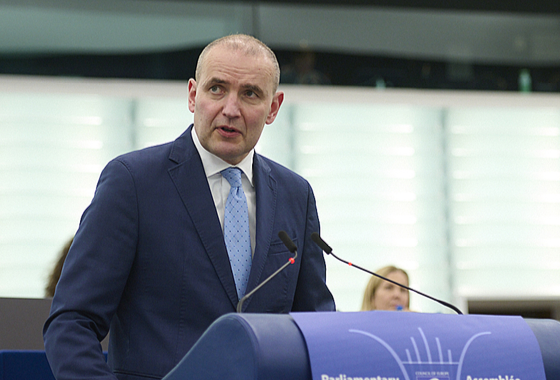
Président de l'Islande
12:36:24
Dear Chairman, dear friends,
Excellencies, everyone,
I'll say a few words in Icelandic also.
Kæra Vigdís, gaman að þú getir verið með okkur á þessari stundu. Þinn er heiðurinn. (in English: Dear Vigdís, it is a pleasure that you can be with us at this occasion. We honour you.)
Can a woman be president? Can a single mother be president? Can a single divorced mother be president?
In 1980, in Iceland, my home country, my fellow citizens – some of them at least – were asking themselves these very questions. We had a presidential election. Four candidates. One woman, for the first time in Iceland. And these questions were raised. The answers to all of them turned out to be a resounding "Yes, yes she can". And yes, she did. For 16 years, Vigdís Finnbogadóttir served us as president in an amazing manner. And she was asked also during the campaign, "Should we elect you because you're a woman?" And then the answer was a resounding, "No, you should just elect me because I am a human being, if you want to. In a free democratic society, we should have a level playing field where everybody can run for office, where everybody can show themselves and others what they're capable of".
And this, as I said, Vigdís did. She was a role model. She was a path-breaker. As the Chairman mentioned, we in Iceland had the good fortune of electing the first woman as head of state. A role model, a path-breaker, but while we need role models and while we need path-breakers, we, more than that, need models that work and paths where we can all travel together. So yes, this award is an award to Vigdís in her name in honour and recognition of her service, of her career as a role model, but it is also an encouragement for others, and we have here, representatives or those who have been nominated for this prestigious prize – good luck with your work. I have no idea who will get the prize. I look forward to seeing it. But all those who are nominated as well, all those women, all those groups who are doing an amazing job: We are in awe, we admire you.
Now, I stand here as a man. Women's rights and gender equality are not only issues that concern a certain part of society. It concerns us all because gender equality is not only a human rights issue, it is not only a women's issue, it concerns us all. And, if it is not enough for you to think it is the right thing to do, it is the honourable thing to do, to campaign for full gender equality, add this, use this argument to those who say this is not something that we should be so much concerned about: It benefits us all. In an equal society, in a society where we respect equal rights for all, everybody benefits – practically and economically – we all become richer. Should that not be something that should reach the ears and minds of everyone?
So with that in mind, I am honoured as an Icelander, but just as a global citizen, to see this award as a recognition of a job well done and as an encouragement to others to follow in the footsteps of our beloved Vigdís Finnbogadóttir.
Thank you very much.
Grèce, PPE/DC, Président de l'Assemblée
12:41:02
Dear colleagues, we would like now to show all present a video on the Vigdís Prize for Women's Empowerment.
Grèce, PPE/DC, Président de l'Assemblée
12:47:32
I would now like to invite the Minister of Social Affairs and Labour Market to come to the rostrum.
Minister Guðbrandsson, the floor is yours.
Ministre des Affaires sociales et du Marché du travail d'Islande
12:47:53
His Excellency, President of Iceland, President of the Assembly, Secretary General, distinguished members of Parliament, Ambassadors, dear guests, and dear Madam Vigdís Finnbogadóttir.
Iceland held the Presidency of the Council of Europe last year until May 2023.
During our Presidency, we hosted the Reykjavík Summit where the Council of Europe's Heads of States were invited and resulted in the Reykjavík Declaration being adopted.
During the Presidency, one of Iceland's priority topics was equality. To accentuate that, Iceland's Government decided in the weeks leading up to the Reykjavík Summit to establish a new international gender equality prize in partnership with the Parliamentary Assembly of the Council of Europe: the Vigdís Prize for Women's Empowerment.
The Prize will be awarded annually for an outstanding action and contributions to the empowerment of women.
But why "Vigdís" Prize for Women's Empowerment while we actually saw that here on the screen before? Let me reflect on it a little bit myself.
Madam Vigdís Finnbogadóttir was the first woman worldwide to be elected as head of state in a democratic state back in 1980.
I was only three years old at that time, and I must admit that I do not remember the election day.
That turned out to be a big day in our history, a turning point.
Those of us who grew up having Vigdís as our president, I think we all have some personal stories that we can relate to her, and here is mine.
I grew up on a farm with a lot of animals, and it's customary in the countryside to name animals after public figures. So, when Vigdís was elected, three baby horses were born on my farm, one of them a mare, a female horse, and of course she was named "Vigdís", but always called "Vikka", which is a short for "Vigdís".
For a very long time, I thought our president was actually called "Vikka". She was not, as I found out later.
And oh my, oh my! What a fierce and powerful horse.
That horse jumped over fences, had a mind of her own, and was very assertive. Very much like women who have had to fight for their place and for basic human rights.
For a little boy who neither understood politics nor feminism, the most powerful horse was female, and it was named after the President.
My generation grew up having a female president, and that was the right thing, and that was the norm.
The election of Vigdís was a game-changer in Iceland when it comes to gender equality, both in politics as well as socially, for the election of the first woman elected head of state was unique and had a snowball effect of encouraging more and more women to become active in political life. We had a role model in the highest position.
In my mind it is important that little girls see that the president can be a woman.
It is important, similarly, for a LGBTI+ kid, a child in a wheelchair, or kids of immigrants to see themselves in powerful positions.
Role models are important for creating a fairer and more just society where everyone can belong.
Vigdís Finnbogadóttir is a national treasure in Iceland. She had the greatest influence on gender equality in our history. It is therefore very fitting that the Prize for Women's Empowerment is named after Vigdís and to pay her a tribute.
Dear guests,
The aim of the Vigdís Prize is to reward outstanding initiatives promoting the empowerment of women in all of their diversity.
Now it has been estimated that if we continue at the same speed, it will actually take us 300 years to reach full gender equality, and that is something that is absolutely unacceptable.
Iceland has sometimes been called a champion of gender equality, yet let's not forget that full gender equality has not been reached, not in Iceland and not around the world.
However, today we celebrate. Today we feel proud. Tomorrow we continue the fight.
Thank you.
Grèce, PPE/DC, Président de l'Assemblée
12:53:22
Dear President,
Minister,
Candidates,
Members of the panel,
Colleagues and friends,
I would like to begin my address by quoting the Icelandic poet Hulda, whose words are written at the entrance of the museum dedicated to Vigdís Finnbogadóttir in Reykjavik. "Mother grey goose lend me wings so that I may fly south across the sea."
This poem may be read as an exhortation for young women to explore the world and make an impact on it precisely as Vigdís did all her life.
I should like to express my heartfelt thanks to the Republic of Iceland, eminently represented today by its President and Minister of Social Affairs and Labour Market.
Thank you for having taken up this idea with enthusiasm and for agreeing to lend the name and spirit of the first woman elected president of your country, and indeed of the world, Vigdís Finnbogadóttir, to the prize.
My sincere thanks to the Icelandic government for providing €60 000 prize money and for bringing a very beautiful and symbolic work of art to the Council of Europe.
The trophy is named kvika. Did I pronounce it well?
As the President informed us earlier, it is magma. Magma is a mixture of air, of lava, of sand, and it symbolises strength, resilience and adaptability.
It will stay in Strasbourg as a reminder of what we aim to achieve through this prize.
The winner will receive a framed picture of the trophy. The second and the third will receive a diploma.
I would like to congratulate all 123 candidates for the first edition of the prize.
The stories told by the sponsors in their applications are truly inspiring. It was really difficult to make a choice among all these moving examples.
Of course, very special congratulations to the three shortlisted candidates here with us today. The Feminoteka Foundation from Poland, the Irida Women's Center from Greece, Ms Pascuala López López from Mexico.
You all deserve to be here today and you all have our deepest admiration for your work, your courage, and resilience.
My thanks also to the selection panel – the selection panel is sitting on the second row – for your thorough and thoughtful examination of the nominations, for the stimulating discussions we had in Reykjavik and in Strasbourg, for your convictions and your clear positions.
Thank you to our dear Secretary General Ms Despina CHATZIVASSILIOU-TSOVILIS, without whose determination and positive thinking this prize would not exist.
I have the honour, as you witnessed, to sit between two secretary generals: the Secretary General of our Organisation Ms Marija PEJČINOVIĆ-BURIĆ, and Ms Despina CHATZIVASSILIOU-TSOVILIS, and it is a real honour, and it is actually these two women who are presenting the meaning of being a woman who is trying hard in her life. They are both role models for the Council of Europe and for all of us.
Dear Marija, dear Ms Despina, thank you so much.
And now – it will not take long like the Oscar awards – it is my great honour to announce the winner of the prize.
The Irida Women's Center from Greece.
Congratulations.
Dear all,
First of all, I would like to tell you to excuse my voice if it is shaking, it is because I am very happy.
Thank you so much. It is with immense gratitude and a profound sense of honour that I stand before you today to accept this prize that is named after the first democratically elected female President, Madam Vigdís Finnbogadóttir, representing our organisation, Irida Women's Center and our founder and CEO Ms Chloe Elizabeth Kousoula.
This recognition is a testament to our effort and the powerful reaffirmation of women's collective strength and resilience everywhere. In this context, I would like to express my honest admiration towards the two fellow candidates, Feminoteka Foundation and Madam Pascuala López López, for their outstanding work, catalysing a meaningful, positive change in women's lives.
I would like also to extend our gratitude to the Council of Europe and the esteemed judging committee for recognising our work. Your recognition fuels our passion and devotion to continue fighting and advocating for women's rights, equality and empowerment. This honourable recognition of our work is the outcome of the persistence, commitment and dedication of our incredible team, having unconditional faith in our vision to leave no woman behind. Every accomplishment, every initiative, and every step forward is a direct outcome of their hard work and tireless effort. It is a team of extraordinary women.
We are also beyond grateful to our donors, partners and supporters. Your belief in our vision and your generous contributions make our work possible. Together, we are building a foundation for future generations where gender equality is not just an aspiration but a reality.
To the women we serve and support, we want to say that you are the true heroes of this journey. Your stories, character and resilience are a daily source of inspiration.
Data for 2023 in the European Union on gender equality ranks Greece 24th among the EU member states with a score of 58 out of 100 demonstrating that there is still much to be done in this direction. Greece used to hold the last place in gender equality with a score remaining static for almost more than a decade. Since 2020, Greece's overall score has increased by 4.6 points, which is one of the fastest paces of progress among the member states.
We applaud the positive steps but we do not overlook the immense shortcomings. More than one in four women in Greece live at risk of poverty and social exclusion. Four in 10 women experienced physical, psychological or sexual gender-based violence at least once in their adulthood. Eight femicides have taken place within the first semester of the year, yet the term femicide is not legally recognised within our country. Poverty and social exclusion can be both a cause and a consequence of gender-based violence. Violence has a tremendous impact not only on the lives of women who experience it, but on society as a whole. It impoverishes women, their families, communities and nations.
Since 2018, Irida has been operating as the first and sole safe community centre for all women and their children, regardless of their nationality, ethnicity or legal status, in northern Greece. We established an innovative and unique women-led space in which the most vulnerable women receive individualised services to become empowered and pursue opportunities for personal and professional growth. Our provisions and services are served by a holistic approach in order to protect, empower and support the most vulnerable women to access their fundamental rights, which most of the time they are deprived of because of their gender.
Through our intrelated programmes, the protection programme and the livelihood programme, our members are supported with casework, legal assistance, court representations, psychological and psychosocial support, skill-building and employability services. We work to eliminate the barriers that hinder women's overall well-being while empowering them to make informed decisions and regain ownership of their lives.
We must continue addressing and advocating for the systemic issues that contribute to poverty, social exclusion and gender-based violence, ensuring that all women live a dignified and safe life and pursue opportunities for personal and professional growth.
Therefore, on behalf of our organisation, we would like to thank you for this recognition – a reminder of how far we have come and an ongoing call to action for the work that still lies ahead. We will continue to fight for a world where every woman is empowered to achieve their full potential, a world where no woman is left behind.
Thank you very much.
Grèce, PPE/DC, Président de l'Assemblée
13:04:10
Now I congratulate the two other shortlisted candidates, whom I call now to the rostrum to receive their diplomas.
[Long applause]
Now if you want to say a few words, you are very welcome. Just for a minute, we don't have much time left.
Thank you so much. It's a huge honour to be here at the Vigdís Prize for Women's Empowerment Award Ceremony.
It's a huge honour to be shortlisted.
This award is very much needed to compliment women's effort for equality and safety. With Feminoteka Foundation, we have been helping for over 18 years women who experience violence, and we know that this sort of service, this help, is still needed.
For many years we have also been helping women without any support from our government, and we will continue to do so. We will continue to help women no matter what. The fact that we are here today for us is a reinforcement of the fact that we are doing the right thing; we have chosen the right path.
[Speaks in indigenous language]
Good afternoon.
Thank you very much for inviting me.
I am here before you, eminent persons. Thank you very much.
I will continue the work that I am doing, the fight for justice and for women's rights. I will continue with this work and I would like to thank Madam Vigdís for her work.
We will continue strengthening our work and the hearts of the women who are struggling.
Thank you.
Grèce, PPE/DC, Président de l'Assemblée
13:08:19
Thank you.
I would like now to invite the Secretary General of our Organisation, the Secretary General of the Assembly, the Deputy Secretary General, the President of Iceland, the Minister of Iceland, the Ambassador of Iceland, Chairperson of the Icelandic Delegation, Chairperson of the Committee on Equality and Non-Discrimination, and members of the panel to join us up here for a group picture.
This concludes the first part of our [part-]session. I warmly welcome you to come to the opening to the exhibition "75 Women in 75 Years of Council of Europe History", which will take place now right outside our hemicycle.
Thank you all.


