The sitting is open.
Very good morning, dear colleagues.
I remind members that, in order to be registered for the sitting, you need to insert your badge when you take your seat, and keep it inserted for at least 30 seconds.
You should also insert your badge in order to speak or vote. To request the floor, please press the “request” button.
I also remind the Assembly that members who have not submitted an annual declaration of interests are required to start any intervention with an oral declaration of interests, or no interest, under paragraph 20 of the Code of Conduct for Members of the Parliamentary Assembly.
In order to allow more members to participate, I propose to reduce the speaking times in this afternoon’s debates to two minutes instead of three minutes. Is that fine with you? It seems it is.
This morning the Agenda calls for the election of 2 judges to the European Court of Human Rights in respect of Cyprus and the Netherlands.
The list of candidates and biographical notices are to be found in Documents 16302, Revised version, and 16312. The opinion of the Committee is presented in Document 16323, Addendum 2.
The voting will take place in the area behind the President's Chair.
At 12:45 p.m. I shall announce the closing of the poll. As usual, counting will then take place under the supervision of five tellers.
Each political group has appointed a teller according to the rules. They are:
Ms Zita GURMAI,
Ms Andrea EDER-GITSCHTHALER,
Mr Axel KASSEGGER,
Ms Lucia PLAVÁKOVÁ
and
Mr Berdan ÖZTÜRK.
I would like to remind them that they will have to be in the room set aside for this purpose. The result of the vote will be announced, if possible, at the opening of this afternoon’s sitting.
For these first ballots, an absolute majority of the votes is required. If a second round has to be organised, it will take place this afternoon between 4:00 p.m. and 7:00 p.m.
I now declare the ballot open.
We continue our work in the meantime.
Ladies and gentlemen,
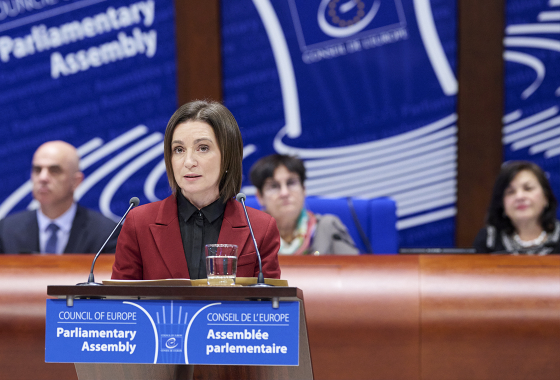
It's now a great pleasure for me to welcome among us the President of the Republic of Moldova, Ms Maia SANDU.
Madam President,
Your country is chairing the Council of Europe's Committee of Ministers for the second time in its history, at a particularly decisive moment for our organisation and for the whole continent.
The priorities of your Presidency, namely to support – for Ukraine – accountability for the crime of aggression, support the New Democratic Pact for Europe and the fight against disinformation and foreign information manipulation, are are all timely and highly relevant.
We have all witnessed the dreadful impact of disinformation on democratic security across our continent. We therefore welcome the decision to address this issue at the heart of your Presidency's priorities.
We also note and fully support your country's concrete action on the ground – notably in support of Ukraine.
You have recently reaffirmed, Madam President, your country's strong European commitment and its determination to join the European family as swiftly as possible; a choice that further strengthens the Republic of Moldova's democratic path.
Please be assured that the Parliamentary Assembly will stand firmly alongside your country to ensure the success of your Presidency.
Without further ado, it's my honour to invite you to have the floor.
President of the Assembly, Madam Petra Bayr, congratulations on your election. Secretary General, Alain Berset, Honourable Members of Parliaments, distinguished guests.
Today, I want to speak about the two wars Europe is facing, how our democracies are being attacked, how those attacks are amplified by technology, and what we should do to protect our peace, our democratic choices, and our freedom.
As Moldova holds the rotating Presidency of the Council of Europe’s Committee of Ministers, allow me to remind you that the Council of Europe was born from the failure of European democracies to protect themselves in time. From the realisation that peace without democratic resilience is temporary.
The Statute of the Council of Europe is explicit.
Its purpose is to achieve greater unity, to safeguard human rights, to uphold democracy and the rule of law.
Not as ideals alone but as systems that must withstand pressure, manipulation, and abuse.
The Council of Europe was never meant to be a comfort zone. It was meant to be a line of defense.
And today, Europe is at war again. Two wars, in fact.
The first is visible, brutal, and devastating.
Russia is waging a conventional full-scale military invasion of Ukraine. Cities are destroyed. Civilians are killed. Energy infrastructure is deliberately targeted. This winter, millions of Ukrainians are living in darkness and cold, not because of the weather, but because the Kremlin has made freezing civilians a weapon of war.
To break the will of a nation by making life itself unlivable.
For most of us, this kind of suffering is impossible to imagine. But for Ukrainians, it is daily life. And it demands not only our solidarity, but our responsibility.
For Moldova, the war is not distant.
In Moldova we know that we owe our peace to Ukraine’s resistance.
We know that if Ukraine falls, Russia will not stop at Moldova.
Ukraine’s fight is therefore about the security of Moldova, of the region, and of Europe as a whole.
And this is also why there can be no lasting peace without accountability for Russia’s aggression. Without justice, war does not end, it only pauses and prepares to return.
Here, the Council of Europe has a vital role to play, not as a neutral observer, but as a political guardian of democratic values and international law. The accountability mechanisms developed within this Organisation, including the register of damage and work to ensure justice for victims, are essential to restore trust in the rules that protect us all.
But while our attention is rightly focused on this war, a second war is unfolding. This is the war against our democracies.
It is less visible. But it is no less dangerous.
This war is being fought inside our societies.
It is a hybrid war. An information war. A war to divide people and control our hearts and minds.
This war is accelerated by technologies we do not fully see and understand. By algorithms that increasingly determine what people read, watch, and believe, while their logic remains largely opaque.
These two wars are not separate. They reinforce one another.
Russia’s military aggression and its hybrid operations pursue the same objective: to undermine, control, and divide Europe.
One destroys cities. The other erodes trust.
One uses missiles. The other uses money, narratives, and manipulation.
This is how democracies are attacked, from within.
At the core of this second war are two things.
Dark money and dark politics.
Dark money fuels dark politics.
Illicit financial flows make manipulation scalable and persistent. They pay for influence operations, political capture, and disinformation designed to divide societies and turn people against themselves, against their own state, democracy, and freedom.
Moldova has been, and still is, on the frontline of this second war.
For two consecutive years, our country has faced massive electoral interference. It was multi-domain.
An energy crisis designed to put economic pressure on vulnerable citizens. Political corruption targeting parties and candidates. Information warfare across online platforms. Cyber operations aimed at institutions and voters.
All with one objective: to seize Parliament, install a Kremlin-controlled government, crush our democracy, drag Moldova into Russia’s sphere of influence, and use it against Ukraine and against Europe.
And if that failed, to delegitimise elections, provoke unrest, and weaken trust in our institutions.
Social networks became central battlegrounds in this war. What we saw in Moldova was not a spontaneous expression. It was organised, funded, and scaled by AI.
One single coordinated network of just over 100 fake accounts on TikTok, operating for less than three months, generated around 50 million views, over 100,000 comments, and more than 1.5 million interactions, in a country of 2.4 million people.
The goal was to create a false impression of overwhelming anger and social collapse, to exhaust citizens, amplify fear, and discourage democratic participation. This was not an isolated case.
We also documented the activity of an influence network, already identified by European partners, which produced more than one thousand coordinated publications about our country in just a few months.
These messages accumulated tens of millions of views and were deliberately laundered through seemingly credible voices before being amplified by inauthentic accounts.
This targeted Moldova’s image abroad.
When traditional propaganda channels were restricted, hostile actors adapted again.
Content linked to Kremlin-affiliated broadcast media was delivered directly into people’s homes through mobile applications, bypassing audiovisual regulation entirely.
When exposed, these outlets did not disappear. They changed domains and jurisdiction. They rebranded and resumed operations within days.
This adaptability tells us something essential.
We are facing professional, well-funded, long-term operations, built on the systematic identification of vulnerabilities, enabled by transnational infrastructure, and sustained by the exploitation of legal loopholes.
Moldova is not the only country facing these challenges. We see similar pressures across Europe.
I am proud to say that Moldova resisted this two-year assault through a whole-of-society effort. Our citizens proved their commitment to peace, to Europe, and to democracy.
But I regret to see Georgia, where, despite the courage of the Georgian people, who continue to stand up for democratic values, European aspirations, and the right to decide their own future, Russia pulled Georgia back into its orbit by weaponising the fear of war, signalling that the wrong electoral choice would come at the cost of peace.
Now Armenia is becoming a target of the same strategy, aimed at weakening sovereignty, influencing democratic choices, and exploiting internal vulnerabilities.
We stand with Armenia and its people as they work to resist these pressures and defend their democratic future.
Among all the ways this hybrid war is waged, the most dangerous for the future of our democracies is information manipulation amplified by technology, opaque algorithms, and artificial intelligence.
If left unchecked, those who control technology will increasingly control how people think.
I am particularly concerned about the impact of this cognitive war on the younger generation.
If we want democracies that can resist manipulation, we must protect the freedom of young minds.
This is not only a question of technology or regulation. It is a question of democratic resilience.
Trust, critical thinking, and mental wellbeing are essential conditions for free societies.
The Council of Europe has already given us a clear starting point: children’s rights apply fully online, and states have a responsibility to protect their best interests in the digital environment.
Moldova’s experience shows why this matters: disinformation works by exhausting societies, by making people fearful, divided, and distrustful. And it is especially effective where young people are left unprotected in digital spaces designed to exploit attention and emotion.
This brings me to what I think we should do.
Long-term efforts alone will not meet the urgency of this threat.
You do not respond to a patient in cardiac arrest by announcing a long-term public health strategy.
You act immediately. You stabilise the patient. You stop the bleeding. And then you invest in prevention and resilience.
Today, our democracies are under acute attack.
Treating this only as a long-term challenge, while elections are actively manipulated and institutions destabilized, leaves democracies exposed at the very moment they need protection.
We must act at the speed of the threat. And we must protect our democracies without betraying democratic principles.
Here, the Council of Europe has a unique role to play.
We need a clear and comprehensive legal instrument on foreign information manipulation and interference, one that addresses election interference, media concentration and capture, media freedom, democratic and information literacy, organised crime, cybercrime, corruption, and the malign use of artificial intelligence and other technologies.
This must allow us to act before damage is done, not after.
After two years of resisting Russian interference, here is what has worked for us.
Coordinated disinformation campaigns must be exposed and disrupted before they shape voters’ perceptions and distort democratic debate.For this, journalists and civil society must be protected.
Foreign interference and proxy actors must be exposed before trust in elections is undermined.
Illegal party financing must be tracked before those who benefit from it gain power through the ballot box.
And I cannot emphasise elections enough.
In democracies, they are the most vulnerable entry point for foreign manipulation, and the most decisive one. This is where trust can be broken fastest, where disinformation has the greatest impact, and where illicit money can translate directly into power.
That is why monitoring must begin months before voting day and extend fully into the online space.
Digital interference must be detected in real time, not reconstructed afterwards.
And illegal money must be identified and stopped before it distorts the will of voters.
Cutting off the financial lifelines of interference, including through cryptocurrency, is essential to stopping manipulation at scale.
The work of the Financial Action Task Force and the Committee of Experts on the Evaluation of Anti-Money Laundering Measures and the Financing of Terrorism (MONEYVAL) has been essential in strengthening anti-money laundering frameworks across Europe. Moldova is also largely compliant with MONEYVAL standards. Yet our experience shows that even strong Anti-Money Laundering (AML) systems are not enough.
We lacked the legal and operational tools to act fast against illicit financial flows specifically designed to interfere with elections.
Money fuels interference. Technology amplifies it. Therefore we must govern the digital space responsibly.
The internet and social platforms have strengthened freedom and connection. They are among humanity’s great innovations. But no invention exists without rules. Electricity requires safety standards. Cars require traffic rules, especially near schools. The digital space is no different.
Children’s wellbeing must be protected.
Freedom of expression must be protected from fake accounts posing as free voices.
Artificial intelligence must be governed with care.
Taken together, these are acts of democratic self-defense. And they define whether democracy remains a living system, or becomes an open target.
So, we must move faster than the threat and take the initiative.
The Council of Europe was created for moments like this, not when democracy is comfortable, but when it is contested.
Moldova’s presidency of the Council of Europe will act with this responsibility in mind.
Thank you.
Thank you very much, Ms Maia SANDU, for your most relevant speech.
Moldova indeed is a model for resistance in hybrid attacks, and I think that we all can learn a lot from you.
Members of the Assembly have questions to put to you now.
We will first hear questions from the speakers on behalf of the political groups, followed by a response from Ms Maia SANDU to each of these questions.
I remind you that the questions must be limited to 30 seconds and no more.
Colleagues should be asking questions, not making statements.
So with that, I first call on behalf of the Socialists, Democrats and Greens Group, Mr Piero FASSINO.
Thank you again President for the very effective speech you made and you have all our friendship, our solidarity, as was seen in the applause that greeted you.
The question I want to ask you concerns a very critical point in the future of Moldova: how do you think the issue of Transnistria can be resolved, which for some time now has obviously been a region over which there is strong separatist pressure, and how do you plan to resolve or deal with this problem?
Thank you very much, Ms President.
Moldova faces many challenges, and conflict is one of the big challenges. The conflict was provoked by Russia, and Russia continues to try to use it against the Republic of Moldova.
We are fully committed to resolving the situation, and we're fully committed to resolving it peacefully.
Steps have recently been made, especially on the economic reintegration of the country. We see more and more people from the Transnistria region, from the left bank of the Nistru river, coming to work on the right bank of the Nistru River. We see a significant change in trade: more than 70% of exports from this region now are going to EU countries, while in the past, 100% was going to Russia.
So changes are happening. But, of course, the biggest impediment to full reintegration is the ongoing illegal presence of the Russian troops. This is the problem that we need to find a peaceful solution to be able to move on with the process.
And again, we're fully committed to the peaceful resolution of the conflict. And we do count on your support in making sure that Russia withdraws its illegal troops from our territory.
Thank you very much.
The next question on behalf of the Group of the European People's Party comes from Mr Ionuț-Marian STROE.

Romania, EPP/CD, Spokesperson for the group
10:32:13
Madam President Maia SANDU,
The Group of the European People's Party, of course, reaffirms its strong support for the 2026 agenda focused on resilience, security, pro-European commitment and reforms.
In the context of Russia's ongoing aggression and increasing hybrid pressure, do you believe that Moldova risks becoming one of the next direct targets of the Russian Federation?
And if so, is the current European and international support sufficient to provide real security guarantees for the country?
Thank you.
Thank you, Ms. President.
As long as Russia continues to attack Ukraine and kill civilians, and as long as it does not respect the territorial integrity of other countries, everybody is in danger. And of course, Moldova is in the region, as I've said, we are safe thanks to the resistance of Ukraine. We are grateful for the support that all the countries are providing to Ukraine and we are grateful for the support we receive to increase our resilience.
But, for us, to feel safe means being a part of the EU. And that is why we are working so hard on that. And of course Russian aggression is a big danger for everybody, not just for countries in Eastern Europe.
Thank you.
The next question, on behalf of the European Conservatives, Patriots & Affiliates from Ms Katalin CSÖBÖR.

Hungary, ECPA, Spokesperson for the group
10:33:51
Thank you Madam President,
We are still in favour of the Eastern European countries, the Balkan countries, and in particular the Republic of Moldova, joining the European Union. We know that you are making great efforts to achieve this, to fight corruption and to look at the judicial systems. You're making a lot of reforms, but the process is still fairly slow.
There's another case. In the case of Ukraine, many people would like to see accession speeded up. Do you think this is fair to Moldova? What message does this send to the Moldovan people, who have been pinning their hopes on it for years?
Thank you.
Ms. President.
Well, yes, we would like to move faster on the EU integration and not just us, but all the candidate countries I believe. We've been working hard. We have made some progress. We still have work to do, we still have reforms to implement, but we're really working very hard. And you could see, even in the last year report of the European Commission, that Moldova was the country which made the biggest progress.
In this current environment, when, especially for small countries, things look very dangerous, there is this urgency to move both on the part of the candidate countries, but also on the part of the EU institutions. We do know that there is a discussion in the EU about the decision-making process and we do appreciate the problems, but we do hope that the solutions will be found quickly.
We know that there are other issues, but I do believe that we should show commitment to a speedy and proper process, because I do believe in a merit-based approach. But on both sides we need to move fast.
Thank you.
Thank you very much.
On behalf of the Alliance of Liberals and Democrats for Europe, Mr Iulian BULAI.
Congratulations for the great results of the elections in 2024/25 and for fighting back in the hybrid war.
Thank you for what you did for the huge amount of Ukrainian refugees being welcomed so properly by the Moldovan people. That's so important. A country with solid resources doing so much. Thank you.
Our question is what can we do as parliamentarians in 2026 to better help the quicker integration of Moldova in European Union, both as Council of Europe and members of the national parliaments?
Thank you.
Madam President.
So Europe has been helping us with the major reforms. These are the anti-corruption efforts, the strengthening of the capacity of the anti-corruption institutions and with the justice sector reform, which is not an easy effort, but to which we're fully committed, and of course, all the other areas with respect to providing for human rights and so on.
So we would like to continue to count on the Council of Europe's support and all the institutions that have been working with us. Otherwise, bilaterally, as EU countries, of course you can contribute to finding the solutions to the problems I just mentioned, so that the EU accession process will continue.
Moldova has shown resilience, but the danger to democracies and especially to smaller countries are not going to disappear in two years from now, in three years from now. We need to act together. And I also want to believe that everybody is taking this seriously, because in the case of Moldova, Russia's interference has been brutal. It was easier for people to see it. It was easier for us and for civil society and for the press to expose it.
In some of your countries, this interference is not going to be that brutal and that multidimensional. But it doesn't mean that it's not going to be damaging and dangerous, especially regarding the manipulation of information, which is not easy for people to see and understand, but which can have a significant effect on our democracies. So I think we need to work together, we need to learn together. We need to protect our democracies together.
Thank you very much.
Ms Laura CASTEL concludes the round of the spokespersons on behalf of the Group of the Unified European Left.
Thank you, Chair and congratulations dear Petra.
Madam President,
In a recent interview you stated that you support Moldova's unification with Romania, a European Union Member State. Does your statement reflect a Plan B of the European integration of Moldova through Romania? In other words, should this position be understood as an alternative strategic model for Moldova's integration, or does your government remain committed to European integration as a sovereign state under its own constitutional framework?
Thank you, Madam President.
Ms President.
Our government remains fully committed to the EU integration process. We have the support of the majority of people, as has been seen in the recent referendum, despite Russia's attempts to interfere.
I do want Moldovans to be safe, and I do want Moldova to stay part of the free world. And I am concerned with what is happening today in the world. And again, our strategy, fully supported by the majority of people, is EU integration. We're working very hard on EU integration. We are making genuine efforts and genuine reforms. And we do hope that the EU is going to make the decision before it is too late.
Thank you very much.
I will now give the floor to other speakers and take them in groups of three. And after three, will pass them to Ms President Maia SANDU.
I once again want to remind you that you must limit your questions to 30 seconds.
Ms Victoria TIBLOM.
Thank you, Madam President.
My query might be slightly off the beaten track, but is one increasingly raised in international media, namely the large number – some estimates say over 20 000 of stray, abandoned and homeless dogs in both Chișinău and in the countryside. I have seen a lot of these stray dogs on my two visits to Moldova. I even saw a small dog running around the street with just a broken leg dangling. These dogs are affected by not just heat and cold, also starvation and the spread of rabies. I'm curious to learn how your government is tackling this problem.
Thank you, Madam President.
Ms Deborah BERGAMINI.
President, you have described well how today the Republic of Moldova is a geopolitical crossroads that gathers all the hopes, but also all the concerns of us Europeans.
One of these concerns is energy.
I would like to ask you how you are dealing with the energy difficulties you have, also in light of the reduction in your dependence on traditional suppliers.
Thank you.
Thank you.
And finally, Ms Bianca-Eugenia GAVRILĂ.
She's obviously not in the room. So then we proceed to Ms Bisera KOSTADINOVSKA-STOJCHEVSKA.
Yes, thank you, Madam President.
Madam President,
Thank you for being with us today. Moldova, under your leadership, became a lesson in resilience in the fight with foreign interference.
With Moldova's presiding over the Committee of Ministers, how do you plan to address this issue?
Thank you.
Madam President. Please, if you would like to respond.
Yes, thank you very much.
On the first question, indeed, we do have this problem. The Parliament actually adopted a law recently. It's not enough to adopt a law. You need to make sure that the law is properly implemented, and you need to make sure that you have the capacity, especially at the local level, because this is an issue which has to be dealt with by the local authorities. But it is an issue for discussion for the Parliament, as I said, and we are trying to improve the situation.
I, myself, actually adopted a dog with three legs; his name is Codrut. By now, I adopted the second stray dog. And at the Presidency, we have two of them. This is also to be an example to the people that we need to take care of animals. But we will continue to work on that.
On the question of energy, I have to say that we have actually done a lot on energy diversification. Four years ago, Moldova was 100% dependent on Russian gas, and almost entirely dependent on electricity produced from Russian gas. Today, we don't consume any Russian gas, and we are very advanced in finishing a high-voltage electricity line, which is going to connect us to the EU market. So we have done a lot. We also invested a lot in renewables. When I became President, only 3% of our energy consumption was coming from renewables. Today, it's more than 25%, and we are very ambitious in our plans.
So it's been difficult, very tough. It's still not easy because every time Russia targets Ukraine's electricity system, it can also affect Moldova's electricity system because we are connected. So the danger is still there. But we have really done a very good job in trying to diversify energy. And now it's more difficult for Russia to interfere. They have to come up with cyberattacks, manipulation of information and so on. In the past, they would just switch off the gas, and then they would paralyse the country. So we got rid of this dependency.
On the lessons on resilience. This is what I tried to explain today, to share a bit of our experience. And, of course, we are ready to talk about more specific issues, because as I said, the interference of Russia in our three elections has been multi-domain, and we have learned a lot. We were better prepared in 2025 than before. It was a whole-of-society effort. It was very important to have not only the government expose this interference, but also independent actors, because then, people will trust it more. What has worked in our case, especially for last year's elections, was very good co-ordination between government institutions, because you do need to have the anti-money laundering institution working together with the Central Electoral Committee with the intelligence, with the anti-corruption, with the police, with the tax inspector, because a lot of illicit money has been involved. We estimate that in the 2025 parliamentary elections, Russia spent something around 2% of Moldova's GDP. So you can imagine how much money this was and how difficult it was to trace the money. And of course, you always need to trace the money to understand who is behind this.
So we're ready to share our experience. And also, we hope that together we can deal with these big challenges that manipulation of information, amplified by technology, is going to put on our democracies in the future.
Thank you very much.
Next on the speakers list is Ms Zanda KALNIŅA-LUKAŠEVICA.
Thank you, President. And Madam President, thank you so much for your speech today and for your leadership that inspires us continuously.
Moldova has shown incredible democratic resilience in the face of foreign interference. And Moldova's institutions and civil society and citizens indeed demonstrated their capacity to protect the integrity of the electoral process.
I planned to ask you if, based on your experience, you could share with the Assembly which factors were most decisive in resisting the interference attempts and what lessons other European democracies should draw on when preparing to counter similar actions from the Russian Federation. But you elaborated on that already in detail during your speech and also the previous question went in exactly the same direction.
So, thank you so much for sharing with us. And if there is one concrete action that this Assembly should do, I think we are very ready to act immediately.
Thank you.
I will take three together. No problem.
And I want to remind you that it is for asking questions. So the next is Ms Mónika BARTOS.
Thank you for your presentation, Madam President.
Tackling migration-related changes is now on the agenda of the Council of Europe. Foreign ministers are expected to adopt a political declaration on migration at their meeting in May.
Despite the serious challenges, Europe is still divided.
How can diverging views and opinions expressed so far be reconciled in the process leading to the meeting in May?
Thank you for your answer.
Mr Bertrand BOUYX.
Thank you, Ms President.
Madam President, you have already addressed this subject with one of our colleagues, but I wanted to come back to your statement on reunification with Romania, a reunification for which you said you were in favour.
This is a way, I presume, of affirming your clear and definitive choice for full integration into the European family, but could you explain your position and tell us what consequences it has had, if any?
Thank you very much.
Thank you very much.
And now over to you, Ms. President.
Thank you very much.
As I've said before, I really hope that we can discuss and come up with solutions on how to defend free speech from the non-authentic accounts and the amplification of this information provided by non-authentic accounts. I do believe that this is something we need to work on and, together with the Secretary-General, we've been discussing these issues. And I do believe that this is the most dangerous issue for our democracies in the future. So, we're ready to work on different aspects of limiting foreign interference in our elections, but the manipulation of information is the most damaging one, in my view, and we're ready to work on that.
On migration, I know that this is a complicated discussion among the member countries. As the country which holds the Presidency, it's our obligation to ensure the venue for a discussion so that a consensus on the issue would be achieved. Of course, we support the independence of the Court. We also understand the concerns of some of the countries. So, we will try to have as many discussions and provide for a proper environment for this discussion, hoping that we could come up with a solution that will be satisfactory to all parts, which is not easy, I understand that.
On the unification, I gave an honest answer to a question. I am concerned with the situation that my country is in today. I do believe in democracy, and the choice of the Moldovans today is to pursue EU integration. I'm fully committed, as the government is fully committed, to EU integration. And we do hope that we will not, you know, find new impediments. And we do hope that all the EU member states will continue to be committed to the enlargement process. This is very important and, at the same time, we're very concerned.
As I said, it is very important for Moldova to stay part of the free world. We don't want to be under Russia's influence. We don't want to be under Russia's occupation. We understand what this means. And I want Moldovans to be safe, and I want Moldova to be free.
We now conclude the questions with the last three speakers. The first one is Ms Larysa BILOZIR.
Madam President SANDU,
Moldova and Ukraine are advancing together in parallel tracks on our European integration path, simultaneously facing severe challenges. While Ukraine is facing an unprecedented war of Russian aggression, Moldova is facing a hybrid war.
How do you see the coordination between our two countries within the Council of Europe framework to strengthen our country's democratic resilience, judicial independence and rule of law in times of war and crisis?
Thank you very much.
Thank you. Mr Oleksii GONCHARENKO is next.
Thank you.
Dear President,
President Maia SANDU,
First of all, on behalf of the Ukrainian people, I want to thank you for your constant support of our country in these very difficult times.
But my question is about the elephant in the room, the Transnistrian elephant. You know this part of Moldova, which is occupied by Russia and became the black hole and base for Russian hybrid threats and intelligence. This is the wound in the body of Moldova, but inflammation comes even further. The whole region feels this inflammation, including Ukraine.
So how and when you plan to deal with this issue?
Thank you very much.
And finally, Mr Titus CORLĂŢEAN.
Madam President,
"Hello, welcome." [spoken in Romanian]
The European Union's decision to start the negotiations with the Republic of Moldova but also with Ukraine on the first clauses and chapters for EU accession has been blocked for more than one year for unfair reasons that you perfectly know.
How do you see the perspectives and modalities for a fast exit from this blockage and for finally starting these negotiations? Romania is a strong supporter of that.
Thank you.
And Madam President, Ms Maia SANDU.
Thank you very much.
Indeed, Moldova and Ukraine are working hard on their EU commitments. It is much more difficult for Ukraine to reform and to implement these reforms, while it is resisting Russia's aggression.
The two countries have similar reforms to implement and I mentioned here the justice sector reform, the anti-corruption effort, strengthening the institutions. And this is where the Council of Europe is helping us. This is where the Council of Europe is helping you. Sometimes we need to find new solutions.
We are happy to see the openness of the institutions here because, for instance, when you need to resist Russia's interference, some of the old standards might not be actual and might not be enough for us to be efficient in resisting that.
So I do believe that we should continue to work together to learn from each other and to advance on our EU path. It is in the interest of Moldova for Ukraine to be a EU member state. It is in the interest of Ukraine for Moldova to be an EU member state, because otherwise we know that Russia can use Moldova against Ukraine as well.
On the Transnistrian region problem, we have worked very hard since the war began not to allow the region to become unstable and to drag the country into the war. This would not help anybody.
We are fully committed to a peaceful resolution to the conflict. It's not that easy when Russia refuses to withdraw its troops which are stationed illegally on our territory.
We are making steps and as I said, we're making steps especially towards economic reintegration. There are challenges, but we will continue to look for a peaceful solution, for a peaceful withdrawal of the Russian troops from our territory because we want to preserve peace for our people.
On the opening of the formal negotiations, I believe this is a question for the member states and a question for the EU institutions. This is a merit-based approach.
Both Moldova and Ukraine have fulfilled the conditions to formally open the negotiations in several clusters. This is stated in the evaluation reports done by the Commission last year, both for Moldova and Ukraine.
We are working, regardless of the fact that the negotiations haven't been formally opened, but we know what the benchmarks are and we're working towards that. But since this is a merit-based process, we do expect the institutions and the member states to come up with a solution.
Madam President,
On behalf of our Assembly, I really want to thank you warmly for your address and for answering our questions so concisely.
We are also very happy that you will attend our ceremony later today, also together with your minister, Mr Mihai POPȘOI, who we will have the chance to hear from tomorrow.
I want to wish you, yourself and your country all the best for the future.
Thank you very much.
Colleagues,
I must remind you that the vote is in progress to elect the two judges to the European Court of Human Rights.
The poll will close at 12:45 p.m.
For those who have not yet voted, please go and do so. It's behind the space here.
We now come to hear the address from our Secretary General, Mr Alain BERSET.
After his address, he will take questions from the floor.
Dear Secretary General, dear Alain,
It is a great pleasure for me to welcome you at the very beginning of my mandate. We already had the chance to exchange yesterday afternoon. We are most happy that you will address our Assembly, as we are used to at the beginning of the year.
I truly believe that the combined efforts of our two statutory bodies are more than ever necessary to address the profound challenges we are facing today.
I'm quite sure that we will find a path towards democracy and a human rights-based future.
I'm confident that we will work very well together during my mandate in the spirit of close and constructive co-operation.
With that, I would like to give you the floor.
Thank you very much.

Secretary General of the Council of Europe
11:00:59
Thank you very much for this very kind introduction.
Madame President of the Parliamentary Assembly of the Council of Europe,
Excellencies,
Dear members of the Parliamentary Assembly of the Council of Europe,
Ladies and gentlemen,
It's really for me an honour to address you at the opening of this parliamentary year. And I would like also, if you allow me Madame President, to start by congratulating you on your election. Dear Petra, you bring long experience to this role. You take on this responsibility at a decisive time for Europe. And I look forward to working closely with you in the months and years ahead.
And I also want to take this occasion to warmly thank the outgoing President Mr Theodoros ROUSOPOULOS, for the really good collaboration we had over these past years, and for your very strong commitment to the Council of Europe and to our shared values.
Excellencies, dear members of the Parliamentary Assembly,
I stood before this Assembly for the first time sixteen months ago in September 2024, just days after taking office. And that same week, at the United Nations General Assembly in New York, Venezuela’s foreign minister said it was time to rescue the founding principles of the UN Charter.
At the same time, in Brussels, the outgoing North Atlantic Treaty Organization (NATO) Secretary General insisted that the Alliance was strong, united, and more important than ever.
In the United States, a presidential candidate said he had a very good relationship with both President Volodymyr ZELENSKYY and President Vladimir PUTIN, and promised to end the war in Ukraine very quickly. After the first and only presidential debate, he was trailing in the polls.
And in Greenland, the headlines were about a landslide that triggered a tsunami in a remote fjord. That was the world we thought we knew. So why are we acting surprised? This rupture did not come out of nowhere.
After the Cold War, Ukraine gave up its nuclear weapons in exchange for the assurance that its sovereignty and borders would be respected, and that force would not be used against it. By the time Russia launched its full-scale invasion of Ukraine in 2022, that assurance was broken not once, but twice.
Secondly, I want to mention the financial crisis of 2008, which exposed years of greed and speculation.
Jobs disappeared. Public debt exploded. And it was people, not the banks, who paid the price everywhere. Accountability stopped with those too big to fail.
Thirdly, I can mention the COVID-19 pandemic that also led us to where we are today. In the first weeks of the pandemic, flights stopped and borders closed. Governments competed for masks, and for vaccines. As fear spread, misinformation filled the gaps.
Just add to this climate change, multilateralism on life support, and the return of certain forms of populism thought long gone, and we entered what I called the perfect storm.
This can give the illusion that we are witnessing is something entirely new. But we are not. What is really new in this situation is the acceleration of crises. It comes with a constant flow of information, it comes with the volatility it creates.
By now, the patterns are clear. Positions change within days, if not hours. Threats are made, only to be reversed. A so-called "Board of Peace" is announced, in an attempt to sideline the United Nations.
Now, we are not naive. Power politics have always existed. What is troubling is where they are appearing. Within alliances, and not outside. Inside spaces built on law, consent, and predictability. And that is why we are speaking of a rupture in the world order.
We are at a turning point in understanding world power, and Europe’s role in it. Today, that struggle is framed in terms of security, from national security to energy security, border security, and cybersecurity. It is invoked to justify decisions abroad. And to reshape politics at home. As we see in Greenland, it reaches even questions of territory.
Europe is told that insisting on international law is naive in an age of hard power. That rules must bend for security. But just look at where this leads. We are hearing threats of military action over the territory of a member State. Once security becomes the overriding logic, everything else becomes negotiable, including sovereignty.
And international law remains the last common language capable of restraining power in a fragmenting world. Institutions dedicated to democracy, human rights, and the rule of law are no longer at the margins of security debates. They are now Europe’s centre of gravity. And the Council of Europe, our institution, was exactly built for this.
Europe does not need to choose between law and security. That is a false choice. Law is Europe’s form of power. Law allows autonomy without domination, it creates co-operation without submission, and security without surrender. This is exactly what we mean by democratic security.
Charles DICKENS wrote A Tale of Two Cities at a moment when an old order was breaking, and no one knew what would replace it.
And Europe is facing, once again, two possible worlds. One where security is reduced to force, and sovereignty becomes negotiable. And one where security is built on rights, on institutions, on law. What happens next depends on the choices we make now. And there are mistakes we cannot afford.
First, we cannot let competing crises pull us off course. Ukraine risks being pushed into the background as crises compete for attention. That would be a serious mistake. This war has not paused. Strikes on infrastructure are leaving people without heat in subzero temperatures. And its outcome will shape Europe’s future for decades to come.
Secondly, international law is not dead. The Council of Europe was founded on the idea that law, not raw power, must guarantee the dignity and rights of individuals and the sovereign equality of states. And Europe must act to protect its legal framework, and the Council of Europe is ready to play its part. If we fail, in Europe, to articulate a legal and political vision, others will fill the vacuum, shifting security from law to strategic leverage.
And finally, middle powers are not powerless. Principles without power are fragile, but power without principles is really dangerous. The space between great powers is not empty. It is where Europe must act. In Greenland or crises like Venezuela, this moment cannot be reduced to a binary choice between sterile condemnation and blind support. In both cases, we abdicate our own responsibility.
Europe’s task is different and must be different. To refuse a world governed by exceptions, to refuse a world governed double standards, or competing spheres of influence. And to insist that security cannot be built by bargaining away the very principles that sustain it.
You know, as Ms Maia SANDU, the president of Moldova, told us before, the Council of Europe was not created for moments of comfort. It was exactly created for moments like what we are witnessing right now.
When the rules of the old order are no longer assumed, even among those who wrote them. What other organisation in Europe exists to confront exactly this question? Not as a military actor. Not as a market. But as a legal community of forty-six democracies, bound by commitments that cannot be rewritten in crisis.
And I think that gives us a particular responsibility. And we are exactly acting on it. When Russia launched its war of aggression against Ukraine, we did not abandon law in the name of force. The opposite. We built accountability where none existed before.
As you know, the Register of Damage is operational. Last December, states signed the Convention establishing the International Claims Commission. And last week, we launched the advanced team for the Special Tribunal for the Crime of Aggression.
When the fighting stops, the Council of Europe will still be there. For institutions. For elections. For democratic recovery.
I can also mention migration. On migration, Europe is also told there are only two options: to abandon legal constraints in the name of control, or to defend principles while ignoring legitimate pressures. That is another false choice.
On the road to Chișinău, Ministers are working within the European Convention on Human Rights. To ensure that security and legality move together. And information itself has become a security issue. Polarisation is engineered, is amplified by platforms, by generative AI, and by foreign interference. That is why the Council of Europe is working on a new Convention on disinformation and foreign interference. Not to police speech, but to protect democratic choice. So no democracy is left to face this alone.
Sometimes, Europe is told that it is weak. That its values are outdated. That history is passing it by. I think the danger is not only that others say this. The danger is that we begin to believe it ourselves.
We face temptations as dangerous as the threats. One is sentimentality. Sentimentality to speak eloquently of values, to issue solemn declarations and quietly accept irrelevance.
Another is atrophy. To hold on to old structures, even as they stop working. And to mistake continuity for strength.
Neither will protect us. Another way is possible. And it is already taking shape. In Ukraine, by building accountability that will outlast the war. On migration, as I just mentioned before, by refusing to surrender our legal standards in the name of control. On disinformation, by defending democratic debate before it is captured or manipulated. In every place where democratic choice is under pressure.
I think, the deepest rupture today is not just geopolitical. It is democratic. And in the coming months, we will announce the next stage of our work, with democratic security as our continent’s answer to the emerging world order.
Europe does not need a kind of "me first" politics. It needs something different. Democracy first. The rule of law first. Human rights first.
Thank you for your attention.
Thank you very much Secretary General Alain BERSET, for your important address.
We will now hear questions from the speakers on behalf of the political groups, followed by a response from the Secretary General to each of those questions.
The speaking time is limited to 30 seconds, you know that already.
I would like to remind colleagues to really ask questions and not give any speeches.
I now turn to the representative from Socialists, Democrats and Greens Group, Ms Zita GURMAI.
Ms Zita GURMAI.
Thank you very much.
Congratulations President.
Colleagues, Mr Secretary General,
We are experiencing unprecedented changes in the international system as we just mentioned, a subject you have also addressed in your recent articles and before the Committee of Ministers, recalling the risk that military security represents without democratic control.
In your view, what role can the Council of Europe play in this rapidly changing world? And what relevant instrument do we have at our disposal to strengthen democratic security? What role is the New Democratic Pact for Europe called upon to play in this? And how can we support women in all this?
Thank you.
There were many questions! Mr Alain BERSET, please.
Secretary General of the Council of Europe
11:18:13
Sorry. Thank you. Thank you for the question.
I think I addressed also a part of those elements in my speech before, but thank you for insisting on this, because democratic security is exactly what we can deliver and where we are strong and what the continent and the member states can also expect from us to do.
What I can add to my intervention before is to – we need to be very concrete. We need to be very concrete and not just, you know, to speak, not just to have some words and good intentions, but to be very concrete.
Where is democracy starting? It is starting with accountability. That's the first point. Accountability is part of democracy. What does democratic process mean? It means to have the choice to decide how you want to see a country governed. And then the population can decide if it is good or not good, if they want to change something. This is pure accountability.
In the context that we are facing right now, accountability in the context of Ukraine. It's what we are working [on], doing with the European Court on Human Rights, the Register of Damage [for Ukraine], Claims Commission and Special Tribunal. That's the first point.
The second point, I think democratic security is to protect democracy, democratic processes. We see, and I mean the intervention before by the President of Moldova was really impressive. Exactly on this.
We are observing in detail what was happening in Moldova for the elections in 2024 and what was happening for the elections in 2025.
We are also witnessing in other countries huge threats about the well-functioning democracies.
It is a point that we address in the New Democratic Pact for Europe. When I say "very concrete", I also mentioned the convention on foreign interference and disinformation that we are working on. This is much more than words. It is like a kind of toolbox that member states should have at their disposal to use to protect democracy – knowing, because there is, you know, a discussion before on this, knowing that those tools are compliant with the European Convention on Human Rights.
This is an exact concrete example that we need to work on. I could have a long list. It will be part of the New Democratic Pact for Europe. And thank you also for your strong support that I feel for this work that we are doing together.
Thank you.
Next one is Ms Andrea EDER-GITSCHTHALER on behalf of the European People's Party (EPP). [Spoken in German] Andrea.

Austria, EPP/CD, Spokesperson for the group
11:20:46
Congratulations, dear Petra, on becoming President. I am delighted that an Austrian woman has become President.
Mr Secretary General, you recently said in an article in the New York Times that you see the return of Cold War logic behind Mr Donald TRUMP's move on Greenland and you also told us today that we are at a turning point.
How do you see the future positioning of the Council of Europe in these difficult times between the European Union, the United States of America, China and Russia?
What concrete measures do you intend to take to strengthen the Council of Europe's position, also with regard to the announced withdrawal of the USA from the Venice Commission?
Thank you very much.
Dear Alain.
Secretary General of the Council of Europe
11:21:34
Yes, thank you very much for that question and also for mentioning Greenland and all those articles in the New York Times.
My first point is, it's not a big surprise what happened there. We shouldn't be totally surprised. I have to remind here, the whole discussion about Greenland was already present in the first mandate of President Donald TRUMP between 2016 and 2020. It wasn't mentioned in detail, but it was mentioned and last year it came up much more in discussion and then this year it was like a big escalation on this whole issue. That's the first point.
The second point for us in Europe and also for Denmark and also for Greenland is that it is a bit difficult to see what our position is in regards to Russia's war of aggression in Ukraine. And on the other hand a very longstanding cooperation that we have with the USA is suddenly called into question. This is a big question and is precisely the reason why I had to say something and not just here, but also for an American audience, and therefore also in the New York Times, as a reminder. Yes, of course, there is this very strong, there is simply this historical connection, where Greenland and Denmark simply belong together.
But you also have to add something that affects us directly. It should never be forgotten that Greenland is covered by the European Convention on Human Rights and also by the Court of Human Rights. This is a very strong and very decisive link to Europe. And we must also remember what I said in my previous speech, that we have values, we have a long-standing stability that we want to maintain and that we must maintain.
What do we want and what do we need to do now to work on the basis of this stability, to support long-term thinking, not too short-term. This is also a problem that we always have and always work with our values.
I will now turn to the Venice Commission and what you said in regards to this.
Secretary General of the Council of Europe
11:24:23
I will change to English to tell you that we are strongly concerned about this evolution that we are just witnessing with the Venice Commission. The Venice Commission is a very, very important body, not just for the Council of Europe – I mean, for constitutional law all around the world. It is a central body. It is a central institution that we have at the Council of Europe and can be very proud of what this institution is able to deliver for countries, for member states, I mean, in Europe, but also for non-member states.
And, for this reason, we also have a new president of the Venice Commission. We will have the occasion to meet the new president very soon. And I also intend to visit the Venice Commission soon, also to support the Venice Commission, and to see what we can do together to have a strong and bright future for this Commission, because it is really needed at the moment we are living today.
Thank you.
And on behalf of the European Conservatives, Patriots & Affiliates, Mr Oleksii GONCHARENKO.

Ukraine, ECPA, Spokesperson for the group
11:25:23
Thank you.
Dear Secretary General,
First of all, thank you very much for your active job and a lot of support towards Ukraine.
I have two questions.
First, unfortunately we have a humanitarian catastrophe in Ukraine right now. In minus 20 weather, people live in apartments without heating, without electricity, often without running water. It's a humanitarian catastrophe. Unfortunately I don't see humanitarian convoys, many lines of them entering Ukraine. We need everything, generators, warm clothes, food – everything. Maybe the Council of Europe can call for action and lead the efforts.
The second question is when in your opinion will the Enlarged Partial Agreement on the Management Committee of the Special Tribunal be concluded?
Can you help to fast forward it?
Thank you very much.
Mr Secretary General.
Secretary General of the Council of Europe
11:26:15
Thank you.
Thank you very much for mentioning the humanitarian tragedy situation in Ukraine. Not only has the country been under attack from Russia for more than 10 years now, the full-scale invasion also started five years ago.
It means also that for civilian populations are very hard and extremely – I mean, I think for us it's quite impossible to conceive and to understand what this exactly means. Probably you need to experience this to understand what it means to be under those attacks for more than 10 years, particularly in winter, what it means for families, children, also eldery people. And thank you for recalling this and reminding us about this.
I can just tell you a small anecdote. Last week, I was in contact with our team. You know that we have 100 agents from the Council of Europe working in Ukraine, alongside the Ukrainian population and living in the same conditions. We also have agents from the Council experiencing exactly what you are, as you are reminding us here. And I wanted to have this contact with them. I hope I will have the occasion to visit Ukraine very soon, and also to visit the people and to visit the country and to see the civilian populations. And thank you for recalling this. It is really an impossible situation with, well, sub-zero temperatures and no heating and an impossible life.
The second point you mentioned when – and I will tell you something at the beginning and at the end of the answer. At the beginning, ratify faster, decide faster, resource faster. What do I mean by that? We did, and we are doing our job. I mean for the accountability I mentioned before. The Claims Commission is progressing very well. It will be important in the future. And for the Special Tribunal, we are also working hard. The whole preparation is now with the advanced team on the legal framework, all organisational questions, setting the discussions, all the elements to make this concrete. We need a kind of plug-and-play solution to go fast. What we need now is a clear and strong support of countries joining and then doing the maximum possible. When I said ratify faster, I mean, we are in a phase with the Claims Commission. Thirty-five countries signed on the very first day of December. Excellent. But without ratification, we will not be able to make steps forward. Now we need this ratification process, and we also need the resources.
For the Special Tribunal, it is the same situation. We need a clear situation on resources, a clear situation on cost – what it will cost – and then we are delivering on our part to make it happen.
As I mentioned before, I mean, accountability is exactly part of democracy. There is no democracy without accountability. And particularly in war situations and after war situations, as we see in Ukraine. That means where it is possible, where there is something to do, ratify faster, decide faster, resource faster.
Thank you. And on behalf of Alliance of Liberals and Democrats for Europe, Ms Yevheniia KRAVCHUK.

Ukraine, ALDE, Spokesperson for the group
11:29:45
Thank you.
Congratulations dear Ms Petra BAYR.
Dear Secretary General, 100 000 Ukrainians already filed their applications to the International Claims Commission for Ukraine. These are the same people that are without electricity and heat in Ukraine. When do you think the compensation fund will start working? And how about the compensation? When will people see the compensation? And with regard to the fight to against disinformation, when will this toolbox you mentioned, the Convention, be given to countries and what range of instruments can we give now? Because member states are waiting now.
Thank you.
Mr Secretary General.
Secretary General of the Council of Europe
11:30:26
Thank you.
Thank you, Madam President.
For the first element, I mean, you mentioned the Claims Commission.
I just want to recall in this room that when the Register of Damage was created by the heads of state and heads of government in Reykjavík, it was in May, June, May 2023. And now, less than three years later, it can be long, but it is at the same time really something efficient – we have not only a fully functioning Register in the Hague, with teams also working in Ukraine. We have now more than 100 000 elements registered in the Register. And the Register is regularly opening new categories. And it will climb; and it will climb a lot in the next few months to have, as far as possible, a clear view about what needs to be repaired and what needs to be compensated. That's the first point.
The second point: last December, we had this step made, creating the Claims Commission. We also need and have here an advance team working for the establishment of the Claims Commission. Then, once we have the Claims Commission and once we have enough countries having ratified the signature they gave in December, and also the resources, then it will be possible to act.
I mean, we can just – and it is at the same time a lot and not enough. We can just, from the side of the Council of Europe, bring the logistics. We can bring the thinking about the whole structure that we need. We can work on this, exactly what we are doing now, but without the full support and strong support of states, member states also for the funding, it will take time. And we now need this.
I could repeat what I told your Ukrainian colleague before. I mean to ratify faster, decide faster and resource faster.
About the second question, the second part of your question about disinformation and foreign interferences. I must tell you that we had the case of Moldova, but we had a lot of different situations in Europe. I can mention here, Romania, I can mention Poland, I can mention a lot of different countries because nobody is protected against this situation right now. We are fully aware of the risks also that we see for the next elections, for example, in Armenia and for the day where it will be possible also to have elections in Ukraine. It will be also extremely risky.
That means speaking about the toolbox. It's maybe a bit too simple as a definition. I think we need... It was just to underline that it's not just to speak about the fight against disinformation, it's not just about solemn statements against disinformation: it is to create something concrete. And well, it will take a bit of time because we need to see if there is a will, a political will from states to develop this convention on foreign interference and disinformation. At the moment, we are doing a feasibility study. I think it's finished very soon. It will be this week. Thank you.
And then we are continuing on this. It will be a discussion also with the Committee of Ministers in Chișinău. The ministerial conference in Chișinău will be really important to see what we want to achieve together. That's the point.
In the meantime, what can we do? It was your question.
In the meantime, there is not much better to do as just to try to understand the experiences that we had in different countries, to see what works, what is not working and to take that information to see what it is possible to do in the country.
But my point and our point should be, in Europe, not just to let each country reinvent the wheel, fighting against disinformation and foreign interference.
We need to learn from each other. That's exactly the purpose of a possible convention. And I mean the next few weeks and months will be really decisive to see if we are able, if we are willing to do this. It will not be enough. It is not the convention or other things, or other things and the convention. We must take all the possibilities we have to act. That means media literacy, education; all those elements are also central to have the strongest possible answer against disinformation and foreign interferences. It is just about protecting our democracies, protecting our democratic processes.
Thank you.
And the last from the speakers on behalf of the group is for the Group of the Unified European Left, Mr Emmanuel FERNANDES.

France, UEL, Spokesperson for the group
11:35:13
Thank you, Madam President.
Mr Secretary General, on 22 May this year, nine Council of Europe member states published an open letter calling into question the independence of the European Court of Human Rights, criticising it for restricting their action in the field of migration, when all the Court does is ensure respect for human rights for all.
The letter echoed the clichés of the far right, portraying migrants as a threat and calling for a degraded application of human rights on their behalf.
Two days later, you replied forcefully that, in a state governed by the rule of law, the judiciary must not be subject to any political pressure and that the institutions protecting fundamental rights cannot depend on political cycles.
So today, can you reaffirm that you and the Council of Europe are totally impervious to these attempts, which have since been repeated, to undermine its essential foundations from within?
Thank you very much.
Secretary General of the Council of Europe
11:35:58
Thank you very much for this question, which touches on a fundamental issue that concerns the Council of Europe at its heart, namely the independence of the judiciary, which we are promoting throughout the continent.
We are doing a great deal to ensure that the message gets across, in particular by supporting countries that are reviewing their judicial systems and adapting their legislation to guarantee judicial independence. And so it is true that it is a little curious, perhaps even bizarre, to see that this same judicial independence is being called into question, for our own Court, by Member States. Not just any Member States, if I may put it that way, but nine that are all members of the European Union. A third of the member states of the European Union have joined forces to ask these questions.
You know the beginning of the story. I was, I think, fairly critical and fairly hard on the method that was used at the outset. I was a little ill-tempered about an open letter that wasn't addressed to anyone, that I still haven't seen, other than in the newspapers - I'm repeating myself a little. A letter that didn't mention the Council of Europe, but it mentioned NATO, God knows why. So it didn't get off to a good start.
That said, as soon as we have Member States asking the question, a question of a political nature, which is an obvious question. The issue of migration concerns us all. It concerns you, it concerns me, it concerns us. It's an issue, it's a social reality, it's part of the way we function as a state and as a democracy, in all sorts of ways. As soon as one third of the Member States of the European Union, 9 of the 46 members of the Council of Europe, raise this question, it seemed to me that the right reaction was to say that we must ensure that this discussion, which concerns us but which is taking place elsewhere and without us, takes place here. That's the first thing. It's almost a question of respect and identity for the Council of Europe. If we want to address the issue of migration in conjunction with the Council of Europe, then we do so, but in Strasbourg, not elsewhere.
The second point is that if we want to tackle this issue, then we do so politically and not by starting to put pressure on the Court. This is why we organised a ministerial conference here in Strasbourg in December, bringing together the justice ministers of the member states to discuss the migration issue. Both objectives were achieved. One, return to Strasbourg. Two, political discussion. That was the goal. Things are continuing now.
I think we need to strike a balance between the legitimate issues raised by the Member States. And I believe that sweeping issues under the carpet or burying our heads in the sand would be the worst strategy in the medium term. In the short term, it's the easiest. Brushing things under the carpet works well in the short term. But later you find them again. So in the medium term, we have to deal with this issue. I think we have to deal with it. We have started to deal with it in the frameworks that know how to do it. In fact, the first discussions took place recently in the Steering Committee for Human Rights, which is the body that deals with these issues. And with that, we need both to deal with the migration issue and to protect the independence of the judiciary. That is what must be possible. That is our objective.
And we mustn't forget either that the judiciary doesn't just fall from the sky. It is an emanation of the will of the people. The separation of powers and institutions are the will of the people who created them, and quite naturally so. Well, as societies evolve, so do these thoughts and the pressures that may exist. We have to channel them, put them in the right place and never give up when it comes to the independence of the judiciary. So the answer to your question is yes. We are doing all this to guarantee the independence of the judiciary, of our European Court of Human Rights. Why are we doing this? Because if we didn't, we would be undermining our own impact on European territory. But at the same time, the migration issue exists. Everyone has an opinion on it, including you and me. And when it comes down to it, in a democracy, it is always legitimate to debate all the issues that seem relevant to everyone.
Thank you very much.
I will now give the floor to other speakers and we'll group them all in threes and then go over to the Secretary General for his answer to the questions.
And the first is Mr Armen GEVORGYAN.
Mr Secretary General,
Yesterday was an opportunity to discuss with you the challenging political situation in Armenia ahead of the upcoming elections. It is important that the Council of Europe does not remain indifferent to ongoing human rights violations and democratic backsliding. But today I would like to ask you about the Armenian prisoners in Baku. Are you negotiating with the Azerbaijani authorities for their unconditional release, as part of your efforts to return the Azerbaijani delegation to the Parliamentary Assembly of the Council of Europe? Thank you.
Thank you. Next is Mr Serhii SOBOLIEV.
.
Mr Secretary General, thank you very much for your support of Ukraine.
And my question. Maybe it's time to continue the initiatives of defence, the Ramstein format that is working excellently and Energy Ramstein, that has started only now.
And maybe it's a good initiative to proclaim in Strasbourg a housing initiative on the base of register of damages that can unite all countries, not only 46 countries, but all countries in the world in support to give possibility for all Ukrainians to receive housing after horrible attacks of Russia.
Thank you.
Thank you.
Ms Bianca-Eugenia GAVRILĂ... I see she is not here.
Then we continue with Mr Titus CORLĂŢEAN.
Secretary General,
Having in mind the fundamental importance of relaunching the peace process in the Middle East and the important role played during the years by the Council of Europe and its Parliamentary Assembly as a platform of contacts and political dialogue between between the representatives of Israel and Palestine – and we saw yesterday the solid and very constructive debate in the political committee – don't you envisage for the future to increase the profile and the contribution of our organisation in this field. For instance, through a special envoy of the Council of Europe in that region in domains like democratic security, fundamental human rights and democratic rules?
Thank you.
Mr Alain BERSET, over to you.
Secretary General of the Council of Europe
11:43:07
Thank you.
Thank you very much for allowing me to answer. I will maybe start with your question, if I understood well, you are speaking about the situation with the prisoners in Azerbaijan. Well, it's difficult for me to comment on individual legal cases in member states, but I want to recall in this situation that it is really important that all member states respect the obligations that they have regarding the Council of Europe and the values of the European Commission of Human Rights in their respective legal systems and also in the concrete cases. It's always the same for me. I mean, we always try to protect and to reinforce the role of the European Convention, and of the European Court on Human Rights. And, as we know, we have cases coming here, and we need to allow the Court to make decisions without undermining this by taking positions before.
Saying this, I can see that in the last few months, we had very good and positive expectations about the peace process between Azerbaijan and Armenia, and it is not going as fast and as deeply as we had expected. I mean, once again, we must also accept and see the situation as being more complicated than we were told it was. I can remember last summer, you know, the relations between the two countries under the auspices of the US President. Peace has been made, and now we are still in some difficulties, and we need to make some progress on this.
You also addressed, at the very beginning of your question – I think the question on Armenia – I don't want to engage in this now because you didn't put a precise question on this, just to recall also the importance for all member states to respect all the rights guaranteed by the European Convention on Human Rights. That means for the rule of law and all ongoing legal proceedings, including obviously those involving political opposition and activists.
For the second question, thank you for the question. If I understood well about an accountability summit. If I understood the question well. I'm not sure because I think it was what I understood. I will try to answer in this sense. We did, and we will continue to do a lot on this. And the meeting that we had in December in The Hague was exactly going in this direction. We have different elements. It is part of a framework. And I think it is also good not to take all those elements together, and just to mix everything with everything, because we have clear structure lines. I can recall and remind you in this context that the European Court of Human Rights is the first, and I would say most important body, functioning, working, at the moment where we are speaking, Tuesday morning here in Strasbourg, just next door. I would say the European Court of Human Rights they are working on cases and adjudicating cases of violations of human rights in the war in Ukraine after the aggression of Russia. They are doing this. They must continue, not only on individual cases, but also on interstate cases. Just to remind you of that in this context, interstate cases published last July between the Netherlands and Ukraine against Russia, with a clear result, very important statements and very important elements in this decision.
The second element is the Register of Damage Claims Commission. It was this summit, I would say, last December in The Hague, a very important moment for the development of accountability and to underline the fact that we are clear – we have a clear line, we are strong, and we are doing one step after another, clearly, without stopping. This is the main message. We are not subject to influences. You know what's happening. We are doing the job, independently of the other contexts.
And this is the same for the Special Tribunal. As I mentioned before, it was important – I think I gave some elements to answer this. That means we have those avenues. We are open, in a bilateral way, to discuss all possible elements that you may think about. But I think we are – because it is the first priority that we have, and I explained before, it's not only just for supporting Ukraine, that's the most important thing. It supports all of us, and it is decisive for democracy, because there is no democracy without accountability, once again.
Thank you for the question about the Middle East. I mean, you're fully right. We are also strongly concerned because the rights we are standing for at the Council of Europe and the values that we have, they are not just for our member states or just for us. I mean, human rights are universal. And they are the same human rights, I mean, in Gaza or in the Middle East or other parts of the world, or in Europe, in our member states.
You have been calling for a more engaged position of the Council of Europe. Thank you also for bringing to us the very positive assessment that you have made about the meeting yesterday. I think it was an important moment to have this meeting, and I was really happy to hear about the positive outcome. It's not the end of the story, it's the beginning of something. And I take your – it was not really a question, but more of a call that you've made. I can just assure you that we are really, really concerned with what is happening, and we always need to find the right balance between what we can say and what we can do. Because just speaking – speaking is good, but it's not enough – and we need to envisage the next steps. We also have an important element with the whole discussion that we launched, and I launched last year, about the external policy of the Council of Europe – external action. We are defining this. The Committee of Ministers is precisely working on this, and probably in this context, we can also readdress these issues.
Thank you very much. The next question comes from Ms Seda GÖREN.
Thank you, Madam Chairman. Congratulations once again.
Mr Secretary General,
Over the past year, some Council of Europe member states have taken the initiative in criticising the Court's interpretation of the Convention in relation to irregular migration. My question is very similar to that of Mr Emmanuel FERNANDES, but I think it is important to come back to it once again, because these positions have highlighted the differences between the Member States on this issue.
In the context of your efforts, which we have witnessed, to strengthen the unity of the Council and which we fully support, what additional measures do you envisage in response?
Thank you very much.
Mr Vladimir VARDANYAN. Dear Vladimir.
Thank you.
Secretary General, just a small reminder: prisoners of war should be repatriated just after the end of hostilities. This is the provision of the general international law and general international humanitarian law.
My question is the following. The UN security system has existed for a long time. It was never efficient, but now we are facing a partial or total collapse of the UN system.
What do you think? Is this possible – the existence of the Council of Europe in an environment where the international order has totally collapsed?
Thank you.
Thank you. And to the last in this round, Ms Larysa BILOZIR.
Dear Secretary General, thank you for maintaining your focus on Ukraine.
I wanted to stress that the scale of destruction of Ukraine is SO big that 2 million households lost their homes or their homes were damaged, and only 23 000 received certificates in order to buy new homes. And actually 25% of these homes were bought by the money of the European Council Development Bank. And this is 6 000 certificates, mostly internally displaced persons and veterans with disabilities.
I would like to draw your attention and to elaborate and to help us to enlarge this programme in order for people to receive more homes, because these programmes turned out to be very effective and very successful. And the Bank of Europe and the Council of Europe Bank only has Ukraine in 5% of its portfolio, and maybe we could enlarge this programme as it turned out to be very successful. Again, very big thanks to you for YOUR support of Ukraine.
Mr Secretary General.
Secretary General of the Council of Europe
11:52:42
Thank you very much, Madam President.
I'm going to start by saying something else about migration.
I think that the elements of an answer were present earlier. I think we need to succeed, but it's not a very simple matter, I'm happy to admit. We have to succeed in taking on and debating all the subjects that are deemed legitimate and important by the Member States. In this case, the will was clear. But we have to manage to do it in a way that allows us to move forward politically, but that doesn't undermine the independence of the judicial system.
I say it like that, and it sounds as if it's a bit complicated at Council of Europe level. But I would just like to remind you that, in principle, this is what all Member States do. When political decisions are taken in parliaments, some governments take a hard line and others change. But in the end, the stability of the system means managing to hold discussions of a political nature, even if they are difficult, remembering in this context that it is very important to hold debates together when we agree on everything, but it is even more important to debate together when we disagree. That's when it gets really interesting and we try to define a common path. And that's what you do in the States, in your parliaments and I hope that you do so by guaranteeing the independence of the judiciary. I can see that this is not the case everywhere. Otherwise, of course, you weaken the scope of the system.
So it was quite interesting, because when we were doing this exercise at the Council of Europe, there were voices raised saying that we really shouldn't talk about this. We mustn't talk about this issue. And then, for me, the image it awakened was: if we don't talk about it, what will happen next? Will the issue disappear because we don't talk about it? It won't disappear, in fact. It will change. It may become even more complicated. The pressure will build up. It's like a pressure cooker. If we don't do something about it, one day it could explode. Our democratic systems and our democratic institutions also have the function of being able to debate everything, even when it's difficult, and to try to see what can be done and what is the right way forward. So those who told me it was important not to talk about it seemed to me to be a strategy that might be valid in the very short term, but dangerous in the medium term. And others said, "Well, you agree to talk about it, but you want to do it politically, whereas what we need to do is tell this Court that enough is enough". That doesn't work either, for the reasons I explained earlier.
So together we need to find a way forward that allows us to tackle the problems, to discuss everything without taboos, but that strengthens the institutions rather than weakening them. If there is one thing, and I think everyone agrees on this, that characterises our continent, our institutions, the member countries and the Council of Europe, it is that we are capable, on the basis of stable institutions, of thinking in the longer term. Not to allow ourselves to be completely overwhelmed by the ultra-short term. That's what could destroy us. In the ultra-short term, in the next second, you can lose your bearings, no longer know where is up, down, left, right, cold, hot. That's the worst thing for a democracy, because a democracy needs orientation. So we need to think in the longer term.
And when I say long-term, what do I mean by that? If I'm talking about 15 or 20 years... You know my love of thinking in terms of time and temporality. If I talk to you about 15 or 20 years, you're going to think that's an eternity. 20 years. 2046. It almost sounds like a science fiction film. 2046 is tomorrow, in fact, and most of us will still be here, I hope, I wish, at least for you. So let's have the strength and courage to think in these time categories, including when it comes to the issues that concern you.
Forgive me, I got a bit lost in my answer, but this is the risk of speaking freely.
Secretary General of the Council of Europe
11:57:01
Thank you for the question about, if I understood well, the total collapse of international order.
And I think that I don't agree with you that the international order would be totally collapsing. We have now, you know, we had in the past a very long period of huge stability. That doesn't mean that we didn't have extremely difficult situations, brutal wars in different parts of the world, on our continent. Just also think about the situation in the Balkans in the 90s, and Ukraine now.
But, it was in the Cold War, a long period of stability, maybe a kind of fake stability, because in the meantime the world was evolving. And if we have this strong stability in an evolving world, without understanding exactly what's happening, one day the tension is too big and you have a chaotic development. And maybe we are witnessing this right now, kind of chaotic moments, also because alliances are being called into question, also because we are seeing maybe some important elements of the world we want to live in based on international law, based on the rule of law, based on democracy and human rights, challenged under strong pressure, maybe even disappearing in some part of the world, if that's the case.
And the question is not for us just to be lost in this chaotic moment, it is to try to define the lines, to see what we want to achieve and what we need to do to protect and to further develop our ways of life based on values. I mean, it's exactly what this house is supposed to do, what we are doing. And I think in this context, we have the strong elements for delivering on this. And it is exactly what we are doing with this thing between accountability and democracy, and also on the New Democratic Pact for Europe.
Regarding the last question, thank you very much for asking this question. I mean, it was not a question. I think it was much more a call and I will take the elements you mentioned. We will have a look at this and I think it is linked to the whole discussion we will have on the next steps for the International Claims Commission for Ukraine, among other elements. I see what you mean among other elements, but we need to have a comprehensive context and to make sure that we can have a positive contribution for the development of Ukraine in an organised manner for the population. First, it must be in this sense and I take your call on board, an interesting element that we will look into.
Thank you very much.
That brings us to the end of the question hour with our Secretary General. Thank you very much, Mr Alain BERSET, for responding to our questions.
Before we proceed with the commemoration ceremony, I will leave some minutes for the protocol to be prepared, and to give everybody the chance to take their seats.
Thank you very much.
Madam President of the Republic of Moldova, Your Excellency,
Mr Secretary General of the Council of Europe, Dear Alain,
The Right Honourable Lord Dubs, very welcome
Excellencies,
Distinguished guests,
Dear colleagues,
Ladies and gentlemen,
Today, we commemorate the victims of the Holocaust, six million Jewish women, men and children murdered by the Nazi regime, and all those who were persecuted, deported, tortured and killed because they were deemed "unworthy of life": Roma, Sinti, queer people, political opponents, people with disabilities, and many more.
This day is, first and foremost, a day of remembrance and respect. But within the Council of Europe, it must also be a day of responsibility. Because remembrance alone is not sufficient.
The Council of Europe was created in direct response to the atrocities of the Second World War. Its very foundation rests on the conviction that peace in Europe can only be secured through the protection of human rights, democracy and the rule of law.
For this reason, Holocaust remembrance cannot be understood as a reflection on the past alone. It is indispensable from our political choices in the present.
We often hear calls to "close this chapter of history". But history cannot be closed.
What can, and must, be sustained is responsibility.
Even if today’s generations bear no personal guilt, we – especially those who come from German-speaking countries – carry a shared obligation: to ensure that the lessons of the Holocaust are translated into concrete political action.
"Never again" is not a symbolic phrase. It is a political commitment. A commitment to defend human dignity. A commitment to protect minorities. And a commitment to resist the erosion of democratic norms wherever it occurs.
I have had the privilege of speaking with Holocaust survivors. Their testimonies remind us that mass atrocities do not begin with violence alone.
The Holocaust did not start with extermination camps. It began with language, with exclusion. With the gradual normalisation of discrimination and the systematic denial of rights. With the stigmatisation of specific groups. With the political acceptance of the idea that some lives mattered less than others.
Jews were targeted first, but not alone. Roma and Travellers, persons with disabilities, LGBTI persons, political opponents and many others were persecuted under an ideology that rejected equality itself.
This history is not distant. It is deeply relevant to our present moment.
This responsibility becomes more relevant in the current European context of multifaceted crisis and war, and of the alarming increase in antisemitism, racism and hate speech — both offline and online, often boosted by algorithms and artificial intelligence.
Antisemitism is visible today in violent attacks, in conspiracy narratives, in the glorification or relativisation of Nazi crimes, and in the growing normalisation of hate.
Memory becomes institutional, structured and forward-looking.
This makes the mission of the Council of Europe more essential than ever, and I would like to pay tribute to the longstanding work of the Organisation in this field.
In my report in 2022 on preventing and combating antisemitism in Europe, I share some concrete examples of how approaches in our Member States can fight the dislike of the unlike. I am very happy to hear some of these voices here today.
The European Convention on Human Rights, the judgements of the European Court of Human Rights, and our parliamentary monitoring mechanisms are not abstract legal tools.
They are safeguards against every processes that once led Europe into the catastrophe.
As President of the Parliamentary Assembly, I wish to state clearly: remembrance obliges us.
It obliges us to confront antisemitism wherever it appears, even when it is politically uncomfortable; it obliges us to reject historical distortion, even when it serves short-term interests; and it obliges us to defend human rights consistently, not selectively.
Holocaust remembrance must never become a ritual that reassures us. Rather, it must remain a moment that challenges us.
Because democracy does not collapse overnight. It erodes gradually, when violations are tolerated, when hate is normalised, and when silence replaces responsibility.
Our task, at the Council of Europe, is precisely to refuse this silence.
Today. And every day that follows.
Thank you.
It is now my honour to give the floor to Her Excellency Ms Maia SANDU, President of the Republic of Moldova.
President of the Parliamentary Assembly, Secretary General, ladies and gentlemen,
We gather today to commemorate the victims of the Holocaust while also acknowledging a responsibility for the present.
Because remembrance is never an act of looking backwards alone. It is also a token of how honestly we look at the world as it is today.
Last year, I visited Auschwitz. I walked through the gates. I listened to testimonies.
I stood in silence where all words fail. And what shocked me was both the horrendous unimaginable scale of the crime and the nefarious past that led to it.
The Holocaust did not begin with gas chambers. It began with words; with the slow erosion of human empathy; with the normalisation of exclusion and the quiet acceptance of injustice. It became possible when human life became disposable and when hatred became policy.
6 million Jews were murdered simply for being Jews.
Alongside them, Roma and Sinti, people with disabilities and many others were persecuted, tortured and killed.
Today we must ask ourselves honestly, are we so certain such a tragedy can never happen again?
The world is on a slippery slope. The precipice towards authoritarianism is closer than ever.
Across Europe and beyond, hate is once again spreading. Antisemitism is rising. Conspiracy theories are flourishing. Violence is normalised in language long before it appears in actions. At the same time, on the global stage, power is increasingly placed over principle, force over law, domination over co-operation.
The rules-based international order, born from the lessons of the Second World War, so that 'never again' would truly mean 'never again' is at a turning point.
The Holocaust was possible because the world lacked the rules and the collective will to protect the vulnerable and hold perpetrators accountable.
And that is why remembrance alone is not enough.
'Never again' is not a promise that sustains itself. It is a responsibility we must renew through our institutions, our choices and our courage.
We owe this not only to the victims we remember today, but to future generations who will ask whether we recognised the warning signs that the world is sliding back towards the renewed devaluation of respect for human dignity in time.
And the time is now. Now, because responsibility cannot be postponed without consequence.
Now, because history does not judge intentions, but actions or inaction. Let us have the courage to act before remembrance turns into regret.
Thank you.
Now, it is my honour to give the floor to Lord Alf DUBS.
Lord Alf DUBS was one of the 669 Czech-resident, mainly Jewish, children saved by British stockbroker Mr Nicholas WINTON, and others, from the Nazis on the Kindertransport between March and September 1939.
Thank you very much for having taken the journey to come to Strasbourg to share your memories with us of these tragic moments.
You have the floor.
House of Lords, saved from the Holocaust on Kindertransport
12:19:29
[Applause]
Thank you very much indeed for this invitation. I am honoured to be here for such an important event. I am delighted to follow the president of Moldova, a country that I have visited frequently, and that I hope to visit again before too long.
I was asked to say a little bit about my family history. I was born in Prague. My father was Jewish, my mother wasn't. My father was not political, but somehow he had a sense of what was happening, because he said to his cousins, "if the Nazis come to Prague" – and we are talking about 1939 – "If the Nazis come to Prague, I am leaving". They said, "oh we'll take our chance". And tragically, in 1942, the Gestapo took them to Auschwitz.
I remember when the Germans occupied Prague, I was six years old. We had to tear a picture of President Edvard BENEŠ out of our schoolbooks and stick in a picture of Mr Adolf HITLER. Somehow, that was a dramatic moment which I remember well.
My mother was refused permission to leave. She was denied an exit permit, so she got me onto a Kindertransport, one of several which left Prague in June 1939. I was one of the youngest. The train took a long time. It crossed Germany. We got to the border with the Netherlands, and the older ones cheered because we were out of reach of the Nazis. I knew it was significant, but at the age of six, how could I tell what it actually all meant?
English was my third language. I spoke Czech and German. So, I had to learn English. And I fully understand what happens to people who have to learn languages when they come as refugees to other countries.
Some of this background was actually characterised very clearly by Mr Nicholas WINTON in the film about him. Mr Nicholas WINTON was the person who organised, with help, the Kindertransport from Prague to London. I didn't meet him for many years and he kept very quiet about it all. But then at one point, he was on television, and I got to know him and I got to know him pretty well. A remarkable man. He did something which other people don't do. He was invited to go to Prague. He was skiing in Switzerland as a young man, invited to go to Prague to see what was happening, as Jewish people were fleeing from the Sudetenland, which had then been occupied as the first stage of occupation of Czechoslovakia. And he looked at this and he said, "This is a problem" – a lot of people say that – and then he said, "I must do something". And that's what made him different. He actually said, I'm going to do something about it. It is very easy to say: "There's a problem in life. Oh, dear. Somebody else can deal with it". He actually began to deal with it.
I suppose I'm very moved in talking about him because he saved my life.
The recent film called One Life about him was pretty accurate historically. It was shown again. It was on the BBC the other day. It's shown again quite frequently. He died not long ago, well, two years ago, at the age of 106. I used to go to his birthday parties at his house in Maidenhead, near London, or indeed at the Czech and Slovak embassies. I said to him once, he was about 103, I said, "Nicky, how are you?" And he said, "I'm fine from the neck upwards". And he was intellectually sharp until the end.
Anyway, my mother did manage to escape at the last minute.
My father died soon afterwards, so it's just my mum and me in England. My mum's English was pretty nil, and it was quite tough for her, very tough for her.
So, I developed an interest in politics as a result of all this, trying to understand the experiences. After the war, my mum visited Prague. And frankly, all the people we'd known in Prague had either ended up in the camps or had left the country. So there was no one left there.
More recently, I went on a visit to Auschwitz with a friend who'd also fled Czechoslovakia. We found ourselves both looking at the suitcases piled up there. Those of you that have been there will know the suitcases. In those days, people put their initials on. We were all looking, both of us were looking to see whether anybody we knew had their suitcase there. We didn't see that, but it was quite a momentous visit.
Now, more recently, I became a local councillor and I was elected to the House of Commons. And then later on, I was put in the House of Lords. I still remember the first time I was asking Mrs Margaret THATCHER, who was then prime minister, a question. And I stood up in the Commons. I was nearly as nervous then as I am this morning. I was so taken aback that I, a refugee, was asking the British prime minister a question that I nearly forgot what I was supposed to ask her. But that was one of the interesting events.
Perhaps more interesting was this. I was asked more recently to go to a school in East London, in Tower Hamlets. I was asked to go and talk about the Holocaust and about refugees. The project for the boys in this school, who were pretty well all Muslim, it was a maintained school, but pretty well all Muslim, was Kindertransport and the Holocaust. And when we got to the questions and answers, the first question was, "What do I say to somebody who denies the Holocaust ever happened?". And I thought that was a terrific question to be asked by a Muslim boy in East London. It is a tribute to the school as well that he saw this as an important question and something that affected him.
I think one of the real challenges is to educate young people. I mean, I'm a much older generation. I'm probably the oldest person in the room, and I was six in 1939. Not anything I boast about.
However, I think the real challenge is to educate young people about the Holocaust. The statistics of awareness of the Holocaust among young people is actually quite disappointing in most European countries.
Certainly when one does talk to kids at school, they tend to get it. I've talked to lots of Jewish schools, for example, in London. They're very supportive of refugees who are mainly Muslim, apart from Ukrainians. So it's interesting. The Jewish community in Britain has been very supportive of Muslim refugees. I think that needs to be said.
More recently, I was invited to go to Berlin to visit the Bundestag, where there was an exhibition of Kindertransport memorabilia on display there. I found that a very moving occasion. It had been put together, a brilliant exhibition. Again, it brought back memories. And they showed letters of people who'd written, children who'd written home, or parents who'd written to them, while it was still possible for such letters to be written.
And can I say incidentally... And this is something I'm not saying here because there's some Germans in the audience, because I've said it in British parliament and elsewhere, but I think Germany has come to terms with its past brilliantly. I have to pay tribute to Germany. Coming from me, I hope that means something. And the previous German ambassador who's just left London, he attended pretty well every event I ever went to to commemorate the Holocaust and Kindertransport and so on. And I think it needs to be said.
I think it's sad that since the tragic events in Israel on October 7, there's been such an increase in antisemitism and in Islamophobia across many European countries. Although I speak mainly for the UK, we've seen attacks on synagogues and of course, there was a tragic murder recently in Australia as well. So this is a worldwide issue and antisemitism has not gone away. And if anything, it has come back.
One statistic in one survey in the UK among 18 to 29 year olds: one third of them could not name a single concentration camp. Isn't that shocking?
And yet the Holocaust Education Trust in London, in the UK, does a brilliant job. They take young people to Auschwitz. They have young people as ambassadors who also spread the word to other schools. So they do a great job. But clearly, clearly, even with the great efforts they're putting into it, more needs to be done, because I think we have to make sure that the next generation or generations coming along understand it, because then people like me will no longer be around, and people above all who've survived the camps will no longer be around. It's important that the message goes on being spread to the next generation, because if we lose that generation, we've lost the whole argument.
We're setting up a Holocaust Memorial and Learning Centre near parliament. Very important. Many countries have done it. There are Holocaust museums and these are important, but we've got to make sure people go to them. We've got to make sure people understand that the message has to be taken to schools.
So the theme for Holocaust Memorial Day is bridging generations. We have to remember those who were murdered for who they are and to stand against prejudice and hatred today. We all have a responsibility. Let's tell you... I'll finish with this.
When I was first elected to the House of Commons, in those days, parliaments sat even later through the night than is the case now. And I'd just been elected, I had all the pomposity of a newly elected MP. I arrived at midnight to take part in a debate. The policewoman was at the door and I said, "Good evening, I'm hoping to speak tonight". And she said, "Yes, sir. Will it make any difference?"
Now, look, the theme for us has to be to make a difference, because if we don't make a difference, if we don't spread the word about the Holocaust, if we don't spread the word about antisemitism, then it will come deeper and deeper into the system in our countries.
So that is our responsibility: to make sure that we spread that message.
Thank you very much indeed for giving me the opportunity this morning to take part in helping to spread that message.
Thank you.
[Applause]
Thank you so much, Lord Dubs, for sharing your memories in such a clear and personal way, and also also throwing parallels to today, and especially also to remind us that our task is to make a difference indeed.
I now want to invite you to watch a video message by the Chief Rabbi of the Federation of Jewish Communities of Ukraine, Mr Meyer STAMBLER.
Chief Rabbi of the Federation of Jewish communities of Ukraine
12:31:34
Mr Alain BERSET, Secretary General of the Council of Europe,
Ms Petra BAYR, President of the Parliamentary Assembly,
My dear friend, Rabbi Mendel SAMAMA,
Distinguished members of the Parliamentary Assembly,
Ladies and gentlemen, and especially our honoured parliamentary delegation from Ukraine, I stand before you as a rabbi and a Jewish leader from Ukraine in the Jewish Museum of Ukraine, in the Dnipro. More than 80 years ago, on the soil of my country at Babyn Yar, more than 33 000 Jews were murdered.
In two days, throughout Ukraine, one and a half million Jews were killed. Europe lost six million Jews and an entire world was erased. But here is the miracle.
Jewish life returned to Europe. In Ukraine today, the Federation of Jewish Communities of Ukraine bring together 160 communities with a network of schools. Jewish children grow up with pride and security.
Thanks to strong support from Ukrainian authorities, Ukraine has proven that you can build a multicultural society where every minority is protected. The Holocaust taught us vital lessons. When Europe saw early warnings signs and chose to look away. The failure to protect innocent people. And now in our generation, we face a similar test, not identical. The Holocaust was unique in its horror, but the moral questions are similar.
Will we stand against aggression or hope it goes away by itself? Will we protect the innocent or only count our own costs? Will we act while there is time or wait until it is too late? I believe there are no accidents in history. God chose you to be in these leadership positions right now. This is not just a privilege, it is a responsibility.
The thriving Jewish life we built along with the entire Ukrainian population in Ukraine is under terror. Synagogues, schools, community centres, all within missile range. Children who grow up in freedom now find themselves in shelters, freezing, without electricity, without steam.
Let me ask you directly, are you doing what is right or what is comfortable? Because there is a difference. A difference your parents and your grandparents paid for with millions of lives. You are not powerless.
You have economic, military, and political power more than any previous generation in Europe. You can give us all the support we need, but must do it now. And the most important thing is to stop being afraid, because fear is one of the things that enabled the Holocaust.
You have two more tests.
First, antisemitism is growing again in Europe. Streets, synagogues with armed guards in Berlin, Paris, Amsterdam. A Jewish child afraid to wear a kippah on the streets of your capital. Where is your "Never again" ?
Second, education. Not just one lesson per year about the Holocaust, but a culture of tolerance, of courage to resist, a personal responsibility, so the next generation knows what to do when they face evil.
The Holocaust taught us not to wait. That when you see evil, you act.
Thank you very much.
Next speaker is Ms Anina CIUCIU.
In 2024, she co-founded the Romani and Voyageur youth collective, ZOR, mobilised against structural antiziganism.
Please, the floor is yours.
Romani and Traveller Youth Collective ZOR, France, Roma and Travellers community
12:36:52
Madam President of the Parliamentary Assembly,
Madam President of the Republic of Moldova,
Secretary General of the Council of Europe,
Ladies and Gentlemen, Members of Parliament
Representatives of the victims of the Holocaust,
Ladies and Gentlemen,
"I am afraid that Europe is forgetting its past and that Auschwitz is only asleep", accurately wrote the Austrian artist Ms Ceja STOJKA, of Roma origin and a genocide survivor. Unfortunately, when I look at the chaos of the world around us, I fear that her omen has already been fulfilled, since atrocities are being perpetrated in several parts of the world as we speak. So the crimes of the Holocaust must be forgotten.
Ms Ceja STOJKA's words resonate even more strongly with me. I am a young Roma Franco-Romanian woman. I am the great-granddaughter of deportees to Transnistria. Since my childhood, I have lived and fought against the structural antiziganism that has continued since the genocide, in a milder form admittedly, but based on the same hatred of our race, to deprive the 12 million men, women and children in Europe of their fundamental rights and dignity, because they are of Roma origin.
So yes, I feel it is our responsibility as young Roma Europeans, we who are all descendants of victims or survivors of the Holocaust, because none of our families were spared this exterminating madness, to bring European history out of oblivion and to keep alive the heritage of resistance that our ancestors bequeathed to us and to whom we are all paying tribute here today.
But this is not a task that we can accomplish alone, and we share this heavy responsibility with you, ladies and gentlemen, those in power in Europe. So, in the name of the 500 000 men, women and children who were methodically murdered, in the name of the thousands of men, women and children who were deported, interned, tortured, robbed and humiliated, and in the name of the thousands of men, women and children who continue to suffer these same atrocities today, I ask you, let us redouble our efforts to ensure that the history of this industrial process of extermination is known, recognised in all its magnitude and that it finally comes to an end for everyone and for ever.
Thank you all very much.
Thank you very much.
We will now hear a statement by Mr Krystian KAMIŃSKI, who is a cultural educator, researcher and translator based in Poland, and a member of the board of Unia Równości, the Equality Union.
Please, the floor is yours.
Unia Równości (Equality Union), Poland, LGBTI community
12:40:07
Madam President of the Parliamentary Assembly,
Madam President of the Republic of Moldova,
Mr Secretary General,
Excellencies, Ladies and Gentlemen,
We gather here to remember the dead, but remembrance only matters if it protects the living. Holocaust remembrance confronts Europe with a difficult truth: the greatest crimes of our times, and past times, are not committed by monsters. They are made possible by systems – political, legal and economic – that normalised exclusion and rewarded obedience.
Today, we honour all those who were persecuted and murdered during the Holocaust, including those whose suffering was later pushed to the margins of public memory. This includes LGBTQI+ persons, targeted through criminalisation, imprisonment and deportation, and too often left without recognition after the war.
In Lublin, where I work with Equality Union, we mark this remembrance each year by commemorating LGBTQI+ victims murdered at Majdanek – the former Nazi concentration and extermination camp. This local act of memory reminds us how easily persecution becomes invisible when it is pushed to the margins of history.
As Ms Petra BAYR has already said, the Holocaust did not begin with camps or mass graves. It began with language that divided people into those who belonged and those who did not. With laws that quietly removed protection. With the idea that some lives could be suspended, postponed, or sacrificed for a so-called greater good.
Europe again stands now at a crossroads. Across our societies, we see movements that promise order through fear, unity through exclusion, and security through the erosion of rights. They rarely announce themselves with open violence. They advance gradually, through selective compassion, moral hierarchies, and the normalisation of indifference.
We also know that injustice does not survive on hatred alone. It is sustained when power aligns with profit, when suffering becomes distant, abstract, or inconvenient. When institutions choose neutrality in the face of dehumanisation, neutrality itself becomes a political choice.
Holocaust remembrance demands that Europe rejects this logic. It calls on us to recognise that human rights are indivisible, that they cannot depend on borders, proximity, identity, or political comfort. Solidarity cannot be selective. Protection cannot be conditional. Remembrance, if it is to mean anything, must be active. It must be an act of positioning. And today, Europe must clearly position itself – on the side of dignity, accountability, and those whose voices are most easily silenced.
The true measure of remembrance is not what we say today, but what we refuse to allow tomorrow.
Thank you.
Thank you so much Mr Krystian KAMIŃSKI.
Now I am pleased to invite Mr Nicolas LAUGEL to take the floor.
He is specialised in the history of the Jews of Alsace, especially between 1933 to 1958. He has close ties with Yad Vashem and was also the scientific director of the “Names Wall” project, inaugurated in 2024 in Strasbourg.
Please, the floor is yours.
Historian, researcher, regional delegate for eastern France of the French Committee for Yad Vashem
12:44:26
Thank you very much.
Thank you very much for this invitation.
"I will give, in my house and within my walls, a monument, Yad, and a name, Vashem, better than sons and daughters; I will give them an everlasting name that shall not be cut off", Prophet Isaiah.
It is from these words that the World Holocaust Remembrance Center, Yad Vashem, takes its name.
Created in 1953 by the Israeli Parliament in Jerusalem, the Knesset, Yad Vashem's mission is to perpetuate and honour the memory of the six million Jews murdered by the Nazis and their collaborators between 1933 and 1945, to pay tribute to the acts of heroism, rebellion and rescue of the Jews of Europe, and to teach this history to future generations, as a warning against all forms of anti-Semitism.
In November 2025, Yad Vashem reached a historic milestone: five million names of murdered Jewish victims were identified, giving each and every one of them their place in the collective memory. Since 1963, the title of "Righteous Among the Nations", the State of Israel's highest civilian distinction, has been awarded by Yad Vashem to non-Jewish men and women who risked their lives to help Jews who were persecuted by the Nazis.
Since 7 October 2023, applications for recognition of this title have doubled. Many survivors of the Shoah, who had never testified before, are now coming out of their silence, as if, more than ever, history and memory were the last safeguards against contempt for humanity.
On 27 January this year, to mark the 80th anniversary of the discovery of Auschwitz and the horror of the concentration camps, we inaugurated a memorial in the heart of our European capital in Strasbourg, on the site of the Consistorial synagogue on Quai Kléber, which was burnt down in the autumn of 1940 by a Hitlerjugend commando from Baden, partly made up of Alsatians.
This memorial bears the title "Names of the victims left without a grave or place of remembrance".
On this wall there are 1 896 names.
I searched for these names one by one.
I retraced their history, their families, their lives, as a modest attempt to bring them out of oblivion, to restore to them the human dignity lost at Auschwitz, and as a response to the barbarians who wanted their names erased forever.
In "La Nuit", Elie WIESEL wrote: "To forget the dead would be akin to killing them a second time".
These words oblige us.
We will not be complicit in their second death. We will never stop fighting against the denial of history, the falsification of memory and anti-Semitism. That is why we are gathered here today, in the heart of a Europe that remembers, to mark the International Day of Commemoration dedicated to the memory of the victims of the Shoah. Six million Jews are looking down on us and telling us: do not tolerate anything that could revive anti-Semitism and the extermination of the Jews.
Let us be worthy of this heritage for the elevation of their souls.
The flame of remembrance for the six million murdered Jews is and will remain eternal.
Thank you very much.
Thank you so much, Mr Nicolas LAUGEL.
I now would like to invite the representatives of the political groups to give brief statements.
First on my list is Mr Frank SCHWABE, on behalf of the Socialists, Democrats and Green Group.
Madam President Bayer, Madam President Sandu, distinguished guests.
The Holocaust was organised on German soil and by Germans. This fills me with great shame. I'm therefore grateful that I may speak here, albeit on behalf of my parliamentary group, but nonetheless as a German.
It fills me with great shame that antisemitism, antigypsyism, discrimination against LGBTIQ, discrimination against people with disabilities, racism and general misanthropy, while never truly gone, are now resurfacing in a way that most of us never thought possible.
The German playwright Mr Bertolt BRECHT wrote in his play The Resistible Rise of Arturo Ui, "the womb is still fertile from which this crawled".
It didn't happen overnight. We heard this several times today. It began with language, with denigration, with hatred, with acts of meanness in everyday life.
That's why our task today in this Council of Europe as well is to resist it with everything we can.
I'm grateful to all those who keep the memory of the Holocaust alive today.
I'm especially grateful to Lord Alfred DUBS, who, through his biography and the example of Mr Nicholas WINTON, demonstrates that even amidst inhumane planned crimes against humanity, a glimmer of humanity was possible.
This is our hope and our warning for today.
Thank you very much.
We will now listen to Mr Emanuelis ZINGERIS on behalf of the Group of the European People's Party.
Emanuelis, please. No, we can't hear you.
And please don't forget to be brief.
Thank you.
Today we are marking the incredibly dark page, the darkest page in the history of European nations. One of the Yiddish-speaking nations disappeared. Every child was hunted by Nazis and their collaborators in every village. And of course today we are making a broader remembrance.
I think the State of Israel was established as an answer, as an echo of the Second World War. And I come from a Holocaust-surviving family. My mother spent four years in the Stutthof Nazi camp and my grandfather in Dachau.
So being a Yiddish speaker today and having the feeling that 5 million Yiddish speakers disappeared, along with 3 000-4 000 writers, poets, a huge secular and religious culture. Now at least we have the Hebrew language. We have lullabies in Hebrew. Today I would like to say to Ambassador Shai COHEN: [speaks in Yiddish]. But I would like to say to my friend Mr Frank SCHWABE, I would like to thank you for Germany not building coalitions with anti-Semitic parties in Germany. And we should follow in every country the example of Germany, not making any government coalition with anti-Semitic parties who are now are becoming a real factor in Europe.
So I think the lesson after the Second World War is that we should fight every day for our human faith. And I would like to say that my mother was alone, fearing the Holocaust. People were absolutely alone. But today we are not alone. We should commit to the speech of the Ukrainian rabbi who asked us to be united against evil. Please be united today, not like it was, more than 80 years ago. Be united against hatred, racism, evil and aggression, the war of aggression on European soil. Am Yisrael Chai.
I now will give the floor to Mr Zsolt NÉMETH, who will speak on behalf of the European Conservatives, Patriots & Affiliates.
Dear Zsolt, over to you.
Madam,
I would like to start by saying that, dear colleagues, we are commemorating here today and we are doing the right thing.
I think the Parliamentary Assembly of the Council of Europe is doing the right thing for many years. I would like to congratulate all of us.
Secondly, yes, we do remember the 6 million Jews who perished in the gas chambers. Also, we remember that this was the darkest page of our common European civilisation. Our common civilisation, not just the German.
Also we do remember, colleagues, that the direct start of this terrible horror was through the Molotov-Ribbentrop pact, through the agreement between Mr Adolf HITLER and Mr Joseph STALIN, the totalitarian dictatorships in our continent.
Commitment? Yes, we need to have two commitments.
One commitment is for the Jewish life. Yes, in Europe it is a miracle that there is Jewish life. I'm from Budapest and there is Jewish life in Budapest. The renaissance of Jewish life is possible. I think we must do everything in Europe to facilitate the renaissance of Jewish life in Europe.
Secondly, we have to have a commitment towards the state of Israel. We Europeans have a commitment towards the state of Israel. Israel has the right to self-defence. We must reject all new forms of antisemitism which is looking at us in the form of anti-Israeli attitudes.
Thank you very much.
[Applause]
Thank you very much.
We now will hear from Mr Iulian BULAI on behalf of the Alliance of Liberals and Democrats for Europe.
Dear Parliamentary Assembly of the Council of Europe President,
Stimată doamnă președintă [Dear Madam President],
Dear guests,
I would like to begin by quoting Elie WIESEL, the Romanian-born Holocaust survivor and Nobel laureate. "The opposite of love is not hatred, it's indifference. The opposite of art is not ugliness, it's indifference. The opposite of fate is not heresy, it's indifference. The opposite of life is not death, it's indifference." These words resonate deeply when we reflect on the grim chapters of history, such as the Holocaust and the extermination of the Roma people. These atrocities stand as a stark reminder that the bloodiest regimes do not only rely on fanatics or leaders, but often thrive because of the everyday participation of some, and the indifference of others.
Yet, history also teaches us that it only takes the courage of a few to say no, to stand up and refuse to comply with injustice, with the authoritarian repression.
So, let us choose not to be indifferent. Let us resist apathy and refuse to accept discrimination and hatred. Together, our voices and actions can make a difference.
Thank you.
Thank you very much.
Our last speaker is Ms Laura CASTEL on behalf of the Group of the Unified European Left.
Dear Laura.
Friends, comrades,
Today, we bow our heads to remember the six million Jews and the millions of others individuals, who were systematically murdered by the Nazi regime: Roma, Sinti, LGBTQ+ individuals, people with disabilities, and political dissidents, all of them.
As it has already been said today, the Holocaust did not begin with the gas chambers, it began with the dehumanization of "the other" and the slow erosion of solidarity. It was the horrific result of unchecked fascism, white supremacy, and a state apparatus used to protect the powerful by victimizing the vulnerable.
Memory is not a passive act. To truly honour the victims, we must confront the rising tide of authoritarianism and xenophobia in our own time. We refuse to be bystanders while rhetoric that mirrors the 1930s creeps back into our political discourse.
"Never Again" means more than just a vow to remember the past, it is a radical commitment to the present. It means fighting for a world where no person is illegal, where every identity is celebrated, and where the machinery of hate is dismantled before it can take root.
Let us honour the dead by fighting for the living. Let us build a future rooted in justice, equity, and an unwavering defence of our shared humanity.
Thank you.
Thank you very much for all the statements.
I would like to invite you now to listen to an artistic performance of the poem My Country, written by Mr Hanuš HACHENBURG in Theresienstadt.
It is played by Ms Marie HATTERMANN and Mr Tristan LESCÊNE from the company Rodéo d’âme.
Please.
Thank you for this excellent conclusion of our ceremony here in the room.
I must remind you that a vote has been in progress to elect two judges for the European Court of Human Rights.
The vote is now closed.
We shall announce the results of this morning when we resume this afternoon.
Before we proceed to the forecourt to continue the commemoration ceremony, we will adjourn this sitting.
The Assembly will hold its next public sitting this afternoon at 3:40 p.m. with the agenda approved yesterday.
The sitting is adjourned.
I now invite you all to come to the forecourt of the Palais de l’Europe.
Thank you very much.