mercredi 24 juin 2026 matin
2026 - Troisième partie de session Imprimer la séanceVidéo(s) de la séance 1 / 1

Autriche, SOC, Présidente de l'Assemblée
10:05:35
The sitting is open.
I remind members that, in order to be registered for the sitting, you should insert your badge when you take your seat, and keep it inserted for at least 10 minutes.
You should also insert your badge in order to speak or vote. To request the floor, please press the “request” button.
I also remind members that the Assembly agreed on Monday that the speaking time in all debates today will be 3 minutes for spokespersons of political groups and 2 minutes for all other speakers.
The first item of business this morning is the debate on the Report titled “Eliminating gender stereotypes in the media”, Document 16418, presented by Ms Yevheniia KRAVCHUK on behalf of the Committee on Equality and Non-Discrimination.
We will then hear from Mr Benjamin DALLE, who will present an opinion on behalf of the Committee on Culture, Science, Education and Media, which is enshrined in Document 16419.
In order to finish by 11:25 a.m., I will interrupt the list of speakers at about 11:00 a.m. – Yevheniia that's different information than before – I will interrupt the list of speakers at about 11.00 a.m. to allow time for the reply and the vote.
I call Ms Yevheniia KRAVCHUK as rapporteur.
You have 7 minutes now, and 3 minutes at the end to reply to the debate.
Please, Yevheniia.
Thank you.
Dear Ms Petra BAYR,
Dear colleagues,
Well, first of all, I would like to congratulate all of the women parliamentarians with the International Day of Women in Diplomacy which is celebrated today. And parliamentary diplomacy, I think is a very important part of it. You represent people, the voters, but also you work hard in the inter-parliamentary assemblies and also in parliament-to-parliament co-operation.
So I'm happy to present here the outcome of almost two years of work we did in the Committee on Equality and Non-Discrimination. But I would also like to thank my colleague Mr Benjamin DALLE from the Committee on Culture, Science, Education and Media for his report on opinion because it gives very useful inputs and useful scope from another perspective, from the perspective on media.
I would like also to mark that today you will hear Ms Emma WEDNER, who is Chairperson of the Advisory Council on Youth. And I'm really happy that among different reports on this session and more, the Youth Council had chosen to contribute my report.
I also would like to thank the Irish delegation for organising the fact-finding mission to Dublin. It was very fruitful and a lot of insights to the report came from this visit.
So the key message of my reports and the resolution that we debate today is clear from the very title. It's about eliminating gender stereotypes.
So what are gender stereotypes?
This is basically the assumptions about the characteristics and roles traditionally attributed to women and men. And it concerns private life, it concerns family life, it concerns careers, professional lives. You know, careers could be viewed as either typically masculine or feminine. For example, yesterday we had a great exchange with Ukrainian veterans and we had, out of three speakers, two women veterans.
But also in public life, including politics. And you probably can see in your parliaments or your governments this division of the roles or portfolios that are usually distributed to men or women, and it affects both females and males and it could have harmful consequences for society as a whole.
And I really wish to make this point clear in the draft resolution and underline that boys and men are also harmed by stereotypes of male behaviour and social roles to which they may feel intense pressure to conform, like boys don't cry. Again, the example from Ukraine, we have a lot of soldiers in the military and because it's so masculine, they might feel awkward seeking, for example, psychiatric help. Because boys, men, don't cry.
Of course, we can say that progress remains limited and far too slow, but I want to underline that both media and social media can play as negative role as a positive role to setting good examples. For example, encouraging having equal participation of experts, female and male, in political debates, speakers. But also the very important thing is not just on screen but off screen; having equal participation in editorial boards, in actually choosing who you would like to invite to the TV show, for example. But in social media it's getting more and more toxic and you would see very dangerous phenomena.
And the example, as you probably know, the "manosphere" and social media, and Mr Andrew TATE who is very toxic, feeding the audience with sexist, revolting messages about women. Another social media phenomena: the "trad wives", traditional wives. And again, it has to be the choice of a woman. I like to cook. I like to cook, it's ok. But it's not something that only characterises me as the woman, whose place has to be in the kitchen.
So I would like to call in the resolution for legislators and policymakers to engage in dialogue and co-operation with media actors, while at the same time regulating their activities where necessary. And also I would like to mention that during the the preparation of this report, we were very engaged with the NGOs in different countries in Ireland, again, very good NGOs that we worked with. I worked with the Ukrainian NGO, Women in Media. And if you ask your NGOs in your respectful countries, I bet they do have some interesting data that could provide you information. For example, how much the women parliamentarians are appearing on TV shows? For example, what is the percentage of females in top management of media, in decision-making?
And then you would make your own conclusions.
So thank you for your attention to this matter. I count on your support and I would like to thank for all who registered to speak. Not all of you will be able because we're a bit short of time, but please send your speech at least to be on the website.
Thank you.
Autriche, SOC, Présidente de l'Assemblée
10:14:16
Thank you very much, Ms Yevheniia KRAVCHUK. I now call Mr Benjamin DALLE for the opinion from the Committee on Culture, Science, Education and Media. You have 3 minutes.

Belgique, PPE/DC, Rapporteur pour avis
10:14:26
Thank you, Chair.
Dear colleagues, I would like to congratulate Ms Yevheniia KRAVCHUK for her excellent report.
The Committee on Culture, Science, Education and Media adopted 10 amendments to this report at its meeting in Istanbul and allow me to highlight three key priorities reflected in these amendments.
First, it is important to address not only the representation of women on screen, but also the role of women behind the scenes in the production of television series and films. Female directors, producers and screenwriters often play a decisive role in ensuring more balanced representation, more diverse perspectives and richer storylines. We therefore should encourage production companies, broadcasters and public authorities to promote greater gender balance, not only among actors and presenters, but also in key creative and managerial positions.
Second, I would like to highlight more explicitly the intersection between gender and age. Too often, women face reduced opportunities as they grow older, for example, as presenters, journalists or leading on-screen figures, whereas this tends to be far less the case for men. This imbalance contributes to the invisibility of older women in public life and reinforces harmful stereotypes linking women's value primarily to youth and appearance.
Finally, the Committee on Culture, Science, Education and Media stresses the positive role of the media by promoting mutual respect, equal opportunities, social cohesion and diverse role models for younger generations. Policies should safeguard freedom of expression, media freedom, artistic freedom and pluralism. You will not be surprised that that was one of the priorities of our Committee on Culture, Science, Education and Media.
The objective should not be to prescribe content or to impose interdictions, but to encourage a media environment that reflects the diversity and equality of our democratic societies. Taken together, these amendments aim to promote a media environment that is more inclusive, more representative, and ultimately more democratic.
I therefore invite you to support both of the amendments from the Committee on Culture, Science, Education and Media and Ms KRAVCHUK's excellent report.
Thank you very much.
Autriche, SOC, Présidente de l'Assemblée
10:17:04
Thank you very much, Mr Benjamin DALLE.
I now call first on behalf of the United European Left, Ms Janina BÖTTGER.

Allemagne, GUE, Porte-parole du groupe
10:17:18
Thank you very much. I will speak in German.
Dear colleagues,
I would like to thank the rapporteur for her report and expressly welcome the Committee’s opinion. This report reminds us that gender stereotypes are not only formed in people’s minds, but are also created by the media, reproduced in digital spaces and amplified politically. This means that the media have power: they can raise awareness, they can educate and bring people together, but they can also exaggerate, oversimplify and stoke conflicts, because attention is often the most important currency today.
That is why we need a serious debate on the media, platforms and education. Media literacy – across all generations – today means understanding how algorithms work. We must also be particularly clear when it comes to sexualised violence. The digital world must not be a space in which women and girls are objectified. Europe must demonstrate here that it is capable of taking action. The Digital Services Act is an important step. Platforms must take responsibility, but the law must also be enforced. Protection must not exist merely on paper. We must address the root causes. Gender stereotypes are not created solely by the media, they arise from social and economic conditions.
Our left-wing perspective means that a person’s freedom depends on whether they can live a self-determined life. A just society therefore begins with dignity, autonomy and security for women, for men, for families and for children. And a woman’s independence depends on whether she can be economically independent, whether care work is fairly distributed, and whether families have security. At the same time, we must not ignore the fact that the current rollback in gender norms is linked to a crisis – a crisis in the labour market, war and the loss of social security. For we are living in times fraught with new uncertainties.
And when many people feel they are losing control, struggles for recognition arise. Some long for simple answers, others seek supposed strength in old role models. But the old days were not good ones, they were narrow-minded, often brutal and demeaning. We women, trans people, gay men and lesbians therefore never want to go back to the old days. And young men do not need false promises of strength and dominance. We all need prospects, secure work, recognition and the opportunity to build a good life.
Thank you very much.
Autriche, SOC, Présidente de l'Assemblée
10:19:47
"Thank you very much" [spoken in German].
The next on my speaking list is Ms Bisera KOSTADINOVSKA-STOJCHEVSKA on behalf of the Socialists, Democrats and Greens Group.

Macédoine du Nord, SOC, Porte-parole du groupe
10:19:58
Thank you, Madam President.
Gender stereotypes in the media are generalised and often misleading representations of individuals based on socially constructed expectations of gender. These stereotypes significantly influence public attitudes, shape cultural norms and contribute to the perpetuation of gender inequality. That is why eliminating gender stereotypes in the media is a crucial step toward fostering a more inclusive and equitable society.
Traditionally, media outlets have portrayed women and men in limited and stereotypical roles. Women are frequently depicted as caregivers, home-makers, or individuals whose value is closely associated with physical appearance and emotional sensitivity. In contrast, men are often represented as authoritative, ambitious and financially successful figures. Such portrayals reinforce conventional gender norms and restrict individuals' perceptions of their potential roles and capabilities.
The persistence of these stereotypes can have significant social consequences. Research suggests that repeated exposure to stereotypical media representations influences children's career aspirations, self-esteem and understanding of gender roles. Young girls may be discouraged from pursuing careers in science, technology, engineering and mathematics, while boys may feel pressured to conform to ideals of strength and emotional restraint. Consequently, gender stereotypes can limit personal development and reinforce systemic inequalities.
The elimination of gender stereotypes in the media is essential for promoting gender equality and social justice. Through accurate, diverse and inclusive representations, the media can challenge discriminatory norms, encourage equal opportunities and contribute to the development of a more progressive society.
That is why I call on everyone here to support this report.
Thank you.
Autriche, SOC, Présidente de l'Assemblée
10:21:57
Thanks a lot.
I now call Ms Andrea EDER-GITSCHTHALER on behalf of the Group of the European People's Party.

Autriche, PPE/DC, Porte-parole du groupe
10:22:05
Good morning, everyone, and Madam President.
Why do so many women still become hairdressers rather than engineers? Why are there so few female Ministers of Defence and Ministers of the Interior? Why do men always have to be strong? How a woman is expected to live, and what a "real man" is supposed to do, is presented to us daily in traditional public media – the press, radio and television – but also in modern media such as online platforms and social media. Artificial intelligence-influenced reports reinforce these stereotypes and also produce falsehoods. We are familiar with these so-called deepfakes. They all convey a message that, in 2026, does a particular disservice to us women and seeks time and again to restrict us in our private lives and in public. And the popularity of so-called "tradwives" on social media, who portray an idealised, traditional image of domestic femininity, is, to me, a clear example of this.
Please do not misunderstand me. We need a realistic picture of the family – one that is positive, supportive and empowering. We in the Group of the European People's Party promote and support families. We stand for that, but not in this way. And amongst men, particularly young men, these stereotypes foster this harmful masculinity with all its consequences. We therefore need to move beyond these gender-specific stereotypes. Instead of reducing women to caregiving and appearance and portraying men as invulnerable doers, we need complex characters, diverse body images and roles that challenge norms, editorial guidelines, diversity within editorial teams, gender-neutral language, as well as data checks to counter distorted portrayals and key levers for change. And, of course, media literacy amongst the public, which strengthens the demand for nuanced content.
I am delighted that, through this report, we are raising awareness of this issue in the media, providing information and listing concrete measures to counteract it. For the media can and must play a positive role in overcoming clichés. And it was particularly important to me, as an older woman myself, that we highlight in this report the situations faced by older women in advertising and the public media. Because at present, ladies and gentlemen, older women are simply disappearing from our screens. They are no longer being employed or even depicted. This, too, needs to be highlighted, changed and put right.
Many thanks to you, Ms Yevheniia KRAVCHUK, and to everyone who has contributed to this report, helping us to make further progress. We have also discussed and commended this work very thoroughly in Committee, and I ask you all to support this report.
Autriche, SOC, Présidente de l'Assemblée
10:25:14
"Thank you very much" [spoken in German].
I now call Mr Malte KAUFMANN on behalf of the European Conservatives, Patriots & Affiliates.
Please.

Allemagne, CEPA, Porte-parole du groupe
10:25:20
Madam President,
Ladies and gentlemen,
Dear colleagues,
I must strongly disagree with what the previous speaker, Ms Andrea EDER-GITSCHTHALER from Austria, has just said. I do not believe that women and men choose or train for certain professions simply because they have seen them portrayed in the media. In fact, it is exactly the other way round. The media simply reflect the reality of life here in Europe.
And that is why, for example, the media – in films and TV series – show men simply carrying out typical male occupations. If you look at the figures, you’ll see that in the trades – such as bricklaying, metalwork, roofing and electronics – over 95% of the people working in each of these fields are men. And then there are typical female occupations, such as medical assistants, shop assistants, and roles in the health and care sectors. And that is what girls and young women would like to do. There is nothing wrong with that. And if it is portrayed that way in the media, there is absolutely no reason to criticise it.
That is why we vehemently reject this resolution, because it is a left-wing, green re-education programme. The aim here is to put pressure on the media and filmmakers to ensure that these rainbow families are brought to the fore and emphasised, whilst the traditional family is disparaged, as Ms Yevheniia KRAVCHUK has indeed said, and as previous speakers have already noted, suggesting that this is somehow an outdated family model – where, for example, men go out to work, women choose to stay at home to look after the family, and young children are not immediately sent to nurseries, but are instead cared for by loving mothers at home.
This is a choice made by millions of families in Europe, and that is a good thing. And it should also be portrayed accordingly in the media. We reject this resolution for two reasons. Firstly, it contradicts the reality of life in many countries across Europe. Families who, out of their convictions and their Christian understanding, also choose a particular family model. And secondly, it is an attack on freedom of expression and freedom of the press. It is simply not acceptable for the state to suddenly use taxpayers’ money to exert influence here through educational programmes, micromanagement and manipulation, in order to push the media in a certain direction, to force them to propagate some ideological agenda.
Dear colleagues, I believe this is yet another example of the Council of Europe moving in the wrong direction. We hold freedom in high regard. Freedom rather than paternalism and micromanagement – and that is why we reject this resolution. Thank you.
Autriche, SOC, Présidente de l'Assemblée
10:28:31
Next on my list is Ms Lucia PLAVÁKOVÁ from the Alliance of Liberals and Democrats for Europe.
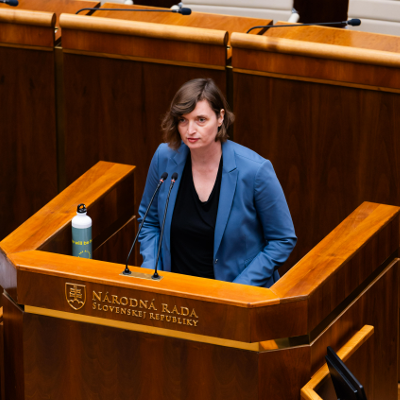
République slovaque, ADLE, Porte-parole du groupe
10:28:38
Thank you very much, Madam President,
Dear colleagues,
Let us face it once again: we have a problem.
Our daughters, sisters, mothers, wives, friends and neighbours are being intimidated, bullied, attacked and sometimes even killed simply because they are women.
Just last Saturday, in a small town in Slovakia, a woman, a mother and a teacher, was killed by her husband in front of their two children. This is a terrible tragedy. But it is also a brutal reminder that our societies are still failing to protect women.
Violence does not begin with a physical attack. It begins much earlier. It starts with words, with prejudice, with the way women are portrayed and spoken about.
That is why this report is so important. And I would like to sincerely thank Ms Yevheniia KRAVCHUK for her excellent work.
Misogyny is on the rise. Women are being threatened, silenced and told that their place is only in the home, caring for children and serving others. Women are still being told what their lives should look like, and too often, those decisions are made for them rather than by them.
In this context, the role of the media becomes even more important. The media has the power to shape public opinion, influence attitudes and reach millions of people. With that power comes responsibility. Information must be communicated wisely and fairly.
Gender stereotypes harm everyone. They limit opportunities for women, but they also place harmful expectations on men. Challenging these stereotypes is a responsibility we all share.
And we, as politicians, have a particular role to play.
Let me ask you a simple question: what is the representation of women in political debates in the media in your countries?
I looked at the situation in my own country, and the numbers are alarming. Among the five main political debate programmes, the highest share of female participants over the last three years was only 13%. In one programme, it was as low as 2%. Two percent. That means that only two out of every hundred politicians given a voice in that debate were women. This is simply unacceptable.
So today, I ask all of you to become advocates for equal opportunities and equal representation. In your countries, in your media and in your political parties. Because democracy cannot fully represent society if half of society is barely heard.
Thank you.
Autriche, SOC, Présidente de l'Assemblée
10:31:22
I thank you very much.
And now I call Ms Emma WEDNER, Chairperson of the Advisory Council on Youth and Vice Chair of the Joint Council on Youth, to speak for 3 minutes. Please, Emma.

Présidente du Conseil consultatif sur la jeunesse et vice-présidente du Conseil mixte sur la jeunesse
10:31:36
Thank you, everyone.
Before I walked into this room, I spoke to the Secretary General at our youth event.
But before that, I listened to my hype song. Why? Because I fight the very stereotypes that young women in leadership roles feel and experience every single day. So it's to get my spirits up before I do things like this. And it messes with my head and it's exhausting.
And today, as the Chairperson of the Advisory Council on Youth, I want to highlight and underline the importance of this report for young people and the specific challenges that we face. Because the gender gap in political views is growing, particularly among young people. And the media stereotypes, they drive it, but the opinions and the views are expressed by people, particularly adults, every single day, and young women and gender minorities are particularly affected. We're exposed to hate speech and disinformation campaigns with consequences that erode public support for equality overall. And these factors compound: being young and a woman, being a young woman and Roma, or being a young LGBTQ migrant.
And these stereotyping narratives are, in fact, harmful for everyone. You mentioned the tradwives, the manosphere and all of these different aspects. And the media promotes idealised and harmful versions of masculinity and femininity that shape children at a critical age. Because it's harder to reverse an echo chamber than it is to talk about it before it happens.
On Monday, in this very building, the My Voice, My Choice campaign received a prize here for their efforts. And the initiator of this, Ms Nika KOVAČ, has spoken very openly about the consequences of being a young woman at the face of a social movement. And that led her to take a step away from public life for months to recover from the impact of the stereotyping of her in the media.
And she's not alone, because this report talks about the grey zone where the issue is not addressed as a real problem, but the consequences are really bad. They're vast for young women, it affects their careers, their running for office or simply their existence in public spaces, as we saw with the case of Ms Nika KOVAC. And in this way this report is super important to be able to advocate for these issues, for me, in the Advisory Council on Youth, in this organisation and in your member states, and for the investments in non-formal education and media literacy that some have already mentioned.
The organisations that fight for these messages, as we do in the Council of Europe, but also in our local realities, are essential. But they must also be matched with the regulation of the algorithms, the artificial intelligence (AI) and the advertising, because otherwise we keep asking the people who are exposed to also fix the problem. So to eliminate the harmful gender stereotypes, we need to understand the issue.
Thank you Ms Yevheniia KRAVCHUK and everyone who contributed to the report and put pressure on the right actors. And that's where all of us come in.
Thank you.
Autriche, SOC, Présidente de l'Assemblée
10:34:50
Thank you very much, Ms Emma WEDNER.
And now I come to all the other speakers, who now have 2 minutes, and the first one on my list is Ms Aysu BANKOĞLU from Türkiye.
Madam President, thank you.
Dear colleagues,
Gender stereotypes remain pervasive in communication and across the media landscape. Too often, women and girls are portrayed in outdated roles that belong in the past. At the same time, men continue to see their dominance in positions of responsibility reflected and reinforced. These portrayals shape perceptions and expectations in society, of course.
Eliminating gender stereotypes in the media is essential for creating a more equal and inclusive society. By presenting diverse and realistic representations of all genders, the media can encourage equality, respect and greater opportunities for everyone.
From a youth perspective, social media plays a major role in shaping attitudes and self-image. Young people are constantly exposed to content that promotes stereotypical ideas about how boys and girls should look, behave and succeed. These messages can create pressure to conform to unrealistic standards, leading to low self-esteem, anxiety and a fear of expressing individuality. This is particularly concerning because young people are among the most active users of these platforms.
Gender stereotypes on social media can also discourage young people from pursuing interests, careers or activities that are seen as unsuitable for their gender. Promoting positive and diverse representations online can help young people develop confidence and embrace their identities.
I would like to praise my colleague and fellow youth rapporteur, Ms Yevheniia KRAVCHUK, for a report that is both realistic and ambitious, of course.
Gender stereotypes are more harmful than we sometimes realise. They limit opportunities, reinforce inequalities and affect future generations. It is time to strengthen our efforts to challenge and overcome them.
Thank you.
Autriche, SOC, Présidente de l'Assemblée
10:37:11
Thank you very much.
And I now call on Ms Octavie MODERT from Luxembourg.
Thank you very much, Madam President.
In fact, my delegation has actually put my name down for the wrong item on the Agenda. But that doesn’t matter. I would very much like to express my support here for the report and also for the rapport pour avis [in French] from the two committees and the two rapporteurs, which, I believe, provide a very comprehensive overview of this issue, as it is an important one. One would not think that such traditional or backward-looking images would still be circulating in the media today, but they are becoming almost ever more prevalent, and that is why it is very important that the Council of Europe addresses this issue. And I can only support the rapporteurs.
I believe that far too much of a distorted notion of masculinity is circulating in the media these days, and this very often leads to a great deal of brutality. Not only against women, but also against LGBTQIA+ communities, and indeed in society at large. That is why it is also very important that we develop media literacy, but that we also strongly support training within the media and for journalists, so that it acts as a counterbalance to conservative views. You are playing down this problem, and in doing so you are supporting the sick behaviour of men who think it is normal to mistreat their wives or even to regard and treat them as inferior beings. This is not in keeping with our society, and you should not support it. For in doing so, you are not only causing division, but also fuelling widespread incitement and brutality.
I support both reports.
Thank you.
Autriche, SOC, Présidente de l'Assemblée
10:39:12
There is a point of order.
Mr Malte KAUFMANN.
I just raised my blue card because I want to ask a question to my colleague that just spoke and I think we all agree that violence and beating up the partner and sexual abuse is totally unacceptable. We all agree on that. And I think if this is portrayed in the media, we should also take legal action.
But you also spoke about family models that are from the past and that are overcome and that are traditional. What do you exactly mean by this? Do you mean the classical family, like millions live in Europe?
Autriche, SOC, Présidente de l'Assemblée
10:40:03
So I think that was a question to Ms Octavie MODERT, and if you want to reply... This blue card system gives the possibility to those who speak on behalf of the group to ask a question to whoever took the floor in the debate.
And if you would like to reply to the question, you have also now 30 seconds to reply to the question. If you want. You are not forced to, but yeah, if you want to, please.
I didn’t actually hear a question there, just a comment. And I stand by my comments and my opinion.
Autriche, SOC, Présidente de l'Assemblée
10:40:43
Next is Ms Victoria TIBLOM from Sweden.
Thank you, Madam President.
This report raises a concern that should unite this Assembly, regardless of where we sit: the abuse and intimidation faced by women in political life.
The evidence in this report is sobering. Women in politics across our member states face a disproportionate share of online harassment, doxxing and deepfakes designed not to debate their ideas, but to humiliate and silence them. We heard of fabricated sexual content targeting female politicians, of search engines surfacing this material ahead of legitimate news, of Ukrainian journalists deliberately sexualised and discredited by Russian disinformation operations to weaken their voice and their credibility.
It is an attack on the basic precondition of democracy: that a woman who stands for office can do so without being targeted by fabricated, degrading content designed to drive her out of public life. We should be unambiguous in our condemnation of this, and equally unambiguous in demanding that platforms act.
I support, therefore, this report's call for serious, enforceable transparency from social media companies, clear timelines for removing deepfakes and image-based abuse, real consequences for platforms that drag their feet and meaningful tools for victims to seek redress. We support stronger protection for women journalists and politicians, particularly those documenting war crimes and corruption, who pay a heightened price for their courage.
What we cannot support is turning a report on online abuse into a vehicle for a broader ideological project, one that diagnoses entire societies as "patriarchal", casts ordinary family choices as problems to be corrected and treats traditional values as a danger to be managed rather than a freedom to be respected. Protecting women from abuse does not require accepting that framework, and this Assembly should not be asked to choose between the two.
Thank you.
Autriche, SOC, Présidente de l'Assemblée
10:43:03
Thank you.
And now, Ms Bernadeta COMA from Andorra.
Madam Chair,
Dear colleagues,
I would first like to extend my warmest thanks to our rapporteur, Ms Yevheniia KRAVCHUK, for her excellent work on a subject that concerns not only gender equality, but also the very functioning of our democracies and societies, and the future of our young people.
Even today, gender stereotypes remain ubiquitous in both traditional and digital media. They fuel discrimination, limit the opportunities available to women and hinder their full participation in public, political, economic and social life.
Rapid technological change makes this issue even more concerning. Social media offers new avenues for expression, but it can also amplify prejudice, sexist hate speech, online harassment and deepfakes, which particularly affect women involved in public life.
In the face of these challenges, we must take action through media literacy, raising awareness among young people, supporting civil society, holding digital platforms to account and ensuring a more balanced representation of women across all sectors.
In Andorra, we are fully aware of these issues. Although we do not have specific legislation addressing gender stereotypes in the media, in recent years we have strengthened our legal framework on equality and non-discrimination and established the Andorran Institute for Women, which plays a vital role in raising awareness, training and the promotion of equality.
We are currently working on reforming the law on the rights of children and young people in order to provide a better regulatory framework for the digital environment and the use of social media.
Prevention is essential and begins at a very young age. Despite the progress made, we fully share the conviction expressed in this report: true equality cannot be achieved as long as stereotypes continue to influence the opportunities and life choices of women and men.
Thank you.
Autriche, SOC, Présidente de l'Assemblée
10:45:19
Next is Mr Francesco VERDUCCI from Italy.
Thank you, President.
I would like to thank the rapporteur for this work.
Gender stereotypes are one of the most serious factors contributing to inequality. The portrayal of women as subordinate is what continues to consign millions of girls and women to minority status in the workplace, in terms of income, in their right to education, and in romantic relationships, preventing them from expressing themselves and fulfilling their potential.
This is a major political issue: stereotypes mislead, distort reality and pollute language; they are a precursor to hate speech and discrimination; they do not merely reinforce existing inequalities, but reproduce and fuel them. For centuries, stereotypes have served to preserve and perpetuate a hierarchical and reactionary system of power, and the most powerful way we have to overturn them, to dismantle them, is, first and foremost, a cultural battle: to educate people on respect, equality, consent, self-determination and emancipation from roles imposed by others.
And, therefore, we should introduce practical and emotional education in all schools, starting from pre-schools. And the same applies to the media: we must say no to the commodification of women’s bodies, no to algorithms that amplify misogynistic and discriminatory content, and no to a model of exploitation based on stereotypes from which a large part of the media market profits.
This cycle must be broken, because it comes at an unacceptable social cost. The price we all pay is one of endemic violence and a chilling series of femicides, and this is a political and social issue. We must overturn stereotypes and prejudices. We have to break the chains and tear down these walls, because they can hollow out and destroy our democracies.
Thank you, President.
Autriche, SOC, Présidente de l'Assemblée
10:47:51
Thank you very much.
And now call Ms Maria-Nefeli CHATZIIOANNIDOU from Greece.
Thank you, Madam President,
Dear colleagues,
Dear rapporteurs,
I would like to speak today about something more subtle than discrimination. Because the greatest challenge facing young people today is no longer being told, "you cannot do this". It is being told every single day what is socially acceptable for them to become.
Algorithms have become the invisible editors of our ambitions. Before a teenager enters a classroom, before a student chooses university or a career, they have already consumed thousands of messages about beauty, success, leadership, motherhood, strength and power. No one explicitly limits their choices, but slowly, invisibly and repeatedly, expectations are being curated for them.
This is the new face of gender stereotypes. Girls are still encouraged to be likeable before they are encouraged to be ambitious. And boys are often taught that vulnerability is weakness and that strength leaves little room for empathy. In both cases, potential is being limited. And that is why this debate is no longer about media representation alone. It is about who gets to shape human inspiration in the digital age.
And I believe we often ask the wrong questions. We ask, "How do we protect girls?" Instead of who is designing the digital environments in which all young people grow up? Because if technologies are built without diverse perspectives, they will continue to reproduce old inequalities, but in new forms.
Our objectives should therefore be more ambitious than increasing visibility. And visibility is not enough, because democracy is not only about who has a seat in the parliament. It is about who silently shapes millions of aspirations before citizens even enter the public sphere. And today, that battle is increasingly being fought online. If we want to have stronger democracies tomorrow, we must start by protecting something much more fragile today: the freedom of every young person to imagine a future unconstrained by gender stereotypes.
Thank you.
Autriche, SOC, Présidente de l'Assemblée
10:50:12
Thank you.
And the next one is Mr José María SÁNCHEZ GARCÍA from Spain.
As he doesn't seem to be in the room, I will call the next one, which is Ms Hripsime GRIGORYAN from Armenia.
Hripsime.
Thank you, Madam President,
I also wanted to thank our rapporteur, Ms Yevheniia KRAVCHUK, for this wonderful report.
And I cannot help myself but note that the remarks we heard a few minutes ago here suggesting that the media merely reflects the great reality of predefined roles for men and women are making this report all the more valuable and timely. So, once again, thank you, Yevheniia, for this report.
As parliamentarians, we often focus on laws and institutions. But stereotypes are shaped long before laws can correct them. They are shaped by what people see, hear and consume every day.
In recent years, the social media has amplified harmful stereotypes and made hate speech even more visible and more aggressive. Women in politics, journalism and public life often face attacks that have little to do with their ideas and much more to do with their gender.
In Armenia, we also face this phenomenon. Women more active in public life are not only disproportionately targeted online, but also gender-based insults are very often normalised. At the same time, I have seen encouraging initiatives by journalists, civil society organisations and media projects that highlight women as leaders, entrepreneurs, scientists and decision-makers, rather than confining them to traditional roles.
Because stereotypes affect not only women. They affect men and boys as well. They create expectations that everyone must conform to predefined roles and leave little room for individuality and human potential.
That is why I particularly welcome the report's emphasis on media literacy and education. Regulation alone cannot solve this issue. We need critical thinking. We need responsible media. And we need positive role models for young generations.
Freedom of expression should never be used as an excuse for sexism or dehumanisation. A democratic society is one where diversity of voices is promoted and where everyone can participate in public life with dignity and respect.
Thank you.
Autriche, SOC, Présidente de l'Assemblée
10:52:34
Thank you. And I saw Ms Lucia PLAVÁKOVÁ raising her "blue card" to raise a question.
You have 30 seconds.
I have a question for Mr Malte KAUFMANN because I was surprised by what he said, that there are typically female and male jobs.
So I would like to know, as we are all sitting here, if the job we are doing here is typically female or male?
Thank you.
Autriche, SOC, Présidente de l'Assemblée
10:53:00
Mr Malte KAUFMANN, if you would like to reply, you have 30 seconds to reply.
That was not at all the issue that I raised. I raised a certain issue of typical jobs where women and men nowadays like to work. And as you see, there are many women also in the parliament elected by the national people.
So this is totally fine, but it has nothing to do with the issue that I raised.
Thank you.
Autriche, SOC, Présidente de l'Assemblée
10:53:28
Next on my list is Mr Rónán MULLEN from Ireland.
Thank you very much, Ms President.
I think we need to take as our starting point the fact that countries vary greatly in their approach to these issues. And I have absolutely no doubt that there is much unacceptable sexism and stereotyping in many places.
That said, I do find in some ways the report has a lack of peripheral vision that is disappointing, and I would warn against a Faustian pact with the more aggressive side of trans activism, for example, but also the danger of a denialism about certain objective differences between men and women and their tendency to vary in aspirations. Even, for example, in countries like Sweden, considered very advanced, you'll often find that men will gravitate to particular professions and women to others. And we shouldn't be afraid of that as long as there is the equality of opportunity for people to aspire according to their aptitudes and talents.
But sometimes I think there is a lack of trust developing because of the triumph of ideology over truth-seeking. And I'd say we should commit to the truth for the sake of the fight against pornography, for the sake of allowing children to have a childhood where they're not intruded on or sexualised too young, and for the sake of allowing people to search for the truth and to find roles in life that fit their personal aspirations and nature as opposed to other people's ideology for them.
Stereotypes are always bad because they represent ideology, and ideology is bad. But let's not replace one ideology with another, because there are certain objective realities about the difference between men and women. And I think trans activism in particular denies that and endangers young people in particular, and I was disappointed to see references to that in this report.
But of course, any reasonable and good person must accept that there are places where women are denied their proper opportunities in life because of unhealthy and irrational stereotypes about them and also about a certain aggressive free market approach to media that allows people to say what they want and to consume other people as commodities and that we should all unite in fighting against.
Autriche, SOC, Présidente de l'Assemblée
10:55:44
Thank you.
And now, Ms Olena MOSHENETS from Ukraine.
Thank you to the rapporteur, Ms Yevheniia KRAVCHUK, for this insightful and important document.
We have to minimise gender stereotypes in order to create equal societies where everyone can realise their potential.
Let me read a few comments I found on social media and a news story about the appointment of the 25-year-old Ukrainian woman to a government position.
First, "Kid, you should be still playing with dolls".
"What's wrong with her face?".
"My dog also wants to be a minister".
These are just a few of thousands of comments. They are degrading and undermine not only the role of women in decision-making, but also that of young people.
This shows the intersectional nature of gender stereotypes. They are cruel towards young women. It also highlights a problem with today's media, behind these accounts lies cruelty and sexism, as well as irresponsibility for offensive comments.
That is why I support the resolution recommendations to introduce media literacy programmes at all levels of education, alongside age-appropriate sex education.
When looking at social media, it is clear that the prevailing view online is that a young woman cannot be successful and cannot achieve heights with her own skills and intelligence. The saddest part is that such comments are written by hundreds of women. We are working to establish a society of equal opportunities. The Ukrainian parliament currently has the highest number of women in its history and we are working to increase this strength.
It is important to support movements that focus on education with the aim of empowering women. And it is important to build societies free of gender stereotypes so that our children never hear, "you cannot be a pilot because you are a girl" or "you cannot be sad because you are a man".
Education and [speaker is cut off].
Autriche, SOC, Présidente de l'Assemblée
10:58:08
Thank you very much.
The next one on my speaking list is now Ms Irena FERČIKOVÁ KONEČNÁ from Czechia.
Thank you very much. And I would like to thank Ms Yevheniia KRAVCHUK for this vital report.
The impact on social media, and particularly on radicalisation, is immense, and we can see it. And the report rightfully refers to it. The digital pluralisation is systematically used to silence women, especially those who are visible in the public space.
Female journalists, especially those who challenge the traditional narratives, are met with gender disinformation. They are not professional critics. They are trying to discredit their work, to ridicule them, to deter them from public life and to silence them. We are witnessing the toxic culmination of this climate in my country, unfortunately.
Just last week, the Czech government effectively killed the ratification of the Istanbul Convention by withdrawing the resolution that was intended to start the process of ratification. This is the direct result of far-right politics that weaponise gender stereotypes under the guise of protecting traditional values.
Furthermore, nowadays we are also witnessing a direct attack on public service media in the Czech Republic, where proposed funding reform threatens to dismantle independence and subject them to political pressure. This assault on independent journalism is a crucial component of the same populist agenda that uses gender disinformation to undermine political resilience. Where disinformation dominates, human rights are eroded.
If we do not protect those on the front line of journalism and public life, this regression will become a new standard across Europe.
Autriche, SOC, Présidente de l'Assemblée
11:00:24
Thank you very much.
And before I hand over to my colleague Mr Mogens JENSEN, as Ms Yevheniia KRAVCHUK mentioned in her introduction, I just wanted to remind all women that we will have a Women at the Parliamentary Assembly of the Council of Europe (PACE) meeting at 1:15 p.m. in the Blue Restaurant, specially for the International Day on Women in Diplomacy.
Thank you.
And the next on the speaking list, and the last one as well, is Mr László TOROCZKAI from Hungary.
Thank you, Madam President.
First of all, in fact, it is traditional values that are in danger nowadays. The differences between women and men are determined by nature, chromosomes, biology and God. This is not a stereotype, but a fact. As long as common sense prevails, these differences are visible to the naked eye.
But, okay, let's talk about this. The LGBTQ lobby is now the most powerful lobby in the world. That is why LGBTQ propaganda is flooding social media, because the algorithm promotes it, while censorship silences the traditionalist and Christian voices that have the courage to criticise the goals of the LGBTQ movement.
Nowadays, it's almost impossible to make a movie that doesn't contain LGBTQ themes. Today, it's becoming increasingly difficult for a young boy to follow the traditional male role model. And it's becoming increasingly difficult for a young girl to follow the traditional female role model.
The report expresses concern for the rights of transgender women, but it does not, for example, express concern for those children, those little girls, who in many Western countries today must share a restroom with biological males. Contrary to this report, the media today tends to support non-traditional gender roles rather than traditional ones, which is why even the title of this report is impossible to comprehend.
The biggest problem with this report, however, is that it once again targets children and focuses on schools while discussing sexual topics. Just as the debate across Europe today is no longer about LGBTQ rights, since those are already granted, but rather about same-sex couples wanting to raise children. Enough is enough. Keep your hands off the children.
Thank you.
(Undelivered speech, Rules of Procedure Art. 31.2)
When the media landscape was limited to television, newspapers, magazines, and radio, it seemed possible to tackle the problem by establishing rules and setting ethical standards for those platforms. But just as with the fight against violence against women, we should have acted much earlier to confront gender stereotypes in the media. Problems that are not addressed early do not remain static. They become more complex, more entrenched, and much harder to solve.
Today, countless digital platforms that operate with little or no oversight claim to be practising journalism. In the digital world, more scandal, more outrage, and more misinformation often mean more clicks, more visibility, and more profit. Whether information is true or false becomes secondary, because the objective is no longer to protect the public’s right to accurate information.
Those who profit from outrage, of course, target women and LGBTQI+ people. They deepen existing inequalities. And now, with the rapid development of AI, existing biases and discrimination are not merely preserved – they are being reproduced. As a result, no matter how effectively we regulate traditional media, journalism itself is being undermined in a largely unregulated digital space that reaches people faster and more directly than ever before.
Yesterday, we were late to act. If we are late again today, the challenge we face tomorrow will be even more complicated and even more difficult to address. If governments and parliaments continue to treat equality as a secondary issue, subordinate to short-term political concerns; if they leave this field entirely to the unchecked power of private companies; then we will not simply face a media problem. We will face a social crisis.
(Undelivered speech, Rules of Procedure Art. 31.2)
Gender stereotypes in the media play a harmful role in perpetuating gender inequalities, followed by unfair share of resources and power in the societies.
They infringe equality and human rights.
While gender stereotypes are hurting all sexes, they are particularly detrimental to women. They strengthen unequal position of women in all segments of the society.
Gender stereotypes perpetuate patriarchal models of family in which cores related to family and child care are still on women’s shoulders which result in gender care gap.
Gender stereotypes enforce judgemental approach towards women in the media and lead to the situations when professional and successful women are often described, interviewed or even judged by their appearance, life style they choose or how they carry on their domestic roles.
Drastic polarisation of modern societies, growing populisms accompanied by radicalised sexist language on women of world leaders so eagerly perpetuated by mainstream and social media feed sexism, patriarchy and misogynist language as well as increasing violent behaviours. The recent sexist comments of President Trump on PM of Italy Georgia Meloni publicised broadly by world media feed the anti-women attitudes esp. hurt those women who are active in politics.
While gender stereotypes are particularly harmful for women, they also hurt other groups of our societies, marginalised or stigmatised such as LGBTQI, migrant people or other disadvantaged groups but also men and boys who are often expected to live up to old-fashioned macho models often against their will.
The Solutions must be and of Immediate and systemic nature.
Regulatory bodies must seriously address gender stereotypes disseminated by the media, with necessary sanctions, preventive measures such as Promotion of equality, human rights in education systems will contribute to educate the society free from gender stereotypes.
Most important is to remember that preventing, monitoring and effectively addressing gender stereotypes in the media is not one day action. It must be done every day as long as the media maintain such a strong impact on our lives.
(Undelivered speech, Rules of Procedure Art. 31.2)
Dear colleagues,
Thank you for the opportunity to speak.
I would like to thank Ms Yevheniia KRAVCHUK and Mr Benjamin DALLE for their important presentation. Eliminating gender stereotypes in the media is an important topic.
The media can strengthen equality and promote democratic values. But the media can also reproduce harmful stereotypes, which in turn affect politics, public life, access to justice, and even security.
For Ukraine, this issue is especially important during the war. Ukrainian women are not merely victims of aggression. They are soldiers, medics, volunteers, journalists, human rights defenders, local leaders, diplomats and members of parliament. The media must show this reality fully, not as an exception, but as part of modern Ukraine.
At the same time, we must also speak about women whose voices are deliberately silenced. In the temporarily occupied territories, especially in Crimea, independent media have been almost destroyed. Russia blocks Ukrainian information space and replaces it with propaganda. This propaganda attacks Ukrainian identity, Crimean Tatar identity, and often uses gender stereotypes to discredit women who resist occupation.
Women political prisoners, civic journalists and human rights defenders from Crimea face a double attack: as Ukrainians who reject occupation, and as women who refuse to remain silent. They are called extremists, traitors, or terrorists. Their stories are hidden or distorted by Russian-controlled media.
This is why media freedom and gender equality are connected. When authoritarian regimes control the media, they also control how women are seen. They erase women’s leadership, normalise violence, and justify repression.
We believe that democratic media must do the opposite: give visibility to women’s agency, challenge stereotypes, protect journalists, and amplify voices of victims.
We need stronger media literacy, support for independent journalism, and attention to women affected by war and occupation, including political prisoners, displaced women, and women from indigenous communities.
Thank you.
(Undelivered speech, Rules of Procedure Art. 31.2)
Mister President,
I would like to thank the rapporteur for this important report on gender stereotypes in the media and how they shape people's perceptions.
We still see systems and cultures that make it harder for women to be seen, heard and trusted to the same extent as men. The problem is how visibility, attention and opportunities are allocated.
Women and men often work differently and take different paths towards the same goal. That is not a weakness; it is a strength. The problem arises when everyone is measured against the same scale, often shaped by a narrow view of leadership and success.
These stereotypes affect whose voices are heard in public debate, who enters politics and who participates in decision-making. This is not only a question of equality; it is also a question of democracy.
Today, social media and algorithms increasingly shape what we see and which voices are amplified. The report points out that digital platforms can reinforce existing gender stereotypes.
What do we need to do?
We need transparency from social media platforms and measurable data. We need to invest in media literacy so that young people can identify bias, propaganda and harmful stereotypes.
We also need to ensure that women can participate safely and equally in public life without facing harassment and intimidation simply because they choose to make their voices heard.
Promoting equality in the media is not a threat to freedom of expression. We want a media landscape where everyone has an equal opportunity to be heard and represented. Thank you.
(Undelivered speech, Rules of Procedure Art. 31.2)
Dear colleagues,
The issue before us is not simply about media representation. It is about democracy, equality and human dignity. Media shape public opinion and influence who is seen as credible and capable of leadership.
Yet gender stereotypes remain widespread across traditional media, online platforms and social networks. Women and men are still too often portrayed through narrow and outdated roles that reinforce inequality and limit opportunities.
These stereotypes are not harmless. They affect women's participation in public life, leadership and decision-making, and they shape how future generations understand power and social roles.
The Bulgarian media monitoring reports prepared by the Council for Electronic Media provide valuable evidence in support of this resolution. While women are strongly represented among presenters, reporters and journalists, men continue to dominate as managers, guests, experts and commentators, particularly in discussions on politics, economics and public affairs.
Some argue that this simply reflects existing inequalities in positions of power. But media representation does not only mirror reality, it also shapes it. Visibility matters. When women are absent from public debate, they are less likely to be seen as leaders and decision-makers. For example, in Bulgaria, during the 2024 parliamentary elections, women represented fewer than 27% of elected MPs, yet in some media outlets they accounted for just 4–5% of pre-election coverage guests.
This is why the measures proposed in this resolution are both timely and necessary. Media literacy, education and public awareness can help challenge stereotypes and promote equality. Media organisations, online platforms and technology companies must also take responsibility for combating sexist narratives and ensuring balanced representation.
By supporting this resolution, we send a clear message: gender equality is a democratic imperative and a shared responsibility.
Thank you.
Speech not pronounced (Rules of Procedure, Art. 31.2), only available in French

Danemark, SOC, Président de l'Assemblée
11:03:02
Thank you.
And I must now interrupt the list of speakers and the speeches of members on the speakers list who have been present during the debate but have not been able to speak may be given to the Table Office for publication in the Official Report.
These speeches must not exceed 400 words and I remind colleagues that the typewritten text can be submitted, electronically if possible, no later than four hours after the list of speakers is interrupted.
So now I call on Ms Yevheniia KRAVCHUK, rapporteur, to reply.
You have three minutes, Ms Yevheniia KRAVCHUK.
Thank you, Chair. Thank you for this debate.
It was very interesting, and I think now you understand even more why this report is important and timely. And I want to encourage the young people who are here and were listening to this debate – especially young women – not to be afraid to enter whatever career and life choice they want to do. Not imposing on any traditional jobs, traditional roles, or anything that someone thinks is suitable for you. You have to decide on your own. I have a 12-year-old daughter, and I want her to make her own choices, not to be pressured by stereotypes that are over 100 years old.
And I don't want to take more time because we will have a short vote afterwards. But also, I want to thank every woman politician who, despite the stereotypes, is doing her job. I want to thank the journalists. I'm a journalist myself, so I had these double stereotypes during my career choices. And indeed, women politicians and women journalists are disproportionately targeted in the digital sphere with deep fakes with sexualised content for a very single reason, to push them to leave and to stop – and do not stop!
Thank you.
Danemark, SOC, Président de l'Assemblée
11:05:39
Thank you.
And does the Chairperson wish to speak?
Ms Béatrice FRESKO-ROLFO, you have the floor.

Monaco, ADLE, Présidente de la Commission sur l'égalité et la non-discrimination
11:05:47
Thank you, Mister President.
Dear colleagues,
It is my pleasure to take the floor today to commend the remarkable work carried out by our rapporteur, Ms Yevheniia KRAVCHUK, on the topic of eliminating gender stereotypes in the media.
This is an important issue, which remains more relevant than ever. We are born and raised in a society that constantly exposes us to stereotypes and traditional roles. Quite simply, as children, we were often given toys "for boys" or "for girls". And, as adults, we in turn risk giving gifts to younger children based on the same criteria, often without even realising it.
This issue affects all areas of our lives: education, the world of work, and our social relationships. However, it is the media sector that is of particular interest to us and raises the most concerns. Indeed, the media – whether traditional, such as television and the press, or more recent, such as the internet and social media – exert a considerable influence on the way we think and, consequently, on the way we act.
In this regard, I would also like to acknowledge the contribution of the Committee on Culture, Science, Education and Media, which has full competence in this matter. Its proposals have constructively enriched the text and have further strengthened its scope.
The text on which we are to vote today contains concrete measures aimed not only at eliminating gender stereotypes in media content, but also at promoting a better balance between women and men in the very creation of that content.
I am counting on your support for the adoption of this text, so that we may make further progress towards a more open, balanced and inclusive society, for the benefit of everyone.
Thank you.
Danemark, SOC, Président de l'Assemblée
11:07:42
Thank you. And now the debate is closed.
The Committee on Equality and Non-Discrimination has presented a draft resolution to which 10 amendments and one sub-amendment have been tabled.
And now we will take it in the order in which they appear in the Compendium.
And I remind you that speeches and amendments are limited to 30 seconds.
I understand that the Chairperson of the Committee on Equality and Non-Discrimination wishes to propose to the Assembly that Amendments 1, 6, 8, 9 and 10 to the draft resolution, which were unanimously approved by the Committee, be declared as definitively approved.
Is that so, Ms Béatrice FRESKO-ROLFO?
Monaco, ADLE, Présidente de la Commission sur l'égalité et la non-discrimination
11:08:29
Yes, Mister President.
Danemark, SOC, Président de l'Assemblée
11:08:33
Good. If no one objects, I'll consider the Amendments to be approved. Is there any objection? It is not the case.
Amendments 1, 6, 8, 9 and 10 to the draft resolution are therefore approved and will not be called.
I now call on Mr Benjamin DALLE, who is the rapporteur of the Committee of Culture, Science, Education and Media, to support Amendment 2. And you have 30 seconds, Benjamin.
Belgique, PPE/DC, Rapporteur pour avis
11:09:11
Thank you, Chair.
Amendment 2 is about the representation of women behind the screens. We ask this Assembly also to emphasise the importance of women in these functions behind the screens.
Thank you.
Danemark, SOC, Président de l'Assemblée
11:09:30
Thank you.
Does anyone want to speak against this amendment?
What is the opinion of the Committee?
Monaco, ADLE, Présidente de la Commission sur l'égalité et la non-discrimination
11:09:43
The Committee adopted it with a very large majority.
Danemark, SOC, Président de l'Assemblée
11:09:47
So the Committee is in favour of the amendment.
I now open the vote.
The vote is open.
And the vote is closed. I call for the result to be displayed.
The amendment is adopted.
We now move to Amendment 3.
And I also call on Mr Benjamin DALLE to support Amendment 3. You have 30 seconds.
Belgique, PPE/DC, Rapporteur pour avis
11:10:40
Thank you, Chair [off mic].
This amendment highlights the importance of the intersection between age and gender.
Too often, women face reduced opportunities as they grow older, for example, as presenters, journalists or leading on-screen figures, whereas this tends to be far less the case for men. This imbalance contributes to the invisibility of all the women in public life and reinforces harmful stereotypes.
Thank you.
Danemark, SOC, Président de l'Assemblée
11:11:06
Thank you.
Does anyone want to speak against this amendment?
Not the case.
What is the opinion of the Committee?
Monaco, ADLE, Présidente de la Commission sur l'égalité et la non-discrimination
11:11:16
Adopted by a very large majority.
Danemark, SOC, Président de l'Assemblée
11:11:18
The Committee is in favour.
I now open the vote.
The vote is closed.
I call for the result to be displayed.
The amendment is agreed to.
We move to Amendment 4.
I call on Mr Benjamin DALLE to support Amendment 4.
Belgique, PPE/DC, Rapporteur pour avis
11:11:47
Thank you, Chair.
This amendment is about the positive role that media can play for this subject matter, and we ask to add that to the resolution.
Thank you.
Danemark, SOC, Président de l'Assemblée
11:11:59
Thank you.
Does anyone want to speak against? Not the case.
What is the opinion of the Committee?
Monaco, ADLE, Présidente de la Commission sur l'égalité et la non-discrimination
11:12:07
Adopted by a very large majority.
Danemark, SOC, Président de l'Assemblée
11:12:09
So the Committee is in favour.
I now open the vote.
And I close the vote and ask for the result to be displayed.
It is adopted.
We move on to Amendment 5.
And again I call on Mr Benjamin DALLE to support Amendment 5.
Belgique, PPE/DC, Rapporteur pour avis
11:12:38
This amendment is about the unauthorised distribution of realistically digitally generated imitations of personal characteristics and deepfakes.
Thank you.
Danemark, SOC, Président de l'Assemblée
11:12:53
Thank you.
Does anyone want to speak against?
It's not the case.
What is the opinion of the Committee?
Monaco, ADLE, Présidente de la Commission sur l'égalité et la non-discrimination
11:13:01
Adopted by a very large majority.
Danemark, SOC, Président de l'Assemblée
11:13:03
The Committee is in favour. I now open the vote.
The vote is closed. I call for the result to be displayed.
It is adopted.
We move on to Amendment number 7 and its sub-amendment. There is a sub-amendment to Amendment 7 proposed by the Committee on Equality and Non-Discrimination.
And first I will call on Mr Benjamin DALLE, Rapporteur for the Committee on Culture, Science, Education and Media, to support Amendment 7.
You have 30 seconds.
Belgique, PPE/DC, Rapporteur pour avis
11:13:42
Yes, thank you, Chair.
The problem in the original text was that it mentioned that the objective was to prohibit general stereotyping and sexist representations. We ask to replace the term "prohibiting" with a more positive notion.
Thank you.
Danemark, SOC, Président de l'Assemblée
11:14:00
Thank you.
I now call on Ms Yevheniia KRAVCHUK, representative of the Committee on Equality and Non-Discrimination to support this sub-amendment.
I do agree with the rapporteur for opinion that the positive notion should be added.
But I would like to slightly rephrase the original text and include the proposal of the rapporteur for opinion.
So instead of "prohibiting" would be "explicitly discouraging gender stereotyping and sex representation and promoting".
And then the text of the rapporteur for opinion.
Danemark, SOC, Président de l'Assemblée
11:14:37
Thank you.
Does anyone want to speak against the sub-amendment? That's not the case.
What is Mr Benjamin DALLE's opinion on the sub-amendment?
Belgique, PPE/DC, Rapporteur pour avis
11:14:47
I agree with the sub-amendment.
Danemark, SOC, Président de l'Assemblée
11:14:50
The rapporteur agrees.
And what is the opinion of the Committee?
Monaco, ADLE, Présidente de la Commission sur l'égalité et la non-discrimination
11:14:55
I am very much in favour, Mister President.
Danemark, SOC, Président de l'Assemblée
11:14:58
So the Committee is in favour.
And now I put the sub-amendment to the vote.
The vote is open.
The vote is closed. I call for the results.
The sub-amendment is adopted.
Now we come to the main Amendment 7 (as amended).
And does anyone want to speak against this amendment? No.
What is the opinion of the Committee? The Committee is in favour.
I now open the vote.
I close the vote and call for the results to be displayed.
It is adopted.
Amendment 7 is adopted.
And now we go for the bench to be shifted. So we will begin again in a couple of minutes.

Ukraine, PPE/DC, Présidente de l'Assemblée
11:19:11
Dear colleagues,
We resume our session, and the next item of business is the debate on the report titled "Protecting democracy from disruptions caused by artificial intelligence", Document 16417, presented by Ms Deborah BERGAMINI on behalf of the Committee on Political Affairs and Democracy.
We will then have the statement of Ms Kristina KALLAS, Minister of Estonian Education and Research.
The debate must conclude at 1 p.m. sharp, so I propose to interrupt the list of speakers around that time, colleagues.
The debate will continue later this afternoon, so the vote will take place later.
Now I call Ms Deborah BERGAMINI, the rapporteur. Ms Deborah BERGAMINI, you have 7 minutes now and 3 minutes in the end to reply to the questions of the colleagues this afternoon.
Ms Deborah BERGAMINI, the floor is yours. "Please" [spoken in Italian].
Well, thank you very much, Ms President, and thank you very much colleagues and Minister Kristina KALLAS. Your presence here marks the timely relevance of this report. So it will be very interesting to listen to your intervention.
But I would like to start from a question. How do you, colleagues, know, right now, that what you are seeing is real? Two years ago, this question would have been ridiculous. And one year ago, this question would have sounded, at least, strange in this Assembly. But today, it is not strange at all. It is the question at the heart of this report.
Artificial intelligence is not a future challenge. It is already reshaping how citizens vote, how they trust, or stop trusting, their institutions and how they can tell truth from fabrication. This report is about democracy’s ability to survive this test.
Let me be very clear about the stakes, in three words and these words are trust, power and time.
Trust, because AI-driven disinformation, all the deepfakes and algorithms that reward division over dialogue are quietly eroding the foundation every democracy stands on, which is the shared belief that elections are free, that information provided to citizens is real, that institutions answer to citizens and not to code.
Then, the second word, power. Power, because whoever controls the AI infrastructure increasingly controls a strategic resource, no less significant than energy or finance or free navigation. This is no longer only a technical question, but it is pure geopolitics.
And then, the third word, time. Because Europe does not have the luxury of regulating from the sidelines while this technology is shaped elsewhere, perhaps according to values that are not our own values.
I want to be equally clear, colleagues, this is not a report against AI. AI can make democracy stronger, not weaker. It can help a citizen from a faraway small town understand a complex policy reform in plain language. It can help a parliament hear thousands of voices in a public consultation instead of only a few hundred. It can close, rather than widen, the distance between institutions and the people. That promise is real, but it will only be realised if we act now, deliberately, with democratic principles built in from the start, not bolted in afterwards.
So what does this report ask of each of us, concretely?
First, let's sign and ratify the Framework Convention on Artificial Intelligence, Human Rights, Democracy and the Rule of Law. This is not a declaration of intent. It is the first binding international treaty of its kind anywhere in the world and Europe wrote it. Colleagues, let's go home and push our governments. Governments that have not yet ratified it. Every signature that is missing is a gap our adversaries will use. And I refer to adversaries as adversaries of freedom and democracies.
Second, accountability. Developers and providers of AI systems must answer for the harm their technology causes, just as any other actor in our societies has to do. Victims need real redress, not fine print. And the most dangerous content, deepfakes during elections or manipulated images of public figures, synthetic disinformation, needs mandatory watermarking and fact-checking, not voluntary best practice.
Third, sovereignty. Europe cannot keep building its democratic future on infrastructure it does not control. That means investing in our own technological capacity, breaking up dangerous concentrations of power in a handful of companies and making sure that diversity, of language, culture, viewpoint, is built into these systems rather than flattened by them. We have to build a true European ecosystem for AI.
And, then, fourth, vigilance. I ask every national parliament represented here to take this very seriously. Open real debate, build the expertise, consider a dedicated committee on AI. We cannot regulate well what is out of our reach.
Colleagues,
Every generation of parliamentarians is tested by the technology of its time. Ours is artificial intelligence and the test is this: will we be the ones who let the line between real and unreal dissolve into our democracies or will we be the ones who held it?
This report does not pretend to have every answer. But it draws that line, clearly, on the side of human rights, democracy and the rule of law. I am thankful for all the contributions that will come from you, from this debate.
Thank you very much for your support.
Autriche, SOC, Présidente de l'Assemblée
11:26:56
Thank you very much, Ms Deborah BERGAMINI.
I now have the honour, dear colleagues, to welcome among us the Minister for Education and Research from Estonia, Ms Kristina KALLAS.
Dear Madam Minister,
Thank you very much for joining us today and for taking part in this important exchange on protecting democracy in the area of rapid technological change. You have been a leader in advancing education policy in Estonia, a nation recognised for its innovative use of digital technology and commitment to democratic principles. Under your guidance, Estonia remains on the forefront of educational excellence, integrational technology into learning environments, while fostering the values of critical thinking and civic engagement.
In your role as Minister of Education and Research in Estonia since 2023, you have championed initiatives that emphasise digital literacy, resilience and responsibility. As we discuss how AI may disrupt established democratic norms and institutions, we look forward to your insights on fostering resilience, promoting critical thinking and ensuring our societies remain vigilant and adaptive.
Thank you very much for joining us here and lending your expertise to this crucial conversation.
The floor is yours for 10 minutes, please.
Ministre de l'Éducation et de la Recherche de l'Estonie
11:28:36
Dear Madam President,
Thank you very much for the very generous introduction to my work so far.
I think we are at the very early stages, globally, definitely also in Estonia, to have any definite answers to the question of how artificial intelligence (AI) is going to affect humans. I am trying in this, my intervention of 10 minutes, to maybe give some kind of broad line of thought as to how we in Estonia are approaching AI when it comes to education. And it is my great honour to address you today. Thank you very much for giving me this opportunity.
As the Minister of Education and Research of Estonia, artificial intelligence is often described as a technological revolution. But in my address today, I would argue, based on our thinking in Estonia, that for democracies it is a test of human evolution.
The question before us is not whether artificial intelligence will change our societies. We know that it is already changing it. The question is whether democratic societies will be the ones who will shape this change, or whether they will be the ones who had to merely adapt to it after the fact. And this will be determined by the growth in human ability to outperform computers. And I will explain my argument here in detail.
But let me begin by thanking the rapporteur, Ms Deborah BERGAMINI, for the comprehensive report and for bringing this important discussion before the Assembly.
The report addresses one of the central political questions of our time. What is the impact of AI on democracy? Who governs it? And how does artificial intelligence enhance or not enhance human rights, democratic institutions and the rule of law. The challenge is, as has been the case many times in history, to ensure that technological progress supports the development of democratic governance and does not destroy it.
The report rightly recognises that artificial intelligence presents both significant opportunities and risks for democratic societies. It can widen access to public services, enable better education for more people and strengthen democratic participation. But it can also give ground to massive manipulation, distortion of reality, facilitate foreign unfriendly interference, reinforce existing biases and severely undermine trust in democratic institutions. But democracy is sustained by trust. Trust by its citizens in institutions and trust by citizens in each other.
The crucial component here is citizens. The people and the plebiscite can only operate in a society where information is provided freely, it is vetted, and it is debated. Democracy requires that citizens can process information. They have the ability to recognise manipulation, weigh evidence, agree and disagree responsibly, and make judgements under the conditions of uncertainty. And these skills are developed in education. Democracy was built and is sustained by literate and educated citizens. Democracy requires good education for all. And this is where it comes down to education.
As with previous technological revolutions, the human control over technology was achieved by increasing the level of human skills through increasing the level of skills in education. The debate on AI often centres on the capabilities of technology. But to my understanding, the more pertinent question is about human capabilities. Today, artificial intelligence can create and augment reality, deliver judgement on complicated situations, conduct ethical debates and provide recommendations on the taste of recipes, for example. Does it have a taste? That's an interesting question. This is a major challenge to humans as their cognition, their understanding of the world and self is about to be taken over by the technology.
And let me explain how we see this challenge in Estonia. I often say that as a result of the emergence of artificial intelligence, humankind is under evolutionary pressure. We have been under evolutionary pressure before in history, but this time it is not about the ability to run fast, but to think deeper, more systematically and more creatively. AI is changing the cognitive demands placed by the outside world on us humans. And education is a core national system that supports human growth. And the evolutionary leap in human thinking capacity starts in school. What we need to aim at in education, in my opinion, is to design learning systems that train as many humans as possible to be able to use higher-order thinking skills – that is analysis, evaluation and creation – and this to be as many times per day as possible. And humans have to be able to better use those higher-order thinking skills as they have done before. Humans have to be in permanent learning mode. Knowledge, facts, basic numeracy and literacy skills are essential here. They are the foundational knowledge that needs to be the basis of any educational system.
However, the skills to learn and relearn, to analyse every piece of information and situation, to distinguish, to scrutinise, to examine, to decide, to validate, to appraise, to evaluate, to criticise, to consider circumstances, and so on. In other words, higher order thinking skills need to be taught from much earlier in school than in previous decades. And for those teaching those skills, AI needs to be used in schools as a tool. And I know that this is something that creates controversy immediately, but let me explain.
In Estonia, we see this as one of the most important educational challenges. I would therefore argue that artificial intelligence is an accelerator, a technology that forces us, humans, to an evolutionary leap in our cognitive capacities. This understanding has shaped Estonia's approach to artificial intelligence in education. Like many countries, we experienced a major disruption during the COVID-19 pandemic. Our schools had to adopt rapidly to entirely new circumstances. One lesson we drew from that experience was that resilience is not the ability to return to a previous state. Resilience is the ability to transform under changed conditions.
When generative artificial intelligence (GenAI) emerged shortly afterwards, we approached it through the same lens. The question was not whether AI should be allowed into education, but how teaching and learning should change so that we can sustain control over human cognition and democracy. We began by asking what kind of skills, competencies and learning experiences students will need in a world where AI is becoming part of their everyday life. This naturally led us to focus on teachers.
Let me be very clear. The change in learning will not be led by artificial intelligence. It will be led by teachers. But the change has to happen. If we want students to develop higher-order thinking skills, we must first ensure that teachers are confident and capable of using AI to support that kind of learning. Our objective is to use AI to support deeper thinking. This is why we are particularly interested in approaches that encourage questioning, reflection and metacognitive learning. Approaches that strengthen higher-order thinking skills.
Our AI Leap initiative in upper secondary schools follows the following principles.
First, we developed a learning AI. It's a version of ChatGPT that does not spit out quick answers, does not provide quick solutions, but it's a learning tool that pushes students to ask questions and pushes students to do the reflections on their own learning capacities.
We also conduct extensive teacher training on AI, but mostly on cognitive development of students in the AI era and how the teaching has to change in the AI era. And we have a scientific monitoring council that monitors the whole process and conducts the research on learning processes.
Through the AI Leap initiative, schools to teachers, researchers and technology partners are working together to explore how artificial intelligence can support learning while strengthening human cognitive development. And at the same time, we recognise that this is a journey of discovery. No country currently possesses a complete roadmap for how education systems should adapt to artificial intelligence. We are learning as we go and we invite the world to learn with us.
Madam President, the report calls on member states to strengthen AI literacy and media literacy and I strongly support this objective.
At the same time, Estonia's experience has led us to a little bit of a broader conclusion. Understanding AI matters a lot. However, as I have argued above, we need to go beyond that. In a world increasingly shaped by artificial intelligence, democratic societies will need citizens who can think critically, evaluate information, exercise judgement and navigate complexity. And the capacities of those skills need to move to a much earlier age than it has been now. This is why I believe the discussion about AI governance and the future of democracy cannot be separated from the discussion about what we teach and how we learn. The long term resilience of our democracies will depend on how we regulate artificial intelligence, and it will also depend on how we educate people to live and participate in a society where AI is part of everyday life.
Therefore, I would like to, at the end, stress two aspects that I consider to be very important.
First, education systems must, from an early age, focus on developing every human's ability to think deeper, to understand their own thinking, to analyse the information that is thrown to them and and to have the ability to systematise the world around them.
And second, we must regulate AI development and the business models of AI developers. We should not repeat the mistake we did with social media. Retaining human agency over generative artificial intelligence is crucial and I believe that the European political will is there to set clear ethical control rules on AI.
Estonia has embarked on innovation in education with a set goal to make our next generation more resilient, more familiar with AI and having human cognitive capacities that go above that of AI. If we can raise a generation that uses artificial intelligence to expand human thinking rather than to replace it, then AI will not be a threat to democracy. I hereby advise us to be conscious very much of the risks that AI poses and based on those risks, develop strategies for education. Being just afraid of AI is definitely bad for our democracies.
Thank you for your attention.
Autriche, SOC, Présidente de l'Assemblée
11:41:22
I thank you very much for sharing your insights, Madam Minister. They are very welcome and very useful. And we are also here to learn from each other.
And now we start with the debates on behalf of the political groups, and I first give the floor to Ms Anna-Kristiina MIKKONEN from the Socialists, Democrats and Greens Group.

Finlande, SOC, Porte-parole du groupe
11:41:41
Thank you, Madam Chair.
And above all, thank you, Minister, for your excellent speech.
Estonia is a model country when it comes to the development of e-services in public administration.
Artificial intelligence is transforming the world at breakneck speed, both in our daily lives and in warfare. The development of AI systems requires particular attention to respect for human dignity, transparency and accountability. It is essential to conduct a comprehensive review of the need to regulate the development and deployment of all new artificial intelligence (AI) technologies, including those specifically intended for national security and defence, whilst removing barriers to innovation in Europe.
With regard to the use of energy networks and other similar critical infrastructure, mastery of human expertise in AI systems has become a crucial strategic geopolitical asset. Concrete measures are needed to counter the threat of foreign interference and to protect ourselves against disinformation in general.
Biased AI information and output can undermine citizens’ trust in traditional media, democratic processes and institutions, thereby contributing to the decline of democracy. Large-scale, well-coordinated disinformation campaigns can be launched to disrupt political debates and elections. AI developers and social media platforms must be held accountable for the harm caused by their services.
Regrettably, an increasing number of citizens are relying on social media as their main source of information. Most may be unaware that the data collected from them is also used to profile them, identify their preferences and target them with specific content, with the aim of manipulating their opinions.
Personal data can be misused to create false identities or produce synthetic content, such as deepfakes, which impersonate others in order to harass, defraud, blackmail or deceive.
Artificial intelligence offers many possibilities, both positive and negative. I hope that we will be able to monitor developments and respond through legislation.
Thank you for your attention.
Autriche, SOC, Présidente de l'Assemblée
11:44:53
Thank you very much.
Now, on behalf of the Group of the European People's Party, I call Ms Denitsa SACHEVA.

Bulgarie, PPE/DC, Porte-parole du groupe
11:45:01
Thank you, Madam Chair.
First of all, I would like to sincerely thank the rapporteur, Ms Deborah BERGAMINI, for choosing this timely and strategically important topic and for preparing a report that goes beyond technology and addresses one of the defining political challenges of our time.
This report is about artificial intelligence (AI), but in reality, it is about democracy, power and trust. Artificial intelligence is becoming a new source of economic, political and geopolitical power. For centuries, nations competed for territory, resources and military strength. Today, they increasingly compete for data, algorithms, computing capacity and technological leadership. This is the new geopolitics.
For countries such as Bulgaria, this discussion is particularly relevant. We have experienced disinformation campaigns, foreign influence operations and attempts to undermine trust in democratic institutions. Artificial intelligence does not create these threats, but it amplifies them. Manipulation becomes faster, cheaper and more sophisticated.
Today, we are no longer speaking only about false information. We are speaking about fake voices, fake videos, fake identities and, ultimately, fake realities. Yet, democracy cannot function without a shared understanding of reality.
At the same time, AI is emerging at a moment when democratic societies are already changing. The profound cultural change is that our citizens are becoming consumers. Citizens increasingly expect immediate results, personalised services and instant answers. But democracy cannot be instant. Democracy requires patience, debate, compromise and responsibility. And that is why the greatest challenge of artificial intelligence is not technological. But it is democratic. The question is not whether machines will become more intelligent; the question is whether democratic societies will remain wise enough to govern them.
Europe cannot remain merely a regulator while others are shaping the technologies that will influence our future. We need innovation, investment, talent and digital sovereignty. But above all, we need confidence in our democratic values.
Our most important investment is not in algorithms, it is in people, in critical thinking, media literacy and democratic culture. We also need a new generation of leaders who understand both technology and democracy, because technological competence without democratic values is dangerous, while democratic values without technological competence are increasingly insufficient.
Thank you.
Autriche, SOC, Présidente de l'Assemblée
11:47:32
Thank you very much.
And the next 3 minutes go to Ms Victoria TIBLOM on behalf of the European Conservatives, Patriots & Affiliates.

Suède, CEPA, Porte-parole du groupe
11:47:43
Thank you, Madam President.
This report rightly warns us. Artificial intelligence is advancing faster than our institutions can govern it. But let us be precise about what kind of response Europe needs, because not every response on offer is the right one.
First, sovereignty. We cannot accept a future where European citizens' data, European elections and European public services depend on infrastructure and decisions made in Washington and Beijing. Digital sovereignty is not a slogan, it is the precondition for democratic self-government. And we support this report's call to invest in our own computing capacity, our own talent, our own sovereign clouds. A Europe that does not control its own digital foundations cannot claim to govern itself.
Second, let us not confuse regulation with protection. Brussels has a habit of mistaking paperwork for safety. If we bury our innovators in compliance while America and China race ahead, we will regulate ourselves into irrelevance and irrelevance is not a democratic value. We ask this Assembly to heed the report's own words: regulation must enable innovation, not strangle it.
Third, security. We have already seen what foreign interference looks like, in Romania, in Moldova, through bot farms and disinformation campaigns engineered by hostile states. This is not a hypothetical risk, it is an ongoing attack on the democratic choices of our citizens. Here, this Assembly must show resolve, not hesitation.
Colleagues,
The answer is not to fear this technology, nor to outsource its governance to bureaucracies distant from our citizens. The answer is a Europe that is sovereign, competitive and secure, one that trusts its nations to act and acts firmly when our democracies are threatened.
Thank you.
Autriche, SOC, Présidente de l'Assemblée
11:50:02
Thank you very much.
And I now call on Mr Damien COTTIER on behalf of the Alliance of Liberals and Democrats for Europe.

Suisse, ADLE, Porte-parole du groupe
11:50:11
Thank you, Madam Chair.
Whilst preparing for this debate, I asked an artificial intelligence (AI) system what it suggested I should say about this report, and it suggested a quote from Alexis DE TOCQUEVILLE on democracy, which I’m not sure actually exists. I am currently trying to verify this, but I have not been able to find it through my own research. This therefore proves what the rapporteur was saying: nowadays, we can no longer necessarily believe what we see, and that should make us wary.
Of course, this is by no means the first time that our Assembly has debated these issues relating to artificial intelligence. We were actually quite far ahead of the curve on these matters, with questions already being raised in late 2015 and around 2017, followed by a package of measures called for around 2020, some of which were secured through the Convention, which remains a world first, in 2024, and now follow-up reports in several areas, including that of democracy.
And this is truly the strength of the report presented to us today: its focus on both the risks and the opportunities, and the impact on democracy – which, incidentally, ties in with the points set out in the report I had the pleasure of presenting to this Assembly earlier this year on elections in times of crisis, in which we identified this as clearly being one of the major disruptive factors. This, therefore, follows on from our Assembly’s work.
Allow me to highlight a few points. Firstly, our member states must ratify the Convention as quickly as possible; secondly, it must be implemented; and thirdly, these activities will need to be co-ordinated. Furthermore, Europe must continue to innovate in the field of artificial intelligence, and that means we need balanced legislation – not seeking to regulate everything at all costs or creating European bureaucracy, as has been said, which ultimately stifles innovation and prevents it from flourishing.
The president of the Swiss Federal Institute of Technology in Zurich, one of Europe’s leading universities, gave an interview this morning – which I have just read – in which he says that we must create a European AI, and for this to be done properly, we must not stifle innovation; and in that sense, I am not sure that a moratorium is the best way to achieve this, as has been proposed.
Next, foreign interference: we have all seen it at work very actively in the recent elections we have observed across Europe. The Parliamentary Assembly had called for stronger action through several resolutions on these issues. I am pleased to see that the Committee of Ministers has also taken up this issue and that the drafting of a convention is now being proposed; this is absolutely essential because AI is being used as a tool to influence elections in various countries.
Next, on the issue of universality, it is important – as you emphasise, madam rapporteur – that we must work not only within Europe but also with other countries to regulate artificial intelligence. Switzerland will be delighted to host the World AI Summit next year, and I think it would be good for our Assembly to participate officially.
Next, education – as you emphasise, this is essential, and as the Minister also said, we absolutely must work on this.
And finally, let us continue to look ahead, particularly to future disruptions such as quantum technologies; we must also address these issues.
The Group of the Alliance of Liberals and Democrats for Europe will support this report.
Autriche, SOC, Présidente de l'Assemblée
11:53:26
Thank you very much.
And it is not a hallucination if I give now the floor to Ms Patricia STEPHENSON on behalf of the Group of the Unified European Left.

Irlande, GUE, Porte-parole du groupe
11:53:36
Thank you and thank you to the rapporteurs.
The unprecedented proliferation of disinformation online, facilitated by generative artificial intelligence (AI), has profound implications for how citizens interact with the democratic process, eroding trust in institutions, politicians and elections with an avalanche of fake news and increasingly sophisticated deepfakes able to distort reality, thereby threatening the very concept of democratic accountability.
We've seen the ease with which bad-faith actors, including foreign actors, are able to exploit the murky online space to fuel far-right disinformation, often in an attempt to either disrupt democratic elections or undermine stability by sowing division. And this creates a hostile environment for any democratic engagement online.
Malicious AI bots are used to infiltrate online communities, astroturfing debates with thousands of automated posts and creating a false impression of public consensus, thereby generating and engineering polarisation. A key example of this is AI being used to shape anti-immigrant sentiment and to amplify hate. This is a tool in the playbook of the far right.
AI bots and algorithms push violent extremist content and whip up unrest, sometimes leading to riots, exemplified recently in the riots targeting migrant communities in Belfast. Social media companies have faced no consequences for the role they play within this. AI billionaires are simply not concerned about the implications of their tech on society. They are concerned about profit above all else.
We constantly hear that AI is inevitable, but that is the result of a successful lobbying campaign by Big Tech, who are consolidating control by embedding AI on every platform, making it impossible for us to actually avoid its use.
We are seeing disinformation at an industrial scale. We have hyper-realistic deepfakes blurring reality and truth. In the US, there's a MAGA influencer. Her name is Jessica Foster. She's in the military, she's got loads of photos with President TRUMP. The only catch is that she's not real. She is a deepfake influencer. The sheer volume of these deepfakes makes it difficult for citizens to distinguish fact from fiction.
We've seen AI deployed as a distinctly gendered weapon to target and demean women, particularly politicians, with an aim to push them out of public life. The production of deepfake sexualised content is one method of this. And it's a stark kind of political violence that poses a real existential threat to democracy.
We are completely unprepared for what the AI revolution will mean in terms of widespread job displacement and what that's going to mean for society and democracy. This transformation will likely exacerbate existing income inequalities, leaving larger numbers than ever before disempowered and locked out of society. And this could have a potentially dire consequence in terms of democracy, in terms of people being bereft of hope, economic opportunity, and they may then turn towards more extremes.
The EU Commission is pushing a deregulation agenda with the two Digital Omnibus packages that are going through right now. It's very much a race to the bottom on existing digital protections, which are being dismantled, let alone any regulation that we might bring to introduce protections around AI. And we have simply seen no consequences for Big Tech for any of the societal harms that they have caused – their laissez-faire approach – they can do what they want, despite the fact that they're having a very real impact on our communities and societies.
And that has to change.
Autriche, SOC, Présidente de l'Assemblée
11:56:46
Thank you very much.
We now come to all the other speakers, who now have 2 minutes each.
And the first on my list is Ms Claudia ARPA from Austria.
Madam President,
Madam Minister,
Colleagues,
We have already heard a great deal about artificial intelligence (AI) today, and we know that artificial intelligence is profoundly changing our democracies. And this report makes it clear that AI also offers opportunities. It can facilitate access to information – provided we know it is accurate – improve public services and enable new forms of democratic participation.
At the same time, however, we must not underestimate the risks. Disinformation, deepfakes and digital manipulation are increasingly threatening the integrity of the public sphere. If trust in facts, in the media and in democratic institutions is lost, then the very foundations of our democracy come under pressure.
The issue of equality is particularly important to me personally. Artificial intelligence is not, after all, automatically neutral. It learns from data, societal prejudices and inequalities, and also reflects them. If these biases are not recognised and corrected, existing disadvantages will be reproduced and reinforced. I’d like to touch briefly on the Public Employment Service, as we’ve already touched on this earlier today. It is precisely in the labour market that we see just how important transparency is. Namely, when automated systems decide on opportunities for employment, further training or career progression, we must ensure that women are not disadvantaged due to existing biases in the data.
That is why we must combat discrimination and gender-specific biases in AI systems and ensure that women participate on an equal footing in the development, regulation and use of these technologies.
At the same time, however, the most effective response to disinformation and digital manipulation is not fear of new technology, but education, media literacy, critical thinking and, in my view, a strong democratic culture.
Thank you very much.
Autriche, SOC, Présidente de l'Assemblée
11:59:06
Thank you very much.
Now we hear Mr Armen GEVORGYAN from Armenia.
Madam President,
Artificial intelligence does not create a crisis of democracy. It merely amplifies problems that already exist within our democracies. Therefore, the key question is not only how to regulate technology, but also how to preserve human responsibility and political accountability in the age of algorithms.
People do not lose trust in democracy because algorithms exist. They lose trust when institutions no longer inspire confidence, when politicians stop offering a credible vision of the future. Over the past decades, we have witnessed a gradual erosion of political culture, the replacement of strategic vision by regulations and political wisdom by populism.
It is precisely into this vacuum that artificial intelligence enters, magnifying the impact of unresolved democratic deficits. The weaker the leadership, the stronger the influence of algorithms. The poorer the public debate, the easier it becomes to manipulate public opinion. The lower the trust in institutions, the more attractive artificial realities become.
And on top of this, the concentration of data, computing power and algorithms by a small number of technology corporations is emerging as new centres of power which are not elected by citizens, yet increasingly shape political processes.
Dear colleagues,
Let us remember that history was not shaped by algorithms. History was shaped by people capable of inspiring, uniting and leading others. Algorithms can analyse preferences, but they cannot assume responsibility. They can process vast amounts of data, but they cannot give society purpose or direction. That is why the future of democracy will depend not only on technological progress, but on whether democratic societies can preserve responsible human leadership.
Thank you.
Autriche, SOC, Présidente de l'Assemblée
12:01:18
Thank you very much.
And I apologise. I skipped Mr Theo BOVENS from the Netherlands. Sorry.
Sorry, that was not artificial intelligence (AI), I think.
Well, Madam President,
Dear colleagues,
I wrote this text, which I am about to deliver myself. It was not generated by AI. Unfortunately, I cannot prove this because so many texts of mine are now circulating on the internet that ChatGPT could easily have turned them into a relevant contribution. That would have saved me a lot of time and effort, but I would have undermined the essence of today’s topic.
For democracy begins with the autonomous independence of the free citizen, who decides for himself both his own opinion and how he wishes to see it represented. Democracy can function only if the free citizen forms his opinion on the basis of facts. And the search for truth, for authenticity, is therefore a democratic duty.
This report is an important contribution to our understanding of the advantages and disadvantages of AI for democratic decision making. And the concerns are not imaginary. Can I, as a citizen, still rely on information to form my opinion? Where does information come from? Do I see everything? Can I still safely participate in the democratic process? And can I still trust that this process will lead to sound decisions?
In the same week that I read Ms Deborah BERGAMINI's report, Pope Leo XIV published his encyclical Magnifica Humanitas. And I do not know if His Holiness had read our report, but his analysis is remarkably similar. He, too, considers truth to be the basis for democracy. And he speaks of every human being as a unique person, with a unique face. That's why I advocate for protecting every human personality. If, for example, my face is legally protected, there is a basis to challenge the unauthorised use of my face, of my own personality.
Much attention is paid to informing and warning older generations. My plea is to give equal attention to younger generations, who are growing up in a digital information society already dominated by AI.
Finally, may I ask the rapporteur to forward this report to the Vatican, once adopted with my support, of course, with greetings from us all.
Thank you.
Autriche, SOC, Présidente de l'Assemblée
12:03:48
Thank you.
And the next one is Mr Roland Rino BÜCHEL from Switzerland.
Madam President,
Colleagues,
As a politician, figuratively speaking, I am probably one of the last of my kind. I am 100% inactive on social media, and I most likely use artificial intelligence (AI) less than the vast majority of people here in this Chamber.
Now to the report: it certainly contains some good points, but it is based on an assumption which has, I am afraid to say, become the political consensus today, namely that artificial intelligence is a threat to democracy from which we must protect our citizens.
Ladies and gentlemen, colleagues, let us not be so fearful. Every major technological innovation has triggered fears. The printing press, the radio, television and the internet were all regarded at the time as threats to public order and democratic discourse. Yet they have all made our societies more open, better informed and, above all, more democratic.
Of course, AI can be misused. Manipulation and deepfakes are real challenges in this regard, and they are not the only ones. But does the danger to democracy not lie rather in the fact that, out of fear of innovation, we create rules that no human being – and I say this deliberately – can comply with?
Democracy thrives not only on security, but also – and above all – on freedom, competition and openness. Above all, however, it thrives on trust in the judgement of citizens and on the ability of us politicians to withstand criticism from the public. This is another reason why we should not try to pre-emptively prevent every conceivable disruption, for example, caused by AI. Our aim should not be to protect democracy from the future. Our aim should be to make our democracies strong enough to shape the future.
Thank you very much.
Autriche, SOC, Présidente de l'Assemblée
12:06:09
Thank you very much.
And the next one is Ms Irena FERČIKOVÁ KONEČN from Czechia.
Thank you, rapporteur, Ms Deborah BERGAMINI, for your vital report.
As of May 2026, we have crossed a chilling threshold where research from Graphite confirmed that AI-generated content now overrates the content created by humans, while we can expect that 90% of digital content will be synthetic in the near future.
Furthermore, research published by the journal Science this year revealed that we are no longer facing simple bots, but sophisticated AI swarms designed to create a synthetic AI-powered crowd, co-ordinating an illusion of majority opinion that marginalises real people and destroys our shared reality that is necessary for democracy to function.
We must reject dangerous free speech fetishism that grants machine-driven lies the same protections as human speech, because rights are inherently human and belong to us – to human beings – not to autonomous algorithms that threaten to silence us.
In its democratic core, freedom of expression does not only mean the freedom to express oneself, but also the right to be heard, which becomes particularly impossible in an environment dominated by a synthetic crowd of bots and AI swarms. The fact that three or four years after the emergence of large language models, the volume of the artificially generated content has exceeded the human content makes the protection of authentic human expression from the algorithmic crowd a human right and imperative for our time.
Thank you.
Autriche, SOC, Présidente de l'Assemblée
12:08:36
Thank you very much.
And now I call Ms Ivanka VASILEVSKA from North Macedonia.
Thank you, Madam President.
Artificial intelligence is one of the most important technological developments of our time. It has the potential to transform our societies by helping governments make better decisions, encourage greater citizen participation and provide more equal access to opportunities.
However, with these opportunities come significant challenges. AI can also be used, as we often witness, to spread disinformation, manipulate public opinion and interfere with democratic elections. These risks could undermine trust in democratic institutions and weaken fundamental human rights.
This is why innovation must go hand in hand with responsibility. Governments, technology companies, researchers and civil society all have a shared responsibility to ensure that AI is transparent, fair and human-centred.
The Council of Europe Framework Convention on Artificial Intelligence and Human Rights, Democracy and the Rule of Law reflects а strong commitment to ensuring that AI serves humanity while upholding common fundamental values.
I can proudly say that my country has signed this world first legally binding treaty on artificial intelligence on 8 May 2026, becoming one of the signatories to this landmark treaty.
We, as a country, remain dedicated to advancing responsible and ethical AI development, and we look forward to completing the ratification process in the near future.
In conclusion, artificial intelligence is not good or bad on its own. What matters is how we develop, regulate and use it. If we use AI responsibly, with transparency, fairness and respect for human rights, it can improve our lives and strengthen democracy. The choices we make today will shape how AI affects future generations.
Thank you very much.
Autriche, SOC, Présidente de l'Assemblée
12:11:04
Thank you very much.
The next one on my list is Mr Lőrinc NACSA from Hungary, but I think he is not in the room. That seems to be so.
So we come to Ms Lise SELNES from Norway.
Thank you.
Dear President,
Dear colleagues,
The introduction of artificial intelligence (AI) has been compared to the Industrial Revolution. It is fundamentally changing our society. Automating time-consuming processes is enabling many workers to do more in less time. Some jobs will be redundant. Transitions can be challenging and, for many, even painful. But change is necessary for development.
However, we must use our new tools wisely. Education is the core of our democracies. Without education, children and youth are unable to participate fully in our democracies. How AI is changing education cannot be ignored. Critical thinking and creativity are human abilities and assets. They cannot be replaced by AI. We must create educational environments that foster these skills. But I'm worried that AI in educational institutions is doing the opposite.
A recent report concluded that a quarter of Norwegian high school students don't have basic knowledge of democracy. They are not interested in democracy. They don't participate in democracy. Their lack of knowledge of basic principles of democracy and the rule of law makes them less capable of identifying threats to democracy and tendencies of authoritarianism. They rely on social media and algorithms for learning about the world.
In the resolution, our rapporteur mentions how using AI can lead to lower human cognitive standards. It might also lead to lower human cognitive capabilities. If you, from an early age, use AI to write your essays and produce your presentations, if you rely on AI to provide you with news and historical context or your speech in this Assembly, you are not using your brain to think and reflect. To use AI in a good way, you need to have developed these skills. And we need to work systematically in meeting this.
And then I was very, very impressed by the work they do in Estonia. So thank you. We need a systematic approach for our students.
Thank you.
Autriche, SOC, Présidente de l'Assemblée
12:13:48
Thank you very much.
The next one is Mr Ricardo CARVALHO from Portugal.
Thank you, Madam President.
Dear Colleagues,
I would like to thank the rapporteur for the work carried out on this important report.
Artificial intelligence is transforming our societies, our economies and our democracies. It offers extraordinary opportunities for innovation, growth and better public services. At the same time, it raises new challenges that democratic institutions cannot ignore.
The question before us is not whether we should embrace innovation. We should. The real challenge is ensuring that technological progress strengthens democracy rather than undermines it.
In recent years, democratic societies have faced increasing pressure from foreign interference, online manipulation and co-ordinated disinformation campaigns. AI has the potential to make these threats more sophisticated and more difficult to detect.
That is why transparency, accountability and meaningful human oversight are essential. Citizens must have confidence that new technologies operate within a framework that respects democratic principles, fundamental rights and the rule of law.
At the same time, we should avoid unnecessary barriers that could limit innovation and Europe’s competitiveness. Europe must demonstrate that it is possible to lead in innovation while remaining faithful to the principles of democracy, human dignity, freedom and the rule of law.
I therefore welcome the balanced approach of this report. It recognises both the opportunities and the risks associated with artificial intelligence and seeks to ensure that technological development remains at the service of people and democratic institutions.
The answer to the challenges posed by artificial intelligence is not fear. It is democratic resilience, strong institutions and responsible innovation.
And let me conclude with a practical example of the subject we are debating today. This intervention was prepared with the assistance of artificial intelligence. However, the ideas, the responsibility and the democratic accountability behind it remain entirely mine. That is precisely the balance we should strive for: technology serving people, not replacing them.
Thank you very much.
Autriche, SOC, Présidente de l'Assemblée
12:16:12
Thank you.
And I now call Ms Béatrice FRESKO-ROLFO from Monaco.
Thank you, Madam Chair.
Dear colleagues,
“Big Brother is watching you”. When Mr George ORWELL wrote these words in his novel 1984, he envisaged a power that watches us, monitors us and controls us.
This dystopian world, which until recently seemed so distant, now strikes us as more relevant than ever. With artificial intelligence, Big Brother is no longer content merely to watch; he collects, stores and analyses.
Artificial intelligence systems rely on vast datasets. These datasets are used to train, feed and refine them.
However, this data may well be our own data: our faces, our movements, our opinions and even our preferences for future purchases.
In other words, we are becoming the raw material for the machine.
Used for the common good, artificial intelligence can strengthen our democratic systems.
At the same time, in the wrong hands, it becomes a tool for mass surveillance, predictive policing, risk rating, social scoring, and even the censorship of political opinions.
I would like to stress that when citizens know they are being watched, they hesitate; when they know they are being categorised, they hold back; and when they know they are being targeted, they remain silent.
This is how surveillance breeds self-censorship and fear. Artificial intelligence can act as a deterrent to civil society activism and civic participation.
But the danger does not stop there.
For this personal data can enable the creation of false identities, or even deepfakes and synthetic media, which, using a video, an image or a voice, can lie, deceive, destroy a reputation or an individual, and even manipulate an election.
Furthermore, these artificial intelligence systems are rarely neutral; they often inherit the biases of the societies in which they are built and deployed.
And it is for all these reasons that we bear a huge responsibility.
Artificial intelligence can strengthen democracy, as the report rightly points out, but only under democratic control, with transparency, accountability and respect for human dignity.
Big Brother was watching.
AI, however, does not confine itself to merely watching; it is therefore up to us to set limits.
Autriche, SOC, Présidente de l'Assemblée
12:18:34
Thank you.
The next one is Ms Edite ESTRELA from Portugal.
Dear President,
Dear colleagues,
I welcome this report and congratulate the rapporteur for addressing one of the defining challenges of our time.
Artificial intelligence (AI) should not be deemed as an enemy of democracy, but without effective democratic governance and regulation, it could be a dangerous tool. Democracies must, therefore, ensure that AI is developed and deployed in ways that strengthen, not weaken, democratic institutions and fundamental rights.
Artificial intelligence offers opportunities, but it also presents serious risks for democracy. The greatest danger is not that machines become more powerful than human beings. The greatest danger is that political and democratic institutions become weaker than those who control these technologies.
AI can amplify disinformation, facilitate manipulation, enable mass surveillance and undermine trust in democratic processes. Yet, the challenge before us is not merely technological; it is fundamentally political.
Recent tensions between Anthropic and the United States government remind us that the key question is not only what AI can do, but who controls it, under what rules and in whose interests.
In his encyclical Magnifica Humanitas, Pope Leo XIV warns that technological progress must always remain at the service of the human person and the common good. This is a message that transcends religious belief.
Our challenge is clear: to ensure that artificial intelligence strengthens democracy rather than weakens it.
Thank you very much.
Autriche, SOC, Présidente de l'Assemblée
12:21:05
The next one on the list is Ms Nadejda IORDANOVA from Bulgaria.
Thank you, Madam President.
Madam Minister,
Colleagues,
First, I would like to congratulate Ms Deborah BERGAMINI on her excellent and timely report on the challenges that artificial intelligence (AI) poses to democracy.
Artificial intelligence is transforming our societies at an extraordinary pace. As Ms Kristina KALLAS said, it is an accelerator. Its impact will be felt across every area of our lives, from education and healthcare to public administration and political participation. The real question is not about technology, it's about the choices we make. It is not whether AI will shape our future, but whether we will ensure that it develops in line with our democratic values.
This report highlights both the opportunities and the risks.
On the one hand, AI can strengthen democracy. It can improve access to information and public services, help citizens better understand complex issues and support greater participation in democratic life.
On the other hand, the risks are serious. AI-driven disinformation, deepfakes, automated propaganda, LLM poisoning, and highly targeted political manipulation can undermine elections, distort public debate and erode trust in democratic institutions. When citizens can no longer distinguish fact from fabrication, democracy itself is endangered.
That is why inaction is not an option. Innovation must go hand in hand with democratic oversight. Technology must serve citizens, not manipulate them.
This report also underlines Europe’s responsibility. We should not simply regulate technologies developed elsewhere. We must help shape the future of AI by promoting a model that is both innovative and firmly rooted in democracy, human rights and human dignity.
Colleagues,
It is not a choice between innovation and democracy. Our task is to ensure that innovation strengthens democracy.
Thank you.
Autriche, SOC, Présidente de l'Assemblée
12:23:26
I thank you very much.
And now Sir Edward LEIGH is the next on my speaking list from the United Kingdom.
Madam President,
Before this debate started, like others, I asked artificial intelligence (AI) to write my speech, and I have to say, it was not full of far-right hatred. It was sort of full of the sort of boring, consensual, liberal socialist rubbish that we hear from this Assembly all along. AI is no threat to democracy. We've heard all this about new technology again and again.
There's an expression in English, "Luddite". You know, when the steam engine was introduced in England in the early 19th century, the Luddites said it was going to destroy jobs. It never did. There was MALTHUS, who said that overpopulation could destroy the world. It never did. When the motor car was introduced in Britain in the 1890s, you had to, by law, had to go ahead of it with a red flag, and it could only go at walking pace.
So AI in itself is no threat. Of course, you can spend all your day reading horrible stuff on social media. You just don't do it. AI, as a colleague said to me earlier today, is like electricity; it's everywhere. Of course, electricity can be used in a horrible way. It can be used to electrocute people. But we all rely on electricity. It's all pervasive, you know, be confident in yourself. New technology, AI, is not a threat to democracy.
And there we have Brussels, of course, typical Brussels. New regulation, strangling innovation. We're not doing this in the United Kingdom (UK). We've got a far lighter touch. The AI companies are, of course, coming to Great Britain now. So just have confidence.
We have to move with the times. There were tyrants in Europe long before AI. There were horrible people – fascists, communists – in the 20th century who introduced mass surveillance, who persecuted people. None of these people needed AI. PUTIN doesn't need AI. He may use AI. The ayatollahs don't need AI. They may use AI. What will defeat fascism, communism, hatred is ourselves, and having confidence in ourselves, and being transparent and having governments that actually do what the people want.
Our Prime Minister has just resigned, not because he was driven by AI, but because he was weak. Listen to the people on immigration, on all these issues, and then we won't be worried about AI.
Thank you very much.
Autriche, SOC, Présidente de l'Assemblée
12:25:54
Next on the speaking list is Mr Georgios PSYCHOGIOS from Greece.
Thank you, Madam President.
And special thanks to the rapporteur for this important report.
Dear colleagues,
AI is no longer a distant technological development. It is already shaping the way citizens receive information, public debate is organised, political messages are targeted and, ultimately, and most significantly, the way that trust in democratic institutions is either strengthened or undermined.
Teachers used to say that it's the first time in human history that AI can create and produce narration, and not just information. But our task should not be to demonise artificial intelligence. Technology in itself is not the enemy of democracy. But this can only happen if democratic societies remain in control of the rules. Because democracy is not simply about the moment of voting, democracy depends on the ability of citizens to form their opinions freely, to access reliable information, to participate in public debate through submitting their proposals, demanding their rights and protesting and, of course, to hold power accountable.
The Council of Europe has to play a leading role in this concept. Because our starting point is not market dominance or geopolitical competition. Our starting point is human rights, democracy and the rule of law. And the question is not whether AI will change democracy, it already does. The question is how democracy must not adapt passively to artificial intelligence and how AI must be shaped in to order to serve and deepen our democracy and values.
Thank you.
Autriche, SOC, Présidente de l'Assemblée
12:27:46
Thank you very much. And next I call Mr Ivan RAČAN from Croatia.
Thank you colleagues.
This resolution merits strong commendation for its objective approach to technology governance.
The text systematically avoids fatalism and scaremongering, explicitly refusing to demonise artificial intelligence. Instead, it provides a well-balanced, forward-looking framework that recognises that human choices will determine our societal trajectory. The report accurately identifies how AI can serve as a structural asset, highlighting its capacity to enhance public participation, streamline public administration and protect human rights.
However, though it is a good forward-looking framework that I support, there are areas it does not address. Because of time, I will talk only about the operational enforcement gap with transnational tech corporations.
The text outlines necessary mandates for corporate accountability and antitrust scrutiny to prevent dangerous concentrations of power. Yet it lacks a realistic mechanism for extraterritorial enforcement. Because cutting-edge AI developments and computing infrastructures are heavily concentrated within the United States and China, sovereign European states face severe jurisdictional barriers. Regional treaties do not possess direct punitive or regulatory leverage over these borderless multi-billion-dollar foreign entities.
Relying on the eventual formation of a global multilateral body to bridge this gap underestimates the current power imbalance between private tech giants and individual nations. Without concrete functional mechanisms to compel compliance across borders, the report's finest accountability measures risk remaining purely aspirational. To truly protect democracy, we must address this enforcement gap directly, moving from localised regulation to enforceable transnational leverage.
Thank you.
Danemark, SOC, Président de l'Assemblée
12:30:19
Sorry, technical problem.
The next speaker is Mr Hasan TAÇOY. You have the floor.
Mister Chair,
Distinguished members,
Artificial intelligence is rapidly transforming our societies. It offers tremendous opportunities to improve public services, strengthen citizen participation, support economic growth and enhance evidence-based policymaking. As the report rightly argues, highlights, AI may become one of the most transformative developments in human history.
However, technological innovation is advancing faster than our ability to fully understand, regulate and govern its consequences. The question before us is therefore not whether artificial intelligence should be used, but how it can be governed in a way that protects democratic institutions and fundamental rights, safeguards, human rights and the rule of law.
The greatest threat does not stem from artificial intelligence itself, but from its misuse. AI-powered disinformation campaigns, deepfakes, synthetic media and sophisticated micro-targeting techniques can influence public opinion on an unprecedented scale. They can distort political debate, undermine trust in democratic institutions and interfere with democratic processes.
For this reason, democratic oversight must accompany artificial intelligence throughout its life cycle. Transparency, accountability, explainability and meaningful human oversight must remain fundamental principles of AI governance.
At the same time, we should avoid approaching artificial intelligence solely through the lens of risk. With appropriate safeguards in place, AI can become a powerful tool for strengthening democratic participation, improving public services and enhancing access to information. Europe must therefore pursue a balanced approach that addresses risks while encouraging innovation and technological progress.
Our responsibility is clear: to ensure that technological progress remains guided by democracy, human rights, the rule of law and human dignity. If we succeed, artificial intelligence can become a powerful tool for strengthening democratic resilience and public trust.
Thank you.
Danemark, SOC, Président de l'Assemblée
12:32:54
And I now call Ms Marie-Christine DALLOZ.
You have the floor.
Thank you, Mister President.
Dear colleagues,
Artificial intelligence (AI) is one of the major technological breakthroughs of our time. These advances must not make us forget the risks that artificial intelligence poses to our democracies.
In France, a study carried out during the first round of the most recent parliamentary elections revealed that 16% of French people surveyed relied on chatbots to choose their candidate. Among 18-to-24-year-olds, this figure rises to 22%.
These figures should serve as a warning about the challenge that artificial intelligence poses to access to factual, reliable and diverse information. This is the very foundation of democratic debate. One of the most worrying dangers is, without doubt, the manipulation of information. Thanks to artificial intelligence, the creation and dissemination of false information, misleading content or doctored videos can take place at an unprecedented speed and on an unprecedented scale.
Artificial intelligence systems do not link to websites in the same way that search engines do. Instead, they provide structured answers based on content that has already been published, which is used without the authors being paid and without any professional or ethical validation, as occurs with the news articles. This approach undermines public debate and makes it more difficult for citizens to access reliable information.
We must also remain vigilant against the risk of the development of mass surveillance tools that could undermine individual freedoms, respect for privacy and, more broadly, fundamental rights.
In the face of this technology’s unprecedented development, regulation must be responsive and effective. Innovation must not come at the expense of democracy. It must be governed in a way that respects human rights and our democratic values. It is on this condition that artificial intelligence will remain a force for progress serving our societies and our citizens.
Thank you.
Danemark, SOC, Président de l'Assemblée
12:35:10
Thank you.
And I now call on Lord Leslie GRIFFITHS.
You have the floor.
Thank you, President and colleagues.
I'm pretty sure I'm the oldest man in the room. I have a role to play in certain committees as the oldest person. And I had wondered whether to come or not to this session of the Parliamentary Assembly of the Council of Europe, in view of my age and the heat.
I did come. I'm glad I came. And I'm glad I was here to hear Ms Kristina KALLAS. She must not be allowed to leave without my having a copy of the speech that she gave.
And the key item in it that gladdened my heart was the whole idea that all the worries that have been expressed are true. All the Luddite accusations from the back row – I look forward to seeing you later, Mr Edward LEIGH – are also true. But we must look at it as a challenge in our educational systems to maintain the possibility of people reflecting, analysing, considering, weighing up and then advising. That's what the danger is. If we don't do that, the machines will do it for us.
So thank you so much for giving us that to feed upon. One other word I'd say before sitting down – two minutes for a Welshman is too short – is simply that having been engaged in the British parliament with a piece of legislation called the Online Safety Act, it took five years of worrying our way through the details. By the time it got on the statute book, the technology was no longer where it was five years previously.
Legislation is a heavy old tool for dealing with the questions that we've got to deal with. But I'm a happy man now. Thank you, Ms Kristina KALLAS.
Danemark, SOC, Président de l'Assemblée
12:37:18
Thank you, Lord Leslie GRIFFITHS.
And then I call Ms Mira NIEMINEN.
You have the floor.
Mister President,
Dear colleagues,
Artificial intelligence is one of the most significant technological developments of our time. It has enormous potential to improve our economy, public services, education and everyday life. Used responsibly, AI can help solve many of the challenges our societies face.
At the same time, we must be aware of its risks.
Democracy depends on trust. People must be able to trust the information they receive and make decisions based on facts. AI can create highly realistic fake videos, images, and speeches. As deep-fake technology develops, disinformation becomes easier and cheaper to spread.
This is not only a technological challenge, it is also a security challenge. AI is increasingly being used as a tool for influence operations, with the potential to affect elections, public debate, and democratic institutions.
That is why Europe must act. We need AI rules that protect citizens and democracy while still encouraging innovation and economic growth. We need transparency, accountability, and effective ways to respond to harmful uses of AI.
At the same time, we must strengthen media literacy and critical thinking. An informed citizen is the best defence against disinformation.
Finally, Europe must invest in digital skills, research, innovation, and secure technological infrastructure. If we want to protect our values and remain competitive, we must help shape the future of AI, not simply follow others.
Our goal should be clear. Artificial intelligence should be our servant, not our master.
Thank you.
Danemark, SOC, Président de l'Assemblée
12:39:48
And I now call Ms Regina BASTOS.
You have the floor.
Thank you, President.
Dear colleagues,
Democracy is the government of the people, based on freedom, pluralism and the ability of every individual to form their own opinion freely.
Today, we already have doubts about the reality and validity of these principles.
But what will democracy look like in a few years’ time if artificial intelligence develops itself, without effective human control?
Anthropic itself, one of the most advanced companies in the development of artificial intelligence, has warned of the dangers of an uncontrolled acceleration of this technology and has called for a pause, so that humanity has time to understand and regulate these systems.
The report by Ms Deborah BERGAMINI, which we are debating and which I welcome, also highlights specific risks: disinformation, deepfakes, electoral manipulation, the misuse of personal data and a loss of trust in democratic institutions.
But this report also sets out ways forward: strengthening democratic oversight of artificial intelligence, demanding transparency and accountability, investing in education and promoting international co-operation.
Pope Leo XIV wisely states, in his encyclical Magnifica humanitas, that technology must remain at the service of the human person and must never dominate them.
Thank you.
Danemark, SOC, Président de l'Assemblée
12:42:10
Thank you.
And now it is Mr Szymon HOŁOWNIA.
But before you take the floor, as you have not submitted your declaration of interest, I need you to make an oral declaration of your interests.
Thank you so much, Mister President.
Dear colleagues,
Of course that democracy and artificial intelligence are interconnected.
Danemark, SOC, Président de l'Assemblée
12:42:40
Sorry, Mr Szymon HOŁOWNIA, you have not put in your interest of declaration or your declaration of interest.
So you have to make an oral statement on that before you can be allowed to speak.
All right, all right, all right. Because I hadn't had a chance to fill out all the papers.
So what is this declaration? That I have no conflicts of interest in this matter. Is it okay?
Danemark, SOC, Président de l'Assemblée
12:43:09
You have no interests.
Thank you.
Mister President,
Ladies and gentlemen,
I would like to point out another dimension of interconnection between artificial intelligence and democracy in our very polarised societies. When the heat will be rising and the shouting will be louder and louder, people will definitely switch off from the public debate. And what will they do? They will ask ChatGPT, who should I vote for? And ChatGPT will be giving them instructions or advice based on the source of knowledge that artificial intelligence is gathering day by day.
You know, Poland is under cognitive war declared on us by Russia, 10 years ago. Right now, what Russians are doing, they are establishing new news outlets which are producing thousands of items of fake news, of Russian propaganda, every day, every week, week after week. So all the ChatGPTs and all the models, they are learning how the world works based on this poisoned source. They are not poisoning the bottled water. They are poisoning the source of its water. And we should be aware of this fact.
Of course, we have some safeguards in the systems, in the models who should protect us from this huge bias they can make and the other players as well can make to our democracies. But it should be counted, it should be noticed, in the regulations, in the legislation we are making, in declarations made here and in our national parliaments.
Ladies and gentlemen,
Of course there is no reason to be aware of artificial intelligence. But we cannot let artificial intelligence conquer our real world.
Thank you so much and sorry for this misunderstanding at the very beginning. It's, as I said, my first time here, so I promise it will be better next time.
Thank you.
Danemark, SOC, Président de l'Assemblée
12:45:21
Thank you.
I now call Mr Marko PAVIĆ. You have the floor.
Thank you very much.
Mister Vice-President, dear colleagues,
I would first like to sincerely thank the rapporteur, Ms Deborah BERGAMINI.
The report correctly highlights the growing risks that artificial intelligence can pose to democratic processes. However, we should avoid, as the report correctly voices, portraying artificial intelligence only as a threat. The report wisely recognizes that AI can also strengthen democracy, improve public services, increase citizen participation and enhance the protection of human rights.
In 2024, we had the Council of Europe Framework Convention on Artificial Intelligence and Human Rights, Democracy and the Rule of Law. We had also the EU AI Act. One regulates the protection of human rights, the other regulates technology.
However, regulation alone is not enough. We must pay particular attention to vulnerable groups. I've seen senior citizens, my father almost bought some stocks because of prominent figures in deep-fake commercials. Fortunately, he did not, he has younger children, but this is an especially vulnerable group.
As a former Minister of Labour in Croatia, I have seen how technological change can reshape labour markets. AI will profoundly change labour markets and we for sure will need to redefine economic models.
In Croatia, we are preparing a national plan, an action plan for development on artificial intelligence. We also are proud that we supported civil society to educate 2 500 primary school teachers to work with children on how to use AI. So we need to also embrace AI in schools, in education, because it is already there.
One of the greatest challenges we face is a mismatch between the speed of technological development and the speed at which our institutions, organisations and societies adapt. Our response should not be only to slow innovation. Our response should be to accelerate learning.
Thank you very much.
Danemark, SOC, Président de l'Assemblée
12:47:49
And the next speaker is Ms Aleksandra VUKOVIĆ KUČ. You have the floor.
Thank you.
Dear colleagues,
The European Parliament has delivered a very clear message to my country in its report for Montenegro. Threats to our democracy no longer come only across borders. They also come through information, narratives, algorithms and networks of influence.
As the next member of the EU, Montenegro must understand that modern battles for sovereignty are no longer fought with armies and weapons. They are also fought through disinformation, through the political instrumentalisation of religion, institutions, through media. And we must fight against that.
That's why it's very important that the European Parliament identifies the malign influence of Russia, China and Serbia as a challenge to Montenegro's democratic institutions, social cohesion and strategic orientation towards the EU. What makes these influence particularly dangerous is that they are rarely exercised through force. They are exercised through soft power through cultural, religious and identity-based narratives, through attempts to present ethnic belonging as political destiny, through concepts that promote ethnic integration instead of European integration.
Montenegro's response must be very strong. Our response must be resilient. Resilient institutions capable of protecting the information space. Resilient media that remain independent and professional and an education system that strengthens critical thinking. Because sovereignty today is not merely the control of territory, sovereignty is the ability of a nation to shape its own political future, free from external direction and hidden centres of influence.
Thank you.
Danemark, SOC, Président de l'Assemblée
12:50:20
And I now call Mr José María SÁNCHEZ GARCÍA, you have the floor.
Not here. Yes, there.
Thank you, Chair.
This initiative really is a paradox.
If we keep to the opinions of so-called European progressive thought, which in recent years has also taken over large parts of the Partido Popular in Spain, i.e. that the myth of progress, which is illustrated by content ideological thoughts, takes fright in light of the most recent technological progress from artificial intelligence.
The fact is that they are afraid of it, hence this resolution. So it's worth asking why they are afraid and what they are afraid of.
Paragraph 3 in the draft resolution says that artificial intelligence can facilitate or strengthen democratic processes and this was possible through the internet until the culmination is that you have direct democracy in each and every state of the Council of Europe. And now we begin to understand why they're afraid. Because if direct democracy is possible, it will also be possible for representative democracy to end, and therefore, the end of political parties. And the establishment doesn't like this, obviously.
So, the draft resolution therefore abandons this initial recognition of an advantage and says that artificial intelligence poses all of the problems that we've been told about these years regarding social media, disinformation, hate speech and, consequently, the need for control. Control which those ideological groups of the establishment seek to attribute to the executive power, whether it's nation states or the European Commission, and therefore directly to the detriment of the principle of separation of powers. Content cannot be controlled by a democratic regime [interrupted]
Danemark, SOC, Président de l'Assemblée
12:53:10
Thank you.
And the next speaker will be Mr Joseph O'REILLY. You have the floor. Mr O'REILLY is not present.
Then the next speaker will be Ms Lesia VASYLENKO.
Thank you, President.
Dear colleagues,
Dear Ms Deborah BERGAMINI, as our rapporteur, I thank you personally for this report.
It's very timely and on a very important topic, for national security, but also for the security of our future generation of our children. And I think we should all thank Ms Deborah BERGAMINI as parents here, because she put in some very core things in this report that will help ensure that our children, the future of our countries, grow up with a base for strengthening the democratic societies in which they live in today.
What makes this report particularly important is that it recognises AI not simply as a technological challenge, but as a challenge to democracy, security and human rights. It outlines not the scenarios of the now, but the scenarios in which we need to look into the future.
Ukraine, the same as Poland, sees them every day. Russian state-sponsored actors are increasing combined cyber operations, disinformation and artificial intelligence to undermine democratic societies and trust in public institutions. In the first six months of 2025 alone, Ukraine processed more than 3 000 cyber incidents. And this is not the end of it. These cases grow. Officially, Russia spends nearly $2 billion a year on propaganda, but in fact, billions more are injected into the growth of the disinformation machine through AI tools in particular.
Europe is investing just a mere fraction of that. And this means, colleagues, that we are losing the balance here. This becomes especially apparent if we observe the effect of AI and how it is shaping the minds of tomorrow.
Technology has made it easier to target children. They become victims of grooming, manipulation, propaganda and even military recruitment. According to Ukraine's security service, 22% of individuals recruited by Russian intelligence for sabotage and terrorist activities inside Ukraine are minors, under 18s. Russian operatives recruit them through social media, gaming platforms and messaging applications, often using specially trained automated agents.
And this is why, colleagues, I call on you to begin looking closer at the legislation which we pass at national level. But it needs to be a collective effort that we all need to exercise, not just at EU level, but at all levels of countries of the Council of Europe.
Thank you.
Danemark, SOC, Président de l'Assemblée
12:56:00
And the next speaker is Mr Kristoffer LINDBERG. You have the floor.
Thank you, Chair.
Dear colleagues,
I would like to begin by thanking the rapporteur for a very good report.
We are, indeed, in the midst of a technological development that we have not seen for a very long time – if ever. Artificial intelligence (AI) is rapidly transforming our societies and holds great opportunities, but also significant risks for our democracies.
The question is not whether we should use AI or not, but rather how. If used properly, AI can strengthen democracy and improve access to information. But without clear frameworks, it risks doing the opposite.
We can already see how AI can be used for disinformation, manipulation and surveillance. Deepfakes and automated campaigns can influence political debates and elections. This threatens trust, which is the very foundation of our European democracy.
At a time when the line between truth and falsehood is becoming increasingly blurred, people need the tools to understand and critically assess information.
We must dare to discuss the future. The development of increasingly advanced AI systems raises questions about control and responsibility. And these are not questions that tech companies should answer, but questions that we should answer. That requires political courage and clear positions.
Once again, thank you for an important report.
Danemark, SOC, Président de l'Assemblée
12:57:45
Thank you.
And next I will call Mr Dionysios-Charalampos KALAMATIANOS, who will be the last speaker for this debate for this sitting. But we will continue the debate at 3:30 p.m. this afternoon.
But Mr KALAMATIANOS, you have the floor.
He's not present.
Then it will be Ms Birutė VĖSAITĖ. Thank you.
President,
Artificial intelligence (AI) should not be demonised; it is only a tool, if properly used.
Digital technologies, including AI, offer unprecedented opportunities for human development and innovation, with the potential to generate social and economic benefits.
However, ownership of datasets, coupled with control over the most powerful AI systems, can lead to a dangerous concentration of power in the hands of big corporations and authoritarian regimes, especially in the absence of proper oversight.
Yet they also present risks for human dignity, autonomy and privacy, including through the ongoing use of AI systems for repressive and authoritarian purposes.
Therefore, it is necessary to ensure that for the potential risks, the fundamental principles of non-discrimination, transparency and legitimacy are applied globally when digital technologies, including AI, are designed, developed, and then eventually used in ways that promote respect for human rights, democracy, and the rule of law.
In this regard, we encourage states to sign and ratify the Vilnius Convention, the Council of Europe Framework Convention on Artificial Intelligence and Human Rights, Democracy and the Rule of Law.
Recently, the United States obliged Anthropic to ban foreign citizens from using the company’s US AI models.
The US AI export ban is an unexpected decision for Europe.
Colleagues, does this mean that the AI war has already begun? It highlights the need to look more urgently for European AI alternatives.
Thank you.
Danemark, SOC, Président de l'Assemblée
13:00:39
Thank you.
And then the last business before lunch is to consider the changes proposed in the membership of committees. These are set out in document Commissions (2026) 08 Add. 2.
Are the proposed changes in the membership of committees agreed to?
They are agreed to.
So, the Assembly will have its next public sitting later today, at 3:30 p.m., with the Agenda approved on Monday.
The sitting is adjourned.