Observation of the early parliamentary elections in Bulgaria
(19 April 2026)
Election observation report
| Doc. 16429
| 18 June 2026
- Rapporteur :
- Mr Chris SAID,
Malta, EPP/CD
- Origin
- The report is drawn
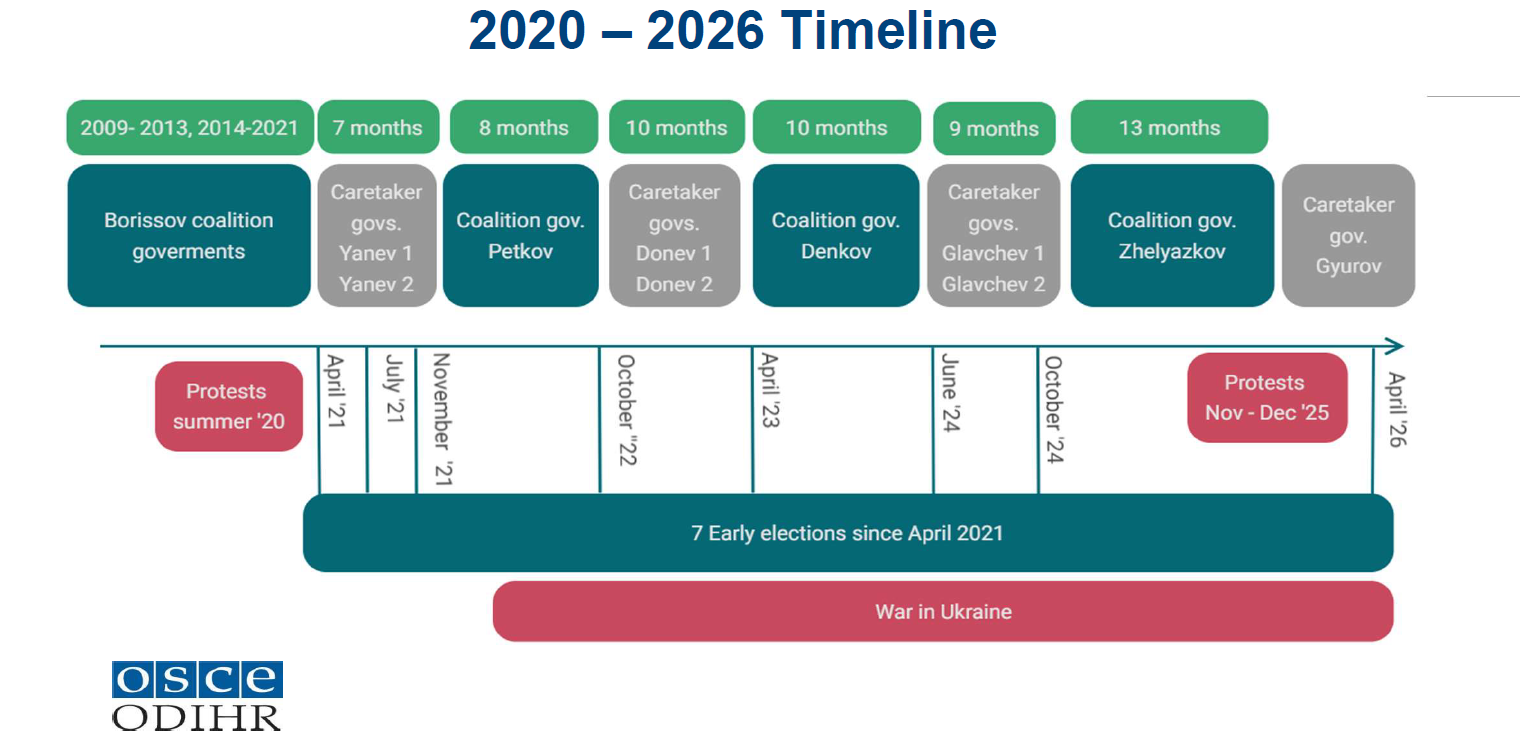
up under the responsibility of the rapporteur. 2027 - Third part-session
1 Introduction
1. The Parliamentary Assembly
has observed all parliamentary and presidential elections in Bulgaria
since 1990. This report concerns the early parliamentary elections
held on 19 April 2026, the eighth early parliamentary election in
Bulgaria since April 2021. It follows the Assembly's reports on
the early parliamentary elections of
4 April,
11 July and
14 November
2021,
2 October
2022,
2 April
2023, and
9 June
and 27 October 2024.
2. Bulgaria joined the Council of Europe on 7 May 1992. It was
subject to the full monitoring procedure from 1994 to 2000 and,
thereafter, to a post-monitoring dialogue concerning outstanding
issues relating to human rights, democracy and the rule of law.
On 1 October 2025, the Assembly decided to close the post-monitoring dialogue
with Bulgaria and to follow developments in the country under the
periodic review procedure.
Note This was
an important recognition of progress, but it did not remove the
Assembly's long-standing interest in the consolidation of electoral
integrity and democratic institutions in Bulgaria.
3. The Assembly particularly welcomes the fact that it was invited
by the 2026 interim government to observe these elections even though,
following the closure of the post-monitoring dialogue, Bulgaria
was no longer under an obligation to do so. This initiative demonstrated
political openness and a commendable willingness to maintain co-operation
with the Council of Europe and its election observation mechanisms
at a sensitive moment in Bulgaria's political life.
4. At its meeting of 2 March 2026, the Bureau of the Assembly
agreed to observe the early parliamentary elections and set up an
ad hoc committee (PACE delegation) of 20 members. The final composition
of the delegation included 13 members. The Bureau of the Assembly
appointed me as chairperson of the ad hoc committee (“head of delegation”)
and appointed Mr Armen Gevorgyan as vice-chairperson to take over
in case of my absence (see the composition of the delegation in
Appendix 1).
5. In line with the co-operation agreement signed between the
Assembly and the European Commission for Democracy through Law (Venice
Commission), on 4 October 2004, Tomáš Langášek, substitute member of
the Venice Commission in respect of the Czech Republic, represented
the Commission as a legal expert during this election observation
mission.
6. The delegation held meetings in Sofia with the Central Election
Commission (CEC), representatives of State institutions, political
parties and coalitions, civil society, the media, and the Election
Observation Mission of the Office for Democratic Institutions and
Human Rights of the Organization for Security and Cooperation in Europe
(OSCE/ODIHR) (see the programme in Appendix 2). On election day,
Assembly observers were deployed in and around Sofia and in several
regions of the country.
7. The PACE delegation formed part of an International Election
Observation Mission (IEOM) conducted jointly with the OSCE/ODIHR.
The ODIHR Election Observation Mission (EOM), led by Ms Dunja Mijatovic,
had been deployed from 13 March 2026. The two delegations worked
on the joint statement of preliminary findings and conclusions which
were presented at press conference on 20 April 2026.
Note
8. The IEOM concluded that the 19 April early parliamentary elections,
marked by an increased participation, were administered transparently
and efficiently, despite gaps in the legislative framework and a last-minute
amendment that undermined the stability of the electoral law. Fundamental
freedoms were generally respected, but the campaign was highly polarised
and marked by negative rhetoric. Online campaigning, which is largely
unregulated, played a prominent role in voter engagement while also
facilitating circulation of disinformation narratives, including
about government activities. The existing campaign finance framework
provided limited transparency and oversight. Institutional efforts
to counter the risk of cyber threats and potential foreign interference
were negatively affected by gaps in the implementation and co-ordination between
oversight bodies. The media environment is diverse and pluralistic
but was constrained by political and economic influence, self-censorship,
and the prevalence of paid and pre-arranged coverage. Women remained
significantly under-represented both as candidates and in elected
office. Election day was generally calm and orderly, but some procedural
shortcomings were noted.
9. The delegation expresses its appreciation to the Bulgarian
authorities, in particular the Ministry of Foreign Affairs and the
staff of its Human Rights Department, the PACE delegation secretariat,
the CEC, the election administration at all levels, ODIHR and all
interlocutors for their co-operation and assistance to the success
of this mission.
2 Political
crisis leading to the successive early elections
10. Since July 2020, Bulgaria has
been confronted with a sustained political crisis rooted in public
frustration with corruption, State capture, clientelism and the
perceived inability of political elites to deliver stable and accountable
government. Between April 2021 and April 2026, Bulgarians were called
to the polls eight times for parliamentary elections, in addition
to presidential and European elections. For much of this period,
the country was governed by caretaker or fragile coalition governments.
Source: OSCE/ODIHR
11. On each occasion, GERB (Citizens
for the European Development of Bulgaria), led by former Prime Minister
Boyko Borisov (2009-2013, 2014-2017, 2017-2021), has always managed
to come out ahead, but this has never been enough to form a stable
and lasting coalition with other government partners. The October 2024
elections again produced a fragmented National Assembly comprising
of a record number of nine political parties and coalitions. A minority
government headed by Prime Minister Rosen Zhelyazkov was eventually formed
in January 2025 by GERB-Union of Democratic Forces (GERB-SDS), Bulgarian
Socialist Party (BSP)-United Left and There Is Such a People (ITN),
with external support from the Alliance for Rights and Freedoms (APS).
However, the political balance remained fragile.
12. Several parties challenged the results of these elections
before the Constitutional Court, citing concerns such as up to 5%
of votes being invalid, significant discrepancies between paper
receipts from machine voting and the digital records, and irregular
voter turnout ranging from low percentages in some regions to as
high as 80% in others. In March 2025, the Constitutional Court invalidated
the results in a number of polling stations (the court declared
the election of 16 members of parliament illegal) and ordered a
recalculation of mandates. As a result, Velichie entered the National
Assembly and several mandates were reallocated. This decision increased
political tensions and reduced the governing arrangement to a minimal
and vulnerable majority. It also placed renewed public attention
on the quality of election-day procedures, counting and tabulation,
and the importance of effective judicial remedies.
13. In late 2025, large-scale public protests broke out following
the presentation of a draft budget that envisaged increases in social
security contributions and State administration salaries. These
protests rapidly widened into a broader expression of public distrust
in State institutions, opaque networks of influence and political
leaders associated with corruption and clientelism. They were particularly
visible in Sofia, Plovdiv, Varna and Ruse and were widely perceived
as reflecting the mobilisation of younger voters and broader social frustration.
14. The government resigned in December 2025. Following unsuccessful
attempts to form a new cabinet, President Rumen Radev
Note resigned on 19 January 2026, before
the end of the term (due in November 2026), with the stated intention
of participating in the forthcoming elections with his newly formed
Progressive Bulgaria (PB) coalition, thus bringing a new player
into an already unstable party system. Vice-President Iliana Iotova assumed
the role of acting president and, after consultations required by
the Constitution, on 12 February, appointed Mr Andrey Gyurov, Deputy
Governor of the Bulgarian National Bank, to form a caretaker cabinet until
the elections.
15. The elections of 19 April 2026 therefore took place in a
context of repeated elections, political fragmentation, heightened
polarisation and declining trust in State institutions. At the same
time, they were also shaped by a widespread demand for change, the
adoption of the Euro on 1 January 2026, the budgetary crisis, concerns
over the cost of living, corruption, foreign policy orientation,
energy security and the integrity of the electoral process itself.
16. The caretaker government replaced all 28 regional governors
and most directors of provincial directorates of the Ministry of
Interior and police chiefs. It also established a Co-ordination
Council for the Preparation of the Elections, appointed an adviser
on elections, and introduced a temporary co-ordination mechanism
to counter disinformation and hybrid threats. These steps were presented
as measures to consolidate administrative control and restore public
confidence in the conduct of the elections.
3 Constitutional
and legal framework
17. The National Assembly of Bulgaria
is a unicameral parliament composed of 240 members elected for a four-year
term through an open list proportional representation system in
31 multi-member constituencies. The constituencies largely correspond
to Bulgaria's administrative divisions, with Sofia divided into
three constituencies and Plovdiv into two. The establishment of
an out-of-country constituency has been postponed until 2028. The
electoral threshold for parties and coalitions is 4% of valid votes
cast nationwide. Independent candidates must meet the constituency
quota calculated under the Hare-Niemeyer method. Voters may express
one preference within a list; a candidate may change position on
the list if the preference votes reach at least 7% of votes cast
for that list in the constituency.
18. Parliamentary elections are primarily governed by the 1991
Constitution, the Election Code of 2014, the Political Parties Act,
the Criminal Code and the Administrative Violations and Sanctions
Act, complemented by decisions of the CEC. The Election Code has
been amended many times since its adoption, and this continued instability
of electoral legislation remains a structural concern.
19. The constitutional reform adopted in December 2023 limited
the President's discretion in appointing a caretaker prime minister
to a small group of senior office-holders, provided that the mandate
of the incumbent National Assembly terminates only when the newly
elected Assembly takes office, and allowed citizens holding dual
nationality to stand as candidates, subject to an 18-month residency
requirement. The Constitutional Court annulled most of the judicial
components of the reform in July 2024, but the election-related
provisions remained in force due to a split vote.
20. The removal of the ban on dual citizens standing for parliamentary
office was in line with previous Venice Commission and ODIHR recommendations.
However, the 18-month residency requirement remains at odds with
international standards and good practice, as it may disproportionately
restrict the right to stand for election without an individualised
assessment of candidates' actual ties to the country.
21. The most significant amendment before the 2026 elections was
adopted in February 2026, after the early elections had already
been called. It introduced a cap of 20 polling stations per non-EU
country outside Bulgarian diplomatic and consular premises. Acting
President Iliana Iotova imposed a suspensory veto, which the National
Assembly rejected. The Ombudsman publicly criticised the amendment
and considered a challenge before the Constitutional Court. The
change may have had a particularly significant impact on voters in
countries with large Bulgarian communities, including Türkiye (previously
168 polling stations), the United Kingdom (previously 116 polling
stations) and the United States (previously 54 polling stations).
22. This late amendment raised concerns about the stability of
electoral law. The Venice Commission's Code of Good Practice in
Electoral Matters and its interpretative declarations underline
that fundamental elements of electoral law should not be changed
shortly before elections and must not be changed after elections
have been called. The 2026 amendment was adopted without broad consensus
and after the elections had been called.
23. Since 2016, voting is compulsory as of 18 years of age – except
those deprived of legal capacity by a final court decision and those
serving a prison sentence, irrespective of the gravity of the offence
– but there is no sanction for persons who do not vote. These blanket
restrictions remain contrary to European standards, Council of Europe
recommendations and the case law of the European Court of Human
Rights. The blanket restriction on prisoners' voting rights was
challenged before the Constitutional Court in March 2026 but the appeal
was declared inadmissible.
24. The preliminary voter lists comprised 6 641 768 voters, included
121 708 first-time voters. Voter lists are compiled automatically
by municipal administrations on the basis of data from the National
Population Register. The October 2024 amendments to the Civil Registration
Act enabled citizens without a regular permanent address to be included
in voter lists on the basis of an address designated by the municipality.
This allowed approximately 27 060 eligible voters to be included
in provisional voter lists, but this positive step was not accompanied
by proactive public information campaigns. The final voter lists
included approximately 6.5 million citizens.
25. The election administration is organised in three levels:
the CEC, 31 district election commissions and 11 836 precinct election
commissions in the country, together with polling stations abroad.
The current CEC was appointed in May 2021 and is composed of 15
members. It generally enjoyed trust and operated transparently through
public sessions, live-streaming and publication of decisions. However,
repeated early elections, shifting parliamentary composition and
legal ambiguities in appointment rules continued to complicate the
full and proportional representation of parties at lower levels.
26. All in all, the legal framework provides a generally adequate
basis for democratic elections, but important gaps remain. These
concern the narrow definition of campaigning, the absence of comprehensive
regulation of online campaigning and third-party activity, limited
rules on the use of administrative resources, insufficient transparency
of campaign finance, restrictive standing in election disputes,
and the lack of direct avenues to challenge some election results
protocols.
4 Candidate registration
and major campaign issues
27. The candidate registration
process was generally inclusive and transparent. In total, the CEC
registered 14 political parties, 10 coalitions and one independent
candidate, representing 4 786 candidates. The nine main ones, represented
in the previous parliament, are:
- GERB:
the centre-right coalition built around their leader and former
Prime Minister Boyko Borisov. Long the dominant force, centre right,
leaning towards EU and NATO; strong presence in local power in the entire
country.
- PP-DB (We Continue the Change – Democratic Bulgaria):
a centrist, pro-European coalition led by Assen Vassilev, focused
on the fight against corruption.
- Revival (Vazrazhdane): a far-right, nationalist, Eurosceptic
and pro-Russian party, led by Kostadin Kostadinov.
- DPS/MRF (Movement for Rights and Freedoms): a pro-EU and
pro-Euro-Atlantic political party traditionally associated with
the representation of ethnic Turkish, Muslim and other minority communities.
Following its internal split in 2024, it has repositioned itself
as a more socially conservative actor, while continuing to be portrayed
by critics as emblematic of oligarchic influence and corruption.
- BSP (the Socialist Party) – United Left: a coalition of
left-wing and socialist parties, mobilising aging, conservative,
pro-Russian electorate, against arming Ukraine.
- APS (Alliance for Rights and Freedoms): another branch
of the DPS, loyal to its historic founder Ahmed Dogan.
- ITN (There is Such a People): a populist party founded
by the singer and television presenter Slavi Trifonov, and chaired
by Toshko Yordanov.
- MECh (Sword/Morality, Unity, Honour): a far-right Eurosceptic
party led by Kiril Veselinski
- Greatness (Velichie): a pro-Russian party founded and
led by Ivelin Mihailov.
28. The game-changing newcomer appeared in the form of Progressive
Bulgaria (PB), a new centre-left coalition led by former President
Rumen Radev and composed of three center-left parties. The coalition became
a central actor in the campaign and drew support across different
parts of the electorate. Prominent figures and former public administration
high officials figured as candidates.
29. The campaign officially started on 20 March 2026 but traditional
campaigning remained relatively low-key throughout the country,
moving predominantly to the social media sphere. Contestants also
used rallies, meetings with voters, local events and media appearances.
Fundamental freedoms of association, assembly and expression were
generally respected, and political actors were able to campaign
freely. Observed events were largely unobstructed and allowed direct
exchanges between candidates and voters.
30. Online campaigning played a prominent role. Social networks
and personal blogs, although not regulated as media services, were
central to campaign strategies and to the circulation of narratives. Disinformation
was used to discredit opponents, reinforce fear-based messaging,
and exploit foreign policy and security issues. The implementation
of the EU Digital Services Act remained incomplete, limiting oversight
of systemic online risks.
31. The campaign was highly polarised and marked by negative
rhetoric and personal attacks. The main themes included corruption,
the influence of oligarchic networks, the cost of living, inflation,
energy policy, infrastructure, foreign policy, the defence co-operation
agreement with Ukraine, the rule of law and the integrity of the
electoral process.
32. The legal framework contains safeguards against the misuse
of administrative resources, but these remain limited and do not
fully address the advantages of incumbency. The ODIHR long-term
observers of the IEOM team observed that some public officials,
including at local level, endorsed candidates or took part in campaign
activities during working hours, blurring the line between State
and party. Such practices are inconsistent with the principle of
a level playing field and should be more clearly prohibited and
sanctioned.
33. Allegations of vote-buying, controlled voting and voter intimidation
were prominent throughout the campaign. These practices have long
undermined trust in Bulgarian elections and were a major concern
in the 2024 elections. In 2026, however, the interim government
took more numerous, visible and proactive measures to prevent, detect
and investigate electoral violations. The Ministry of Interior reported
intensified operations, arrests and investigations, including in
areas previously considered vulnerable. It also reported the seizure
of approximately EUR 1 million during operations against vote-buying.
34. The PACE delegation commends the interim government for treating
vote-buying and controlled voting as a central threat to democratic
legitimacy and for acting more actively and efficiently than in
previous election cycles. These efforts did not entirely restore
public trust, and allegations remained widespread, but the direction was
positive. Sustained action, independence of law enforcement, effective
prosecution and final convictions remain necessary to demonstrate
that such practices carry real consequences.
35. The government also launched initiatives to prevent, detect
and respond to foreign interference, disinformation and cyber threats.
A co-ordination mechanism between the Ministry of Foreign Affairs,
the Ministry of Interior and the Ministry of Electronic Government
was established, while Bulgaria requested the activation of the
EU Rapid Alert System. These were useful first steps, but the methodology,
public communication and co-ordination between oversight bodies
remained insufficiently developed in the short period running up
to the elections.
36. Women remained under-represented in political life. They accounted
for approximately 30% of candidates and 24% of lists were led by
women (before the elections, women represented 28.75% of members of
parliament). In the Zhelyazkov government, only 1 out of 21 ministers
was a woman. The interim government included 6 female ministers.
There are no special legislative measures to promote women’s participation,
and most party platforms do not have related policies. Few parties
promoted women candidates or addressed women's political participation
in campaign messages. Only two major contestants addressed issues
related to women electorate. The campaign period rather included
gender-based attacks and smear campaigns. According to ODIHR long-term
observers, women candidates from PP-DB and GERB were targets of
online abuse on social media and in traditional media. Minority
issues were largely absent from party platforms, while the requirement
to conduct the campaign only in Bulgarian remains contrary to previous
ODIHR and Venice Commission recommendations.
5 Media landscape
37. Bulgaria's media landscape
remains diverse and pluralistic, with numerous television, radio,
print and online outlets. Television continues to be an important
source of political information, while online platforms and social
media increasingly shape voter engagement. However, media remains
highly concentrated, dominated by two broadcasters bTV Media Group
and Nova Broadcasting Group; and there is low level of trust in
media.
38. Our interlocutors raised concerns about declining editorial
independence, political and economic influence over outlets, self-censorship,
and the limited capacity of voters to access impartial and comprehensive
information. Criminal defamation, although not punishable by imprisonment,
continues to be a concern for editorial independence and investigative
journalism, even though the 2023 amendments to the Criminal Code
provide for better protection of journalists in cases of alleged
defamation with regard to public officials.
39. Election coverage was heavily shaped by pre-arranged agreements
and paid content. This reduced the scope for genuine editorial scrutiny
of candidates and their programmes. The distinction between journalism and
political advertising was not always clear, and the prevalence of
paid interviews and pre-arranged campaign reports weakened the informative
function of the media. Debates organised by several outlets did not
feature party leaders, many of whom declined to participate.
40. The public broadcasters formally met their legal obligations
to provide coverage to all contestants. Nevertheless, the monitoring
of the media environment indicated that formal equality of airtime
does not necessarily translate into meaningful information for voters.
Limited analytical reporting, fewer adversarial interviews and the
reduced space for critical editorial coverage constrained citizens'
ability to compare political programmes and assess candidates.
41. The online information environment was particularly vulnerable.
Disinformation narratives circulated actively, including about government
activities, foreign policy and alleged external interference. Fact-checking organisations
and civil society monitoring initiatives played a useful role, but
the overall regulatory and institutional response remained fragmented.
Further safeguards are needed to protect media freedom, ensure transparency
of political advertising, and maintain the distinction between editorial
content and paid campaign promotion.
6 Election day
observations
42. On 19 April 2026, The IEOM
deployed 155 observers from 33 countries, including 142 observers
from ODIHR and 13 observers from PACE. Our six teams covered Sofia,
Plovdiv, Blagoevgrad, Kyustendil, Rila, Pernik and Breznik and their
surrounding areas, including urban, rural and village settings.
The delegation observed opening, voting and counting procedures.
Its findings should be read together with those of the overall statistics
of the IEOM, while taking into account the more limited statistical
basis for some stages of the process.
43. According to the statistical debriefing presented after election
day, the overall assessment of voting was very positive: 98% of
observations were rated “very good”, only 13 cases were assessed
as “bad”, and no cases were assessed as “very bad”.
44. The general impression of the delegation was that election
day was calm, orderly and broadly well administered. Observers considered
that voters had a genuine choice and were able to cast their ballots
freely. Several members of the delegation also noted that, if serious
electoral violations had occurred, they were more likely to have
taken place before election day than during voting itself.
45. The opening of polling stations did not reveal major problems.
Around half of the polling stations observed by the IEOM opened
within 15 minutes of the scheduled time, which was considered acceptable. Some
delays appeared to be linked mainly to voting machines not functioning
properly at the start of the day.
46. The presence of political party representatives was high throughout
the process. In most polling stations observed, all or almost all
of the nine political parties were represented, mostly through their
participation in precinct election commissions. This pluralistic
presence created useful checks and balances and helped minimise
the risk of irregularities.
47. Unauthorised persons were observed only in very small numbers
and, where present, they did not appear to interfere with the process.
In some village settings, the presence of international observers
attracted attention from local residents, who were curious about
their role and purpose. The atmosphere in such locations was generally
calm, familiar and closely observed by the local community.
48. The most recurrent concern related to accessibility for persons
with reduced mobility, which remains uneven. While designated accessible
polling stations generally provided better access for voters with disabilities,
many non-designated polling stations did not allow independent access
or had inadequate internal layout. Important steps were taken for
voters with visual and hearing impairments, but further adaptation
is needed for voters with visual, cognitive and physical disabilities.
49. The delegation also noted some problems with polling station
layout and equipment. While conditions inside polling stations were
generally satisfactory, some layouts were not always appropriate,
and difficulties were observed with voting machines and polling
screens. In approximately 5-6% of polling stations using electronic
voting equipment, the equipment was not fully operational. These
problems did not appear to affect the overall validity of the process,
but they contributed to delays and to the administrative burden
on polling staff.
50. The secrecy of the vote was generally respected. The statistical
debriefing indicated only 21 cases concerning secrecy out of around
600 voting observations, which was considered a low number. Some
of these cases appeared to reflect cultural habits, including family
voting or voters showing ballots to relatives, rather than organised
attempts to undermine secrecy. Nevertheless, the delegation reiterates
that the secrecy of the vote is a fundamental safeguard and should
be protected consistently in all polling stations.
51. The delegation again observed that the combined use of paper
ballots and machine-produced ballots makes the process slow and
cumbersome. Several observers considered the dual system to be burdensome, particularly
during counting, when results from paper and machine ballots had
to be reconciled. The voting machines were often described as being
used mainly as ballot printers rather than as full electronic voting machines,
which limits their potential while still adding complexity to the
process.
52. At the same time, our members expressed differing views on
the role of voting machines in building trust. Some considered that,
even when used only as ballot printers, machines may help reduce
invalid ballots and provide voters with an additional choice. Others
underlined that public trust in software and electronic equipment
remains fragile and cannot simply be imposed. The delegation reiterates
that technology can strengthen confidence only if accompanied by
transparent procedures, independent auditing, clear safeguards and
effective public communication.
53. Concerns were also raised about auditing, source codes and
the information generated or retained by voting machines. Some participants
recalled an earlier call of the PACE delegation for an international
or independent audit of source codes. The delegation considers that,
as long as technology is used in elections, the authorities should
ensure that its functioning is transparent and understandable not
only to experts, but also to election officials, contestants and
the public.
54. The delegation welcomed the use of video recording and live
streaming of counting, which was introduced in response to previous
allegations of fraud and recount disputes. Several observers considered this
measure useful for transparency and for possible subsequent checks.
Also, the CEC did not report non-compliance with recording requirements.
At the same time, the Election Code does not provide specific sanctions
for failure to record, and this gap should be addressed.
55. Excessive paperwork remained one of the clearest practical
weaknesses of the process. Observers repeatedly described procedures
as time-consuming and administratively heavy. The process of checking identity
documents, locating voters on the paper register, issuing and stamping
ballots, removing ballot corners, finding voters again for signature
and then allowing them to leave was described as slow and cumbersome.
56. The use of a single paper voter register also caused delays
and queues in some polling stations. Observers suggested that, if
paper registers continue to be used, they should at least be divided
alphabetically or into several sections. Some also considered that
electronic voter identification could significantly improve efficiency.
The delegation notes that simplifying voter identification and reducing
paperwork would make the process more efficient without weakening
safeguards.
57. Counting was assessed positively overall. The main issue identified
was that copies of the protocol were not always posted outside the
polling station entrance: in 16 out of 45 relevant cases, this requirement
was not fulfilled. Other problems appeared minor and were often
linked to fatigue.
58. Overall, the delegation concluded that election day was technically
sound and conducted in a peaceful environment, with strong party
presence, few indications of interference and no significant disruption.
At the same time, the observations confirmed several long-standing
weaknesses: insufficient accessibility, underuse and contested trust
in voting machines, excessive paperwork, slow counting and the administrative
burden created by the dual voting system. These issues did not call
into question the overall conduct of election day, but they should
be addressed as part of a broader reform of Bulgaria’s electoral
practice.
59. The CEC received complaints and signals on election day relating
to campaign silence, technical malfunctions, procedural errors and
alleged election violations. The Ministry of Interior also received
signals related to vote-buying and controlled voting. The handling
of these cases will be important for the final assessment of the
effectiveness of remedies and accountability mechanisms.
7 Election results
and post-electoral developments
60. Beyond the increased turnout,
the results of the 19 April 2026 early parliamentary elections revealed
a significant change in Bulgaria’s political landscape, as shown
in this comparative table of the eight rounds of parliamentary elections
held between 2021 and 2026:
|
Party
|
April 2021
|
July
2021
|
Nov 2021
|
Oct 2022
|
April 2023
|
Jun 2024
|
Oct 2024
|
Apr 2026
|
|
Progressive Bulgaria
(PB)
|
-
|
-
|
-
|
-
|
-
|
-
|
-
|
131
|
|
GERB – SDS
|
75
|
63
|
59
|
67
|
69
|
68
|
66
|
39
|
|
We Continue the Change (PP)
|
-
|
-
|
67
|
53
|
64
|
39
|
36
|
37
|
|
Democratic BG
|
27
|
34
|
16
|
20
|
|
Revival (Vazrazhdane)
|
-
|
-
|
13
|
27
|
37
|
38
|
33
|
12
|
|
MRF (DPS)
|
30
|
29
|
34
|
36
|
36
|
47
|
-
|
-
|
|
MRF – New Beginning
|
-
|
-
|
-
|
-
|
-
|
-
|
29
|
21
|
|
ARF
|
|
|
|
|
|
|
14
|
-
|
|
BSP for Bulgaria
|
43
|
36
|
26
|
25
|
23
|
19
|
19
|
-
|
|
Bulgarian Rise
|
|
|
-
|
12
|
-
|
-
|
-
|
-
|
|
ITN
|
51
|
65
|
25
|
-
|
11
|
16
|
16
|
-
|
|
Velichie
|
-
|
-
|
-
|
-
|
-
|
13
|
10
|
-
|
|
MECh
|
-
|
-
|
-
|
-
|
-
|
-
|
11
|
-
|
|
Nr of parties in parliament
|
5
|
5
|
6
|
7
|
6
|
7
|
9
|
5
|
61. According to the official results
published by the CEC, Progressive Bulgaria won a decisive victory
with 1 444 920 votes, representing 44.594% of the vote, and obtained
131 seats in the 240-seat National Assembly. It was followed at
a considerable distance by GERB-SDS, with 433 755 votes, 13.387%
and 39 seats; PP-DB, with 408 846 votes, 12.618% and 37 seats; the
DPS, with 230 693 votes, 7.120% and 21 seats; and Vazrazhdane, with
137 940 votes, 4.257% and 12 seats. The CEC recorded 3 360 330 voters
who signed voter lists and 3 240 156 valid votes cast for candidate
lists.
62. Voter turnout reached 50.70%, a marked increase compared with
38.94% in October 2024 and 34.41% in June 2024. This increase should
be read as a significant sign of renewed civic mobilisation after
several years of voter fatigue and repeated early elections. In
political terms, the result gave Progressive Bulgaria an absolute
majority, while nearly one fifth of votes were cast for parties
that did not pass the 4% electoral threshold.
63. The result represents a major departure from the fragmentation
that had characterised the seven previous parliamentary elections
since 2021. For the first time in recent years, one political force
obtained the possibility to govern independently, potentially ending
the cycle of weak coalition governments and repeated political deadlock.
Whether this will lead to stable and effective governance will depend
on the capacity of the new majority to translate its electoral mandate
into concrete reforms.
64. Most parties represented in the outgoing National Assembly
lost ground. GERB-SDS lost around half of its previous support,
while the DPS recorded one of its weakest results in decades. The
BSP-United Left alliance failed to pass the electoral threshold,
leaving the Bulgarian Socialist Party without parliamentary representation
for the first time since the beginning of democratic transition.
With the exception of Vazrazhdane, far-right and populist parties
represented in the previous Assembly also failed to enter parliament.
65. This outcome can be interpreted as a strong public demand
for change, institutional effectiveness and political deliverability.
The vote therefore carried not only a partisan message, but also
a broader demand for cleaner governance, greater accountability
and an end to the cycle of instability.
66. At the same time, the scale of the victory creates a heightened
level of responsibility for Progressive Bulgaria. The new majority
will be judged on its ability to stabilise prices, strengthen institutions,
advance anti-corruption and judicial reforms, and restore trust
in public administration. A clear majority may help overcome the
institutional paralysis of recent years, but it also requires strong
safeguards, parliamentary scrutiny and respect for pluralism.
67. The post-electoral process proceeded rapidly and without the
deadlock that had characterised previous convocations of the National
Assembly. By decree of the acting President Iliana Iotova, the newly
elected 52nd National Assembly was convened for its first sitting
on 30 April 2026, under Article 75 of the Constitution. On the same
day, it elected Mihaela Dotsova of Progressive Bulgaria as Speaker,
with 188 votes in favour out of 237 voting, with support from Progressive
Bulgaria, GERB-SDS and the MRF, while PP, DB and Vazrazhdane abstained.
This swift election of the Speaker contrasted with the prolonged
deadlocks seen after previous elections and enabled the Assembly
to complete its initial business on the same day.
68. Following the opening of parliament, on 7 May 2026, Mr Rumen
Radev received the mandate to form a government. On 8 May 2026,
the National Assembly approved Mr Rumen Radev as Prime Minister
and approved his proposed Council of Ministers (124 in favour, 70
against and 36 abstentions). This allowed the formation of Bulgaria’s
first single-party government in many years and, in principle, created
the possibility of a full parliamentary term until 2030.
69. The political profile of the new government will require close
attention. Mr Radev’s campaign centred on the fight against corruption,
the dismantling of oligarchic networks, the reduction of prices
and the restoration of stability. These themes correspond to the
main grievances expressed during the 2025 protests and to long-standing
concerns raised in previous PACE reports, including the need to
strengthen the rule of law, judicial independence and the effectiveness
of anti-corruption institutions.
70. However, the foreign policy orientation of the new government
remains one of the main issues to be observed. Mr Radev has previously
expressed Eurosceptic and Russia-friendly positions, including criticism
of aspects of EU policy and of Bulgaria’s euro adoption. Some analysts
have therefore described the result as potentially opening a period
of “euro-cooling” in Bulgaria’s external positioning. Such assessments
should be approached with caution, as Bulgaria’s institutional framework,
EU and NATO membership, full Schengen integration and entry into
the eurozone on 1 January 2026 create strong structural anchors.
Nevertheless, the balance between a «pragmatic foreign policy» and
Bulgaria’s existing Euro-Atlantic commitments will be an important
test for the new government.
71. All in all, despite the new Prime Minister’s high public profile,
relatively little is known about the inner workings of his political
circle or the policy instincts of his closest advisers. Thus the
new political configuration offers both an opportunity and a risk.
It offers an opportunity because a stable majority may finally allow Bulgaria
to move from crisis management to long-delayed reform, including
in areas repeatedly identified by the Assembly, the Venice Commission
and GRECO. It also carries risks if the concentration of power weakens parliamentary
oversight, marginalises opposition voices, or slows Bulgaria’s commitment
to European standards.
72. These elections appear to have produced a clear and workable
parliamentary majority after years of instability. However, that
stability is not an end in itself. The new authorities should use
their mandate to strengthen democratic institutions, ensure effective
checks and balances, combat corruption, safeguard media freedom
and minority rights, and maintain Bulgaria’s commitments as a member
State of the Council of Europe.
8 The ways forward
73. The renewed political stability
should also be used as an opportunity to move from repeated diagnosis to
concrete reform. The roadmap identified in the previous PACE election
observation report remains relevant, but it now requires updating
and implementation in light of the 2026 experience.
74. The Assembly, together with the Venice Commission, stands
ready to assist the Bulgarian authorities in addressing outstanding
recommendations. Reform should be inclusive, evidence-based and
not conducted under the pressure of imminent elections. The guiding
principle should be simple: electoral rules must strengthen trust,
not become instruments of short-term partisan advantage.
8.1 Addressing electoral
malpractices
75. Vote-buying, controlled voting
and intimidation remain among the most serious threats to electoral integrity
in Bulgaria. The proactive measures taken by the interim government
in 2026 were welcome and should become a permanent, institutionalised
approach. Law enforcement operations should be non-selective, transparent
and followed by prompt investigations, effective prosecution and
final judicial outcomes. Voters should also be encouraged to report
unlawful pressure through safe and accessible channels, accompanied by
public information campaigns explaining their rights and available
safeguards.
8.2 Combating corrupt
practices
76. Electoral integrity cannot
be separated from the broader fight against corruption. Bulgaria
should fully implement outstanding GRECO recommendations, especially
those concerning campaign finance, integrity in public office and
law enforcement. The National Audit Office should have adequate
powers, resources and independence to oversee political finance
effectively. Public officials and members of parliament should be subject
to meaningful conflict of interest rules and regular substantive
checks of asset declarations.
8.3 Electoral legislation
and system reform
77. Substantial changes to the
Election Code should be prepared through an inclusive and transparent process,
with sufficient time for consultation, implementation, training
and voter education. Late amendments, such as the February 2026
changes on out-of-country polling stations, should be avoided. Any
reform of the electoral system should aim to improve governability
while preserving pluralism and equal suffrage. The authorities should
seek the opinion of the Venice Commission and ODIHR on major reforms
before adoption.
8.4 Voter registration
and disenfranchisement
78. The blanket disenfranchisement
of persons under judicial interdiction and prisoners should be abolished and
replaced by rules that respect proportionality and individual assessment.
The inclusion of citizens without a permanent address in voter lists
was a positive step, but it should be accompanied by proactive information and
outreach. Out-of-country voting arrangements should be assessed
to ensure that restrictions do not disproportionately affect citizens
abroad.
8.5 Enhancing ethical
standards
79. Political parties and coalitions
should adopt and enforce codes of ethics applicable to candidates, elected
officials and party representatives. These codes should address
conflicts of interest, intimidation of voters, hate speech, gender-based
attacks, disinformation and the misuse of public office. Ethical
standards should be supported by training, internal enforcement
mechanisms and clear consequences for violations.
8.6 Preventing misuse
of administrative resources
80. The legal framework should
more clearly regulate campaigning by public officials, including
at local level, and prevent the use of public office, public premises,
social benefits or public-sector employment to influence voters.
Sanctions should be timely, proportionate and dissuasive. A clear
separation between State and party is essential to a level playing
field.
8.7 Voting methods
and technology
81. The role of electronic voting
machines should be reconsidered through an independent evaluation.
If machines are retained, they should serve a clear purpose, be
supported by independent certification, transparent audits and adequate
institutional capacity within the CEC. The result management system
should be independently certified. Video recording and live streaming
should be preserved and strengthened, including by introducing sanctions
for failure to record where legally required.
8.8 Enhancing voter
participation
82. The increase in turnout in
2026 was encouraging, but it should not be taken for granted. Restoring participation
requires stable institutions, credible reform and visible accountability.
Civic and voter education should target first-time voters, citizens
abroad, disadvantaged communities and voters with disabilities.
Political actors should avoid rhetoric that deepens cynicism and
should engage citizens through substantive debate.
8.9 Inclusion of
women and minorities
83. Women remain under-represented
as candidates and elected officials. The authorities and political parties
should consider temporary special measures, internal party targets,
placement rules and capacity-building programmes to improve women's
representation. Minority participation should also be encouraged. The
prohibition on campaigning in languages other than Bulgarian should
be reviewed in light of international standards and previous recommendations.
8.10 Media freedom
and election coverage
84. Legislative and practical measures
are needed to protect journalists from intimidation, abusive litigation and
undue political or economic pressure. The distinction between editorial
content and paid political advertising should be made clear. Public
service media should be given sufficient editorial freedom to provide analytical
election coverage, debates and interviews, rather than merely formal
equal airtime.
8.11 Transparency
in parliamentary work
85. Transparent law-making is essential
for public trust. Parliament should ensure adequate timelines for bills,
meaningful consultation with civil society and experts, publication
of amendments in due time, and careful scrutiny of electoral legislation.
Fast-track procedures should not be used for changes affecting fundamental electoral
rights unless strictly necessary.
8.12 Stability of
institutions
86. Bulgaria needs stable institutions
capable of implementing long-term policies. Frequent changes to electoral
rules, repeated elections and temporary administrative arrangements
have undermined legal certainty. The new authorities should use
the parliamentary majority responsibly to consolidate institutions,
not to centralise power. Stability must go hand in hand with checks
and balances, transparency and respect for Council of Europe standards.
9 Conclusions
87. The PACE delegation commends
the Bulgarian election administration and the many officials who organised
the 19 April 2026 early parliamentary elections in a professional
and transparent manner. The elections were administered efficiently,
and election day was calm and orderly. Fundamental freedoms were generally
respected, and voters were offered a genuine choice.
88. After years of political instability and repeated returns
to the polls, Bulgarian citizens defied expectations and voted in
strong numbers to give the country a chance for stable government.
The responsibility now lies with Bulgaria's political leaders to
respect that message and turn this vote into effective and credible governance.
89. The clearest message of this election is that Bulgarian citizens
asked for change. The results reflected the spirit of the demonstrations
at the end of 2025, driven by public frustration over the perception
of state capture, the influence of oligarchic networks, the slow
pace of anti-corruption reform, and concerns over public spending
and the budgetary crisis. In that context, these elections became
central to restoring political legitimacy.
90. They also confirmed a trend already noted by the Assembly:
the continued erosion of traditional mainstream parties that have
increasingly failed to meet public expectations. This points to
a deeper crisis of confidence in parties that have not delivered
sufficient reform, integrity and stability.
91. The delegation remains seriously concerned by persistent suspicions
of vote-buying and controlled voting ahead of these elections. It
therefore commends the interim government for its proactive and
efficient efforts to address these practices and to put in place
measures against foreign malign interference. Such threats remain
a serious challenge to public trust and to the integrity of the
democratic process and need to be tackled seriously.
92. Measures such as the streaming of vote counting appear to
have increased transparency and confidence. The continued use of
voting machines also shows that election procedures must evolve
with the times. But technology can build trust only if it is supported
by transparent procedures, independent audits, institutional capacity
and clear safeguards.
93. At the same time, outdated administrative practices still
slowed parts of the process. If Bulgaria wants elections that are
both efficient and trusted, reform must address both new technology
and old habits. More broadly, these elections once again show the
need for a serious revision of electoral law and practice. The revised
roadmap offers a clear blueprint to move to action.
94. The Assembly will continue to follow developments in Bulgaria
under the periodic review procedure. The closure of the post-monitoring
dialogue in October 2025 was a recognition of progress, not an end
point. The 2026 elections show that Bulgaria has the institutional
capacity to conduct orderly and transparent elections, but also
that the quality of democracy depends on the political will to tackle
entrenched practices that weaken public confidence.
95. The new authorities should therefore treat electoral reform
not as a technical exercise, but as part of a broader effort to
restore trust in democratic institutions. This requires serious
follow-up to observation recommendations, transparent parliamentary
work, independent oversight institutions, meaningful media freedom
and a clear separation between public authority and party interest.
96. The Parliamentary Assembly, together with the Venice Commission,
stands ready to work with the new authorities to further strengthen
Bulgaria's electoral framework and democratic standards.
Appendix 1 – Composition of the ad hoc committee
Based on the proposals by the political groups
of the Assembly, the ad hoc committee was composed as follows:
Chairperson: Mr Chris SAID, Malta
Vice-Chairperson: Mr Armen GEVORGYAN, Armenia
Socialists, Democrats and Greens Group
(SOC)
- Mr Jone BLIKRA, Norway
- Ms Bisera KOSTADINOVSKA-STOJCHEVSKA, North Macedonia
- Mr António MENDONÇA MENDES, Portugal
Group of the European People’s Party (EPP/CD)
European Conservatives, Patriots &
Affiliates (ECPA)
- Mr Armen GEVORGYAN,
Armenia
- Mr José María SÁNCHEZ GARCÍA, Spain
Alliance of Liberals and Democrats for
Europe (ALDE)
- Mr Bertrand BOUYX, France
- Ms Marijana PULJAK, Croatia
- Ms Rian VOGELS, Netherlands
Group of the Unified European Left (UEL)
Venice Commission
- Mr Tomáš LANGÁŠEK, Substitute
member of the Venice Commission in respect of the Czech Republic
- Ms Tone SØRFONN MOE, Legal advisor, Venice Commission
Secretariat
- Mr Domenico VALLARIO, Legal advisor, Venice Commission
Secretariat
Secretariat
- Ms Ivi-Triin ODRATS,
Deputy Head of the Elections Division
- Ms Carine ROLLER-KAUFMAN, Assistant, Elections Division
Appendix 2 – Programme of the meetings of
the PACE Electoral Observation Mission
Friday, 17 April 2026
14:00-15:00 PACE delegation meeting
- welcome remarks by Mr Chris Said, Head of the PACE delegation
- presentation on the political environment by Mr Dimitar
Betuhovski, Assistant, Consultant to the delegation
- presentation on legal aspects by Mr Tomáš Langášek, Substitute
member of the Venice Commission in respect of the Czech Republic
- briefing on practicalities by the Secretariat
15:00-16:30 Presentation by the ODIHR Election Observation
Mission
- Welcome and overview
of the EOM’s work – Ms Dunja Mijatović, Head of Mission
- Political Background, Contestants and Campaign – Ms Jelena
Stefanović, Political Analyst
- Media Landscape and Campaign – Ms Adeline Marquis, Media
Analyst
- Legal Framework and Complaints – Mr David Ghonghadze,
Legal Analyst
- Election Administration, Voter and Candidate Registration
– Mr Xavier Noc, Election Analyst
16:45-18:15 Exchange of views with representatives of NGOs
active in the field of election observation
- Ms Nadezhda Gologanova, Civic Initiative for Free and
Democratic Elections
- Mr Svetoslav Malinov, Center for the Study of Democracy
- Ms Iva Lazarova, Institute for Public Environment Development
- Ms Bilyana Wegertseder, Bulgarian Institute for Legal
Initiatives
- Ms Zlatina Todorova, European Dialogue for Civic Education
and Culture
18:15-19:15 Exchange of views with representatives of the
media
- Mr Alexandar Detev, Deutsche
Welle (DW)
- Mr Lyudmil Iliev, journal “Sega”
- Mr Lyubcho Neshkov and Mr Velislav Iliev, BGNES
- Ms Genka Ivanova, BTA
- Maria Cheresheva, Association of Bulgarian journalism
- Ms Gabriela Naplatanova and Kadrinka Kadrinova, Union
of Electronic Media
Saturday, 18 April 2026
09:00-11:50 Consecutive meetings with leaders and representatives
of political parties and coalitions:
09:00-09:30 Citizens for European Development of Bulgaria
(GERB) – UDF
- Georg Georgiev
- Yordanka Fandakova
- Hristo Gadzhev
09:30-10:00 We continue the change – Democratic Bulgaria
(WCC-DB)
- Mr Nikolay Denkov
- Ms Alexandra Sterkova
10:00-10:20 Movement for Rights and Freedoms – New Beginning
(DPS-NN)
- Ms Atidje Alieva-Veli
- Ms Elena Yoncheva
- Ms Iskra Mihaylova-Koparova
- Mr Stanislav Anastasov
- Mr Taner Kabilov
- Mr Hamid Hamid
10:30-10:50 Progressive Bulgaria
- Mr Petar Vitanov
- Ms Mihaela Dotsova
- Mr Anton Kutev
10:50-11:10 “There is such a People” (ITN)
11:10-11:30 United Left (BSP)
- Ms Natalia Kiselova
- Mr Enyo Savov
12:00-12:45 Presentation by the ODIHR EOM on the E-day procedures
- Election Day Procedures – Mr Xavier
Noc, Election Analyst
- STO Reporting – Ms Anders Eriksson, Statistical Analyst
- Security – Ms Katarzyna Witt, Security Expert
13:00-13:45 Meeting with the Chairperson and members of the
Central Election Commission
- Ms Kameliya
Neykova, Chairperson
14:00-15:45 Meeting with ministers of the caretaker government
responsible for running the elections
- Mr Radi Naidenov, Deputy Foreign Minister
- Mr Ivan Anchev, Deputy Minister of Interior
- Ms Ivelina Dundakova, Chief of the Cabinet of the Minister
of Interior
- Mr Nikolay Saykov, Chief of the Cabinet of the Minister
for Regional Development and Public Works
- Mr Ivan Naydonov, Permanent Secretary to the MFA
- Ms Maria Spassova, Ambassador at Large and Head of the
Working Group on Countering Disinformation and Combating Hybrid
Threats.
- Ms Elitsa Videnova, Director of the Public Relations and
Protocol Directorate at the Ministry of E-Government and member
of the Election Observation Coordination Team
- Ms Hristiana Grozdanova, Director Human Rights Directorate,
MFA
- Mr Ivan Madzharov, Deputy Director General Directorate
National Police
- Ms Milena Ivanova, Head of Department, Human Rights Directorate,
MFA
16:00 Meeting with drivers and interpreters
Sunday, 19 April 2026
06:30 Departure to observe the opening of polling stations
07:00-20:00 Election Day – observation in polling stations
20:00-23:00 Observing the closing and counting in polling
stations
Monday, 20 April 2026
08:30-09:30 Meeting of the delegation (debriefing and preparation
of a statement)
15:00-16:00 Joint press conference with the ODIHR EOM
Appendix 3 – Press release of the International
Election Observation Mission
Bulgaria’s early parliamentary elections
offered voters a genuine choice, but were marked by high levels
of polarization and negative rhetoric, international observers say
SOFIA, 20 April 2026 – Bulgaria’s 19 April early parliamentary
elections were marked by an increase in participation and were administered
transparently and efficiently, despite gaps in the legislative framework
and a last-minute amendment on the number of polling stations abroad,
that undermined the stability of the electoral law and the inclusiveness
of the process, international observers said in a preliminary statement
released today. Held against a backdrop of repeated elections and
prolonged political instability, the authorities undertook measures
to safeguard electoral integrity, including efforts to address persistent
allegations of vote buying and intimidation.
Fundamental freedoms were generally respected, but the campaign
was highly polarized and marked by negative rhetoric, the observers
said. Online campaigning, which is largely unregulated, played a
prominent role in voter engagement, while also facilitating the
circulation of disinformation narratives, including about government
activities. Key policy issues such as energy, foreign policy, corruption,
the rising cost of living, the rule of law, and infrastructure dominated
campaign messaging.
“The process we have observed offered voters a genuine choice,
but in an atmosphere of significant political polarization and campaign
rhetoric that was often negative”, said Dunja Mijatović, head of
the election observation mission from the OSCE Office for Democratic
Institutions and Human Rights. “Fundamental freedoms were respected
and the process was generally well administered. At the same time,
work remains to be done, including in addressing issues such as
alleged vote-buying, disinformation, and limited transparency in
many aspects of the campaign.”
“After years of political instability and repeated returns
to the polls, Bulgarian citizens defied logic and voted in strong
numbers to give the country a chance for stable government,” said
Chris Said, Head of the delegation of the Parliamentary Assembly
of the Council of Europe. “The responsibility now lies with Bulgaria’s
political leaders to respect that message and turn this vote into
effective and credible governance.”
The legal framework provides a generally adequate basis for
democratic elections, although a number of prior ODIHR and Council
of Europe Venice Commission recommendations remain unaddressed,
including those concerning the residency requirement for candidates,
the effective investigation and sanctioning of electoral violations,
legal avenues to challenge results, and measures to enhance the
participation of women and minority groups.
The media landscape is pluralistic, yet concerns were raised
about political and economic influence, widespread self-censorship,
and limited analytical reporting, limiting voters’ access to impartial
and comprehensive information. While legal guarantees for freedom
of expression and access to information exist, criminal defamation
and unimplemented safeguards under the European Media Freedom Act
remain concerns for editorial independence. ODIHR media monitoring
indicated that, despite formal compliance with airtime rules, a
reduced scope of editorial and critical news coverage on the part
of private media outlets weakened voters’ ability to make informed
choices.
Although government authorities established mechanisms to
address disinformation, the risks of cyber threats, and foreign
interference, gaps in the implementation of the EU Digital Services
Act and delays in co-ordination between oversight bodies negatively
affected their effectiveness.
The election administration met legal deadlines and managed
preparations efficiently across all levels, although late resignations
of lower-level commissions strained the process. Election day was
generally calm and orderly. While the vast majority of polling stations
operated smoothly, some procedural shortcomings were noted, including
isolated cases of ballot handling and failure to ensure the secrecy
of the vote or to follow proper voter verification procedures.
Women remain underrepresented in public and political life,
and few parties promoted women candidates or addressed women’s political
participation in their campaigns. There were several instances of
gender-based attacks and smear campaigns, however, including in
the use of AI-generated content to defame a woman journalist. Positively,
women featured as prominent speakers in more than half of the campaign
events observed.
The legal framework that governs party and campaign finance
continues to leave prior ODIHR recommendations unimplemented, including
those on the lack of pre-election reporting and limited oversight by
the National Audit Office. The legislation does not regulate third-party
campaigning, and online political advertising is not subject to
comprehensive disclosure, creating potential loopholes for unregulated
spending. In some instances, campaigning by public officials during
working hours blurred the line between state and party.
Election dispute resolution is provided for through both election
commissions and administrative courts, with expedited procedures
for filing and adjudicating some complaints. Gaps in the legal framework,
including restrictive standing, the inability to challenge election
results protocols directly, and lengthy sanctioning and enforcement
processes, limited access to effective legal redress and undermined
due process.


