21/04/2026 Equality and Non-Discrimination | Session

The President of the Council of Europe’s parliamentary body hails ‘a historic milestone’ partly driven by rule-changes
The Parliamentary Assembly of the Council of Europe (PACE), which brings together parliamentarians from the Council’s 46 member states, contains an equal number of women and men for the first time in its 77-year history.
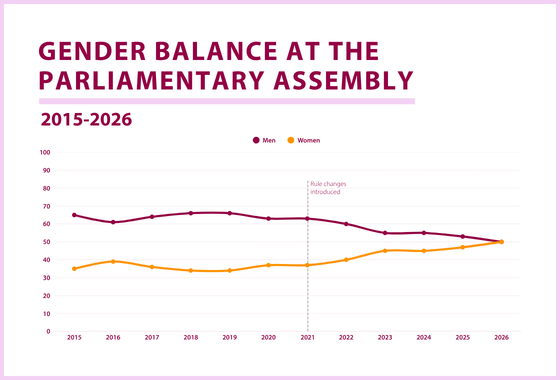
A review of gender equality statistics published today shows that in January 2026 – taking into account both representatives and substitutes – women in the Assembly made up just under 50% of the total membership, after steady increases in recent years.
“I am proud that our Assembly has been able to achieve gender parity, a historic milestone which means a great deal to me personally,” said PACE President Petra Bayr, herself the fifth woman President of the Assembly, who has made the issue a priority. “I have no doubt that politics which reflects the experience and needs of both women and men is better politics.”
She thanked national parliaments for appointing greater numbers of women to the Assembly in Strasbourg, even though only around a third of Europe’s national MPs are women, according to IPU figures.
“I hope that our success in achieving this result – using regulatory changes to increase the numbers of women not just in the membership but also in leadership roles, as well as awareness-raising – may serve as an inspiration to other parliamentary bodies around the world,” she added.
The increase in the number of women members follows a series of rule-changes introduced by the Assembly after the election of Despina Chatzivassiliou as the Assembly’s first ever woman Secretary General in January 2021, when women made up only 37% of the Assembly.
Rules adopted in 2021 required parliaments to submit national delegations which respected the “one-in-three” principle for members of the under-represented sex. From the beginning of 2027, delegations must contain a minimum representation of 40% of each sex – with exact numbers depending on the size of the delegation.
When the Assembly met for the first time in the summer of 1949, historical records show that only a single woman was accredited out of 101 representatives, Margaret Herbison of the United Kingdom.
The Assembly, which elects judges of the European Court of Human Rights, has also taken steps to increase the number of women judges on the Court by requiring states to include at least one woman among the three candidates they put forward for election, unless an exception can be justified. Of the current bench of 45 judges 16 are women, representing 35%.