


21/05/2026 Monitoring
The Monitoring Committee, meeting in Sarajevo on 19 May, welcomed the progress made by Serbia as regards the reform of the judiciary and prosecution services since its accession to the Council of Europe in 2003, in particular the adoption of amendments to the Constitution in February 2022 and of several laws on the organisation of the judiciary and prosecution service.
However, the committee noted that since the last PACE resolution on “The honouring of obligations and commitments by Serbia”, adopted in 2012, the situation has changed and that “there are now serious concerns about the country's adherence to the principles of democracy, rule of law, and the observance of public freedoms”.
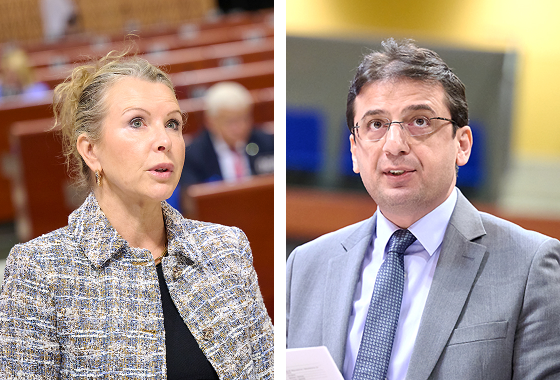
Drawing on a report by Victoria Tiblom (Sweden, ECPA) and Yunus Emre (Türkiye, SOC), the committee expressed concern about a political environment marked by significant polarisation and ongoing tensions between the government and the ruling majority, on one hand, and political opposition, student movement and civil society on the other.
The parliamentarians deplored incidents of abuse of force by law enforcement authorities, arbitrary arrests and ill-treatment in custody during mass protests – following the November 2024 collapse of the Novi Sad railway station canopy, which resulted in the deaths of 16 people – which continued until the end of 2025 and led to a student movement seeking transparency and justice. They also deplore the alleged use of a sonic weapon to disperse crowds during the mass demonstration in Belgrade on 15 March 2025.
In this context, the committee called on the authorities to “avoid the use of unnecessary force against protesters” and to conduct independent investigations into these cases. It also urged the authorities to stop reprisals and intimidation measures against civil society activists, human rights defenders, journalists and independent media outlets, to ensure a conducive environment for their work.
Despite the reforms, recent amendments the Law on Public Prosecutor's Office, the Law on the High Prosecutorial Council, the Law on the Organisation and Jurisdiction of State Authorities in the Fight against High-Tech Crime, the Law on Judges, and the Law on the Seats and Territorial Jurisdictions of Courts and Public Prosecutor's Offices (“Mrdić laws”) negatively affect the functioning of the judiciary and prosecution service, the adopted draft resolution emphasises. The committee therefore called on the Serbian authorities to amend these laws as soon as possible, in line with the recent recommendations of the Venice Commission.
Finally, the committee expressed concern at the frequent organisation of early elections at short intervals, “which disrupts the functioning of democracy and state institutions”. It underlined the need to reform the electoral system in accordance with the recommendations of the OSCE/ODIHR and the Venice Commission.
It proposed to examine the outstanding issues within the framework of a forthcoming report on the honouring of obligations and commitments by Serbia.