


11/10/2016 Session
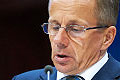
Addressing the Parliamentary Assembly today, Jürgen Ligi, Minister for Foreign Affairs of Estonia, mentioned the recent events that had taken place during Estonia’s Chairmanship of the Committee of Ministers, including notably the attempted coup d’état in Turkey. “It is important that the Committee of Ministers and the Parliamentary Assembly, the two main statutory bodies of our Organisation, work closely to support the Turkish authorities and the people of Turkey,” he said.
Referring to the fight against terrorism, he told member states that “more needs to be done” and encouraged them to continue their counter-terrorism efforts and to sign and ratify the Additional Protocol to the Council of Europe Convention on the Prevention of Terrorism, the main aim of which is to prevent and combat the phenomenon of “foreign terrorist fighters”. “The Protocol is the only existing international instrument in the world which offers legal tools and practical measures to address this problem,” he pointed out.
Mr Ligi also outlined the actions taken by Estonia during its Chairmanship of the Committee of Ministers of the Council of Europe, which ends in November. Children’s rights were among the priorities of the Estonian Chairmanship, particularly in relation to the migration crisis. “Estonia will continue to address the subject of children in the refugee crisis at a high-level conference on children’s rights to be held in Tallinn, on 4 November,” he announced.
“Human rights and the rule of law on the Internet is also among Estonia’s priorities,” he said, inviting the Council of Europe to continue with its standard-setting and monitoring arrangements which address and follow the evolution of the Internet and new technologies in general. In this connection, he mentioned the stock-taking conference on the Council of Europe Gender Equality Strategy 2014-2017 (Tallinn, 30 June – 1 July 2016) which explored, in particular, the impact of the Internet era on gender equality, and the tools available under the Istanbul Convention – which Estonia is to ratify soon – for tackling online sexist hate speech and gender-based cyber bullying.
He pointed out that the Committee of Ministers regularly adopted electoral assistance programmes to help member states organise elections that are in keeping with democratic principles, citing the recent case of Georgia, and the Republic of Moldova. “The Parliamentary Assembly plays a key role in ensuring the promotion and application of European electoral standards,” he added.