


30/09/2026 Session
Sa visite marque le demi-siècle d'adhésion du Portugal au Conseil de l'Europe
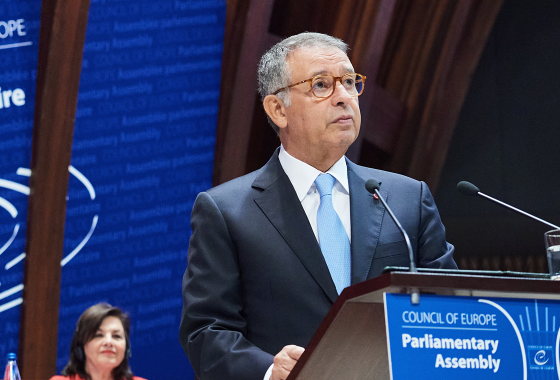
« L’Europe ne doit pas être une forteresse. Elle doit être un espace de liberté, de dialogue et de coopération, ouvert sur le monde et fidèle à ses principes. En cette période de tensions géopolitiques, de désinformation et de fragmentation croissante, nous avons besoin de renforcer le dialogue, pas de le réduire. Nous devons développer la coopération, pas l’isolement. Le multilatéralisme est indispensable », a souligné aujourd’hui le président du Portugal, António José Martins Seguro dans un discours devant l'APCE.
Le président Martins Seguro a qualifié de priorités essentielles pour l’ensemble du continent la défense sans compromis des droits humains, la sauvegarde de la démocratie, le renforcement de la cohésion sociale et l’édification d’une Europe ouverte sur le monde. « Le respect de la dignité humaine doit être la boussole de l’Europe », a-t-il souligné.
Le président a réaffirmé la ferme volonté du Portugal d'œuvrer en faveur de l'abolition de la peine de mort – dont le Portugal a été l'un des pionniers –, de promouvoir l'égalité de genre et de lutter contre la discrimination, ainsi que de collaborer avec d'autres pays pour prendre des mesures face au changement climatique, entre autres priorités.
La visite du président Martins Seguro au Conseil de l’Europe a eu lieu une semaine seulement après le 50e anniversaire de l’adhésion du Portugal – le 22 septembre 1976, deux ans après la Révolution d’avril 1974 qui a marqué le début de la transition du pays vers la démocratie.
Dans son discours prononcé devant des parlementaires de toute l’Europe, il a déclaré que « l’adhésion au Conseil de l’Europe était l’expression d’un choix sans équivoque : le Portugal souhaitait appartenir à une Europe de la liberté, de la démocratie et de l’État de droit. Cette adhésion n’était pas un simple acte diplomatique. Il s’agissait d’une profession de foi politique et morale. C’était le choix d’un pays qui souhaitait bâtir son avenir en se fondant sur la liberté, la justice et le respect des droits humains. »
Tout en reconnaissant le rôle joué par le Conseil de l’Europe dans la construction d’un espace commun de droits, de principes et de garanties, il a mis en garde contre les difficultés actuelles, telles que la montée des mouvements extrémistes, la méfiance à l’égard des institutions, la discrimination, le discours de haine et la xénophobie, ainsi que les tentatives d’affaiblissement de la protection des droits, le mépris du droit international et l’incertitude géopolitique croissante.
À propos de la guerre d’agression menée par la Russie contre l’Ukraine, le président a exprimé le soutien de son pays à l’Ukraine et à l’action menée par le Conseil de l’Europe pour que les responsables aient à rendre des comptes, notamment par le biais du Registre des dommages, de la Commission internationale des réclamations et de l'accord sur la création du Tribunal spécial pour le crime d’agression contre l’Ukraine. Pour lui, le soutien à l’Ukraine est un « devoir de solidarité envers sa population » et revient à défendre la sécurité de l’Europe et la crédibilité de ses principes.