


30/09/2026 Session
[En cours de traduction]
Russian state assets should be repurposed to pay Ukraine potentially “billions of euros” in compensation after two rulings against Russia by the European Court of Human Rights, according to the Parliamentary Assembly of the Council of Europe (PACE).
In two inter-state cases brought by Ukraine, the Strasbourg-based Court has already ruled that Russia was responsible for serious human rights violations caused by its war of aggression, though the amount of “just satisfaction” it must pay to Ukraine has not yet been set.
But given the scale of the damage inflicted on Ukraine, which is “unprecedented in the history of the Council of Europe”, any awards could potentially amount to “billions, tens of billions, or hundreds of billions of euros”, PACE pointed out.
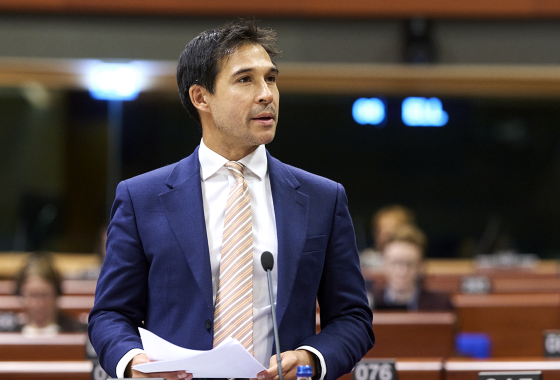
Approving a resolution and recommendation based on a report by Tony Vaughan (United Kingdom, SOC), the Assembly said the repurposing of Russian state assets to pay compensation to Ukraine in cases concerning the war “would constitute a lawful countermeasure under international law”.
Around 260 billion euros of Russian Central Bank assets were immobilised following Russia’s full-scale invasion of Ukraine, of which 210 billion euros are currently held in the EU. The parliamentarians urged the creation of a “funding mechanism” under Council of Europe auspices to receive these funds and disburse them to Ukraine. The funding mechanism could also be used to disburse funds to others who have brought claims against the Russian Federation, if additional sources of funds were to become available.
Russia was excluded from the Council of Europe on 16 March 2022, and ceased to be a party to the European Convention on Human Rights six months later, but remains bound by Court rulings on violations up to that date. “This obligation under international law does not diminish with time and cannot be set aside by Russian domestic law,” the parliamentarians pointed out.
The Assembly also urged national authorities to ensure that other claimants against Russia can launch legal proceedings to obtain the compensation owed to them, by ensuring that national legal frameworks allow for the domestic enforcement of any European Court of Human Rights’ just satisfaction award against the Russian Federation, for as long as Russia refuses to pay it.
Finally, the parliamentarians called for the drawing up of a public list of individuals, who – where Russia is found by the Court to be in breach of certain key articles of the Convention – have participated in large-scale human rights violations and not yet been held accountable. This list should be kept updated and communicated to all member states, the EU and the ICC for targeted sanctions or prosecution.