jeudi 1 octobre 2026 matin
2026 - Quatrième partie de session Imprimer la séanceVidéo(s) de la séance 1 / 1

Autriche, SOC, Présidente de l'Assemblée
10:11:59
Good morning, dear colleagues.
The sitting is open. I remind members that in order to be registered for that sitting, you should insert your badge when you take your seat and keep it inserted for at least 30 seconds. You should also insert your badge in order to speak of vote. To request the floor, please press the "request" button once.
The first item of business this morning is the general policy debate on "Europe, the fastest-warming continent: accelerating climate action with young people" in Document 16493. This item will have a different format than our usual debates.
It will be presented by Ms Aurora FLORIDIA on behalf of the Committee on Social Affairs, Health and Sustainable Development. And then we will have statements from guest speakers as follows.
Mr Michael O’FLAHERTY, a very well-known guest here as Council of Europe Commissioner for Human Rights,
Mr Mr Kamal KISHORE, Special Rapporteur, Special Representative of the United Nations Secretary-General for Disaster Risk Reduction,
Ms Emilie TAMO KAMGUIA, Member of the Council of Europe, Advisory Council on Youth
Mr Benjamin VAN BUNDEREN ROBBERECHTS, founder of the non-governmental organisation (NGO) Climate justice for Rosa.
They will all have 5 minutes to speak.
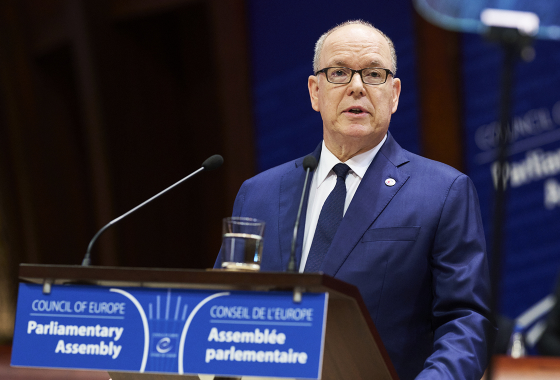
And after that we will turn to the speakers list. The debate must conclude by 12:30 p.m. for the address of His Serene Highness Prince Albert II of Monaco.
And before we start, let me say something about that issue this morning, dear friends.
And I just realised that I have the wrong speech open. But here comes the correct one now. I have the pleasure and honour to open this general policy debate on the environment today. And I'm especially pleased that it will take place in the presence of our honourable guests which we have with us and also in the presence of young people, because it's very important to not only discuss about their future life and their future Earth, it is important to discuss with them and include them in our debates and in our decisions. And I think that's something the Assembly really puts into practice and not just into declarations.
And as I already had the occasion to state in my opening speech this week, on Monday, I want us to move together towards a binding convention on the right to live in a safe, healthy and sustainable environment. Not as a declaration, not as a recommendation, as a plain treaty with binding commitments behind it. Because the right without robust implementation mechanisms is only a wish and not really a right.
We are best placed to do so. The European Convention on Human Rights enshrines the rights to life, the right to respect for privacy and for family life, and the right to a fair trial. And today, our human rights work increasingly recognises all these rights cannot be fully realised in a degrading, polluted and dying environment. The right to life means little without clean air to breathe. The right to respect one's home means little when that home is swallowed by rising seas. The natural conditions that make human life possible are increasingly understood as part of the very substance of the rights we are charged to protect.
Our organisation exists to uphold human rights, democracy and the rule of law. Environmental degradation is, at its core, a question of justice. It is the vulnerable, the poor, the marginalised, the not-yet born who bear the heaviest burden of pollution, deforestation, climate disruption and loss of biodiversity. When we criminalise the most serious environmental offences, when we hold corporations and individuals accountable for ecological destruction, we are not merely protecting nature, we are protecting human rights. We are protecting the right to life, the right to health and the right to a future.
With this in mind, and without further ado, I give the floor to the distinguished rapporteur on this debate, Ms Aurora FLORIDIA, who is also the Chairperson of the Parliamentary Network for a Healthy Environment.
Dear Aurora, the floor is yours. 7 minutes.
Thank you, President.
Dear panellists,
Dear young representatives,
Dear colleagues,
Today is a great day for the Council of Europe, we are putting today climate action with young people at the core of our debate.
We are finally giving it the space it deserves.
And, wow, let me say, that it fills me with gratitude, with joy, and with a real and well-deserved sense of satisfaction for the great teamwork that has brought us here; involving different offices, committees and actors, both within and beyond the Council of Europe. A teamwork that has kept us together for three years now, even through the more difficult moments, when the winds were strongly against the issue we are discussing today.
There is more. Today, we are finally talking about "accelerating" climate action, by actively involving younger generations.
There is no doubt that we need to accelerate. Inaction is no longer an option. Because inaction is already costing us dearly, and it is sparing no one.
I have worked on climate issues for years, but the summer of 2026 shocked me. This year, for once we can all agree: across Europe, we have all experienced first-hand the devastating impacts of climate change and rising temperatures. And for far too long. Extreme heat, drought, floods, wildfires, impacts on our health and our economies, and tragically, on people’s lives.
So, the question behind my report is quite simple: how can we accelerate climate action by involving young people much more strongly; not simply as a generation affected by climate change, but as protagonists in shaping a future in which our planet remains "habitable"?
I would like to highlight a few key points.
First of all: the urgency. Europe is warming more than twice as fast as the global average, and we are heading towards a breach of the 1.5°C threshold in the early 2030s. This does not make the Paris Agreement irrelevant, it makes action even more urgent. Every fraction of a degree matters. Every year matters. Regardless of what other countries and continents do.
This is why it is important to put habitability at the centre of climate action. We are not above nature: we are part of the living world, and our lives depend on the conditions that sustain it. Habitability must become a core value of European action, alongside freedom and dignity. Because if we destroy the conditions that make life possible, human rights will have no meaning.
This brings me to young people. They are at the heart of this report because they are at the heart of the urgency to act. A child born this year, in 2026, will be 74 years old in 2100. For that child, the end of the century is a lifetime, not a distant date on a chart.
Young people have contributed little to this crisis, yet they should not be the ones to pay the price for the decisions we make today.
But I frankly refuse to speak of young people only as vulnerable people we must protect. They must be involved and help decide where the money goes and have the means to build what comes next. Because young people are not just asking for change, they are also creating it. We need the young generations.
Then there is responsibility and accountability, including our own. The draft resolution asks national parliaments to review openly climate commitments every year, with young people taking part. Governments should explain what they promised, what they achieved and how they will close this gap.
Finally, and this is central to the report, we need a paradigm shift: human rights and the environment are intertwined. This is also made clear by the Reykjavík Declaration.
So this report also calls for "accelerating" the ongoing work towards recognising, within the Council of Europe, a legally binding instrument guaranteeing the right to a healthy environment as a standalone one, with particular regard to the rights of young people and future generations.
I really understand that some member states may be concerned that recognising such a right could slow down economic development or expose member states to costly litigation.
But I believe the opposite is true. Laws and rights can be like lighthouses in difficult times: they give us direction and help us act at the right moment. And we cannot leave this issue to the goodwill of citizens, civil society and companies alone.
Dear colleagues,
We must accelerate climate action and keep a clear timeline. And we know: dreams are powerful and they can become reality. I dare to dream that next year, with the magic word "accelerating", we will meet here again to recognise the right to a healthy environment, accelerating it, of course, the magic word; making it an added value of the Council of Europe and a distinctive contribution to our beloved Europe.
Au travail!
Thank you.
[Applause]
Autriche, SOC, Présidente de l'Assemblée
10:24:22
Thank you very much, Ms Aurora FLORIDIA.
We now come to the distinguished guests, to our panellists.
Thank you very much for accepting to come and discuss your views with us. And please keep in mind that you have about 5 minutes for your interventions. And it's my pleasure to first give the floor to our Commissioner for Human Rights, Mr Michael O'FLAHERTY.
Dear Michael, environment seen under the prism of human rights is a focus of your work and I know that you are an absolute ally in this regard and you consider them as independent.
You promote the growing recognition of the right to a clean, healthy and sustainable environment among member states, assist them in upholding the organisation's human rights standards with regard to environmental protection, and support the work of environmental human rights defenders.
You recently declared that you saw every day in your role as Commissioner the, and I quote, "interplay of attacks on the environment and human well-being" and that you also saw "how the defence of this planet is profoundly a human rights responsibility".
With that, I am happy to give you the floor, dear Mr Michael O'FLAHERTY.

Commissaire aux droits de l'homme du Conseil de l'Europe
10:25:48
President,
Rapporteur,
Honourable delegates to the Assembly,
Fellow panellists, members of the Council of Europe Advisory Council on Youth,
It took a long time for our Europeans general societies to wake up to the triple planetary crisis of climate change, biodiversity loss and pollution. And that was despite warning after warning from across the world, of disappearing Pacific island states, of calamitous rainfall, of ruinous desertification and the related displacement.
It seems as if it is only now that our European societies have woken up to the high danger following that dreadful summer of record temperatures and wildfires and a continent deeply unprepared. And here I have to observe that we had no shortage of European signs. The degradation of our environment has been visible to all. For instance, in my own hometown in Ireland, the extent of flooding increased dramatically over just the past decade.
And, of course, we have all benefited from sustained civil society activism. Brave, smart and passionate. This morning I pay tribute to, and I thank everyone who has tried to wake us up. In particular, I thank senior activists, such as the group of senior women activists, KlimaSeniorinnen, in Switzerland, and everywhere, I thank young people.
We still desperately need the engagement of civil society, but the burden of duty now falls elsewhere. Above all, we are at the moment to wake up our politics and to put the crisis at the heart of our parliaments and governments. We need leadership that is scientifically informed and is no longer interested in trade-offs and short-termism. And in this regard I appreciate the role being played by this Assembly. I acknowledge how far ahead you are of many national parliaments and how your deliberations will greatly enrich global, regional and country-level efforts.
To assist the Assembly and all of us to rise to the moment, allow me briefly to suggest five actions for our political leaders.
First, listen. In the first place, listen to the planet in its pain. But also listen to the scientists and the activists. Listen to those who will inherit the damage that we have done. Young people have every reason to be furious, and they must be heard.
Second, protect. It is essential that those who protest, especially young people, are adequately protected by our states. The right of peaceful protest should be respected. And here I'm very worried about the situation in a number of our countries.
Third, obey. Our governments have the duty to obey the law, including international human rights law. This includes the environmental-related jurisprudence of the European Court of Human Rights and the guidance recently offered by the International Court of Justice (ICJ) regarding the duty to ensure a clean and healthy environment. What's more, in addressing legal obligations, it is necessary that our governments make sure to implement both the mitigation of harm and the adaptation of society.
Fourth, avoid one-size-fits-all approaches. Climate change does not hit all equally. It strikes far harder for those already overlooked at the edge of our societies. I think of the Roma, pushed to live on filthy landfill sites. I think of older people, institutionalised in shoddy buildings totally unsuited to today's climate.
Fifth, fill the global legal gap. In other words, it is high time to draft and promote a binding treaty for Europe on the right to a clean and healthy environment. We need a sturdy treaty whereby our states can be held to account. A roadmap to make it sturdy is, of course, those sources I mentioned a moment ago: the judgments of the Court and the opinion of the ICJ. Another element of the map is the deep experience of this organisation in crafting treaties and giving them robust oversight systems.
President, dear friends, in conclusion, I have to admit that I am no climate scientist. I am not in a position to interrogate the claim of some that we are already past the tipping point and that environmental catastrophe is inevitable. But I am clear that such foreboding must not deter us.
Doing nothing is not an option.
Thank you.
Autriche, SOC, Présidente de l'Assemblée
10:31:10
Indeed. Doing nothing is not an option.
Thank you for that, Mr Michael O'FLAHERTY.
Now I turn to Mr Kamal KISHORE, the Special Representative of the United Nations Secretary-General for Disaster Risk Reduction and Head of the United Nations Office for Disaster Risk Reduction. We worked together on a national basis for many years and I'm happy that he's here today.
Mr Kamal KISHORE brings us a simple message and a powerful one: too often we act after the flood, after the fire, after the storm. It is time to act before, from responding to disaster prevention. He will also remind us that young people are not only beneficiaries of climate resilience, they are partners in building it. And he will show that disaster resilience and societal resilience go hand in hand. A society that stands together, stands firm.
This is why the environment is a priority of my Presidency. Protecting nature means protecting people. Mr Kamal KISHORE, the floor is yours.
Représentant spécial du Secrétaire général des Nations Unies pour la réduction des risques de catastrophe, Directeur du Bureau des Nations Unies pour la réduction des risques de catastrophe
10:32:23
Madam President,
Honourable parliamentarians,
Distinguished young representatives,
At the outset, I would like to thank the Parliamentary Assembly of the Council of Europe for organising this debate on one of the defining challenges of our time and for inviting me to participate.
From floods and glacier collapses to wildfires and heatwaves, climate related hazards are becoming more frequent and more severe across Europe. When these hazards impact communities that are exposed and vulnerable, they result in disasters that take a heavy toll on lives, livelihoods and public finances. But, even in the face of a climate crisis, these outcomes are not inevitable. We can prevent climate hazards from becoming disasters. That is the goal of the Sendai Framework for Disaster Risk Reduction and the purpose of my office today. Let me highlight three main points.
My first point is that countries must move from responding to disasters to preventing them. This is central, and I'm happy to say that this is beginning to gain traction. Because it is increasingly clear that simply waiting for disasters to occur will not only lead to thousands of avoidable deaths, but will also bankrupt our local and sometimes national budgets. Through legislation and budgetary decisions, we can ensure that disaster risk reduction is integrated into infrastructure development, land use planning, housing and economic development. We also need your support to create policies that encourage the private sector and communities to reduce risk rather than create it.
My second point, young people should be recognised not only as beneficiaries of investment in climate resilience, but as leaders in shaping it. They can be and must be agents of change. That is why the Sendai Framework calls on countries to provide youth with the space and modalities to not just contribute but to also lead disaster risk reduction. We must do a better job of harnessing the initiative, imagination and ingenuity of young people to build resilience for the long term. Through my travels over the last 2 years, I have seen inspiring examples across Europe, including Youth Declaration: A Call to Action that was adopted in Budva in 2024, a regional platform for Disaster Risk Reduction, and the heat risk management initiative "Flames of Change", launched by our regional office in Brussels.
My third point, we must recognise that disaster and climate resilience are inseparable from societal resilience more broadly. Disaster and climate risk reduction is often viewed as a technical issue for emergency services or civil protection agencies. But the reality is that climate-related disasters affect every aspect of society. Climate and disaster resilience should be viewed as enablers of many of the goals that parliamentarians here are working to achieve. Resilient societies are societies where children can continue learning during crises, where communities know whom to turn to for trusted information, where essential services continue uninterrupted and where social cohesion is maintained because no one is left behind when disasters strike.
Excellencies, we live in a time when our societies are being tested by climate change and growing uncertainty. Disasters, climate-related and other disasters, geophysical disasters, feed on inequality and vulnerability and leave behind even more of these. If we want to protect security, prosperity and stability, we must invest in resilience for all.
And I thank you.
Autriche, SOC, Présidente de l'Assemblée
10:37:09
Thank you very much for this really very useful knowledge and your important address.
I would now like to invite Ms Emilie Tamo KAMGUIA, member of the Advisory Council on Youth of the Council of Europe, to take the floor.
This summer showed us the violence of the climate crisis. Young people felt it directly. But young people are not only victims, they are the driving forces for transition.
Ms Emilie Tamo KAMGUIA will call on member states to move from words to action and to implement the Council of Europe's recommendation on young people and climate action concretely and immediately. She welcomes the draft report and recommendation before us, including the support for the right to a healthy environment and to the proposed mid-term review.
She will speak for climate justice and for a just transition that does not forget the most vulnerable and marginalised young people. And she has a clear call to action for us as parliamentarians. As President, I want this Assembly to listen to young people not as a courtesy, but as a duty.
Ms Emilie Tamo KAMGUIA, please.
Membre du Conseil consultatif sur la jeunesse du Conseil de l'Europe
10:38:25
Thank you, Chair.
My name is Emilie; I'm a 28-year-old environmental engineer. Like many of my generation, I am scared and angry at decision makers for not protecting my future from one of the greatest threats facing humanity: the triple planetary crisis.
I might live long enough to see the 2080s. Yet, given Europe’s warming speed, my eighties may be 5°C warmer than those some of you have known. One day, my grandchildren may ask me: "What did you do to make a difference?" I hope to answer: "I helped convince decision makers to take the next step."
Summer 2026 broke records. Well, next summer will too. Young generations will face the intensification of extreme weather events and the collapse of entire ecosystems because of the collective failure to counter the catastrophe.
Although our contribution to climate change is minimal, we will suffer the consequences all our lives, in education, work, access to healthcare, food, water, housing and civic space.
This summer, in the South of France, where I come from, young farmers lost everything they worked for in wildfires.
Last June, during the youth event around the new Democratic Pact, dozens of young people ended up sleeping on mattresses in the meeting rooms of the European Youth Centre because of the heat in their bedrooms. We even had to relocate the event because the air conditioning failed.
Meanwhile, Fanny, a friend and middle school teacher, faced the tears of exhausted students taking their exams in 38°C heat, unable to perform at their best. Several fainted and were sent to recover in the school’s only air-conditioned room.
And after school, the least privileged children return to urban heat traps, while others turn on air conditioning or escape to cooler places. Age, gender, disability, ethnicity, income and their intersections exacerbate climate vulnerability.
Climate change kills tens of thousands every year, here on the continent of human rights that this institution swore to protect. You may die of old age. We may die from the consequences of climate change.
So tell me, how can we not be angry, when the facts are here, and the actions don't follow? When the least responsible are the first victims?
But young people are not only victims: we are leading the way to transition. We were among the first ones in the streets. Mobilising, standing in solidarity and demanding action.
Yet, here again, we are undermined, heard but not listened to. Young environmental defenders are attacked, sometimes even called "terrorists". Young people are exposed to disinformation, growing climate denial and distrust. This. must. stop.
To do our part in climate change mitigation and adaptation, we need our rights to be protected, especially for those suffering violence and repression. We need barriers to youth participation removed, access to reliable information, tailored education and opportunities to develop green skills. The most disadvantaged and marginalised youth groups need protection from climate injustice and discrimination.
Luckily, we already have an instrument covering these needs and waiting to be implemented: the Recommendation on young people and climate action.
Now, the Advisory Council would like to thank the Youth rapporteur for her extensive work and the drafting of the report.
We strongly support the immediate drafting of a convention recognising the right to a healthy environment. As the President of the Parliamentary Assembly of the Council of Europe recalled on Monday: "There is no human right that survives an uninhabitable continent".
We support the follow-up to the recent judgement of the Court, which recognised that climate change can seriously affect our human rights and that governments must take effective action.
We ask for the implementation of the Recommendation on young people and climate action and welcome a mid-term review to make sure progress has been made. We also acknowledge the Youth Department’s support to youth organisations working on the environment, and we are pleased to have some recipients of these grants with us today in the room.
We finally stress the importance of supporting the newly established Steering Committee on the Environment (CD-ENV) in implementing the youth-related actions that are already included in the Action Plan while welcoming the initiative on future literacy and inter-generational justice.
Members of the Parliament,
My conclusion is simple. For decades, science has been crystal clear, and the consequences are already here. You cannot continue to look away.
Listen to what youth are asking for and adopt the draft resolution and recommendation before you today.
Young generations are watching you and will live with the decisions you take today.
Protect our rights. Protect our future. Do not fail us.
Thank you.
Hongrie, PPE/DC, Président de l'Assemblée
10:43:48
Thank you very much, Ms Emilie TAMO KAMGUIA, for your address to this house.
And, last but not least, I'm pleased to welcome the youngest participant in this debate, Mr Benjamin VAN BUNDEREN ROBBERECHTS, founder of the NGO Climate Justice for Rosa. And this House already had the privilege of listening to him at the Global Forum of Environmental Rights Defenders in this Chamber in spring this year. And I think we are all grateful that you came back. Thank you very much, because your testimony moved many, and I think many understand now that movement is necessary
For young Europeans, this issue is not abstract, not technical, not far away, as we have already heard. It is here, it is now. So Benjamin will speak about young people who have already lost loved ones, homes, their sense of safety or part of their future. And his message is clear. Those who are affected must have a real say in the decisions that affect them.
So, Benjamin, thank you very much. You have the floor.
Fondateur de l'ONG Climate Justice for Rosa
10:44:52
Thank you.
Dear Excellencies,
I'm Ben. I'm a 19-year-old climate activist from Belgium and the founder of Climate Justice for Rosa.
In films and novels, climate catastrophe is often imagined as one drastic moment when the whole world suddenly collapses. Reality is much less cinematic, but no less deadly. It comes as a flood in one country, a wildfire in another, unbearable heat somewhere else.
We are living through a global crisis in fragments, and that's precisely why this room matters. When one nation sees lives being taken by raging water, and another counts the deaths from extreme heat, this Assembly can see the whole picture. For the Council of Europe, this is ultimately a question of human rights. What does the right to life, to health or to a home mean when we fail to protect the conditions that make those rights possible?
I know what one of these fragments looks like from the inside. Five years ago, when I was 14, I met a girl called Rosa at a summer camp in Belgium. She was 15, a climate activist like me and convinced that young people could change the world.
Then the floods came.
Rosa and I were trying to reach higher ground when she was taken by the water. I remember only her head being above the water and she was shouting, but the water was too strong. I jumped in after her and I was holding her with one arm while trying to grab some branches hanging over the stream, but the water wasn't water any more – it was a raging brown monster dragging us along. We went underwater and I don't really know what happened next, but suddenly I got struck by a pole sticking out of the water and I was still holding Rosa with one arm. Then an even bigger wave came and she got dragged out of my arms. I climbed out of the stream but I couldn't see her any more. And then, three days later, seven kilometres downstream, her body was found.
220 people died in those floods in Belgium and Germany that night. For the rest of Europe, it was a terrible disaster on the news. But for Rosa's family and friends, the world changed forever. Since then, I've watched the pattern repeat itself: families displaced by wildfires, parents who have lost children, workers becoming dangerously ill in extreme heat because staying home was not an option.
How could we have known so much for so long and still have allowed this crisis to become this dangerous? Nobody in this Chamber has been promised that the climate crisis won't hit their communities, their home or their child. At some point, we have to stop pretending these are isolated events.
For years, young activists were called alarmists. Now the reality is catching up. Somehow the question becomes whether we warned you in the right way. There is something deeply uncomfortable about watching responsibility move from those who had the power to act to those who spent years begging them to act.
Adaptation and mitigation were never alternatives. We must protect people from the warming already here, while preventing much worse warming. And I do not want to be invited here simply because my story makes climate change feel real. Rosa's death should not be reduced to a testimony. If institutions invite people who have lived through these crises into rooms like this one, then that experience has to matter when decisions are made. Lived experience should not only be heard after disaster, it should help prevent the next one.
The right to a healthy environment is not an abstract principle. It's about whether a child can breathe clean air, drink safe water and grow up without their home, health and future being threatened by a changing climate. The resolution before you today can be another step. But ultimately, a right only means something if people can rely on it. We need a binding right to a safe, healthy and sustainable environment, and the commitment to make it real, so that words spoken here in Strasbourg become protection in people's lives.
So I ask you to adopt this resolution, but not to let the mission end here. Every parliamentarian here will leave Strasbourg and return to their national parliaments. So when you go home, take the whole picture with you. Five years ago, one fragment of this crisis reached my life. Her name was Rosa. She was 15 and had plans for a future she never got to live in. There will be other names if you fail. But the next name doesn't need to be inevitable.
You already have the warnings. You have the evidence. Now connect the dots, see the whole picture, and do everything you can to protect future victims from dying. Thank you.
[Applause]
Hongrie, PPE/DC, Président de l'Assemblée
10:49:40
Thank you very much. That closes the list of statements by our invited guests.
And before we move on to the general political debate, allow me to recognise the beginning of Breast Cancer Awareness Month today. In my family, we have lost multiple people to breast cancer and I have two daughters, and I hope that they will not be afflicted by this.
And I would like to also thank the work of those activists like Ms Elizabeth HURLEY or Ms Stella KYRIAKIDES or Ms Nancy BRINKER, or others who have worked tirelessly to fight against this. So, thank you for bearing with me while I recognise this and there's going to be an event at midday today and I hope that we will see many of us there. Thank you very much.
And with that, we move on to the debate. And I call first, on behalf of the political groups, Ms Yuliia OVCHYNNYKOVA from the Alliance of Liberals and Democrats for Europe.

Ukraine, ADLE, Porte-parole du groupe
10:50:43
Mister President, dear colleagues, dear young friends,
On behalf of the Alliance of Liberals and Democrats for Europe, I thank our Rapporteur, Ms Aurora FLORIDIA, and especially the young people contributing to this debate.
We all know that Europe is the fastest-warming continent. And in Ukraine, war has shown with tragic clarity that environmental destruction can harm ecosystems and human lives for generations.
Environment is no longer a silent victim of war or crisis, it speaks through the voices of children, youth, researchers, and politicians.
When I was a little girl, after a severe drought, dry grass caught fire near my home. I ran to help put it out. My mother ran after me and asked: “Yuliia, are you safe?” I replied: “Yes. But the environment is not.” At this time, I did not know that protecting nature would become my life’s work — as a researcher, as a youth leader, as a parliamentarian now.
Today, that memory reminds me that when we see a danger, we have a responsibility to act.
And this brings me to young people. We often tell you: “You are our future.” But you are also our present. And you have the right to influence decisions whose consequences you will live with far longer than we will.
I propose five concrete principles for real influence.
First: make intergenerational justice real.
Second: assess decisions through the eyes of future generations.
Third: protect young environmental defenders. Young people must be free to speak, organise and act peacefully. Environmental engagement is not a threat to democracy; it is democracy in action.
Fourth: make climate literacy part of democratic resilience. In an age of disinformation, young people need science, critical thinking and environmental education.
Fifth: give young people a structured role in decision-making. Let us build on the Council of Europe’s pioneering youth co-management model and bring young people directly into our environmental work and the Reykjavik process.
This is also at the heart of my report, “Climate action as a human and democratic responsibility”, developed in continuous dialogue with young people.
Dear colleagues, participation without influence is not enough. Let us move from consultation to influence, from promises to accountability, and from speaking about future generations to working with them.
Because the question is not only what planet we leave to young people. It is what democracy we build with them today.
Thank you very much.
Hongrie, PPE/DC, Président de l'Assemblée
10:53:39
Thank you very much.
The next speaker is Mr Aaron VALENT from the Group of the Unified European Left (UEL).

Allemagne, GUE, Porte-parole du groupe
10:53:46
Mr President,
Dear colleagues,
Europe is warming more than twice as fast as the global average.
The consequences are already being felt: heatwaves, droughts, floods and wildfires are threatening people, their health and their livelihoods.
The climate crisis is not some abstract issue for the future. It is already determining how safe and affordable our everyday lives are. That is why climate action must not be played off against social security. Those who rely on buses and trains need reliable and accessible public transport. Those who need to heat or cool their homes need affordable energy.
And workers in the sectors affected need secure prospects as our economy is going to change. This means expanding renewable energy more rapidly, making buildings more energy-efficient and strengthening public transport. At the same time, we must prepare for the consequences of global warming that we can no longer prevent. Local authorities need sufficient funding to do so, especially in places where heatwaves, floods and other extreme weather events hit people particularly hard.
And one thing is clear above all: young people must be involved in these decisions. Not simply by just listening to them, but by ensuring that their proposals actually influence our political decisions. They are the ones who will have to live the longest with the consequences of our failures we make today. So anyone talking about the future of Europe must take these things very seriously: protecting the climate is a social issue.
We need decisive action now that brings people with us, brings the youth with us and does not simply shift the costs onto the public.
Thank you very much.
Hongrie, PPE/DC, Président de l'Assemblée
10:55:52
Thank you very much.
The next in line is Ms Hripsime GRIGORYAN from the Socialists, Democrats and Greens Group (SOC).

Arménie, SOC, Porte-parole du groupe
10:56:02
Dear colleagues,
Dear young colleagues,
On behalf of the Socialists, Democrats and Greens Group (SOC) I would like to thank our rapporteur, Ms Aurora FLORIDIA, for the great, timely and highly practical report.
What I particularly value is that it puts a human face on what can otherwise become a very technical debate. We speak about temperatures, emissions. Yet behind these numbers are people: a farmer facing another drought, a family struggling with rising costs, and a child who will live with the consequences of the decisions we make today. And those consequences are not equally shared. Those with the fewest resources are the most vulnerable. Climate policy, therefore, cannot be separated from social justice. This is why I find the report’s concept of habitability so powerful. Just as freedom and dignity are fundamental European values, habitability should be at the heart of our policies. Because without a liveable climate, accessible water, clean air, rights and freedoms risk becoming abstract promises.
And this brings us to intergenerational fairness. Those of us who have the power to decide today cannot pass the risks, the damage and the cost of repairing them to our children. That means ambitious climate targets, deadlines, monitoring and corrective action when we fall behind. The KlimaSeniorinnen judgment reinforces precisely this responsibility. Commitments alone are not enough; there must be an effective and verifiable path towards them.
And young people must be part of shaping that path. Not simply invited to conferences, given a microphone and sent back home. Instead, their participation should be permanent and meaningful – in policy, in budgets and in the economic choices. We should give young people the knowledge to recognise misinformation and greenwashing; support their projects and create quality jobs in the green transition. The transition must be environmentally ambitious, yet also socially fair. And it makes economic sense. The evidence presented in this report is clear: inaction will ultimately cost us more than action.
Dear colleagues,
This debate also has a particular resonance for Armenia, which this October will host COP17 on Biodiversity. Climate and biodiversity are distinct challenges, but they meet at exactly the point this report describes: protecting the ecosystems, water and natural resources on which human life depends. COP17 will also be about turning international commitments into implementation.
And Europe should take another important step: recognising the autonomous right to a healthy environment and moving, without further delay, towards a legally binding Council of Europe instrument, with effective monitoring and a voice for young people.
Finally, there is something here that should rise above political divisions. Whatever our political family, whatever country we come from, we all speak about how much we value our children, our youth and those not yet born. Climate action is one of the most concrete ways of turning that care into responsibility. Our generation should not be remembered as one that understood the problem, had the means to act and still passed the bill to the next.
Let us leave them something better: a Europe that remains liveable, fair and full of possibility.
Thank you.
Hongrie, PPE/DC, Président de l'Assemblée
10:59:19
Thank you very much.
The next speaker is Mr Marko PAVIĆ from the Group of the European People's Party (EPP).

Croatie, PPE/DC, Porte-parole du groupe
10:59:25
Thank you very much.
Dear Chair, dear colleagues, dear young people,
On behalf of the Group of the European People's Party (EPP), let me start with conviction. Conviction that love of our countries means stewardship of the environment for young people.
The report before us is right to place young people at the centre of this debate. Young people have contributed relatively little to cumulative greenhouse-gas emissions, yet they will live longest with the consequences of the decisions we make.
As a climate scientist myself, I would also like to underline an important scientific point: global warming does not mean that every region warms at the same rate.
Europe is particularly exposed. Europe has warmed by around 0.56 °C per decade over the past 30 years, more than twice the global average, and is already around 2.5 °C above the pre-industrial age.
We must also be clear about the Paris Agreement. The Intergovernmental Panel on Climate Change (IPCC) had already indicated that the 1.5°C level of global warming could be reached by the early 30s. It means that we don't have decades to prepare as we initially thought.
I have experienced this unequal geography of warming personally. During a visit to Antarctica with the British Antarctic Survey, I spent one month on a scientific cruise aboard the research vessel James Clark Ross on the Antarctic Peninsula, which experienced warming of 2°C and it was a profound experience for me.
During my Antarctic and Southern Ocean work, I also studied the ENSO system: the El Niño-Southern Oscillation coupled system. ENSO is one of the major natural drivers of year-to-year variability and, in 2026, we experienced a strong El Niño with effects on Europe.
Global warming means that there is more energy in the system for extremes. We've seen fires in Spain and floods and fires in France. The European Union has chosen to lead, and although the EU is responsible for only 7% or 8% of greenhouse gas emissions, we lead. However, leadership must also be economically and socially sustainable. We cannot ask Europeans to inherit a protected continent, but a weaker economy, fewer opportunities, affordable energy and technological dependence. Climate policy must therefore be connected to competitiveness, industrial capacity, affordable energy, research, innovation and high-quality employment.
The war against Ukraine also demonstrated how dangerous excessive dependence on imported fossil fuels can become. Energy policy is therefore not only climate policy; it is also security policy.
For the EPP Group, the climate transition should therefore be guided by responsibility rather than ideology: responsibility to science, responsibility to citizens who must be able to afford the transition, responsibility to European industry and jobs, and above all responsibility to generations who are not yet sitting in this Chamber to have a preserved planet.
Thank you very much.
Hongrie, PPE/DC, Président de l'Assemblée
11:02:43
Thank you, Marco.
The next speaker on behalf of political groups is Mr Paweł JABŁOŃSKI from the European Conservatives, Patriots & Affiliates (ECPA).

Pologne, CEPA, Porte-parole du groupe
11:02:52
Dear President,
Dear colleagues,
It is time for some common sense in this debate, as it is focused on involving young people in climate policies, and yes, politicians of Europe owe young people an explanation and an apology. Because indeed, as the title says, Europe is now the fastest-warming continent. But at the same time, this report carefully avoids mentioning another scientific fact: that it is Europe that has cut its emissions to the largest degree.
Now, the left very often says that they like to base their policy on science. So here are some scientific facts for you. Since 1990, Europe has cut its emissions already by over 30%. At the same time, emissions in Asia tripled; in Latin America, they rose by 70%; in Sub-Saharan Africa, by over 80%. And the report says, I quote, "insufficient global action is no justification for European wait-and-see approach".
Well, I have bad news, dear colleagues: it is precisely the opposite. It is the insufficient action of other non-European countries that should now prompt us to finally change our course. Because look where it has put us so far. We are the first in cutting emissions, and yet still we are the first in warming. We are bearing all the costs; we are putting constraints and burdens on our industry, strangling our economy, slowing down development, and still we suffer the most consequences.
Now, how do you explain this to young people? And the answer is obvious. Carbon dioxide doesn't know geographical borders. Whatever we do in Europe doesn't change anything anymore. In the global dimension, European emissions now only amount to just 6% of the global scale. So even if Europe goes to zero tomorrow, it doesn't change anything significantly for the world.
So here we are. Our industry is losing competitiveness. Factories close here and reopen elsewhere, or very often where energy is dirtier. Emissions don't disappear; they just move abroad, and our jobs also go with them. It doesn't help the climate; it just makes us poorer. And young people understand us much better than most of you. They do not want more regulation, more costs, higher energy prices, higher costs of living. They do not want to fear whether they will be able to afford to buy a home, to start a family, to raise children. They do not want more jobs to be offshore to Asia or Latin America. They want to feel that Europe is caring for them, for its citizens. They want jobs, they want homes, they want affordable prices. They want cheaper energy. They want a prosperous, competitive and resilient Europe.
And Europe must finally change course, first and foremost in the interests of young people. Common sense must return to Europe. Now, obviously, this report will be adopted because the ideologies have the majority here in this House. But recent polls already show that more and more young people understand that we must change this suicidal approach that is killing our economy, that is not helping the climate, that is only supporting growing emissions and climate warming from other non-European countries.
Thank you.
Hongrie, PPE/DC, Président de l'Assemblée
11:06:06
Thank you very much.
That concluded the list of speakers from the political groups, we move on.
And as a first, I'm very happy to welcome a youth representative, Ms Emma WEDNER.
Présidente du Conseil consultatif sur la jeunesse
11:06:20
Thank you.
Dear guests,
My name is Emma and I'm the Chairperson of the Advisory Council on Youth. And when we proposed the topic for this debate in May 2026, we didn't know what the summer would look like. The fires, the floods, the droughts and the lives lost. And this may well be one of the coolest summers that we will experience in the rest of our lifetime.
That's why I want to talk about disinformation and the need for legal action. Disinformation polarises and it feeds climate denial, erodes trust in science and inhibits communities to act. But it doesn't happen by accident. It's driven by these very political and economic incentives that want to stall climate action for their benefits at the expense of human rights, democracy and the rule of law.
People need reliable climate information, and journalists, scientists and youth activists are essential here. And where formal education on climate education fails, youth organisations must be empowered to support this gap. This is why we welcome the report's focus on literacy and intergenerational justice. Because disinformation kills. When early warnings and adaptation measures to climate change are not taken seriously or not trusted, people lose their lives.
This is why the Advisory Council on Youth also supports the initiation of a convention, a legally binding one that allows us to call for accountability of governments. Because this debate is not abstract for us. It affects everything. It's about finally getting a house and finding that you cannot live there in the summer anymore. It's about maybe not wanting to have children for the fear of the life that they will live.
But young people are already leading the pursuit for climate justice through legal means. The World's Youth for Climate Justice, they fought for an advisory opinion at the International Court of Justice and they got it. And around Europe, young people are suing their governments to demand action for climate change.
Now, the KlimaSeniorinnen case at the European Court of Human Rights has shown that the legal pathways also within this region can support this. But we need a binding document to support us in getting accountability.
So we should not fear the binding instruments. We should fear the consequences of the triple planetary crisis.
Thank you.
Hongrie, PPE/DC, Président de l'Assemblée
11:08:40
Thank you.
The next speaker is Mr Frank SCHWABE from the Socialists, Democrats and Greens Group (SOC).
Socialists, Greens, Democrats and many others.
Mr President, Mr Paweł JABŁOŃSKI,
I’ve heard there are brown bears in Poland. What do you actually do if you come across one? Do you say there aren’t any brown bears at all? Or that there shouldn’t be any brown bears in this forest? Or do you simply close your eyes?
I think that would ultimately – I have to put it this way – be rather foolish, and it would probably be quite deadly as well. Incidentally, it’s the same with climate change: if we ignore it, it will be quite deadly for many people.
There’s bad news and good news about climate change. The bad news is: we’re suffering major economic damage, we’re losing animal and plant species every day, and we’re losing human lives every day. The good news is that God – whoever or whatever we believe in, or even if we don’t believe in anything at all – has, in the end, given us a brain, specifically so that we can think about how to deal with climate change. And that’s why we can adapt through technology. We can even achieve economic success through this, as we are proving all over the world. And we are also able to adapt. And, incidentally, the two go hand in hand. It makes no sense to pit them against each other; rather, they belong together and are two sides of the same coin.
We are not a nature conservation organisation, as has just been said. We are a human rights organisation. But climate change does, in fact, have a human rights dimension. And I would like to thank all those who have put this on the agenda today, and in particular Ms Aurora FLORIDIA for initiating this important debate today. And I wish to urge and encourage the Committee of Ministers and the governments to take seriously what we decided at the Reykjavík Summit, namely that we wish to put this environmental dimension on the agenda. And I hear that the work being carried out there – and unfortunately many embassies are not represented here today – is being delayed, and that even after three years there are still no results.
What we have seen in the KlimaSeniorinnen Schweiz ruling is not just a matter for Switzerland, but concerns all the other member states as well. And we need a response to this. I am delighted that young people are so active and that we have such a wonderful youth organisation. We should listen more to the youth organisation in many areas. You carry what defines us in your hearts, and that is the direction we must take. Thank you very much.
Hongrie, PPE/DC, Président de l'Assemblée
11:11:14
Thank you. Mr Zsolt RÁKI.
Thank you, Mr President.
Dear fellow members,
For more than 26 years, I have been an organic farmer in Europe, south-eastern Hungary.
This is one of the fastest warming region, not only in Hungary, but in the entire Europe as well as in the world.
I have raised dairy cows and produced organic milk. Since 2011, our farm has operated a biogas plant, turning manure into renewable energy. So, for me, climate change has never been an abstract political debate.
I felt its first real blow in 2021, when heat came along with severe drought. That year, 300 hectares of our maize were devastated by extreme heat and the lack of rain on the Great Hungarian Plain.
Standing there, looking at those fields, I was not thinking about climate models or political debates. I was asking myself a very simple and painful question: will I have to slaughter hundreds of cows, to save the rest, because I cannot feed all of them? Or could I somehow find enough feed elsewhere?
This was not theory any more. It was about my farm, my animals, and the life, we had built over decades.
There is a Hungarian saying that goes: "the first slap hurts the most."
Unfortunately, we did not have to wait long for the next ones.
Then came 2022. The hottest summer of our lives.
Then 2024, 2025 and 2026, each bringing another year of extreme heat.
Five difficult years out of six! This is not normal.
We had to start adapting. We changed our crop structure, focused more on autumn-sown crops, soil-management techniques and preserving water in the soil. We changed our farming practices.
At the level of one farm, I couldn't change the climate. I could only change the way, I responded to it.
Darwin famously stated: "survival does not belong simply to the strongest, but to those best able to adapt to change."
But there is a limit to adaptation.
A farmer can change his crops. A community can conserve its water. A country can change its policies.
We must be honest about political responsibility. For 16 years, Hungary's climate adaptation policies failed to keep pace with reality on the ground. During those same 16 years, an entire generation grew up. They will live with the consequences of today's decisions, far longer than we will.
But none of us can change the climate alone.
And this is where our responsibility as politicians begins.
So I would like to leave you with one question: how many more "first slaps" do our farmers, our communities and our children have to experience before adaptation is no longer enough and we finally act together?
We have to realise it.
Thank you.
Hongrie, PPE/DC, Président de l'Assemblée
11:14:20
Thank you. Next is Baroness Thérèse COFFEY, please.
Thank you.
I want to congratulate my friend Ms Aurora FLORIDIA on putting together this report and resolution. And while she knows that there are elements in her recommendations I don't support, I think she has highlighted many key issues that all governments, all parliaments, absolutely do need to address.
We know that climate change is real. It matters on so many fronts for people now, but particularly for young people and indeed future generations not yet born. And understandably, young people are keen to make sure they have a planet to live on. I completely agree.
Of course, one way to involve young people is to help them gain skills and jobs in sectors that will help the environment and tackle climate change. Whether that be as scientists, nature- and climate-friendly farmers, engineers for nuclear power and renewable energy, I could go on, but we have to absolutely make sure that policies work in harmony with nature by innovating and using nature based solutions as a priority.
Now, when my party was in government, we did reduce carbon emissions substantially, higher than any other G7 country in that time, hosting a successful climate Conference of the Parties, and incentivised action by citizens to continue the reduction, aiming for net zero by 2050.
Now, as a Minister, I passed many laws of which I could speak at length, but I don't need to. My stronger point at the moment is that we must act. I do think we are acting and we need to remove barriers that are preventing some of the issues of it not happening globally.
Our countries have already signed worldwide agreements. We have several conventions already in place indeed in the Council of Europe and people should be holding their governments to account through their parliaments.
Now, the legal ruling of Verein KlimaSeniorinnen Schweiz at the European Court of Human Rights was heralded, but for me, and the British judge also, it was not an appropriate ruling for the Court, significantly changing its jurisprudence by making that decision. And further, I do not agree with the proposal to create a standalone human right, but I do want people to know I am absolutely behind making sure that that we make the changes necessary. I still do believe we have to try our best to keep 1.5°C alive to make sure that we have a plan of which we are proud to pass on to the next generation.
Hongrie, PPE/DC, Président de l'Assemblée
11:16:32
Thank you. Next is Ms Béatrice FRESKO-ROLFO.
Thank you, Mr President,
Dear colleagues,
Behind this excellent report by our colleague lies a human face. Behind every rising curve lies a generation growing up with a question that our own generation has never had to ask with such urgency: what sort of world are we going to live in?
Climate change is not merely an environmental issue. It directly affects the very rights that we are tasked with protecting. This climate issue has therefore now fully entered the realm of human rights, making young people genuine actors in the fields of law, democracy and grassroots activism.
A few years ago, in the Duarte Agostinho case before the European Court of Human Rights, six young Portuguese people sought to have the impact of climate change on their fundamental rights recognised. In France, according to an IPSOS poll, 44% of 18–35-year-olds rank global warming among their top concerns. However, 72% of young people feel they hear everything and its opposite about global warming, illustrating their confusion in the face of the flood of information.
It is vital to give them access to reliable information, as in the age of social media they may be exposed to misinformation, conflicting scientific data and contradictory narratives.
Let us have no doubt that the new generation will seize the right to hold those in power to account and to bring climate issues into the realm of fundamental rights.
We will not be judged on what we have said. We will be judged on what young people will have to put right after we are gone.
Thank you.
Hongrie, PPE/DC, Président de l'Assemblée
11:18:14
Thank you. Ms Irena FERČIKOVÁ KONEČNÁ.
Dear President,
Dear colleagues,
Thank you warmly, rapporteur Ms Aurora FLORIDIA, for this very timely report.
The summer of 2006 left no room for doubt. Europe is warming twice as fast as the global average. We have seen record heat waves, rivers running dry and devastating wildfires. Yet in response, we see dangerous political backlash across Europe, including in my own country, the Czech Republic. Far-right and anti-systemic forces deny the climate consensus, enable the spread of climate disinformation and attempt to silence climate justice human rights defenders.
Ignoring science does not erase democratic accountability. Without a habitable continent, there are no human rights to enjoy. Intergenerational justice is not an abstract idea. It is a living reality of today's youth. And as the European Court of Human Rights confirmed in the KlimaSeniorinnen ruling, we cannot push the price of climate inaction onto our children and future generations.
Young people are not bystanders. They have agency and the right to claim a liveable future. We must protect climate justice human rights defenders from political pressure and recognise the right to a healthy environment in law in all member states. Let us stand with our youth, with rights defenders, and meet our responsibility to present and future generations.
Thank you.
Hongrie, PPE/DC, Président de l'Assemblée
11:20:08
Thank you. I'm happy to call again a representative of youth organisations, Mr Xesc MAINZER.
Vice-président du Conseil consultatif sur la jeunesse
11:20:18
Thank you, Chair.
Dear members of the Assembly,
My name is Xesc MAINZER and I'm the Vice-Chair of the Advisory Council on Youth. Action on climate crisis is not simply a matter of preservation of our societies, which is in itself a massive mission. It is also and fundamentally a test about how our democracies function. Climate has been, over the years, the most important concern for young people. We, the youth, have consistently understood how the climate crisis endangers our lives. And after this summer of extreme weather events, the world is at last coming to understand that this is a threat to our present as well.
In light of these dangers, we, the youth, are showing commitment by standing at the vanguard of the climate movement, with large numbers of young people all over Europe pushing it forward. And as the climate crisis needs to be a priority for humanity, our civic spaces to advocate for solutions are somehow shrinking. We cannot accept that those that hamper efforts to address the crisis want to shut the doors of political debate to environmental organisations and defenders by excluding them from public funding or even from parliamentary debates.
But it's not just about being shut out of the political debate, dear members. Many young people, environmental activists, have been and still are being prosecuted for their activism. Some voices in society loudly criticise youth for not being engaged. And when we do so on the matter that we care about, we end up on trial for it. Such a shameful approach is not how democracy should function.
As the recent European Forum on Environmental Human Rights Defenders organised by the Council of Europe highlighted, it is essential to ensure strong civic spaces for environmental activism. And as Commissioner Michael O'FLAHERTY reminded us, activists need to be protected.
To wrap up, I would like to end on a note of gratitude by thanking the Parliamentary Assembly and the rapporteur Ms Aurora FLORIDIA. Gratitude not only for putting the climate crisis again at the forefront of our policy debate and treating it with the urgency it deserves, but for acknowledging that young people have a fundamental role to play in this endeavour. But to do so, they need to be supported and protected.
Thank you very much.
Hongrie, PPE/DC, Président de l'Assemblée
11:22:33
Thank you.
Next is Ms Minna REIJONEN.
Studies show that young people are the most worried about climate change. However, I have often wondered why fears and worries about climate change seem to be especially strong among young people.
In the news, on social media and in the speeches of politicians and influencers, the world is often presented in a very negative way. The world is on fire, rainforests are dying, glaciers will soon be gone, the oceans are polluted, the air is polluted, the soil is polluted and even living our everyday lives causes pollution.
We are destroying the world around us.
It is true that, especially in the past, humanity should have treated the Earth better. For example, waste management was almost unknown. However, in Europe, and especially in the Nordic countries, we are among the leading examples when it comes to recycling and protecting nature. Are we sometimes making our communication unnecessarily dramatic? I believe we should not scare the people too much.
Young people have lived their whole lives in a world where climate change is a major topic and where more information is available than ever before. Almost anything can be found with just a few search words. They read, they watch videos and they are probably even smarter than we think.
But what do constant negative news stories do to people? Is the world really as hopeless as our way of talking sometimes makes it seem?
It is easy for politicians to focus on negative things because it gets people's attention. We should and must talk about negative issues, but we should also talk about the positive things.
At least in Finland, we often talk about young people's faith in the future. I believe that strengthening young people's hope for the future is also the responsibility of us adults.
Thank you.
Hongrie, PPE/DC, Président de l'Assemblée
11:24:59
Thank you.
Next is Ms Filiz POLAT.
Dear Mister President, dear youth representatives,
"You have stolen my dreams and my childhood with your empty words. How dare you?" To this day, I remember Ms Greta THUNBERG’s words before the United Nations General Assembly, which shook to the core everyone who had until then been in denial about the severity of the climate crisis.
What began as a protest by a schoolgirl has become the largest global youth movement and protest movement of the century. All over the world, you – and young people everywhere – are fighting relentlessly for nothing less than the future of our planet. I would like to thank Ms Emilie TAMO KAMGUIA and Mr Benjamin VAN BUNDEREN ROBBERECHTS, representing the commitment of young people worldwide. Thank you.
Our esteemed colleague Ms Aurora FLORIDIA states unequivocally in her report – and I would really like to quote her – that "the habitability of the planet is the primary condition for life and thus the starting point and the heart of all other human rights enshrined in the European Convention on Human Rights and the European Social Charter" and that the decisions taken today will determine this habitability throughout the lives of present and future generations.
In my home country, Germany, the highest court emphasised as long as five years ago in a historic ruling – and I quote – "a responsibility toward future generations, the state shall protect the natural foundations of life and animals".
Climate protection is a human right. Climate change is real, and lawmakers must take action to counter it. In this way, the freedoms of future generations are being curtailed. The concept of freedom has been redefined. The KlimaSeniorinnen (Climate Grandmothers), who are here today, also brought a case in Switzerland – they took legal action because everything they hold dear is at stake – and they were successful before our European Court of Human Rights. A failure to protect the climate violates human rights.
Thank you very much.
Hongrie, PPE/DC, Président de l'Assemblée
11:27:23
Thank you. Next is Mr Yuriy KAMELCHUK.
Mr President,
Dear colleagues,
Today, we are discussing a resolution that touches upon our fundamental right, the right to a safe and liveable future. Document sounds the alarm, presenting stark facts: Europe is the fastest-warming continent.
Our warming rate is twice the global average. The summer of 2026 served as yet another terrifying reminder of the scale of this crisis. We have witnessed extreme heat, hundreds of thousands of hectares devastated by wildfires and the critical shallowing of Europe's major rivers, such as the Rhine and the Danube.
These are no longer abstract climate models or a distant prospect. This is our highly dangerous present reality.
According to reports, we are dangerously close to breaching the critical warming threshold of 1.5°C as early as the early 2030s. And the potential 3°C toward which we are heading is not just "slightly worse weather." It is a global catastrophe: the destruction of infrastructure, unprecedented pressure on agriculture, threats to food security, and severe water shortages.
We have no right to remain idle. This resolution highlights two key aspects.
First, immediate and radical emission reductions are necessary. We cannot postpone decisions, falsely hope for some magical carbon capture technologies in the future.
Second, we are obliged to involve young people in climate action at all levels of decision-making. Intergenerational justice means that we have no right to steal the future from those who will have to face the consequences of our irresponsibility today.
The right to a clean, healthy, and sustainable environment is a fundamental human right. By supporting this report, we are taking a step toward genuine intergenerational solidarity.
I urge you all to vote in favour.
Thank you.
Hongrie, PPE/DC, Président de l'Assemblée
11:29:48
Thank you.
Next is Ms Meritxell ALCOBÉ.
Thank you, Mr President,
Ladies and gentlemen,
Europe is currently the fastest-warming continent in the world. The consequences of climate change are already evident in rising temperatures, extreme weather events, the loss of biodiversity and growing risks to health and the economy.
Faced with this reality, the member states of the Council of Europe have a responsibility to act with determination and to fully involve the younger generations in this effort.
Young people are not merely the actors of tomorrow. They are already key players in the ecological transition, through their commitment and their ability to promote more sustainable ways of life.
The Principality of Andorra, although small in size, is directly affected by the effects of climate change, particularly in its mountainous regions.
Situated in the heart of the Pyrenees, it is witnessing a reduction in snow cover, changes to mountain ecosystems and increasing pressure on its natural resources.
This is why Andorra is continuing its efforts towards sustainable development, the energy transition and the reduction of emissions.
These initiatives are based in particular on innovation and raising awareness, with a special focus on the training and education of younger generations.
Environmental education is a priority within our education system. From a very young age, pupils are taught about recycling, waste management and the responsible use of water. Educational projects and environmental initiatives also help to strengthen their practical commitment.
Ladies and gentlemen,
Andorra reaffirms the importance of young people’s participation in environmental policies. To this end, we call on the Council of Europe to strengthen programmes promoting young people’s participation in climate policies, particularly through international exchanges, educational projects and co-operation between states.
I would like to thank Ms Aurora FLORIDIA for her comprehensive, balanced and insightful report, as well as for the attention she has paid to young people, who represent the generations of tomorrow and are key players in the fight against climate change.
We simply need to believe in them, listen to them and work with them. Let us give them the means to play a full part in finding the solutions our continent needs.
Thank you.
Hongrie, PPE/DC, Président de l'Assemblée
11:32:20
Thank you. Next is Ms Anna-Kristiina MIKKONEN.
Mr President,
Climate change is a human rights issue which also leads to rising healthcare costs. We must prepare for climate change across all sectors.
Europe is ablaze. Fires are spreading through parched forests. Agriculture has suffered severely. The water level of the Danube has fallen so low that mammoth bones have been discovered in its riverbed. Record-breaking heatwaves in Europe, combined with the El Niño phenomenon, offer a foretaste of the reality that awaits us within a decade.
In France alone, and particularly in the Bordeaux region, more than 250 000 people have been evacuated. Many of them have lost their homes; two firefighters have died and four others have been injured whilst battling the blazes. The fires in France have ravaged such a vast area that the scale of the damage ranks among the worst the country has experienced since the Second World War.
All over the world, headlines are reporting the harsh reality of increasingly frequent heatwaves and wildfires. This year, Europe has been hit by successive heatwaves and widespread drought, phenomena that researchers attribute to human-induced climate change.
In France, for example, last July was the hottest on record. After all, it was 31°C here in Strasbourg as recently as yesterday, even though it is now October. ‘Coolcations’ – holidays focused on staying cool – are on the rise, making the Nordic region an increasingly popular destination.
I want to do my bit to preserve the planet in a good condition for the future of my one-year-old daughter.
Hongrie, PPE/DC, Président de l'Assemblée
11:34:41
Thank you.
The next is Ms Birgit BESSIN.
Honourable President, honourable colleagues,
Nowadays, the concept of climate protection has become a political and, above all, a left-wing ideological battle cry. It is a pretext for squeezing the middle class and imposing a green re-education agenda. Citizens are constantly having new burdens imposed upon them. Skyrocketing energy prices are leading to deindustrialisation. More and more job losses and paternalism.
Here in Germany, our Alternative for Germany (AfD) party has called on the Federal Government to declare, as soon as possible, its withdrawal from all international treaties and agreements that entail obligations relating to so-called climate protection or the reduction of CO₂ emissions. We have called on them, in particular, to withdraw from the Paris Agreement and the Green Deal, and to work towards corresponding amendments to EU law. For we must finally put an end to such ideological shackles to which we have all succumbed.
We need pragmatic and technology-neutral solutions to the natural changes that have always existed, rather than ideological bans and regulations. Environmental protection, yes; climate hysteria, no.
We need robust infrastructure, flood defences and forward-looking regional agriculture. Above all, we need secure and affordable energy, nuclear power and genuine innovation, rather than ideologically driven wind power and solar mandates. And even the EU has, after all, recognised nuclear energy in its taxonomy as a sustainable transitional technology, ladies and gentlemen.
Research and technology are the future, not bans. Young people deserve a proper education, opportunities and prosperity from all of us – not fearmongering or doomsday scenarios, because the latter has been proven to make our children and young people ill. The future of Europe’s youth cannot be built on wind turbines; rather, it must be founded on economic strength, a sense of home and identity. That is why you should also return to a genuine, open-ended debate.
Thank you very much.
Hongrie, PPE/DC, Président de l'Assemblée
11:37:06
Thank you.
Next, a youth representative, Mr Filip JANKOVIĆ.
Honourable Chair,
Esteemed members of the Parliamentary Assembly,
Distinguished guests,
My name is Filip JANKOVIĆ. I'm the Secretary General of the Cooperation and Development Network Eastern Europe, an umbrella organisation that aims to empower Eastern European progressive change makers and to advocate their perspectives on the European level.
The issue of habitability is an ever-present reality in Eastern Europe. Look no further than Croatia, Albania or my native country, Serbia. The illegal dumping of 37 tonnes of waste in Croatia, the endangerment of rare species in Albania and the European Union's strategic commitment to lithium mining in Serbia, which is a non-EU state, despite the opposing opinion of the Serbian youth who have been on the streets protesting against such a move.
These issues directly affect young people, who have taken matters into their own hands. We demand accountability from the governments of the countries we all love. As the report correctly highlights, recent fires and droughts have severely affected habitability across Europe. The Danube's low water levels threatened the operation of the Hungarian nuclear power plant, exposing the risks that climate change poses to critical infrastructure and public safety.
Also, this is no longer our future; it is our present. And it is affecting people of all generations, from kids to our senior citizens. Habitability amid climate crisis and war has been central to our work across Eastern Europe. Last year, with the support of the Council of Europe's European Youth Foundation, we facilitated an event in Ukraine exploring the environmental consequences of Russian aggression. This year, we dedicated our work to biodiversity, climate protection and environmental preservation, empowering young people to raise awareness about these issues in their own communities.
We recommend the adoption and implementation of this report as a necessary step forward. But we must demand further action. We demand to be heard, not dismissed as immature, unserious or destructive. And let us remind ourselves: political power can no longer be used as an excuse for inaction. It must be used to the benefit of all people, regardless of our age.
Thank you.
Hongrie, PPE/DC, Président de l'Assemblée
11:39:49
Thank you very much.
Next is Mr Patrick BONIN.
Please turn on your microphone.
I can't hear you. Sorry. Do you have your card in? Did you turn it on?
Mr President, young people, colleagues, thank you for coming.
First of all, I would like to remind us all that the World Health Organization (WHO) identifies climate change as the greatest threat to human health. The greatest threat. And we remember that, as early as this summer, we saw the wildfires and the deadly heatwaves. We are talking about 4.1 million hectares in Canada that have been burnt. We are talking about thousands of people who have been evacuated. We are talking about 36 000 deaths in Europe. 36 000 deaths. That is the reality we must address right now.
This climate crisis is affecting both sides of the Atlantic. Clearly, the planet is currently burning, and it is our people who are suffering. And meanwhile, the reality we face is that some governments are dragging their feet. Some governments are dragging their feet, but others are continuing to move forward, setting themselves ambitious targets. We now need credible plans to achieve them.
Whilst our neighbours in the United States are backtracking, others are continuing to move forward. And unfortunately, I must inform you that Canada’s new government is following the US’s lead and engaging in climate denial. Not only is it in climate denial, but there is talk of plans to increase – indeed, to double – the production of oil from the oil sands, one of the, if not the, most polluting forms of oil to produce. There is talk of billions of dollars being invested – public money – to build pipelines and eventually triple the production of gas produced by hydraulic fracturing, one of the most polluting types of gas in the world.
Meanwhile, Canada is taking a step backwards – and not just that, but is currently undertaking the greatest environmental deregulation in the country’s history. It wants to circumvent environmental laws to facilitate increased oil and gas production. And let me remind you that Canada’s current Prime Minister used to be the Governor of the Bank of England. He used to say that climate change was a serious issue, but unfortunately, Canada is no longer part of the solution.
Let’s work together. Let’s roll up our sleeves. The climate crisis is serious. It hasn’t gone away just because we have a new President in the United States. We must stand together and think of the young people. We can build the future. Let’s make sure we’re on the right side of history.
Thank you.
Hongrie, PPE/DC, Président de l'Assemblée
11:42:56
Thank you, Mr Georgios STAMATIS.
Thank you, Mister President. Allow me to speak in Greek.
When one is a politician, one has to improve the lives of young people. These are young people who are seeking a better life, a better future, and they're counting on us. And they can't have a better life without a better environment. The environment is not something which should be an issue for debate in congresses or encyclopedias. The environment demonstrates that in the absence of action, we will lose. And young people are calling for better opportunities and jobs, and we need to be with them in realising their dreams.
But how can someone live in an environment which is gradually disappearing, when future wars may be waged over water? And we have to give an opportunity to young people to contribute to forging their futures through a better environment, through green transition and through job creation. Young people in a sustainable environment may then have families. And tomorrow they will be the heads of government and the heads of state, and so we need to help them to take decisions in future as heads of state and government.
And our colleague's report points in this direction. Without young people, we have no future. And without a clean environment, we will have no future for our youth. So the solution is a better environment with the involvement of young people.
Thank you.
Autriche, SOC, Présidente de l'Assemblée
11:45:12
Thank you very much.
I have to apologise that I had to leave for other official duties. I very much regret that I couldn't hear the intervention of Mr Benjamin VAN BUNDEREN ROBBERECHTS intervention, but I had the privilege of listening to him already in spring, so I know about his destiny.
Next on the list of speakers is Ms Luz MARTINEZ SEIJO, please. From Spain.
Thank you very much Madam President.
Thank you very much to Ms Aurora FLORIDIA for her wonderful report.
One of the major questions of our generation is also one of the most important for our young people: will we be able to leave, to those coming after us, a better planet than the one that we got? We are not talking about some far-off challenge, we are talking about a reality that we are passing through now. In Spain, forest fires are worse and worse, desertification is worsening, drought is affecting water, agriculture and our communities. We are also suffering worse floods, more frequent heatwaves, with significant social, economic and health consequences. We must recognise how serious this situation is.
But we do have the technology, the ability and the knowledge to tackle it. The first thing needs to be education. We need young people who are trained, who can understand the environmental challenges, to have the appropriate responsible reflexes and reject misinformation.
The second is a fair energy transition. We need cleaner energy, we need to improve energy efficiency and we need to reinforce our strategic autonomy. But this transition will only be successful if it protects the most vulnerable amongst us, that is to say vulnerable families, workers and territories.
The third point is innovation. Scientific research and technological development will be essential to enable us to find sustainable and effective solutions. Protecting the environment means progress which is capable of lasting.
We're not just protecting nature or reducing emissions, we're talking about preserving the inhabitability of our planet. Without accessible water, without clean and healthy environments it's becoming more difficult to guarantee human rights, freedom and justice. Countering climate change is therefore the responsibility of current and future generations.
Dear young people, you are often described as a generation worried about the future. I prefer to think of you as a generation which is prepared to build the future. Your energy, your commitment and your capacity for innovation will be decisive.
Thank you very much.
Autriche, SOC, Présidente de l'Assemblée
11:47:59
Thank you. And now we hear Mr José María SÁNCHEZ GARCÍA, from Spain as well.
Thank you, Madam President.
I cannot congratulate Ms Aurora FLORIDIA for her report, because that would be illogical. The question of climate change, in this case, in the context of young people, is an issue which is intellectually unsustainable with a demagogic approach to the issue: talking about youth, youth and youth.
Well, young people are being deceived with this sort of report; that's what's happening. Now look, you can't talk about science when, for example, in March this year, more than 1 700 scientists, including a Nobel prize winner, denied the reality of climate change. So, you need to follow the science. And if you don't like the science, you say it's not science. And that is purely ideological as an approach.
What is true is what Mr Paweł JABŁOŃSKI said. We know that the economic consequences of these extreme green policies have been disastrous. Disastrous. And have involved the ruin of economic sectors in countries like Spain, for example. There are also cases in France, Italy and Portugal. So, you can't talk about science when the scientific reality has nothing to do with all of this. And you are talking about perceptions as if they are realities.
And there is also some sort of causal link here. In 2024, there was a judgment at the European Court of Human Rights, and states are obliged to follow it; otherwise, they will be penalised. And there's Article 8, the right to privacy and family life. And as a result, states are being compelled to adopt climate policies which make a mockery of this organisation and our Court.
Thank you.
Autriche, SOC, Présidente de l'Assemblée
11:50:23
Next is Ms Sena Nur ÇELİK KANAT from Türkiye.
Dear colleagues,
I thank the rapporteur Ms Aurora FLORIDIA for this wonderful report and I fully support the draft resolution.
Armed conflicts, geopolitical competition and growing security concerns are putting increasing pressure on global climate efforts, weakening climate commitments, delaying implementation and straining multilateral co-operation.
Yet climate change does not wait for more favourable political conditions. Delaying action today risks irreversible damage tomorrow. Consequences of which will be borne longest by the young people and future generations.
Climate resilience is not only an environmental or economic issue but also a question of human rights and intergenerational justice. The right to a clean, healthy and sustainable environment must therefore guide our policies.
Türkiye’s Zero Waste initiative, led by First Lady Emine ERDOĞAN, shows how sustainable consumption and resource efficiency can strengthen climate resilience. Türkiye’s waste recovery rate rose from 13% to 37% in 2025, while the initiative has become a United Nations-supported global movement.
This November, Türkiye will host COP31 in Antalya under the theme "Dialogue. Consensus. Action" reflecting precisely what is needed today: moving from discussion to decisions, and from decisions to implementation.
Meaningful youth participation is central to this process. Young people should be able to help shape decisions about their future, not simply being invited to listen.
Through Türkiye’s Climate Ambassadors initiative, universities select student representatives annually to promote climate awareness and youth participation. In 2025, they developed action plans and contributed to Türkiye’s climate policy and diplomacy.
Member states must set ambitious climate targets with clear deadlines while establishing permanent mechanisms for youth participation and strengthening climate education.
On the margins of COP31, we will hold parliamentary meetings, in co-operation with several international parliamentary assemblies.
I look forward to welcoming you to my hometown of Antalya to carry this work forward together.
Thank you.
Autriche, SOC, Présidente de l'Assemblée
11:52:49
Thank you. We come now to the next youth representative and I call Lena Coco BELLINGHAUSEN KOVATS.
Représentante de la jeunesse
11:52:58
Thank you.
My name is Lena Coco BELLINGHAUSEN KOVATS and I'm a climate justice activist from the Nordic and Baltic Sea region.
I stand here today with a message from hundreds of young people across our region. Our message is clear and it is loud. So let me be blunt: we need a just transition away from fossil fuels immediately if we want a chance at a habitable future and present.
This was one of the hottest and most disastrous summers of my lifetime and most likely the coldest ahead of us all. We need corporations and companies driving fossil extraction to be held accountable by our governments. Yes, climate change kills, but at the hand of companies that we can take direct action against, instead of repressing young activists that fight these exact corporations that are killing us and our chance at a habitable future.
This has not been a distant threat for a long time now, but a reality that we live in and that is becoming more extreme with every year. Young environmental defenders know what scientists and even the International Energy Agency agree on: none of the goals set forth in this recommendation are remotely possible without a just transition away from fossil fuels.
I want to highlight that a just transition does not mean a shift from one kind of resource extraction to another. It means including the indigenous youth in our region and youth with diverse backgrounds and needs to shape our path towards a habitable future. A just transition cannot leave anyone behind and that includes the elderly, the workers, the disabled and every single young person struggling to imagine a life beyond crisis. This is where intergenerational solidarity means you act with the urgency we feel. You act with the fear that is our everyday reality and support a just transition away from fossil fuels and vote for a habitable future. Thank you.
Autriche, SOC, Présidente de l'Assemblée
11:54:57
Thank you very much.
And next is Ms Belén HOYO from Spain.
Thank you, President.
Ladies and gentlemen,
I would like to begin by acknowledging the work of the rapporteur. Climate change is a reality, and Europe is duty-bound to act. And to act, not just with its head, but also with its heart, making the fight against climate change compatible with the economy and the well-being of our societies.
The information in this report is crystal clear: Europe is warming more swiftly than the global average, and its countries are suffering the result. So the debate should not be between acting and not acting; the real debate is knowing how to act.
And here I think we need to introduce a thought which is especially important when we speak about youth and future generations, because our responsibility to them is not merely handing on to them a more sustainable planet; we also have to hand on to them a more prosperous, competitive Europe, able to create jobs, with a strong industry and with opportunities for them to build their own future.
Both things, ladies and gentlemen, must be compatible. Environmental and ecological transition cannot become a succession of prohibitions, obligations and costs which our societies cannot afford. We can't ask our farmers, companies, industry or our families to make efforts for things where there is not yet a viable technological alternative or an economically viable alternative.
When a climate policy overlooks the economic and social consequences, those who suffer first are not those who have the most resources. That is not climate justice.
Sustainability has three inextricably linked aspects: economic, social and cultural. We need to act. The young people need us to act. But we need to make sure that we do it properly, addressing the environmental, social and economic aspects. But we also need to be ambitious, because protecting the planet and protecting the prosperity of coming generations are not incompatible objectives.
Autriche, SOC, Présidente de l'Assemblée
11:57:31
Thank you [spoken in Spanish].
And next one is Baroness Theresa GRIFFIN from the United Kingdom.
Thank you, President.
Dear colleagues,
Firstly, can I warmly congratulate Ms Aurora FLORIDIA and welcome our young people. It is a privilege to have you here and to listen to your wise words.
For the air that we breathe, for the future of our planet, Europe has to accelerate action on climate by actively engaging our young people. I had the privilege of declaring a climate emergency in the European Parliament in 2019, voted on with a clear majority. But that was years ago, and we must act.
The summer of 2026 saw Europe experiencing the effects of global warming more than any other continent. More than twice the global average. Five hundred thousand hectares of land burnt by wildfires by August. Without a livable climate, clean air, accessible water and working ecosystems, our very human rights are challenged.
Children and young people are especially vulnerable. Climate change deepens inequality, access to education, healthcare, reproductive health, and exposure to violence. A child born in 2020 will experience a near five-fold increase in extreme weather under 3°C of global warming.
Intergenerational equity, human rights and democracy demand that Europe acts so we do not pass the burden of risks and damage to our children and their planet. Young people should be central to shaping and determining current and future actions. The very future of our planet depends on actively engaging and accelerating our action with young people.
Thank you.
Autriche, SOC, Présidente de l'Assemblée
11:59:58
Thank you.
And we now hear Ms Claudia ARPA from Austria.
Thank you very much. Madam President, colleagues, members of the audience, young people, KlimaSeniorinnen Schweiz, and indeed all generations listening to us today.
We have, astonishingly, become accustomed to so much: to record-breaking heat, to drought, to low water levels in rivers, but also to forest fires. And perhaps that is precisely what is so worrying – that the extraordinary eventually comes to sound ordinary. When I look at Europe, my home country of Austria and the province of Carinthia, this development is by no means an abstract concept. It affects our communities, our countryside and our everyday lives. Europe is warming faster than other continents. The consequences have long been visible, even if the laws of physics are sometimes called into question.
But it does not affect everyone equally, and it affects women and girls in a particular way. I would like to touch on this briefly here. For the climate crisis is hitting a society in which women still do the bulk of care work, often earn less and therefore have less leeway to protect themselves against rising costs, heat or other pressures. And it also affects a society where young people’s voices are often not heard.
And the climate crisis knows no gender – unlike our society, because a heatwave affects everyone in the same way, but it does not affect everyone equally. It makes a difference whether I live in a well-insulated flat or in an overheated rented flat. It makes a difference how much I earn, and it also makes a difference whether I am looking after children. That is why climate policy is also women’s policy.
But just as important is the question: who bears the burdens and who gets the opportunities in today’s world? It is the young people, and it is time that we simply gave you the space. Young people have contributed little to historical emissions, but they will nevertheless have to live with the consequences of these decisions for a long time to come. And that is why it is not enough simply to talk about young people; we must talk to them. And that is why I would like to say thank you once again to so many of you for being here and sharing your perspectives with us. Because participation begins where decisions are actually made.
Thank you very much.
Autriche, SOC, Présidente de l'Assemblée
12:02:21
Many thanks from me too.
Autriche, SOC, Présidente de l'Assemblée
12:02:24
The next speaker on the list is Ms Olena MOSHENETS from Ukraine.
Thank you, Madam rapporteur, and thank you to all the speakers for their valuable contribution to this important debate.
Europe is the fastest-warming continent in the world. In 2024, Europe experienced its warmest year on record. And just this June, while many of us were here in Strasbourg for the summer session, Western Europe experienced the warmest June on record. So this is not an abstract discussion about the future. We are already experiencing the consequences of climate change.
However, for Ukraine and therefore for Europe, the climate crisis cannot be considered separately from the war. Since the beginning of Russia's full-scale invasion, environmental damage in Ukraine has reached enormous proportions. Nearly 11 000 cases of environmental damage have already been documented. And they are not simply numbers in a report. They are evidence of ecocide. They represent destroyed ecosystems, polluted water and land that communities will have to restore long after the fighting has ended.
The reconstruction of Ukraine will be one of the largest reconstruction projects in Europe in recent decades. At the same time, we have an opportunity not simply to rebuild what has been destroyed, but to create something more resilient, more energy efficient and compatible with Europe's climate objectives. And this is precisely where young people must play a meaningful role.
The Council of Europe has already recognised the need for meaningful youth participation in climate policy making. However, participation should mean more than just being invited to a conference or being asked for an opinion. Young people should be involved in designing and implementing green reconstruction, as professionals, researchers, entrepreneurs, local leaders and policy makers. If you want climate action to be implemented faster, we need to give young people not only a voice, but also responsibility.
Thank you.
Autriche, SOC, Présidente de l'Assemblée
12:04:43
Thank you.
Now we will hear Ms Tuula HAATAINEN from Finland.
Ladies and gentlemen.
Thank you, Chair.
I warmly thank Ms Aurora FLORIDIA for this report.
In Europe, we experienced an exceptionally hot and dry summer. River levels dropped well below normal, wildfires raged, and people had to get used to warnings of stifling heat. Meanwhile, in Asia, heavy rains and landslides caused severe flooding and mudslides.
The Planetary Health Check report, published last week, also revealed the stark reality facing our planet. According to the report, compiled by a large team of researchers, seven of the nine key systems that sustain the Earth's habitability have drifted further away from the state considered safe. This increases the risk of long-lasting, large-scale, and even irreversible changes.
These examples demonstrate that climate change is not merely a future threat; it is already visible all around us. If we fail to curb climate change, its impacts will intensify and worsen further.
Yet, voices from the far right continue to downplay climate change and call for a rollback of climate action.
If insufficient action is taken to combat climate change, living conditions on Earth will become increasingly difficult for future generations, and natural disasters will become the new normal. It is no wonder that, faced with such future scenarios, many young people experience climate anxiety and worry about both their own lives and the lives of future generations. It is the duty of our politicians to ensure that young people can have confidence in their future and see hope in it.
Thank you.
Autriche, SOC, Présidente de l'Assemblée
12:07:08
Thank you. And we now hear Ms Marietta KARAMANLI from France.
Is that all right? Yes.
Thank you, Madam Chair, excuse me.
Indeed, first of all, I too would like to thank our rapporteur for her analysis and proposals. This report highlights that Europe is the fastest-warming continent and calls for climate action to be stepped up, with young people fully involved. Exceeding the 1.5°C threshold must neither be trivialised nor lead to a delay in emissions reductions.
It makes habitability a core value of public policy and also emphasises intergenerational injustice, because young people, who have contributed the least to historical emissions, will bear the long-term consequences of inaction. The report also recommends climate targets, assessments of their impact on young people, and regular parliamentary scrutiny. It also calls for young people to be involved in climate policymaking.
We must therefore strengthen climate education, the protection of physical and mental health, access to quality jobs, and support for youth-led initiatives. Young people are already suffering the tangible effects of global warming. In educational settings – schools, universities, training centres and sports facilities – adaptation must therefore become a concrete component of education policy, including energy-efficient refurbishment during the summer, greening, access to water and cool spaces.
The text also usefully highlights a specific health vulnerability: increased exposure to heat, its impact on mental health and the rise of eco-anxiety. This reality must therefore lead to preventive action in schools and universities.
Climate policies must also protect against the health effects that are already observable. The report’s ambition is therefore particularly welcome in its rejection of tokenistic consultations. It calls for young people to be involved in decision-making – as was quite rightly pointed out by all the young people who spoke earlier – as well as in monitoring climate commitments and having a genuine ability to influence priorities. Similarly, therefore, ensuring that young people are represented in decision-making bodies could be one of the first concrete steps forward.
I would like to thank you all for your commitment – young and old alike, the rapporteurs and all our colleagues in various parliaments who will take these concerns even further.
[Speech interrupted by the Chair]
Autriche, SOC, Présidente de l'Assemblée
12:10:06
I now call the next youth representative, which is Haytam BENHACHOUM.
Thank you Madam President,
Honourable members,
My name is Haytam. I study agricultural engineering and I represent the International Association of students in Agricultural and Related Sciences (IAAS), in which is the international and largest organisation of students in agriculture.
But also today, I want to speak on behalf of all the young people across Europe, young people who will live the longest with all the consequences of the decisions we make today. Climate change does not discriminate. It does not care about your age, about your nationality, about your gender or where you were born. It just crosses the borders.
But while it affects all of us, it does not affect all of us in the same way. I want to shine a light on young people in rural areas because they often have fewer services, fewer opportunities and less protection from climate impacts. This summer, drought affected half of the European Union and the United Kingdom. But for young farmers, drought is not a statistic. It is months of work lost. It is income lost. And there's also uncertainty about whether they can afford to plant again the next year. And when farming becomes more uncertain, young people, they just leave. So if young people leave agriculture, who would feed Europe in 2050?
This is why youth in agriculture need a real voice in Europe's climate future. But having a voice is not enough. Young people also need the knowledge to use it. How can we ask young people to act on a crisis they have never been properly taught to understand? We need climate education and in every classroom, because knowledge can truly empower honourable members. We did not choose the climate crisis, but we can choose how we can respond to it. Give the young people the knowledge, give them the power, give them the voice, but also the opportunity to do so.
We, the youth, are ready to learn, we are ready to act and we are ready to speak.
Thank you.
Autriche, SOC, Présidente de l'Assemblée
12:12:07
Next is Mr Marc RISCH from Liechtenstein.
Thank you, Madam President, esteemed colleagues and guests,
many thanks to the rapporteur for this most urgent report. There were two moments during the debate when my blood pressure almost shot through the roof, but more on that later.
I shall present my remarks, as a concerned doctor and scientist, under the heading "When the foliage falls silent, we must speak all the louder".
I shall confine myself to a brief consideration of the biophysical reality, for the biophysical limit for the survival of human life has been reached. This is genuine science. The dramatic fact is this: from leaf temperatures of 42°C onwards, photosynthesis in the chlorophyll of trees and forests breaks down. This is not a gradual process. It is an abrupt biophysical halt. That is genuine education, that is genuine knowledge, and it has absolutely nothing to do with left-wing ideological struggle, manipulation or voodoo science. At 42°C, we face the certain threat of oxygen deprivation. Unfortunately, empty phrases such as "openness to technology" – or even "voodoo" – will get you nowhere here.
To be perfectly clear: there is no room for negotiation when it comes to thermodynamics. This is first-year medical school material, in Spain and Germany alike. The planet’s biological infrastructure is collapsing before our very eyes, and has been doing so for years.
Dear colleagues, it is our duty to do more than simply reverse the acceleration of climate change – together with you, the younger generation, and together with concerned older people. Who will pay the price if we fail to meet our climate targets? I repeat: at 42°C and above, the right to life – which we hold so dear – comes up against a harsh, immutable biophysical reality. Climate anxiety must not be a diagnosis. Climate anxiety should be our compass. A compass to finally find our way out of our narcissistic, exploitative behaviour towards Mother Earth.
Thank you.
Autriche, SOC, Présidente de l'Assemblée
12:14:35
Thank you. And Ms Aysu BANKOĞLU from Türkiye is next.
President,
Dear colleagues,
I would like to thank Ms Aurora FLORIDIA for this vital report. And I would like to welcome our dear young friends from the different youth organisations as youth representatives.
And as parliamentarians, we must recognise a fundamental truth highlighted in this report. The habitability of our planet is the primary condition for all human rights. And the European Court of Human Rights also made this undeniably clear: climate inaction is a violation of our human rights. Yet the heaviest burden of our delay falls on the youth. They have contributed the least to this crisis, but they will live with its consequences for their entire lives.
And within this generation, we must pay special attention to girls and young women. Dear colleagues, climate change is not gender-neutral; it drastically deepens existing inequalities. Climate disasters disrupt their access to education and vital resources, threaten their healthcare and increase their exposure to violence. There is no climate justice without gender justice. And our approach to the climate crisis must be truly intersectional. Young people from marginalised, minority and underprivileged communities are often the first to experience environmental devastation.
But despite bearing these unique vulnerabilities, the youth are routinely sidelined. We invite them to the panels, and we applaud their activism, but when it comes to drafting budgets or tax policies, governments mostly exclude the youth. This tokenism must end, dear colleagues.
And intergenerational equity demands that we do not pass the bill for our inaction on to the next generation.
And it is time to establish the right to a healthy environment as a legally binding instrument across the Council of Europe. So let's take real and legally binding responsibilities.
Madam President, the average age of this Assembly right now looks better with our young representatives.
Thank you.
Autriche, SOC, Présidente de l'Assemblée
12:17:03
Next, I call Ms Wanda NOWICKA from Poland.
The report of Ms Aurora FLORIDIA addressing environmental crisis in Europe is very timely and needed. Congratulations.
Climate change, extreme heat, droughts, fires, floods, storms, unbearable temperatures have become a daily reality for Europeans. Therefore, universal mobilisation to address climate challenges is desperately needed and it should engage all segments of our society, especially young people. Today, generations of youth are often much more aware than others of dangers for the future resulted from climate change, as their future life in reality will be mostly affected by those changes.
In Poland, movements of young people engaging with the environment-friendly policies and campaigns are visible and impactful. Climate activists called the Last Generation have been undertaking actions blocking the street traffic. Despite some controversies around such actions, it has been acknowledged that the Last Generation movement has significantly contributed to growing awareness in the society about climate change and they impacted state policies such as allocating funds for carbon-free public transportation systems.
People of all ages are engaging in numerous and diverse actions. We are all inspired by activists called KlimaSeniorinnen Schweiz, who won against the country Switzerland in the European Court for Human Rights.
So if so many good things are already happening to protect our planet, why the situation is so critical? European societies are more and more aware of the imminent climate catastrophe and they want policymakers to deliver. We politicians need to do much more before it's too late. We owe this to our future generations.
Thank you.
Autriche, SOC, Présidente de l'Assemblée
12:19:27
Thank you.
And the last person who has the chance to speak in this debate today is Mr Andries GRYFFROY from Belgium.
Dear colleagues,
Today we stand at a critical crossroads in human history. But you, our youth, are the ultimate catalyst for a sustainable tomorrow. True climate action requires your boundless energy, your fearless voices and your brilliant minds.
To secure our future, we must look beyond traditional methods. We need aggressive mitigation to slash carbon emissions globally, paired with a revolutionary approach to energy efficiency that transforms our homes, schools and industries into smart, green and clean ecosystems.
However, the impacts of climate change are already here. This is why we must heavily invest in adaptation. Adaptation means rewriting our relationship with nature. It means engineering resilient infrastructure, restoring protective ecosystems like mangroves, and designing sustainable agricultural systems that can withstand extreme weather. Youth-led adaptation ensures that our most vulnerable communities are not left behind, turning survival into an opportunity for sustainable growth.
None of this transformation is possible without a strong foundation. Education is our core power, equipping your generation with the knowledge to disrupt outdated, polluting systems. Armed with this knowledge, your passion for innovation will birth the next generation of green and clean technologies.
Innovation is not just about inventing new gadgets; it is about rewriting the rulebook. It is about young entrepreneurs pioneering circular economies where waste becomes a resource, developing AI-driven tools to optimise clean energy grids and finding creative, localised solutions to global crises.
The future is not a distant reality to wait for. It is being actively built right now by your ideas and actions. Let's collaborate, think differently, adapt intelligently and drive bold climate action together. The time to act is now.
Thank you.
(Undelivered speech, Rules of Procedure Art. 31.2)
Dear young friends,
In Greek myth, Cassandra saw the future, but no one believed her.
Our tragedy is different!
Today, most people do believe Cassandra. Proof are the fires in Greece. Floods in Valencia. Glaciers vanishing from the Alps. We no longer read about it. We live it.
Yet there is a new denial: delay!
"Not now. Not us. Too expensive." Delay is more dangerous than denial, because it sounds reasonable.
So who wants to stall green transformation?
Climate is not a technical issue. Solar is the cheapest electricity in history, yet we subsidise fossil fuels by over a trillion dollars a year. Profits private, losses public.
This is not a fight between generations. It is a fight over power. We spend $2.9 trillion on arms; just 5% could cover climate finance. In Belém, more than eighty governments called for a roadmap away from fossil fuels. The final text did not even contain the words "fossil fuels." A handful vetoed it. And the richest 0.1% emit in one day what someone in the poorest half - who suffer the consequences - emits in over a year.
This is climate apartheid.
Power answers to organised power. And here is the hope: give citizens the facts, education, and a real voice, and they can be braver than governments. Ireland’s Citizens’ Assembly showed it. We must multiply deliberation and participation around climate change policy empowering the voice of our citizens. Swiss grandmothers took their government to court - and won. If grandmothers can hold power to account, so can their grandchildren. Demand information. Demand education. Demand co-decision. Demand a voice. Protest, but also enter institutions and politics. Network across borders. Build youth climate councils. Don't wait for a seat at the table. Create the table.
Own the transition. Sun and wind are everywhere. So, fight to become the producers of our own energy - giving power to the people.
Decarbonisation will democratise power.
Some do not want this.
Europe must take the lead. For one more reason: Green is a peace project.
Algorithmic disinformation, polarisation and AI competition, are becoming the new threat to both climate and peace. Olof PALME, the late PM of Sweden who was brutally assassinated taught us: common security is not built against rivals, but with them. The same is true for our planet.
A green future means participation, peace, justice and dignity.
And it begins with you.
(Undelivered speech, Rules of Procedure Art. 31.2)
The evidence is truly overwhelming.
2025 was one of the warmest years on record, while the summer of 2026 has brought prolonged heatwaves across Europe.
Biodiversity is under growing threat.
The climate crisis is not merely a European problem but a global one. And yet, despite COP30 in Brazil, major gaps remain. The United States have withdrawn from the Paris Climate Agreement. China and India continue to prioritise economic growth, at the expense of the environment. The European Commission has finally presented its climate targets for emissions reduction without a complete framework for its implementation.
Dear colleagues,
The green transition must also be a fair transition.
It must leave no one behind, in all of Europe's regions. This is especially important in the field of energy. Energy transition must go hand in hand with energy democracy: with the participation of citizens and local communities in the production of renewable energy, rather than allowing its benefits to remain concentrated in the hands of an economic oligarchy.
Environmental democracy is crucial. It ensures access to accurate and easily accessible information on the state of the environment and all relevant threats. It promotes participation in decision-making. Local communities and civil society, and young people in particular, must have a meaningful voice. We already have valuable examples of citizens' assemblies in France, the United Kingdom and Ireland. Environmental democracy guarantees access to justice. Citizens and civil-society organisations must have effective legal remedies allowing them to challenge decisions that violate environmental law.
Climate policy is not just another political objective. It is an existential condition for our planet, for our future, for generations to come.
Speech not pronounced (Rules of Procedure, Art. 31.2), only available in German
Speech not pronounced (Rules of Procedure, Art. 31.2), only available in Italian
Autriche, SOC, Présidente de l'Assemblée
12:21:53
Thank you.
I want to thank all speakers. I think the long list of speakers showed the interest of all and the commitment of the many.
And with that, I give the floor to Ms Aurora FLORIDIA, rapporteur. You have 3 minutes.
Thank you, President.
I would like to sincerely thank the colleagues, the panellists, the young representatives, for your powerful and strong words, insights and perspectives that you shared here today in this Chamber.
We have heard words of anger, words of frustration by the young generation. They are watching us and we have to deliver. We have also heard that it is urgent to act now. And this resolution, this report, is only one step on the way that we are working on. You demand that we recognise a right to a healthy, clean and sustainable environment. We are working on it and we need the member states to be on board.
And it is like a climbing team, let me explain it like this. Some of the member states are leading the way, some are helping others to climb and some are afraid to move forward, which is understandable. There are a couple of colleagues that are hesitant. And to them I would simply say, listen to the debate, listen to the young generations. Follow our work. It is a work that it is indeed practical, not ideological. We are searching for solutions. Come to our Parliamentary Network for a healthy environment, join the work we are doing.
But please, please, don't prevent those who are ready to move forward. We want to reach the summit of this mountain together. Together with the young generations, together with all generations. And let me also thank the KlimaSeniorinnen that are here and that really show what it is to work for an intergenerational objective. So we need to be united and we need to move forward.
So let's be dreamers. I mean, I'm really a dreamer. Three years ago, I didn't think we would be here today and with you, with the young representatives, and also with the KlimaSeniorinnen and with you to speak here. So let's be dreamers. And you can be sure that we will work on accelerating the recognition of the right to live in a healthy and sustainable world. Thank you.
Thank you for everything. Thank you for the staff. Thank you.
Autriche, SOC, Présidente de l'Assemblée
12:25:43
Thank you.
I see that the Chair of the Committee on Social Affairs, Health and Sustainable Development would also like to take the floor.
You have 3 minutes.

Pays-Bas, SOC, Présidente de la Commission des questions sociales, de la santé et du développement durable
12:25:48
Thank you very much, President.
Yes, I would like to say a few words on the debate, because if you listen here, you think there's a lot of agreement on the steps we need to take in the situation we are in. I only heard some who said we should not make young people afraid of climate change. And I would say to them, if you see a tiger, you can, of course, pretend it is a kitten and try to pet it, but fear is a much better and more reasonable response when you see a tiger, because it will make you come into action and do what you need to do and bring yourself to safety. And this is what we need to do.
I was once one of you, and I am now 30 years later, standing here. I think we need more progress. And we are working on a legally binding instrument. We have countries who want to move forward on it. Without this legally binding instrument, we have not made enough progress. We heard about a farmer who, for five years on end, has lost stock, who has lost his income. We have heard about the young people who worry about their future. We have heard about all the climate disasters. This morning in the news was that Switzerland lost, only this year, 5% of its glaciers. This is immense for freshwater supply. This is immense for farming. This is an immense impact on our food production.
We have no time left. We have to take action, and we have proposals for concrete action.
So I want to say to all my colleagues in this room, from across the aisle, if you are in favour of doing more, please ask your government to stop stopping the next step and, if possible, join the commitment to a new legally binding instrument. It will bring, in most countries, nothing new in the sense of legislation, but it will bring much better protection to young people, to old people who suffer from health issues due to climate change already.
We say we are about human rights; this year we lost thousands and thousands of people in Europe – fathers, mothers, sisters, brothers – due to climate change. And it will be worse every year, even if we do our best. So, I have decided, as Chair, I have one committee still left as Chair, to put the object of climate change and this report again on the Agenda.
And if you spoke here, and I look to all my colleagues, I expect from you not only to speak here, but in the next weeks to go to your government and ask them to make positive steps in a legally binding instrument, and then we can talk about the concrete steps we took forward here in December. And I want to thank the President and Ms Aurora FLORIDIA for organising the whole Green Day, because it is extremely relevant in the year of a super El Niño. We talked a lot about Europe, but to be honest, my concerns are for the world.
Thank you very much.
Autriche, SOC, Présidente de l'Assemblée
12:29:21
The debate is closed.
The Committee on Social Affairs, Health and Sustainable Development has presented a draft resolution and a draft recommendation in Document 16493, to which no amendments have been tabled.
We will now proceed to the vote of the draft resolution contained in this document. A simple majority is required.
The vote is open.
The vote is closed.
I call for the results to be displayed. Thank you very much.
The draft resolution is adopted.
[Applause]
We will now proceed to the vote on the draft recommendation contained in Document 16493. I remind you that a two-thirds majority is required.
The vote is open.
The vote is closed.
I again call for the results to be displayed.
The draft recommendation in Document 16493 is adopted.
[Applause]
Congratulations to the rapporteur and to the Committee. Thank you very much.
We will now hear a statement of His Serene Highness, Prince Albert II of Monaco. And we are just waiting for him to enter.
Autriche, SOC, Présidente de l'Assemblée
12:32:18
Your Highness,
It is a great honour to welcome you to the Parliamentary Assembly of the Council of Europe.
Your presence is a distinction for this Assembly, and it is a powerful statement of the values we share. A world that is more just, more sustainable and more peaceful. In June, at our Standing Committee in Monaco, we had the opportunity to start a conversation about exactly those topics, and we will continue it now in Strasbourg.
Your Highness, you are known as a visionary leader and as a tireless advocate for our planet. In April 2006, you travelled to the North Pole. You saw with your own eyes what global heating does to the Antarctic ice. I visited the Antarctic twice, and I have seen what tremendous destruction is going on there. Your journey inspired the creation of the Prince Albert II of Monaco Foundation that same year. Since then, your foundation has championed environmental causes across the globe, protecting marine biodiversity, fighting global heating and promoting sustainable development. Today, it is one of the world's most respected voices for biodiversity and climate action.
From both polar regions to the Mediterranean basin and to projects in the least developed countries, you have become one of the most consequential environmental leaders of our time. Your commitment speaks directly to the mission of the Council of Europe and of this Assembly in particular. It is a privilege to stand alongside you in this common cause.
I also recall the appreciation of Monaco's successful chairmanship of the Committee of Ministers, which is still underway. Under Monaco's leadership, the Committee is advancing on key priorities, including bringing environmental protection into the framework of human rights. The dramatic debate on the environmental crisis through the lens of human rights, held in early September in Monaco, showed this forward-looking approach. It strengthened the Council's role in facing the triple planetary crisis: the climate crisis, pollution and the loss of biodiversity.
To live in a healthy environment is a human right. Monaco understands this. So does this Assembly.
Your Serene Highness, your dedication to our environment and your steadfast support for multilateral co-operation is an inspiration for all of us. We are grateful for your continued partnership. We look forward to learning from your experience and vision. And on behalf of the Parliamentary Assembly of the Council of Europe, the Parliaments of our 46 member states, our observers and our partners for democracy, I extend to you our warmest welcome and our deepest gratitude. We look forward to your address, and let's continue what we started in Monaco.
The floor is yours.
Thank you very much, Madam President. [In English]
Madam President of the Parliamentary Assembly of the Council of Europe,
Secretary General of the Council of Europe,
Madam Secretary-General of the Parliamentary Assembly,
Deputy Secretary-General,
Mr President of the European Court of Human Rights,
Mr Commissioner for Human Rights,
Madam President of the Congress of Local and Regional Authorities,
Honourable Members of Parliament,
Your Excellencies,
Ladies and gentlemen in your respective capacities,
Dear friends,
I am delighted to be able to address you today in the context of Monaco’s presidency of the Committee of Ministers of the Council of Europe. This is the first time that the Principality of Monaco has held this important position; for my country, it is both a responsibility and an honour. It is also the result of a deep commitment, which I would like to speak to you about today.
Since 5 October 2004, the date of our accession to the Council of Europe, Monaco has forged a vital bond with this organisation, based on shared values and on the conviction that small states have a particular role to play in the construction of Europe and in maintaining global balance. This conviction, which brings us together today, is rooted in the history, values and actions of my country. Since you have given me this opportunity today, I should therefore like to take advantage of this special session to tell you who we are, what unites us and what makes Monaco a country that is fully committed to the causes you champion.
Foremost among these shared values is a deep commitment to rights, justice, the protection of fundamental freedoms and respect for human dignity. Monaco is a state governed by the rule of law, proud of its principles and firmly committed to the defence of human rights and freedoms, which lie at the heart of this organisation’s mission. Our Constitution, our laws and our judicial system protect each and every one of our citizens and residents. They guarantee freedom of expression, freedom of worship and freedom of opinion for all. Our constitutional monarchy ensures a fair balance of powers whilst safeguarding the stability and long-term future of our country. Our social system, undoubtedly one of the most advanced on this continent, offers everyone a place in society and significant protections. Our society, comprising more than 140 nationalities and in which nationals are in the minority, is a model of harmonious co-existence and openness to the world. And our economy relies on the daily contribution of tens of thousands of foreign workers, tourists and investors, who serve as a tangible reminder of the importance and value of hospitality and dialogue with others.
For all these reasons, the Principality of Monaco’s commitment within the Council of Europe is a self-evident fact that we are delighted to be able to embody in practice through the key issues that underpin our presidency. Whether it be the protection of children’s rights, the fight against violence against women, the fight against cybercrime, or the promotion of sport, we have the opportunity to better affirm who we are and to step up our efforts to extend and strengthen the principles that guide us across our continent. For we are convinced that the major challenges facing our societies and the threats they face must be tackled collectively, in the light of our shared values. This is the second reason why, in my view, our commitment to the Council of Europe is so apparent and essential: the pressing need to defend multilateralism and to demonstrate its value in the face of the crises our world is facing.
As a small state covering barely more than 2 km², how could we possibly be tempted by an international system based solely on the right of force, numbers or power? Having cherished our independence, our system of government and our Constitution for over 700 years, how could we possibly subscribe to an unstable order subject to the vagaries of chance and the balance of power?
Yet the Council of Europe is precisely a community based on the rule of law that guarantees these principles. Its strength rests on a single foundation: a shared legal heritage, freely undertaken commitments and mechanisms to ensure they are upheld. The European Convention on Human Rights and the Court that ensures its application lie at the heart of this framework. Supporting their authority and guaranteeing the Court’s independence thus ensures the effective protection of the rights of some 700 million European citizens, including, now, 10 000 Monegasques and the 40 000 residents of our principality who feel fully at home here.
But this system is only robust if every state honours its commitments and fully implements the judgments handed down to it. This is a collective requirement from which no one can exempt themselves without weakening the entire edifice. Similarly, this system is only robust if it guarantees the integrity, sovereignty and freedom of the states it brings together.
The Russian Federation’s aggression against Ukraine constitutes, in this respect, a flagrant violation of international law which we cannot accept. In the face of this crime – which it has condemned unreservedly – the Principality of Monaco has supported all initiatives calling for the withdrawal of Russian forces and reaffirms Ukraine’s territorial integrity. It has adopted numerous restrictive measures in line with those of the European Union. It has provided humanitarian aid to the Ukrainian people.
The Council of Europe, too, has responded with determination to this crisis, notably through the work of the Register of Damage for Ukraine, the establishment of the International Claims Commission, and progress towards the operationalisation of the Special Tribunal for the Crime of Aggression against Ukraine. In doing so, our organisation has sent a message that extends beyond the conflict in Ukraine alone. Violations of international law cannot go unanswered. Lasting peace cannot be built either on the violation of shared principles or on the impunity of those who trample on them.
At a time when multilateralism is being put to the test, this means strengthening the work of international organisations within their respective areas of competence. Its external action strategy, adopted in Chișinău, is a step in this direction. It aims to bring greater coherence and scope to the Council of Europe’s work, whilst maintaining its complementary role alongside the European Union, the Organization for Security and Co-operation in Europe (OSCE) and the United Nations. Each organisation must be able to make its own contribution. It is on this basis that multilateralism retains its meaning.
Moreover, the Council of Europe’s influence extends beyond the borders of our continent. Several of its conventions have become benchmarks far beyond its member states. This ability to persuade and bring people together is a strength that we must preserve. For multilateralism is based on a simple conviction. Whatever they may be, the major challenges of our time cannot be addressed by individual action alone. This is the third point I would like to raise today, as I highlight the profound common ground that unites the Principality of Monaco and this organisation.
Wars, like climate crises; technological threats, like attacks on our democracies – these are all perils that know no borders. In the face of these threats, our responses must be devised and built together. In speaking of this imperative, I am thinking in particular of a subject that is especially close to my heart – and which, as you have pointed out, Madam President, is a key focus of Monaco’s efforts: the protection of the environment. We now know that maintaining a viable, healthy planet – with its climate balance preserved, its oceans teeming with life and its biodiversity flourishing – is essential to the development of humanity.
Yet global warming, pollution, species extinction and the degradation of the most fragile ecosystems are already having a tangible impact on our societies and economies, and are threatening the exercise of our fundamental rights. In the face of such phenomena, no one can act alone. No state, no institution, no actor, whatever its nature, can be effective unless it brings together all stakeholders, for all bear responsibility for the current situation and all have the capacity to influence it, each at their own level. Our response can therefore only be a collective one, based on scientific knowledge, international co-operation and our responsibility towards future generations.
For Monaco, this commitment is long-standing. Support for science, the protection of the oceans and the preservation of biodiversity have been at the heart of the Principality’s work for nearly 150 years. They are the raison d’être of the foundation that bears my name. Over the past 20 years, it has led or provided significant support for more than 800 projects across the globe, particularly on our continent. For each of these, we work in close partnership with research centres, universities, businesses, governments and international organisations. Among these, the Council of Europe naturally fulfils its responsibilities. This is another issue that makes our commitment self-evident. The environmental strategy for 2025–2030, which emerged from the process launched in Reykjavík, bears witness to this. The case law of the European Court of Human Rights also reminds us that environmental damage has very real consequences for the rights guaranteed by the Convention.
On 2 September, during the Meeting of the Ministers’ Deputies hosted by Monaco, we sought to create a forum for dialogue, bringing together scientific expertise, legal analysis and political perspectives. These discussions demonstrated just how deep and inseparable the links are between environmental protection, fundamental rights and public policy.
I am aware of the attention your Assembly pays to the recognition of the right to a clean, healthy and sustainable environment. This debate must continue with ambition and pragmatism, whilst respecting each party’s remit and seeking convergence amongst our states. Protecting nature means safeguarding the very conditions under which the rights we defend today can be exercised tomorrow.
Madam President,
Honourable Members of Parliament,
Your Excellencies,
Dear friends,
Upholding the rule of law, maintaining dialogue between nations, and preserving our planet, these three imperatives stem, at their core, from a single conviction: that our future cannot be built through isolation or the use of force, but through responsibility, co-operation and respect for the rules we have collectively established. In a difficult, fragmented and uncertain world, it is therefore our responsibility to preserve the spaces where nations can meet, understand one another and act together in the service of peace, stability and progress.
It is this vision of the world that, for decades, has been at the heart of Monaco’s many commitments to the rule of law, international co-operation and the protection of the planet. It is this very vision that Monaco has been upholding since 2004 within this organisation – dare I say, our organisation – and which we shall continue, now more than ever, to uphold alongside all of you. Because multilateralism is a treasure that we must protect and nurture, because it is our shared destiny.
Thank you.
[Applause]
Autriche, SOC, Présidente de l'Assemblée
12:48:39
Your Highness,
Colleagues,
Ladies and gentlemen,
This morning, a prince and a young activist spoke in our Chamber. Quite a good diversity, I would say. And two generations, but one message. The climate crisis is not coming; it is here. And thank you all for contributing.
I think I know that; also, reflecting on what you said, we all have homework to do. We all have to bring these debates from here back home and try to do as much as we can. And among that is also the resolution and the recommendation on "Europe, the fastest-warming continent: accelerating climate action with young people", because we just amended it with a big majority.
But also other things that you just mentioned. I can assure you that, for instance, the protection, the support and the solidarity with Ukraine are a very high priority, such as the Special Tribunal for the Crime of Aggression against Ukraine. And, indeed, it is up to hold those accountable who are the ones who are to be held accountable. And we will fight for that, because we know that peace will only be sustainable and lasting when those who are the perpetrators come away with nothing. It's the open door for the next conflict.
And also what you said about multilateral bodies, to help them to be active, to be efficient, to be really with robust solutions and ways forward. I think it's also the same as what we hear about the environment and peace: it's not only to act after it's too late; it's also to prevent it. It's to prevent disasters. It's to prevent human disasters which come with war.
So, let us work for a planet that is healthy, peaceful and fair to everybody. Thank you very much for this debate.
[Applause]
The Assembly will hold its next public sitting this afternoon at 3:30 p.m. on the basis of the Agenda agreed on Monday.
The sitting is adjourned.