jeudi 23 avril 2026 matin
2026 - Deuxième partie de session Imprimer la séanceVidéo(s) de la séance 1 / 1

Autriche, SOC, Présidente de l'Assemblée
10:06:51
Good morning, dear colleagues,
The sitting is open.
I remind members that in order to be registered for the sitting, you should insert your badge when you take your seat and keep it inserted for at least 30 seconds. You should also insert your badge in order to speak or to vote. To request the floor, please press the request button just once.
I also want to remind the Assembly that members who have not submitted an annual declaration of interest are required to start any intervention with an oral declaration of interest under Paragraph 20 of the Code of Conduct for Members of the Assembly.
The next item of business this morning is the current affairs debate on "Accountability and justice: a call to step up efforts for the establishment of the Special Tribunal for the Crime of Aggression against Ukraine".
The speaking time is limited to 3 minutes for all members today, except the first speaker chosen by the Bureau of the Assembly, who is allowed 7 minutes to speak.
The first one in the debate is Mr Frank SCHWABE.
Mr Frank SCHWABE, you have 7 minutes following the debates, with 3 minutes to respond. Over to you.
Thank you very much, and good morning, Ms President,
Distinguished colleagues, ladies and gentlemen,
We meet today in an Assembly that represents Europe‘s commitment to law and human rights. These principles were built after the worst moments in our history.
Today, they are under serious pressure again. This is not just another debate. It is a test. We must decide whether international law still protects the vulnerable, or whether it fails when faced with open aggression.
Think about the contrast in today’s world. Recently, millions, and maybe you as well, watched the Artemis II mission and looked to the sky with hope and curiosity. It showed what humanity can achieve through cooperation.
In Ukraine, the sky means something very different. People look up and see missiles and drones. They see destruction. They see fear. This is not accidental. And it is a deliberate campaign to destroy infrastructure and they try to break a nation.
The human impact is severe. During the winter, hundreds of thousands of people had to leave their homes because energy systems were destroyed. Entire cities were left without heat or electricity. To understand the scale, imagine cities like Vilnius, Stuttgart, Glasgow, Malaga, Rotterdam, or Dublin suddenly emptied. Families forced to leave everything behind.
This is not abstract. It is targeted harm against civilians. And it is a war crime. The scale of destruction is immense. Ukrainian authorities have recorded more than 215 000 incidents of war crimes. The total damage is estimated at over 580 billion euros.
Behind these figures are real people. Homes destroyed. Businesses lost. Lives disrupted. Children taken from their families and transferred to Russia.
All of this comes from one decision: the decision to launch a war of aggression. This is a central crime. It made all other crimes possible.
This Assembly has not remained silent. In good cooperation with our Ukrainian colleagues, we are the leading international organisation to support Ukraine, not with money, nor with weapons, but with political power.
Important steps have been taken to ensure accountability within the Council of Europe. Progress has been made on a compensation mechanism. The International Claims Commission for Ukraine has been adopted and opened for signatures. It has strong support, with 35 States and the European Union having signed the treaty. We now need ratifications for its entry into force.
The Register of Damage is fully active, and more than 130 000 claims have been submitted. The Register of Damage will, in the future, be absorbed by the Claims Commission.
There has also been progress in the courts. The European Court of Human Rights issued a landmark judgment in 2025 holding Russia responsible for serious violations of the Convention, including attacks on civilians and torture, in occupied Ukraine.
But justice also requires addressing the crime of aggression itself. The Assembly was the first international body to propose a special tribunal to prosecute and punish the Russian political and military leaders who are responsible for the crime of aggression. And yes, President Vladimir PUTIN himself, as well.
In June 2025, the Council of Europe and Ukraine signed the bilateral agreement for the establishment of the Special Tribunal. And most of us were witnesses when President Volodymyr ZELENSKYY was here in the hemicycle. Soon it will be one year since the agreement was signed.
However, the Special Tribunal for the Crime of Aggression is not a reality yet. There is growing support among member states. The European Union has already provided funding to begin preparations. The Netherlands has taken an important step by hosting the initial phase. We encourage the Netherlands to go further, host the fully-fledged tribunal and present a plan of financing as soon as possible.
But the formal establishment of the Council of Europe Enlarged Partial Agreement (EPA) for the Special Tribunal is still lacking, which means that the Special Tribunal is not yet fully funded, judges and prosecutor are not yet appointed. Let me say it very clearly, we expect with great determination, that the EPA resolution will be adopted by the Committee of Ministers in Chișinău in a few weeks.
Today, after a too-long phase of indecisiveness, 19 member states have notified their intention to join the EPA, including Germany, France and UK. A non-member State has also expressed its intention to become a founding member. So that means, we see now a new phase of dynamics. Because of this it is now, in the name of the Assembly, of your national parliamentarians to urge members countries of the Council of Europe to proceed and to notify your intention to join the EPA now. Do not wait for more financial clarification as an excuse. You will be able to face it. We urgently as the Parliamentary Assembly of the Council of Europe call upon all remaining Council of Europe member States to finalise their internal procedures and to use the political momentum now.
The adoption of the EPA will not in itself render the EPA operational. Some states treat the EPA as an international agreement, which means that they will require a parliamentary ratification procedure, as in Germany, for instance. The entry into force of the EPA will therefore take place as a second step, only when a number of states unconditionally commit to joining, ensuring the financial sustainability.
Now is the time to act. This Tribunal must be established this year, 2026. Not later. Delays risk turning justice into empty words. Work is ongoing to secure funding and political support. National parliaments must play their part. Governments must commit. There can be no compromise on basic principles. The rule of law matters. Human rights matter.
The Assembly has played a decisive role in shaping a system of accountability. We were the first pushing for it. We have been consistent since the beginning of the full-scale aggression. History is clear. Lasting peace in Europe has never been built on impunity. It has been built on accountability. Justice is not an obstacle to peace. It is a condition for real and lasting peace.
If aggression has no consequences, it sets a dangerous precedent. We must now move from political commitment to operational reality. We must act with unity and determination. We must show that Europe stands for law, not force. And we must ensure that those responsible for the war are held accountable.
Thank you very much.
And "Glory to Ukraine!" [spoken in Ukrainian].
Autriche, SOC, Présidente de l'Assemblée
10:15:51
Thank you very much to the first speaker.
And we now go to the round of representatives from the political groups. And we start with Mr Oleksii GONCHARENKO on behalf of the European Conservatives, Patriots & Affiliates.
Mr Oleksii GONCHARENKO, please.
Thank you.
Thank you very much.
Dear Chair,
Dear colleagues.
You know, maybe the worst thing which is happening right now is that the war in Ukraine became a routine. For the fifth year, we're here speaking about the Russian full-scale invasion. Great words by the Rapporteur. Thank you, Mr Frank SCHWABE.
But again we're saying "we must", "we will", "let us show". And the war continues and already less people speak every session, less and less people speak in Ukrainian debates. That's true. You can see it by your own eyes, because what's new to say? But the war continues and we are completely exhausted by this war.
I yesterday spoke with my son, he's seven years old, and he told me, "Dad, I'm afraid to go to sleep. This night, they will bomb us again?". I don't know what to say to him. And I want to tell you we need peace. Maybe you know, somebody is coming from Ukraine to Europe, or some guests are coming to Ukraine, then coming back and saying, these people are made of steel, they are unbreakable. We are exhausted to be unbreakable. We are not made of steel. We are real people from flesh and blood. We want peace. That's the only thing which Ukrainians want today. We don't want to take Moscow, we don't want anything else. We just want to end this war as soon as possible. On the current lines where we are. We're ready to do this.
And my address to you is, let us not just make 100 more resolutions, let us do something. You will come back to your capitals. Ask your governments what we can do to stop the war in Ukraine now. If the United States of America is busy with the Middle East or anything else, why is Europe not taking a leading role? Why we are not speaking? Let us speak with China. China needs the European market. We need peace in our home. Let us find the ways. Oh, in other case, who are we? What we are worth? If we will just year after year, session after session, we will sit here and speak again. "Ukraine war". "Poor Ukraine". And we will continue to die, to die, to die every day.
This morning in Dnipro again they killed people. It's already something which we can't continue like this. We need peace. That is our only address to you.
Help us. Thank you.
Autriche, SOC, Présidente de l'Assemblée
10:19:08
Thank you very much.
Ms Lesia VASYLENKO, on behalf of the Alliance of Liberals and Democrats for Europe, is next.

Ukraine, ADLE, Porte-parole du groupe
10:19:15
Thank you, Madam President.
Dear colleagues,
Speaking on behalf of the Alliance of Liberals and Democrats for Europe Group, I would like to first of all thank our dear colleague Mr Eerik-Niiles KROSS for initiating this debate.
Thank you for to Mr Frank SCHWABE for giving us an excellent report.
Since Nuremberg, aggression has been called the 'mother of all crimes'. History has taught us that appeasing the aggressor doesn't help. It only leads to more wars, more killings, more destruction.
Ukraine is not an exception.
Russia's aggression began in 2014. It escalated in 2022. For more than 12 years, Ukrainians have been living the horrors of war.
More than 15 000 civilians killed, over 40 000 injured, mass destruction, deportations, torture.
I can go on, but this is what happens when accountability fails and impunity prevails.
Dear colleagues,
This Parliamentary Assembly was the first to call for a special tribunal on aggression back in 2022.
The idea is very simple: to confirm de jure what we all know de facto.
Russia has committed an act of aggression against Ukraine, and Ukraine is the victim.
Such a decision by an international judicial institution will remove all ambiguity that blocks accountability today.
Earlier this year, the Enlarged Partial Agreement (EPA) on the Management Committee of the Special Tribunal for the Crime of Aggression against Ukraine was announced.
Today, 20 countries have expressed readiness to sign, including France, which made this announcement in this very Parliamentary Assembly on Monday.
This agreement defines how the tribunal will function, who the judges will be, who the clerks will be, and what procedures will apply. The more countries sign, the greater the global weight of the tribunal. There can be more countries signing, and there must be more.
This is why, colleagues, we ask your respective governments to join the EPA. We ask you to reach out to partners of democracy across the globe and urge them to support the Special Tribunal on Aggression against Ukraine.
Last but definitely not least, we need full financial commitments from participating states.
Before that, of course, we need a clear, detailed budget from the host country, the Netherlands, setting out the costs of the premises, the infrastructure and the operations in the Hague.
Without a budget, it is not possible to move forward. We know that. We respect that, colleagues, but we have come a very long way to make this tribunal possible.
On behalf of the Alliance of Liberals and Democrats for Europe Group, I thank all of you for your efforts, your support along the way, and your commitments.
I thank the Council of Europe, the Committee of Ministers, the Permanent Representation of Ukraine and all the ambassadors here in Strasbourg who have worked to build the legal framework of this tribunal.
I also thank the team back in Kyiv, especially Ms Iryna MUDRA and Mr Anton KORNEVYCH, for their dedication and leadership in this process.
Now we need one final step: signatures, ratifications, including of the International Claims Commission for Ukraine that is necessary to compensate the victims, a financial commitment and the will to act.
Remember, justice delayed is justice denied. This tribunal needs to see the world today, this year.
Thank you.
Autriche, SOC, Présidente de l'Assemblée
10:22:25
Thank you very much.
And I now call on Ms Patricia STEPHENSON on behalf of the Group of the Unified European Left.

Irlande, GUE, Porte-parole du groupe
10:22:32
Thank you very much.
And I want to thank the rapporteur for bringing forward this debate.
This year, Ukraine enters its fourth consecutive year of bloodshed as a result of the crime of aggression. We've seen significant progress in establishing the legal framework for a special tribunal, and that is historic. It's a massive step in the right direction for accountability.
We want to note that the International Criminal Court (ICC) remains the most suitable venue to prosecute these crimes. However, of course, the Russian veto at the Security Council and Russia's non-member status at the ICC mean that the Council of Europe is the only appropriate organisation capable of organising these prosecutions.
It is crucial that accountability goes hand in hand with serious European initiatives to stop the war. Since President Vladimir PUTIN's crime of aggression, over 220 000 children have been abducted by the Russian State. At least 700 have had their lives tragically ended. And over 2 300 are reported missing. These children are the most innocent victims of this illegal war.
But, of course, the numbers and the scale of the horror is much more. And without the initial act of aggression, these atrocities would never have happened. And that is why it is essential not only to deter future crimes, but to give voice to the suffering of Ukrainian people that prosecution is pursued.
Although the tribunal statute was a hard-won compromise, it isn't without its flaws. Non-governmental organizations including Amnesty International have raised serious fears that immunity clauses will shield those most responsible from meaningful consequence. The tribunal cannot allow immunities to become impunity. Those who bear the greatest responsibility for the crime of aggression must not escape prosecution.
Funding, of course, is another major concern. I know the European Union has provided 10 million to fund the advanced team. That's a welcome development. But it's only a fraction of the 75 million per year the tribunal is expected to require. We can't allow this initiative to become a symbolic gesture, underfunded and structurally incapable of delivering true justice. And we cannot allow a lack of resources to cripple the tribunal's credibility from the outset.
The Special Tribunal is a monumental step forward, but we can't lose that momentum. International law has faced serious setbacks in recent years and this tribunal can help shift that momentum back towards the concepts of stability and accountability and justice.
If we fail to deliver justice to the Ukrainian people for Russia's crime of aggression, we risk lasting damage to the authority of this institution and the broader system of international justice. By prosecuting those who unleashed murder and displacement upon millions to serve their own ambitions, we set a precedent that this crime will not go unpunished in Ukraine or indeed anywhere else in the future. Today, it's Ukraine. Tomorrow, accountability must be extended to every breach of international law around the world, including, of course, Palestine.
International justice has to be consistent for everyone. This is the only way to preserve the credibility of the international justice system, which, at this moment in time, is under such threat, and build a world that is safer for all of us and indeed safer for future generations.
So, once again, thank you to the rapporteur for this debate.
Autriche, SOC, Présidente de l'Assemblée
10:25:26
Thank you very much.
And now, Ms Bisera KOSTADINOVSKA-STOJCHEVSKA, on behalf of the Socialists, Democrats and Greens Group.

Macédoine du Nord, SOC, Porte-parole du groupe
10:25:30
Thank you, Madam President
The war in Ukraine is not just a regional conflict; it is a defining moment for the international order and the principles that underpin it. At its core, this war is about sovereignty, the fundamental right of a nation to determine its own future without external coercion. When one state invades another to redraw borders by force, it challenges the very framework that has helped prevent large-scale wars in Europe for decades.
One of the clearest arguments in understanding this conflict is the scale of human loss. According to the United Nations, at least 50 000 civilians have been killed and over 41 000 injured since the full-scale invasion began in 2022, though the real numbers are believed to be higher. Military casualties are even more staggering, with estimates suggesting hundreds of thousands of soldiers killed and total deaths potentially reaching 500 000 to 600 000. When including wounded and missing, overall casualties may approach 2 million people. These figures are not abstract. They represent shattered lives, destroyed communities, and a humanitarian crisis on a vast scale.
These immense losses bring into sharp focus the legal dimension of the conflict, particularly the concept of the crime of aggression. This crime refers to the planning, preparation, initiation or execution of an act of aggression by a state leader. Unlike war crimes or crimes against humanity, which address conduct during war, the crime of aggression targets the decision to wage an illegal war itself: the original act that unleashes all subsequent violence. In the case of Ukraine, many legal scholars and governments argue that this threshold has clearly been crossed.
This is why the proposal to establish a Special Tribunal has gained traction, supported by institutions such as the European Union and the Council of Europe. Existing mechanisms like the International Criminal Court can prosecute war crimes and crimes against humanity, but they face jurisdictional limits when it comes to the crime of aggression in this specific case. A dedicated tribunal would fill that gap, focusing directly on the political and military leadership responsible for initiating the invasion.
And we really need to step up our efforts, because the people in Ukraine count on us.
The argument for such a tribunal is both legal and moral. Without accountability at the highest level, the international legal order risks appearing selective or ineffective. If leaders can launch wars of aggression without facing consequences, the prohibition against such acts becomes meaningless. Establishing a tribunal would reaffirm that even the most powerful actors are bound by law.
Ultimately, the staggering casualty figures underscore why this effort really matters. The destruction witnessed in Ukraine did not arise spontaneously. It began with a deliberate decision to use force unlawfully. A Special Tribunal would not undo the loss, but it would send a clear message: the architects of such suffering cannot act with impunity, and the rules designed to preserve peace still carry weight.
Thank you.
Autriche, SOC, Présidente de l'Assemblée
10:28:41
Thank you very much.
And Mr Gustaf GÖTHBERG, on behalf of the Group of the European People's Party, will conclude the round of spokespersons on behalf of the political groups. Please.

Suède, PPE/DC, Porte-parole du groupe
10:28:53
Thank you, Madam President, and thank you, dear colleagues.
Four years into Russia's full-scale invasion of Ukraine, we are still not in doubt about what we are witnessing. This is not only a brutal war, but it is a deliberate violation of the very foundation of international law, which is the prohibition of aggression.
Colleagues, we already see accountability efforts underway for war crimes and crimes against humanity. And these are crucial. But there remains a gap, a gap when it comes to prosecuting the crime committed by the leadership itself: the decision to wage this illegal war.
The war is unjust. It's unfair. It's illogical. It's illegal. We have seen bombed cities, atrocities on the battlefield, sexual violence aimed at Ukrainian women, deported Ukrainian children – deported only because they are Ukrainian children.
And we have also seen unprecedented bravery from the Ukrainian people. A Special Tribunal for the Crime of Aggression against Ukraine would send a clear message; no leader, no matter how powerful he thinks he is, is above the law. And this is not about revenge. It is about responsibility, about restoring trust in international law and about giving the Ukrainian people and all those who believe in a rules-based order the justice they deserve.
I urge all member states, especially those who have not yet done so, to actively support the establishment of this Special Tribunal. Join the core group, provide legal expertise, secure the necessary funding, offer political backing, make it clear that we stand united still, not only in words, but in action indeed.
And my country, Sweden, has also shown leadership when it comes to European support for Ukraine. Ukraine is the first priority for our foreign policy. Sweden is the third largest contributor of aid to Ukraine. Military aid has a broad and fundamental support in the Swedish Parliament among all political parties. And His Majesty the King of Sweden visited Ukraine last week as the first monarch since the full-scale invasion. The Swedish Parliament is set to vote on this particular issue of the Special Tribunal on 11 June. We expect full support.
Madam President, Ukraine is fighting not only for its own freedom, but for the principles, the very principles that protect peace in Europe. And the least we can do is to ensure that those who launched this illegal war are held accountable for it. Justice cannot and must not be selective. It must be firm, and it must be delivered. Justice delayed is justice denied. Let us take this step, and let's do it now. Let's establish the Special Tribunal.
Thank you very much.
Autriche, SOC, Présidente de l'Assemblée
10:31:48
Thank you very much. We now come to the ordinary speaking list. And first I give the floor to Mr Denis BEGIC from Sweden.
Thank you, Madam President.
Dear colleagues,
The agreement to establish a Special Tribunal for the Crime of Aggression against Ukraine is not just a legal development. It is a moral necessity. Because without accountability, there is no justice. And without justice, there is no lasting peace.
This tribunal sends a clear message: those who plan and wage wars of aggression cannot hide behind power or position. They will be held responsible. Not someday, but through institutions we build today.
But this is also about something more. It is about truth. About ensuring that what has happened in Ukraine can never be denied, distorted, or rewritten.
We have seen before what happens when justice comes too late, or not at all. In Bosnia and Herzegovina, it took years before perpetrators were brought before international courts. And even today, we still see the denial of crimes, the glorification of war criminals, and attempts to rewrite history.
We must not repeat that mistake.
By establishing this tribunal now, we are not only pursuing justice, we are protecting the historical record. We are saying: the facts matter, the victims matter, and the rule of law matters.
This is not about revenge. It is about responsibility. And it is about defending the principles on which the Council of Europe stands.
And to my Ukrainian friends: I always talk in every parliament that we have to stop the war on Ukraine. We have to do everything. And you have my promise that I am doing it every occasion I can.
Thank you.
Autriche, SOC, Présidente de l'Assemblée
10:33:45
Thank you very much. And Ms Yelyzaveta YASKO from Ukraine is next.
Ms Yelyzaveta YASKO, please.
Dear colleagues,
For me, when I speak about the war in Ukraine again and again, I often actually find myself in a situation when I don't know, how can I repeat the same things all over again for so many years?
And as our colleagues said, we are also people. Yes, I think we have a lot of steel inside us, but it doesn't mean that we don't want to have some normal things in our lives. And this winter I found myself in my apartment when it was six degrees and it was not possible to sleep in the bedroom. There was no water, there was no electricity. And I was there with my daughter actually saying that it's okay, we are together. It's cold, but we can use the blankets. There is no electricity, there is no water. And I think this is a psychological mechanism to cope with such situations.
Of course it's great, but when we get used to it, that every day there are a lot of people who are killed, that there are a lot of infrastructure, a lot of things in our society that become very different. This is not the reality that we want to have, but our society has changed a lot. In the streets of Kyiv, you can see at the same time, very different types of people, different professions, different nationalities. But among them you would also see people who lost their legs and their hands, and they walk there together with us. Our society looks very different.
We cannot tolerate just empty promises anymore. And we continue demanding justice. And this is very hard for many of us here who come back to Kyiv and to speak to people. And they ask us, so what do you bring from Strasbourg? And we, of course, we share things about the Special Tribunal, but they want to have something very concrete and something now. That's why the Special Tribunal is something that we really hope will bring something very concrete to every person in Ukraine one day. But let's try to speed it up. We need these ratifications. We need a lot of parliaments and governments to approve that. This is important for justice, so that every person would know that aggression can be persecuted. This is not all right. This is not normal.
And I just want to dream that one day we will be able to say that we had some normal days in our lives and it wasn't six degrees in the apartment and no water and electricity, that it was absolutely normal. We had our holidays and we could enjoy our life in peace. But we know that peace is not possible without justice. And that's why we are working here.
Thank you.
Autriche, SOC, Présidente de l'Assemblée
10:36:57
Thank you.
Baroness Thérèse COFFEY from the United Kingdom is next.
Thank you, Madam President,
As President Volodymyr ZELENSKYY said in 2023 in The Hague, “there can be no peace without justice”.
Over a quarter of a million crimes due to the aggression of Russia and its various agents have been recorded, of which over 220 000 are war crimes.
We must maintain our determination to hold Russia to account for its illegal and barbaric actions in Ukraine, and to ensure that justice prevails.
I am very proud that the British government has been a leader on accountability. I also strongly recognise the work undertaken by the Parliamentary Assembly of the Council of Europe, and the Committee of Ministers.
I briefly though, want to pay particular tribute to my friend Baroness Victoria PRENTIS, who was the Attorney General in the United Kingdom that initiated this work, on behalf of that then government. In particular, training more than 100 Ukrainian judges in war crimes prosecution and management, training national police of Ukraine on the forensic response, supporting mobile justice team field visits and assisting civil society organisations to deliver psychological and legal assistance to survivors of horrific sexual violence in conflict.
It is good that many prosecutions are already happening successfully in Ukraine, at recognised international standards – that includes the really challenging role of Ukrainian lawyers acting as defence lawyers for Russian soldiers.
We know that the International Criminal Court (ICC) has initiated investigations and issued arrest warrants, but it was right that Russia was not allowed to block any further items being done by the ICC, as it could have done if the Security Council had been asked by the ICC to go beyond its usual jurisdiction. But it was right that the issue of the crime of aggression be pursued and an alternative beyond the ICC be created.
Now, as I say, I do commend this Assembly and the Council of Europe for undertaking to establish this Special Tribunal for the Crime of Aggression against Ukraine with the signing of the agreement with Ukraine 10 months ago.
And I think it is welcome news that the negotiations on the Enlarged Partial Agreement (EPA) outlining the Tribunal's operating model have concluded. I understand that there are still some issues about funding, and to ensure the Tribunal will be both politically and financially sustainable.
But, Madam President, while I appreciate establishing something like this can take time, I hope that you will take our message that this really matters. It may not seem like the top priority in practise for prosecuting the masterminds of this illegal invasion and attrition, while bombs and bullets are still flying.
But the people of Ukraine need this.
We need this.
Let's get on with it.
"Glory to Ukraine" [spoken in Ukrainian].
Autriche, SOC, Présidente de l'Assemblée
10:40:02
Thank you very much.
Mr Oleksandr MEREZHKO from Ukraine is next.
Dear colleagues,
The creation of the Special Tribunal for the Crime of Aggression against Ukraine is a truly landmark moment in the history of humankind and international law. It can be compared only to the creation of the Nuremberg Tribunal, and its continuation of human attempts to form necessary conditions for just peace and global security. There cannot be peace and security without justice. There cannot be justice without accountability. Martin Luther KING JR. once said, "True peace is not merely the absence of tension, it is the presence of justice".
Dear colleagues,
If the aggressor is not punished for its crimes, then peace all over the world is in grave danger, as unpunished evil always returns. Unpunished crimes of aggression encourage other potential aggressors, be it in Europe or the Indo-Pacific region, as now, Russians believe that they can get away with any atrocity and crime they have committed against Ukraine and its peaceful people. They believe that they can continue to commit crimes against humanity, war crimes and acts of genocide with impunity. We must put an end to this impunity by creating and supporting the Special Tribunal for the Crime of Aggression against Ukraine.
In the name of justice and international law, we should bring to justice not only Russian war criminals, starting with President Vladimir PUTIN, but also Russia itself, which is a criminal state and terrorist regime, as was recognised in one of our resolutions. Under international law, the major subject of this law and subject of international legal responsibility is the state. Hence, we have every legal, logical and moral reason to include the Russian state and its accomplices within the jurisdiction of the new tribunal.
We cannot allow the Russian state to get away with the crime of aggression. It is not enough to bring to justice certain war criminals without ignoring the responsibility of the state. The Russian state will have to pay reparations for all its crimes against Ukraine. It must not avoid its international legal responsibility. Additionally, my suggestion would be to include Russian criminal organisations within the jurisdiction of the Tribunal, and thereby continue the tradition of the Nuremberg Tribunal. Russian criminal organisations such as the special services, general staff and the ruling political party should also be brought to justice and outlawed.
Dear colleagues, I hope that these suggestions will be taken into account and can contribute to achieving justice as well as just and lasting peace for Ukraine.
Thank you.

Danemark, SOC, Président de l'Assemblée
10:42:54
Thank you very much.
The next speaker is Mr Piero FASSINO. You have the floor.
Thank you, President. I will speak in Italian.
I thank my colleague Mr Frank SCHWABE for his introduction.
We have listened to our Ukrainian friends, who have conveyed to us their anguish, their dramatic situation. They are soon approaching five years since the war started. Five years is how long the First World War and the Second World War lasted. We risk the war in Ukraine lasting even longer. And we all know what a dramatic condition a war causes in families, in people, in the social and civil life of a country.
And we also know that Moscow is playing the long game, if you like, so much so that it prevents any peace negotiations, it tends to exhaust the daily lives of Ukrainians with indiscriminate bombardments, not only on military installations, but on energy plants, on civil and social infrastructure, on people's homes.
Precisely for this reason, we need, as Mr Frank SCHWABE strongly emphasised, to speed up the implementation of the Special Tribunal for the Crime of Aggression against Ukraine as much as possible, so that there really is a chance for Ukrainians to see the dramatic damage and suffering they have suffered repaired, at least in moral terms and in terms of justice.
Chișinău is very important; we expect that from Chișinău, there will be an acceleration by the ministers and governments in signing the accession to the Special Tribunal and the Enlarged Partial Agreement.
In this same period, the Congress of Local and Regional Authorities of our institution must start an initiative to verify which programmes can be put in place in favour of local authorities, to reduce the dramatic impacts of the war and also to start thinking about how to rebuild the situation in those municipalities and local realities in the aftermath of the war.
In short, we need to speed things up.
The Council of Europe has been very strongly committed to this issue from the outset, expressing its support, its solidarity with Ukraine in every way. I recall the action plan, I recall the Register of Damage, which has already registered over 120 000 complaints, and the establishment of the Special Tribunal. These are all acts and facts that demonstrate our willingness to take up the desperate appeal that has come to us again today from our colleagues and to work to ensure that Ukraine is supported, and is supported while also ensuring peace and justice for Ukraine.
Thank you.
Danemark, SOC, Président de l'Assemblée
10:46:10
Thank you.
The next speaker is Mr Adam BODNAR.
You have the floor.
Mister President,
Dear Colleagues,
Accountability for war crimes resulting from the Russian aggression in Ukraine must remain an absolute priority. We cannot forget the suffering of millions of Ukrainians – the countless lives lost, the tragic fate of civilians, and the most horrific atrocities of the war. Justice is not only a legal obligation; it is a moral imperative.
On 25 June last year, the Council of Europe signed an international agreement with the government of Ukraine to establish a Special Tribunal for the Crime of Aggression against Ukraine. This tribunal will prosecute those responsible for initiating this unlawful war. In doing so, it will fill a crucial legal gap that has been identified by Professor Philippe SANDS in the Financial Times because the jurisdiction of the International Criminal Court currently covers war crimes, crimes against humanity, and genocide, but it does not allow for the prosecution of the crime of aggression.
And I think that we should underline that the establishment of this tribunal is the result of extensive international negotiations and different strategies presented careful, different legal models. But ultimately, it was decided that it would be the tribunal associated with the Council of Europe and that it is the Council of Europe that would take a leading role. In this way, Ukraine is sharing its jurisdiction for the crime of aggression as defined under the criminal code of Ukraine.
It is great that this initiative has support from the European Union and that starting from the middle of 2025, the effort to create a tribunal has been made.
Right now, states that support the tribunal may join the Enlarged Partial Agreement, and many states have done so.
I would like to inform that on 15 April this year, Mr Radosław SIKORSKI, Deputy Prime Minister and Minister of Foreign Affairs of Poland, has also signed a declaration of intent regarding Poland’s accession. The document has been submitted to the Secretary General of the Council of Europe with the approval of the Polish ministers.
I would like to underline the immediate launch of the tribunal is essential. Therefore, I call on all remaining member states of the Council of Europe, as well as on other like-minded countries, to join this effort and ratify the Enlarged Partial Agreement (EPA).
And I hope that the upcoming conference in Chișinău will become a milestone, a true victory for justice, demonstrating the united resolve of the international community to hold perpetrators accountable.
And I can only agree that the Special Tribunal should start its work already this year.
Thank you.
Danemark, SOC, Président de l'Assemblée
10:49:18
Thank you.
And the next speaker is Ms Olena KHOMENKO. You have the floor.
Dear colleagues,
After more than 11 years of Russian crimes of aggression, attacks against civilians and systematic threats to the democratic order of Europe as we know it, the decisiveness of the Parliamentary Assembly to hold the architects of this war to account must be non-negotiable.
We have spoken a lot about The Hague for Mr Vladimir PUTIN and his friends, but only our co-operation and determination in working towards a common goal make it possible to happen.
The Special Tribunal for the Crime of Aggression against Ukraine had the chance to stop being merely an idea only last June when the agreement establishing it was signed in Strasbourg.
The next vital step for us, as we believe for all European countries that still share a belief in the rule of law, is to bring the law into action.
On 21 January this year, the Enlarged Partial Agreement governing the trial process was finalised. The preparations for the full time functioning of the tribunal are happening before our eyes.
It is the perfect chance for every one of us to to do our part in fulfilling the commitments we take upon ourselves with the creation of this organisation.
We welcome the first 20 states that confirmed their intention to join the Enlarged Partial Agreement and the substantial support of the. European Union, which shows already that Europe as a community is ready to take action, successfully surpassing the basic minimum for its operations.
We are now obliged to do our best to ensure the long term legitimacy of this tribunal. Its moral and political weight depends on the breadth of its membership.
Creating the real weight and pressure for decisions of the Special Tribunal for the Crime of Aggression against Ukraine must be prioritised. There is no justice without holding the top leadership, political and military leadership of Russia and Belarus accountable for launching this war. Ukraine welcomes the broad support for this tribunal from many states of the EU.
I encourage everyone present in this Chamber to support our fight for justice.
The meeting of the Committee of Ministers on 15 May is another milestone in our critically important work. As the formal entry into force of the Enlarged Partial Agreement is planned at the time, we encourage every state to take its part in combating the gravest international crimes on European territory.
Neutrality or ignorance in the face of the most serious international law violations in the 21st century should no longer be an option.
Justice for Ukraine is justice for the international order.
We will depend on it.
Danemark, SOC, Président de l'Assemblée
10:52:32
Thank you very much.
And the next speaker is Ms Anna-Kristiina MIKKONEN.
You have the floor.
Thank you, Mister Chairman.
Dear colleagues,
Today, we are addressing a very important issue. Right from the start of Russia's war of aggression against Ukraine, this Assembly demanded that a Special Tribunal be set up to ensure the responsibility of the aggressor. I am proud that this Organisation acted with conviction when other organisations could not. In just a few years, the Council of Europe has created an accountability mechanism based on our values and our fight against impunity. Our next goal is to ensure that we see this through to the end, that is, to finalise the Tribunal as quickly as possible.
In this room on Monday, our dear Ukrainian colleague Ms Yevheniia KRAVCHUK read us a list of 19 countries that have already agreed to join the enlarged partial agreement on the Special Tribunal for the Crime of Aggression against Ukraine. Finland was not on this list, and this did not go unnoticed by the Finnish members. I can assure you that Finland's support for Ukraine remains very strong. But words must be followed by action.
A month ago, my delegation asked for an explanation of Finland's failure to accept the Tribunal in a written question to the Minister. This week we received a reply, but it was unsatisfactory. As a result, our Finnish delegation chairman decided to speak to the media. The article was published the day before yesterday, and the same evening, Finland sent a note agreeing to join the Tribunal. It took a bit of a push, but I'm proud to be able to announce that you can now add a twentieth country to the list: Finland.
Slava Ukraini.
Thank you very much.
Danemark, SOC, Président de l'Assemblée
10:55:08
Thank you very much.
And the next speaker is Mr Yuriy KAMELCHUK.
You have the floor.
Thank you, Mister Chair.
The world is going crazy. Vladimir PUTIN and Russia must pay for everything, and there is not other way. It's about basic values and responsibility. Europe is still buying Russian oil and gas. Why? Is it new? No, it was the same during World War II, when the Soviets were selling oil and gas to Europe and Germany while fighting with Hitler. History is repeating. European Union countries are still buying Russian oil and gas. And this is a way of financing Russian rockets and drones to Ukraine.
In 2022, it was about 150 billion of energy supplies. In 2025, it's better, still 15 billion to Russia for Russian drones and rockets. The is European Union still buying Russian fertilisers. It's about 16% of the entire market. Is it normal? No, it's not.
We need to look to Czech Republic, which is transforming oil factories. And it's not about now. It's not about Slovakia and Hungary transforming the oil factories, oil refineries. It's talking about $1 billion. That's it. And that's a way for stopping financing Russia to send rockets and drones to Ukraine.
The same with fertilisers, the same with diamonds, the same with all things that we buy from Russia. I'm calling not only European countries, but in other words, stop financing Russia. Stop trading with Russia, it can stop the war in Ukraine. That's the only way when the Russian economy will collapse. When will we do it?
There is also a Special Tribunal for Crimes of Aggression against Ukraine. This mechanism will help Ukraine get the fair and responsible repatriations from Russia to rebuild our country, to rebuild our infrastructure. And that's the only way that we can get the frozen Russian assets in European countries and other countries. We're talking about 300 billion that actually is frozen and actually sleeping. We can transfer it to a special trust, which can earn about 10% yearly, not 1% yearly, that is now. It's like using Ukrainian money from Russian frozen assets, still not helping us.
Please vote for this resolution. Please help Ukraine to rebuild everything after the war.
Thank you.
Danemark, SOC, Président de l'Assemblée
10:58:24
Thank you.
And the next speaker is Lord Carwyn JONES.
Carwyn, you have the floor.
Thank you, Chair. I hope you can hear me.
In 1918, following the Treaty of Versailles, an important principle was enshrined in international law, that of self-determination. Now, arguably it only applied to European nations at that time, but nevertheless an important principle was established that is now being followed by the people of Ukraine: the idea that nations have the right to determine their own futures and have the right to resist aggressive and unprovoked attacks by other nations. It was an important step towards the development of what we now call international law.
But let's face it, international law is under threat. There are those who ignore it. There are those who previously were countries who upheld international law, who are no longer as strong in supporting it. There are some who say that international law doesn't exist at all, because how can you have a legal system where there are no sanctions that can be enforced? And those same people will say, well, we can put in place a tribunal, but will it ever do anything?
My answer to those people is this: there are two reasons why today's debate is important.
Firstly, the message. The message that is being sent from here today is that we do not tolerate the idea that military force can be used to overturn an elected government. That we uphold the rules-based international order, that we respect and recognise international law and that we are willing to put in place a structure to bring those who have created so much death in Ukraine to be held answerable for their actions.
The message is important. It shows our commitment, and that commitment is unwavering.
Secondly, who knows what will happen in the future? We don't know, it may well be at some point that circumstances will change and those people will appear before the Special Tribunal for the Crime of Aggression against Ukraine, and we must be ready for that day when it comes. And hopefully, of course, it does.
So from our perspective, it is hugely important that we are able to say to the people of Ukraine, "we are with you, and we are putting in place a structure to deal with the people who caused you so much pain and to bring justice to the people of Ukraine".
Sometimes wars, when they go on for too long, can create a sense of fatigue amongst those nations who support countries like Ukraine. I can say as far as the United Kingdom is concerned, there is no such fatigue. The UK is as strong as ever in its support for Ukraine. There has been no reduction in the level of support for Ukraine's position and enabling it to stand up to Russian aggression.
Because ultimately, across Europe, people know full well that those who create destruction, those who cause havoc, must be held to account.
Danemark, SOC, Président de l'Assemblée
11:01:39
Thank you.
The next speaker is Ms Iryna KONSTANKEVYCH.
You have the floor.
Dear colleagues,
In 2026, we stand at the decisive moment for European justice and for the credibility of international law. The creation of the Special Tribunal for the Crime of Aggression against Ukraine is no longer a theoretical debate. It is moral and legal necessity.
Today, Ukraine is defending its territory, sovereignty and its very right to exist against the ongoing armed aggression of the Russian Federation. Ukrainian soldiers, civilians and institutions are not only protecting our country, they are defending the principle upon which Europe is built. Accountability for the crime of aggression must not remain an abstract principle, it must become a reality. Because when those who plan and execute war face no consequences, we don't only fail the victims, we weaken the very foundation of peace in Europe and beyond.
This Tribunal is not about revenge, it's about responsibility. It's about making clear that no position, no title, no office can shield individuals from justice. History has taught us that impunity invites repetition. Accountability builds deterrence.
This Tribunal must serve three purposes:
First, it must be a condemnation.
Second, it must be reminder.
Third, it must be a warning, a warning that Europe, through institutions like the Council of Europe, will not tolerate aggression. And justice will follow those who violate the peace.
Colleagues, Ukraine is paying the highest price of the values we all share. Supporting this Tribunal means standing not only with justice, but with Ukrainians' right to live in peace, free and independent.
The Tribunal we support today will indicate how future generations judge our commitment to law, our force. Because accountability is not only about the past. It is the strongest guarantee for our future.
Thank you.
Danemark, SOC, Président de l'Assemblée
11:04:30
Thank you.
The next speaker is Mr Serhii SOBOLIEV.
You have the floor.
Thank you Mister President,
Dear colleagues,
10 months have already passed. We have a decision from 21 countries, first of all from our organisation, and our friends from all over the world who have made the decision to start the work of Special Tribunal for the Crime of Aggression against Ukraine.
Of course, it's very important that all other countries, first of all from our organisation, and of our friends all over the world to make the same decision.
Why is it so important to start this work?
Now, tens and tens of different organisations are trying to gather the crimes of aggression against Ukraine, but it's very hard to understand how it will work all together. Only the work of our General Prosecutor Office makes thousands and thousands of such decisions. You can imagine how many facts we have all over the world about this.
My colleagues recalled the work of the Nuremberg Tribunal. I want to remind you that the decision to form this tribunal was in August 1945. The start of the work of the Nuremberg Tribunal happened in three and a half months. 20 November 1945. It's a good example of how we can do the same great work.
The second answer: really, we need to build a new building for this tribunal, or we can use some other building because it will need – maybe not months – but years to build this new building. So it must be a decision also that will be the honest answer of when we can start the work of this Special Tribunal.
Third, it's very important to have Russian money, Russian frozen assets, for this great job. It will be a good symbol that Russians will have to use their own money in order to have a Special Tribunal against Mr Vladimir PUTIN, and other crime elements of the Russian Federation.
One more very important fact: only one decision of an International Criminal Court order on the arrest of Mr Vladimir PUTIN can pose a question for 125 countries: what to do with Mr Vladimir PUTIN? We see how it will create a serious reaction all over the world only based on this one decision.
So we really need to start this work very quickly to make a final decision and to use any other building in The Hague to start the work of the Special Tribunal for the Crime of Aggression against Ukraine.
It will be the best answer for all crime elements, not of the war of aggression against Ukraine, but as well as against Georgia, against other countries, and it will be the best way of how to solve this problem.
Thank you.
Danemark, SOC, Président de l'Assemblée
11:07:45
Thank you. And the next speaker is Mr Titus CORLĂŢEAN. Titus, you have the floor.
Thank you, Mister President.
Colleagues,
The support for Ukraine against the crime of aggression committed by Russia represents a strategic priority for the Council of Europe. It was established by the Secretary General of this organisation by the Committee of Ministers and confirmed by the Parliamentary Assembly of the Council of Europe.
The key element is represented by the establishment of the Special Tribunal for the Crime of Aggression against Ukraine committed by Russia. And here, the Parliamentary Assembly played and continues to play a central role in supporting this process.
I draw your attention to the fact that the establishment of this Special Tribunal is a must for European democracies. Because according to international laws, the violation of fundamental principles of the international law, such as the territorial integrity and sovereignty of a state through an international crime, generates the imperative need to assure accountability for this crime. And we don't have yet the international legal mechanism for that.
We cannot accept a precedent created by Russia without an appropriate reaction. Then, it is fundamentally important for Ukraine, but also for us, if we want to save multilateralism and the foundation of our international society based on rules and not on military and political aggression.
It is important to know that the first ever international treaty establishing the first legal definition of the crime of aggression was adopted in 1933 in London. And the fact that that definition, it's about Article 2 of the Convention for the Definition of Aggression, was proposed jointly during the London Conference by the Romanian foreign minister, Mr Nicolae TITULESCU, and, paradoxically, by the People's Commissar for Foreign Affairs of the Soviet Union, Mr Maxim LITVINOV.
Eighty years later, on 3 March 2014, the foreign ministers of the European Union, after the illegal annexation of Crimea by Russia, decided, following my proposal at the time on behalf of Romania, and and using the legal definition that I have mentioned, still valid today in its content, to condemn Russia for acts of aggression.
So there is no surprise at the constant position of my country, Romania, to support Ukraine against the crime of aggression committed by Russia. And no surprise that the decision for becoming part of the mechanism for the establishment of the Special Tribunal is in an advanced phase within our legal and political domestic order in Bucharest. So we intend to announce the final decision before the Session of the Committee of Ministers in Chişinău.
In conclusion, strong support for the establishment of the Special Tribunal for punishing the crime of aggression committed by Russia against Ukraine.
Thank you.
Danemark, SOC, Président de l'Assemblée
11:10:47
Thank you. And the next speaker is Mr Emanuelis ZINGERIS. He's not here?
Okay, then the next speaker will be Mr Christophe BRICO. You have the floor.
Thank you, Mister President.
Vladimir PUTIN and his regime are serial aggressors. We're not even talking about Chechnya any more, but South Ossetia and Abkhazia in 2008, Crimea in 2014 and even the Donbass in 2014, and finally Ukraine in 2022.
Vladimir PUTIN and his regime are serial killers, mass killers in fact, with several hundred thousand dead.
Vladimir PUTIN and his regime are serial kidnappers. We regularly talk about children here, but we could also talk about prisoners of war or even civilians who are put in prison without sometimes even having a trial and without any contact with any form of defence or any form of support or family.
What separates us from the barbarity of Vladimir PUTIN and his regime is that they have founded a multilateral order on the rule of law. In 1946, Nuremberg separated civilised nations from barbaric nations or from a barbaric nation.
So today, once again, it is up to us to separate ourselves, to be the civilised world, the world of law-based multilateralism against force-based barbarism.
Obviously, we all supported the creation of this Special Tribunal for the Crime of Aggression against Ukraine, or at least a large number of us did. My country did. My country consistently supports the sovereignty of states and their territorial integrity. This is also the case for Ukraine, and I hope that we can make rapid progress on the implementation of its Tribunal and that the criminals of Vladimir PUTIN'S regime, and if possible Vladimir PUTIN himself, will be brought to justice. Vladimir PUTIN himself, will be brought to justice and sentenced.
Thank you very much.
Autriche, SOC, Présidente de l'Assemblée
11:13:18
Yeah. I also have to insert my card to speak. And I now give the floor to Mr Marko PAVIĆ from Croatia.
Thank you very much, Madam Chair.
Dear colleagues,
In this Parliamentary Assembly of the Council of Europe, we have discussed many reports on Ukraine, from abduction of Ukrainian children to crimes committed against civilians. I come from Croatia and Croatia stands firmly with Ukraine. Our nations share a bond rooted in resilience, courage and defence of sovereignty.
Croatia is the recent European Union member that experienced war on its own territory. Croatia remembers the pain, destruction and injustice. We therefore feel deep empathy and solidarity with our Ukrainian friends who are enduring a unjustified and brutal aggression. We have demonstrated continuous and unwavering support for Ukraine, from proudly hosting the First Parliamentary Summit of the International Crimea Platform in 2022, to most recently welcoming the speaker from the Verkhovna Rada, Mr Ruslan STEFANCHUK, to Croatia in our Parliament for the Three Seas Initiative just a month ago.
At this Summit we are reaffirming our strong political partnership and our commitment to Ukraine's sovereignty, territorial integrity and European future. We all hope for just peace to end this war. However, there cannot be true peace without justice. Peace cannot be sustainable if those responsible for crimes are not held accountable. We hear that also, from Ukrainian war veterans who come to Croatia for rehabilitation in our Veteran Centre, that justice is needed.
These are not abstract issues. These are real human tragedies that demand a clear and firm response. Croatia brings its own experience with international justice through the International Crime Tribunal for the former Yugoslavia, that was active from 1993 to 2017. It demonstrated that those bearing the greatest responsibility for atrocities can indeed be brought to justice. It sent a powerful message: accountability is possible even after the darkest chapters of conflict.
Therefore, we must accelerate our efforts towards establishing the Special Tribunal for the Crime of Aggression Against Ukraine. This is not only a legal necessity, but a moral obligation. Justice must not wait. Let us step forward our efforts and assure that international law is upheld. And let us do it this year.
Thank you very much.
Autriche, SOC, Présidente de l'Assemblée
11:16:01
Thank you very much.
The last on my list is Ms Mariia MEZENTSEVA-FEDORENKO.
Please, Mariia, the floor is yours.
(I made the same mistake; no card. "Thanks" [spoken in German].)
Colleagues,
It is a big privilege to close this debate, but we're not closing the whole process yet.
Dear Mr Frank SCHWABE, thank you for standing up for this leadership in the discussion.
Colleagues,
I would like to remind you that we are just about to witness a historical moment. Indeed, in the coming meeting in Chișinău, Moldova, under the presidency of our colleagues, we will witness a historical moment of justice.
The Special Tribunal for the Crime of Aggression against Ukraine has the green light because a minimum of 16 member states have already signed the Enlarged Partial Agreement. Every one of you said the number "20" plus one, Costa Rica. I would like to name these countries that have already signed in order to thank them, and of course, to promote and understand that more of you will do so soon.
This is: Austria, Portugal, Iceland, Poland, France, Costa Rica, Croatia, Estonia, Germany, Latvia, Lithuania, Luxembourg, Moldova, the Netherlands, Norway, Slovenia, Spain, Sweden and the UK. Of course, we've just heard that Romania is about to sign, and many others are to come. I say in my promotion, from Fiji to Australia, colleagues, any country which believes in international justice can do so.
This is historical because since 1948, 1949, we are about to see after the Nuremberg trials, the real international tribunal which will drag those really responsible for hundreds and thousands of war crimes, like the ones mentioned by colleague Mr Christophe BRICO: the deportation of children, hundreds and thousands of civilians in captivity, prisoners of war that don't swap according to the Geneva Convention and international law. But Russia must do it. Please shine your light, be the ambassadors of their stories. Critical infrastructure is damaged. Your economies are targeted, your national elections are targeted. So we really have to stop it.
Colleagues,
It is just as simple as that. Mr Vladimir PUTIN really doesn't like international order. He and his gang are afraid of justice becoming real. Even if we start in absentia, sort of in the absence of these criminals, the process will start.
What is very simple to understand? All the evidence is collected. The office in The Hague can even start today.
€10 million was granted from the EU for operational costs. This is so simple to prove that back in the day, 22 March, when Mr Vladimir PUTIN addressed the world that he was about to invade us, he said it all. He and his team are criminals responsible for mass war crimes.
Thank you, colleagues, for this support. This is historic.
Autriche, SOC, Présidente de l'Assemblée
11:19:31
I will ask now. Thank you very much, that concludes the list of speakers.
And I will ask now, Mr Frank SCHWABE, he obviously wants to have another 3 minutes.
May I ask you, colleagues, after Frank's intervention and after I close this item, can I ask you to remain in the room? I have to make a very important announcement afterwards.
Thank you.
Madam President,
Dear colleagues,
Thank you very much for this very important exchange of views. I would like to thank all the Ukrainian colleagues for always opening your heart in this debate. I know it is not easy to describe your personal situation. I would like to ask, for sure, Mr Eerik-Niiles KROSS was mentioned, Mr Iulian BULAI and the Alliance of Liberals and Democrats for Europe for the initiative for this debate.
But, we want to show – and I think it was seen through the speakers for the groups that we have, whatever divide us here, that we have a very big unity on this question. And the more we are united here, the more we can give our signals outside to the governments, to the Committee of Ministers, to the Secretary General and to the concerned countries.
And, as I understand, we are united in having trust in the Netherlands to do everything as soon as possible, to prepare everything, to implement this Special Tribunal for the Crime of Aggression against Ukraine. As I understand, we are united to ask all our governments to do the next steps in Chișinău in the Ministerial Conference.
And I understand we are united to ask all the member countries, and I, for sure, I could read the list, but you can look into the list. Thank you for the initiative in Finland, and there are some other countries to come to us and notify everything that is necessary to implement this Special Tribunal.
Dear colleagues,
I understand from our Ukrainian colleagues that they don't know what to say after so many years and in this really horrible situation. So, let's do everything that Ms Yelyzaveta YASKO's small daughter, that Mr Oleksii GONCHARENKO's seven year old son, cannot just grow up in peace, but can grow up where those who did this to them take responsibility.
Thank you very much.
Autriche, SOC, Présidente de l'Assemblée
11:22:19
I want to thank you all for this very important debate.
I remind you that at the end of a current affairs debate, the Parliamentary Assembly of the Council of Europe is not asked to decide about a text, but the matter may be referred by the Bureau of the Assembly to the responsible committee for a report.
Now I would like to come to the announcement that I already mentioned.
I very much regret to inform you that the restricted Assembly document on the agenda of one of our Assembly's committees has been leaked to the Spanish media. This is the third time in the past 12 months that confidential Assembly information has been shared with the Spanish media – with the same Spanish media, again.
I would thus like to remind all members that restricted Committee documents are provided on a confidential basis and must not be shared. Any such action constitutes a breach of several provisions of the Code of Conduct for members of the Assembly in particular Paragraph 13. Such a violation may lead to an investigation and possible sanctions in accordance with our rules.
I can also inform you that they will have a debate about this case with the chairperson of the Committee on Rules, Ethics and Immunities later that day to discuss this issue.
So thank you very much for taking note of this really important issue, because if we cannot trust each other in the way we work, we will lose a lot of credibility.
So please keep to the Code of Conduct. Keep to the rules.
Autriche, SOC, Présidente de l'Assemblée
11:24:05
So the next item of business this morning is a current affairs debate on "The need for a respect of international law, peace and stability in the broader Middle East".
The speaking time is limited to 3 minutes for all members except the first speaker chosen by the Bureau, who is allowed 7 minutes in the debate.
I first call Mr Piero FASSINO and I will give you another moment to take your badge. Exactly. Without that, no 7 minutes.
And following Mr Piero FASSINO's introduction, we will have then a debate limited for everybody to 3 minutes each.
Mr Piero FASSINO, over to you.
Thank you Mr. President, I will speak in Italian.
The entire Middle East, from the Mediterranean to the Persian Gulf, is, as we know, in the throes of a devastating fire, which is causing the entire world anguish over possible catastrophic events. And the lesson we must learn is that, without a political strategy, the unilateral use of force and weapons does not lead to solutions, but sows chaos and increases a condition of international anarchy, as Pope LEO XIV accurately reminded us of.
We know that at the origin of the events was the massacre perpetrated by Hamas on 7 October against a number of Israeli kibbutzim and a youth concert, causing over 1 500 casualties and 250 people were kidnapped. That horrendous massacre was followed by a harsh Israeli reaction, with the invasion of the Gaza Strip, causing thousands of casualties, including many women and children, continuous population displacements and the devastation of a large part of the territory. A reaction that much of the international community deemed disproportionate and in violation of human rights. And today Gaza lives in the limbo of absolute uncertainty with the paradoxical outcome that part of the Strip has been abandoned to the despotic control of Hamas.
The conflict has spread to Lebanon, with the continuous offensive launched by Hezbollah, with thousands of explosive missiles against Israeli villages, causing dozens of casualties and the forced displacement of some 80 000 Israeli citizens. Israel deployed a harsh military response, occupying the territories of north Lebanon. A ceasefire agreement and a commitment to implement Resolution 1701 were also broken by Hezbollah, prompting severe condemnation from Lebanese President Joseph AOUN himself. And, in turn, the Israeli government decided to invade north Lebanon, thus violating its sovereignty and territorial integrity.
The unilateral decision, in open violation of international law, by President Donald TRUMP and Prime Minister Benjamin NETANYAHU to strike Iran, which had already been hit by bombings in June 2025, has precipitated an already grave situation.
We know the escalation of increasingly dramatic events.
The bombings resulted in the elimination of Supreme Leader Ali KHAMENEI and many Iranian leaders, extensive destruction to the city's urban fabric and infrastructure, and the dismantling of Iranian military equipment, including nuclear technology sites. And Tehran reacted, in turn, with the launching of explosive missiles on the Gulf countries and Israel and the blocking of the Strait of Hormuz, a crucial passage of energy supplies essential for the world economy.
A scenario that is still open to dramatic developments, given the failure of the first talks between the United States and Iran and the suspension of a second round of negotiations. The policy pursued by the Israeli government also contributed to this dramatic scenario.
On 7 October, the whole world did not hesitate to condemn Hamas' devastating actions, recognising Israel's right to self-defence and reaffirming the inviolability of its existence. But from that solidarity, the Netanyahu government has made choices that in no way can be justified. The inhuman suffering to which the civilian population of Gaza has been subjected, the subtraction of its territories from Lebanon, the continuous aggression against the Palestinian population of the West Bank and the progressive de facto annexation of the West Bank, thus liquidating the 'two peoples, two states' solution, indispensable to give peace and stability to the region.
Just as the decision of the Israeli Knesset to introduce the death penalty for Palestinians accused of terrorism, a law incompatible with the principles of the Council of Europe, to which Israel has adhered in its observer status, can in no way be accepted.
And from this forum, which has always fought for the universal abolition of the death penalty, as we reiterated yesterday, we call on the Israeli authorities to revoke that law, hoping that the Supreme Court will reject it and, in the meantime, we ask that it not be applied in any way, as a significant part of Israeli public opinion is also demanding.
In the same way, we condemn the ferocious repression taking place in Iran, where the arrest, torture and murder of opponents continues, even in recent weeks.
And while we certainly share the international community's determination to find safe solutions to Iran's military nuclear programme and the unblocking of the Strait of Hormuz, we are dismayed, and I believe it must be strongly stated, by the inadequate reaction to the executions in Tehran. Human life is certainly not worth less than a gallon of petrol.
And from this place we make an appeal to the Iranian leadership: stop. Stop the executions and free the political prisoners, acts that would open a new phase in the political and social life of Iran.
From this Parliamentary Assembly of the Council of Europe we reiterate, in conclusion once again, that the tools for conflict resolution are dialogue, negotiation and respect for the rights of every state, every community, every person. This is the only way to bring peace and stability to the Middle East.
For those goals, the Council of Europe and this Assembly of ours have acted and will continue to act. And we ask all the member states of the Council of Europe to inspire all their political action with those principles.
Thank you.
Autriche, SOC, Présidente de l'Assemblée
11:31:03
Thank you very much.
We now come to the speakers on behalf of the political groups.
I first call on Mr Bertrand BOUYX on behalf of the Alliance of Liberals and Democrats for Europe.
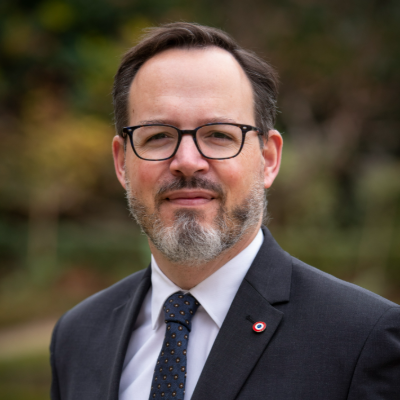
France, ADLE, Porte-parole du groupe
11:31:13
Thank you, Madam President.
Ladies and gentlemen,
Here we are at the topical debate entitled "The need to respect international law, peace and stability in the Middle East". Very well, we are well aligned with the very identity of our institution, respect for international law, everywhere, at all times.
We're used to saying that the Middle East is complicated, which is a rather easy, rather lazy way of putting it, to excuse the fact that international law is not applied there at all or not at all, that the principles and rights that benefit European citizens are not fully applicable because, you see, the Middle East is complicated. It's not the same.
Yet the principles are simple, and a human being is a human being, regardless of where they were born or where they live. A broken tibia hurts no less, whether you're in Europe or the wider Middle East, as the debate goes.
The Group of the Alliance of Liberals and Democrats for Europe therefore wishes to reaffirm some simple principles.
The first principle is that all peoples have the right to take full control of their own destiny. Individual destinies and collective destinies, the Iranian people as much as any others, the demonstrators for a free and democratic Iran have our full support. Our institution must support them as it supports the free peoples of Russia and Belarus, beyond the political regime that oppresses them and forces them to remain silent or go into exile.
The second principle is that no people has ever been liberated by bombing from foreign powers whose war aims, if they exist at all, have nothing to do with the happiness of the bombed people. Israel and the United States are doing nothing for the Iranian people. Worse still, they are making their situation worse, leaving them with the Cornelian choice between defending their freedom against the regime or defending their country with the regime. The former are hunted down as agents of the enemy powers in time of war, while the latter are driven into the arms of the regime by a simple patriotic reflex.
The third principle is that territorial expansion, whether it is called colonisation or a security zone, has never produced peace. As Europeans, we know that a country that has been deprived of its territory by war will not rest until it is ready to take revenge. Israeli troops must withdraw from Lebanon and the settlers must stop terrorising the Palestinians on the West Bank to force them to leave. This is essentially what President Macron said when he received the Lebanese Prime Minister last Tuesday.
Fourth and last principle, I will quote Article 6 of the 1789 Declaration of the Rights of Man: "The law is the same for all, whether it protects or punishes". The death penalty is an abjection, but to reserve it solely for Palestinians is unprecedented. We will have the opportunity to discuss this again at the next part of the session and to draw the consequences if this law comes into force.
That is all the Group of the Alliance of Liberals and Democrats for Europe can say at this stage.
Thank you very much.
Autriche, SOC, Présidente de l'Assemblée
11:34:27
Thank you.
Now, Ms Patricia STEPHENSON, on behalf of the Group of the Unified European Left.
Irlande, GUE, Porte-parole du groupe
11:34:31
Thank you very much.
The current conflict in the Middle East is a direct result of President Donald TRUMP and Prime Minister Benjamin NETANYAHU's illegal war. Let there be no doubt that President Donald TRUMP is a warmonger. Since his second term, President Donald TRUMP has bombed seven countries, including bombing a girls' school in Iran, killing 175 people, most of them children.
The bombing campaign has brought suffering to people across the Middle East, but we need to be clear that this was never about regime change for the people of Iran, who've lived, indeed, under authoritarian oppression for decades; this is simply about US and Israeli interests. Shockingly, the US has eased sanctions on Russia as a consequence of their illegal war, which is utterly unacceptable given the debate we just had.
While we must condemn Iran's retaliatory strikes, we can't forget that they are a direct consequence of the aggression in the first place. President Donald TRUMP claims this war was fought to bring peace to the Middle East, but you simply cannot bomb your way to peace. His behaviour is erratic, and it is a barrier to peace. A few weeks ago, President Donald TRUMP said, "a whole civilisation will die tonight, never to be brought back". Genocidal words and utterly chilling. And while they didn't come into effect, we can have no faith that he is a good-faith negotiator in this process.
Two weeks ago, Israel dropped 100 bombs on Lebanon in the space of 10 minutes. One hundred bombs in 10 minutes. The terror those people must have experienced is unimaginable. Since Israel's offence began, more than 2 400 people have been killed in Lebanon. Peacekeepers have been attacked. Four have been killed in the last month. Two from France, two from Indonesia. We offer our deepest condolences to those countries and their families. Lebanon and the United Nations Interim Force in Lebanon (UNIFIL) mean a great deal to the people of Ireland. The Irish Defence Forces proudly hold the longest unbroken record of peacekeeping, with troops deployed to UNIFIL since 1978.
While terror unfolds in Lebanon and Iran, Israel continues to breach the alleged so-called ceasefire. Over 700 people have been killed since October, and violent settler attacks in the West Bank have seriously escalated, including the murder of a 14-year-old boy only yesterday. We want to note that the report in the Middle East, currently under preparation, must condemn the oppression of the Palestinian people and strengthen their right to self-determination.
Despite commitments to ceasefires, we are seeing violations. The exclusion of Lebanon and previous ceasefire agreements was utterly egregious. We're seeing attempts at the gasification of Lebanon by the Israeli state. And President Donald TRUMP's behaviour and so-called approach to peace negotiations have made any genuine attempt at ceasefires impossible. President Donald TRUMP is a bully. His bully-boy tactics have wreaked havoc across the Middle East. He celebrates inflicting serious economic pain on Iran, but the reality is he is inflicting economic pain on all of us and all of our countries as a consequence of his actions.
The actions of the US and Israel in Iran mark a clear breach of international law. Yet leaders across Europe, including in Ireland, have utterly failed to call it out for what it is. If we cannot condemn breaches of international law, how can we hope to prevent them? International law is being ripped up before our very eyes. We cannot turn our back on the multilateral system. If we do, we will have a world where might is right, where the biggest bully wins, and the rest of us live in fear. We are on the precipice of a world under destruction. We commend the principled stance of Prime Minister Pedro SÁNCHEZ and call on other leaders to show the same courage in the face of direct attacks on the international legal system designed to keep us from another world war.
Now more than ever, we must lean into institutions of international law, into multilateralism, into dialogue and into peacebuilding.
Autriche, SOC, Présidente de l'Assemblée
11:37:58
Thank you very much. And I now call Mr Namık TAN on behalf of the Socialists, Democrats and Greens Group.
Madam President,
Esteemed colleagues,
The Middle East is facing an increasingly fragile and interconnected crisis. What we are witnessing today is not a series of isolated developments, but a broader pattern. Continued violations of international law risk further destabilising the region and undermining prospects for lasting peace. The erosion of legal norms combined with persistence of armed confrontations is deepening insecurity rather than resolving it, with serious consequences for civilians across the region.
Despite ceasefire arrangements, hostility continues. In Gaza, civilians are still being killed, while humanitarian needs remain overwhelming as widespread destruction continues to disrupt daily life and restrict access to basic services such as healthcare, water and education. In the occupied West Bank, developments on the ground point to a deepening of structural inequalities. These include the continued expansion of settlements and increasing settler activity.
Policies and practices are progressively drawing lines between communities. This evolving situation raises serious concerns regarding legal safeguards, accountability and the protection of fundamental rights. It also complicates efforts to preserve the conditions necessary for a negotiated and sustainable resolution, including the viability of a two-state framework supported by the international community.
In Lebanon, ongoing strikes and demolitions, even during a temporary ceasefire, have led to displacement and civilian casualties, clearly illustrating how fragile and uncertain these arrangements remain on the ground. Such developments risk further escalation if restraint is not exercised.
At the same time, the escalation involving Iran risks extending the conflict across the entire region. Ongoing military confrontations, blockades and threats to critical infrastructure continue. The Strait of Hormuz is experiencing rising tensions, reflecting growing uncertainty in a strategically vital corridor and raising concerns about broader implications for regional stability. These developments demonstrate how quickly instability can spread beyond borders and affect regional and global security, including energy markets and economic stability.
Dear colleagues, lasting peace requires restraint, accountability and a genuine commitment to diplomacy. All parties must respect ceasefires, protect civilians and uphold international law as the foundation for stability, security and co-existence.
Thank you.
Autriche, SOC, Présidente de l'Assemblée
11:41:27
Thank you.
The next speaker is Mr Ricardo CARVALHO on behalf of the Group of the European People's Party.

Portugal, PPE/DC, Porte-parole du groupe
11:41:32
Thank you, Madam President.
Dear Colleagues,
Today’s debate is, above all, a call for collective responsibility.
The Middle East remains a region where peace is fragile and where too many people continue to live under the weight of insecurity, violence and uncertainty.
In this context, we must reaffirm a fundamental principle: respect for international law is not optional, it is the foundation of a just and lasting peace.
The Group of the European People's Party (EPP) reiterates its clear and unequivocal condemnation of all forms of terrorism and war. Israel has the right to live in security and to defend its citizens. This is a principle that must be clearly upheld and consistently defended.
At the same time, we must also be equally clear: all actions must fully respect international humanitarian law, particularly with regard to the protection of civilians and the unimpeded access to humanitarian aid.
This balance is not a contradiction. It is what gives legitimacy to our common position.
Dear Colleagues,
If we are serious about contributing to stability in the region, we must strengthen multilateralism and reinforce the institutions that uphold dialogue and international norms. It is precisely in this spirit that we should underline the importance of keeping diplomatic channels open, including within the Council of Europe.
Israel’s participation in this framework should not be seen as an obstacle, but rather as an opportunity for dialogue, accountability and gradual convergence towards shared standards.
Isolation rarely produces constructive outcomes.
Engagement, principled, demanding engagement, does.
We must therefore focus on three key priorities:
Reaffirming our commitment to multilateralism, strengthening the role of the United Nations and European institutions, like Council of Europe; advancing a credible political solution, notably through a two-state solution that ensures security for Israel and dignity and self-determination for the Palestinian people; enhancing regional and international cooperation, promoting stability, trust and long-term development.
Dear Colleagues,
At a time of heightened tensions, closing doors is not a strategy.
Keeping dialogue open is not a sign of weakness, it is a condition for peace.
The path ahead is very complex.
But one thing is clear: peace in the Middle East will only be achieved through respect for international law, consistent engagement, and the political courage to choose dialogue over division.
Thank you very much.
Autriche, SOC, Présidente de l'Assemblée
11:44:15
And the round of the list of speakers on behalf of the political groups is concluded by Mr Paweł JABŁOŃSKI from European Conservatives, Patriots & Affiliates. Please.

Pologne, CEPA, Porte-parole du groupe
11:44:25
Madam President, dear colleagues,
Almost every session, we meet here in this Assembly and we debate about the Middle East. And unfortunately the situation seems to be worse than ever.
War crimes are committed on a daily basis and by almost all parties and all stakeholders. Tens of thousands of civilians have already lost their lives and many more are losing theirs every day. Mass bombings, terror attacks, the indiscriminate use of force by military or other organisations.
At the same time, all parties claim that they are fighting for a noble cause, that they are fighting against an enemy that is inherently evil. And I have some bad news, because all those who kill innocent people are evil. And there is no light side and dark side here.
It is true that human rights violations can happen anywhere. But there is a difference between a democratic state and a terrorist organisation. If crimes against humanity and terror attacks are committed, democratic states should take responsibility, should bring those responsible to justice.
To understand the difference, we must look back at what happened over the course of the past several years and see whether the crimes that have been committed were accounted for. Were they condemned? The terrorist attacks of 7 October 2023 of Hamas were never prosecuted, never condemned actually, neither by the organisation itself nor properly by many Arab countries, Palestine included.
This is an appalling example. This is injustice and this is proof that there is lack of commitment to peace. At the same time, though, crimes committed on a daily basis by Israel Defense Forces (IDF) soldiers in Gaza, now in Lebanon, there are crimes that these soldiers have confessed to. They were also never condemned. Many were never prosecuted, many were never accounted for.
I will show you one particular case. On 1 April 2024, IDF soldiers murdered a group of volunteers from World Central Kitchen, including Polish national Mr Damian SOBÓL. These people were providing food to civilians in Gaza. Two years have passed since then. Were these murderers from the IDF prosecuted? Were they even accused? No, they were transferred to a different military unit.
This is not justice. This is not the way to a stable peace. Because a country that fails to deliver justice loses international credibility and begins to be perceived as no different than organisations such as Hamas. And I call upon all stakeholders to stop violence, to refrain from using violence, and most of all, to bring all those responsible for crimes to justice, be it Hamas, be it other terrorist organisations, be it IDF soldiers, be it other people that are responsible.
Because justice, and respect for international law, is the only way to a secure and stable peace.
Thank you very much.
Autriche, SOC, Présidente de l'Assemblée
11:47:27
Thank you very much.
We now come to the ordinary speakers list and we start with Mr Bernard SABELLA from Palestine.
Dear Madam President,
Esteemed colleagues,
The Middle East region is not facing a series of isolated crises, but a web of interconnected wars and conflicts, as Ms Dora BAKOYANNIS's outlined report clearly demonstrates on the situation of the Middle East. At the centre of this lies the Palestinian-Israeli conflict, which continues to embolden extremism, fuel proxy wars and destabilise the region as a whole.
It is within this context that the recent Israeli law introducing the death penalty must be assessed. This law is not only a flagrant violation of international law and the Council of Europe principles, it represents a deliberate departure from the norms upon which any credible peace process must rest. Far from advancing a two-state solution, it directly undermines it. Such measures deepen fear, entrench division and signal that vengeance, and rather than justice, is becoming the prevailing principle.
Let me be equally clear on the Palestinian side, for the benefit of some members of this esteemed Assembly: the president of the Palestinian Authority has imposed a moratorium on the execution of death sentences in the Palestinian territories, and no executions have been carried out under this policy. The exception remains Hamas in Gaza, where executions have taken place without the presidential authorisation required by law.
Europe cannot afford to remain a passive onlooker. It must no longer allow hegemonic-leaning powers to dictate the Middle East agenda and other agendas, while Europe is reduced to the role of donor and damage controller. Financing and managing conflict is not a strategy. It risks becoming a form of complicity in maintaining the status quo. What is needed is a coherent European political strategy for the Middle East, one that defends international law, advances a just and final settlement of the Palestinian-Israeli conflict and refuses to normalise violations of human rights and humanitarian law.
For our part, all actors in the region must move beyond narratives of victimhood and instead work towards ending conflicts, respecting the sovereignty and integrity of all states and upholding the values that protect people who have suffered greatly in ongoing wars.
We, as Palestinians, remain steadfast that the only sustainable path forward is a negotiated two-state solution that ensures an independent Palestinian state alongside Israel, based on international law and the Council of Europe's principles.
We came to affirm that [mic cut] is a right and a legal obligation.
Thank you.
Autriche, SOC, Présidente de l'Assemblée
11:51:32
Thank you very much. Next on my list is Mr Max LUCKS from Germany.
Mr Max LUCKS, please.
Thank you, Madam President.
Dear colleagues,
It is an honour for me to speak after our colleague Mr Bernard SABELLA from the Palestinian Legislative Council, because I believe the voice we just heard is a voice of someone who devoted and devotes his entire life to building peace and a better future for everyone in the Middle East. And this while so many in the Middle East want all of us to believe that there is not a good path to a future for the people.
Hamas, Hezbollah and far-right ministers in Israel such as Mr Ben GUER want us to believe that there is no alternative to war. They want us to believe that there is no path to co-existence. And that is why, dear colleagues, I believe we have to keep the hope, the hope of many people from the Middle East, whether from the Palestinian Legislative Council or the democratic voices in Israel, from the left, from the centre, or from Palestinian legislators within the Knesset. Or the hope of those people who believe that the statehood of Lebanon can work, and that a working Lebanon can defend against Hezbollah by itself.
So, dear colleagues, don't give up the idea of a two-state solution. And let's not only talk about condemnation and analysis. This is very important, but let's also talk about how we can create a real impact for the people in the Middle East.
We are 46 member states with so many different views. We know how to communicate to each other, how to work with each other, even under the worst circumstances. We have the Knesset and the Palestinian Legislative Council both as observer parliaments in our organisation.
I believe that we can heighten our ambition and that we really can contribute to a two-state solution and to more dialogue and to a pathway to a good future for every single person in the Middle East, whether in the Gaza Strip, in the State of Israel and its borders under international law, in the West Bank, in Lebanon, and also in Iran.
Dear colleagues,
And that is why I also want to remind you that the bloody machinery of this regime in Iran is continuing and continuing. Don't forget the minimum 30 000 young people killed on the streets in January this year. Don't forget the women of Iran. Don't forget the minorities in Iran. Don't forget the overall majority of Iranians who want to live in peace, who want to live in dignity, who want to live in freedom, and who want us to work for them and to stand in solidarity with them.
Thank you.
Autriche, SOC, Présidente de l'Assemblée
11:54:48
Thank you, Max.
And next on the list of speakers is Mr Nikolaus Samuel GUGGER from Switzerland.
Madam President,
Dear colleagues,
The Middle East is not near a crisis. It is in the fire. Cities burn. Families break. Children learn the geography of bomb shelters instead of the geography of their own country. And what do we do? We discuss!
Let me say it plainly: this region is trapped in a spiral that feeds itself. Every rocket calls the next. Every strike breeds new revenge. Every night, another funeral, on both sides of every border. And always – always – it is the civilians who pay. A mother in Gaza. A father in Beirut. A child in Tel Aviv. A grandmother in the south of Lebanon. People who decided nothing. People who wanted no war. People who only wanted to live.
When whole cities are shelled, when hospitals fall, when hundreds of thousands flee, that too is a breach of international humanitarian law.
Suffering is not a competition. Innocence has no side. And yet, we are watching exactly this: a logic of revenge that justifies itself by ignoring the pain of the other. That is the moment morality collapses, and diplomacy with it.
Look at the region today. A ceasefire is announced at breakfast and questioned by dinner. Agreements last only as long as they are useful. Every night, we hold our breath for the next strike. That is not stability. That is the waiting room of catastrophe.
Colleagues – this Council was born in 1949, out of ashes. Out of the knowledge of what unchecked hatred does to a continent. It was built on one sentence, and one sentence only: human rights apply, always. Not when convenient. Not when strategic. Not when our own allies are comfortable with it. Always.
That promise is on trial right now. In this Chamber. In this moment. And history will read the minutes of this debate.
So let me leave you with the only sentence that matters today: peace is not the silence of weapons. Peace is the space where justice is still possible. And peace without justice is not peace. It is a pause. A short, fragile pause, before the next explosion. We owe the people in that region more than our silence. We owe them our courage.
Thank you.
Autriche, SOC, Présidente de l'Assemblée
11:58:01
Thank you very much.
Next is Ms Lesia VASYLENKO from Ukraine.
She doesn't seem to be here so we proceed to Mr Mehmet AKALIN from Türkiye.
Madam President, dear colleagues,
First of all, I wish to underline the urgent need for peace, stability, and respect for international law across our wider region. We must acknowledge the scale of devastation caused by the United States and Israeli military attacks across Iran, that effects extend far beyond the region.
We must also speak honestly about the increasingly aggressive nature of the military escalation by Israel towards Palestine and Lebanon. Repeated airstrikes, the targeting of densely populated civilian areas, and the disproportionate use of force, risk normalising a cycle of violence that undermines both regional security and international norms. Such actions deepen instability, fuel resentment, and make the prospects for peace increasingly distant.
The humanitarian suffering in Palestine, the Gaza Strip, and Lebanon continues to deepen. The destruction of civilian sites – homes, hospitals, and essential infrastructure – raises serious concerns under international humanitarian law. We can not overlook the tragic bombing of a girls’ school in Minab, southern Iran, where more than 150 children and teachers were killed – an event that demands accountability.
The continued expansion of offensive tactics without meaningful restraint or accountability is unacceptable. No state, regardless of circumstances, should be exempt from international scrutiny when civilian lives are placed at risk. We must also stand firmly and genuinely against all forms of terrorism and terrorist activity in the region.
Lasting stability requires immediate and practical steps.
First, an urgent humanitarian lasting ceasefire across the region is essential to prevent further loss of civilian life and create space for diplomacy.
Second, humanitarian aid corridors must remain open and protected to ensure access to food, medicine, and emergency support.
Third, all parties must respect international law and uphold the protection of civilians, without exception or double standards.
Finally, regional dialogue, supported by international institutions, remains the only path toward reducing tensions and preventing wider instability.
We must remember that peace is built through justice, dialogue, sincerity, and a shared commitment to human dignity.
Thank you.
Autriche, SOC, Présidente de l'Assemblée
12:01:22
Thank you.
And next one is Ms Edite ESTRELA from Portugal. Ms Edite ESTRELA, please.
Edite it's your turn now.
Thank you, dear President. Sorry.
There are moments in history when a single image says everything. An image that shocks us, that forces us to confront an uncomfortable truth. The image of a minister celebrating with champagne the discriminatory and irreversible approval of the death penalty against Palestinians. What does that say about the path we are on?
This war is not just a conflict; it is a collapse of humanity and of international law. Yes, Israel has the right to defend itself, but the devastation of Gaza is not defence; it is the destruction of an entire people, and the world cannot stay silent in the face of such suffering.
Now, with the United States and Israel escalating attacks on Iran, the crisis deepens dangerously. Iran’s repressive regime does not justify violating the sovereignty of a nation or pushing the region closer to a wider war. Peace is not built on domination. It is not built on policies that divide human lives into those who are protected and those who are not.
That image is not just disturbing. It is a warning. A warning that the road to peace in the Middle East is becoming more distant, more fragile, more uncertain. And beyond that image, beyond that moment, we are witnessing something even larger. A conflict that many experts warn is leading to the most serious energy crises in history. A conflict whose consequences are not contained, they spread, they destabilize, they reach every corner of the globe. Families paying more to heat their homes. Economies under pressure. Uncertainty growing everywhere.
When international law is set aside, when global institutions are ignored, when decisions of war and peace are made without legitimacy, then instability becomes inevitable. We are all affected. We are all, in some way, victims of these choices.
So, the question is: "What are we willing to accept?" If we accept a world where force replaces law and where power decides whose lives matter, then we are not just witnessing a crisis, we are allowing it. And history will remember that.
Thank you very much.
Autriche, SOC, Présidente de l'Assemblée
12:04:48
Thank you very much.
And now Ms Yelyzaveta YASKO from Ukraine has the floor.
Today the issue of peace and security in the Middle East goes beyond the region. And I'm sure that each of us in Europe feels the consequences of all of that.
The global economy, the international legal order and even short-term disruption of key transport chains or in particular the Strait of Hormuz are already having tangible consequences on our economy and especially for European states. Regarding the humanitarian dimension, I also don't need to mention how bad it is.
For Ukraine, this is not a theoretical problem. We know how security and economy is connected not only inside in the country, but globally. But we know also how these can be used by different aggressors because we know that the question of raising the energy price is something that can be used as a tool to manipulate different governments.
And of course the diversion of international attention on all of these questions from what happens, for instance, now with the Russian aggression against Ukraine, doesn't really bring any more stability and long-term solutions to the region.
We are making the practical contributions to finding more solutions in the Middle East and we are sending a lot of our specialists who know how to operate with drones and with different weapons. But we are also aware that the situation in the Middle East brings a lot of very practical, very big security challenges, such as, for instance, the lack of air defence.
This is not a surprise. It is not a secret that unfortunately now in the world there are not so many of the weapons that can be used for air defence because so much of it was spent in recent weeks because of Iran. And this is a huge problem because we don't know how we are going to enter this autumn, this winter or even this summer. We need in Ukraine much more air defence.
While of course we believe that security should come with strong weapons, we also think that it's not going to make a very big difference if there is no political will and international contributors to global peace. And we really hope the situation in Iran and this terrible situation in the Middle East has some solutions soon, because this greatly affects all our security and the global order.
Thank you.
Autriche, SOC, Présidente de l'Assemblée
12:07:56
Thank you very much.
And now Mr Jon ENGEN-HELGHEIM from Norway.
Thank you, Madam President.
In a conflict as complex, emotional and long-running as the one in the Middle East, the credibility of the Parliamentary Assembly of the Council of Europe depends on one fundamental principle. Balance. Without balance, our debates risk losing both moral authority and factual clarity.
Let me be clear from the outset. Criticism of Israel is legitimate. No state should be beyond critical review. And I don't support everything Israel does. But honesty is required as well. Israel is subjected to to a level of criticism in this Assembly that is not applied equally to other actors involved in the same conflict. This imbalance weakens our role as a guardian of universal human rights standards.
We saw this clearly in yesterday's debate on the death penalty. Israel has adopted legislation that I personally really don't support. At the same time, in Palestinian territories, particularly in Gaza, the death penalty is applied against Palestinians accused of collaboration with Israel. In several documented cases, executions have also occurred without due process.
This selective focus on Israel does not strengthen human rights protection, it undermines it. A balanced debate also requires us to acknowledge an uncomfortable reality. Some of Israel's opponents do not even attempt to comply with the most basic human rights obligations. When violations by one side are systematically condemned, while similar or worse abuses by others are ignored or excused, we transform human rights into a political instrument rather than a universal standard.
If this Council is to maintain its integrity and credibility, we must apply criticism consistently, proportionally and without political selectivity. Balance is not about taking sides in a conflict. It's about ensuring that all principles are applied equally to all. Anything less risks damaging both this Assembly and the values it exists to defend.
Thank you.
Autriche, SOC, Présidente de l'Assemblée
12:10:49
Thank you very much.
Ms Belén HOYO from Spain is next.
Thank you very much, Madam President.
Ladies and gentlemen,
I really believe that all of us here today – and in particular those of us who have a responsibility of representation in this Parliamentary Assembly of the Council of Europe – we must make an effort to maintain a balanced position based on common sense. And, above all, we should avoid using such a complex and painful conflict as this to reflect national political debates.
The reality is clear. We're facing an escalation of violence in the Middle East which must be stopped as soon as possible. Every day that passes results in more innocent victims, more suffering, and more instability. There is no possible justification for the indiscriminate suffering of civilians. And respect for international humanitarian law must be an uncrossable red line for everyone.
Now, peace is not built by ignoring the causes and one of the causes is, without doubt, the destabilising role of the Iranian regime. A regime which, for decades, has been oppressing its own people and protecting instability throughout the region; directly and through organisations like Hamas and Hezbollah. In Iran, there is a system which systematically represses freedom. It persecutes and intimidates and punishes anyone who dissents. Journalists, students, activists and normal citizens are detained and judged without guarantees for the simple fact that they think differently.
And within this reality, Iranian women represent the most obvious face of this oppression. Their basic rights are limited: the way they dress, their freedom of movement, their ability to decide on their own lives. And when they raise their voices, the response is repression.
Colleagues,
We must move towards peace and we must avoid a regional escalation. Bombing in Lebanon means an obvious risk of expanding the conflict, and this is only worsening a situation which is already extremely fragile. We cannot allow violence to be extended without control.
There is something that needs to remain clear: peace in the Middle East involves resolutely combatting terrorism. There can be no stability as long as armed organisations act with impunity, sowing violence and using the civilian population as a shield. This battle must occur within the framework of international law. Fairness and legality are not incompatible.
Colleagues,
Europe stands for more than interests. It stands for values. And we must act on these values and not remain silent.
We must call for restraint, de-escalation and a return to negotiations. There are no simple solutions but there are clear principles: the defence of human rights, the rule of law and peace based on guarantees. Because it is only on the basis of those principles that we can aspire to a real, fair and lasting peace for the entire region.
Thank you.
Autriche, SOC, Présidente de l'Assemblée
12:14:05
Thank you very much.
And Mr Oleksandr MEREZHKO is next, from Ukraine.
Thank you.
Dear colleagues,
When we are talking about the war in the Middle East and how to bring peace to the region, we should keep several things in mind.
First, there is an axis of evil which is not interested in true peace in the Middle East and seeks only to destroy the rules-based order. I mean of course, two totalitarian terrorist regimes, Russia and Iran, which have officially concluded a comprehensive strategic partnership.
Both regimes support each other in committing the crime of aggression and have many striking similarities.
Both regimes use different terrorist groups as their proxies.
Both are brutal totalitarian regimes, using force against their population and against neighbours.
Both use religion as a weapon, hate their neighbours and deny the right of other states to exist.
Both disseminate propaganda and disinformation.
Iran provides Russia with drones which help Russia murder civilians in Ukraine, while Russia provides Iran with intelligence, information and technologies used for military purposes.
Both are accomplices in numerous crimes against humanity.
Dear colleagues,
If we want to establish lasting peace in the Middle East and Europe, we need to confront both regimes and to recognise that they are two sides of the same evil.
Thank you.
Autriche, SOC, Présidente de l'Assemblée
12:15:55
Thank you.
And I call now Ms Zeynep YILDIZ from Türkiye.
Thank you, Madam Chair.
Dear colleagues,
We are gathered here today once again to address the harrowing developments in the Middle East and the fundamental necessity of respecting international law.
For decades, we have denounced Israel’s inhumane policies. Let us be absolutely clear: the international community’s failure to check Israel's long-standing impunity has paved the way for genocide. As it has failed to employ the necessary mechanisms to prevent the genocide in Gaza, Israeli aggression has now escalated into a conflict that threatens the stability of the entire world.
We have warned that every violation of law by Israel goes unpunished would create a massive risk for global stability. It is with profound regret that I must see state our warnings have been borne out far sooner than predicted. Following Palestine, Iran and Lebanon are now being openly targeted. We are no longer discussing a localised conflict; we are witnessing an unrestrained reaching beyond its borders to affect the global stage.
For over two years, we have chronicled the massacre of tens of thousands of Palestinians – their lost rights to life, to food, and to shelter. Yet, international organisations have failed to take a single substantive step.
Perhaps the current world order – which seems to care more about the economy than human lives and the rule of law – will finally act when faced with these facts: i would like to offer a few reminders:
The damage to Gaza's infrastructure alone has reached 35.2 billion dollars, 26.3 billion dollars is required immediately, merely to restore the most basic services. Regional economic losses already exceed 120 billion dollars. Some projections suggest the total cost of the conflict involving Iran could reach 1 trillion dollars. And if this crisis deepens, global growth is expected to decline to 1.4%.
The world is staring down the barrel of a massive energy crisis, one that will, without doubt, trigger a global inflation. Israel’s reckless attacks do more than claim the lives of thousands of Palestinians; they threaten the physical and economic security of people everywhere.
Every act of aggression left to go unchecked leaves a lasting scar on the collective memory of humanity and disrupts the lives of all.
I conclude with one simple, yet haunting question: what else does the world need to witness before it finally moves to stop Israel?
Thank you.
Autriche, SOC, Présidente de l'Assemblée
12:19:04
Thank you.
Next is Mr Armen GEVORGYAN from Armenia.
Madam President,
In January, this hemicycle heard some calls for strong measures against Iran. This logic was implemented regardless of our common political will. The conflict is not over, but all of us are already dealing with its contradictory results. The use of force has not resolved the problem. It has made it broader, deeper and more dangerous, and Iran has emerged as a "steel porcupine", a state that makes the cost of confrontation prohibitively high.
Instability in the Middle East is increasingly affecting Europe, not only in terms of energy. It is reshaping priorities, limiting the capacity to respond to multiple crises at once and testing democratic values and unity. The military operation against Iran aimed to eliminate a threat, but instead it has led to growing global interest in nuclear deterrence. More countries are coming to a simple conclusion: those who have such capabilities are far less likely to be targeted.
Intentions were to isolate Iran, but instead we see rising tensions surrounding Israel. The war has become a challenge for the entire region and has shown how fragile existing models of security and prosperity in Arab states truly are.
The new reality in the Middle East creates real risks for lasting peace and economic development across the entire Caucasus region. Regional chaos is used by Azerbaijan to intensify the destruction of Armenian Christian heritage in Nagorno-Karabakh, a process that should concern all of us who care about peace, justice and identity. And finally, the unresolved conflict still has huge potential for further collapsing the region on a larger scale and destroying the global stability.
Dear colleagues,
It should be clear, especially in Europe, which faces serious security challenges, that force can alter realities. But it does not always make them just or acceptable to all. That is why our task today is not simply to wish for peace, but to stop the dangerous trend of war becoming a routine instrument of politics in the 21st century. If power replaces rules, no one will be safe.
The Western world cannot approach all nations in the same way or rely on a single model of dialogue. Distinct civilisations require nuance and understanding. Ignoring this reality leads us to confrontation and failed policies. It raises a fundamental question: are we creating more risks than we are resolving? Because today, this is no longer only about Iran. It is about the kind of international security system we are shaping. It is time for wisdom and responsibility to return to international relations.
Thank you.
Autriche, SOC, Présidente de l'Assemblée
12:22:03
Thank you.
And I now call on Mr Emmanuel FERNANDES from France.
Thank you, Madam President.
International law must prevail in all circumstances and on every surface of the planet. The subject before us today is the wider Middle East.
In this part of the world, widespread chaos has spread from Lebanon to Iran to the Palestinian territories, threatening the international balance. We need to be clear about who the troublemakers are, the chief aggressors who, steeped in their imperialist and colonialist doctrine, are laying waste to the Middle East.
Yes, our Assembly must denounce and condemn the exactions of Israel, led by the extreme right-wing supremacist government and war criminal Benjamin NETANYAHU, but also those of the United States led by the fascist Donald TRUMP. In Lebanon, Israel has been waging a war of invasion since the beginning of March, with massive air strikes and ground operations in the south of the country.
More than 2 400 people have already been killed in this war, including several journalists, dozens of villages have been destroyed or razed to the ground in the south, and more than a million people have been displaced. This war, which is being presented as being directed against Hezbollah, is in fact affecting an entire people, with civilians being the first victims. Two French soldiers from the United Nations Interim Force in Lebanon (UNIFIL) have also lost their lives, and I would like to pay tribute to them here. Enough is enough!
Israel, which is continuing its genocide in Gaza with more than 70 000 direct victims, its massacres in the West Bank and its apartheid against the Palestinians, in particular with this despicable new law on the death penalty dedicated to them. Israel must be prevented from doing any harm! We must support Palestine and Lebanon! Our member states must act urgently to sanction Israel, starting with the end of observer status for the Knesset within our own Assembly!
The situation in Iran is just as worrying. The illegal war unleashed by the United States is continuing, and the announced resumption of bombings raises fears of a major escalation. We express our solidarity with the Iranian people, who will not achieve freedom or democracy under a deluge of bombs. Let me be clear: neither the mullahs nor the Shah! No outside interference and no theocratic authoritarian regime!
The Iranian people, who have suffered the tyranny of the ayatollahs for decades, will not be saved by being subjected to a deluge of fire that would take them back to the "Stone Age", according to President Donald TRUMP's unbearable threats. Europe is covering itself in shame and dishonour by kowtowing to the American President: we must be a pole of resistance to imperialism and colonialism!
Our institution must stop behaving like a branch of the North Atlantic Treaty Organisation (NATO). International order is based on law, not force. Defending without ambiguity, without double standards, the system of international law and the international jurisdictions responsible for ensuring compliance with it, is the only compass that must constantly guide everything we do in this Assembly: it is the condition for peace and stability, in the Middle East and throughout the world.
Thank you very much.
Autriche, SOC, Présidente de l'Assemblée
12:25:30
Thank you.
Next is Mr Christophe BRICO from Monaco.
Thank you, Madam President.
As we said just an hour ago, in this institution, we defend a multilateral order based on the rule of law.
And it turns out that since 28 February this year, Iran, and more generally the area of the Middle East that surrounds it, has been in a state of chaos, the full consequences of which had probably not been estimated at the time the operations were launched.
I have no sympathy for the Iranian monarchy. Just a month ago, the Iranians were on the streets, terribly repressed. Up to 30 000 people are said to have died.
And a month later, the Americans have decided to launch an operation, so it seems that democracy is definitely not their objective.
They probably didn't anticipate the blocking of the Strait of Hormuz, the consequences for all our countries, all our citizens, and the price of gas and other commodities that go with it.
So here I will continue to defend a multilateral order based on the rule of law.
This type of – preferably avoidable – operation should be sanctioned by an international decision, by a UN decision, for example. This has already happened in our history.
But in any case, at the level of our continent, and perhaps we should concentrate a lot on our continent, once again, I believe we must continue to defend what we are doing here: debate, law, democracy, the rule of law and human rights, which are under the chaos of people who prefer to use power over the law.
Thank you very much.
Autriche, SOC, Présidente de l'Assemblée
12:27:36
Thank you.
And now Ms Meryem GÖKA from Türkiye.
Dear President and colleagues,
We are living through a transition.
The era of unipolar dominance is over, but a fair, inclusive, and institutionalised multipolar system has not yet emerged.
In such an environment sovereignty and territorial integrity cannot be treated as diplomatic vocabulary, used when convenient, ignored when uncomfortable. If these principles are to mean anything, they must apply to all.
What troubles us today is not only violation but normalisation … the gradual acceptance of breaches of international law as precedent.
One of the most striking examples of this is Israel’s approach to the death penalty in the West Bank which constitutes a violation of international human rights law and underscores the broader illegality of its occupation.
Nowhere are double standards more visible than in Gaza. This sends a devastating message: even genocide may go unpunished when perpetrators are politically protected.
Is international law not the greatest safeguard of the weak: one that – once broken for one – is weakened for all ?
For years, externally engineered political interventions – justified as "democracy promotion" – have produced nothing but instability. From Iran to Afghanistan, from Iraq to Syria, from Palestine to Lebanon – the pattern is unmistakable.
Didn't we all know that the international rules-based order was actually asymmetrical? Yet, the gap between rhetoric and reality was known, tolerated, and ultimately normalised.
Debates across international platforms from the Davos World Economic Forum to the Munich Security Conference show that the criticisms Türkiye has raised for years are now being echoed in the Western world. Those who constantly lecture others on values have long undermined the very values-based international system they claim to defend. Hypocrisy, plain and simple.
When violations are justified or ignored elsewhere it should not come as a surprise that the same disregard for law reaches their own borders.
We knew that selective exemptions – and identity-based applications of international law would erode its credibility globally.
We are deeply concerned. And Türkiye’s position is clear: not dismantlement but reform of the international rules-based system to restore justice and legitimacy. As President Tayyip ERDOĞAN has emphasised “The world is bigger than five." It is a call to reform a system where a few decide for all. We will continue our principled struggle for a human-centred order where the "rightful are strong, not the strong are right."
Thank you.
Autriche, SOC, Présidente de l'Assemblée
12:30:35
Thank you.
And Mr Armağan CANDAN from Cyprus is the next one.
Dear colleagues,
The Middle East is a melting pot for cultures, civilisations, alongside deep historical ties and also complex challenges.
The destruction of Gaza by Israel underscores an urgent need to respect international law and a renewed commitment to peace and stability. The attack of the US and Israel to Iran has shown us that conflicts and wars are not regional anymore. Their effects are much wider and the whole world is simply vulnerable, with the immediate effects being felt dramatically worldwide.
In this context, the war in the Middle East requires immediate and active involvement of Europe. It is worthwhile to underline that all of the European Union leaders are meeting today in my country, Cyprus, to address the conflict in Iran and the Middle East, which poses serious challenges to Europe.
In the broader region – I am talking about the Eastern Mediterranean – bears instant and broader challenges among which my country Cyprus stands out.
For decades, the unresolved dispute in Cyprus has symbolised the region's fragility. Developments in the Middle East clearly demonstrate that it is no longer possible to address the Cyprus issue, for example, in isolation from the wider region. Let me recall the drone attack to Cyprus that just happened only last month in March, which struck the UK sovereign base in Cyprus.
We Europeans are not exempt from the conflicts in the Middle East. Issues such as energy sources, maritime jurisdiction, security balances, migration and geopolitical competition have further emphasised the importance of rules-based international order. In this regard, Cyprus should rather be a centre of co-operation, dialogue and stability in the European Union, alongside good relations between Türkiye and Greece. We cannot afford yet another regional tension in the Eastern Mediterranean.
Let this be a call for action for leaders and stakeholders across the Middle East, Eastern Mediterranean, Europe and beyond.
Thank you.
Autriche, SOC, Présidente de l'Assemblée
12:33:08
Thank you.
Next is Ms Seda GÖREN from Türkiye.
Thank you, Madam Chairman,
Ladies and gentlemen,
Respect for international law cannot be selective or circumstantial. It must not depend on the players involved or the political balance of power at the time. A credible international order cannot be based on variable geometry interpretations.
Today, in the wider Middle East, we are witnessing a worrying deterioration in peace and stability. Recent actions by certain state actors show a dangerous tendency to circumvent the fundamental rules of international law. When such behaviour is tolerated, the whole system is weakened.
Added to this is a serious drift in international discourse, where threats and the logic of confrontation are increasingly taking precedence over dialogue and the rule of law. Some recent statements, explicitly referring to the massive use of force, are not insignificant. They reflect an extremely worrying trivialisation of violence.
Even without immediate implementation, such threats directly weaken the foundations of international order. A system based on rules can never depend on impulsive declarations or individual decisions. When global security becomes hostage to the will of one actor or another, it ceases to be a stable framework and becomes a factor of permanent uncertainty.
In this context, it is essential to reiterate the obvious: bombing cities and targeting civilians is terrorism, whoever the perpetrator. If we start making distinctions based on the identity of the victims or the perpetrators, then we forfeit any credibility when it comes to human rights.
It is precisely for this reason that the silence or hesitation of our Assembly in the face of certain situations is deeply worrying. This restraint undermines our credibility and gives the impression that our principles can be applied selectively.
Ultimately, such inconsistency paves the way for a more unstable and dangerous world for future generations. If international law ceases to be a common reference point, it will be replaced by the law of the strongest.
Our responsibility is therefore clear: to defend international law unambiguously and to act consistently. Only then can we make a real contribution to peace and stability in the region and beyond.
Thank you very much.
Autriche, SOC, Présidente de l'Assemblée
12:35:59
Thank you.
And Ms Pelin YILIK from Türkiye is next.
Thank you, Madam President.
Dear colleagues,
I regret that our debate on the Middle East today will not be the last debate on this matter.
Recently we have heard some good news from the region.
Firstly, we welcome the ceasefire in Gaza, but we know that this is quite fragile. Israel perpetrates its terror in the West Bank as settlements continue and attacks carried out by settlers and Israeli soldiers persist. Moreover, Palestinians still suffer under dire living conditions due to the Israeli aggression. And we are quite far away from the two-state solution that would ultimately resolve this conflict.
We must always keep in mind that as long as the Israeli-Palestinian conflict remains unresolved, we will not achieve peace and stability in the Middle East. The path to global peace lies in addressing the injustices in the Middle East and recognising the right to security for all. The cycle of violence prevailing in the Middle East is not merely a regional issue; it is a severe test of global conscience.
Secondly, the war launched by the United States and Israel against Iran further exacerbated the situation in the region. This war on Iran has the risk of spilling over into a broader regional crisis. The temporary ceasefire on this front promises a glimpse of hope, but we are worried that this ceasefire is fragile too.
Full implementation of this ceasefire on the ground is an absolute necessity for ensuring stability and the cessation of hostilities. Israeli attacks on Lebanon and also against the United Nations Interim Force in Lebanon are also deeply alarming. Intense attacks by Israeli forces on Lebanon and Israel's policy of occupation and depopulation also risk obstructing the ceasefire with Iran.
This conflict has already taken a heavy toll on the people of the region and the global economy as it has repercussions on the regional and global markets, including energy markets. Our organisation and international community must employ all the tools at their disposal to put an end to the atrocities we face in the Middle East, particularly in Gaza and Lebanon. Otherwise, sadly, we have a quite pessimistic future ahead.
Thank you.
Autriche, SOC, Présidente de l'Assemblée
12:38:39
Thank you. Next one is Mr Mustafa CANBEY.
Thank you also for submitting your declaration form so you don't have to do an oral declaration now.
The floor is yours.
Okay, thank you.
I have no conflict of interest. I will submit my declaration of interest to the Parliamentary Assembly of the Council of Europe as soon as possible. Okay.
Madam President,
Dear colleagues,
The Middle East has been deprived of peace for four decades, scarred by a cycle of war, power struggle and interventions that have claimed millions of lives.
Today, this tragedy is most acute in Gaza. Years of Israeli occupation, settlement expansion and indiscriminate attacks have created a humanitarian catastrophe. Palestinians face starvation, displacement and annihilation under relentless bombardment and suffocation under wreckage.
Empowered by the international community's inaction, Israel has now introduced a Death Penalty Bill specifically for Palestinians. This is yet another alarming sign of the consequences of impunity. Combined with this crisis, recent escalations involving the US, Israel and Iran have caused deep regional and global wounds. Beyond physical destruction, this conflict has disrupted trade, hindered economies and fuelled inflation.
The human consequences are dire. Two thousand people have died, and millions more are displaced. Meanwhile, the crisis in the Strait of Hormuz ripples across the globe. Freedom of navigation is a global necessity. The Strait must remain open in accordance with international law. While we welcome the recent ceasefire and applaud mediation efforts, we must remain vigilant. Recent military actions, particularly those by Israel against Lebanon, risk jeopardising these fragile agreements. The international community must ensure that these efforts are not sabotaged.
We must call for a permanent ceasefire and a conciliatory approach. The only way to prevent renewed escalation is to reach a lasting agreement on the Strait of Hormuz and broader regional disputes. We must unite to secure the long-term peace our world desperately needs and condemn violations of international law that endanger civilians.
Thank you.
Autriche, SOC, Présidente de l'Assemblée
12:41:50
Thank you. And the very last person on my speaking list is Mr Ali ALGHZAWI from Jordan.
Thank you, President.
Honourable members,
I come before you from Jordan, a country that has long believed that stability cannot be built through force alone, and that justice, diplomacy and mutual respect remain the true pillars of lasting peace.
Today, the escalation in the Middle East threatens to widen conflict across the region. Jordan believes in the co-existence of all nations in the Middle East as a foundation of peace, stability and prosperity.
Jordan continues to support the two-state solution based on international law. As His Majesty King ABDULLAH II has repeatedly stated before the international community, there can be no security without justice, and no stability without a credible path to peace.
Honourable members,
When major powers disregard international law, bypass multilateral frameworks or undermine institutions such as the United Nations and the United Nations Security Council, the entire world pays a price. At this moment of global uncertainty, Europe carries a historic responsibility. The world needs a Europe that leads with wisdom, independence and principle. A Europe that supports peace efforts, strengthens multilateral institutions, invests in development and acts as a stabilising pillar between competing powers.
His Majesty King ABDULLAH II has often reminded the world, our region's future depends on choosing co-operation over conflict and hope over despair. Let us restore faith in diplomacy. Let Europe stand as a force for balance and reason. Let us choose peace before another generation is consumed by war.
Thank you, Madam President.
Autriche, SOC, Présidente de l'Assemblée
12:44:22
Thank you very much. That concludes our list of speakers.
Mr Piero FASSINO would like to respond. Please, Piero, the floor is yours.
Thank you President.
But I believe – I thank all those who have spoken – that they have all spoken with one voice.
War does not create any solution; on the contrary, it aggravates a condition of chaos and international anarchy, and law is the only compass to give peace and stability to the continent and in the various theatres of conflict today.
Rights are inalienable, non-negotiable. That is why we condemned Hamas and condemn the Iranian regime and, for the same reason, we denounce the violations of law that come from the actions of Mr Donald TRUMP and Mr Benjamin NETANYAHU.
And we all know that what is happening actually calls into question the multilateral system of world governance, in favour of a balanc based on force, but we know that an international balance and order based on force is a source of injustice and new conflicts.
However, at this point I believe, at the end of this debate, that our problem is not only the denunciation, which we have all done, it is also to understand how we can help the forces that are fighting to stop wars and to make negotiations and peace prevail.
Meanwhile the opposition in Israel: the Israeli death penalty law has rightly been denounced here. There is broad opposition in Israel against this law. We need to support it so that this battle is won and that law is revoked. We need to support those in Palestine and the Gaza Strip who continue to believe in the possibility of peace.
There is an episode that has perhaps been greatly underestimated: a few weeks ago in Deir al-Balah, which is a municipality in the Gaza Strip, local elections were held, for the first time in 20 years, when they had always been prevented by Hamas.
We must support the United Nations Interim Force in Lebanon (UNIFIL) and its role in peace and stabilisation, and I also express here our solidarity with France, with Indonesia, which has seen its sons fall in this task of peace.
And we must support those in Iran who are fighting every day against that regime to demand freedom. And here we have a problem. It is not enough for us to denounce it. It is right to say, as has been said here: it is not the bombing that will bring freedom to the Iranians.
So there is a problem for us: to put all the political pressure possible and necessary to help the Iranians. It would be a very painful outcome if, at the end of this crisis, there was the nuclear agreement, the agreement on Hormuz, leaving what is happening in Iran untouched and passively watching the opponents of that regime continue to be hanged, arrested, tortured.
In short, we need to work, and the Council of Europe has always taken action on this, it has relations with the Knesset, it has relations with the Palestinian National Council, it has relations – as our Jordanian friend's speech here shows – relations with the countries of the region. Let us work together with them to build the conditions for a more rapid, the most rapid overcoming of the war and for the reaffirmation of the rights of peace and stability in that tormented chessboard.
Thank you.
Autriche, SOC, Présidente de l'Assemblée
12:48:19
Thank you very much for this debate.
And I also want to remind you that at the end of a current affairs debate, the Assembly is not asked to decide about a text, but the matter can be referred by the Bureau to the responsible committee for a report.
The Assembly will hold its next public sitting this afternoon at 3:30 p.m., with the agenda approved on Monday.
The sitting is adjourned.