Le Prix Vigdís 2026 de l'empouvoirement des femmes a été décerné à « Ma voix, mon choix », un mouvement féministe populaire, né en Slovénie, qui rassemble plus de 300 organisations de toute l’Union européenne œuvrant en faveur d’un accès sans danger et accessible à l’avortement.
Doté d'une somme de 60 000 euros, ce Prix annuel, décerné conjointement par l'Assemblée parlementaire du Conseil de l'Europe (APCE) et le gouvernement islandais, récompense des initiatives exceptionnelles visant à promouvoir l'empouvoirement des femmes dans toute leur diversité, en Europe et au-delà.
Il s'agit de la troisième édition de ce Prix, qui porte le nom de l'ancienne Présidente islandaise Vigdís Finnbogadóttir, première femme au monde à avoir été élue cheffe d'État.
En 2025, « Ma voix, mon choix » a recueilli plus de 1,1 million de signatures pour une initiative citoyenne sur l’accès sans danger à l’avortement, aboutissant à une résolution historique du Parlement européen et à l’engagement de la Commission européenne d’utiliser les fonds de l’UE pour financer les services d’avortement.
En acceptant le Prix lors d’une cérémonie à Strasbourg, le jour de l’ouverture de la session plénière d’été de l’APCE, Lana Čop, représentante de l’oganisation, a déclaré que ce Prix récompensait non seulement une campagne, mais aussi « des milliers de personnes qui ont préféré l’espoir au cynisme et l’action à la résignation ».
« L’Europe ne se construit pas uniquement à travers ses institutions. L’Europe se construit aussi entre les personnes. Par la solidarité. Par le courage. Par l’amitié. Et par la conviction inébranlable qu’un avenir meilleur vaut la peine qu’on se batte pour lui », a-t-elle ajouté.
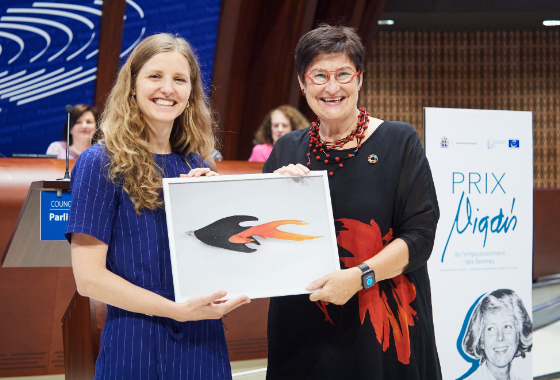
La Présidente de l’APCE, Petra Bayr, a remis à Me Čop un chèque de 60 000 €, un diplôme et le trophée du Prix, une sculpture réalisée à partir de magma volcanique islandais et baptisée Kvika. Elle a rappelé les paroles de Vigdís Finnbogadóttir selon lesquelles, si le monde peut être sauvé, ce sera par les femmes, ajoutant : « À voir l’actualité ces derniers temps, je pense que la paix et l’espoir sont ce dont nous avons tous désespérément besoin ».
Félicitant l’organisation lauréate, la Présidente a souligné que « ceux qui militent en faveur des droits sexuels et reproductifs étaient confrontés à une opposition massive de la part d’organisations disposant de ressources considérables ».
La ministre islandaise de la Justice, Þorbjörg Sigríður Gunnlaugsdóttir, représentant le gouvernement islandais, a également pris part à la cérémonie : « Les trois initiatives présélectionnées pour le Prix de cette année méritent notre reconnaissance et nos applaudissements. Leur travail nous rappelle que le changement est possible ». Vigdís a été un modèle pour toute une génération de jeunes Islandaises, a-t-elle rappelé, en montrant que les femmes pouvaient aspirer aux plus hautes fonctions – et y parvenir.
Les représentantes des deux finalistes du Prix 2026 ont chacune reçue un diplôme : le groupe « Girl Child Counselling Women » du Kenya, qui vient en aide aux enfants, aux filles et aux jeunes mères touchées par le VIH/sida et l’extrême pauvreté, et « Sasane – Samrakshak Samuha » du Népal, une organisation dirigée par des survivantes qui lutte contre la traite des êtres humains, le mariage des enfants, l’exploitation sexuelle et la violence de genre.
Un peu plus d’une centaine de candidatures provenant du monde entier ont été examinées par le jury du Prix, composé de six expert.e.s indépendant.e.s dans le domaine de l’empouvoirement des femmes – trois désigné.e.s par l’Assemblée et trois par le gouvernement islandais – et présidé par la Présidente de l’Assemblée.
Le Prix a été lancé à Reykjavik en mai 2023 en présence de Vigdís elle-même. L'année dernière, le Prix a été décerné à l'organisation « Women of the Sun » (Femmes du Soleil) de Palestine*, qui vise à créer des voies et des opportunités pour les femmes palestiniennes afin qu'elles puissent accéder à des domaines habituellement monopolisés par les hommes.
La première édition du Prix a été décernée en 2024 au Centre des femmes Irida en Grèce, une ONG locale qui œuvre pour améliorer la vie des femmes victimes de pauvreté, d'exclusion sociale et de violence fondée sur le genre.
* Cette désignation ne saurait être interprétée comme une reconnaissance de l'État de Palestine et ne préjuge pas des positions individuelles des États membres du Conseil de l'Europe sur cette question.
L'appel à candidatures pour le Prix Vigdís 2026 est désormais clos. La date limite pour soumettre les candidatures était le 27 mars 2026.
Pour information, les candidatures doivent être soumises en remplissant un formulaire de nomination officiel, accompagné d'un formulaire de signatures de sponsors signé par au moins cinq sponsors. L'ensemble des documents justificatifs doit être téléversé via la plateforme en ligne officielle. Les candidatures sont seulement acceptées en anglais ou en français.
Pour tous les détails relatifs aux critères d'éligibilité et au processus de nomination, veuillez consulter le Règlement.
L'appel à candidatures pour le Prix Vigdís 2027 sera lancé en novembre 2026.
Toute personne ou groupe de la société civile, dont les organisations non-gouvernementales nationales ou internationales, associations et entreprises privées peuvent être proposés pour le Prix.
Le jury du Prix, présidé par le Président de l'Assemblée ou un·e représentant·e désigné·e, est composé de six membres indépendant·e·s reconnu·e·s pour leur expertise dans le domaine de l'empouvoirement des femmes. Trois membres sont nommé·e·s par le Bureau de l'Assemblée, sur proposition de la commission sur l'égalité et la non-discrimination, et trois sont nommé·es par le gouvernement de l’Islande.
Les membres du jury ont un mandat de deux ans, renouvelable deux fois. Les membres actuel·les de l'Assemblée ne peuvent pas être membre du jury.
Jury (octobre 2025-octobre 2027)
Jury (octobre 2023-octobre 2025)
Le Prix est remis lors d'une cérémonie se tenant à Strasbourg le lundi de la Session plénière d'été de l'APCE, qui a lieu habituellement fin juin.
Le nom du ou de la lauréat·e est annoncé par le ou la Président·e de l'Assemblée.
2026 : The Girl Child Councelling Women et Sasane - Samrakshak Samuha