mercredi 26 janvier 2022 matin
2022 - Première partie de session Imprimer la séanceVidéo(s) de la séance 1 / 1
Dear Colleagues,
If you would allow me, I would like to reopen the sitting. We will have a busy day today, an exciting day, I hope, and debating most relevant issues.
First we'll start with the conclusion of our Rules Committee on the still unratified credentials of the Russian delegation. I'll read out the message that I received from the chair of the committee.
At the opening of this part session, the credentials of the Russian delegation were challenged on procedural grounds and, in accordance with Rule 7.2, referred to the Committee on Rules of Procedure, Immunities and Institutional Affairs. At its meeting, on the 25 January 2022, the Committee on Rules of Procedure, Immunities and Institutional Affairs adopted the following opinion:
“1. On the 24 January 2022, the still unratified credentials of the Parliamentary Delegation of the Russian Federation were challenged on procedural grounds, in accordance with Rule 7.1.a of the Rules of Procedure of the Assembly, on the ground that “the election of parliamentarians from nationwide party lists in Russia includes votes from the illegally occupied and annexed territory of Crimea.”
2. The Committee recalls that it has held several exchanges of views on similar challenges to the still unratified credentials of the parliamentary delegation of the Russian Federation in 2019 and 2020. It also recalls that it has previously examined this question in Opinion (Doc. 15218) on Challenge, on substantive grounds, of the still unratified credentials of the Parliamentary Delegation of the Russian Federation on 27 January 2021.
3. These exchanges of views and the opinion of the Committee took account of the opinion of the Venice Commission on "the compliance with Council of Europe and other international standards of the inclusion of a not internationally recognised territory into a nationwide constituency for parliamentary elections”. The Committee “emphasised that by virtue of the obligation of States and international organisations under international law not to recognise the consequences of the illegal annexation of a territory, the ratification of the credentials of the Russian delegation by the Assembly would in no way constitute recognition, even implicit, of the annexation of Crimea by the Russian Federation”.
4. The Committee recalls that in its above-mentioned opinion on this issue the Venice Commission stated the obligation under international law for the Parliamentary Assembly not to recognise an annexation “does not necessarily entail the obligation to deny credentials to the whole delegation of an annexing State. Other options are possible. The Parliamentary Assembly might consider increasing the range of such options for the future”.
5. On the basis of the above, the Committee concludes that the credentials of the Parliamentary Delegation of the Russian Federation should be ratified.”
This is the opinion of the Committee on Rules of Procedure, Immunities and Institutional Affairs and this is where the Assembly has to leave it.
The next item of business is the debate on the report titled, “Football governance: business and values” (Doc. 15430) presented by Lord George FOULKES on behalf of the Committee on Culture, Science, Education and Media. This will be followed by a statement from Mr Giovanni INFANTINO, President of FIFA – International Federation of Association Football. In order to finish by 11:30 a.m., we must interrupt the list of speakers at about 11:20 a.m. to allow time for the replies and the vote. The rapporteur has 7 minutes to present the report and then will have a further 3 minutes to reply at the end of the debate. I will also allow president INFANTINO to have concluding remarks at the end of the debate after its introduction at the beginning of the debate.
I see that Lord FOULKES has installed himself at home somewhere in Britain. I have heard, George, that you are also one of those soccer fans and those who are infected by Covid, which is another virus, but we are happy to have you here.
I give you the floor. You have 7 minutes.
Thank you Mr President,
I'm speaking here from Edinburgh.
Mr President, dear colleagues,
The great Liverpool football legend Bill Shankly, who was born in Glenbuck in my former constituency in South Ayrshire, he once said "football is not a matter of life or death; it's more important than that". True, that was a wee bit of an exaggeration, but football does play a very important part in the lives of so many people represented by us here today.
That's why I've had numerous meetings on your behalf with our partners on this issue, including representatives of the fans, players, agents, clubs, leagues, and of course UEFA and FIFA. So we warmly welcome here today Mr Giovanni INFANTINO. His presence is a mark of the mutual consideration and respect and of the excellent collaboration which FIFA and our Assembly have built up and seek to develop further.
Can I also thank him and his many senior officials for the help they gave us during the preparation of this report, which does include many significant demands to FIFA, which I hope he will endorse and follow up.
My main concern which runs through the whole report is that big business, as represented by some oligarchs and corporate owners, by a few rapacious agents, and by other self-centered commercial interests, has had a harmful effect on the beautiful game.
Of course we want football to be prosperous, but we need to take action to avoid financial access and to ensure that business doesn't take precedence over human rights – which is our duty to protect.
On to the proposals that the report asks you to endorse: first needs to be a reform of the transfer system and the regulation of agents, with reasonable limits on their fees and the setting up of a clearing house for all financial transactions as FIFA has proposed, to ensure greater transparency of financial dealings.
You know a few of the mega-rich agents are even challenging FIFA's competence on this for obviously selfishly reasons, and they have objected to my support for it, but it has been backed by the smaller agents who do the daily grind on behalf of so many of the players in lower leagues and in poorer countries.
This reflects a key theme of the report which highlights the rapidly growing disparities of wealth at both club and league level. That's why the report strongly opposes any project like the proposed European Super League, which was fortunately scuppered by widespread fan protest. We back the UEFA to continue as the body responsible for European football, and urge it to expand its revenue distribution scheme to help the smaller clubs.
We propose in particular that European leagues establish a solidarity fund using a small percentage of TV revenue to finance projects developed by fans, particularly to help clubs recover from the Covid-19 pandemic.
We also recommend that fans and players be given a greater role in football governance at all levels. Football wouldn't exist without players, and fans are the lifeblood that keep the heart pumping, yet they are marginalised in decision-making.
We hope that both FIFA and UEFA will endorse these developments towards more inclusive decision-making internationally, but there's also a need to parallel these developments in clubs and national leagues and associations.
Also, the protection of underage players and gender equality are two prominent human rights issues we cover. We call for young players to be treated as human beings, not as commodities, with attention given to their education and their wellbeing as well as their footballing skills. In particular we commend the project to set up a safe sport entity to deal with cases of abuse in sport. It's time we join efforts to mobilise our energy to face this growing threat.
And while we acknowledge that much has been done on gender equality, we recommend further action on both equal pay and women's representation on decision-making bodies. For the sport in general and football in particular it can really help with removing the cultural drawbacks which have perpetuated inequality between women and men in our society.
We've looked in detail with FIFA and particularly the ILO at other concerns about working conditions in Qatar, both on and off site. On the basis of our discussions – particularly with the ILO – we do not favour a boycott of the World Cup in Qatar, but we do strongly recommend that we continue the pressure on the authorities right up to and during the competition.
Countries which bid to host major events in the future must satisfy human rights criteria. For this reason, we consider that in the future a thorough human rights compliance assessment to be a precondition for accepting any country's bid. All bidding countries should ensure workers- rights, protect athletes of minor age from sexual abuse and all forms of violence, and ensure gender equality, combat discrimination in sport, and uphold fundamental civil and political rights.
Mr President, that's all I want to say by way of introduction, as I'm very much looking forward to hearing from Mr Giovanni INFANTINO and the comments from colleagues, which I shall respond to in my reply at the end.
Thank you very much indeed.
Thank you very much to you, Lord George FOULKES, for your introductory remarks and as you said at the end of the debate you will be able to react.
Colleagues, if I tell people somewhere else that I am from the Netherlands and I mention the name of our Prime Minister or of the newly elected President of this Assembly, people say "Okay", but if I say that I am from the country of Johan Cruyff, Ruud Gullit and Marco van Basten, Frenkie de Jong and Lieke Martens, then they say "Oh, you're Dutch," and that is an indication that our soccer players are perhaps the best ambassadors of our countries. If they perform well, the country is seen as doing well. And like in politics, the game of football needs players, spectators, referees and it needs rules and institutions. And I am most happy that we have, today, amidst us the President of – one could call it the United Nations of soccer – the President of the International Federation of Association Football (FIFA), Mr Giovanni INFANTINO.
Mr Giovanni INFANTINO has been President of FIFA since 2016, and as such, oversees one of the world's largest sports organisations. We are talking about millions of players and we are talking about billions of fans. The good news is that all these fans are experts so they do not really need Mr Giovanni INFANTINO to explain something about the game, but we need Mr Giovanni INFANTINO to say something about the rules and the organisation.
When I mentioned Ruud Gullit and Johan Cruyff everybody reacted; if I say that Mr Giovanni INFANTINO, who is well known all over the world, is accompanied by a famous citizen of Strasbourg, Mr Arsène Wenger, everybody says "Arsène Wenger", now we are talking. Now we know what item is on the Agenda. So Mr Wenger, I also very much welcome you here to accompany Mr Giovanni INFANTINO and without further delay, I would like to give the floor to you President INFANTINO to address our Assembly.
Thank you very much.

Président de la FIFA - Fédération Internationale de Football Association
10:25:30
I don't know if we can make this fit here, but, dear President, members, I'm very proud and happy to be here today speaking about the topic or, certainly, one of the main topics which truly unites Europe: and it's football. It does not only unite Europe, it unites actually, as a matter of fact, the entire world.
And I give you the ball.
<<Gives a ball to President Mr Tiny KOX.>>
Very good. Thank you thank you very much for the invitation. My thanks as well to Lord George FOULKES, which I saw in a screen up there, but I'm sure sure he's still watching us. Thanks to everyone here in Strasbourg at the Council of Europe and in the Committee and those who have worked on this report which will be discussed and debated today.
This is a true honour to be here for me as a FIFA President. We have started a relationship with the Council of Europe in 2018 where we signed a memorandum of understanding, and since then we have been constantly working together trying to help growing football and the governance of football.
We have, as FIFA, as well entered other agreements with the African Union, with ASEAN, with CARICOM, with the World Health Organisation, with UNODC, with UNESCO, and so on so forth. Because FIFA realises that football, well, might not be a matter of life and death, but more important than that, as it was said eloquently before. But football is also indeed much more than a sport and we have to take our responsibility in this respect very seriously.
I'm also happy and proud to be able to share with you some personal thoughts and, of course, on behalf of FIFA some thoughts on the report and on the main topics related to that.
Why I speak about personal thoughts? Because everything is linked. I am personally as well a product, so to say, of European integration. I am somehow a product of the values which have created this Council of Europe: the values of human rights, of inclusion, of rule of law. I'm an immigrant or son of immigrants. My parents had the chance to go to work from Italy to Switzerland and they were given work, and they were given dignity together with work, and they were given an opportunity and the chance, and I could then study in Switzerland, and today I am here as president of FIFA. And we have, as FIFA, and all of us as leaders of societies, the responsibility to put these values high up.
So I want to speak today about four main topics: human rights, it was mentioned, and, in particular, the situation in Qatar; about the transfer system; about safeguarding children and vulnerable people from abuses; and ultimately about the future of football as well.
First of all, when we speak about human rights and workers' rights and the situation in Qatar, again, my thanks to Lord George FOULKES and his team for having integrated into the report our input in this respect.
I think that change doesn't come quickly. We know it, in Europe it took decades, sometimes even centuries, for change to happen. Change on workers' rights, change on human rights. But change is happening, and when it happens we have as well to recognise it. Thanks to the World Cup, thanks to the spotlight that football brings to a country like, in this case, Qatar.
Well, the system has evolved in a record time of only a few years. What has changed concretely? Well, the Kafala system has been abolished. And over 300,000 workers in the last year have been able to change their job. And I repeat here what I said at the beginning: work means dignity. You give work, you don't give charity to people. You have to give them also a proper legislation, and the minimum wage as it was introduced as well in Qatar. Regulations about protecting workers from the heat have been introduced as well. Workers' committees have been created.
Now, does this mean that we have now a paradise country? No, certainly not. A lot needs still to change, a lot needs still to be done. We need to keep the focus and the pressure all together, but we also have to recognise that change has indeed happened, and support those who are investing their time, their energy, and their beliefs for this change to happen. And let's face it, this change happened because of the spotlight of a football event.
There is a lot of business going on with Qatar, with the Middle East, with other countries. And no change is happening because of the business, but change has happened thanks and because of the power of football and the competition. And this change does not have to continue only until the World Cup, it has to continue well beyond that. And the signs for this are indeed very positive. So thanks for acknowledging and recognising that.
The transfer system is also about solidarity, it's also about these values which are so dear to us here in Europe, about training, about education. And 20 years ago FIFA at the time with the European commission decided on a new set of rules and, after 20 years, it's time to analyse whether these rules on the transfers of players have had the effect that we wanted.
What kind of effect did we want? Well, we wanted to encourage contractual stability, solidarity, education and training of players, and bringing transparency, another key element in governance of football, into the game. Twenty years later, we have to admit that not everything went as it was hoped, and we have to amend and change these rules, and that's what we are doing. And again, our thanks to Lord George FOULKES and his team for having analysed our proposals in great detail.
I just want to give you one figure or actually three figures which are quite shocking. In the last year pre-Covid, so pre this situation that we are all living in 2019, the value spent, or the money spent on transfers of football players in one year was about about €7 billion. Around 700 million, so 10% of this amount went to players' agents. So 7 billion, 700 million, and around 70, so 1%, went to training of players to solidarity for the clubs, the smaller clubs, who trained players.
When you see these figures and, by coincidence, these figures are kind of the same 70, 700 and 7 billion, when you see these figures, you see that something is not right, that we need to address it and that we are addressing it by creating a clearing house, to make sure that training compensation solidarity has to go to the clubs who trained players, to make sure the players will be trained at smaller clubs, have the opportunity to train them, to bring transparency in the interactions between clubs and players, between players' agents and players. It is very very important that we have this transparency, that we avoid excessive commissions, and that we make sure that money goes where it has to go, which is in development of players, in solidarity, in development of football.
So thanks for your support, because obviously, every time a regulator like FIFA comes in and wants to regulate, to bring transparency and efficiency to a system, you are faced with an army of lawyers who are obviously saying that any sort of regulation violates some European legislation of some sort, but we are sure that what we do is not only perfectly legal but it is also absolutely necessary for the good of football, for the image of football, for the development and the future of football.
And if we speak about values and if we speak about human rights and if we speak about development and training of players, we have to talk as well about protection, about protection of young players. Not only football players: young boys and girls who want to practice sport. And for too long, for too long we have been hiding behind a situation which is worrying, because abuses sadly happen, they happen as well in football. And we need to face that. And we had to face it at FIFA the hard way, in countries also outside of Europe where there is no legislation, no governments, no states helping victims.
We had to step in and we realised that this goes beyond, of course, our possibility as a sports body, and for this reason we embraced a new project, we led a debate about creating an agency, an independent external agency in collaboration with governmental authorities, with international authorities, with sports bodies. An agency which will help victims all over the world to have the right assistance, to have some protection, to be receiving assistance for them, for their families, in any sport.
Because every boy and every girl, not only in Europe but everywhere in the world, needs to be able to go and practice sport in a safe and healthy environment. And we cannot just hide this topic away, so we are pushing for the creation of this new independent agency. And thanks again as well there for your support in this respect.
The final topic that I would like just to mention briefly, if I still have, yes, a minute, yes, thank you, is the future of football and one of the remarks as well in the report about the question on the World Cup every two years. And we have Arsène Wenger here who is in charge of studying that project for men's football, and for women's football we have Jill Ellis who is in charge of studying that question as well.
Let me say that on this topic I would have preferred or I would have liked, we would have liked to engage indeed also in a debate, in a dialogue with the Council of Europe, and I take this opportunity as a first step in discussing the future of football as well of course with the Council of Europe. Because what this topic is about is not about whether we want the World Cup every two years, it's about what do we want to do for the future of football.
The Super League was mentioned earlier as well by Lord George FOULKES, we see that football is going into a direction where a few have everything and the vast majority has nothing. I understand in Europe the World Cup takes place twice per week, because the best players are playing in Europe. So in Europe there is no need for additional possibilities and events, but if we think about the rest of the world, and also if you think about Europe, the vast majority of Europe, who doesn't see the best players, who doesn't participate in the top competitions, then we have to think about what football brings, which goes beyond the sport.
Because football is about what I was saying at the very beginning, about opportunities, about hope, about national teams, about the country, about the heart, about the joy, about the emotion. And we cannot say to the rest of the world: give us your money, if you have or happened to have a good player by coincidence give us the player as well, but watch us on TV. We need to include them, we need to find ways to include the entire world, to give hope to Africans so that they don't need to cross the Mediterranean in order to find maybe a better life, but more probably death in the sea. We need to give opportunities, and we need to give dignity, not by giving charity but by allowing the rest of the world as well to participate.
Now, maybe the World Cup every two years is not the answer. We discuss it, we debate it, we started the process with a vote of 88% and this, Council of Europe, is also about democracy: 88% of the FIFA Congress, including 30 European members out of 55, to debate, to discuss, and to see what the best way is to be more inclusive. Not just to speak about saying no to discrimination, but to actually act into exactly that direction by being more inclusive, by bringing everyone on board, and by trying to give opportunities, hope and dignity to the entire world.
We engage in a discussion, we engage in a debate, we will see at the end of this debate, not today but in a few months time, what the result is.
Football is unique, football is global, but we have to make it truly global, we have to make it truly inclusive, such as the values that have built Europe and that we are bringing as well all over the world. And football definitely is an instrument and a tool that is at your disposal, at the disposal of every citizen, in order to have more opportunities and more chances to be inclusive.
So again, thank you very much to all of you for listening to me.
Grazie mille, muchas gracias, vielen Dank, merci beaucoup, it's an honour and I'm proud and happy to be here with you today and to answer of course any question that you might have later on.
Thank you so much.
Thank you.
Thank you, Mister Infantino, for your most interesting speech, and of course for this. This is for in our free time to play football with a real football.
As I told you and Mr Wenger before, I cannot make this sign here. All soccer fans know what I mean. We do not have a VAR, but we do have our members. They might have second thoughts about what Lord George FOULKES has said in his introductory remarks, or what you have said, President Infantino, have said in your remarks.
You will have a fair chance, fair play, at the end of the debate to react.
Now, first, we are going to listen to the five representatives speaking on behalf of the five political groups.
As number one, I call Mr Mogens JENSEN from Denmark, who will speak on behalf of the Socialists, Democrats and Greens Group.
Mr Mogens JENSEN, you have the floor.

Danemark, SOC, Porte-parole du groupe
10:43:32
Thank you very much, Mister President, Mr Tiny KOX, and congratulations with your election.
Dear Colleagues, on behalf of our Group, I would like to thank our good colleague, Lord George FOULKES, for this important report.
I think we all know, and it has also been stated here by Mr Infantini, how how big a role sport, and not least football, plays in many people's lives.
When people participate in and follow football, and thus, this sport, with its major role in media and in stages around the world, has a significant impact on attitudes and values among people globally.
At the same time, football plays a major economic role worldwide. This also means that not at least the football organisations have a great responsibility in their organisation and in the way of running the sport of football, to live up to a number of very fundamental values which the Council of Europe is set in the world to defend: democracy, respect for human rights, anti-corruption, anti-discrimination and equality. This is a huge responsibility which I think we have to say today is worn satisfactorily by UEFA and FIFA.
Therefore, there is a good reason to very welcome FIFA's president Mr Infantini, who is present here today and also takes the dialogue as we have had it since 2018.
The course when we hopefully and shortly adopt this Resolution and Recommendation, I think we will send some very clear signals to not at least football's international organisations. You need to radically tighten the conditions that countries bidding for those major football events must meet in terms of protecting human rights and ensuring that compliance is monitored and that sanctions are severely penalised if that's not the case.
You need to make a greater effort for gender equality in the world of football. You need to take better care of the protection of underage football players.
In addition to this, there is still a great deal of work to be done to clean up after the corruption scandals that have unfortunately plagued also FIFA and other organisations. It is imperative that not at least FIFA and UEFA take responsibility for ensuring that their organisation is fundamentally based on democracy and on economic transparency. This is not at least important for the benefit of the general public and the millions around the world who support football every day.
The Resolution we are debating here today calls for further co‑operation and dialogue between FIFA, UEFA and the Council of Europe, and other important stakeholders. I hope that FIFA and UEFA will commit to this.
I see a clear message in this Resolution of the Parliamentary Assembly. I see it as a kind of a yellow card for international football organisations. Now it's the time to act accordingly.
Thank you very much, Mister President.
Thank you very much Mr Mogens JENSEN.
Knowing you are speaking from Denmark we are thinking about Christian Eriksen of course and we wish him well.
The next speaker on our list is Mr Aleksander POCIEJ from Poland, who is going to address our Assembly on behalf of the Group of the European People's Party (EPP). Mr Aleksander POCIEJ you have the floor.

Pologne, PPE/DC, Porte-parole du groupe
10:47:34
Thank you, Mr President.
I would like to thank our rapporteur for this report and I agree with most of the theses that are included here in the summary, in the recommendations.
I am totally convinced that young players should not be treated as objects; that is fundamental. And something has to be done about the transfer rules, about the rules of national federations, because the scandals that have occurred at a very high level are everywhere, including in our respective national federations.
I also have no doubt that the prices of player transfers and the salaries of players are exorbitant. In a world where we say that the rich should not be so rich, at a time when the poor are so poor, even the most talented players, who are the heroes of our days, should respect this common value and the common feelings we have.
On the other hand, I do not agree at all with what is said in point 22 of the report, namely: "to promote equality of salaries and bonuses paid to male and female players". Why, in tennis, in horse riding, have women obtained, without really having to fight, the same salary? For the simple reason that the audience is almost the same. If you watch the French Open, if you watch Wimbledon, you watch women as well as men. It's easy. In horse riding, women beat men.
You started, Mr President, by saying that you come from a country where there were Cruyff, Van Basten, Gullit, De Jong. And we can name hundreds of great male players, from Pelé to Messi. But you did not mention the name of a single female player.
Thank you very much.
Thank you to you, Mr Aleksander POCIEJ.
The last name that I mentioned was of our famous soccer player, Lieke Martens. My oldest granddaughter wants to be the new Lieke Martens, of course.
But thank you very much.
So the next the next speaker in our debate will be Mr Dmytro NATALUKHA from Ukraine and he is going to speak on behalf of the European Conservatives Group and Democratic Alliance (EC/DA).
Dmytro, you have the floor.

Ukraine, CE/AD, Porte-parole du groupe
10:51:31
Dear President,
Dear distinguished colleagues,
I hope you hear me well.
I'm very thankful to Mr Rapporteur for this report.
As we have seen everywhere in Europe this summer, football is a huge unifying force. It fosters the integrity of our societies, it promotes mutual respect and equality, it elevates the burdens of our everyday lives.
I definitely endorse the proposal contained in the draft Resolution. However, one proposal is particularly important, which is the call of the draft Resolution on FIFA and UEFA to make the election of host states of major football events subject to a thorough assessment of their compliance with human rights standards based on the up-to-date information of international governmental and non-governmental organisations.
Relevant human rights standards shall include freedom from discrimination and other fundamental civic and political rights. In particular, freedom of expression and freedom of peaceful assembly, both as regards staging the competitions and in general.
In my opinion such an assessment is an immensely important step towards enforcing human rights and enhancing accountability for their violations. In this regard, it is rather outrageous and unacceptable that Russia, for example, a country with a consistent and extensive record of human rights and international law violations, were trusted to host the 2018 FIFA World Cup, the 2020 UEFA European football championship, and this year again, the 2022 UEFA Champions League Final.
All these tournaments either were or will be hosted by a country that according to Resolution 2022/30 is sponsoring the discrimination of the LGBTI community or suppressing freedom of speech and political opposition as reflected in Resolution 2363 of this Assembly, or illegally occupying territories of other sovereign countries as provided in Resolution 2387 of this respected Assembly.
Therefore, I do not accept that Saint Petersburg is allowed to host the Champions League Final while Alexei Navalny is languishing in prison after an attempted assassination by means of Novichok, when millions of people are suffering from violations of their rights which this very Assembly considers outrageous.
For this very reason, it is of the utmost importance to indicate in such a substantial and remarkable report all countries that violate human rights, not just those who are not members of the Council of Europe.
We have to be fair ladies and gentlemen, and such fairness implies that countries hosting championships in the nearest future, such as Russia for example, would have the opportunity to remedy such violations before the championships, and not after they end.
Therefore, I firmly call on UEFA and FIFA to implement the bidding procedure advised by the draft Resolution, and stop allowing to use football for propaganda purposes.
Thank you very much for your attention.
The next speaker in our debate is Ms Alexandra LOUIS, from France, on behalf of the Alliance of Liberals and Democrats for Europe.
Ms LOUIS, you have the floor.

France, ADLE, Porte-parole du groupe
10:54:56
Thank you, Mr President. I take this opportunity to congratulate you on your election.
Dear colleagues,
Mr Rapporteur,
Beyond the traditional economic and political issues, the governance of soccer also involves ethical and human rights issues.
I would like to begin by welcoming the report by our colleague, Lord George FOULKES, which underlines the global issues of this globally popular sport, whose influence among our fellow citizens has never been so strong.
In every country in the world, people support their nation, they support their club. No other sport, no other cultural practice is subject to such a degree of adulation. Where I come from, soccer is a religion, with the Velodrome as its temple and Olympique de Marseille a link between all the inhabitants.
Because it is so important, soccer must evolve and be exemplary in the face of challenges that go beyond the simple framework of sport.
In order to move towards good governance, it is essential to commit to a responsible and ethical mode of management. All stakeholders, clubs, authorities and managers involved in the economy, promotion and development of sport must be aware of their obligations and duties.
From this point of view, two points seem to me to be of the utmost importance: a reinforced framework of respect for human rights and better financial regulation to curb the growing excesses in the soccer economy.
As far as respect for human rights is concerned, it is essential that our Assembly call for order, especially for countries wishing to host major sporting events. They have a duty to assume ethical obligations and to work closely with federations and associations committed to the defence of human rights.
The year 2022 also inevitably brings to mind the organisation of the World Cup in Qatar. While our Assembly welcomes the efforts made by FIFA and the Qatari authorities, we must not forget the difficult working conditions experienced by the workers during the preparation of the event and the thousands of accidents, including fatalities, that took place during this period.
The Assembly therefore calls on FIFA and UEFA to review the conditions that countries applying to host major soccer events will have to meet in terms of guaranteeing human rights. If this is not the case, an evaluation should take place, with the obligation to respect these criteria and the establishment of mechanisms to monitor these commitments.
The second point I would like to quickly mention concerns the economics of soccer and its inequalities.
In its report entitled "The Financial Landscape of European Football", the auditing firm KPMG noted the growth of all sources of revenue in European soccer, with rapid expansion that has not been uniform. This situation has become more pronounced in recent years and has led to growing disparities between leagues and clubs.
Initiated by the Bosman ruling, whose objective was in itself the defence of players' freedom and human rights, the expansion of the transfer market́ accentuates this polarisation of the football economy. It is now essential that FIFA be able to better regulate this system in order to curb questionable practices and provide more transparency concerning financial flows.
Thank you for your attention.
Thank you to you, Ms Alexandra LOUIS.
Next, I call to the debate Mr Thomas PRINGLE from Ireland and he speaks on behalf of the Group of the Unified European Left (UEL).
Thomas, you have the floor.

Irlande, GUE, Porte-parole du groupe
10:58:29
In the cover page for this debate it says that "business must not, however, take precedence over values".
That is a very worthwhile statement but unfortunately I think it is a statement that has been lost in relation to football at the moment. Are we really to believe that there is any value left in football when we see how the major clubs behave across Europe and how FIFA has behaved with the giving of the World Cup to Qatar?
I must confess that I am no expert and have not spent much time looking at how football behaves in the world today but then I am probably like most of the world in that regard.
The granting of the world cup to Qatar and the stories that have emerged from there in relation to the treatment of workers on the building of the stadiums are shocking.
The distinct impression being given when reading this report is that FIFA is doing all it can to improve the situation and is working hard to get it right. That may be so now. And that may be down to organisations like ours in getting involved and trying to drive change within football, but it is my distinct impression that FIFA was dragged to this point rather than wanting to do something for the rights of workers. It was probably more to do with the reaction of the public to the situation. It seems to me that the work of the ILO would have more to do with improving the situation than FIFA.
I do agree that the Council of Europe has a role to play when we consider that there are many large European companies that are operating in Qatar and looking to profit from the World Cup; they should be made to ensure the protection of human rights in their work. But in saying that it is welcome that FIFA appear to be on board in improving the situation and that is something that must continue after the world cup this year but only time will tell.
Unfortunately, in Ireland FIFA would not be known as a bastion of rights-based work and would be known more for financial irregularities and it would be extremely welcome if that was to change also.
I would like to talk a bit about the financial situation in relation to the game in Europe as well. The report highlights shocking figures really in relation to the imbalance in how clubs are funded.
Total funding in European football in 2018 was over €21 billion.
With the average operating revenue for clubs in what is called "Cluster A" of €160 million per annum, which is the leagues of England, France, Germany, Italy and Spain. In "Cluster B" of €31.7 million and even less further down the leagues.
That level of financial disparity means that the problems will be very difficult to address. Effective ways of tackling that is the only way that football will be accountable and that football can really be seen to be acting on behalf of the people rather than the oligarchs and big business that own football.
Thank you.
Thank you, Mister PRINGLE.
That concludes the list of speakers on behalf of the groups. We will now hear as many remarks as possible from the other speakers.
The next speaker in our debate is now Mr André VALLINI from France.
You have the floor.
Mr President,
Dear colleagues,
Football is by far the most popular and unifying sport that exists today. It is therefore necessary that it conveys, as has been said before, values in line with those we wish to pass on to our children, in particular the respect of human rights. In reading this report, two points catch my attention.
First of all, I am thinking of the rights of workers, who have come from Asia to work on the various construction sites for the 2022 World Cup in Qatar. For many NGOs, the situation of these workers is tantamount to slavery and the International Labour Organization speaks of at least 50 deaths and 37,000 injuries in 2020 alone.
The Guardian newspaper reports that more than 6,500 foreign workers have died in the past decade on these same construction sites. Although the German and Norwegian players have displayed the expression "human rights" on their shirts in reference to these accusations, denunciations remain minimal and silence is the rule. Faced with this situation, our Assembly must take a stand. The reform of labour laws in Qatar remains insufficient and FIFA must therefore assume its responsibilities and continue to put pressure on Qatar to improve the situation of workers in the country.
Secondly, the rights of underage players must be protected against all forms of abuse. Since 2001, Article 19 of the players' status regulations has laid down the principle that the international transfer of a player is only permitted if he is at least 18 years old. However, exceptions are made if the player's parents move to the country where the new club is located.
Today, this principle could be challenged. Indeed, the possibility of international transfers of players aged between 16 and 18 could become the norm. We must oppose this change in the regulations of the status and transfer of players.
Indeed, according to Mediapart, despite the principle of the ban, in 2018 FIFA received 3,300 applications for registration of transfers involving players under 18, which represents 20% of transfers, one transfer in five. Some unscrupulous agents arrange the transfer of several players to maximise their chances of finding a nugget that will make them a lot of money. But for those who are not retained by the club at the end of a year's contract, these players are left to fend for themselves in a foreign country where they have no family. This is what we must avoid.
So I will be supporting this draft Resolution.
Thank you, Mr President.
Thank you, Mr André VALLINI
Now I call to the debate Mr Oleksii GONCHARENKO from Ukraine.
Oleksii, you have the floor.
I do not see Mr Oleksii GONCHARENKO in the hall so we go to the next speaker, that is Mr Dara CALLEARY from Ireland. Mr Dara CALLEARY, you have the floor.
Thank you Mr President. Thank you to Lord George FOULKES for his report.
Anybody that starts his presentation by quoting Bill Shankly is very welcome to any forum that I participate in. I note from Lord George FOULKES' background that he has taken on corporate might in soccer before and in football before, so I know that this report, which is very welcome, will be followed through.
Mr President,
Many of the issues we discuss at this forum are very macro. They may not affect people's daily lives; this does.
This weekend many, many, millions of our citizens across the Council of Europe member states will participate in football of all ages.
Can I say to our Group of the European People's Party (EPP) colleague in relation to his remarks about women's football, I quote him the name of Stephanie Roche, who in 2014 was the runner-up in the Ballon d'Or for the best goal in football. There are many more Stephanie Roches and there are many more women who want to be Stephanie Roche, and who should be equally paid. They put in the same effort, they do the same training, on dirty pitches in all sorts of weather to give us the kind of sport that we love.
Football is crucial and soccer is crucial in keeping our populations healthy – physically healthy, but also mentally healthy. In the context of the post-pandemic era when so much sporting activity was destroyed, football and soccer would be crucial in rebuilding our continent post-Covid-19.
Can I say to Mr Giovanni INFANTINO, I welcomed your remarks. I welcomed what I sense was the genuine nature of your remarks.
But can I propose, Mr President, that in order to test the sincerity of FIFA's response to this report, that when we gather next year, that we have a post-Qatar report: are the commitments that FIFA has committed to, as endorsed by Lord George FOULKES in his report, will they actually be implemented? Will Qatar take place in the actual competition? What changes will happen afterwards?
I think for this report to be true and to be effective, as an Assembly we should come back to it next year and see whether the commitments that are entered into on the part of FIFA were honoured.
Can I also have Lord George FOULKES and Mr Giovanni INFANTINO – have they done any work or have they any consideration in the very early stages of the impact of cryptocurrency on football? It is beginning to become an issue. It is beginning to become an initiative that is impacting on the business models of football. We need to ensure that fans are protected from that.
Finally, Mr President, there was a political slogan in this country once of my own party: 'a lot done, more to do'.
Can I say to Mr Giovanni INFANTINO that is something he should look at, but in terms of assessing the more to do, we will take our role very seriously.
Thank you.
Thank you, Mr Dara CALLEARY.
Next in the debate I call Ms Emine Nur GÜNAY from Turkey. Emine, you have the floor.
Thank you President, first of all, congratulations you on your election as the speaker of PACE.
Dear Colleagues, I congratulate the rapporteur for his inclusive and incisive report. The report not only points to very important problems football faces today, but also offers constructive solutions for these problems.
Football has gone beyond being a sport and has become a promising business. In the past, money was not that much important in football as today, but now football is among the well-paying careers.
This situation could be considered as harmless at first glance. However, the commercialisation of football creates a huge financial gap between big and small clubs. While big clubs are able to pay millions of dollars for just one player, other small clubs cannot even pay their players’ salary. This situation puts pressure on small clubs to loan money that they cannot pay back. This inequality needs to be addressed.
There is no doubt that football, as other branches of sport, belongs to all citizens. Local football teams are one of the most important institutions that ensure everybody, especially for the young people, can enjoy football. As we are all aware, many of these local football clubs are small sports clubs. That is why it is crucial to support small football clubs. In addition, these football clubs not only encourage people to get involved in sports, it also ensures that financially disadvantaged young people are prevented from getting involved in criminal activities. However, young people also must be protected from abuse in sports. Therefore, I sincerely support FIFA’s initiatives to establish safe sports centres.
Last but not least, men continue to dominate senior roles in the management of football. This paves the way for women being held back in the football industry. To avoid this situation, women should be allowed to play further roles in football management. As an example from Turkey, as a good example, the president of one of the football clubs is a businesswoman, and they are doing very well. I hope these numbers will increase in the years to come.
Thank you very much.
Thank you very much, and I share your hope.
Next, I call to the debate Mr Constantinos EFSTATHIOU from Cyprus.
You have the floor.
Thank you very much, Mr President, and allow my congratulations for your election and please accept my certainty that you will fulfil, in the best manner, your high standard mission.
My congratulations also to Lord George FOULKES for his excellent report, and my greetings also to Mr Giovanni INFANTINO and Ms Tsakona here as an associate.
Playing sport teaches many universal values such as fairness, sportsmanship, teamwork, inclusion and respect. Everyone is equal in sports and everyone should have the same opportunity to participate and compete.
Today, sports leagues have evolved into giant businesses, closely interlinked with large-scale industries and entertainment companies. Predominant sports like football are major players in the global financial market, with the top-spending clubs and the highest paid athletes at the forefront. Sports clubs should adopt salary caps, revenue sharing and expenditure ceilings. We must remain vigilant against the increasingly growing international sports market because we have a common responsibility to uphold the ethical spirit of sport. We cannot accept the proverb that the more you spend the higher you go.
Football governing bodies must continue to remain autonomous and free from influences stemming from financial gain and political or cultural affiliations. A key priority for member states should be fighting corruption and scandal, while promoting transparency and good governance. In cases of major international sports events, host countries should meet basic social norms and shared standards, starting but not limited to human rights, which is widely stated in the report.
At the same time, through their targeted coverage of major sports, such as football, media organisations engage in feeding the lucrative sports industry. That is why they should remain largely independent from sponsors of any kind, including political affiliations, and more importantly they must be held accountable for their role in shaping the moral behavior of all people involved in sports.
Thank you very much.
Thank you very much Mr Constantinos EFSTATHIOU.
Our colleague Mr Oleksii GONCHARENKO was in the dugout, but he is back in the field.
I give you the floor Mr Oleksii GONCHARENKO.
Thank you.
Thank you Mr President.
First of all I would like to thank the rapporteur for the great work and a great report. Thank you very much. It is a really very important issue we are discussing now.
Football is not just a sport. Football is the favourite game of millions. That's why it is also often used in an absolutely wrong way. It is often used in a wrong way in commercial issues, but also, unfortunately, in political issues which we are here for, our Assembly, the Council of Europe.
For example, we know that all dictators like big shows. They know the Roman principal panem et circenses. They know the principal "bread and shows" to people, and they try to do this.
They also try to use sport to show their legitimacy. That's why I want to address Mr Giovanni INFANTINO and ask him to be very very precise and careful with such things. Not to give opportunities to dictators to buy football championships for themselves, to provide them in their countries, just to show that they are legitimate, that they can be speaking by white auditory and by the world.
We know such examples, like for example in the Russian Federation in 2016. We know other examples. That is something which I think we need to stop. We need to remember that football is something not only about the game, but about values. The values of equality. The values of fighting against racism. The values of fighting xenophobia, which is so important in today's world.
So that's first what I want to address to Mr Giovanni INFANTINO. I hope he will consider it for the future.
Secondly, I would like to say that we really need more and bigger cooperation between institutions like ours, which are fighting for human rights, democracy, rule of law, with sports institutions. Because in today's world, football stars for example, sports stars, have more influence, we should say the truth, on people, on society, on the way people think, than even we politicians or other people.
That's why it's so important to be together. To speak, to defend our common values together. That should be our way to a better future, to a better sport, and to a better Europe and a better world.
Thank you again for a great report.
Thank you Mr Giovanni INFANTINO for taking part in our session, and I encourage you to move forward in the directions which I was speaking about.
Thank you.
The next speaker in our debate is Mr Axel SCHÄFER from Germany, and he is speaking on behalf of the Socialists, Democrats and Greens Group.
Mister Axel SCHÄFER, you have the floor.
Okay, yes.
Mister President, Ladies and gentlemen,
Thank you also from my side to Lord George FOULKES and to Mr Gianni INFANTINO both for the report and for the open debate that we are having here. I want to focus this on three points.
One is soccer and values. It is sometimes a difficult balancing act that we have to walk. On the one hand, that sport is not political in the classical sense. On the other hand, that human right is indivisible. That's why it's important for me that we support both the federation and the athletes when they actively stand up for human rights, be it also through some symbolic actions on site, before games, as this happened.
This is also a great benefit for soccer, because human rights, as we know, are indivisible worldwide. At this point I would like to remind you of the development that has taken place. From my point of view a positive development at the World Cup 1978 in Italy, in Argentina, sorry, in Argentina. In times of military dictatorship, soccer was played in stadiums where political prisoners had previously been imprisoned, maltreated and abused. At times, that didn't seem to bother anyone at FIFA at all. Thank God, that's different today.
That is why I would like to emphasise once again at this point what does not always come out so clearly in this report: human rights is always also a question of practice.
Secondly, of course, there is also the question of equality for women. When Mr Gianni INFANTINO was born, in 1970, women's soccer was played in Germany for the first time. Before that, it was forbidden. This is big progress, so we have to get more participation from women and also recruiting. Lastly, we are patriots, patriotism being the opposite of nationalism. Even with fans at our events, let's always see that we rejoice together in celebrations and not that there are hostile attacks.
Thank you very much.
Thank you.
The next speaker in our debate is Mr Dimitri HOUBRON, from France.
You have the floor.
Thank you, Mr Chairman.
Mr Rapporteur,
My dear colleagues,
First of all, I would like to salute the work of the rapporteur on a sport that is ultimately the revelation of the state of our society, whether it be on the weight of big money, equality between women and men, the recognition of less visible professions or the rights of minors. In my speech, I would like to focus on the projects of a European Super League and a World Cup every two years. These are projects on which the report is opposed, and I share its opinion.
These two projects take place in a context of health crisis where the world of sport continues to adapt to the multiple consequences of this pandemic on its functioning. According to the promoters of these projects, the idea would be to arouse the interest of the younger generations who would be in danger of turning away from soccer because of the fact, according to them, that there would be a lot of low-level matches. Thus, the creation of a league of the best clubs and the more frequent repetition of a World Cup would help to increase the number of high-level matches.
Moreover, according to the supporters of these projects, these projects are justified by the fans' desire for change. However, in view of the worrying statements of the Football Supporters Europe association and the numerous angry demonstrations of the fans, which have caused the clubs to back down from their plans to secede, it is clear that these projects are fuelled – let's be clear about this – only by the lure of profit. Soccer, its culture and its heritage are reduced to an accounting dimension.
With regard to the European Super League, the Sky Sports channel has estimated that more than 5 billion euros would be redistributed to the 20 clubs participating in this competition, which is three times more than the historic Champions League. When the project was announced, analysts questioned how these clubs had obtained the financial guarantee to be able to launch such a European Super League project. According to Sky Sports, the clubs had to find almost 6 billion euros. A sum in which would have participated the American bank JP Morgan but also, and this is more worrying, the Public Investment Fund which is the public investment fund of Saudi Arabia.
Let us recall that the European Parliament has taken up the issue by stating its opposition to, and I quote, "dissident competitions that undermine these principles and endanger the stability of the global sports ecosystem". He called for, and I quote, "European sport culture to be aligned with the EU values of solidarity, sustainability, inclusion for all, open competition, sporting merit and fairness".
Although it has been put on hold, the project of this new competition is not extinguished because its commercial company still exists and is making new plans.
As for the project of establishing a biennial World Cup, here too the arguments are financial, as evidenced by the feasibility studies presented by FIFA, which highlight an increase in revenue of 3.9 billion euros.
Here too, the criticism has been severe, particularly from players who point to the already overloaded schedules of clubs and national teams, which are difficult to maintain, especially in view of the current health situation and the organization of the next World Cup in Qatar next winter.
While FIFA plans to submit the project of a biennial World Cup to a vote in the spring, six national federations are threatening to leave the body if it is adopted, namely Norway, Sweden, Finland, Denmark, Iceland and the Faroe Islands. The situation is likely to get worse as these Nordic nations are members of UEFA, which is itself strongly opposed to the project.
Thank you.
Thank you, Mr Dimitri HOUBRON.
Now I call in the debate Mr Andrey EPISHIN from the Russian Federation. You have the floor.
After Mr Andrey EPISHIN, we listen to Ms Yuliya LOVOCHKINA.
Mr George LOUCAIDES and Ms Minerva HERNÁNDEZ RAMOS, please make sure you ask for the floor.
Mr Andrey EPISHIN, you have the floor.
Thank you very much Mr President.
We overall support the initiatives and proposals in the draft Resolution.
At the same time we would like to point out that certain clauses of this Resolution - especially paragraphs 3 and 4 - seem to draw too much attention to potential human rights violations in preparations of the World Cup in Qatar, which we cannot support.
This is a dubious approach that smacks of intervention in internal affairs of states by international organisations which could lead to politicising sport. We're concerned abut the idea of interference of the ILO in the world of sport in determining how fit countries are to host world sporting events.
We believe that the decision of host selection should be left to FIFA and UEFA when it comes to international human rights obligations. That is the remit of states.
Thank you for your attention.
I wish our organisation every success in the development of football in Europe as well as throughout the world.
Thank you.
Thank you, Mr Andrey EPISHIN.
I now call Ms Yuliya LOVOCHKINA from Ukraine.
Ms Yuliya LOVOCHKINA, you have the floor.
Dear President, dear colleagues,
I would like to express my sincere gratitude to rapporteur Lord George FOULKES who presented a comprehensive overview of the football industry through the prism of core values and human rights standards.
Football has a universal appeal across our troubled world and its diverse cultures. Generating emotional intensity and involving the charged audience in intriguing performance, football also plays an important social function, unifying all. Under growing contradictions and conflicts within individual countries and regions, football contributes to reducing the level of aggression and intolerance.
Moreover, football contributes to awareness and understanding among bearers of different values traditions and cultures, advancing human dignity through sports around the world.
Despite many of the advances made towards collaboration between host countries and their national authorities, the relevant international sports federations and human rights organisations to develop and ensure the broad spectrum of human rights in the football industry, there are still some major challenges.
Human rights conditionalities forbidding countries, respect for rights of special categories of persons, financial imbalances are a matter of concern. In this respect, the presented report provides us with an opportunity to define the need for greater financial solidarity between men and women's football and more solidarity within the football system.
At the same time, the right to solidarity should not shift attention away from what is necessary for basic prosperity. Thus providing a top-level product to the potential audience requires major investments. In this respect, excessive solidarity could destroy the fragile balance of self-reliance of the football system, changing the vector of natural sports selection in favour of dependency.
Also fully sharing the idea of the need to readdress different gaps. The income will finally depend on the interest of the public in the football team, in general, be it men's or women's football teams, and on the interest of sportsmen or sportswomen, in particular.
What is indeed required is a cultural shift in women's empowerment in order to create a sustainable gender-responsive ecosystem at national levels. I do believe the best human rights policy is no more than words on paper without necessary actions and incentives to make it part of everyday practice.
To conclude, making major changes requires the involvement and support of all relevant stakeholders both on the national and international levels. To this day the Council of Europe has made and is still making a major contribution to creating and enabling a conductive environment with human rights and the respective ecosystems. It is now the turn of host countries, national authorities and relevant international sports federations to commit their efforts to make human rights policy to be a part of everyday football on the agenda.
Thank you for your attention.
Thank you Ms Yuliya LOVOCHKINA.
Next in the debate I call Mr George LOUCAIDES from Cyprus.
He's not connected I hear.
So we go to the last speaker, and then I have to interrupt the debate.
It's Ms Minerva HERNÁNDEZ RAMOS from Mexico.
Good to see you Madam.
You have the floor.
Yes, you are the last speaker in the debate.
Ms Minerva HERNÁNDEZ RAMOS, please ask for the floor again.
Good morning.
The report from this committee expresses clearly the concern of this Assembly because of the financial excess in football, and tries to increase transparency in the financial flows related to transfers.
This has attracted my attention because it is closely related to my work in our parliament in Mexico. We consider that football can be considered a vulnerable activity, because its vulnerability to financial excess. The financial monitoring group has said football is the world's favourite sport in the world with we believe, 38 million registered players and five million referees for example. As Juan Villoro, Mexican writer said, it's as if God was a ball shape.
In Mexico football represents 54% of the gross GDP generated by sports. The brand value of the ten most popular teams is over 540 million dollars. We believe that it is a truly stellar amount.
But we need to think also about the information we receive from the financial intelligence group and links to organised crime. They say that more than 50% of football teams that exist in Mexico are located in territories with gangs.
Although football is important for social cohesion, regrettably, all too often, football is used as a vehicle to try and conduct various illegal activities. For example human trafficking, corruption and dealing in narcotic substances.
But football is also the best organised and most widely spread form of entertainment in the planet, so there's a decisive social aspect of this.
As this Assembly says, at no point should we allow business to prevail over other values. We need to think about this.
According to us, in our Mexican delegation, we think that this report for the Assembly is important, as it acknowledges rightly the economic aspects linked to football and the potential risks because of negligent and fraudulent activities, suggesting reforms when it comes to player transfers and the standards for the clean financial gains so that we can guarantee transparency in financial flows.
The measures adopted by this Assembly will surely pave the way for future models and should serve as an inspiration for various reforms we have planned in Mexico.
Thank you very much and all the very best from Mexico.
Muchas gracias Ms Minerva HERNÁNDEZ RAMOS.
You were the last speaker in this debate. I unfortunately now have to interrupt the list of speakers.
The speeches of members on the speakers' list who have been present physically or remotely during the debate, but have not been able to speak, may be given to the Table Office for publication in the official report, provided that the speakers connected remotely can report their actual presence when the debate is closed.
I remind colleagues that typewritten text must be submitted electronically no later than four hours after the list of speakers is interrupted.
Before giving Mr INFANTINO the possibility to reply in the extra time of the match, I would inform the Assembly that I have decided that this ball will be available for every delegation in the Assembly who wants to play a game against another delegation – preferably against a delegation with which it is at odds – it could help!
That is if Mr INFANTINO agrees!
Then I give you the floor, and the extra time is five minutes maximum.
Président de la FIFA - Fédération Internationale de Football Association
11:33:50
Thank you, thank you very much, Mr President. Thanks indeed to all the members for their contributions. A lot of comments were made, which shows the interest of everyone in the report. I would just like to address, of course, a few of them, which seemed important to me as well.
The first one about human rights generally and human rights with regards to Qatar and the World Cup in particular, and what FIFA is doing in this respect.
I was elected president of FIFA in 2016. Since 2016, FIFA has enshrined human rights principles in its statutes – they were not there before.
Since 2017 we have had human rights requirements as a specific topic in bidding processes for future World Cups. We used this, for example, in the award of the World Cup 2026 which went to the United States, Mexico and Canada, or the Women's World Cup 2023 which went to Australia and New Zealand. So there is, of course, work in progress there. Human rights criteria are an integral part today of the bidding process of the new FIFA. It's important.
It is important as well – I very happily take on the proposal to come back in a year for a post-Qatar World Cup report – because speaking about human rights, speaking about progress being made there, and the progress still to be made there, of course we need to keep the pressure up, we need to continue to fight for human rights.
We need to recognise also the efforts which were made. We need to rectify certain things, because when I hear today – and I can accept it maybe from some media outlets – but when I hear today that 6,500 people died in building football stadiums in Qatar, well it's simply not true, because the real figures are three persons passed away. Three is still three too many. Of course, every human life that is lost is a tragedy, but there is a big difference between three and 6,500.
We can say things, of course, in different ways. I'm not saying that the situation has improved in Qatar. It's Building and Woodworkers' International (BWI), it's the International Labour Organization (ILO), it's union syndicates who are saying that. FIFA is not of course the police of the world, but FIFA is part of the world and part of a process which I think we need to continue pushing, because – as I was saying before – we give dignity giving work to people. Working conditions in the meantime are similar to the ones in Europe as well.
Human rights means – and again is not me saying it, but workers' unions – human rights also means equality between men and women. Obviously this is a top priority for FIFA. Obviously we have to boost and develop women's football. Again, all over the world, this is one of our top priorities as well.
Speaking about FIFA more generally – governance, transparency – it's a new FIFA. Of course we are not perfect by far, but we try to do our best. When we speak in this respect about, for example the World Cup every two years or indeed the Super League in Europe, well what I can say is that actually the World Cup – and Mr President you were speaking about viruses – the World Cup is actually the antidote to any closed breakaway league. There is nothing more open, more inclusive, more non-discriminatory than a World Cup where the entire world participates and can participate, whereas a breakaway league of a few top teams is obviously something that we cannot support, we can only object to.
So we need to be open to Europe. We need to be open to the world in this respect. I look forward to continuing the discussions and the engagement with you in this area, because what we give, and I repeat that, to the world is emotions, is these values that are indeed crucially important for everyone.
I see we are coming to the end. Again, thank you very much. It was an honour. We are here to continue engaging with the Council of Europe and with all of you. With your help, together, I think we can contribute to giving some smiles to many boys and girls out there.
Thank you very much.
Thank you, President INFANTINO, for being with us and also thanks to Arsène Wenger for listening carefully to what we have said here.
We are looking forward to the post-Qatar report to be discussed over here.
Thanks again for being here.
Now I give the final word to Lord George FOULKES, the rapporteur, to reply in the debate.
George, you have the floor.
Thank you very much, Mr President.
I think the number of people who have spoken and the enthusiasm with which they have spoken indicates the interest in this. If I can deal with just one or two points.
Mr André VALLINI from France and Mr Thomas PRINGLE from Ireland raised the issue of Qatar and working conditions. I had a very long discussion with the ILO representative actually in Qatar and his recommendation was "keep the pressure on on working conditions right up to, and including and during the competition". That's what we're recommending. So that it came from them.
Mr Aleksander POCIEJ from the Group of the European People's Party asked about why do we want to give parity to women's football, because they don't have the audience, don't have the coverage. This is a catch-22 situation. Of course if they don't get parity and we don't support them they won't get the coverage. So that's why we want to move in that direction, and that's why my report suggests that.
Can I also say in relation to the World Cup every 2 years: we were against that. We think that would harm European football. Sorry to disappoint Arsène Wenger for whom I have the greatest respect. Did a great job at Arsenal, but I'm afraid I think this would be harmful to European football.
And then, on the question of the conditions of the football transfer system, the conditions of agents, limiting agents, there's already lobbying against what FIFA are proposing and what we are proposing. I've had a letter already. The mega-rich agents are going to fight this and we must fight against them. And we recognise the role of FIFA to make regulations within reason.
Can I also say that we need to develop our memorandum of understanding with FIFA between the Council of Europe. And I'd like to thank the Deputy Secretary General Bjørn Berge for his help with this and getting the Parliamentary Assembly much more involved as we develop this memorandum of understanding. And that should include, and I say it to the Russian delegation, it's us who can advise FIFA and UEFA on these issues of human rights.
So there are a number of other issues arising from this report that need a further look at: players' rights, fans' involvement, a whole range of other things, as well as coming back in a year. But there are a lot of good people on our committee with experience, we should be able to pick this up. And finally can I really thank Roberto Fasino for all the work that he's done, well beyond the call of duty, and helping me with this report. Wouldn't have been possible to produce it without his help.
And then can I say to those of you who are really interested in football switch on to Sky Sports tonight and watch Heart of Midlothian versus Celtic and cheer on Hearts if you want the underdog to win, cheer on Hearts.
Thank you very much indeed.
Thank you very much, Mr Rapporteur. I never miss a match of Heart of Midlothian of course.
Then now I ask the chairperson of the committee, Lord Alexander DUNDEE, whether he wishes to speak.
Yes, I assume.
You have 3 minutes.

Royaume-Uni, CE/AD, Président de la Commission de la culture, de la science, de l'éducation et des médias
11:43:22
Well, thank you, Mr President.
Dear colleagues, when in 2011 the Committee on Culture, Science, Education and Media first discussed good governance and ethics in sport, many considered that to be a waste of time. However, majority opinion is now completely different, for over the last ten years dealing with sport in this context has proved to be very necessary.
Consequently, sports and human rights have become one of the key subjects for the Council of Europe, which is able to stress the importance of fair treatment and good human rights practice in football and all sports. The Assembly and the Council of Europe have built up a solid working relationship with FIFA, UEFA and other relevant stakeholders. We are also very fortunate to have had the guidance of Mr INFANTINO who has kindly joined our proceedings today.
All of us will be enormously grateful to my UK colleague Lord George FOULKES and for the way his report sets out so clearly what further needs to be done.
Children and women players must be protected from abuse and violence. Racism and hate speech have to be eliminated in football and other sports, and as Mr INFANTINO has already stressed, the dignity of players should be respected at all times. And in order to make these things happen, not least must all those responsible for football organisation and governance, speak with one voice.
The report highlights a number of actions to be taken. One of these is for human rights conditions to form part of the bidding process as well as a commitment by host countries. Another for combined efforts to establish the Safe Sport Entity which FIFA is already promoting.
I am sure that colleagues will agree that we should now all back the report's draft resolution and recommendations then follow these up in our own national parliaments.
Thank you very much.
Thank you very much Lord DUNDEE for your last remarks.
Now, dear colleagues, the Committee on Culture, Science, Education and Media has presented a draft resolution [Doc. 15430] to which two amendments have been tabled. There is also a recommendation, to which no amendments have been tabled. The amendments will be taken in the order in which they appear in the compendium. I remind you that speeches on amendments are limited to 1 minute.
I ask parliamentarians participating remotely to ask for the floor only when they have to support their own amendment or wish to speak against an amendment. I have been informed that the Committee did not take a position on the two amendments and would like to apply rule 67.4.d which means that the rapporteur will give his opinion on the amendments.
Now I call for Amendment 1 Ms Yevheniia KRAVCHUK to support Amendment 1.
Madam KRAVCHUK, you have 1 minute.
Madam KRAVCHUK?
Are you there to present Amendment 1?
Madam Yuliya LOVOCHKINA, you are going to present the amendment?
Speech not pronounced (Rules of Procedure, Art. 31.2), only available in French.
Speech not pronounced (Rules of Procedure, Art. 31.2), only available in German.
(Undelivered speech, Rules of Procedure Art. 31.2)
Dear Colleagues,
I think we must all thank Lord Foulkes for this report as it presents the Council of Europe and member states with an extra instrument for the promotion and protection of human rights.
As a human rights organisation, the Council of Europe has struggled for some time to ensure that the Convention rights and freedom are adhered to with the traditional framework of instruments and mechanisms for human rights protection failed on many occasions as provided in numerous reports and resolutions passed by this Assembly.
The situation, thus, calls for an out-of-the-box approach to stimulate member states to comply with their obligations.
This report offers exactly that an extra instrument of promotion and protection of human rights. Advertising a more robust stance on human rights through football definitely can and will have effect. It happens that in the period from 2018 to 2022, four global football events are hosted by Russia and Qatar – countries found to have genuine problems with human rights compliance.
While I agree with the general purposes of the report, I believe that more could have been achieved immediately in bettering the human rights situation for millions of people living in Russia and territories occupied by Russia if the case of this country had been mentioned alongside Qatar.
Finally, the report should be more specific on what happens if a host country fails to respect human rights and meet its obligations.
It is clear thar unless there are direct implications, it is hardly likely that rules will be respected. Thus, I believe it should be explicitly stated that host countries systematically violating human rights may lose their host status and football competitions may be relocated elsewhere.
I hope that the honourable Rapporteur will agree with my proposed amendment aimed at providing even more incentive for countries to respect and protect human rights.
I am going to support the Amendment.
This Amendment was based on the consideration that radical measures such as rigid requirement for disqualification may have the opposite effect on women's free access to sport and could result in an element of football geography. However, during numerous discussions with Lord George FOULKES, I arrived at the conclusion to share his position and I thank our rapporteur for taking some of our arguments on board.
That means that you maintain the Amendment or...?
Yeah, that means that I share the position of the rapporteur and he doesn't support the Amendment in full, and partly considerations were implemented in the text of the Amendment.
OK, thank you, Yuliya.
Does anyone who wants to speak against the amendment?
What is the opinion? I don't see any. What is the opinion of the rapporteur?
Lord George FOULKES?
I do not support this Amendment. I do support the other one but I do not support this one because I think it will weaken our call on gender equality and I think it is important that as an important part of our role as human rights to press this. And as Ms Yuliya LOVOCHKINA said, we have had some discussion and I have amended the report to take account of their concern but I think this Amendment would not be helpful.
Thank you very much Mr Rapporteur.
I shall now put the Amendment to the vote. The vote in the hemicycle and via remote voting is now open.
The vote is closed. May I ask for the results to be displayed.
The Amendment is not carried.
We go to Amendment 2.
I ask Ms Lesia VASYLENKO to support Amendment 2. You have 1 minute.
Thank you, and first of all thank you to honourable Lord George FOULKES for this report which actually provides an out-of-the-box extra mechanism for human rights compliance.
And the amendment in question actually intends to enforce the recommendations in this report even further and make sure that they are 100% implementable by providing an extra sanction which could be applied to countries that systemically breach and violate human rights in the form of actually having the risk of these host countries losing their host status and having the football competition to be relegated to a different place should they fail to to change their approach to their human rights obligations.
This, I believe, will make the report stronger and I hope that Lord George FOULKES shares the same opinion.
Thank you.
Thank you Ms Lesia VASYLENKO.
Does anybody wish to speak against the Amendment?
I do not see any.
What is the opinion of the rapporteur?
I am in favour of this Amendment. The substance of the Amendment is actually implicit in the report but the Amendment makes it explicit and I think it is helpful in that regard and I would urge the Assembly to support this Amendment.
Thank you Mr Rapporteur.
I shall now put the Amendment to the vote.
The vote in the hemicycle and via remote voting is now open.
The vote is closed.
I ask for the results to be displayed.
The Amendment is carried.
We will now proceed to vote on the draft Resolution contained in Document 15430 as amended.
The vote in the hemicycle and via remote voting is now open.
The vote is closed.
May I please ask for the results to be displayed.
The Resolution is carried.
Now we come to the vote on the draft Recommendation.
The Committee on Culture, Science, Education and Media has presented a draft Recommendation in Document 15430 to which no amendments have been tabled.
We will now proceed to vote on the draft Recommendation.
The vote in the hemicycle and remotely is open.
The vote is closed.
May I please ask for the results to be displayed.
The Recommendation is carried with the demand of two-thirds majority.
I congratulate the rapporteur for the result of this debate.
This ends the first debate on sports of this morning.
The next item of business will be now.
The next item of business is the debate on the report titled "Sports policies in times of crisis" in Document 15426, presented by Mr Carlos Alberto GONÇALVES on behalf of the Committee on Culture, Science, Education and Media.
We will take some minutes to get the rapporteur installed and we will change presidency.
For the record, I would like to mention that, due to a technical issue, I voted in favour of an Ukrainian amendment on the Item Football governance: business and values. My intention was to vote against the amendment.

France, ADLE, Présidente de l'Assemblée
11:57:15
The next item of business this afternoon is the presentation of and debate on the report by Mr Carlos Alberto GONÇALVES, on behalf of the Committee on Culture, Science, Education and the Media, entitled "Sport policies in times of crisis".
I would like to remind you that we must finish the examination of this text, including the vote, at 1 p.m. We will have to interrupt the list of speakers at about 12:30 p.m. in order to hear the reply from the Committee and to take the necessary votes.
The rapporteur has seven minutes in which to present his report and three minutes in which to reply to the speakers at the end of the general debate.
You have the floor, Mr GONÇALVES.

Portugal, PPE/DC, Rapporteur
11:58:08
Thank you, Madam President.
Dear colleagues,
I would like to begin my presentation with a threefold observation.
Firstly, the crisis caused by the Covid-19 pandemic has taken a terrible toll on the world of sport. I am referring not only to professional sport and the big players in the sport business, but also and above all to all those small players, including the volunteers who make what we call popular sport possible, and to the people who practise sport as a leisure and recreational activity.
While the economic impact of the pandemic on sport is well understood, the societal impact on vulnerable groups is less so. The pandemic has had a devastating effect on semi-professional and amateur sport, as well as on the physical activity and well-being of European citizens, especially the most disadvantaged groups, highlighting and even reinforcing pre-existing socio-economic inequalities.
Secondly, the measures adopted by our governments do not seem to me to take sufficient account of the social role of sport. The world of sport, in my opinion, is not receiving sufficient support to recover quickly. This, in my opinion, is a mistake. Of course, I am well aware of the budgetary difficulties that the pandemic has caused. All sectors, including strategic sectors, of our societies have been severely impacted. The financial means available, I admit, are limited and our margins for manoeuvre almost non-existent.
Nevertheless, I am convinced that it is necessary to give higher priority to sports policies and budgets, to put it in the words of the Council of Europe, to policies aimed at sport for all. I think we can do this by acting intelligently. And I think we have to do it if we want to give meaning to what we affirm in the new text, the revised European Sports Charter of the Council of Europe, which proclaims that access to sport for all is a fundamental right and affirms that every human being has the inalienable right to access sport in a healthy environment.
Thirdly, the crisis generated by the pandemic has favoured the emergence of certain problems affecting the sports movement. Without wishing to assume catastrophic tones, I would say that these foundations are being challenged; and if the foundations are touched to undermine them and not to strengthen them, the consequence is that the system as we know it is likely to collapse.
The idea of launching a European Super League in soccer is an example of the current tensions in the sports movement. The excellent report by my colleague Lord George FOULKES, which we have just debated, deals with the issue from the angle of the stability of the soccer ecosystem, but this example shows how difficult it is to defend the values of solidarity and inclusion in sport in general. The sport movement must improve its functioning and our Assembly has not ceased to call on the major sport organisations to review their governance system. But we must work, work together, to make the system better and certainly not to encourage its collapse.
This threefold observation was the basis of my report. It provides, in a way, the key to reading it and the justification for many of the concrete proposals that we put forward in the draft resolution. I will mention a few of them.
A first avenue for reflection and action is that of a more holistic conception of public policies. We must emphasise the interconnections of sport with health, education, tourism, infrastructure development, small business, among others. It is not a matter of spending more, but rather of leveraging the effect that the promotion of sport can have in other sectors. This is why our governments should include sport in recovery and resilience mechanisms and plans, integrating sport support measures into sustainable economic and social development strategies, while ensuring that a fair share of resources in the sport sector supports the revival of popular sport.
We propose a series of very concrete measures in this regard. Among others: develop sports infrastructures, encourage access to sports activities for low-income families, promote sport-health activities, encourage sports authorities to develop products adapted to different groups, focus on the development of women's sports, enhance the value of sports and physical education within the framework of education systems.
A second avenue for reflection and action is that of increased collaboration with the sports movement to defend a vision of sport as a public good. Collaboration between public authorities and sports organisations must be strengthened to create the conditions that encourage an active lifestyle.
It is also necessary to prevent the rise of a commercial sport-entertainment model. Recognising the importance of sport as a sector of the European and global economy must not lead us to forget its social role and its role as a vector of values, or even to sacrifice the safeguarding of its values to a pure market logic.
We must set up a system where all the actors can have their rightful place, with the common objective of healthy sport, clean sport, sport that is accessible to all, both in terms of practice and entertainment. Between the excessive defense of monopoly positions that may seem unjustifiable today and the dogmatism of market liberalisation as if sport were a commodity like any other, I believe it is possible to find more balanced, more efficient and, of course, fairer solutions.
It is with this in mind that we wish to call on the International Olympic Committee and the other governing bodies of international sport to ensure open, participatory and transparent decision-making processes; to strengthen coordination in the definition of the calendar of major international sports competitions by avoiding overloading it, as Lord George FOULKES spoke about earlier in his report; to put forward a real reflection on the mechanisms of financial solidarity between high-level sport and grassroots sport as well as between the different sports throughout the world; to aim for a more balanced distribution of revenues from the sale of broadcasting rights; to study the implementation of financial guarantees and compensation mechanisms to increase the financial stability of National Olympic Committees and sports federations; and, for example, to consider the creation of reserve and solidarity funds; and to study the implementation of collective insurance mechanisms, at least on a transitional basis.
Madam President, I stop here, I heard the bell telling me that my time is up. I would, of course, like to hear my colleagues' reaction to these proposals.
Thank you.
France, ADLE, Présidente de l'Assemblée
12:05:25
Thank you, Mr Rapporteur.
We will now proceed to the general discussion. I remind you that speakers are limited to three minutes.
I now call Ms Marie-Christine DALLOZ for the PPE Group.
You have the floor.
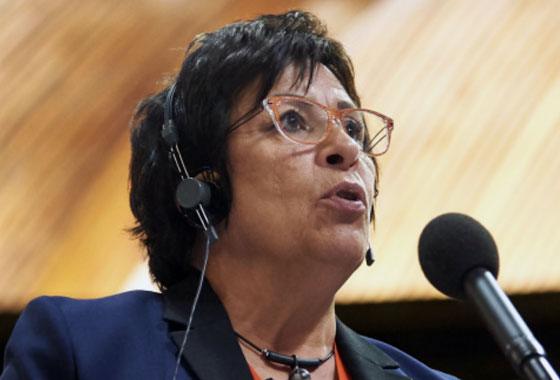
France, PPE/DC, Porte-parole du groupe
12:05:40
Thank you, Madam President,
Mr Rapporteur, Mr Mr Carlos Alberto GONÇALVES,
Dear colleagues,
The world of sport has been hit very hard by the Covid-19 pandemic, whether it be high-level competitions that have been cancelled or postponed, or amateur sports that have been made impossible because of confinements or restrictions on access to sports facilities. The consequences of this upheaval are multiple.
All categories are concerned. Athletes are particularly affected because they can no longer train properly and see their income threatened. The general public also pays a heavy price because the impossibility of practicing a regular physical activity has significant consequences on physical health: weakening of the immune system, weight gain, deterioration of sleep and, in terms of mental health, increase in stress.
Low-income families are more vulnerable and the situation of their children is becoming worrying because of the lack of physical activity. As our Rapporteur has pointed out, I am not forgetting all the volunteers who work in the sports world because they create this essential social link. Many sectors are affected: health, education, tourism, trade and, of course, the media.
The GDP of the European Union linked to sport dropped by 15% in 2020. The importance of sport is clear and we must ensure that this sector is included in the post-crisis recovery plan.
I support your proposal concerning the access of the sport sector to European funds: this seems to me to be a good level of intervention. I welcome the fact that the revised European Sports Charter of the Council of Europe proclaims that access to sport for all is a fundamental right and that every human being has the inalienable right to access sport in a healthy environment.
Like you, I urge all member states of the Council of Europe to ratify the Saint-Denis Convention, which calls for an integrated approach to safety, security and spectator services at sporting events. This would allow the resumption of championships in the best possible conditions.
Sporting events are an important source of revenue and play a key role in the recovery of the sector. They should not be tainted by suspicion. Like you, I believe that the Council of Europe Convention on the Manipulation of Sports Competitions, the so-called Magglingen Convention, should be ratified by all Council of Europe member states.
Therefore, the Group of the European People's Party will vote for the resolution submitted for our approval and I thank you and congratulate you for your work.
Thank you.
France, ADLE, Présidente de l'Assemblée
12:08:51
Thank you Ms Marie-Christine DALLOZ.
I now give the floor to Mr Oleksii GONCHARENKO for the European Conservatives Group.
It is your turn.

Ukraine, CE/AD, Porte-parole du groupe
12:08:57
Thank you Madam Chair. Thank you to the rapporteur for his great work and a really important report.
I would like to speak about the fact that sport should be out of politics.
That's extremely important today, because we know historically that dictators, tyrants, they like to use sport to cover their crimes and to show their might. We know this starting from Mr Adolf Hitler and finishing with Mr Vladimir Putin. We know that on 8 August 2008, on the day of the beginning of the Summer Olympic Games, Mr Putin started an aggression against Georgia. Immediately after the Winter Olympic Games 2014, on the last day of the Olympic Games, he started an aggression against Ukraine.
Now in several days we will have the start of the new Winter Olympic Games. What we see now is hundreds of thousand military troops on the borders of Ukraine, Russian troops ready to invade. That is a huge challenge for the whole continent and even the world. Again, he is trying to cover this up with sport events and that is very bad.
By the way, we see that tyrants also like to show the successes of sportsmen from their countries to be their own successes. For this they are making sportsmen use doping, they are making officials help them in this, they are persuading doctors to do this. What we have now is, for example, the Russian Federation could not raise the Russian flag at the Olympic Games because of their misuse of doping. Their sportsmen had to come under the Olympic flag and could not say that they represented the Russian Federation. That is something awful which we see with our own eyes.
So we need to have a very clear understanding in our organisation, which fights for human rights, democracy, and rule of law, that sports cannot be used to cover up violations of human rights, democracy and the rule of law by different dictators all over the world.
We need to stop things like this. We need to speak about this clearly. Sport should be really pure. It should be about human health. It should be a way to fight xenophobia. It should be a way to fight inequality in the world – but not be used by tyrants.
So that's the topic I wanted to raise. Thanks again to the rapporteur. I'm sure that we need to speak about things like this, because they influence our life extremely today. Sport is such a huge and important part of the life of millions of Europeans, that we cannot just look at it and say you can do whatever you want there: no you cannot.
Sport should be out of politics. Sport should really be about values, and not about tyrants.
Thank you very much.
France, ADLE, Présidente de l'Assemblée
12:11:59
Thank you.
I now give the floor to Mr Dara CALLEARY, I hope I'm pronouncing his name correctly, for the Alliance of Liberals and Democrats for Europe.
He is online.

Irlande, ADLE, Porte-parole du groupe
12:12:11
Thank you, Madam Chair, and thank you to the rapporteur for his very good report and for his very passionate remarks.
I welcome the recommitment within the report to the European Sport Charter of our Council and in particular the assertion that all human beings have an inalienable right of access to support in a healthy environment. I endorse the rapporteur's views on sports being part of a holistic vision that is much more than one thing, and that governments must consider it as thus also.
Many governments have outlined plans, including our own, to invest in sport at the levels outlined in the report. And I think, as I have said, in relation to football it would be useful for us to revisit this issue next year to see how those plans were implemented and to see the impact that they had.
Sports in the post-pandemic phase, as we hopefully move into that, is under huge pressure. The values of sports in terms of community involvement, of volunteer involvement, and of amateur involvement are under huge pressure. But let's be real: they were under this pressure before the pandemic, too. And I think that we must ensure that in a post-pandemic environment with a new view of life that sport is crucial to that view.
I come from a country, Ireland, where our biggest sporting organisation, the Gaelic Athletic Association, is based on amateur sports. Its teams are all amateurs. It is a very professional body, with staff working for it. It has 2,200 clubs in the 32 counties of our island and another 400 clubs around the world. One million people watched the All-Ireland football final on television last year, and it is regularly the biggest viewing event of the year.
The Gaelic Athletic Association has its roots in every community that it is in.
It does not owe its roots to commercial or to other agendas and I welcome the remarks, I endorse their remarks, that the foundation of that kind of spiritual spirit is being chipped at.
Finally, Madam Chair, I would like our rapporteur to reflect on, in the context of his holistic views, to reflect on sport as an inadvertent, and has to be emphasised, inadvertent facilitator of addiction. Things such as gambling, things such as alcohol, as drugs, that sports maybe use in a manner that was never intended to be, by commercial interests. And that a consequence of that use is that citizens and their families may be suffering. That is something we must be aware to, something we must be wise to, something we must be attentive to, in terms of our policy on our declaration.
Thank you, Madam Chair.
France, ADLE, Présidente de l'Assemblée
12:15:14
Thank you.
I now give the floor to Mr Thomas PRINGLE for Group of the Unified European Left.
Irlande, GUE, Porte-parole du groupe
12:15:22
Thank you, Madam Chairperson.
The COVID-19 pandemic was and certainly is a time of crisis. That definition is certainly true. The value of sport, both high-level professional and grassroots level, cannot be underestimated at this time and I think that that was one of the lessons of the pandemic.
As the report says, small clubs and associations are the backbone of the European sports movement, nurturing local participation and community belonging. I think it also has shown that ultimately the only body that can protect sport and support it in difficult times is the state. I think that is something that we should not be afraid of either. The return for the state and society are well worth it and pay dividends in the long run. There is the ability of people to have an outlet during lockdown when sporting activities still went on behind closed doors without attendances served as a vital outlet for citizens.
Also, sporting organisations at a local level were able to provide support for the community in the early stages of the pandemic by having a readily available pool of volunteers who were able to ensure that there was a widespread response that helped the vulnerable in society. They should not be forgotten at this stage of the pandemic. We appear to be moving out of this pandemic but there is a chance, probably, that it could happen again. Hopefully not, but who really knows?
Funding for sports at a national level is critical and given the large drop in sponsorship – 26% in Ireland, one of the highest in Europe – shows that we cannot rely fully on the private sector to support sporting organisations. So really, the only viable option is the state. We need to devise ways to show that value for money has been achieved by supporting the sporting organisations.
I agree with the report when it says we need to value sport's strong interconnections with other sectors, such as health, education, tourism, construction, transport, research and innovation, digital transition, green transformation, media and retail, and indeed this may not even be an exhaustive list at this stage. But it shows the interconnectedness of all of society and the constant attempt to siphon off the profitable uses for the private sector does not ultimately benefit society at all. Ultimately, it is a state that must pick up the slack and save the day. Why should we do that for the benefit of the private sector whose only drive is to make a profit for itself.
I think if states and politicians were honest with themselves and their communities, the lesson from the pandemic in terms of sport and wider society is that we need a state that can pick up the slack for the benefit of everyone. We should have that as a lesson of a pandemic as well.
Thank you.
France, ADLE, Présidente de l'Assemblée
12:18:01
Thank you, Mr President.
I now give the floor to Ms Marietta KARAMANLI for the Socialists, Democrats and Greens Group. She is online.

France, SOC, Porte-parole du groupe
12:18:12
Good morning, Madam President,
Dear colleagues,
First of all, I would like to thank our colleague the rapporteur for his proposals concerning sport policies in times of crisis. His recommendations have a double dimension: to include sport in the framework of recovery plans and in sustainable development.
In the first case, the recovery must therefore address the sports sector, both industrial and service, as well as amateur and leisure – I was going to say pleasure. The report makes demands of the Olympic world to harmonise measures for the protection of athletes and the public during competitions and major meetings, and also to guarantee sustainable funding.
I will make two observations on behalf of my other group.
First, the observations made: a first observation is that sport – and physical activity – forms part of health policy. It contributes to a policy of health prevention by fighting against the sedentary lifestyle that the pandemic itself has encouraged and, as such, it should not be conceived as an external element of a policy in favour of health but as a pivot of it. Moreover, it contributes to social relations through the personal and physical involvement it requires and the human interactions it encourages. In this respect, simple outdoor activities such as walking and cycling have experienced unprecedented growth; new categories of people, particularly women and young people, have taken up these activities.
These changes must therefore be taken into account: urban spaces must take better account of needs; facilities must be built and made accessible to as many people as possible, especially in working-class neighbourhoods; investments must be monitored; and an indicator of health improvement linked – or correlated, at any rate – should be devised and implemented, showing progress and encouraging it.
My second observation is that if access to sport and physical activity for as many people as possible is a societal issue, during and outside of the crisis, it is not enough in itself to impose itself on everyone. The pandemic may have made many people reluctant and demotivated. It is therefore necessary to help the stakeholders, schools, clubs, at all levels, educators, volunteers, universities, communities, through training and high level research, to develop capacities, actions and resources to make people like physical activity.
Finally, some European countries have developed models and best practices that can be used as case studies, with wide-ranging consultation mechanisms, where children and youth are actively involved in the planning and implementation of programmes that concern them.
This is what I wanted to reiterate on behalf of our group, which strongly supports this report. I would like to congratulate you in advance.
Thank you.
France, ADLE, Présidente de l'Assemblée
12:21:18
Thank you, Ms Marietta KARAMANLI.
We will continue with the list of speakers. So, I would like to say that the next three are on the line. If they would like to prepare themselves already.
We are going to call Lord Leslie GRIFFITHS but I would like Ms Linda Hofstad HELLELAND and Mr Claude KERN to be ready so as not to waste time.
Lord GRIFFITHS, you have the floor.
Thank you very much indeed Chair.
We are grateful indeed for the hard work that's brought this report to our attention.
Sport is indeed a factor for human development and personal and collective wellbeing, as well as for social development and economic growth. Money has radically changed the aura and atmosphere of sport during my lifetime. Its driving forces now are often profit, prestige and a cult of celebrity. This leaves sport with a dangerous underside which harbours inequality, abuse, prejudice and violence. In a body like this, we must surely give our attention to these factors.
In my remarks, I want to honour those who within their various sports have contributed handsomely towards addressing the human rights agenda we all care about. I can only give a flavour of the range and influence of such people:
Marcus Rashford and Raheem Sterling – UK footballers who have stood up against racism, as well as proving leaders in the struggle against poverty.
In cricket, Azeem Rafiq has blown the whistle on deep-seated racism.
In the USA, Colin Kaepernik, one of American football's iconic players, took the knee during the singing of the national anthem in his protest against racism and also unchecked police brutality.
Simone Biles, an astoundingly brilliant gymnast, brought the question of mental illness and a dehumanising coaching regime to the attention of the whole world.
Peng Shuai, a promising Chinese tennis player, appears to have been banished after making allegations of sexual abuse against a highly placed official.
Billie Jean King is renowned for her championing of women's rights in professional tennis.
She and more recently Tom Daley, medal-winning diver and contented knitter, have openly championed gay rights.
Harry Wales established the Invictus Games and thereby gave wounded, sick and injured ex-servicemen and women opportunities for competitive sport.
Lewis Hamilton, flag flyer for more diverse participation in Formula One racing, has founded a charity to advance the cause of talented young people from ethnic minority groups, and is also offering leadership in the search for greener ways of running the sport in which he excels.
Finally, we shouldn't forget Grigory Rodchenkov, who blew the whistle on Russia's state-run doping programme, revealing a deep web of deception and fraud that he had once helped to facilitate.
Voices like these coming from within sport are likely to carry a huge amount of importance.
And bodies like ours should aim to support and enhance their work and bear witness, for these are very brave people.
Thank you.
France, ADLE, Présidente de l'Assemblée
12:24:48
Thank you Lord GRIFFITHS – who was for the United Kingdom – I forgot to give the country.
Now we will hear from Ms Linda Hofstad HELLELAND for Norway.
I thank the rapporteur for an important report.
He points to important challenges that need to be addressed within international sports. I fully concur with his observations and conclusions.
While fully respecting that anti-doping was not included in this report, I nevertheless would like to take this opportunity to talk about this important matter.
Doping is still one of the major threats to our sporting values.
Fair play and clean sport is crucial to the integrity of sport and sport competitions.
Over the last few years, we have witnessed considerable challenges and threats to the integrity of sports.
We need to stand united in the global fight against doping.
The anti-doping effort from the Parliamentary Assembly should be based on the principles of independence, separation of power and providing a transparent and accountable sport.
All anti-doping work must be transparent, open and accountable, done with respect for human rights and the rule of law.
When the pandemic hit hard in March 2020, the anti-doping work was paralysed. Very few tests were carried out and many asked whether it was now easier than ever before to attack the integrity of sport.
It’s good that the overall anti-doping efforts have advanced a bit from before, but statistics still show a significant decrease in the number of doping tests worldwide. This worries me, President.
In the future, public authorities and NADOs must have a contingency plan on how to deal with such crises. We need to have the right tools to protect clean athletes, also in a pandemic. That is sports integrity.
The biggest problem in sports, even during a crisis, is doping. And because of this, it needs to be on our agenda.
I therefore, Madam President, would like that the committee working on sports, the Committee on Culture, Science, Education and Media, asks experts in the World Anti-Doping Agency, to give a briefing, and update, on the current situation. Not only the data on the number of tests, but also how the pandemic has affected anti-doping efforts, and what we need to do in the future to strengthen our efforts towards clean sports and the fight against doping.
Thank you.
France, ADLE, Présidente de l'Assemblée
12:28:07
Thank you, Madam.
Mr KERN, from France, please.
Thank you Madam President.
Dear colleagues,
I would like to thank our Rapporteur, Mr Carlos Alberto GONÇALVES, for his very precise analysis of the issues related to sports policies in times of crisis. I am all the more sensitive to it as I was, in the French Senate, the rapporteur for the bills relating to the organisation of the Olympic and Paralympic Games 2024 and I have often spoken about sports values and access to sports practice.
The report of our colleague rightly underlines the general issues and the international mechanisms that contribute to an integrated practice of sport. I would like to echo his call for the promotion, ratification and effective implementation of the principles contained in three Council of Europe conventions that are particularly important in this respect: the revised European Sports Charter, the Saint-Denis Convention on an integrated approach to safety, security and services at football matches and other sports events, and the Magglingen Convention on the Manipulation of Sports Competitions.
I also fully agree with the need to put in place financial support and policies adapted to the development of sport for as many people as possible. I have intervened a lot in the Senate on this subject and I want to inform you that the Senate has just adopted, last week, a bill, after the National Assembly, aiming at democratising sport in France. In the absence of action from the government, it is the Parliament that has taken up the issue, in conjunction with the representatives of the sport movement. In the Senate, we have been particularly careful to introduce provisions aiming at developing sport in schools, to better value the commitment to sport at the university level or to boost "sport-health".
Beyond the action carried out at the national level, I would like to emphasise the importance of local sport policies implemented by the local authorities. In a fairly recent report, I insisted on the importance of partnership governance between the state and local authorities but also on the need to respect local practices.
Finally, the issue of resources is a major one. I agree with the wish expressed by our colleague that, beyond public resources, the high-level sports movement, which for some sports receives considerable resources linked to sports rights and by-products, can show solidarity in order to allow access to sport for the greatest number of people. This is a great challenge for society and I will therefore vote for the resolution presented to us.
Thank you for your attention.
France, ADLE, Présidente de l'Assemblée
12:31:06
Thank you, Mr KERN.
We end the list with Ms Petra BAYR, from Austria.
Thank you very much Madam President.
I really want to support this report. I think it tackles really very important issues, but I want to add another thought: the crises we all witness on many folds – the pandemic, the climate crisis, the crisis of democracy, of rule of law, of uneven distribution of wealth and I would like to add another one which is the growing intolerance. In this respect it is another crisis we are facing: the dislike of the unlike, it's growing in a rapid way and the othering – to see people as the other – is spreading.
In my work on the report on combating antisemitism in Europe, I became aware of the very important role of sports and in particular of football in combating hate and intolerance.
Very often the outcry, the chants, the flags of sports fans really spread hate. They are racist, fuel prejudices, and feed hate. When sports stars speak out against hate, intolerance, antisemitism and racism, they can have a really huge impact on their fans, making them reflect on what exactly their chants mean, who they are hurting; they really become aware that they might be infringing human rights and that they simply are discriminating against other human beings. That's the opposite of the spirit of sport, quite often.
Another reason why sports activities, and sports in general, must be supported in time of crisis is this social impact on the cohesion of our society.
We should really value the impact of sports in combating hate and misanthropy. I will try to include this function of sport in my newly elected function as General Rapporteur combatting racism and intolerance.
Thank you very much for this report. I think it's really inspiring and shows how many functions sport might have.
Thank you.
France, ADLE, Présidente de l'Assemblée
12:33:49
Thank you Ms BAYR.
I must now interrupt the list of speakers. Registered speakers who are present during the debate or who are connected remotely and who have not been able to speak may, within four hours, transmit their typed statement to the session service for publication in the record, provided that the remotely connected speakers can prove their actual presence at the time the debate is closed. This transmission must be made electronically.
Mr Rapporteur, you have three minutes to reply. It is your turn.
Portugal, PPE/DC, Rapporteur
12:34:33
Thank you, Madam Chair.
I am going to appeal to my spirit of synthesis although there are many questions, relevant questions.
I would, of course, like to thank my colleagues for their questions, their proposals, their suggestions, their comments and to say that sport is really a fundamental sector. That is why one of the themes that runs through our whole debate is this European Sports Charter, which provides for sport for all as a fundamental right. I think that this is something that is transversal to all the debates, in view of the new events, at least for our generations, the very difficult moments, the crises, the consequences at various levels for our societies. Of course, there is also a huge impact on sport, a sector that is also transversal in our society and that has an economic role, as was already mentioned by a colleague.
However, it is true that in this report I wanted to emphasise its social role, because sport promotes inclusion, integration, and social cohesion. It promotes values such as solidarity, healthy lifestyles - we have talked about this during this debate - and education. I often call it a "school of life".
Our colleague who spoke last talked about issues of inequality and differences. Sport is a good example where, often, these inequalities and differences become blurred. When you see, for example, the national selections of my country - you will look at them if you see them - you have all the modalities. There are players who, even if they are Portuguese by nationality, have several origins, are believers of various religions. Nevertheless, they are there to defend a country, and this is an example that sport can integrate everyone. It has the capacity to do so, and it is an example.
That is why this pandemic that has left people at home has not allowed inequalities to decrease: they have sincerely increased.
It is true that this report thinks, of course, about financial recovery, about financial solidarity which seems very important to me. The high level sport which, today, has a lot of money, must help the sport of small communities, small clubs. We know that in the most difficult districts, it is like that.
We have talked about the Macolin Convention, the Saint-Denis Convention and, as I have already said, the European Sports Charter. We can see that here, at the Council of Europe, we have done important work, work that is recognised, so that this sector is really recognised.
We know that sport, as I said, is a major social factory and is therefore sincerely important for the quality of life. I think we had a morning at the Parliamentary Assembly of the Council of Europe that dignifies not only this sector but above all this Chamber.
I hope to have the support of our colleagues when we vote on the draft resolution and in our respective national parliaments. We will also have to do our job and take into account what we will approve today.
Once again thank you, Madam President and all the colleagues who are in the room and on the line.
Thank you.
France, ADLE, Présidente de l'Assemblée
12:37:43
Thank you.
Mr Chairman of the Commission, did you want to add something? It's your turn.
Royaume-Uni, CE/AD, Président de la Commission de la culture, de la science, de l'éducation et des médias
12:37:54
Thank you very much, Madam President.
Dear colleagues,
This excellent report by Mr Carlos Alberto GONÇALVES emphasises how important sport and physical activity are to the good health of people of all ages, as well as for bringing them together in their local and national communities, as the rapporteur in his reference to solidarity has just emphasised.
Clearly sports and being physically active benefit everyone. Both should be encouraged by all those in a position to do so, whether they be public authorities, parliamentarians or sports organisations themselves. However, public authorities and sports organisations ought to work together more than they probably do, advertising the advantages of health exercise, enabling more options if possible, providing better incentives, if necessary.
Different areas should also compare notes more than they do in order to find out to mutual advantage what works best in a variety of different communities to achieve a greater number of people playing sports and taking proper exercise.
Paradoxically, the recent Covid-19 difficulties may even assist more sport and exercise since the determined result now to study properly what works best, not least taking into account newly developed facilities, can pave the way towards a significantly better uptake when restrictions come to be removed later on, and significantly better than it might have been before Covid-19.
The draft resolutions draw our attention to several important points: that healthy exercise and sport is for everyone, the aspect of equal rights, the need to protect women's sports, and in all places, the priority to look after the vulnerable who otherwise might be denied opportunities.
Eight amendments have been tabled. The Committee has not been able to take a position. However, the rapporteur will be able to guide us. Meanwhile, on behalf of the Committee, I thank him very warmly for this extremely useful report.
France, ADLE, Présidente de l'Assemblée
12:40:07
Thank you, Lord Alexander DUNDEE.
The discussion is closed.
We shall discuss the draft resolution, to which, as you said, eight amendments have been tabled but not discussed in committee.
Consequently, in accordance with Rule 67.4.d of the Rules of Procedure, the Rapporteur will be given the floor to express his personal position on these amendments.
Ladies and gentlemen, I remind you that the speaking time for each amendment is limited to 1 minute.
Who wishes to propose Amendment No. 2? Is Mr. Andrey EPISHIN on the line or anyone else?
Mister EPISHIN, you have 1 minute for Amendment no. 2.
Speech not pronounced (Rules of Procedure, Art. 31.2), only available in French.
(Undelivered speech, Rules of Procedure Art. 31.2)
We all know the Latin phrase meno corpore, sana corpore which means healthy mind in a healthy body and all research bears this out that physical exercise is an important and essential part of mental and psychological well-being.
We in Ireland love our sport, both participating and watching/supporting – I can tell you that the excitement on All-Ireland days in September for football and hurling are experiences to behold. Of course many other sports such as rugby, soccer, tennis, horse racing, golf, etc. are hugely important to us. Also apart from the physical benefits – the team participation and working together aspect is also a crucial role that brings benefits to other paths of life.
I commend the rapporteur’s report and recommendations, he is correct in saying that sport was one of the sectors hardest hit by the restrictions imposed. It is interesting to look at the
Value of Sport in Ireland
Sport-related consumer spending has increased by 77% over the past ten years. It generated €3.3 billion in the Irish economy in 2018 through increases in subscription fees, more spending on fitness club memberships and more investment on sports equipment as well as other factors.
97,000 cases of disease were prevented due to physical activity participation in 2019 saving us over €498 million. Just under 9,500 cases of chronic heart disease and stroke were prevented alone.
Sport provides 64,080 jobs or just under 3% of employment. This is a significant increase from just over 2% in 2008.
The huge number of volunteers involved in grassroots sports is also noteworthy.
Apart from the economic impact on sport, its key role as a means of building social capital, its contribution to social inclusion and combating inequalities is immeasurable. Organisations like Special Olympics provide important opportunities to those with intellectual disability to participate in team sports exclusively and within integrated mainstream sporting organisations. I would also like to mention SARI who address racism through their sports work.
Amongst the hardest hit from the pandemic is grassroots sport. Our own Minister for Sport, jack Chambers has put a key focus on this in terms of financial supports to build back well and better, providing targeted support to support grassroots sporting organisations and social inclusion.
We also need to address the area of sponsorship and send strong messages about the types of sponsorship that are not appropriate – for example from drinks companies and sports betting organisations.
Speech not pronounced (Rules of Procedure, Art. 31.2), only available in French.
Speech not pronounced (Rules of Procedure, Art. 31.2), only available in French.
Speech not pronounced (Rules of Procedure, Art. 31.2), only available in French.
(Undelivered speech, Rules of Procedure Art. 31.2)
Thank you Chair,
We recognize the splendid work of Mr. Carlos Alberto Gonçalvez in preparing this report and we support the resolution.
The COVID-19 pandemic and the measures to address the crisis affected the way in which sports are practiced, and the way the public attends sport events. Therefore, it is required an orderly response of authorities at local, national, and international level as recognized in the proposed resolution, celebrated by the Mexican delegation.
The sanitary crisis requires innovative solutions, and maybe permanent, so that the population may continue to benefit practicing sports and physical activity, specifically aiming the body and mind health.
In Mexico, the practice of sport is a constitutional right for every person, and the State has to promote its practice through the implementation of programs for the exercise of this right.
The pandemic made evident the weakness of our health system and showed the incapacity to implement the required actions for its control, in order to prevent the avoidable mortality caused by COVID-19.
In this pandemic context, physical activities and sport practice could turn into an important tool to support public health; it could confront the negative effects of the pandemic on mental health and on the overweight and obesity faced by Mexicans.
Nonetheless, the Federal government did not set its full attention and interest in fulfilling this responsibility in relation to physical activity and sport, assigning for 2022, 73 million euros for the sport and physical activity budget. This represents just one euro per year for every two inhabitants, an amount significantly reduced if compared with previous years.
With these actions, our country will clearly maintain its difficult status in complying with the SDG 3, specifically “Ensure healthy lives and promote well-being for all at all ages”.
The Mexican delegation deem the proposed resolution as an achievement, inviting the public authorities to:
Develop intersectorial policies to promote sport and physical activity in an ethical inclusive and safe environment, establishing pertinent health measures.
Use sport to face the pandemic negative impacts.
In The Mexican Congress, PAN parliamentarians will keep insisting for the government to assume its responsibilities and guarantee the right to practice sport. We trust the Parliamentary Assembly of the Council of Europe to keep up its excellent work regarding the respect, protection and promotion of this right, whose ultimate aim is social wellbeing.
Thank you
Thank you very much, Madam President.
Regarding this Amendment what we suggest is that you support this Amendment without mention of the specific text.
France, ADLE, Présidente de l'Assemblée
12:41:55
Thank you, sir. Please stay on the line as there are others that are supposedly from you.
Is anybody against this amendment?
Mister Rapporteur?
Portugal, PPE/DC, Rapporteur
12:42:08
Madam President,
Mister EPISHIN,
I am against this amendment. I am not in favour of it because it aims to eliminate the mention of the European Sports Charter, which is the new reference text of the Council of Europe in this field and which is innovative because it carries the idea of the right of access to sport as a fundamental right.
It has been discussed in the debate. Several colleagues have mentioned it, which shows its importance. To eliminate this point would, of course, weaken the report.
France, ADLE, Présidente de l'Assemblée
12:42:38
We will therefore proceed to the vote. The rapporteur, in his personal capacity, is against this amendment.
Amendment No. 2 was rejected.
Amendment No. 3: Mister EPISHIN?
Yes, thank you.
We have some misgivings about the words "financial solidarity". This could be used to set up mechanisms which might exert additional pressure on countries which have fallen from favour, if you will. So we ask for your support for this Amendment.
France, ADLE, Présidente de l'Assemblée
12:44:06
Is anyone against this amendment?
Mister Rapporteur, your opinion?
Portugal, PPE/DC, Rapporteur
12:44:13
Madam Chair,
I am against it. I am not in favor of the amendment because it seeks to delete point 6 entirely, which calls for the establishment of safeguard mechanisms and the strengthening of financial solidarity. This goes against the very philosophy of the report.
France, ADLE, Présidente de l'Assemblée
12:44:31
Thank you. We will therefore put to the vote this amendment, which has received an unfavourable opinion from the rapporteur personally.
Amendment No. 3 is rejected.
Amendment No. 4: Mister EPISHIN, we are listening to you.
Thank you.
The idea of getting sportsmen and various organisations representing them involved in sports decision-making is controversial. So we ask for your support for this Amendment.
France, ADLE, Présidente de l'Assemblée
12:45:57
Thank you, sir.
Is there anyone against?
Mister Rapporteur, your opinion?
Portugal, PPE/DC, Rapporteur
12:46:04
Madam President,
I am against this amendment because it seeks to qualify point 9 of my report, which advocates the participation of fans and sportsmen in the decision-making process, by adding "as appropriate and in accordance with national legislation". The proposed nuance, de facto, removes all force from the statement because everything is up to each State. This issue of fan participation is a theme that, even in the debate, preceded ours.
Thank you.
France, ADLE, Présidente de l'Assemblée
12:46:34
Thank you, Mister Rapporteur.
We will proceed to vote on Amendment no. 4, which was personally rejected by the rapporteur.
Amendment No. 4 has been rejected.
Amendment No. 5: Mister EPISHIN, you have the floor.
Thank you.
For us it is unacceptable that you are coming up with new categories of vulnerable situations, including amateur athletes and volunteers in that group.
We would prefer to say "people in vulnerable situations" without including the whole list. I think that would be easier and better.
Thank you.
France, ADLE, Présidente de l'Assemblée
12:47:58
Thank you, sir.
Is there anyone against?
Mister Rapporteur, your opinion?
Portugal, PPE/DC, Rapporteur
12:48:06
Madam Chair,
I am against because this amendment seeks to broaden the scope of the targeted support that is requested for vulnerable people. Athletes and several sports actors are mentioned.
I can understand what Mr Andrey EPISHIN has proposed but we are talking about sport. This is a report on sport and, frankly, to broaden it without defining it is really not in the scope or, at least, the objective of the report. I can understand, but this is about sport, only sport. To do otherwise would be to open it up to everything. It is a report only about sport and the agents associated with this sector.
France, ADLE, Présidente de l'Assemblée
12:48:42
Thank you, sir.
We will now proceed to vote on the amendment, which was rejected by the rapporteur personally.
Amendment No. 5 was rejected.
Amendment No. 6, Mister EPISHIN? It is yours.
Yes, thank you.
We already mentioned this when discussing another amendment, involving fans in sports governance is a very controversial idea. That's why we hope this Amendment will garner your support.
Thank you.
France, ADLE, Présidente de l'Assemblée
12:50:12
Thank you.
Is there anyone against?
Mister Rapporteur, your opinion?
Portugal, PPE/DC, Rapporteur
12:50:21
Madam Chairperson,
This amendment again seeks to qualify paragraph 10.5 by again adding "as appropriate and in accordance with national legislation". It is therefore symmetrical to Amendment No. 4 and, of course, raises the same problem.
France, ADLE, Présidente de l'Assemblée
12:50:36
Thank you, Sir.
We will now proceed to vote on amendment no. 6, which was rejected by the rapporteur personally.
Amendment No. 6 was rejected.
Amendment No. 7: Mister EPISHIN, you have the floor.
Thank you.
In this case, we are somewhat baffled by the focus here on EU structures and mechanisms.
As you know, we have a much broader membership here at the Council of Europe than in the EU.
Therefore, we hope you can support this amendment.
France, ADLE, Présidente de l'Assemblée
12:52:00
Thank you.
Is there anyone against?
Mister Rapporteur, your opinion?
Portugal, PPE/DC, Rapporteur
12:52:08
Madam President,
I am against this amendment to delete paragraph 11, which concerns the access of the sports sector to the European Union's financial instruments. This is a proposal that I have insisted on a lot, and I think it would be a shame to lose it.
In addition, when we look at our document, there is, of course, also a proposal to have partnerships with countries bordering the member States of the European Union.
This is a theme on which I have insisted a lot, and I think that the report would lose some of its substance without this point.
France, ADLE, Présidente de l'Assemblée
12:52:40
Thank you very much, Sir.
We will proceed to vote on amendment no. 7, which was rejected by the rapporteur personally.
Amendment No. 7 was rejected.
Amendment No. 8: Mister EPISHIN, it is your turn.
Yes, thank you.
We see this paragraph as an attempt to impose model contracts in sports.
We hope you can support our amendment.
France, ADLE, Présidente de l'Assemblée
12:54:03
Thank you.
Is there anyone who wishes to speak against?
Mister Rapporteur?
Portugal, PPE/DC, Rapporteur
12:54:11
Madam President,
I am against because this amendment aims at deleting paragraph 12.4, which invites to review the standard contracts, for example those with host cities and other sites for the organisation of major international competitions, in order to better cover the risks related to the pandemic.
I think that this is an important point in this report, and my opinion is therefore unfavorable.
France, ADLE, Présidente de l'Assemblée
12:54:35
Thank you very much, Sir.
We will proceed to vote on amendment no. 8, which was rejected by the rapporteur in his personal capacity.
Amendment No. 8 has been rejected.
The last amendment is No. 1. I call Mrs Svetlana ZHUROVA to support this amendment. You are on the line: I am listening.
Thank you, Madam president.
Many thanks to the rapporteur for his report.
I would like to support paragraph 12 but I want to introduce an amendment. The aim being to ensure full participation in international sporting events of athletes who have been vaccinated with vaccines available and recognized in their countries
For instance, if you get vaccinated and then that vaccine is not recognized in the country you are going to compete in, you might be placed in quarantine even if you've taken a negative PCR test. And we've seen the difficulties which can occur with Novak Djokovic in Australia, so we need, in short, a more responsible approach to this.
If athletes have been vaccinated, even if that vaccine is not recognized by the country where the event is taking place, we need to protect the rights of the athletes in question, so that they can partake in the competition on an equal footing with other sports people.
France, ADLE, Présidente de l'Assemblée
12:56:56
Thank you, Madam.
Is there anyone in the room or on the line who is opposed?
Mister Rapporteur, what is your opinion?
Portugal, PPE/DC, Rapporteur
12:57:07
Madam President,
My opinion is favourable. I think that the amendment proposed by Ms Svetlana ZHUROVA is an important and topical issue today. It is an issue that has been brought to us, so I think it is interesting to introduce her amendment in this report.
France, ADLE, Présidente de l'Assemblée
12:57:23
Thank you, Mister Rapporteur.
We will proceed to vote on Amendment No. 1, which the Rapporteur personally approved.
Amendment No. 1 is adopted.
That concludes the amendments.
We shall now proceed to vote on the draft resolution contained in Document 15426 as amended. A simple majority is required.
The draft resolution is adopted.
I thank you and wish you a good appetite.
The next public meeting will be held this afternoon at 3:30 p.m., in accordance with the agenda of this part-session.
The meeting is closed.
For the record, I would like to mention that I voted against the 1st Russian amendment presented by Mr Epishin by a mistake on item Sport policy in time of crisis.