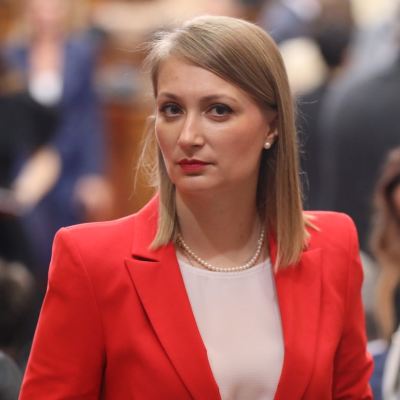
May I invite you to take your seats, please.
I declare the Second Part-Session of the 2026 Ordinary Session of the Parliamentary Assembly of the Council of Europe open.
Dear Secretary General,
Deputy Secretary General,
Secretary General of the Parliamentary Assembly,
Honourable Ambassadors,
Dear colleagues,
It is an honour to open this part-session for the first time as your President.
Three months ago, you placed your trust in me. I have not forgotten the gravitas of that moment. And I carry it with me every single day. Sometimes, these three months feel like years. Because the world does not wait for us to settle in. It does not slow down for transitions. It does not spare us its contradictions.
Since we last gathered, the ground has shifted. Not in one place, in many places, at once. And what we are witnessing is not a series of isolated incidents or crises, it is a pattern.
A pattern in which institutional law is bent and sometimes broken, in which democratic norms are challenged openly, shamelessly, in which human rights are treated not as universal, but as optional.
That should concern every one of us. Not just as politicians. It should concern us as human beings.
Russia's war of aggression against Ukraine continues. Civilians are killed. Infrastructure is destroyed. A people's future is held hostage.
And yet, I notice something troubling in addition. Attention is fragmenting. Support is becoming conditional, and commitment, elastic.
Let me be clear: Ukraine is not just defending its territory. Ukraine is defending the very principles on which this Assembly was built.
Solidarity is not a feeling. It is a choice, a choice made again and again, even when it is inconvenient. We must make that choice. Now. Together. By pushing to finally proceed with the special tribunal and the compensation fund.
The war in Iran is also evolving and escalating. A region that is already fragile is fracturing further. And the consequences do not stay over there. They reach our security, they reach our economies, our energy supplies, and the food security of some countries and the cohesion of our societies.
We cannot afford selective attention.
Every silence we choose is also a choice.
We are also confronted with decisions that strike at the core of who we are. The move to expand the use of the death penalty, in a discriminatory way, by the Knesset, a parliament that holds observer status in this very Assembly, is such a moment.
Let us not relativise this. The abolition of the death penalty is not a technical or legal position. It is a civilisational choice. It defines who we are.
And if we begin to treat our principles as flexible, we do not just compromise on policy, we compromise on principle. And once principles bend, credibility disappears. Credibility is not only about what we say. It is about how we act, especially when it is uncomfortable.
The reports raising serious questions about possible links between a former Secretary General of the Council of Europe and the criminal Epstein network cannot be ignored.
The relevant bodies at the Council are already investigating and working. And the Assembly will not remain silent either.
Integrity is not selective.
Accountability is not optional.
Transparency is not weakness, it is the foundation of everything we build.
The crimes associated with that network, corruption, exploitation, trafficking, rape, abuse, blank toxic misogyny, represent everything we stand against.
Our response must be unequivocal. Full investigation. Full accountability. Full justice for every single victim.
The values we defend in the world must first be lived within our own walls.
So when we see ongoing or newly initiated brutal and illegal wars, the breach of international obligations by an associated parliament, the disclosure of the poisonous and far-reaching effects of a criminal network, there are lots of reasons to be desperate, but desperation is not an option, not for us as politicians, and not for the people we represent and serve.
I want to tell you something I saw a few weeks ago.
Together with a large PACE delegation, I was in New York, at the UN Commission on the Status of Women. And despite the manifold backlash, despite the pressure, despite the regression, people are standing up.
Young people, women, civil society organisations from every corner of the world.
Mobilised. Determined. Unafraid.
And they asked a question, not so much in words, but in their eyes. Will Europe lead? Will Europe stand firm? Will Europe still be a place where rights are not just defended, but advanced?
I can tell you they are not only watching us. They are counting on us. From NGOs, like-minded states up to the Secretary General of the UN, all their hope lies in our continent.
Dear colleagues,
History will not judge us for the complexity of this moment. It will judge us for our response.
Whether we hesitated or whether we acted. Whether we drifted or whether we held our course. Whether we defended our principles or quietly allowed them to fade.
So today, we have a choice.
Not resignation, but responsibility. Not ambiguity, but clarity. Not fear, but determination. Not division, but unity.
Because the strength of this Assembly does not lie in any one voice.
It lies in our collective commitment. A commitment to stand together, across borders, across political lines, across differences, when it matters most.
Erosion does not happen dramatically. It happens step by step. Decision by decision. Silence by silence.
We are not observers of history. We are its authors. So let us be calm in tone. Clear in principle. And firm in action.
That is the leadership this moment demands. That is the leadership we will deliver together.
Thank you and let's continue working on a firm European future.
Before I move to the first item, I remind the Assembly that members who have not submitted an annual declaration of interests are required to start any intervention with an oral declaration of interest under paragraph 20 of the Code of Conduct for Members of the Parliamentary Assembly.
I also remind members that, in order to be registered for the sitting, you should insert your badge when you take your seat and keep it inserted for at least 30 seconds.
The next item on the Agenda is the examination of credentials of new members. The names of the members and substitutes are in Document 16379. If no credentials are challenged, the credentials will be ratified. Are any credentials challenged?
I don't see any challenges.
So they are accepted.
Then we come to changes in membership of committees.
The next item of the Agenda is to consider the changes proposed in the membership of the Assembly’s committees. These are set out in Documents Commissions (2026) 04, Addendum 1 and Commissions (2026) 05.
Are these proposals approved?
They are approved.
There is a request for current debates or debates under urgent procedure.
Before we examine the draft Agenda, the Assembly needs to consider requests for debates under the urgent and current affairs procedures.
The Bureau has received the following requests:
- Debate under the urgent procedure in the framework of the Assembly opinion requested by the Committee of Ministers: "Request for opinion on the draft additional protocol to the Council of Europe Convention on Laundering, Search, Seizure and Confiscation of the Proceeds from Crime and on the Financing of Terrorism".
The next one is:
- Current affairs debate from the Alliance of Liberals and Democrats for Europe: “Accountability and justice: a call to step up efforts for the establishment of the Special Tribunal for the Crime of Aggression against Ukraine”.
The next one is:
- Debate under the urgent procedure from the Unified European Left Group: “Suspension of Israel’s observer status with the Parliamentary Assembly of the Council of Europe in light of systemic violations of international law”.
Then the next one is:
- Debate under the urgent procedure from Mr Abdurrahman BABACAN and 19 other members of the Assembly: “Addressing Israel’s death penalty law in Occupied Palestinian territories in the context of Council of Europe standards”.
And:
- Current affairs debate from the five political groups: “The need for the respect of international law, peace and stability in the broader Middle East”.
At its meeting this morning, the Bureau decided to recommend the Assembly hold the following urgent debates during this part-session:
- Debate under the urgent procedure in the framework of the Assembly opinion requested by the Committee of Ministers: "Request for opinion on the draft additional protocol to the Council of Europe Convention on Laundering, Search, Seizure and Confiscation of the Proceeds from Crime and on the Financing of Terrorism";
The second is a current affairs debate from the Alliance of Liberals and Democrats for Europe: “Accountability and justice: a call to step up efforts for the establishment of the Special Tribunal for the Crime of Aggression against Ukraine”;
And, the last one is a current affairs debate from the five political groups: “The need for the respect of international law, peace and stability in the broader Middle East”. Is that agreed?
It is, so the Bureau’s recommendation is accepted.
(Oh, not? OK, everything is fine.)
The current affairs debate “Accountability and justice: a call to step up efforts for the establishment of the Special Tribunal for the Crime of Aggression against Ukraine” will take place on Thursday morning, as the first item.
The current affairs debate on "The need for the respect of international law, peace and stability in the broader Middle East” will take place on Thursday morning, as the second item.
And the urgent procedure debate "Request for opinion on the draft additional protocol to the Council of Europe Convention on Laundering, Search, Seizure and Confiscation of the Proceeds from Crime and on the Financing of Terrorism" will take place on Thursday afternoon, as the first item.
We can now move on to the next item of business, which is the adoption of the agenda for the second part of the 2026 Ordinary Session (Document 16353, prov 2).
The draft Agenda submitted for the Assembly's approval was brought up to date and adopted by the Bureau this morning.
I remind you that we have just agreed the urgent procedure and current affairs debates set out in the draft before you.
To allow more members to participate in this very busy part-session, the Bureau has decided to reduce speaking time in debates for some sittings within this part-session to two minutes instead of the usual three minutes. This reduction to two minutes will apply to all debates today, on Tuesday and on Wednesday.
Is the draft agenda as it was amended before with the three urgent items accepted? It is. So, it is agreed.
The next item on the Agenda is the debate on the Progress Report of the Bureau and the Standing Committee (Doc. 16377 and Addendums 1 and 2).
This will be combined with consideration of the report of the Ad Hoc Committee of the Bureau on the Observation of the early elections to the Assembly of Kosovo on 28 December 2025, which is Document 16380, presented by Mr Yunus EMRE.
I propose to interrupt the list of speakers at about 12.55 pm.
In the debate I call Mr Pablo HISPÁN to present the Progress Report.
You have 7 minutes now, and 3 minutes at the end to reply to the debate.
Mr Pablo HISPÁN, if you would like to come to the first row, we could start. And Mr Yunus EMRE, is already approaching us. Perfect.
Mr Pablo HISPÁN, you have the floor for a maximum of 7 minutes now.
(Whenever you want to speak, you need your badge. Without your badge, no words).
Madam Chair,
At its meeting on 2 March 2026, the Bureau appointed me as the rapporteur for this report, which covers activities from the last Bureau meeting of the first part-session of Friday 30 January 2026, until this morning's press session Bureau meeting.
As you know, the progress report is basically a compilation of the decisions taken at Bureau meetings. Furthermore, Addendum 1 on gender equality in the functioning of the Parliamentary Assembly of the Council of Europe in 2025 describes an annual overview of the status of gender equality within the Assembly. In this respect, I would like to congratulate the Assembly on achieving gender parity among its members for the first time in its history.
Let me now highlight some of the main activities that occurred during the period covered by the present report and the three main topics.
First, election observation missions. The month of April was very rich and intense in terms of electoral activities. In Hungary, parliamentarian elections on 12 April, I had the honour of chairing the Ad hoc Committee that observed these elections. There was Bulgaria's parliamentarian elections on 19 April, with the delegation headed by Mr Chris SAID from the Group of the European People's Party Malta. On 17 April, a post-election technical mission to Pristina took place composed of the chairperson and vice-chairperson of the Ad Hoc Committee that observed the elections to the Assembly of Kosovo on 28 December 2025. My colleague Mr Yunus EMRE will certainly tell you more in a few minutes.
Second, Parliamentary Assembly of the Council of Europe (PACE) participation in major events. An Ad Hoc Committee of the Bureau participated in the Organisation for Economic Co-operation and Development (OECD) Global Parliamentarian Network in Paris from 11 to 13 March. The Assembly contributions and active participation in this event allowed to strengthen even further the long-standing strategic partnership between the OECD and the Parliamentary Assembly of the Council of Europe. An Ad Hoc Committee of the Bureau participated in the High-Level Conference on the European Social Charter in Chișinău on 18 and 19 March. The Assembly was represented at this event at the highest level by its President, but it also jointly organised a side event on the theme Multi-Level Governance for the Implementation of Social Rights, with the Congress in the margins of the Conference.
Third, other relevant initiatives during this period. The Václav Havel Human Rights Prize appointed our dear friend Ms Ingjerd Schie SCHOU as member of the Selections Panel. We are looking forward to working with her again in her new role.
The Bureau also approves the terms of reference of the new network of parliamentarians to promote the implementation of judgements of the European Court of Human Rights. Let me also point to the launching event of the new network which will take place today at 2:00 p.m. in room 11.
The Bureau also discusses at length developments concerning the Epstein files and the role the Assembly could take in this respect, bearing in mind the involvement of the former Secretary General of the Council in this scandal. As a first step, I cited the Committee on Rules, Ethics and Immunities to report on the need of accountability of the Council of Europe, high ranking officials elected by the Parliamentary Assembly and increased integrity standards for the organisation. Secondly, this morning, the Bureau has decided to cite its Committee on Political Affairs and Democracy for a report, a strong response to Epstein's files, ensuring full transparency and accountability.
I remain at your disposal should you require further information on the activities of the world during this period. Thank you for the attention.
Thank you very much.
And now Mr Yunus EMRE has the floor for his report.
Dear President,
Dear colleagues,
I had the honour to lead the Parliamentary Assembly delegation that observed early elections to the Assembly of Kosovo on 28 December 2025. I thank my colleagues in the delegation, the authorities of Kosovo, the Council of Europe Secretariat and the Council of Europe Office in Pristina for their support.
These elections took place in a difficult political context. They were the fourth elections in one year and followed a period of institutional deadlock. Our Assembly was the only international organisation to observe the elections. Despite political polarisation and limited preparation time, our overall assessment was positive. These elections were technically well-organised, professionally prepared and generally inclusive.
Election day was calm and orderly. We nevertheless identified several concerns.
First, the Central Election Commission (CEC) repeatedly refused to certify Srpska Lista, the main Kosovo Serb party. This decision was later overturned by higher authorities, which raised questions about the impartiality of the CEC.
Second, the voter register remains a serious problem. With around 2.1 million registered voters in a country of some 1.5 million inhabitants, the accuracy of the list must be improved.
Third, shortcomings remain in campaign finance, oversight, media independence, accessibility and the availability of election materials in languages used by non-majority communities.
Fourth, women's participation must be supported more effectively, not only through quotas, but through real opportunities to campaign and be elected.
Finally, out-of-country voting procedures should be reviewed and strengthened.
The most serious issues, however, emerged after election day. Following investigations and recounts, it appeared that around 240 000 preferential votes had been manipulated in several municipal counting centres. Last Friday, together with my deputy head of delegation, Mr STAMATIS, I visited Pristina for a post-electoral mission. Our conclusion was clear: this attempted manipulation was serious. It did not affect the distribution of seats between parties, but it distorted voters' preferences and undermined trust in the process.
The institutional response, however, was swift. The Central Election Commission detected the irregularities quickly, the prosecution ordered an immediate investigation, and the CEC decided on a full recount before certifying the results. We now expect Kosovo authorities to complete these proceedings, bring those responsible to justice and take firm measures to prevent such abuses in the future.
Dear colleagues, our delegation made several recommendations: depoliticise the Central Election Commission, update the voter register, strengthen campaign finance oversight and better protect the integrity of preferential voting.
Our message is clear: these elections were overall well-organised and generally inclusive, but the shortcomings we identified are serious and must now be addressed.
Let me welcome the new delegation of the Assembly of Kosovo and thank the authorities for their comments and commitment to strengthening electoral safeguards. The Parliamentary Assembly, together with the Venice Commission, stands ready to support these efforts. Kosovo now faces a new institutional test. The Assembly must elect a new president by 28 April. If it fails to do so, new early elections will be called. I call on all political forces: act responsibly, find the necessary compromises and ensure fully functioning institutions. The people of Kosovo deserve nothing less.
Thank you.
Thank you very much.
With this, we start the debate.
First of all, I come to the representative to the speakers on behalf of the political groups.
I will remind that these have 3 minutes according to our rules.
First, as a representative from the Socialists, Democrats and Greens Group, I call Mr Piero FASSINO. You have the floor.
Thank you, Mister President. I speak Italian.
I would like to thank my colleagues Mr Pablo HISPÁN and Mr Yunus EMRE for their timely reports.
I would like to focus my three minutes on a few issues: the first is the elections in Hungary.
I believe that we all followed with great attention and also concern the course of those elections, which represented a vote of liberation from the regime that had been established in that country in recent years.
There was a very high turnout, a plebiscite for the Péter MAGYAR list, which won the elections. There was an attitude of responsibility and generosity on the part of the other opposition parties, which decided not to present candidates in order to ensure that the party led by Péter MAGYAR had a critical mass of votes to have a two-thirds majority in Parliament, which it did. And Péter MAGYAR's first declarations go in the direction of rebuilding the rule of law in its entirety: freedom of the media, independence of the judiciary, parliamentary activity not stifled by a two-thirds majority, and other measures, all of which go in the direction of rebuilding a condition of full legality and rule of law in Hungary. I believe that we can only follow these objectives favourably, of course monitoring step by step that this is indeed the case.
On the other hand, great concern, I believe, and my colleague Mr Yunus EMRE also said so, has been and still is raised by the elections in Kosovo. Not only because the elections, which, it is said, were professionally organised but then gave rise to many irregularities, which the rapporteur has explained to us, but because with these elections, the condition of political fragility in Kosovo has not been unblocked.
The early elections were held because it had not been possible to elect a new president of Kosovo, and now we are in the same condition: the Assembly has met, has two candidates who have been put forward and have been rejected. If a new president is not elected by 28 April, we will go to early elections again.
Naturally, this is of great concern to us, because it exacerbates the fragility of the political situation in Kosovo, it exacerbates the weakness of the application of the rules of the rule of law. It also puts the Council of Europe, which has on its table the request for the admission of Kosovo to our Assembly, in difficulty.
On this, the Parliamentary Assembly's opinion was favourable, but it is clear that a condition of instability and uncertainty certainly does not help to reach a final decision.
Thank you very much, that you are.... we can't hear you anymore, Mr Piero FASSINO. Your speaking time expired.
The next one on my list is Ms Dora BAKOYANNIS on behalf of Group of the European People's Party.
Ms Dora BAKOYANNIS, please, 3 minutes.

Greece, EPP/CD, Spokesperson for the group
12:06:45
Madam President,
Allow me first to thank the Parliamentary Assembly of the Council of Europe's delegation that observed the elections in Kosovo, and especially Chairperson Mr Yunus EMRE and Vice-President Mr Georgios STAMATIS for the valuable work.
The findings are indeed serious. The refusal to certify results for the main Kosovo-Serb party, the manipulation of preferential votes and discrepancies in voter records. They are not minor technicalities. They go to the heart of democratic credibility.
Yet I fear we may soon be called back to Pristina. For over a year and a half, Kosovo has been trapped in a political deadlock. The coming days will determine whether the country faces yet another election cycle. I sincerely hope that political leaders act responsibly and proceed with the election of the president. Kosovo needs to return to the path of European integration, a path that once seemed within reach, but from which it has drifted ever since.
Dear colleagues,
I believe I have earned the right to speak my mind about Kosovo. I have proven beyond doubt that I do not stand against Kosovo. I believe the human rights of all Kosovos deserve the highest level of international protection. The authorities in Pristina exercised de facto and unchallenged control over the territory, and with that reality comes responsibility: responsibility to ensure co-existence.
Co-existence is not optional. It is embedded in Kosovo's constitution and institutions, but the constitution is only meaningful if it is lived in practice. As long as co-existence is sidelined, instability will persist.
Co-existence between Kosovo Albanians and Kosovo Serbs will not happen without the establishment of the Community of Serbian Municipalities, not as a Republika Srpska 2.0, but as a mature legal and political acknowledgement of the realities on the ground.
Kosovo was shaped in the shadow of a conflict, but it does not have to remain defined by it.
We must show that the legacy of conflict can be overcome through common sense, responsibility and political courage.
Thank you.
Thank you very much.
And now for the European Conservatives, Patriots & Affiliates, we hear Mr Zsolt NÉMETH.
Zsolt NÉMETH, sorry.
Thank you very much, Madam President, for the floor.
Congratulations to Mr Pablo HISPÁN for the report.
I would like to talk about the Hungarian elections as well.
Colleagues, it was a result which we need to analyse: 53% of the votes resulted in a two-thirds victory of the winner. I would like to express my gratitude to everybody who came to the Hungarian elections. I believe that this demonstrated that Hungary is a multi-party democracy based on the rule of law and obviously free elections and the political stability of the past 36 years is reinforced.
I would also draw your attention to one factor, which is the foreign interference. Brussels, in recent years, has played an important role in the political and financial intervention, sometimes blackmail, in the Hungarian political process. Even in the last phase of the campaign, we could experience that the kind of Russia-friendly perception was spread by certain agencies' secret tappings, which was injecting into the Hungarian election result.
I believe that the Council of Europe will play an important role in the coming years concerning Hungary. Foreign interference will be a pivotal element of the new democratic pact preparations. I also believe that monitoring a two-thirds government of a member state is always an important task of the Council of Europe, as it was in the past period. And I believe that we can be a very positive help to a successful Hungary. As the opposition, the Conservatives and the Patriots in Hungary wish that the new government will be able to govern successfully this country.
Thank you very much for your attention.
Thank you very much.
Now on behalf of the Alliance of Liberals and Democrats for Europe, Mr Eerik-Niiles KROSS.

Estonia, ALDE, Spokesperson for the group
12:12:08
Thank you, Madam President.
I will try to keep it short since we're talking about progress and the progress report, four points on things that we have and have not made progress on.
First, probably the most important issue this body is working on is the International Tribunal for the Crime of Aggression against Ukraine. The Council of Europe signed the treaty with Ukraine last June. There were 33 countries who were in the core group drafting it. By now, only 19 countries have joined. I mean, it is better than it was three months ago. I commend the President and Secretary General, everyone who worked on it, but we all need to push the countries to join. It's somewhat easier now since our American friends have faded away from that process, but at the same time it also makes it harder, because some countries are worried that it might harm the peace process. No, it's not. It's only going to help the peace process.
The second most important issue where we have not made any progress at all, I think, is the deported Ukrainian children.
There are still more than 20 000 of them in Russian captivity. We have a network at the Parliamentary Assembly of the Council of Europe that works on it. We promised each other that we would create an international mechanism on the return of the children. That was in a resolution last year. We haven't. We have not even started work on this. So I really encourage us to do more.
Third, we have now the platform of the Russian democratic forces working with us. They have an event on Thursday. They have an exhibition in the Parliamentary Assembly in the Hemicycle Hall. Please visit. It's a joint project with Ukraine political female prisoners. Let's give our Russian friends a chance. Let's learn to know them and create some trust, because there is not much trust left, as we know, between Europe and Russia right now.
And last, yes, the Hungarian elections were well-run during the day. As a rapporteur in Hungary, co-rapporteur, I was also there. Our observers did a very good job and it was a surprisingly friendly environment.
What concerned us and should concern this body was the behaviour of the Organization for Security and Co-operation in Europe (OSCE) Parliamentary Assembly. Not that they did anything wrong, but they let a Russian representative be part of the core group and that discredited the institution in the eyes of most of the Hungarian opposition, media, NGOs. They refused to meet them and that's a problem because we have a joint statement with them, we agreed on the content of the statement, but I think this body should think about future co-operation, because if one institution is discredited and ours works with them closely, we will be discredited too.
Thank you very much.
Thank you very much.
And Ms Sophia CHIKIROU, on behalf of the Group of the Unified European Left, will conclude the list of the spokespersons on behalf of the political groups. Please.

France, UEL, Spokesperson for the group
12:15:36
Thank you, Madam Chairman,
Ladies and Gentlemen.
Institutions like ours exist to fight the war for international law and human rights. Yet we are caught up in painful and sometimes shameful contradictions. In Gaza, genocide continues, and in Palestine, colonisation intensifies. In Israel, the apartheid regime is getting tougher, with the death penalty law aimed exclusively at Palestinians.
The Secretary General, Mr Alain BERSET, has condemned this as a serious step backwards, and the President, Ms Petra BAYR, believes that this law seriously compromises Israel's observer status with our Assembly. We agree with these statements.
Unfortunately, the Bureau of the Parliamentary Assembly of the Council of Europe refused to hold an urgent debate on Israel's exclusion from observer status. We also know that, in order to stand up to Israel and its leaders, activists, journalists and citizens are being monitored throughout Europe and measures to combat disinformation, influence and even terrorism are being used to silence them.
For example, the French minister, Mr Jean-Noël BARROT, who will be here shortly, attacked Ms Francesca ALBANESE on the basis of fake news and accused her of anti-Semitism. The MEP Ms Rima HASSAN was taken into custody on the pretext of "apology for terrorism". France has prevented Mr Shawan JABARIN, Director of Al-Haq, from entering the country. He is also prevented from taking part in meetings at the Parliamentary Assembly of the Council of Europe. In Germany, there are more than 9,000 cases of legal proceedings against citizens in connection with Palestine.
Our values and principles are very weak when it comes to Palestine. The same contradiction emerged with Iran. The American-Israeli war is illegal and unjust. There is no justification for it. And when some European leaders invoke international law against Iran, as Ms Kaja KALLAS did, but remain silent when it comes to the United States and Israel. They are validating an order based on violence and not on law.
A selective right is not a right. It is an instrument of domination. So the problem is not the absence of law. The problem is the point at which we begin to renounce it, and that, in my view, is the tipping point. I suggest, ladies and gentlemen, that we realise this. And to emerge from the crisis, let's try to be consistent with our values, without exceptions and without double standards. This is what people are calling for. The mobilisations in all of Europe's countries, popular mobilisations, have done much more for peace than many of our European leaders.
That is why I wanted to draw your attention to this point in our colleague's report, because I believe it is essential that we realise that, as parliamentary representatives, it is our duty to carry the voice of the people above all else, and to carry this voice that demands peace and that demands political coherence.
This is not the case today, I believe, with this refusal to put on the agenda the debate to exclude Israel from the observer status of our Assembly.
We now proceed to the list of speakers who have two minutes.
Please be aware that your microphone will be cut off after two minutes.
The first on my list is Ms Hripsime GRIGORYAN from Armenia.
Thank you, Madam President
Distinguished colleagues,
Speaking here today, I do so not only as a member of parliament of Armenia, but as a representative of a society that in recent years has made a very conscious – and at times –difficult choice to place democracy and peace at the heart of our statehood.
Since 2018, Armenia's democratic path has not been linear, nor has it been easy. It has been tested by war, by regional instability and by internal pressures. And yet it has endured and evolved.
Today, Armenia is recognised by leading international indices as a country with a high level of media freedom and freedom of expression. And this is not an abstract achievement. It reflects a lived reality where the public debate is vibrant and at times uncomfortable, but free. This is particularly important in a broader European context where we observe increasingly complex electoral dynamics, including externally backed attempts of intervening in internal processes through hybrid tools.
Unfortunately, Armenia is facing similar challenges, including disinformation campaigns, organised ones. What is even more astonishing and painful at the same time is that high-ranking clergymen, led by the de facto leader of the Armenian Apostolic Church, are being instrumentalised and actively involved in serving the interests of third countries against Armenia.
There are also reported cases coming from law enforcement bodies about revealed attempts to channel significant financial resources into the country, with credible suspicions of their intended use in electoral manipulation by the opposition. I say this to declare that Armenia is not only declaring about its democracy, but also actively defending it. And my government has the will to defend our democracy to do this.
In parallel, we're witnessing a historic transformation in our region. That's the peace established between Armenia and Azerbaijan. And yet this progress unfolds in a fragile geopolitical environment. For the first time since independence, the communications are reopening, and the logic of confrontation is changed, gradually being replaced by the logic of connectivity.
Thank you very much.
Thank you very much.
Next on my list is Ms Biljana PANTIĆ PILJA from Serbia.
Please, you have the floor.
Thank you.
Ladies and gentlemen,
The elections in Kosovo and Metohija were anything but democratic.
They represented a prearranged political operation with a clear objective to eliminate the Serbian list as the only legitimate and authentic representative of the Serbian people.
Mr Albin KURTI systemically carried out obstruction aimed at preventing the political participation of the Serbian list. Only after numerous complaints and sustained pressure from Europe was the Central Election Commission compelled to allow the verification of the list.
Therefore, it is difficult to speak of a democratic electoral process in Kosovo and Metohija and this is something you are well aware of.
109 people have been detained for election manipulation.
Despite intimidation and electoral engineering, the Serbian list secured 10 mandates. However, once again, one of those mandates was effectively taken away.
These elections will remain a clear example of how democratic procedure can be used to undermine democratic substance.
The core issue is the right of the Serbian people in Kosovo and Metohija to have their own legitimate representatives.
These elections took place in the shadow of ongoing and serious violence against the Serbian population.
Since the rise to power of Mr Albin KURTI, more than 700 ethnically motivated attacks against Serbs have been recorded. United Nations Security Council Resolution 1244 is not being respected. The Brussels Agreement is not being implemented. The community of the Serb municipality remains nothing more than words on paper. And that is how it has been for 13 years.
By defending the rights of the Serbian people in Kosovo and Metohija, we are defending international law and the principles of the UN Charter.
We have already warned that disregard for international law opens Pandora's box. Now, suddenly everyone invokes international law – but international law must apply equally to all. To Serbia, to Denmark, to Ukraine; to all countries without exception.
Thank you very much.
Now I give the floor to Mr Ardian GOLA, Assembly of Kosovo.
You can speak hopefully. Did you insert your badge? Try it once more.
Dear Madam President,
Respected members of the Parliamentary Assembly of the Council of Europe (PACE),
Ladies and gentlemen,
The Republic of Kosovo today stands as a fully functioning democracy with institutions that deliver. Its electoral history, including the last elections, speaks for itself. Elections that are democratic, peaceful and increasingly professionally administered. Minor isolated intra-party irregularities noted in the PACE report were identified by our institutions and addressed decisively. A full recount was conducted and investigations were launched, demonstrating the system's ability to self-correct and uphold accountability.
Kosovo's elections have been continually positively assessed by international credible institutions, such as the European Union, PACE Election Observation Mission, Freedom House and other independent assessments.
Kosovo's constitutional order is firmly aligned with European standards. Minority rights are not merely protected, but structurally embedded through constitutionally guaranteed representation and institutional inclusion. The overturning of the Central Election Commission (CEC) of Kosovo's administrative decision regarding the non-certification of the Serb List by the Election Complaints and Appeals Panel (ECAP) and the Supreme Court of Kosovo demonstrates institutional safeguards and systemic resilience. Nevertheless, we have to acknowledge that Srpska Lista is yet to distance itself from the Banjska aggression, which was led by its previous vice-president.
Ladies and gentlemen,
Dear friends,
In a very fragile geopolitical environment, Kosovo remains a proactive, reliable actor with a clear Euro-Atlantic orientation. Full membership of the Republic of Kosovo in the Council of Europe, following a successful endorsement and vote in this honourable and very respected institution, is a merit-based decision that we have been waiting for for more than two years, and it would strengthen democratic security and stability in the region.
Kosovo does not stand before you as a promise of what it might become. It stands before you as proof of what it already is. History will not ask whether Kosovo was ready. It will ask whether Europe was ready to recognise the newly [interrupted at the end].
Thank you very much.
I now give the floor to Mr Vladimir ĐORĐEVIĆ from Serbia.
Thank you, Madam President.
Let me ask you something. If this were happening to your people, would you call it democracy? Because this is not my opinion. This is written in the Council of Europe report.
In Europe today, Serbs in Kosovo are denied the right to political representation. Their main parties are blocked again and again without clear legal grounds, until the courts are forced to correct it.
Tell me, is that democracy or is that control?
In Serb-majority areas: pressure, sociopolitical pressure, people afraid to vote.
Ask yourself what kind of free election requires courage just to show up.
And then the votes. 240 000 votes affected. 240 000!
Mass manipulation, hundreds arrested. You vote, someone else decides.
Would you accept that in your country? You walk into a polling station, your language is not there, your script is not there.
So I ask you, do you exist only when it's convenient?
Journalists threatened, media under pressure, truth becoming dangerous. Is that freedom? Or is that enforced silence?
Even when Serbs win seats, their will is blocked.
So let's stop lying to ourselves. This is not politics. This is a denial of basic human rights.
Here is the question you cannot escape: is this allowed today and if it is, who is next?
Today, rights are taken from Serbs, tomorrow from you.
If you stay silent today, don't be surprised then when tomorrow you're no longer allowed to speak.
Thank you.
Thank you very much.
And we now listen to Ms Yevheniia KRAVCHUK from Ukraine.
Madam President,
Dear colleagues,
I'd like to stop at two points.
First, Hungarian elections. I had a chance to be part of the observation mission that was chaired by Mr Pablo HISPÁN, the rapporteur. And I want to congratulate the Hungarian people with this democratic process. And we see that the power is being transferred in a peaceful way and we have to also acknowledge it.
And also I want to underline that although I saw so many negative posters of President Volodymyr ZELENSKYY, President of Ukraine, on the streets of Hungary, myself as the member of Ukrainian Parliament and just a Ukrainian, I did not feel the hate from Hungarian people. So I do hope, as a Ukrainian politician, that we have now a chance to build normal relations with Hungary, as our partners and as our neighbours.
And also I want to stop at the Special Tribunal. Last week, we reached a very important threshold. We have the minimum of countries that agreed to join the enlarged partial agreement. And right now it's 19 countries of the Council of Europe, plus one outside. And I want to read them aloud. It's Austria, Croatia, Estonia, France, Germany, Iceland, Latvia, Lithuania, Luxembourg, Republic of Moldova, Netherlands, Norway, Poland, Portugal, Slovenia, Spain, Sweden, Ukraine and United Kingdom. So if you have not heard your country, please give a friendly push on your government to ask when they're going to join.
We have these coming weeks and, of course, we would like to have countries from outside of Council of Europe also joining. It's very important because impunity is not an option and accountability is at the heart of our organisation.
Thank you.
Thank you very much.
And we already have Costa Rica on board from outside.
Now I give the floor to Ms Dunja SIMONOVIĆ BRATIĆ, please, from Serbia.
Dear colleagues,
The recent elections in Kosovo and Metohija were once again conducted in highly challenging circumstances for the Serbian community.
Concerns have been raised regarding the level of transparency and inclusiveness of the process, particularly in relation to the treatment of the Serbian List, which represents a significant part of the Serbian population.
It is also important to note reports indicating procedural irregularities as well as the absence of adequate institutional support for the Serbian community within the Kosovo budget framework.
All of this is unacceptable.
Let me remind you that 13 years ago in Brussels, an agreement between Belgrade and Pristina was reached under the facilitation of the European Union.
While Serbia has undertaken substantial steps in implementing its commitments, key elements on the side of Pristina remain outstanding, most notably, the establishment of the Association of Serb-majority Municipalities has yet to be realised.
This mechanism was seen as a cornerstone for safeguarding the individual and collective rights of the Serbian community.
Within the Council of Europe, this issue has also been recognised as one of the important conditions in the context of Kosovo's membership aspirations.
Two years after the relevant report was adopted in the Parliamentary Assembly of the Council of Europe, no progress has appeared.
At the same time, developments on the ground, such as the closure of the healthcare facilities serving Serbs, raise additional humanitarian and institutional concerns.
In parallel, ongoing judicial proceedings before the Kosovo Specialist Chambers involving former members of the Kosovo Liberation Army, including Mr Hashim THAÇI and Mr Kadri VESELI, underscore the importance of accountability and the rule of law.
Finally, allow me to recall the work of Mr Dick MARTY, whose investigations into serious allegations, including those related to the so-called “Yellow House”, led to a resolution adopted in this Parliamentary Assembly. His work remains a reminder of the responsibility we all share to uphold justice, credibility and the integrity of our institutions.
Thank you.
And now the floor goes to Mr Oleksii GONCHARENKO from Ukraine.
Thank you very much.
Dear President,
Dear colleagues,
Today, we all see that the world is on fire. The war continues, and we all see what's happening in the Middle East. And we all see the price of resources. The Strait of Hormuz and now the whole geo-economy is under threat, and the whole geopolitics is under threat. And when the war continues, Russia is not just attacking on the battlefield. Russia is trying to take control of critical minerals and critical resources. And one more attempt at doing this – I just found it in the Financial Times – I just want to tell you that currently is happening the covert operation of taking control of Eurasian Resources Group and Kazzinc. You've probably never heard of these companies, but they are one of the largest producers of cobalt, zinc and other critical materials in the world. And now these companies can be bought by the so-called Shahmurat MUTALIP. This person was never known, but in the first scrutiny, it's clear that this person is connected with sanctioned Russian banks and sanctioned Russian oligarchs.
And now it's the time for us to react. Because we can't provide democracy without having access to energy. And we see this now. We can't provide rule of law and human rights when we don't have access to critical minerals and resources. And while we are just speaking about values, countries like Russia and their proxies and their allies are taking under their control the most important, the most precious resources in the world. So we need to react. We must engage directly with the European Commission, particularly the Director General for Financial Stability, Financial Services and Capital Markets Union and the Directorate General for Trade, as well as the European External Action Service, to assess the risks linked to this transaction. This transaction can also be linked to Glencore corporation.
I think we need to react today, not to allow Russia and their proxies to take even more control over strategic resources.
Thank you.
I have to excuse (myself), I did not have the accurate list, so I skipped Mr Aleksandar MIRKOVIĆ from Serbia. You now have the floor. Apologies.
It's okay. Thank you.
The elections in Kosovo and Metohija were not a democratic process. They were pre-arranged political operations with one goal: to eliminate Srpska Lista as the only legitimate and authentic representative of the Serbian people.
Despite all pressures, intimidation and obstruction, the Serbian List won an all-Serbian majority, securing more than 42 000 votes. According to clear electoral rules, this result means winning all 10 guaranteed mandates for the Serbian community in Parliament. However, Mr Albin KURTI carried out political engineering and stole one mandate for the Serbian List through a contingent of Albanian votes. These votes came from areas where there are practically no Serbs, including places from which Serbs were ethnically cleansed in 1999. These votes went to Mr Albin KURTI's acolyte, Mr Nenad RAŠIĆ.
Elections in Kosovo and Metohija happened under severe and continuous violence against the Serbian people. Since Mr Albin KURTI came to power, there have been more than 700 ethnically motivated attacks on Serbs. These include attacks on Serbian children, families and objects of the Serbian Orthodox Church without any adequate response from the international community or institutions in Pristina. The policy of double standards and disregard of international law does not lead to peace. It deepens conflict.
I told you that you had opened Pandora's box by violently changing the borders of my country, by trampling on the UN Charter and by disrespecting the sovereignty and territorial integrity of Serbia. Then, you didn't care. Now, repeating my words, you wonder who will be next. I'm sorry that you'll have to learn the hard way that we are right regarding the historical injustice you caused my people. But I am glad that the support for the fake state of Kosovo is now coming back to you like a boomerang. I will repeat again one more time: Kosovo is Serbia. If it's not for you, then you have no right to cry over the fate of the other countries that could be forcibly deprived of their territory. Thank you.
Thank you very much.
If I'm not mistaken, Ms Gökçe GÖKÇEN is not here.
So we skip her and proceed to Ms Elvira KOVÁCS from Serbia. Elvira, please. Thank you.
Distinguished Madam President, dear colleagues,
Promotion and consolidation of pluralist democracy is one of the main objectives of the Council of Europe and our Parliamentary Assembly.
In that case, observation of the parliamentary elections in both Kosovo and Hungary indicates flows and failures in the integrity of the electoral process.
Since the last time we discussed Kosovo, there has been an alarming degradation of the situation. No progress has been achieved towards the establishment of the Association of Serb-majority Municipalities.
I note with disappointment the unwillingness of the authorities in Pristina to take action towards the resolution of crucial issues concerning the protection of minority rights.
The biggest problem is the risk of open violence, which is all too real, and security depends on the protection of the rights of the Serb community.
The establishment of an inter-municipal association is not a requirement under Council of Europe standards. But in the case of Pristina, the establishment of the Association of Serb-majority Municipalities is an international obligation, and the most concrete way to ensure the effective protection of the Serbian community in the northern municipalities.
With regards to Hungary, just one week after the elections, as I already said in this Parliamentary Assembly of the Council of Europe, I know that Hungary is a committed member of the Council of Europe. The rule of law and democracy fully apply in Hungary.
But I'm also convinced that only together can the political majority and the opposition create an inclusive, prosperous and sustainable society and ensure the integrity of democratic mechanisms and maintain political trust as an important indicator of political legitimacy.
Modern democracy is a political system in which the political majority and opposition share responsibility for strengthening citizens' trust in the political system and democratic institutions, ensuring the proper functioning and offering the public an informed choice.
Thank you.
Thank you very much. And Mr Bekim KJOKU from North Macedonia is next.
Madam President, esteemed colleagues, Kosovo is the newest country in Europe and yet it has become a model for conducting free and fair elections in the region. I would like to thank the Parliamentary Assembly of the Council of Europe (PACE) for its election observation mission in Kosovo and for its serious and professional work.
It is important to state clearly that international observers, including PACE, have consistently found that elections in Kosovo are conducted in a calm, orderly and inclusive man. The Council of Europe's eminent lawyers' report has explicitly noted that Kosovo standards for minority protection not only meet, but in several respects exceed, applicable international standards.
Very recently, the Kosovo Parliament has passed the Law on Foreigners, which establishes a clear EU-aligned framework that facilitates legal stay and supports family reunification. If there were genuine concern for the rights of the Serbian community in Kosovo, there would be support for Kosovo's membership in the Council of Europe. Such membership would grant all individuals, including the 4% Kosovo Serbs, direct access to the European Court of Human Rights.
Moreover, concerns about minority rights must be addressed constantly across the region. The practice of the so-called passivation of addresses affecting ethnic beings in Southern Serbia has been explicitly raised by the European Parliament in its 2021 resolution in the European Commission.
What is the passivation of citizens' addresses? It is a form of administrative exclusion, one that risks amounting to the systematic erasure of minority communities from the legal and civic framework. And this is very concerning. Thank you.

Iceland, SOC, President of the Assembly
12:41:49
Thank you.
Ms Lesia ZABURANNA, you have the floor.
Dear President, dear colleagues,
Within the framework of the progress report of the Bureau and Standing Committee, I would like to highlight several important elements that deserve particular attention.
First, I would like to express our appreciation to the Bureau for the adoption of the January 2026 Resolution "Supporting the commitment to a comprehensive, just and lasting peace for Ukraine and the security of the European continent".
This is a strong and timely political signal. It reflects a clear understanding that achieving a just and lasting peace for Ukraine is not only a matter of national importance, but a cornerstone of security and stability across the entire European continent.
What is one of the most important tasks for us now?
We kindly ask you also for legislation, your national base for the establishment of a Special International Tribunal as an answer to the crime of aggression.
In addition, I would like to underline and share gratitude for your support for the importance of the Motion "The security of critical infrastructure as a pillar of democratic stability in Europe".
This issue is particularly urgent today. The protection of the energy system, water supply and other critical infrastructure is directly linked to the resilience of democratic institutions and the wellbeing of citizens.
The experience of Ukraine clearly demonstrates that attacks on such infrastructure are not only attacks on services, but on democratic stability itself and for human rights overall.
In conclusion, the progress report reflects important and timely work by both the Bureau and Standing Committee.
Thank you so much.
Iceland, SOC, President of the Assembly
12:44:06
Thank you.
Ms Ana JAKOVLJEVIĆ, you have the floor.
Thank you.
Ladies and gentlemen,
The Council of Europe plays a vital role in promoting democratic standards, human rights and the rule of law. Its assessments of elections aim to ensure that every community can participate equally and freely in political life.
Even though the report describes the elections in Kosovo as generally well organised and professional, concerns were raised about the participation of the Serbs, and they are seen as a central political issue. The key political issue, repeatedly emphasised in the last 13 years and important for the Serbian community, is the need to establish the Community of Serb Municipalities. This mechanism is seen as an important step toward ensuring local self-government and strengthening trust between communities. Its creation remains a significant expectation in efforts to guarantee meaningful political inclusion.
The Community of Serb Municipalities should also ensure the protection of fundamental economic and social rights. It is aimed to have full overview power in the areas of economic development, education, health, urban and rural planning in accordance with the European Charter of Local Self-Government. These are not only basic human rights, but also fundamental conditions for long-term stability and equality.
In addition, the protection of cultural and historical heritage is essential for the Serbian people. Serbian religious sites, monasteries and cultural landmarks in Kosovo represent an essential part of European heritage. Their preservation and security are vital both for the identity of the Serbian community and for broader cultural diversity.
In conclusion, protection of human and civil rights of Serbian people and other minorities is essential, and the Council of Europe has to call for continued commitment to the minority rights, institutional inclusion and mutual trust. Ensuring the rights of the Serbian community in Kosovo is not only a legal obligation, but the cornerstone of truly democratic societies.
Iceland, SOC, President of the Assembly
12:46:16
Thank you. That concludes the list of speakers.
I call on Mr Pablo HISPÁN to reply. You have three minutes.
Thank you very much, colleagues, for all your comments.
The election in Hungary was a very special moment for this institution because, as some of our colleagues have said, NGOs and some political parties, especially the parties that won the elections, didn't want to engage with the Organisation for Economic Co-operation and Development (OECD).
We were the only international institution that had engagement with all the political actors in those elections. So for us, it was very important. In the end, after what happened months before, a year before in Georgia, we could get a final joint statement.
The day of the elections were fair and transparent, but there were a lot of concerns about the previous preparations of the elections and well, all the issues that the final report gets.
In the Kosovo election, well, we have seen the concern. I was also a member at one of the election observations in Kosovo in the past, and there are a lot of concerns.
Mr Yunus EMRE has taken these concerns into account in his report.
And yes, the question of the International Tribunal is one of the most important issues that we are facing. Today, the Joint Committee will also have a debate with the Committee of Ministers on this issue.
I think that it is one of the issues that we must also push from our parliaments, from the countries that have not passed resolutions supporting the Special Tribunal.
On the question of Israel that one colleague asked about: I think in the last three years, in every single session we have spoken in this plenary session about the question of the Middle East, the situation in the Middle east, the war and so on. So there have been too many debates about the issue, so nobody can say that this issue has not been discussed. So I think that's all.
Thank you.
Iceland, SOC, President of the Assembly
12:49:12
Thank you.
The debate is closed.
I now propose that the decisions in the Progress Report be ratified, as they appear in Document 16377 and Addendum 2. Are there any objections?
There are no objections. The progress report is approved.
The Assembly will hold its next public sitting later today at 4:00 p.m. with the Agenda which was approved this morning.
This sitting is adjourned.