mercredi 1 octobre 2025 matin
2025 - Quatrième partie de session Imprimer la séanceVidéo(s) de la séance 1 / 1

Royaume-Uni, SOC, Président de l'Assemblée
10:05:31
Good morning, colleagues.
The sitting is now open. I'm sorry, we're running five minutes late and there are a lot of speakers, so we really do have to get started.
The first item of business this morning is the current affairs debate on the political crisis in Serbia. The speaking time is limited to two minutes for all members except for the first speaker chosen by the Bureau, who has seven minutes. And can I urge you please to keep to the two minutes, because the longer you take, you're stopping somebody else getting a chance to contribute to this debate.
In this debate, I call Ms Victoria TIBLOM. You have seven minutes initially and three minutes at the end to reply to the debate. You are now the first speaker, and I invite you to address the Assembly.
Dear Colleagues,
The issues we are discussing today are unfortunately not new for us. We are soon coming up on a year since the tragic accident at the Novi Sad train station, when the concrete canopy of the main railway collapsed, killing 16 people and injuring many more. The cause of the collapse is still under investigation.
Since I became the Committee on the Honouring of Obligations and Commitments by Member States of the Council of Europe (Monitoring Committee)’s rapporteur on Serbia last January, I have closely followed the deteriorating situation in the country and issued a few statements, alone or together with my former rapporteur colleague Axel SCHÄFER, who left the Parliamentary Assembly last June. We immediately reacted to instances of journalists’ surveillance revealed by Amnesty International last December, to the mass protests when they had started, to various restrictions to NGO activities and on the alleged used of sonic weapons during the demonstration on March 15th.
At the end of August, I made another statement condemning the recent surge in violence across Serbia, following violent clashes between demonstrators and security forces in major cities including Belgrade, Novi Sad, Niš and Valjevo. While police responded with excessive force, it was accused of failing to prevent the initial attacks that triggered these confrontations.
These developments represented a clear escalation of the mass protests ongoing since November 2024, which until then had been largely peaceful.
I unquestionably condemn all forms of violence, whether committed by state authorities, pro-government groups or protesters, and once again urge all sides to refrain from further violence and to engage in constructive dialogue.
The Serbian authorities must immediately cease the excessive use of force; ensure swift, independent, and effective investigations into all incidents of violence; and hold accountable both law enforcement officers and private individuals found responsible. Furthermore, law enforcement bodies should make every effort to protect individuals and groups from provocations and violence perpetrated by non-state actors.
Since the end of August, the situation has not completely calmed down, as protests continue, and protesters now firmly call for new elections.
I hope that I will soon be able to visit the country with my new colleague, Mr Yunus EMRE, and to finalise the monitoring report on Serbia. It is now a priority, as the last monitoring report dates back from 2012.
Thank you.
Royaume-Uni, SOC, Président de l'Assemblée
10:09:37
Thank you very much.
I now call the representatives of the political groups. Mr Piero FASSINO on behalf of the Socialists, Democrats and Greens Group. You have two minutes.
Thank you, President.
I am going to speak in Italian.
We are talking about Serbia, a large country, the largest country in the Western Balkans, which has always played a leading role in that region.
For the past seven months, Serbia has been shaken by continuous demonstrations (by students, youth, but not only) by a large part of the population, following the incident seven months ago that saw 16 victims in the collapse of a bus shelter in Novi Sad and that gave rise to a thousand demonstrations denouncing corruption, the oppressive system and the lack of respect for citizens' fundamental rights by the Serbian government and President Aleksandar VUČIĆ.
These demonstrations have gradually involved a large part of the population. And I believe that we must therefore be very concerned about what is happening, because instead of addressing the demands that are being made, first and foremost the call for new, genuine, democratic elections (the last democratic elections in Serbia date back to 2012), they are not being met and instead the response from the government and the authorities is a police response of repression, hoping in this way to silence what is now a demand that involves a large part of the Serbian population.
What is happening in Serbia is not only related to the internal situation.
Let us not forget that the dispute between Serbia and Kosovo has not been resolved, and that this dispute is one of the elements that undermines the stability of the Western Balkans. Let us also not forget that, in a few weeks, the Serbian minority in the Bosnian Republic will hold a referendum, called and promoted by the President of Srpska, Milorad DODIK, which may also call into question the unity of Bosnia and Herzegovina; and this is another element that undermines the stability and balance of the Western Balkans.
For this reason, I believe that we must view what is happening in Belgrade with great concern and we must put in place as the Council of Europe all initiatives that can lead the authorities to change their attitude and convince them to respond to the democratic demands that come from the population and to give correct and just answers in respect of rights and respect for citizens and democracy.
Thank you.
Royaume-Uni, SOC, Président de l'Assemblée
10:12:37
Thank you very much, Mr Piero FASSINO.
I now call Mr Pablo HISPÁN on behalf of the Group of the European People's Party.

Espagne, PPE/DC, Porte-parole du groupe
10:12:44
Thank you, President.
We are having this debate because there is a big concern about what is happening in Serbia. Student protests have continued to demonstrate since last November in Serbia. The terrible accident in Novi Sad, where 16 people died, ended in social turmoil. Nobody likes the scenes of violence that we have seen.
At the beginning, the students were demanding official accountability for the deaths caused by the collapse of the outdoor canopy of the railway station and an end to the trials of people arrested during the previous protests. In May, three weeks after the new government was formed, they added a new demand: the dissolution of the National Assembly and the calling of snap Parliamentarian elections.
During these events, representatives and supporters of the students, plenums and so-called citizens assemblies repeatedly crashed with the police and demolished the party premises on the ruling parties and also intimidated officials by going to their home addresses and calling them derogatory names.
The fight against corruption is one of the priorities of every government. And in the case of Serbia, there is a criticism in its fight that could be more intensive and more comprehensive.
Serbia is at a crossroads. There are a lot of us in Europe who want Serbia and the rest of the nations of the Balkans committed to achieving full membership of the European Union, and forgetting that there is a need for a clear look of Europe with its principles and values.
The region is in a very difficult moment and the situation in Serbia makes the situation more and more worrying. There is a clear need of a broad and inclusive political dialogue between the government, the political forces and the civil society representatives – especially with the young generation.
In the last resolution of the European Parliament on Serbia, it called on Serbian authorities to carry out its own anti-corruption reforms and take more measures to ensure judicial independence and prosecutorial autonomy.
To conclude, the European People's Party Group welcomes the formation of the new government. But we remain concerned about the ongoing protests and their impact on access to education. And we are ready to support the decision taken by the society and political forces in an inclusive dialogue. We hope that the authorities will take political measures to diffuse the tensions.
Once again, we call all parties to engage in a constructive and inclusive dialogue without any kind of red lights. Dialogue is always the solution. This is what we encourage to all Serbians, from the government to the society. Perhaps it's the best tribute that we can pay to those who died in that terrible accident in Novi Sad.
Thank you.
Royaume-Uni, SOC, Président de l'Assemblée
10:15:15
Thank you, Mr Pablo HISPÁN.
I now call Ms Elisabetta GARDINI on behalf of the European Conservatives, Patriots & Affiliates.

Italie, CEPA, Porte-parole du groupe
10:15:26
Good morning.
I share the concerns that were expressed. I will not go back over the facts that have been mentioned by the rapporteur and my colleague Mr Pablo HISPÁN.
But I do want to say that discussing the political crisis in Serbia today also means looking beyond the borders of a single country, because the Western Balkans are not a periphery of Europe, but a decisive crossroads for the stability of our continent.
This is why I say that what happens in Belgrade or Novi Sad does not only concern Serbia, but concerns and touches the whole of Europe.
And it also reminds us of how fragile democracy can become when political confrontation turns into mutual delegitimisation, when the public square replaces the institutions, when dissent results in violence.
Democracy, I remind us all, is not defended by intimidation, it is not defended by storming political headquarters or by personal attacks. Democracy is defended, as Mr Pablo HISPÁN said, with dialogue, with the ability to recognise the legitimacy of the other, to respect common rules, to seek shared solutions even in the deepest divergences.
Many times we should also do an examination of conscience, because many times the words that are spoken in this courtroom are fanatical. We take one side over another. And this does not help. Many times with the best of intentions, I want to believe, tones and words are used that do not help dialogue and this is a great responsibility that each of us must take on.
I hear words that are not good, words that do not help dialogue. We have this responsibility. We must choose dialogue as the method. We cannot and must not give in to polarisation, but build spaces for confrontation and listening every day.
This is an appeal I make to the benches of everyone from all political parties, from all political families. If we succeed in doing this, we will also give a hand to Serbia, to all countries, to all our nations, which will be able to find solutions, but only in this spirit of co-operation.
Thank you.
Royaume-Uni, SOC, Président de l'Assemblée
10:18:01
Thank you, Ms Elisabetta GARDINI. I now call Ms Lucia PLAVÁKOVÁ on behalf of the Alliance of Liberals and Democrats for Europe.
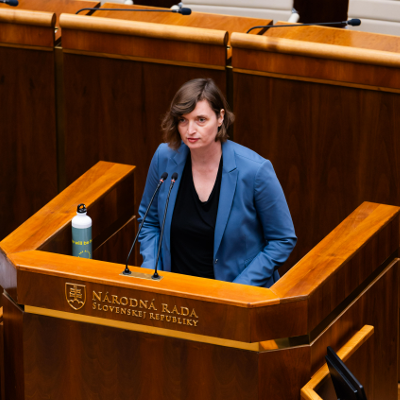
République slovaque, ADLE, Porte-parole du groupe
10:18:07
Thank you very much.
Dear colleagues, dear friends,
Today, we are discussing the deeply troubling situation unfolding in Serbia, a country caught in a democratic backsliding.
Since the tragic collapse of the Novi Sad train station canopy almost a year ago, which killed 16 people, including children, Serbian society has been shaken. The incident, widely suspected to have been caused by corruption and negligence, became a spark for mass outrage. Instead of accountability, the government responded with denial, intimidation, and violence.
This is not an isolated crisis. Since November 2024, hundreds of thousands, especially students, have repeatedly taken to the streets, demanding justice and change. The regime’s answer? Brutality. Protesters beaten, arrested, and even ran over. A student activist had his jaw broken; the attackers were later pardoned by the President.
Moreover, freedom of assembly is now under existential threat in Serbia. A new draft law would criminalise street blockades, potentially jailing peaceful protesters for up to a year. At the same time, teachers supporting their students have been punished, and state violence continues to escalate, especially targeting young women like student Nikolina SINĐELIĆ, who was abused, threatened, humiliated by the police and even threatened to be raped by the commander of the police unit.
In Serbia, we are also witnessing the normalisation of political persecution. Six members of the opposition party, the Movement of Free Citizens (PSG), are still under house arrest, accused absurdly of terrorism. Their only crime? Daring to fight for democracy in their country.
Dear colleagues, dear friends,
This is a test, not only for Serbia, but for Europe. We must not look away while shaking hands with those who are responsible. Now is the time to speak up.
Thank you.
Royaume-Uni, SOC, Président de l'Assemblée
10:20:26
I now call Mr George LOUCAIDES on behalf of the Group of the Unified European Left.

Chypre, GUE, Porte-parole du groupe
10:20:33
Dear colleagues,
The current situation in Serbia calls for our Assembly's attention and sense of responsibility. Demonstrations that began as expressions of grief and frustration have evolved into a wider mobilisation, reflecting legitimate concerns about democratic governance, media freedom and public accountability. While incidents of violence have been indeed reported, the majority of citizens have acted peacefully to voice their discontent.
Our position must remain principled and forward-looking. Violence and hatred from any side should be rejected firmly. At the same time, the rights to peaceful assembly, freedom of expression and access to pluralistic media are cornerstones of democracy and must be fully safeguarded. What matters most now is constructive engagement. We encourage the Serbian authorities to prioritise dialogue with students, civil society and opposition actors, to listen carefully to legitimate demands and to commit to reforms that can rebuild trust.
In particular, focus must be put to the implementation of the Organization for Security and Co-operation in Europe (OSCE) recommendations on electoral processes, on steps to ensure judicial independence and on stronger guarantees for media pluralism, they are essential. We equally call on protesters to remain peaceful and to isolate those who seek confrontation. Building a democratic future requires restraint, patience and a shared commitment to non-violence. The Council of Europe, including our Assembly, should remain a partner in this process. We should be ready to support institutional reforms, to provide expertise and to accompany Serbia on its own path towards stronger democracy and the rule of law.
This is not about winners or losers, dear colleagues. It is about ensuring that the Serbian people can live in a society where institutions are trusted, freedoms are protected and social justice is a reality.
Thank you.
Royaume-Uni, SOC, Président de l'Assemblée
10:22:39
Thank you, Mr George PAPANDREOU.
That completes the political group representatives.
Colleagues, you have 2 minutes. Please try to keep within 2 minutes, because if you don't, you are denying somebody else on the list a chance of contributing to this debate.
The first speaker is Mr Denis BEGIC of Sweden.
Thank you, Chair.
I was present in Serbia during the last elections. I saw people who wanted to believe in change, but I also saw how difficult that road has become. And we all know this – in Serbia, as in Sweden – the struggle for democracy and dignity is never easy.
The facts are clear. Serbia is sliding backwards in every major democracy index. Freedom House now calls the country only 'partly free'. The Economist Democracy Index has fallen to 6.2. These are not just numbers, they mean that freedoms, rights and trust are shrinking in people's everyday lives.
Civil society – that should be the lungs of democracy – faces harassment and intimidation. Human rights defenders are labelled as 'foreign agents'. The government tries to silence the very voices that keep democracy alive.
But we have also seen something else: the courage of students. For months, young people have led protests demanding nothing more radical than this – that institutions simply do their job. To the students I say: your courage inspires, your presence gives hope and your struggle matters for every citizen, not only in Serbia, but in the whole of Europe.
Because democracy is not only about indexes or institutions, it is about daily life – putting food on the table for your children, finding a job that pays a decent wage and being able to dream of a better future. Right now, all of this feels far away. That is why I say change cannot wait.
I believe in the Serbian people's ability to rise, to demand freedom and justice. Democracy in Serbia can flourish again, but only if we dare, only if we act, and only if we do it now.
Thank you.
Royaume-Uni, SOC, Président de l'Assemblée
10:24:52
Thank you, Mr Denis BEGIC.
Our next speaker is Ms Biljana PANTIĆ PILJA of Serbia.
Thank you.
Ladies and gentlemen,
Nowhere in the world is it permitted to block roads, bridges and intersections. Nowhere in the world is it permitted to organise violent, unauthorised gatherings. In Serbia alone, over the past 10 months, there have been 24 000 unauthorised public gatherings and more than 12 000 random and unauthorised blockades.
I find it incredible that we are talking here in Strasbourg about the protests in Serbia, when such protests here were quickly dispersed by the police. In Serbia, hooligans have injured 150 on-duty police officers. The offices of the Serbian Progressive Party are being attacked. People are coming to politicians' homes and calling for their lynching.
It is time to condemn such behaviour and to make it clear that these are not democratic values upheld by the Parliamentary Assembly of the Council of Europe. Freedom of gathering does not mean preventing someone's freedom of movement or physically attacking them because they think differently.
When the President of Serbia, Aleksandar VUČIĆ, offered early elections, the protesters said no. When President Aleksandar VUČIĆ called for dialogue several times, they said they would not engage. Dialogue is a cornerstone of democracy and without dialogue there can be no solution.
Marta KOS stated that hatred, vandalism and violence must not be tolerated. That attacks on members of the government and their families as well as on the offices of the political parties, are unacceptable. Do you agree with Marta KOS or do you consider violence and vandalism acceptable? Is it acceptable for a rioting mob to come to the house where you live with your family?
The police must do their job and they are expected to follow the example of their colleagues in the European Union. We need to have dialogue and life in Serbia to finally return to normal. This should be the goal for all of us. And this is what the President of Serbia, Aleksandar VUČIĆ, advocates.
Thank you.
Royaume-Uni, SOC, Président de l'Assemblée
10:27:09
Thank you.
Our next speaker is Mr Vladimir ĐORĐEVIĆ of Serbia.
Thank you, Mr Chair.
Dear colleagues – fighters for human rights, democracy and the rule of law in Europe.
Today marks 11 months since the roof collapse in Novi Sad. Corruption killed 16 people. And because of your inaction and an autocratic regime protected by Western interest, the Serbian people are now more eurosceptic than ever. So thank you Europe for supporting a regime that builds excellent co-operation with Russia and China, while deceiving its people and deceiving you, the very regime you praise and even finance.
What do we see? Media silence, police batons, stolen elections. They call this 'stability'. 'Stability' built on broken bones and stolen voices. If that is stability, then chaos would be a blessing.
Students demand free elections; they get tear gas. The opposition demands dialogue; they get handcuffs. The journalists demand truth, they get threats. And Europe answers with silence.
Apparently democracy matters anywhere except in Serbia and here, in this Council of Europe, too many play the three monkeys, blind, deaf and mute when freedom in Serbia is crushed.
Champions of democracy at home, silence and compliance abroad. What a miracle of European values!
This is not reform, this is autocracy with a European mask. Every day you stay silent, you applaud it.
Here is what you must do: end media control; investigate censorship and funding; release arrested citizens, students and opposition protesters and make accession conditional on free and fair election.
The Serbian people are watching your words, your votes, your silence.
Your name will remain like footprints in the snow. And history will not forget.
Thank you.
Royaume-Uni, SOC, Président de l'Assemblée
10:29:25
Thank you.
Our next speaker is Ms Sabina KUDIĆ of Bosnia Herzegovina.
Thank you.
Mass protests, mass detentions, arrests of the opposition, surveillance of journalists and regional destabilisation. All of this didn't inspire the Council of Europe to do its job and conduct a monitoring procedure of Serbia for not 1, 2, 5, 7 years, perhaps a decade. No, 13 years. 13 years this chamber hasn't discussed or adopted or considered a monitoring report on Serbia. And this is our record on the books.
Compared to Russia, let's say that went as far as seven years, Serbia is now doubling that record. This is unprecedented and unacceptable.
If we look at what we have done in the past couple of years, just alone, not to mention in 13 years, we have conducted periodic monitoring. And besides the regular monitoring procedures of countries such as Sweden, France, San Marino, now we are examining the Netherlands and Greece. Sure, these countries need to be looked into, but are they priorities? And is the situation in these countries so severely different to the situation in Serbia?
So we exhausted every single excuse in the book. Literally. We can't do it before the elections, there is too much crisis, we haven't been invited by the government, so on and so forth. So for the next time, since we are looking for additional excuses not to do our job, I suggest we say that the dog ate the report and our homework.
The Serbian government has lost its credibility.
I invite us, dear colleagues, to not go down with them and not lose our credibility in our work. And I invite us to do our work, conduct the proper monitoring procedure so the Alliance of Liberals and Democrats for Europe and my colleagues, European liberals, won't have to continue demanding and asking for these kinds of current affairs discussions and debates. We need a proper report. We need it now.
Thank you.
Royaume-Uni, SOC, Président de l'Assemblée
10:31:47
Thank you very much.
Our next speaker is Mr Ivan RAČAN of Croatia. Have you put your badge in?
Thank you.
Dear colleagues,
Serbia today is in a blind alley, and tragically it is moving even deeper into it. Political stagnation, contested elections, captured institutions, and shrinking media freedoms all point to a path that does not lead forward. Instead, it narrows, it darkens and it isolates.
Europe can and must act with principle, by setting clear conditions on the EU path, by protecting independent journalism and civil society, by confronting disinformation, and by offering real opportunities for young people and local communities to see and feel the benefits of European standards.
But let us be honest, only Serbia itself can make necessary changes. Only its political leadership – and above all its citizens – can make the turn that leads out of the blind alley and back onto the road of democracy, responsibility and genuine European partnership.
The Serbian people deserve better than politics of fear and control. And Serbia's neighbours deserve better too: a Serbia that is not a source of instability, but a reliable partner in building peace, prosperity and regional co-operation.
The question now is not whether Europe will keep its doors open, we all know it will. The question is whether Serbia will change its course towards this open European door or will remain firmly in the blind alley of its own making. This is a question for all in Serbia, the government, the opposition and the protesters.
Thank you.
Royaume-Uni, SOC, Président de l'Assemblée
10:34:12
Thank you.
Our next speaker is Mr Carl-Philipp SASSENRATH of Germany.
President,
Dear colleagues,
Ladies and gentlemen,
"The world today is in disarray", this is something many people say these days. But I often ask myself, how does that sound to the people of the Western Balkans? To those who endured war, violence and tears in the not so distant past.
Of course, we, in our individual countries and together in the Council of Europe, face many challenges.
One of those challenges, unfortunately, we have witnessed here in this very Assembly over the past few days, and I have to address this, when populism prevails over patriotism, when the right to free speech is confused with fact-free speech, when freely elected politicians misuse their power to undermine the very foundations on which they were elected.
We must not, and we will not, turn a blind eye to such political arson.
Right now, Serbian democracy is challenged. For almost a year now, Serbia has been experiencing unprecedented political unrest. We are following the developments in Serbia very closely. Serbia is not only a European country, it is also a candidate for EU membership and an important partner. What we wish for is a return to mutual respect and dialogue within Serbian society. Violence must be rejected on all sides. Any threats to the separation of powers must be addressed.
As an essential step towards the next parliamentary elections, government, opposition and civil society must urgently agree on reforming the voter register and the electronic media authority. We must also be ready to support Serbia against hybrid influences from the outside, especially during this critical phase.
What is more, developments in Serbia must not be allowed to endanger peace and progress in the region. Serbia is a pivotal actor for stability in the Balkans. With that comes enormous responsibility for all of Europe. In this context, let me recall the Dayton Agreement, almost to the day, 30 years ago, and it remains a victory of diplomacy over violence.
This very Assembly has taken an overwhelming decision on Kosovo‘s admission. I call upon the Committee of Ministers to now take that political courage.
Thank you very much.
Royaume-Uni, SOC, Président de l'Assemblée
10:36:45
Thank you.
Our next speaker is Mr Aleksandar MIRKOVIĆ of Serbia.
Thank you.
Over 24,000 illegal gatherings and blockades. Around 800 attacks on the offices of my party.
186 injured police officers – 45 of my colleagues.
22 attacks on journalists.
These are not my words or just numbers. This is the fact that shows the real face of the so-called peaceful protests in Serbia, whose goal is the violent overthrow of President Aleksandar VUČIĆ.
Despite the evidence, some of you are trying to turn proven violent offenders into victims. The best example is sitting here in front of you. The next speaker from our delegation directly organised the violent beating of opponents. My colleagues attacked the police, boasted about in social media and today presents himself as a victim.
It is absurd. Would such people in your countries enjoy freedom, sit in parliament or be a member of these institutions? Of course not.
President Aleksandar VUČIĆ invited everyone to a dialogue several times, but they refused. Why? Because they do not want peace and dialogue. They want only violence and chaos.
You accuse Serbia of police brutality, yet no one of these hooligans was brutally beaten, seriously injured, and only a small number are in prison now. But that is not important to you.
You keep repeating untruths only because you cannot stand President Aleksandar VUČIĆ's independence policy.
I ask you, why is it acceptable for your police to beat people, use dogs, water cannons against people who peacefully walk, while Serbian police are condemned, even when defending themselves from stones, wooden sticks, torches and attempts to burn them alive?
There will be no civil war in Serbia, no matter how much some may wish it. And when I see who supports violence in my country, I feel only pride. Because if I were on the same side as those who call Kosovo independent and blame Serbia for everything, I would be worried.
Dear colleagues,
In the end, to be completely honest, the words spoken here do not affect me much. Because most of you have never been to Serbia and you follow not the facts, but serve an agenda. What matters to me is what the citizens of Serbia think and want. And they want the policy of President Aleksandar VUČIĆ, a strong, independent, sovereign Serbia, in which decisions are made by the people through dialogue, not by foreign powers or violent extremists from the streets.
Thank you, Živela Srbija.
Royaume-Uni, SOC, Président de l'Assemblée
10:39:01
Thank you very much.
Our next speaker is Mr Saša MAGAZINOVIĆ of Bosnia and Herzegovina.
Dear colleagues,
To speak about the crisis in Serbia without facing the truth would be both meaningless and hypocritical. For decades, Serbia’s political leadership has interfered in the internal affairs of neighbouring countries, including my own, Bosnia and Herzegovina. That policy has in the past caused immense suffering and loss of life, and today it remains a threat to peace and stability.
The government in Serbia, which has long been anything but democratic, continues to promote a destructive Greater-Serbian ideology. Through its allies in the region, it undermines the institutions of neighbouring states and creates crises.
Within Serbia, it survives by spreading fear, constantly inventing enemies among its neighbours, Western countries, journalists… And when no others are left, the "enemy" becomes its own citizens, even children’s programmes on public television, where, recently, one boy dared to say he supported the protests.
I want to make this absolutely clear: the enemies of Serbia are not the peoples of the region, countries of the region, not Europe, and especially not the citizens who are demanding freedom and justice.
Serbia has no real enemies, only those invented by the ones in power, to cover up political crime, corruption and hate speech coming from the highest institutions.
The crisis in Serbia must end with accountability. What we in the Balkans, need is truth, not propaganda; democracy, not a cult of personality; and above all, we need the rejection and condemnation of the expansionist ideologies that always lead to conflict and new crises.
Thank you.
Royaume-Uni, SOC, Président de l'Assemblée
10:41:21
Thank you.
Our next speaker is Mr Marko PAVIĆ of Croatia.
Thank you very much.
Mr Speaker,
Croatia is a good neighbour to Serbia and, as a responsible neighbour, we support Serbia’s European Union path and the strengthening of democratic processes. At the same time, Croatia is committed to speaking frankly and truthfully about the current political crisis in Serbia, rather than offering silent acquiescence.
On November 1, 2024, in Novi Sad a concrete canopy collapsed, tragically killing 16 people and injuring many more. This disaster became the spark that ignited mass student and civic protests across Serbia.
These protests have now lasted more than 11 months, with high levels of intensity and persistence. However, the protests soon escalated into confrontations, and peaceful demonstrations were undermined.
In January 2025, Serbia detained and deported at least five Croatian civil society activists and organisations who had travelled to Belgrade for NGO events. The activists reported that police entered their hotel, questioned them, and ordered their expulsion, with a document stating they were considered a security risk to Serbia. Croatia responded by issuing a protest note to Serbia and formally demanding an explanation.
Some of these NGOs have been received here in the Council of Europe, like the Croatian Youth Network, whose president was detained as well as some prominent Croatian artists and citizens.
Croatia has urged the European Commission and EU institutions to intervene regarding this so-called "blacklist" of Croatian citizens, as it is not merely bilateral tensions but a violation of the fundamental freedoms of association, movement, and civic engagement in an EU candidate state.
We support Serbia's path to the EU. We offer our support and mentorship, but the rule of law and democratic standards need to be set.
Thank you.
Royaume-Uni, SOC, Président de l'Assemblée
10:43:35
Thank you.
And our final speaker this morning is Ms Jelena MILOŠEVIĆ of Serbia.
Thank you. Thanks to my colleague Mr Aleksandar MIRKOVIĆ for announcing me.
Since the canopy fell and killed 16 people, Serbia has been in deep political crisis and repression has reached its peak. Institution is being abused. Students and ordinary citizens are being arrested, while fabricated criminal proceedings are being conducted against opposition members of Parliament. For example me. The photo of the student Bogdan JOVIČIĆ, brought from detention in handcuffs to his father's funeral went viral for the whole world to see. That is the true face of the autocratic regime of President Aleksandar VUČIĆ. Hold on to power at all costs. Silence dissatisfaction of the people. Instead of an election, we have a show of force. First governments steal the election and then they overturn the cards decision and form a majority illegally. That happened at the local election in city of Zaječar. The court annulled the constitutive session, but the Minister's opinion was deemed stronger than the court's ruling. This is called overthrowing the constitutional order. And for that you go to prison. Except in Serbia.
Serbia under president President Aleksandar VUČIĆ and his regime has become a safe haven and operating hub for various mercenaries that were being used in the failed attempt by Russia to influence elections in Moldova. There was a training camp in western Serbia for people from Moldova and other countries to organise riots and to try to block the free will of the Moldovan voters in the recent elections. Is it possible that anyone still believes that President Aleksandar VUČIĆ actually drives Serbia to a European future? Our future is in Europe, but not with the current government. People of Serbia want freedom, justice, rule of law, and this regime must go on first minimal free election and become a dark history of my country.
Živela demokratija i Srbija.
Royaume-Uni, SOC, Président de l'Assemblée
10:45:46
Thank you very much.
I must now interrupt the list of speakers. The... point of order.
Dear colleagues,
There are ten more people subscribed for this debate. There are 15 more minutes that have been allocated to this debate. There are at least three more Serbian people who want to speak about this. It is very much engaging. I would like you to go ahead with at least ten more minutes.
Thank you.
Royaume-Uni, SOC, Président de l'Assemblée
10:46:11
It is not a one hour debate. I'm advised the business has to stop now in preparation for the next debate.
We have not been informed of this. And we will consider this a restriction of our rights.
Royaume-Uni, SOC, Président de l'Assemblée
10:46:22
Please retake your seat. There is no debate on it. It is ended.
The speeches by members on the speaker's list have been given...
To continue the debate for at least 10 minutes. Sorry. There is a clear will of this Assembly to continue the debate at least for 15 minutes as the Chair of the Alliance of Liberals and Democrats for Europe has said. So please, let's continue because there are lots more speakers and the debate should continue for at least one hour.
Royaume-Uni, SOC, Président de l'Assemblée
10:46:51
It is not a one-hour debate. I'm advised. I'm only doing what I'm advised. It is not a one-hour debate, and I'm sorry, I cannot take any more points of order. We must get on with the business.
The speeches of members on the speaking list who are present during the debate but have not been able to speak may be given to the Table Office for publication in the Official Report.
[indistinct comments off mic]
Speeches must not exceed 400 words. I remind colleagues that the typewritten text must be submitted electronically, if possible, no later than 4 hours after the speaker's list is interrupted.
That concludes the debate. I now invite Ms Victoria TIBLOM.
[indistinct comments off mic]
I am advised. It is not a one-hour debate. Order, please. Order. Order. Retake your seat, please, sir.
[indistinct comments off mic]
Retake your seat. Well, you're disrupting the whole procedure. You disrupt the procedure. You carry on.
[indistinct comments off mic]
I am not curtailing it. I'm advised by the officials that it is not a one-hour debate. I'm advised. It must now end. Now you carry on. You carry on.
[indistinct comments off mic]
If you wish to continue, then the next debate will be curtailed. That's up to you. It's up to you. I am told it is not a one-hour debate. I can only go on the advice I have been given.
[indistinct comments off mic]
The debate is concluded. The debate is concluded. Now we can carry on. All you are doing is disrupting the next debate. It's up to you, but we will not be calling any more speakers.
[indistinct comments off mic]
I will not be calling any more speakers. I will not be calling any more speakers. I am not abusing anything. I am not abusing anything. If you, as the leaders of the various political groups, have a problem, you should take it up with the Secretary General. I am told it is not a one-hour debate. We might have thought it was, but it is not. It is up to you.
[indistinct comments off mic]
The debate is ended. The debate is ended.
[indistinct comments off mic]
There will be no vote. The debate is ended.
[indistinct comments off mic]
I'm advised it is not a procedure in these circumstances. I do understand we've all been frustrated, but the debate is ended. It is ended.
I now invite Ms Victoria TIBLOM to respond. You have 3 minutes.
[indistinct comments off mic]
Can I say to you, sir, why are you attacking me? I am only advised by the... I am not deciding this. I am not deciding this. I am not. I am advised that I am not allowed to allow this debate to continue. Now, it's as simple as that. If you have a problem, take it up with the Secretariat.
[indistinct comments off mic]
Ms Victoria TIBLOM, you have the right to reply. You have 3 minutes. Ms Victoria TIBLOM, you have the right to reply.
[indistinct comments off mic]
Exactly. I think we need to finish this debate. And we have the rest of the speakers still on the list. I think it is very wrong to not continue the debate.
Mr Chair, the Serbian colleagues want this. The whole Assembly wants this. Please be obedient to the great majority of this house. It's unacceptable what goes on.
Royaume-Uni, SOC, Président de l'Assemblée
10:51:47
I can't move on this. I have no option.
It is not my decision. It is not my decision. The procedure is there. I am told it is not possible to continue.
Do I take it, Ms Victoria TIBLOM, that you don't wish to reply? If you wish to reply, tell me. You don't wish to reply to the debate? It's over. Are you prepared to respond?
I would like to hear the rest of the debate before I respond.
Royaume-Uni, SOC, Président de l'Assemblée
10:52:46
This session is over.
[indistinct comments off mic]
Colleagues. Colleagues. Colleagues. No one would want this debate to continue more than I. Because this is an important issue. My hands are tied. It is not my ruling. I am telling you. This is the advice I have been given that the procedure is not one hour. I thought it was an hour. It is not. It is not in my power. It is not in my power to change the rules.
Now, if the political leaders wish to have a discussion, come forward. But I can do nothing more on this matter. Honestly. Believe me, I would have continued this debate for as long as possible, but it is not in my power to continue it.
Royaume-Uni, SOC, Président de l'Assemblée
10:56:55
Colleagues, will you please take your seats?
Can I again make it clear that this is not my decision? I'm acting on advice. However, in representation from the political leaders, I think we should have three more speakers, but I'm advised that will reduce the time in the next debate. So you're knocking off people in the next debate who will not be able to speak. That is not my issue, but I have to advise you of that. So the next speaker is Mr Đorđe STANKOVIĆ of Serbia.
Dear colleagues, dear Europeans,
For almost a year now, citizens and students in Serbia have been protesting against corruption that has already taken 16 lives. Instead of justice and free elections, we face growing repression.
In your countries, the rule of law, respect of citizens, functioning institutions and free elections are fundamental values. In Serbia, we do not have them. And that is why we want you to be aware of what is happening.
Police brutality and parapolice groups have attacked protesters, even inside government buildings. Activists such as Nikolina SINDJELIC have been threatened with violence and humiliation without accountability. This is not possible without the consent of President Aleksandar VUČIĆ.
Only a week ago, pro-government outlets openly announced the planned killing of student activist Pavle CICVARIĆ at an upcoming protest. Over the past year, whatever elections were held, the ruling party used intimidation and manipulated the result. This is not an isolated case; this is part of the pattern.
True change in Serbia is only possible through free and fair elections and free media. That is the struggle we are leading both in institutions and on the streets.
Serbia's first democratic Prime Minister Zoran ĐINĐIĆ said our generation carries an immense responsibility but also a great honour. Only those who are willing to sacrifice personal comfort can say we belong to the generation that saved Serbia. I quote Zoran ĐINĐIĆ because he foresaw what needed to happen in Serbia to change - the unity of all opposition forces, of all citizens.
And now, almost 25 years after 5 October, far too little has changed, because we often made the wrong choices, not only us in Serbia as a people, but also you as our European partners.
Let the coming year for Serbia be like this year for Moldova.
Živela Srbija, živela demokratska Srbija!
Royaume-Uni, SOC, Président de l'Assemblée
10:59:28
Thank you very much. Our next speaker is Ms Marijana PULJAK of Croatia.
Dear colleagues,
Today we are discussing the political crisis in Serbia, a member of the Council of Europe and a candidate for the European Union. Precisely because of that status, we must hold Serbia accountable to the highest democratic standards.
Unfortunately, the reality is very alarming. For more than six months, five members of the Movement of Free Citizens have been kept in detention, without indictment, without evidence, solely because of their spoken words. They did not commit acts of violence, they did not endanger public safety, they simply criticised the government. This is nothing less than political persecution and a grave violation of human rights. Freedom of expression and political activity are not privileges, they are fundamental rights that must be protected.
At the same time, the process concerning 16 people dying in the canopy collapse at the Novi Sad railway station on 1 November 2024, has been conducted without transparency, leaving citizens angry and disillusioned. Instead of solving problems lawfully and openly, the authorities resort to intimidation and repression.
Let me add this also: the way the European Union and some European leaders treat President Aleksandar VUČIĆ, welcoming him as if he were a genuine democrat, is deeply disappointing for many people in Serbia. They ask themselves: if Europe does not support them in their struggle for democracy and freedom, then from whom can we expect solidarity? These mixed messages only weaken the democratic forces in Serbia.
Political opponents are not enemies. Silencing them is a sign of weakness, not strength.
Serbia’s European path cannot be credible unless it is built on rule of law, genuine pluralism, and respect for human rights. It is our duty here, in this Assembly, to call on Serbia’s authorities to immediately free those unjustly detained, to ensure full transparency and accountability for the Novi Sad tragedy, and to reaffirm the basic democratic principles that bind Europe together.
Thank you.
Royaume-Uni, SOC, Président de l'Assemblée
11:01:43
And I now call on Ms Dunja SIMONOVIĆ BRATIĆ of Serbia.
Thank you, Chair.
Dear colleagues, the title of this debate is wrong. There is no political crisis in Serbia. A ruling majority exists and existed all the time. This was a social crisis in one moment. And that was not enough to create a new political force or articulation. That's why protests became violent in the summer.
Why do we have this debate again? Let me remind you that we've had the same in the April session. Well, because one of the leaders of the political groups here in the Assembly is a clear protagonist of Albin KURTI and his political partners from the Serbian Parliament.
The happiness that they felt when the report for Kosovo was embraced in this Assembly would be the same if they succeeded in their wishes for the violent takeover of power in Serbia. So, protagonists of Albin KURTI, let me cheer you up. The momentum for the removal of the government outside democratic processes is gone.
So let me update you on what happened in the meantime. Students who were angels in the beginning now became disruptors of the professors and deans at the faculties who first let them live there. And now they are calling the police to evict them because there is no money for idleness anymore.
The opposition realised that there is no place for them on the magical students list and started to humiliate them in public, designating them as phantom administrators of social networks. Still, there is no clear political articulation from the students. They range from the radical right to the radical left.
The government took responsibility on many issues. President of Serbia, keep the door open to talk to anyone who is ready to declare himself the representative of the students or the opposition. And the elections will be next year.
Thank you.
Royaume-Uni, SOC, Président de l'Assemblée
11:03:42
Thank you very much. I now invite Ms Victoria TIBLOM to reply. You have three minutes.
Thank you, Mister President.
Thank you for this current affairs debate. Even though it was cut short, I think we can all agree that Serbia and its citizens deserve the future they dream of. Life in Serbia should return to normal, and that both sides should sit down at the negotiating table and get a solution.
Thank you.
Royaume-Uni, SOC, Président de l'Assemblée
11:04:08
Thank you very much.
Now I'd like to make a statement to the Assembly. I've been the subject of a bit of anger, abuse. You're entitled to it. We're a free country, free society. But I acted on the advice of the Secretariat. That was obviously unsatisfactory to the overwhelming number of people here.
In order that no one else should endure on the disruption we've had here, may I respectfully suggest to the leaders of the political groups that they have a meeting with the Secretariat so these matters can be clarified in the future.
I certainly believed this morning that this was a one hour debate. I was advised it was not so because we needed to clear the business in order to start the next debate, which has lots of speakers. So, I can understand your anger with me. You're entitled to it.
But as a justification, I'm only saying that I acted on the best advice I had. I had no other advice.
And to the political leaders: it's up to you. If you want to do something, please do it. So you don't have to endure – or anybody else in this chair has to endure – what has just gone on.
Thank you very much.
This debate is now closed. I remind you that at the end of this debate, the Assembly is not asked to decide upon the text, but the matter may be referred by the Bureau to the responsible committee for a report.
Colleagues, thank you very much.
You showed some flexibility in lengthening the time of the other debate. The next debate is incredibly important. It's about the murder of journalists. So I hope that you or whoever is in the chair will show some flexibility, allowing the next debate to run over by five or ten minutes so people can get in. Because it's quite wrong that this supremely important debate which we're having now should be cut short.
(Undelivered speech, Rules of Procedure Art. 31.2.)
Serbia’s current political situation is complicated by the protests of one part of the country’s students, firstly protesting because of the alleged absence of the investigation on the collapse of the canopy at the Railway Station Building in Novi Sad, and then requesting early parliamentary elections in which they would participate with their own list with no parliamentary opposition members. To date, it is not clear who would be in this list at all.
Almost every day and almost exclusively unregistered gatherings intentionally make everyday life of citizens harder.
In the current complex political situation, Alliance of Vojvodina Hungarians has the obligation to protect the interests of the Hungarian community. We are advocating that life in Serbia should return to normal, and that both sides, the position and the blockaders, sit down at the negotiating table and that with dialogue and compromises we get to a solution, to return to the institutions of the system.
European integration of Serbia remains a priority to the government.
In a nutshell: I strongly believe that our country, Serbia, is a European country. Violence should be condemned. To be more precise, all forms of violence must be condemned. Of course, that the freedom of speech and the freedom of assembly should be ensured, but on the other hand, everybody must respect the country’s institutions, too. Trust is built through dialogue. And it is clear that you cannot trust someone if you do not accept dialogue.
As a representative of a Hungarian minority living in Serbia I am convinced that we can all agree that Serbia and its citizens deserve the future they dream of. Not a chaos. Not blockades. But a normal life. We need a normal functioning of everyday life.
And this is the responsibility of all of us. Almost a year after the terrible tragedy in Novi Sad, after lot of emotions, disappointment etc. it is essential for Serbia to come back to the normality.
Therefore, it remains for us to hope that there will be finally a dialogue of all interested parties, which will make it possible to overcome the present political crisis and lead to an enhancement of all spheres of life.
(Undelivered speech, Rules of Procedure Art. 31.2)
Serbia stands at a crossroads – and frankly, it's heading in the wrong direction.
For ten months now, Serbian citizens have taken to the streets. Students leading the charge, demanding justice, transparency, and an end to the corruption corroding their country. The spark was the tragedy in Novi Sad – sixteen people killed when a railway station roof collapsed, a roof that had supposedly just been renovated. That disaster laid bare the rotten reality of fraud and cronyism under President Vučić.
How has his government responded? With batons and arrests. Peaceful protesters beaten. University professors sacked for disloyalty. Civil society groups smeared as foreign agents. When people demand answers, they're met with riot police and government-organised thugs.
This isn't how EU candidate states behave. This is the playbook of creeping authoritarianism.
Liberal Democrats have always understood – democracy in the Western Balkans isn't some distant concern. It's central to European security. Serbia's slide towards strongman rule doesn't just harm Serbian citizens – it threatens the fragile peace in Bosnia and Herzegovina and Kosovo. As do the reckless actions of Putin’s puppet Milorad Dodik whose Republika Srpska threatens to destabilise the whole region.
Brussels cannot turn a blind eye. The EU is Serbia's biggest investor, pumping in billions. That gives us leverage – leverage we must use. Every euro of support should be conditional on democratic reform, media freedom, and genuinely free elections. Not one penny should go towards entrenching autocracy.
Our message must ring out clearly: the protesters filling Belgrade's streets aren't terrorists, whatever Vučić claims. They're citizens demanding the same rights and freedoms we take for granted. Their courage deserves our solidarity.
Serbia's future doesn't lie with Putin's Russia or with domestic repression. It lies with democratic Europe. And the European Union must act like it truly believes that – before it's too late.
(Undelivered speech, Rules of Procedure Art. 31.2)
Dear President,
Dear colleagues,
Serbia is undergoing a period of heightened political tension, characterised by widespread public discontent over corruption, perceived government mismanagement, and erosion of democratic norms.
The main reasons for the recent protests include the terrible accident in Novi Sad in November 2024, when the roof of a train station collapsed, killing 16 people.
Students were among the first to mobilise, demanding accountability for the victims and system-wide reforms. Their actions escalated into broader demands: freedom of the media, judicial independence, more transparency in government, and now, early parliamentary elections.
Riot police have been deployed at many protests, with tear gas, stun grenades, and arrests reported. There have also been confrontations between protesters and pro-government groups.
Some political consequences have already followed: resignations, including of a Prime Minister, have been triggered, by public pressure. However, many protesters believe that these changes have so far been insufficient and largely symbolic. This is why they insist on calling for a snap election to allow political renewal before the usual electoral cycle.
As regards the possibility of holding new parliamentary elections, I would like to recall that, since 2000, all but one parliamentary election have been early elections. The frequent organisation of elections at short intervals destabilises the functioning of democracy and State institutions.
I hope that a solution will soon be found to cease tensions, stop violence and respect people’s will and that Serbia will continue its path toward European integration.
As a new Monitoring Committee’s co-rapporteur on Serbia, I should point out that the preparation of a new monitoring report is a matter of urgency and priority for the Assembly. Along with my colleague, Ms Victoria TIBLOM, I remain ready to co-operate with the authorities in the framework of the Assembly’s monitoring procedure.
Thank you for your attention.
Speech not pronounced (Rules of Procedure, Art. 31.2), only available in French.
Royaume-Uni, SOC, Président de l'Assemblée
11:06:21
I'm sorry. Thank you very much.
Colleagues,
It's important now, you want to get on to the next debate, I know that. But please take my advice and talk to the Secretary, the leaders talk to the Secretary. And if possible, we can extend the next debate now, if that helps people. But I must now hand over the Chair to the President. I'm somewhere on the list to speak in the next debate. Thank you.

Grèce, PPE/DC, Président de l'Assemblée
11:07:36
Dear colleagues, we will continue now.
First, let me announce that we will have with us the President of the Republic of Malta instead of 12:10 p.m., so we'll have time for the next debate.
Secondly, I want to thank Lord Don TOUHIG. He is absolutely right. This is the right thing to do. He was following the rules that we have all agreed to.
Thirdly, I take the advantage of thanking those who have made some proposals. It is a proposal to be discussed with the Presidential Committee, because it is the Presidential Committee and then the Bureau of the Assembly that have decided to hold so many current or urgent affairs debates.
So I don't want to say by that that we're going to limit the next session's debate. But we have to take into consideration that when we decide that we have more debates, then sometimes the time is not as much as we would all like.
So, I will go now to the second debate of the day.
The next item of business is the debate on the report titled "Journalists matter: the need to step up efforts to liberate Ukrainian journalists held in captivity by the Russian Federation", presented by Ms Yevheniia KRAVCHUK on behalf of the Committee on Culture, Science, Education and Media.
We will then hear from Ms Nadejda IORDANOVA, who will present an opinion on behalf of the Committee on Legal Affairs and Human Rights. And in order to finish at 12:10 p.m., I will interrupt the list of speakers at about 12:00 p.m. to allow time for the reply and the vote.
I call now Ms Yevheniia KRAVCHUK, rapporteur.
As you know, dear Yevheniia KRAVCHUK, you have 7 minutes now and 3 minutes at the end to reply to the debate.
You have the floor.
Thank you, Mr President.
Thank you, colleagues.
Indeed, this Assembly proves over and over again that freedom of speech is very important. And now, we will be descussing and debating and, hopefully, will support the resolution that I prepared.
And it starts with Journalists Matter, and journalists do matter. If you look at the numbers of journalists that were killed under different circumstances, especially during the time of war in the last few years, the numbers have drastically gone up. And we all know that without journalists, society remains blind, deprived of the right to know the truth. And journalism is the cornerstone of democracy and any society that strives to live by the rules.
During the full-scale invasion of the Russian Federation against Ukraine, over 800 crimes against media and Ukrainian journalists have been commited by the Russian Federation. In the report it says 108 journalists killed. But, unfortunately, I will have to tell another number. 111 journalists killed. Some of them were combatants, but 12 of them, including colleagues from different countries who worked for international media, were killed when they were wearing the badge press on their front and on their back, making them a target, rather than this badge helping them in this case.
Today, as of fall of 2025, we know at least about 26 Ukrainian journalists that are detained either in the occupied territories or in the Russian Federation itself. And since it's not just about numbers, it's about specific people, their families and about profession as such, I would like to read out their names.
Oleksii BESSARABOV, detained in 2016.
Dmytro SHTYBLIKOV, detained in 2016.
Ernes AMETOV, 2017.
Marlen ASANOV, detained in 2017.
Tymur IBRAHIMOV, detained in 2017.
Seiran SALIEV, detained in 2017.
Server MUSTAFAIEV, detained in 2018.
Rustem SHEIKHALIEV, detained in 2019.
Ruslan SULEIMANOV, detained in 2019.
Osman ARIFMEMETOV, detained in 2019.
Remzi BEKIROV, detained in 2019.
Amet SULEIMANOV, detained in 2020.
Asan AKHTEMOV, detained in 2021.
Iryna DANYLOVYCH, detained in 2022.
Yevheniy ILCHENKO, detained in 2022.
Vilen TEMERIANOV, 2022.
Iryna LEVCHENKO, detained in 2023.
Vladyslav HERSHON, detained in 2023.
Anastasia HLUKHOVSKA, 2023.
Heorhiy LEVCHENKO, 2023.
Oleksandr MALYSHEV, 2023.
Maksym RUPCHOV, 2023.
Yana SUVOROVA, detained since 2023.
Aziz AZIZOV, detained since 2024.
Rustem OSMANOV, detained since 2024.
Hennadiy OSMAK, detained since 2024.
As you see, this practice did not start in 2022 with the full-scale invasion. And this resolution also brings, for the first time, the phenomena of the citizen journalists in occupied territories of Ukraine, especially occupied Crimea, where they have to do their duties because the professional journalist doesn't exist because all of the free media outlets are closed.
Dear colleagues,
I would like also to tell you about the tragedy of Viktoria ROSHCHYNA. And I brought her portrait so you would see the face of this young journalist. She will be forever 27 years old. She was detained in occupied Zaporizhzhia region when she went there voluntarily in 2023 to cover the torture that is happening with civilians in the occupied regions. And she was tortured herself. She was brought to Taganrog. It's one of the most famous prisons of the Russian Federation where people are being beaten up, tortured.
And now, thanks to a lot of investigations that are ongoing from the journalists, we know the exact date of her death is 19 September 2024. And she was brought to Ukraine in a plastic bag, with some vital organs missing, without brain, without trachea, without eyeballs. And we assumed that it might be the signs that the cause of the death was trying to be hidden in this way.
But there is room for hope. And today in Strasbourg we have two freed Ukrainian journalists, Vladyslav YESYPENKO and Dmytro KHILYUK. There they are. Please give them a round of applause.
(Applause)
Vladyslav YESYPENKO was detained since 2021 in occupied Crimea. He's a journalist for Radio Free Liberty. And Dmytro KHILYUK, just imagine, over a few months ago, he was still in a Russian prison. He was released on the Independence Day of Ukraine, on 24 August 2025. And he found the courage and strength to come to you and to be present during the vote for this resolution.
And, of course, what this resolution entails, you can read it in the paper, but actually we demand further sanctions, especially for those who are doing this violation of international law against journalists and media outlets.
We, of course, demand all of the illegally detained to be released and returned home alive. Of course, we demand access to all of the prisoners, all civilian prisoners and all prisoners of war, especially, for example, that the International Committee of the Red Cross could enter.
And we strongly feel that justice should come. So, also the resolution asks for the establishment of the comprehensive mechanism for the reparation and the damage that was caused to Ukraine.
And, of course, the Special Tribunal that was numerous times accepted and proposed by this Assembly, also to be practically established.
So I urge you to engage in debate, as long as you can.
Thank you.
Grèce, PPE/DC, Président de l'Assemblée
11:16:59
Thank you, Ms Yevheniia KRAVCHUK.
I call now Ms Nadejda IORDANOVA for the opinion from the Committee on Legal Affairs and Human Rights.
You have three minutes.

Bulgarie, NI, Rapporteure pour avis
11:17:13
Thank you, Mister President.
Dear colleagues, let me begin by congratulating Ms Yevheniia KRAVCHUK for preparing this important report.
Grèce, PPE/DC, Président de l'Assemblée
11:17:21
Can you speak closer to the microphone?
Bulgarie, NI, Rapporteure pour avis
11:17:25
Is it better now? Thank you so much.
The report raises awareness about the plight of Ukrainian journalists held in captivity by the Russian aggressor. Their only crime is telling the truth. They've been silenced, separated from their families, and in too many cases, tortured, disappeared or killed. Each one of them is an example of how the aggressor has tried to bury the truth. We heard just now some of their names.
As George ORWELL said once: "Journalism is printing something that someone else does not want printed; and everything else is public relations". The fact that so many Ukrainian journalists are behind bars tells us just how much Russia fears the truth and how essential it is that we defend it.
This report makes a clear demand: the immediate release of all journalists detained in violation of international law. Until that happens, Russia, at the very least, must provide information to families, grant access to the International Committee of the Red Cross (ICRC) and humanitarian organisations.
The report includes a list of Ukrainian journalists who should be released, those detained in Crimea in 2016 and those detained in other occupied territories between 2022 and 2024. It rightly recalls that journalists working in areas of armed conflict are to be treated as civilians and as such are provided for by the international humanitarian law, specifically the Fourth Geneva Convention (IV).
Russia's actions, torture, enforced disappearance and the destruction of media infrastructure are not accidents of war. They may constitute war crimes and crimes against humanity. That is why I support the call for the (International Criminal Court) ICC and all member states to investigate and prosecute these practices.
I propose two amendments to strengthen the resolution.
First, to remind Russia that it is bound by the decision of the European Court of Human Rights, more specifically, in two interstate cases, Ukraine v. Russia, and Ukraine and the Netherlands v. Russia. Judgments which require the immediate release of all unlawfully detained journalists. The second is intended to clarify that the criminalisation of incitement under the ICC statute applies to genocide and not to the other crimes.
This Parliamentary Assembly, more than once, stated that Russia and its officials are at least attempting or publicly inciting genocide against the Ukrainian nation. Both proposals were supported by the Committee.
Colleagues,
It is now time for pressure. It is time for solidarity. If we allow truth-tellers to remain in prison, then we surrender to silence as another weapon of law.
Thank you.
Grèce, PPE/DC, Président de l'Assemblée
11:20:36
Thank you, Ms Nadejda IORDANOVA.
So, dear colleagues, now we go on with the speakers.
On behalf of the political groups. Mr Conor MURPHY, on behalf of the Unified European Left.
Mister President, dear colleagues,
Freedom of the press is not an optional luxury. It is a foundation upon which all other rights rest. If we allow its destruction, then democracy itself crumbles and we must act with moral clarity and solidarity to defend those who risk everything to bring the truth to light.
Journalists are not soldiers, yet they enter battlefields armed only with words, images and the fragile promise of truth. They do not fight for territory, but for memory, to ensure that suffering is not erased and that crimes are not hidden in silence. That is why so many journalists are deliberately targeted.
The report tells us that since the full-scale invasion of Ukraine, more than 800 crimes have been documented against media workers, including 108 killed journalists, many clearly marked as press. In Gaza, 247 journalists have been killed, not by accident, but because they carried cameras and notebooks instead of arms. Their deaths remind us of a grim truth: in modern warfare, controlling the narrative is as important as controlling the ground.
To silence journalists is to silence witnesses, to bury accountability along with the bodies of civilians. At this moment, we stand at the crossroads of truth and tyranny. This is not collateral damage. It's a war on truth itself. And we must be crystal clear: journalists are civilians protected under international law, yet the aggressor state continues to abduct, torture and unlawfully detain them in occupied territories within its own reach. Some may even be the victims of enforced disappearance.
But solidarity must also be structural. The Parliamentary Assembly of the Council of Europe campaign Journalists Matter must be amplified. And the platform for protection of journalists must press for answers, collect evidence and ensure accountability. We support Ukraine in its determination to protect media professionals and uphold media freedom in the face of ongoing challenges.
Colleagues, without journalists there is no truth, and without truth there is no democracy. Our duty is clear: protect those who protect our freedom.
Thank you.
Grèce, PPE/DC, Président de l'Assemblée
11:22:57
Thank you.
On behalf of the Socialists, Democrats and Greens Group, Baroness Shami CHAKRABARTI.

Royaume-Uni, SOC, Porte-parole du groupe
11:23:04
Mr President,
Esteemed colleagues,
It's a privilege to support this resolution. To do it justice in two minutes is a huge challenge. That's inadequate time to reflect the illegal targeting, detention and torture of Ukrainian journalists by the Russian Federation, or even to repeat those names of the disappeared, to articulate the ways in which this violates both human rights and international humanitarian law, and how there must be accountability on the part of the Russian leadership and military, to celebrate the Journalists Matter campaign, and to look also to other places in Europe and beyond where journalists have been suppressed and murdered, not least in catastrophic numbers in Gaza.
So instead, I reflect on the ease with which even democratic political actors may sometimes become irritated by free media and risk licensing tyrants to do so with lethal damage to journalists' lives and democracy itself. I remember the late legendary war journalist Marie COLVIN, who first lost an eye in the civil war in Sri Lanka and was ultimately assassinated by the Syrian regime in 2012. Two years earlier, she spoke at St Bride's, the journalists' church in London.
Our mission is to report these horrors of war with accuracy and without prejudice. We always have to ask ourselves whether the level of risk is worth the story. What is bravery and what is bravado? Journalists covering combat shoulder greater responsibilities and face difficult choices. Sometimes they pay the ultimate price.
Support their courage. Support this report.
Grèce, PPE/DC, Président de l'Assemblée
11:25:15
Thank you.
On behalf of the European People's Party. It is now the turn of Ms Marianne BINDER-KELLER.
Since Ms Marianne BINDER-KELLER comes from Switzerland, I take advantage to remind you colleagues, that those of you who want to sign the book of condolences for our late Swiss colleague Mr Alfred HEER, who had passed away recently, you can go until the end of the session to pay respects in the Berlin Room.
Ms Marianne BINDER-KELLER, you have the floor.

Suisse, PPE/DC, Porte-parole du groupe
11:25:46
Dear Mister President, dear colleagues,
I would like to thank you for this excellent, thoroughly researched and well-founded report, which I have the honour of supporting on behalf of the Group of the European People's Party.
However, please allow me to share a few basic thoughts on the relationship between autocrats and media professionals. Yes, journalists matter. Freedom matters. Democracy matters. Without free journalism, there is no democracy. Without free media, there is dull autocracy. Why do autocrats fear free speech and free opinion like the devil fears holy water? Because dictatorship and truth are mutually exclusive. Because criticising autocrats contradicts autocracy and because the path to dictatorship leads via propaganda and ultimately to war. It is the deliberate distortion of the law in order to dispose of injustice. Propaganda is the deliberate corruption of the minds of critical citizens in order to manipulate them in their favour. You are familiar with George ORWELL's dystopian novel "1984". In it, the regime dictates the narrative and a Ministry of Truth adapts history and events day by day.
Dear colleagues,
At the beginning of the week we honoured journalists. Honours for people who defy lies. In our Group of the European People's Party, we have heard harrowing reports from journalists who have been through hell. The horrors that the Russian regime inflicts on journalists are unbearable. This makes journalists all the more determined to stand up against propaganda, fake news and lies. They are doing this for the delicate plant that is democracy. Democracy, for which so many people have done so much. Audiatur et altera pars. Long live media freedom. It is the enemy of the cowardly dictator and we must not be cowards. We are the Council of Europe, the council for human rights.
Thank you.
Grèce, PPE/DC, Président de l'Assemblée
11:27:59
Thank you, Ms Marianne BINDER-KELLER.
On behalf of the European Conservatives, Patriots & Affiliates, Mr Oleksii GONCHARENKO.

Ukraine, CEPA, Porte-parole du groupe
11:28:10
Thank you, President.
Dear colleagues,
All those who are in Russian captivity should be taken back for sure. But the case of journalists is especially important, because journalists are there because they were serving societies, serving all of us. And when they are in captivity, it means all of us are in captivity. We are in a Russian prison. So we need to do everything we can to liberate them as soon as possible.
Russia is deliberately hunting journalists. Why? It's clear why. Because Russian tyranny, exactly like all other tyrannies, is that they are most afraidof the truth. That's why we need to protect the truth. That's why we need to protect the journalists.
Also, I want to address our colleagues from Italy and the Italian government and from Spain. There is a luxurious villa on Lake Como of Russian propagandist Vladimir SOLOVYOV. There is a luxurious villa of Anatoly SHARIY near Barcelona, on the Mediterranean in Spain.
I want to ask you - it's time to confiscate these luxurious villas and to make from them, from the villas of lies, to make from them real homes of truth. To make them residences for free journalists from the whole world over. Let us name these names. For example, the name of Viktoria ROSHCHYNA, a Ukrainian journalist who was killed and tortured in Russian prison. We need to do it now .
And just look at these villas. Do we really want to live in a world where for lies you are paid millions and for the truth you are paid in death or torture in prison? And while Ukrainian journalists are tortured in Russian prisons, Russian propagandists like Ksenia SOBCHAK are drinking wine in Paris restaurants and filming some propaganda again.
We should stop this as soon as possible. Let the journalists be free. Please support them.
Slava Ukraini!
Grèce, PPE/DC, Président de l'Assemblée
11:30:26
Thank you.
On behalf of the Alliance of Liberals and Democrats for Europe, it's Ms Valentina GRIPPO.

Italie, ADLE, Porte-parole du groupe
11:30:31
Thank you President, colleagues.
First of all, we must thank Ms Yevheniia KRAVCHUK and the Ukrainian journalists here today in Strasbourg for their work.
We launched this call for a resolution for them a year ago, to turn generic solidarity into verifiable action.
First of all, the resolution calls for more protection, immediate access of international bodies to places of detention, and notification of family members and lawyers of the place of detention and health conditions, funds for assistance to families and newsrooms, health corridors for post-release rehabilitation, and the systematic use of the fundamental tool, the Council of Europe platform, to report, verify and follow up each case until its closure.
The good thing about this resolution is that it is very concrete.
A list of actions: putting journalists at the centre of negotiations, not on the sidelines; priority in prisoner exchanges, with public tracking of the names and status of each case; targeted sanctions: those who act against these principles must be held accountable; seizure of assets against prison directors, investigators and judges responsible for torture and show trials.
Protect, release, seek accountability.
The resolution explains exactly how to do all these things. It can be done, but we must, in the name of Victoria ROSHCHYNA, for all imprisoned journalists, for all those who have lost their lives, for those who are here today to bear witness with us, we must strongly support this resolution and then implement it immediately in all our states.
Thank you.
Grèce, PPE/DC, Président de l'Assemblée
11:32:28
Grazie Ms Valentina GRIPPO.
Ms Petra BAYR is next.
Thank you very much.
Today, I do not want to speak about numbers. I want to speak but about a person, Iryna DANYLOVYCH.
Iryna DANYLOVYCH is a daughter of Crimea, a trained medical professional, a trade union leader and a journalist. Her only "crime" was to speak the truth. For this, she was kidnapped by the Federal Security Service of the Russian Federation (FSB), locked in a basement for ten days, tortured and threatened with death.
Today, she is serving nearly seven years in a Russian prison on absurd charges of "possessing explosives". In reality, her health is collapsing. She has gone deaf in one ear, suffers unbearable pain, and it's very likely that she suffered a stroke. This is not justice. This is cruelty and this is used as a weapon of war.
And Iryna is not alone. There are dozens of Ukrainian journalists, and hundreds of political prisoners, who share her fate in Russian captivity. Their names must not be forgotten. Their voices must not be silenced.
This is why I urge you, beside the campaign Journalists Matter, also to join the Political Prisoner Mentorship Programme, launched by Ukraine’s Ministry of Foreign, and I'm sure Ms Yevheniia KRAVCHUK can tell you much more. If you are interested, it is quite simple, but powerful. Each of us can take responsibility of one prisoner, be it a journalist or not, to speak in their name, to advocate for them, to remind them, and also to remind the world, that they are not abandoned.
Colleagues, silence helps the oppressors. Solidarity helps the oppressed. Let us stand with Iryna DANYLOVYCH, and with all Ukrainian political prisoners, including journalists, in Russian captivity, until they are free.
And thank you very much for this very good report, Yevheniia KRAVCHUK.
Thank you.
Grèce, PPE/DC, Président de l'Assemblée
11:34:38
Thank you, Ms Petra BAYR.
Ms Zanda KALNIŅA-LUKAŠEVICA now. Zanda.
Mister President.
First, let me thank Ms Yevheniia KRAVCHUK for this detailed and comprehensive report.
Dear colleagues,
While Ukrainians bravely fight Russian forces and pay the highest price on the battlefield, it is our obligation to confront Russia’s crimes in the international arena.
Russia’s war has produced too many violations to ignore: abducted children, destroyed lives and cities and journalists killed or held in captivity. We must not forget any of these crimes.
But the price Russia currently pays, through sanctions and isolation, remains insufficient to change its behaviour. We must maximise the cost to Russia. And we know what would hurt Russia most.
First: Transfer Russia’s frozen assets to Ukraine, so Ukraine can strengthen its armed forces to recover and defend its sovereign territory.
Second: Europeans must finally stop buying Russian oil, gas and LNG. It's blood money used to finance Russia’s crimes.
Third: we must be louder outside our own bubble and put Russia’s war at the centre of our discussions with partners around the world.
Indeed, we must hold every individual, Russian officials, soldiers and civilians who enable crimes accountable for what they commit.
Dear colleagues,
Journalists play a vital role in society by uncovering truth, holding power accountable, and providing people with accurate information to make informed decisions. In many cases, they risk their lives.
When Latvia fought to regain its independence in 1991, journalists played a vital role to show the truth, brutality and real face of Soviet regime. Cameramen Gvido ZVAIGZNE and Andris SLAPIŅŠ paid the highest price.
But the truth, Soviets couldn’t kill. And they won’t succeed this time either.
There is no middle ground. In this moment of history we must stand firm until justice prevails and Ukraine achieves victory.
Thank you.
Grèce, PPE/DC, Président de l'Assemblée
11:37:07
Mr Markus WIECHEL is next. Markus.
Thank you, Mr President.
Dear friends and colleagues,
We gather here today not just as parliamentarians, but also guardians of the truth. In a world darkened by Russian aggression, this draft resolution lays out the brutal reality.
Russia's war against Ukraine is a savage assault on truth, but also on journalism itself. Since February 2020, we've seen over 800 crimes against media professionals, 108 killed, many deliberately targeted despite their press vests. TV towers have been shattered, editorial offices in ruins, and at least 26 journalists unlawfully detained, some for nearly a decade since Crimea's occupation.
This is no accident. It's a war on truth, where free voices are branded enemies to hide atrocities. We mourn all those tortured and killed in custody, a stark symbol of Russia's contempt for international law. Yet recent releases remind us that pressure works.
Russia must cease these violations right now. Release all detained journalists, many of them named in this report. Provide their locations and grant access to the International Committee of the Red Cross (ICRC) and UN monitors.
We, as members of this Assembly, must amplify this through sanctions, target commanders, intelligence chiefs, prison heads with travel bans, asset freezes and more.
We must support Ukraine's Register of Damage, a special tribunal, and reparations for shattered lives and infrastructure. Let us prosecute those inciting hate and war crimes, bolster Ukrainian media with funds and awareness.
And today, I urge the adoption of this resolution. The time for nice words is over. Action alone will free the truth.
Thank you, Mr President.
Grèce, PPE/DC, Président de l'Assemblée
11:39:16
Thank you.
Mr Gusty GRAAS, you have the floor.
Thank you, President,
Dear colleagues,
This part-session rightly places journalists at the heart of our concerns.
Whether it be this report on the Ukrainian journalists detained by Russia, the reporters in Gaza or the symbolic fact that the three candidates for the Václav Havel Prize are all journalists.
Because the right to free information is not a democratic luxury; it is the very foundation on which any democracy worthy of the name rests.
Nowhere in Europe is the destruction of this right more systematic than in the Russian-controlled territories of Ukraine.
The figures are implacable: more than 800 crimes against the media. 108 journalists killed. 26 still detained in inhuman conditions.
Behind these statistics, there are faces and shattered lives. Viktoria ROSHCHYNA's face haunts our collective conscience.
Viktoria ROSHCHYNA knew what she was risking. But she also knew that without witnesses, crimes remain in the shadows. It is a tragic paradox that it is those who are denied the right to speak who know best the price of freedom of expression.
These 26 journalists in Russian jails understand what we, speaking freely here, risk forgetting.
Dear colleagues,
In the face of this barbarity, our indignation is no longer enough.
Deliberate attacks on journalists are war crimes. But let's not wait for tomorrow's verdicts. Today, we have a powerful weapon at our disposal: international pressure. Pressure that can still save the 26 journalists languishing in Russian jails.
Every resolution adopted, every sanction imposed, every voice raised in this House is a message to those who believe they can muzzle the truth: we will not give in.
Victory for truth. Victory for freedom. Victory for Viktoria ROSHCHYNA.
Thank you for your support.
Grèce, PPE/DC, Président de l'Assemblée
11:41:37
Thank you, Mr Gusty GRAAS.
Lord George FOULKES is next.
Dear Lord George FOULKES, you have the floor.
Mr President, as Sir Edward LEIGH said earlier, this is one of the most important debates of our whole week, and Ms Yevheniia KRAVCHUK has produced an excellent report and an excellent introduction outlining the problems that we face. But condemning those is not enough. What we also need to ensure is a transparent register of all detained journalists, full access by independent monitors and accountability for all those responsible, as Ms Valentina GRIPPO so rightly said earlier.
But we must also be aware that these abuses are only part of a much wider campaign of aggression by the Russian Federation against Ukraine, against democracy, the very foundation of this Council of Europe.
And that's why, as Ms Zanda KALNIŅA-LUKAŠEVICA said earlier, we must go beyond words of sympathy. We must give stronger support to Ukraine – financially, humanitarian-wise, and in military terms as well. And that's why we need tougher sanctions.
In the United Kingdom, Russian assets have been frozen, but we're only at the moment passing the interest on that to Ukraine. We must pass all of those assets to Ukraine to help build up Ukraine in the future. The struggle of Ukrainian journalists for truth, the struggle of the Ukrainian people for our freedom, is our struggle too, in the whole of Europe. If we believe in democracy, if we believe in justice, then we must act with courage, not only to liberate those journalists held in Russian prisons, but to ensure that Ukraine prevails in this war and this invasion by Russia.
Slava Ukraini.
Grèce, PPE/DC, Président de l'Assemblée
11:43:34
Thank you, Lord George FOULKES.
Mr Emanuelis ZINGERIS, you have the floor.
Dear friends,
We are just facing the expansion not only of Russia, but the expansion of Soviet Russia Stalinist rule to the whole of Europe with their hybrid operations and expansion of the territory of Russia during their violent war against the sovereign, independent and democratic Ukraine.
I was asking my friends in India, how do you think we should have a united democratic world in favour of defending democracies? Defending democracies against the invasion of a totalitarian state and expanding their habits to make people captive.
So, the issue of journalism presented fantastically in our Committee yesterday shows not only courage, but Russia's special endeavours and their action to silence; to silence the news from the frontline; to silence the news from Bucha; to silence the news of the ethnic cleansing of Ukrainians and resettling colonists in the occupied region and change the ethnic elements to bring in Russian colonies.
So in this case, yesterday a terrible picture was presented of what they're doing with people from free mass media, especially Ukrainians. And we discovered, Mister President, the new fact that the Red Cross is doing nothing! The Red Cross has become absolutely silenced during all our requests. Coming here, I saw six resolutions tabled during the last year with the points from our Parliamentary Assembly, with our friends from this Chamber, to ask the Red Cross to be involved. Where are they? We should make a motion of resolution and make an inquiry of the Red Cross' activities, not visiting captive people in Russian captivity. Our focus should be on the Red Cross, and why they're refusing to go even to Belarus, even to the Russian Federation. And now to see the captive journalists and captive inmates taken from Ukraine.
Om this case we should be united, asking all international organisations to be active in liberating our friends.
Thank you.
Grèce, PPE/DC, Président de l'Assemblée
11:46:35
Thank you. I take note of what you have said on the Red Cross.
Mr Didier MARIE is next.
Dear colleagues,
If we have been kept informed for the past four years of what has been happening on the front line and in the occupied territories since the Russian Federation's invasion of Ukraine, it is thanks to the journalists who, with courage and determination, continue to work at the risk of their lives.
We have been reminded of this on several occasions. Since the start of the war in February 2022, no fewer than 111 media professionals have lost their lives, including 12 while reporting. A further 26 are currently being detained illegally in Russian prisons.
At this point, I would like to remind you that the Russian Federation remains bound by the Geneva Convention and its additional protocols, which grant special protection to war correspondents and journalists covering conflicts. In addition, the European Court of Human Rights, which has jurisdiction in Ukraine, ruled on 25 June 2024 that Russia was responsible for numerous human rights violations in the Ukrainian territories it now occupies, particularly against journalists.
It is clear that Russia has little regard for international law. It is therefore necessary for our respective governments to step up the pressure on the Russian authorities in order to obtain the release of journalists detained in violation of international law. This will necessarily involve new sanctions aimed in particular at those directly involved in the crimes committed against these journalists, but also against their families.
Journalists must be protected so that the world can be informed, which is what Russia is trying to prevent, for fear that its abuses will become public knowledge. Russia prefers disinformation to free information. We must denounce this.
At the same time, we must continue to support the activities of the Register of Damage for Ukraine, the establishment of the Compensation Commission for Ukraine, and the setting up and operation of the Special Tribunal for the Crime of Aggression against Ukraine. The crimes committed by Russia must not go unpunished, and we will be voting in favour of this draft resolution.
Grèce, PPE/DC, Président de l'Assemblée
11:48:56
Thank you.
Sir Edward LEIGH is next.
Mr President,
This body is only powerful and only has real point when we're completely united. And I think in that sense, this debate now is a high point of our week.
Yesterday evening, we had a debate on Hungary; we were divided. I'm not sure what that will achieve. But today – I'm a conservative – I've agreed with every single word of every single speech that has been made so far.
I've agreed with the very moving and powerful speech made by Mr Conor MURPHY right at the beginning of this debate. In very powerful language, he spoke up on behalf of journalists – non combatants, not soldiers – whose only job is to tell the truth.
I've agreed with every word that Baroness Shami CHAKRABARTI made on behalf of the Socialists, Democrats and Greens Group.
Lord George FOULKES and myself are old sparring partners, but he also spoke movingly on behalf of freedom.
But you know what moved me most was when I went downstairs and I saw those video clips of Viktoriia ROSHCHYNA. We may be old and cynical, perhaps been around too long – well certainly, maybe I have been. But when you look at that young woman, so full of hope, so young, so brave, forever 27, her life so cruelly cut short, tortured, bits of her body removed... why, this is sheer cruelty. This is horror.
So, I think when we have these debates, we are speaking for the whole of Europe, and we are saying to all the people in Europe: Long live freedom. Long live truth. Long live Ukraine.
Thank you.
Grèce, PPE/DC, Président de l'Assemblée
11:50:59
Thank you.
Lord Don TOUHIG is next. Don.
Mister President,
Ms Yevheniia KRAVCHUK’s report is one of the best, and most powerfully argued cases I have seen.
I spent 27 years of my life as a journalist working on a newspaper called The Free Press. And when I read this report, paragraph 89 on page 18 jumps off the paper. Speaking of the Ukraine conflict she writes: "This war is also a war against truth and, as such, free media and journalists are treated as enemies."
I was trained to report true facts untainted by personal opinion or pressure from interested parties. My editor, a brilliant teacher of journalists, always said: "Never allow yourself to be influenced by interested parties. Facts and truth are what matters."
Across our continent, journalists are under pressure and their rights under threat. That is why we here in this Council of Europe must be their defenders and guardians, as Sir Edward LEIGH has just said.
Amnesty International said that last year was the deadliest ever for journalists. 124 journalists were killed, the highest number ever. Journalists are often the first to be targeted because they are often the first to warn when freedom is under threat.
Throughout history, tyrants have known that if they can silence journalists, then they can clear the way against protesters. Without independent journalists, there can be no truth, no press freedom, no freedom at all. An American, Richard FEYNMAN, once said: "I would rather have questions that cannot be answered than answers that cannot be questioned."
Journalists ask the questions that tyrants do not want asked and certainly do not want to answer. And we see in this report how the Russians are targeting the Ukrainian media. On April 6, a Russian ballistic missile caused severe destruction to the offices of Ukraine’s foreign broadcasting services. The Russians claimed they had destroyed a military facility. More attacks followed.
The safety of Ukraine’s journalists is of increasing concern to us all.
Colleagues, these journalists and thousands of others across Europe ensure that press freedom is upheld. To do that they must be able to work without fear of persecution. We should never forget that journalists help ensure that the powerful are held to account.
Peoples everywhere must stand with them.
Slava Ukraini!
Grèce, PPE/DC, Président de l'Assemblée
11:53:22
Thank you, Lord Don TOUHIG.
Ms Regina BASTOS is next.
Thank you, Mister President.
Mister President, colleagues,
The persecution of Ukrainian journalists by the Russian Federation is not an excess of war. It is a deliberate strategy.
By silencing the press, Putin's regime seeks to erase evidence of crimes and to impose lies as the official narrative. This is not new. We saw the same in Chechnya, in Syria and in the Balkans, where censorship and intimidation were used to conceal atrocities.
Today In Ukraine, 26 journalists are missing or held in captivity. They are subjected to torture and to sham trials. Turning journalists into targets means turning information itself into the enemy.
Our response cannot be timid. Just as the International Criminal Court judges crimes committed in the Balkans and Rwanda, we must ensure that every perpetrator, from prison guards to the leadership of the Kremlin, faces international justice.
Freedom of the press is not a luxury. It is the red line that separates civilisation from barbarism. If we accept that Russia may continue to detain and kill journalists, truth itself will become the first victim. That's why we must state clearly here in this Assembly, Ukrainian journalists are not alone. Russian censorship will never triumph over European democracy.
Thanks, rapporteurs. Thank you.
Grèce, PPE/DC, Président de l'Assemblée
11:55:30
Thank you, Ms Regina BASTOS.
Ms Larysa BILOZIR is next.
Dear President,
Dear colleagues,
I thank Ms Yevheniia KRAVCHUK for such an important report.
As a journalist herself, Ms Yevheniia KRAVCHUK's work in international institutions on protecting journalists is very vital. It is clear to us that Russia’s war against Ukraine is also a war against truth. That’s why journalists are deliberately targeted.
We must speak here about Ukrainian prisoners of war who are tortured and denied access in Russian jails, but also about a silent crisis: at least 16 000 civilians are officially reported missing or in captivity.
Russia systematically violates international humanitarian law. Captives are denied lawyers, family contact, and humanitarian visits. They vanish into sham trials, branded as “extremists” or “terrorists.” Journalists face particular brutality: abduction, torture, denial of medical care, even execution.
The returned body of journalist Viktoria ROSHCHYNA showed wounds, broken ribs, electrocution marks. She weighed less than 30kg. When her body was returned, her eyes were cut out, brain removed and larynx torn out. This horrific sight appears as a message from Russians to the whole world: do not see the crimes, do not think about them, and do not speak of them.
The Parliamentary Assembly of the Council of Europe has launched the annual Victory for Viktoria initiative to honour her and other killed journalists. I thank our President Mr Theodoros ROUSOPOULOS for his support in such an initiative.
Alongside our efforts to bring Ukrainian soldiers home, we must fight for journalists and civilians too. They are the invisible victims of this war. We must not allow them to be forgotten.
Thank you.
Grèce, PPE/DC, Président de l'Assemblée
11:57:39
Thank you, Ms Larysa BILOZIR.
Mr Mattias JONSSON is next.
Thank you, Mister President.
First of all, thanks for this important report.
A country like Sweden will always stands up for freedom of speech, press freedom and the safety of civilians during war, of course.
What is happening in Ukraine is not just an attack on a country. It is also an attack on free speech and on the truth.
Since Russia's full invasion, there have been more than 800 cases of media rights being violated. Journalists have been killed, put in prison, been tortured. This is not by accident, it is because they are journalists.
One terrible example is Viktoria ROSHCHYNA, a Ukrainian journalist who was tortured and killed while she was held by Russian forces. We will never and we cannot forget her.
Under international law, journalists in war zones are civilians. Attacking them is a war crime and also a way to try to silence the truth.
I strongly support the call to free all journalists who are in prison. I also support strong action to make sure that the people responsible are brought to justice, through the International Criminal Court (ICC) and international courts.
I believe that sanctions should be even stronger against Russian people who commit or help with these crimes.
At the same time, Ukraine must try to continue to help protect all of its journalists support free media, of course.
Attacking journalists is attacking democracy itself.
As members of the Council of Europe, we have a duty to act, not just to talk. Therefore, it's important to support this report for the journalists and for the truth.
Thank you.
Grèce, PPE/DC, Président de l'Assemblée
11:59:34
Thank you, Mr Mattias JONSSON.
Dear colleagues,
I must now interrupt the list of speakers. The speeches of members on the speakers list who have been present during the debate but have not been able to speak may be given to the Table Office for publication in the official report. Speeches must not exceed 400 words. I remind colleagues that the typewritten text can be submitted electronically if possible, no later than four hours after the list of speakers is interrupted.
That concludes the list of speakers.
Before I give the floor to Ms Yevheniia KRAVCHUK, as a rapporteur, I would like to personally thank Ms Yevheniia KRAVCHUK for her report and for accepting my proposal some months ago to introduce the day that we call 'Victory for Viktoria Day'.
As a former journalist, I had been working as a journalist from 1981 till 2000. So it's been 25 years that I'm not a journalist anymore. But I never forget that journalism, like politics, is a mission and not a profession. I'm really glad and I want to thank her on behalf of the jury, our former president Mr Tiny KOX, who is present here today, that on 25 August, when I proposed to the jury of the Václav HAVEL that we need to do something about journalism in this session, they accepted unanimously.
Imagine how touched I am that this session is dedicated to the people who are related to human rights. When a member of a jury told me, how can we relate the Václav HAVEL Award with human rights, I said, because human rights can thrive only under light and journalism brings light. Darkness is the worst for human rights, the worst situation.
So thank you to all the political groups for supporting this very important initiative of Ms Yevheniia KRAVCHUK.
Ms Yevheniia KRAVCHUK, you have the floor for three minutes.
Dear colleagues, dear President,
First of all, thank you for this idea. Indeed, hopefully when we vote for this resolution, we will put it into action, and every Autumn part-session we will commemorate the memory of those who put their life at risk to report, to bring the truth.
This commemoration day will be called "Victory for Viktoria" in the memory of Viktoria ROSHCHYNA. At 1 p.m. we will be opening an exhibition dedicated to those Ukrainian journalists who are still in captivity. But also we will welcome those who we brought back, and they are with us in Strasbourg.
I would like to thank each and everyone for these words. A lot of Ukrainian journalists are actually following this debate, so they will know that we have total unity on this issue, and on the issue of the detained, not just journalists, but civilian detainees and prisoners of war. So that is very valuable for us.
Indeed there is a mentorship programme and a course that you could follow and you can just pick up the name or two and speak about those detainees – journalists or other civilian detainees – and spread the word, so their names would not be forgotten and it would put much pressure on Russian Federation to be able to bring everyone home.
Thank you again. Hopefully we'll support the resolution with big numbers or unanimously.
Thank you.
Grèce, PPE/DC, Président de l'Assemblée
12:03:30
Thank you, Madam Yevheniia KRAVCHUK.
And I have to ask now if the Chairperson of the Committee wishes to speak for 3 minutes?

Türkiye, ADLE, Vice-Président de la Commission de la culture, de la science, de l'éducation et des médias
12:03:40
Thank you, Mr President.
Dear colleagues,
I think that the report and the presentation provided by Ms Yevheniia KRAVCHUK speak for themselves. In that regard I have little to add.
I would rather like to make mine the words of Ukrainian journalist and human rights defender Maksym BUTKEVYCH, winner of this year’s Václav Havel Human Rights Prize. Words that were pronounced here in this hemicycle on Monday, that is, less than one year after his release from Russian captivity.
He said the following: "Please do not forget Ukrainian prisoners of war, do not forget Ukrainian civilians illegally detained by Russia, Ukrainian children illegally kidnapped by Russia. Do not forget all those who fight for freedom and dignity, and are repressed and deprived of liberty in Europe and elsewhere. Please remember them, fight for their release and help us defend the most fundamental things, without which we cannot imagine our Europe, our future nor our very humanity."
Please, let’s not forget them.
In that sense, I hope you will support Ms Yevheniia KRAVCHUK's report.
Thank you.
(Undelivered speech, Rules of Procedure Art. 31.2)
On Monday we had the opportunity to have an exchange of views with Ukrainian prisoners of war and civilians detained by Russia, and we heard the testimonies of recently liberated journalists, among them Maksym BUTKEVYCH who was awarded the 2025 Vaclav Havel human rights price.
Their testimonies have shown an immense personal strength, courage and determination to bring the truth of aggression to light and to confront the Russian propaganda.
What a task they faced!
What a torture and de-humanization they endured!
To dismantle Vladimir PUTIN's lies who calls his full-scale invasion and brutal destruction of Ukraine “special military operation”, who challenges Ukraine’s legitimacy as a state, and who calls the Ukrainian government neo-Nazis which must be de-nazified was an enormous task.
Vladimir PUTIN’s evil plan was to defeat Ukraine within several days, capture its leaders and install his puppet regime.
Thank God, his plan failed while the invasion was met with fierce resistance of brave Ukrainian sons and daughters.
The same determination, vigor and strong commitment was demonstrated by Ukrainian journalists who raised their voices and stood fast against the Russian propaganda.
The exhibition outside our hemicycle is the testimony which no one can deny.
We don’t know how many more people will die because of Vladimir PUTIN’s obsession to conquer Ukraine, but one thing that came out very clearly to the entire world is that millions of Ukrainians are willing to fight to the very end, and this is a living prove that freedom and independence is the most sacred duty.
The bottom line is that no matter how the war unfolds, the truth that Ukrainian journalists revealed, and the sacrifices which Ukrainian people endured, will stick in their hearts and minds for centuries to come.
(Undelivered speech, Rules of Procedure Art. 31.2)
Good afternoon,
I’m pleased to be joined by a strong Canadian delegation made up of both government and opposition Members of Parliament, including my colleague, Ms. Lisa HEPFNER, a Member of the governing Liberal Party. If time permits, you may hear from her a little later in this session.
For context, I am a Member of Canada’s opposition Conservative Party, and I will be offering my remarks through that lens.
Like Ms. Lisa HEPFNER, I am also a former, and some might say recovering, journalist.
While she worked in television, I worked in radio, back when it was the go-to source for breaking news. It was a time when newsrooms were well staffed, reporters had beats, and journalism focused on facts, allowing the public to form their own opinions.
But journalism, as we know, is not a protected profession everywhere. Tragically, in many parts of the world, words, whether spoken or written, can become dangerous. We see this, for example, in the unjust detention of numerous Ukrainian journalists by the Russian Federation.
This situation highlights a broader, disturbing trend: authoritarian regimes using violence, censorship, intimidation, and legal repression to silence journalists. These tactics aren’t just attacks on individuals, they are attacks on truth, transparency, and accountability.
Often, these efforts are designed to suppress dissent and enforce a singular narrative, one that serves the interests of the regime, not the people. The result? A public that grows more distrustful, and a journalism profession that grows more endangered.
Not all threats to press freedom are violent, however.
Some are more subtle, but equally damaging.
This includes laws that restrict what people can read, watch, or say in public. It includes policies that protect certain forms of speech while punishing others. And yes, it includes direct government funding of media, which, in some cases, can blur the lines between public interest journalism and state messaging. All of which, puts the integrity of journalists at risk.
In Canada, we value a free and independent press and I stand with those around the world who continue to report the truth under increasingly difficult and dangerous conditions.
Journalists must be able to do their jobs freely and independently. Their work is essential, not just for democracy, but for the health and safety of the societies we all represent.
Thank you.
(Undelivered speech, Rules of Procedure Art. 31.2)
Mister President, dear colleagues,
The work of journalists is the cornerstone of democracy. They report the truth and bring us reliable information from places we cannot go to. In crisis areas this task is important but also dangerous. Too many journalists must bear a too heavy burden for their work: arrests, violence, torture and even death.
This Assembly cannot accept that the Russian Federation is keeping journalists in captivity. This is a blatant violation of international law and a blow to the principles of media freedom. Our duty is to demand the release of journalists and bring light on these breaches in international forums.
The protection of journalists is our common duty. We must strengthen the mechanisms needed to safeguard the work of media professionals in circumstances where their presence is necessary but where their safety is at risk. This means that we cannot stay silent when states deliberately use journalists as targets, as Russia is doing in Ukraine.
Journalists are not parties to the conflict. They are messengers bringing us neutral and reliable information. If their voices are silenced, our joint understanding of the world is weakened.
Let’s send a clear message: the protection of journalists is our joint effort. We do not accept the suppression of the media or the silencing of the truth.
(Undelivered speech, Rules of Procedure Art. 31.2)
Dear colleagues,
We are gathered here to talk about those who are paying the highest price for freedom of speech – Ukrainian journalists held captive in Russia.
Today, at least 26 Ukrainian journalists are in captivity. These are political sentences. Their names are clearly recorded in the “Journalists Matter” resolution. The fact that these names are voiced publicly fosters international advocacy. But we must be honest: since 2022, Russia has committed more than 800 crimes against the media in Ukraine. This is a war not only against the state, but also against the truth. The Russian regime is afraid of journalists, afraid of the transparency.
We remember Viktoria ROSHCHINA, a journalist who died in a Russian prison after being tortured, humiliated, and denied water, food, and medical care. Her story has become symbolic, but unfortunately, it is not the only one.
We are happy about every return. They are living proof that international pressure works. On Monday, Ukrainian journalist Maksym BUTKEVYCH addressed on behalf of those held captive.
But this is not enough. Russia must be held accountable. Sanctions must be tightened! The creation of a special tribunal for the crime of aggression must become a reality!
At the same time, we must make greater use of the Council of Europe's Journalists Matter platform to draw attention to the situation of Ukrainian journalists in Russian captivity. We also call on member states to join the initiative. It is important to support those who have been forced to leave the country. Ukrainian journalists should be able to integrate into the media of the countries that have accepted them and continue their work so that the truth about the war is heard everywhere. We are grateful to the European Union for its initiative to provide grant support to Ukrainian media.
It is important for us not to remain silent. Journalists are the voice of truth! And together, we must do everything we can to ensure that this voice is never silenced! please support the resolution.
Thank you!
(Undelivered speech, Rules of Procedure Art. 31.2)
Mister President, dear colleagues,
I would like to thank the rapporteur for this important and timely report. Freedom of opinion is an important value. A journalist´s job is to inform about things and events. Without journalists, we will not get accurate information about the horrors happening in Ukraine.
International law and humanitarian law protect journalists in times of war. But what does Russian do? It disregards its own obligations, and Ukrainian journalists are even being killed. I am shocked that journalists are being unjustly accused and even tortured. And why is this happening? It is happening for the simple fact that Russia is not interested in the truth and wants to hide the facts.
This cannot continue. Ukrainian journalists are key in reporting events in their own country. Freedom of speech belongs to everyone. The whole world needs to know about these shocking and unfortunate fates of journalists.
Russia in trying to scare journalists, in Ukraine but also in its own country. There is no investigative journalism in Russia. The situation is impossible.
We must defend freedom of speech, we must defend the truth, and we should introduce serious penalties for those who do not respect this.
(Undelivered speech, Rules of Procedure Art. 31.2)
I speak today to fully support this motion and report. The detention of Ukrainian journalists by Russia is a human rights issue and breach of international law.
And as we sadly know, in the most horrific cases, it leads to death.
The role journalists play in upholding democracy and calling for accountability is a cornerstone of a functioning system.
Journalists are protected under international law – we need to remember tht they sacrifice their wellbeing to uncover the truth of war.
This is particularly true in the incredibly tragic case of Viktoria ROSHCHYNA captured in the occupied territories in September 2023.
Viktoria was held without charge and denied access to legal counsel.
And September 2024, she was declared dead - one year after her capture. Her body was returned to Ukraine only this February. Mutilated and marked as an anonymous corpse – a further injustice even after death.
Her family and loved one have received no justice.
This horrific crime was a calculated act of terror against those who dare to report on atrocities committed in the occupied territories.
And sadly, Viktoria’s story is not an isolated case.
Around 26 other journalists are still held in Russia, along with 16 000 Ukrainian civilians, as well as 20 000 abducted children.
Each day that Ukrainian journalists remain in Russian detention is another day of inhumane treatment, another day that could mean they never come home.
We cannot allow this. Detained journalists must be released and those responsible must be held accountable.
Because the truth is: whether in Ukraine, or in Gaza, aggressors prefer to commit their crimes away from public view – and silencing and targeting journalists is the way to hid their crimes.
And so they target the men and women working to expose the real situation on the ground: journalists, reporters, storytellers who risk everything to make sure the world cannot look away.
We have a responsibility to uphold our shared values of human rights and democracy.
In this case that means working toward a safe return of those still held without due process, those who were only detained because of their vital work exposing the horrors of war.
(Undelivered speech, Rules of Procedure Art. 31.2)
Dear colleagues,
Behind every number, behind every report of “detained journalists,” there is a human life, a family waiting, and a voice silenced by force.
Let me share just one story. This Monday, the Václav Havel Human Rights Prize was awarded to Maksym BUTKEVYCH, a Ukrainian journalist and human rights defender. For decades, Maksym has given his voice to others: refugees, vulnerable communities, those without protection. He was known for his compassion, for his integrity, and for his unwavering belief in human dignity.
And yet today, Maksym himself is voiceless, unjustly imprisoned by the Russian Federation. His family and friends wait for him, his colleagues continue his work, but his place is not in a cell. His place is here, among us, in free Europe.
Maksym’s case is not unique. Dozens of Ukrainian journalists remain behind bars. They are punished simply for reporting the truth about Russia’s war of aggression. Each day of their captivity is not only a personal tragedy, but also an attack on our common values, on freedom of expression, democracy, and the right to know the truth.
Colleagues, we cannot afford indifference. If we do not defend journalists, we allow lies to win. If we do not fight for their freedom, we weaken our own democracies.
That is why I call on this Assembly to redouble its efforts, to speak out louder, to apply stronger pressure, and to make sure that names like Maksym BUTKEVYCH are never forgotten until they are free.
We must step up our efforts: to demand the immediate release of all Ukrainian journalists held in captivity, to strengthen international mechanisms of pressure on the Russian Federation, to provide legal, psychological, and financial support for those who have suffered persecution, and to ensure that the names of imprisoned journalists are spoken in parliaments, in media, and in international forums, until they are free.
Journalists matter. Their freedom is the freedom of all of us. Their voice is the voice of democracy itself.
Let us not rest until every Ukrainian journalist unjustly imprisoned by Russia is brought home.
Thank you.
Speech not pronounced (Rules of Procedure, Art. 31.2), only available in French.
(Undelivered speech, Rules of Procedure Art. 31.2)
Dear friends and colleagues,Only through the actions of brave journalists do we hear about war crimes and genocide. Perpetrators of these crimes dream of a world without critical reporters. Journalists in Ukraine face life-threatening risks while reporting on the genocide being committed. This is nothing new. The Holodomor was reported to the Western world in 1933 by journalist Gareth JONES. His bravery would ultimately cost him his life. Unfortunately, good journalism can be life-threatening, but it is a necessity for defending human rights and democracy.
Russia is knowingly attacking, torturing, and imprisoning civilian journalists. This is a blatant violation of Article 79 of the Fourth Protocol of the Geneva Convention and Article 19 of the Universal Declaration of Human Rights. Ukranian Journalists will also play a key role in the reconstruction of Ukraine after the war: by bringing transparency to the spending of reconstruction funds. By controlling the democratic and human rights efforts of Ukraine. Like everywhere else in Europe.
Unfortunately, the press in Ukraine is struggling financially as the war has taken its toll on its colleagues and equipment, without it being able to finance replacements.
It is our responsibility as member states of the Council of Europe to protect human rights, media freedom, and democracy. Therefore, we must not only ensure the safety of Ukrainian journalists and ensure that the imprisoned journalists are released. We should also help the journalists in their capacitybuilding, in their work and with practical help like equipements.
Speech not pronounced (Rules of Procedure, Art. 31.2), only available in French.
(Undelivered speech, Rules of Procedure Art. 31.2)
First, let me warmly congratulate the winner of this year’s Václav Havel Human Rights Prize, Ukrainian journalist and human rights defender Maksym BUTKEVYCH. Yesterday, in our Group of the European People's Party, we had the privilege of hearing from him directly and his colleagues reflecting on the immense suffering of journalists during the war in Ukraine.
Two other courageous journalists, from Georgia and Azerbaijan, were runners-up. This prize, awarded by our Assembly, sends a clear message: defending human rights and the truth in wartime is a universal struggle.
Croatia, together with our Prime Minister Andrej PLENKOVIĆ, strongly supports Ukraine in this struggle. We know what it means to face aggression and to defend freedom. And we remember our own journalists who paid the highest price.
Allow me to recall the name of Siniša GLAVAŠEVIĆ, the Croatian journalist from Vukovar. He was wounded in the line of duty, arrested, and ultimately executed at Ovčara. His fate, and that of many others in Vukovar, our own “Butcha”, is a lasting scar for Croatia.
These experiences oblige us not to remain silent. We must speak up for the Ukrainian journalists who today are unlawfully detained, tortured, or disappeared in Russian captivity. According to this report, at least 26 Ukrainian journalists are still being held. Their only “crime” is telling the truth.
Our Assembly must send a united message: these journalists are civilians, protected by international law. Their immediate release must be demanded. Accountability for crimes against them must follow.
Supporting this report is therefore not only an act of solidarity with Ukraine, it is a defence of the principles of free press, human dignity, and justice for all who risk their lives to tell the truth.
(Undelivered speech, Rules of Procedure Art. 31.2)
Thank you for the opportunity to address this assembly on the situation of journalists held captive in Russia and those dying in war zones at an unprecedented rate.
I worked as a daily news journalist for about 25 years before entering into politics, but I mostly reported on local stories and rarely felt my life was at risk in my day to day work. However I still knew my work was integral to my community; that sharing stories, covering politics and crime, and connecting people was a critical part of maintaining the democracy we enjoy in Canada.
As the president of this assembly noted at the beginning of the week; democracy is impossible to maintain without the freedom of journalists to report what they see and hear. And journalists operating in conflict zones, the ones who do put their lives at risk for their important work, they are protected by international humanitarian law. These protections are legal obligations.
Canada will continue to call for the immediate release of all journalists unlawfully held by Russian forces. In particular, Ukrainian journalists are being threatened, silenced and subjected to arbitrary detention in Russia, for doing their jobs and reporting truths.
According to reporters without borders, Russian forces are arresting journalists who refuse to collaborate with them. And we hear that detained journalists in Russia face unthinkable cruelty.
We know what is happening in these Russian detention centres partly because Canada, along with 40 other members of the Organization for Security and Cooperation in Europe, has invoked the Moscow Mechanism to send an expert mission to investigate Russia’s treatment of Ukrainian prisoners of war. This is one way we can hold Russia accountable for human rights and humanitarian violations.
I would like to thank the rapporteur and the Ukrainian delegation for your tireless advocacy on behalf of your country. You are not only standing up for Ukraine, but for all Western democracies. Canada stands with you.
Thank you.
(Undelivered speech, Rules of Procedure Art. 31.2)
Dear colleagues,
As a former journalist in Greece, I am very sensitive for what is happening in our difficult times.
The war in Ukraine is not only a fight with weapons. It is also a battle for truth.
Too many journalists have been abducted or imprisoned by Russian forces in the occupied territories.
Some remain missing, while others face long prison terms on unfounded charges like “spying”. These are grave violations of human rights that strike at the very heart of society’s ability to know and to understand. This situation is inacceptable.
At the same time, we need to recognize that in Ukraine, a nation defending itself under extraordinary circumstances, journalists also face challenges.
I must clarify it is not the same with what is happening with russian regime, but it is clear that the pressures of war have led to certain restrictions and a concentration of news flows. These measures are often justified as necessary for security, but it remains vital that even in times of conflict, steps are taken to preserve media freedom as a safeguard of democracy.
This challenge is not unique to the war in Ukraine. Around the world, from Türkiye, where journalists are imprisoned on charges of “terrorism,” to the United States, we see a troubling trend: governments, whether authoritarian or democratic, seeking to control the narrative and limit independent voices.
Our message must be clear: journalists are not adversaries, but guardians of truth. To silence them is to weaken our societies. Ensuring their rights and safety is not only an obligation to those who risk their lives on the frontlines of conflict, but also a cornerstone of peace and democracy everywhere.
(Undelivered speech, Rules of Procedure Art. 31.2)
Dear colleagues,
Since Russia Federation’s full-scale invasion of Ukraine, more than 800 crimes against journalists and media professionals have been recorded. More specifically, 108 people have been killed which reporting, under shelling, or after torture. At least 26 Ukrainian journalists are currently detained in Russia or in temporarily occupied territories on fabricated charges, without fare trial, or adequate medical care. Many are subjected to torture or are victims of enforced disappearance. This is not only a war against a sovereign state. It is also a war against the truth itself.
We have a duty to deliver a clear, political response to these systematic abductions of journalists, which constitute a blatant violation of International Humanitarian Law and Geneva Conventions. That is precisely what we are seeking to achieve by this report.
The report highlights that a just and sustainable peace must include the unconditional release of all civilian captives, including journalists whose only “crime” was to inform the world. It is very encouraging that the report supports deploying every available political, economic and diplomatic lever, to secure the immediate liberation of these journalists.
We should coordinate sanctions and targeted measures, intensify pressure through international forums, and ensure that Russia cannot normalize the abduction and mistreatment of media professionals.
΅We also welcome the report’s insistence on unfettered access for the International Committee of the Red Cross and other humanitarian organizations to monitor detention conditions and the health of detainees.
Additionally, we support this report, because it highlights the need for compensation of victims of Russia’s crimes, including journalists and media infrastructure. It is also of major importance, that this draft resolution calls on member States to support the Register of Damage for Ukraine and the establishment of a Special Tribunal for the crime of aggression.
It is very encouraging that the report supports strengthening international protection frameworks, including a new special protocol to the Fourth Geneva Convention and a relevant UN resolution to protect civilians, including journalists, who are illegally detained during armed conflicts.
In the light of these evidence, we salute the report’s comprehensive approach: name the crimes, protect the victims, punish the perpetrators, and rebuild the legal shields that war has dented.
Colleagues, our credibility is measured by whether our words change facts on the ground. Let us adopt this draft resolution and move immediately from principles to practice, until the last journalist is free.
Thank you for your attention.
Grèce, PPE/DC, Président de l'Assemblée
12:05:15
Thank you, dear Mr Mehmet AKALIN.
The Committee on Legal Affairs and Human Rights has presented the draft resolution, Document 16237, to which two amendments have been tabled. They will be taken in the order in which they appear in the compendium. I remind you that speeches on amendments are limited to 30 seconds.
I understand that the Chairperson of the Committee wishes to propose to the Parliamentary Assembly that Amendments 1 and 2 to the draft resolution, which were unanimously approved by the Committee, be declared as definitely approved.
Is that so? Yes. Thank you.
If no one objects, I will consider the amendments to be approved.
Is there an objection? No.
So the amendments are approved.
We will now proceed to vote on the draft resolution contained in Document 16237 as amended. A simple majority is required.
The vote is open.
The vote is closed.
I call for the result to be displayed.
The draft resolution in Document 16237 as amended is unanimously – I think – adopted.
Dear colleagues,
Once again, congratulations to all of you, the rapporteurs, and those who had the opportunity to participate and the rest, as I said, I would like to ask you to deposit your speeches to the relevant office.
I would like to ask you to remain seated because in the next few minutes we will hear the address of Her Excellency, the President of Malta, who will enter the room soon.
Grèce, PPE/DC, Président de l'Assemblée
12:10:18
Welcome, Madam President.
Dear colleagues, we will now hear an address by Her Excellency, Madame Myriam SPITERI DEBONO, President of Malta. And after this address, Madam President will take questions from the floor.
It is my honour to welcome among us Her Excellency. Madam President, thank you for joining us today and for agreeing to this exchange of views.
You are originally from the island of Gozo, that mythical place where, according to Homer, the nymph Calypso is said to have kept Ulysses for seven years. Fortunately, Zeus intervened and he was released, much to the joy of Penelope.
One might say that this was already an early lesson in gender relations. From myth to reality, your own life's journey has been marked by a deep engagement with questions of equality.
For many years, you chaired the women's branch of your political party, and you were active in the Gender Equality Commission from its earliest days. In 1996, you broke new ground by becoming the first woman to serve as speaker of Malta's House of Representatives. And in 2024, you were unanimously elected as the 11th president of the Republic of Malta.
At the Parliamentary Assembly, we also strive to advance equality and to empower women. Our biggest prize for women empowerment has often shone a spotlight on courageous women who inspire us all.
In this spirit, Madam President, we salute you as a role model. I would once again like to thank you for taking the time to engage in this dialogue with us. And without further ado, Madam President, the floor is yours.
President of the Parliamentary Assembly, Secretary General of the Council of Europe, distinguished members of the Parliamentary Assembly, Excellencies, and other esteemed visitors,
I stand before you in my capacity as the Head of State of Malta. But I also speak to you as a woman and a European citizen. My views and perspectives have been shaped over the decades I have lived through, events I have witnessed and analysed, the ebbs and flows of transformation, disruption, progress – at times regress – both in my own country and across our continent.
This occasion holds particular meaning for me, as it coincides with my country's 60th anniversary as a committed member of this organisation. For Malta, the Council of Europe is a forum where our core values are nurtured, upheld and translated into tangible progress. Our membership of the Council has deepened our engagement, shaping not only our national reforms, but also our wider international outlook.
To speak here today is therefore a moment of solemn reflection, a reflection on where we stand as democracies, as societies and as custodians of the promise made by Europe 75 years ago when the European Convention on Human Rights was adopted to safeguard freedom, justice and democracy on our continent.
This is also a moment for renewed resolve. History teaches us that rights achieved are not rights automatically guaranteed. We have got to be ever vigilant that democratic values are never eroded. Throughout my life, I have witnessed progress. Legal systems have grown more inclusive, institutions more effective, voices that were long silenced are finally being heard, acknowledged and empowered to claim their rightful place in our societies.
Our continent has been at the forefront of these transformations, setting standards in human rights, in dignity and equality. Yet, we must also confront a troubling paradox. While our legal frameworks have never been more comprehensive, the values that underpin them – equality, solidarity, justice – have never felt more fragile. Across Europe, discrimination is re-emerging, both in blatant forms and in more subtle ways. Digital technologies, once seen as tools for liberation and democratic participation, are now too often used to deepen division, spread misinformation and disinformation online and offline, targeting women, immigrants, minorities, LGBTIQ persons and other vulnerable groups.
It is regrettable, and it starts to be very worrying when such actions are met with silence and are allowed to subsist unexposed and unopposed. Gender-based violence is not only persisting, but it is also evolving. In both private and public spheres, women and gender-diverse persons are facing a resurgence of harm that is increasingly visible. Yet disturbingly, it is achieving normalisation. Misogynistic narratives, once pushed to the margins, are now echoed in mainstream discourse. Online spaces, once hailed as tools for empowerment, have become arenas of harassment and targeted abuse. Too often, women who dare to lead or speak out pay the price with their safety, their dignity – even with their lives. This is a stark reminder that progress is not permanent. Hard-won gains must be defended, renewed and advanced with every generation, constantly strengthened to withstand evolving currents.
Distinguished members, it is true that the journey towards women's empowerment and leadership has made significant strides. Many long-standing barriers have been challenged, and societal attitudes have changed, often more rapidly than the institutions designed to reflect and support them. Yet, despite these achievements, there is still a long way to go before we can declare that equality has been accomplished.
In Europe and across the globe, women continue to be underrepresented in the highest levels of political and institutional leadership. Malta has played a meaningful role in this journey. Less than a decade after becoming a republic, a woman was appointed as the head of state of our country. In doing so, we took a step towards shattering the perception that the highest echelons of power were only for men. However, while such breakthroughs may send a powerful message and serve as a statement of intent, they must be part of a broader effort and not an isolated measure.
When progress slows, we have to push it forward. Change does not happen by chance. It happens when people demand it with conviction and courage, and push it forward with perseverance and persuasion. In that spirit, Malta has, in recent years, introduced gender quotas in its national parliament. This was a tangible and necessary step towards visibly redressing imbalances in political structures. It was a decision made in recognition of the fact that representation should never be just symbolic; it must be meaningful, a critical mass. Adequate presence and participation by the female gender is essential to the legitimacy, the diversity and the effectiveness of democratic institutions.
I believe we have come to a juncture where we have to stop and analyse whether the present surge of violence targeted at women from all angles – not least on the domestic front – is itself a backlash, the result of the progress we have achieved so far. If this is so, it means that we have not done enough to change the inherent attitudes of masculine superiority in parallel with legal and social developments to achieve equality. It would indeed be tragic if the progress achieved so far is lost through misguided extolling of traditional family structures harkening back to patriarchal stereotypes. Democracy must be lived and sustained through justice, through equality, through civic engagement, through education and also through upbringing. It must be shielded from manipulation and from the perversion of truth by those who seek to weaponise falsehoods for power.
In a world increasingly shaped by the digital sphere, truth and trust have to be resilient. Misinformation and disinformation erode public trust, fuel division and undermine the very foundations of free and open societies. They target not only institutions, but also the human dignity and civic involvement that democratic systems are built upon. The freedoms democracy is supposed to guarantee are themselves vitiated. Freedom of speech, of expression and of the press end up perverting freedom of thought and freedom of choice. This is why Malta stands in full alignment with Secretary General Alain BERSET's initiative for a New Democratic Pact for Europe, which seeks to redefine and strengthen democracy. We see this initiative as a moral imperative, renewing our social contract, fostering the kind of public discourse that democracy deserves and demands.
As a country, we believe that democracy must be experienced in every community, embraced by every generation and reflected in every citizen's life. Democracy's principles of inclusion, acceptance of others, participation and sharing, the trickling of common good down to each and every individual citizen must be moulded into the psyche of the younger generations if these values are to be felt on the ground and work their way upwards through the hierarchies of power, manifesting themselves in future leaders who wield the power. This belief is reflected in Malta's own national policies. We were among the first European countries to introduce the right to vote at 16, a clear affirmation of the principle that political maturity is shaped through active engagement, that civic responsibility is nurtured through participation, and that age alone should never define a citizen's ability to contribute meaningfully to public life.
Democracy's strength is measured not by how well it serves the powerful, but how it includes the young, the marginalised, the unheard. It is therefore our responsibility to ensure that democracy does not become an abstract ideal, but is a daily practice fuelled by participation, by trust and grounded in truth.
Of vital importance is how we teach and understand our own histories. A healthy democracy must be courageous enough to confront its past, learn from its failures, as much as celebrate its triumphs. By doing so, we equip ourselves, and especially the upcoming generation, to face challenges with the wisdom and resilience needed to come up with solutions to new and complex problems.
Democracy imposes a collective duty to protect the most vulnerable sections of the population, particularly children. Children cannot navigate the digitalised world on their own. Excuse me. While offering great opportunities, the digital environment also exposes children to cyberbullying, exploitation, manipulation and abuse.
As we consider the world that young people are inheriting from us, we cannot ignore one of the most urgent, global and defining casualties of our time: climate change. Climate change, together with biodiversity loss and pollution, tests our environmental stewardship and imposes upon us grave responsibilities demanding immediate action.
Distinguished members, we must not lose sight also of the current international geopolitical situation. At the Reykjavík Summit two and a half years ago, we declared our support for Ukraine and made a solemn commitment. Today, that commitment remains constant. Ukraine's pursuit of justice, accountability and sovereignty in the face of an unrelenting war of aggression continues to stand at the top of the Council of Europe's agenda, as well as the priorities of Malta's Presidency.
Through concrete achievements, including the Register of Damages, the Action Plan for Ukraine "Resilience, Recovery and Reconstruction" and the Consultation Group on the Children of Ukraine, we have praised the rights and dignity of the Ukrainian people at the core of our collective actions. Work on the future Claims Commission is a vital step towards redress, accountability and reparation.
We were honoured to spearhead the historic milestone achieved last June, whereby the Committee of Ministers paved the way for the signing of the bilateral agreement on the establishment of the Special Tribunal for the Crime of Aggression by President Volodymyr ZELENSKYY and Secretary General Alain BERSET. The Tribunal will ensure that those who have violated the UN Charter are held responsible through legitimate legal mechanisms.
In keeping with these principles, in its sections both within Europe and beyond, Malta, last week, during the United Nations General Assembly, formally recognised the State of Palestine. The humanitarian situation in the Gaza Strip is catastrophic. On 7 October 2023, Hamas carried out brutal attacks, which reignited the embers of war in the Middle East. Hostages must be released immediately. However, the scale of retaliation by Israel has far exceeded the established principles of necessity, distinction and proportionality. Humanitarian aid must reach its destinations. It must reach those in dire need of it. The Gaza population faces hunger, dehydration, trauma and lacks medical care. Starvation is no longer a looming threat, it is a daily reality for countless families struggling to survive amidst ongoing hostilities. And always, the most vulnerable are children.
In this context, Malta's recognition of the State of Palestine was not simply a political act. It was a principled reaffirmation of our unwavering commitment to human rights, justice and the belief that all peoples deserve to live in dignity, peace and security, free from fear and deprivation. It is our hope that the formal recognition of Palestinian statehood in recent days can contribute in some way to a lasting peace.
Distinguished members, guided by its enduring commitment to equality and human dignity, Malta's Presidency has placed the fight against all forms of violence, discrimination and hatred at the core of its agenda. The conflicts in Ukraine and Gaza, and also those elsewhere around the globe, have laid bare the deep injustices, the entrenched inequalities and the grave consequences of failing to uphold our shared humanity.
At a time when hate speech, polarisation and intolerance are gaining ground across our societies and seeping into public discourse, we must confront this corrosive tide with unwavering resolve. Defending democracy against hate speech and the distortion of truth is to defend the dignity of us all. If we are to remain true to the values that define the Council of Europe – the rule of law, human rights, democracy – then we must stand firmly and collectively for these rights, for the protection of our shared humanity, for the preservation of social cohesion and the democratic fabric of our communities.
As we mark the 75th anniversary of the European Convention on Human Rights, let us keep vibrant and alive the extraordinary vision that rose from the ruins of war. A Council of Europe rooted in justice, guided by human dignity, united in its commitment to the enduring power of the values enshrined in the Convention. The relevance of any organisation, including the Council of Europe, depends on its ability to reflect, to respond, to renew itself, especially in times of profound challenges.
Thank you, all.
Grèce, PPE/DC, Président de l'Assemblée
12:32:22
Thank you, Madam President.
May I invite you to take the seat reserved for Heads of State and you can answer questions that you have agreed from your seat.
We will first hear questions from the speakers on behalf of the political groups, and then we'll hear the response from the President of the Republic of Malta to those questions.
I remind my colleagues that the questions must be limited to 30 seconds and no more, and colleagues should be asking questions and not making speeches.
I will start with the list, as I said, with the speakers on behalf of political groups and first, on behalf of the Socialists, Democrats and Greens Group, is Ms Filiz POLAT.

Allemagne, SOC, Porte-parole du groupe
12:33:28
I will speak in German.
Thank you very much, Mister President.
Until 2023, the Republic of Malta was the only EU country with a complete legal ban on abortion. Despite the 2023 reform, it remains the most restrictive country in the EU in this area.
Madam President, last Saturday, on the occasion of the International Safe Abortion Day in Valletta, many people responded to the call from Voice for Choice Malta under the slogan "Women deserve healthcare, not a court date!" to demonstrate against the almost total ban on abortion and the recent judgement in which a 28-year-old woman was sentenced to imprisonment for having an abortion.
On behalf of my group, I therefore ask you: how do you justify the continued prosecution of women who choose to have a safe abortion in the light of the European Convention on Human Rights and are you planning concrete legislative initiatives to ensure women's reproductive self-determination?
Grèce, PPE/DC, Président de l'Assemblée
12:34:48
Would you like to respond?
Abortion is a very deeply debated topic in Malta. The people have been discussing this for a very long time. Discussion is still ongoing.
The political parties do not have it on their agenda. There is no party with a commitment to introduce abortion. Of course, we are aware that there are still certain roles which could end up in situations like this one you mentioned, of this woman. But the law is what it is unless it is changed.
We are focusing, however, on moving forward in respect of values and ensuring that everyone has access to high-quality sexual and reproductive health services.
Malta offers a comprehensive range of sexual and reproductive health rights, including sexual and reproductive health education, antenatal, natal and postnatal care, prevention, diagnosis and treatment of sexually transmitted infections and other infections and concerns, as well as working and helping couples who face infertility problems.
Malta provides information, support and counselling for victims of sexual and other forms of violence. The morning after pill has been legally available in Malta since 2016.
There have also been several initiatives taken in relation to combatting violence against women. These include amendments to the Criminal Code. Feminicide is now a crime on its own, a special kind of crime. Also, virginity-testing is a criminal offence. Apart from that, we have intensified our efforts across all sectors, particularly in schools. And professionals have been trained to deal with cases of gender-based violence.
The Malta Police Force has opened numerous hubs to deal with such cases. We offer protection, but the question of abortion is still debatable. And of course, with something like that, the population itself has got to be prepared for it.
The climate in Malta, the political climate, our backgrounds entail that, with abortion, we treat it with caution and the population has got to be ready.
Grèce, PPE/DC, Président de l'Assemblée
12:38:06
Thank you, Madam President.
On behalf of the Group of the European People's Party, it is Ms Andrea EDER-GITSCHTHALER. Andrea.
Ms Andrea EDER-GITSCHTHALER, we cannot hear you.
Can you press the button once?

Autriche, PPE/DC, Porte-parole du groupe
12:38:29
Madam President, so today is the day of the older people, I ask you a question about the younger people.
Because youth empowerment is high on the agenda of the Maltese presidency.
In the face of increasing trends of democratic backslide, Malta wants to foster a more active, meaningful and engaging role for young people in democratic life.
During Malta's presidency, the achievements of 15 years from the Lanzarote Convention were highlighted in a ministerial conference hosted in Valletta.
Are we all doing enough to live up to our moral and legal obligations to take meaningful action for our children, particularly in light of emerging risks linked to digital environments and artificial intellectual intelligence?
And what further measures does Malta plan to take, empower and to protect children during its presidency?
Thank you very much.
Grèce, PPE/DC, Président de l'Assemblée
12:39:33
Madam President, would you like to respond?
Our societies face unprecedented geopolitical and social challenges, and so youth empowerment is nowadays more important than ever. We must do our utmost to secure the active participation of the younger generation in democratic life. The solutions not only for tomorrow, but also for today, rest in the hands of young people.
Malta's efforts, both leading up to and during its presidency of the Council of Europe, have been guided by one conviction, namely that empowering young people is not only an investment in their future, but an investment in Europe as a whole.
Nationally, following the forward-looking decision to lower the voting age to 16 in 2014, this government has continued to take progressive steps.
In December 2023, we introduced the necessary amendments to enable 16 year old elected representatives to serve as mayors and deputy mayors. Malta became the first European country to take this step and we are proud that this reform was unanimously adopted by all members of Parliament. I strongly urge other parliaments to consider embracing the experience this possibility of affords as well.
In May, we held our first presidency event dedicated entirely to youth in cooperation with the Parliamentary Assembly at the margins of the Standing Committee of the Parliamentary Assembly of the Council of Europe in Malta. It provided a key platform for Maltese youth to engage directly with parliamentarians from all over Europe, fostering dialogue on pressing issues. A week later, we brought together over 500 participants from 42 countries at the 4th European Youth Work Convention. This three-day event focused on addressing the needs and aspirations of young people while promoting their inclusiveness, active participation and empowerment.
We also supported initiatives by the National Youth Council and our youth delegate to the Congress of Local and Regional Authorities, recognising that giving young people a stronger role in democracy is not just an opportunity afforded to them, but our responsibility.
In Strasbourg we are also promoting youth perspectives in the organisation's work, including by participating at the Octopus Conference, the Youth Peace Camp and through the efforts of the North-South Centre that retains youth engagement at its heart.
The culmination of these efforts will be the 10th Conference of Ministers responsible for Youth which will convene in Malta next month after a 13-year absence. Its aim is to take stock of the progress made since the last conference in light of the Reykjavík Declaration and to agree on the main directions for European youth policy in the coming years.
To this end, it will bring young people and policymakers together around the same table to foster dialogue and decisions that will lead to results. This is a model which is dear to our heart and that we are proud to be promoting within the Council of Europe, ensuring that young people are part of both the process and its outcomes.
We are proud to be recognised as a driver in European youth policy and are determined to continue along this path, working hand in hand with young people to build a more peaceful, more fair and more inclusive Europe.
Grèce, PPE/DC, Président de l'Assemblée
12:43:57
Thank you, Madam President.
On behalf of the European Conservatives, Patriots & Affiliates, Mr Bob De BRABANDERE.

Belgique, CEPA, Porte-parole du groupe
12:44:06
Madam President,
Malta is one of the EU's smallest member states, yet because of its location in the central Mediterranean, it has faced significant pressure from illegal migration.
With limited territory and resources, how is your government addressing the impact this has on Malta's security, social cohesion and long-term stability?
Grèce, PPE/DC, Président de l'Assemblée
12:44:30
Thank you. Madam President, would you like to respond?
Migration is a challenge and no nation can confront it on its own. It calls for stronger co-operation within Europe and with our partners in countries of origin and transit.
If we focus only on managing arrivals, we risk ignoring the deeper drivers of conflict, poverty, instability and human rights abuses. A balanced approach that strengthens borders while tackling root causes through partnership, development and stability will deliver solutions that are effective and sustainable.
Our foremost priority must always be to protect human life and support people in building safe, peaceful and prosperous communities. This means addressing the root causes of migration while disrupting smuggling networks that exploit the vulnerable, putting lives at risk both at sea and on land.
These were precisely the principles underlying the Valletta Summit on Migration 10 years ago, and these principles remain relevant today.
At the international level, Malta has been active. Just to give an example, we continue to strongly support and participate in the Migration Capacity Partnership for the Mediterranean Training Institute, established in Valletta. Together with the International Centre for Migration Policy Development and international partners, the training institute offers participating southern partner countries - Libya, Lebanon, Jordan and Tunisia - accredited training designated to professionalise migration management according to their needs. Courses cover a holistic view of migration management, including communication, legal migration, re-integration, regulation and tackling human smuggling, economic diplomacy and diaspora engagement.
The institute has also recently hosted a leadership course specifically for female officials from a variety of government entities, including ministries of the interior, customs, foreign affairs and the armed forces, highlighting Malta's commitment to inclusive capacity-building and migration governance. In conclusion, where migration is complex and challenging Europe's human rights network, the vigilance of the European Court of Human Rights and proactive initiatives demonstrate that we can confront these challenges in a principled, co-operative and effective manner.
We must always keep in full view that we have a fundamental obligation to receive and continue offering genuine asylum to those who need and qualify for it.
Grèce, PPE/DC, Président de l'Assemblée
12:47:49
Thank you, Madam President.
On behalf of the Alliance of Liberals and Democrats for Europe, Ms Lesia ZABURANNA.

Ukraine, ADLE, Porte-parole du groupe
12:48:01
Thank you.
Dear Madam President,
For almost four years, my country has been fighting for its independence and sovereignty. Actually, today we honour the day of the defenders of Ukraine, both men and women. Almost 1 million people are now fighting in our army for our independence. Almost all our children in Ukraine are victims of this terrible war.
So, could Malta expand co-operation with Ukraine in the field of rehabilitation and medical assistance to military and civilian victims of the war?
Thank you.
Grèce, PPE/DC, Président de l'Assemblée
12:48:46
Thank you, Ms Lesia ZABURANNA.
Madam President, would you like to respond?
Since the onset of Russia's war of aggression against Ukraine, Malta has been proactive in providing humanitarian assistance, both bilaterally and multilaterally. The support encompasses various initiatives aimed at alleviating the suffering of those affected by the conflict.
Bilateral assistance – Malta has extended its support through several direct initiatives.
Medical aid: shipments of medicines and medical supplies have been dispatched to Ukraine to address urgent healthcare needs.
Oncology services: free oncology services have been offered to cancer patients fleeing Ukraine, ensuring continuity of care for those in need.
Winterisation support: financial contributions have been made to fund the purchase of generators and medical equipment aiding Ukraine's winterisation plan to prepare for harsh winter conditions.
Project HOPE Initiative: Malta has financially supported Project HOPE's efforts in Ukraine, particularly in the renovation and modernisation of the Mykulychi outpatient clinic. This solar-powered facility provides essential healthcare services to over 2,500 residents, including internally displaced persons, enhancing community resilience and reducing the burden on other health facilities.
Multilateral engagement at the multilateral level – Malta has actively participated in collective efforts to support Ukraine.
EU humanitarian aid: the European Union has allocated over 1.1 billion for humanitarian aid programmes in Ukraine, with Malta contributing to these initiatives through various channels.
The Council of Europe Action Plan: Malta has provided contributions to the Council of Europe Action Plan for Ukraine 2023-2026, addressing critical issues related to strengthening Ukraine's resilience and protecting the human rights of its citizens during and after the conflict.
Malta remains committed to supporting Ukraine through both direct assistance and collaborative international efforts. The country's proactive approach underscores its dedication to humanitarian principles and solidarity with the people of Ukraine during these times.
Grèce, PPE/DC, Président de l'Assemblée
12:51:41
Thank you, Madam President.
On behalf of the Group of the Unified European Left, the co-Chair of the party, Mr George LOUCAIDES.
Chypre, GUE, Porte-parole du groupe
12:51:49
Thank you, Mister President.
Dear Madam President, allow me to congratulate you on your speech, but also on Malta's recognition of the Palestinian state.
Malta's presidency has emphasised the rule of law and fundamental rights.
Yet across Europe we see rising inequality, democratic backsliding, pressures on civil society, the climate crisis and the advance of far right forces all centering our values, our shared values.
Could you share what concrete steps Malta has taken to embed climate and social justice, equality and the protection of the most vulnerable?
Grèce, PPE/DC, Président de l'Assemblée
12:52:32
Thank you, Mr George LOUCAIDES.
Madam President, would you like to respond?
During our presidency, we have placed the most vulnerable in society at the centre of our work. This is reflected in the attention we have given throughout our presidency to the plight of victims of human trafficking, children's rights, especially those who fall victim to sexual exploitation and abuse, and victims of gender-based violence.
As champions of LGBTIQ rights, Malta has prioritised the protection of all individuals, irrespective of their gender. We have worked relentlessly towards the finalisation of the Council of Ministers' Recommendation on the Equality of Rights for Intersex Persons, which we look forward to launching later on this month.
Speaking specifically on climate change, it is undeniable that an unhealthy environment and the challenges brought about by climate change pose significant risks to human beings. Addressing these matters requires a multi-stakeholder approach bringing together national authorities, local authorities and grassroots organisations. This point was central to the International Conference on Multi Level Governance Approaches to Address Environmental Challenges, held under our presidency, which focused on fostering cross-sector collaboration.
Another key lesson from our presidency has been the importance of a whole-of-society approach when addressing issues related to human rights, the rule of law and democracy, including active engagement of civil society and grassroots organisations. Youth plays a vital role in this regard, and they should be given more opportunities to influence policies. However, youth is not the only sector capable of contributing.
As highlighted during the side event organised by the Maltese Presidency at the All Digital Summit 2025, it is crucial that the older generation is not left behind and also has a voice in addressing new and emerging challenges, such as those posed by digital technologies. In this context, the Building Democratic Resilience to Disinformation conference, held in Malta on 17 September, was a crucial step in promoting awareness, co-operation and practical solutions across generations, reinforcing the principles of democratic resilience and participatory governance.
We look forward to continuing to co-operate with upcoming presidencies to ensure that the spirit of a whole-of-society approach and multi-stakeholder co-operation, which the Maltese president has sought to instil, endures.
Grèce, PPE/DC, Président de l'Assemblée
12:55:54
Thank you, Madam President.
Ms Mónika BARTOS is next.
Thank you for the floor.
Madam President, thank you for your presentation.
As you mentioned, we are facing new challenges. Artificial intelligence is becoming an integral part of our lives. What is your view? Will the protection of human rights relating to artificial intelligence be able to compete with other sectors, like competitiveness or economic development?
Thank you for your answer.
Grèce, PPE/DC, Président de l'Assemblée
12:56:28
Thank you, Ms Mónika BARTOS.
Madam President, would you like to respond?
Malta's message is clear: we remain firmly committed to a human-centric approach to emerging technologies. We are convinced that technology should not only serve as a driver of competitiveness and innovation, but must also be translated into responsible, citizen-focused policies that safeguard the common good.
This is a principle we are determined to uphold both at the national and international level. Locally, our focus lies on strengthening education and training so that our citizens of all ages are equipped with the knowledge and skills to engage confidently with new technologies.
Here at the Council of Europe, Malta is a proud supporter of the Framework Convention on Artificial Intelligence and stands ready to continue promoting its adoption and implementation. In this regard, digital inclusion represents one of the greatest enablers of social and economic equity in our time. It is essential that digital inclusion efforts remain continuous and comprehensive, addressing differences in gender, age, economic status, abilities and vulnerabilities. This is not merely a policy objective, it is a moral imperative.
Grèce, PPE/DC, Président de l'Assemblée
12:58:02
Thank you, Madam President.
Ms Bisera KOSTADINOVSKA-STOJCHEVSKA.

Macédoine du Nord, SOC
12:58:08
Madam President,
For tens of years we witnessed hardship, death, atrocities in the Middle East.
Throughout these years, different governments in Malta supported the Palestinian cause and was in favour of a two state solution.
Recently, Malta was one of the countries recognising the State of Palestine.
While denouncing the atrocities of 7 October and the grave atrocities since then, in Palestine. in different international forums, Malta promoted a permanent ceasefire, the release of hostages and peace at the earliest.
How can Malta support these goals?
Thank you.
Grèce, PPE/DC, Président de l'Assemblée
12:58:44
Thank you, Ms Bisera KOSTADINOVSKA-STOJCHEVSKA.
Madam President, would you like to respond?
The current humanitarian crisis is a stain on our collective conscience. It signifies a failure on our part. We cannot allow the further killing of thousands of innocent people, babies, children, youth, the elderly and frail to continue. We cannot turn our heads the other way because of other considerations.
That is why we support all efforts towards an immediate ceasefire, unimpeded aid access, including to UNRWA, the protection of civilians in accordance with international law and the full respect of humanitarian principles as well as international humanitarian law.
This is something we have done both at the national and international levels. We were one of the first countries who expressed continued support to UNRWA and we remain committed to providing humanitarian assistance to civilians in need, both in Malta and in Gaza. Considering the trajectory and scale of events throughout Gaza and the West Bank, the two-state solution is indeed facing an existential threat. We remain committed to a solution rooted in relevant United Nations Security Council resolutions and internationally agreed parameters with pre-1967 borders and Jerusalem as the capital of both states.
It is with this in mind that Malta announced its formal recognition of the state of Palestine at the UN General Assembly, with the intent of joining other countries in a concrete step towards safeguarding the wider Middle East peace process to preserve a political horizon.
Grèce, PPE/DC, Président de l'Assemblée
13:00:44
Honourable President of the Republic of Malta,
I want to warmly thank you for your speech and for answering the questions that my colleagues raised to you. And, of course, I want to thank Malta for its Presidency. We are honoured to have you here. Thanks once again.
Dear colleagues, the Assembly will hold its next public sitting this afternoon at 3:30 p.m. with the Agenda approved on Monday.
The sitting is adjourned.